People often ask why do Hindus have so many gods or why Sanatan Dharma speaks of so many divine forms. Some believe there are countless gods, others say there are 33 crore gods, while some believe there are only 33 Devas. When we look deeper into the scriptures, the truth is much simpler and far more beautiful.
In this article, you will discover the real meaning behind the many deities in Sanatan Dharma, understand the truth about the 33 crore gods myth, learn why different divine forms represent One Supreme Reality, and see how this timeless teaching helps us understand the unity behind all forms of worship.
Our tradition teaches that wherever there is purity, wisdom, divine strength, or the power to bless, there is Bhagwan. The forms may be many, but the truth behind them is one.
Quick Facts
| Quick Facts | Details |
|---|---|
| Main Teaching | One Supreme Reality expressed through many divine forms |
| Scriptural Basis | Rigveda, Upanishads, Bhagavad Gita |
| Common Myth | Hindus worship 33 crore separate gods |
| Scriptural Truth | The Vedas describe 33 Devas, not 33 crore gods |
| Famous Verse | Ekam Sat Vipra Bahudha Vadanti |
| Core Philosophy | Many paths, One Divine Truth |
Table of Contents
ToggleThe Real Meaning of the 33 Devas in Sanatan Dharma
Ancient sages explained this concept with remarkable clarity. In the Brihadaranyaka Upanishad, Maharshi Yajnavalkya explains that there are 33 Devas, not 33 crore gods. This teaching helps answer the common question of why do Hindus have so many gods and corrects one of the biggest misconceptions about Sanatan Dharma.
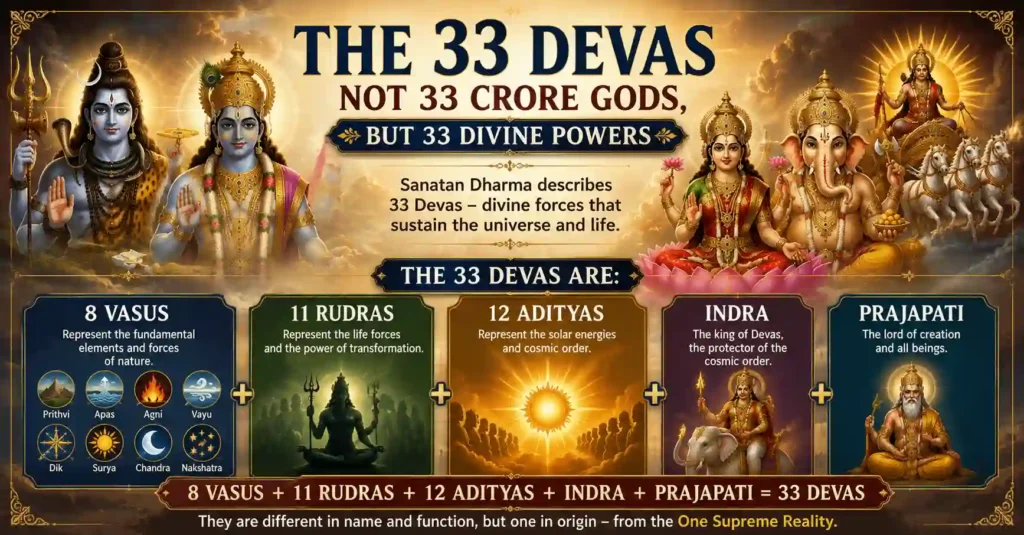
The 33 Devas consist of:
- 8 Vasus
- 11 Rudras
- 12 Adityas
- Indra
- Prajapati
Together, these divine powers represent different aspects of the universe and the forces that sustain life.
The Vasus symbolize the natural elements that support existence. The Rudras are associated with life force, the senses, and the inner self, while the Adityas represent the Sun’s journey through the twelve months, reminding us of the rhythm of time.
Indra represents divine leadership and cosmic order, while Prajapati symbolizes creation and the continuation of all living beings. Rather than being separate gods competing with one another, these Devas express different functions of the One Supreme Reality that operates throughout the universe.
How the 33 Devas Became the 33 Crore Gods Myth
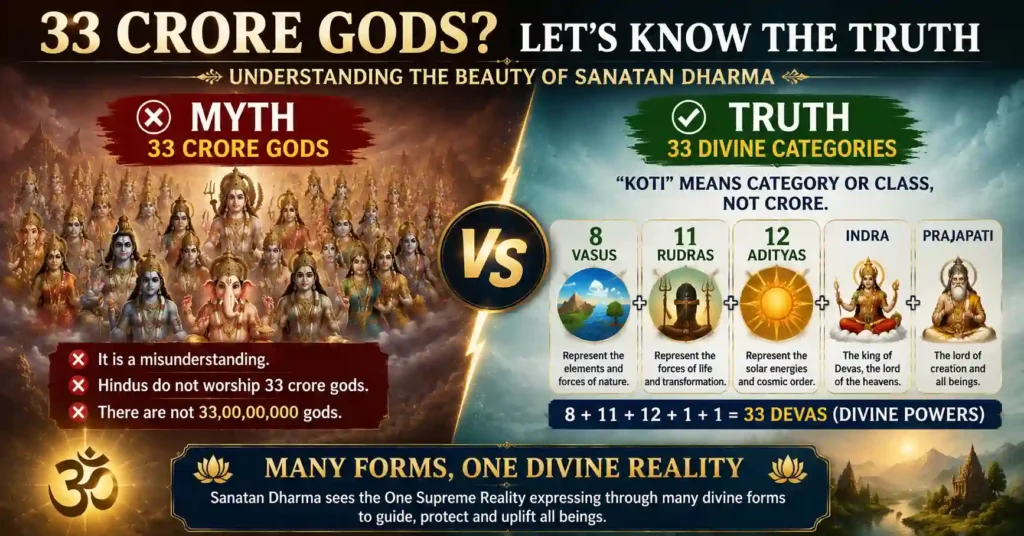
Over time, the Sanskrit word koti came to be commonly understood as crore, but its original meaning is category, class, or type. This difference in interpretation led to one of the most widespread misconceptions about Sanatan Dharma.
In the scriptures, the 33 Devas represent 33 divine categories or cosmic powers, not 33 crore separate gods. Ancient sages used these Devas to describe the different forces through which the One Supreme Reality sustains and governs the universe.
As the meaning of koti changed in later times, many people began to believe that Hinduism worships 33 crore gods. This misunderstanding gradually spread, even though the original scriptural teaching remained unchanged.
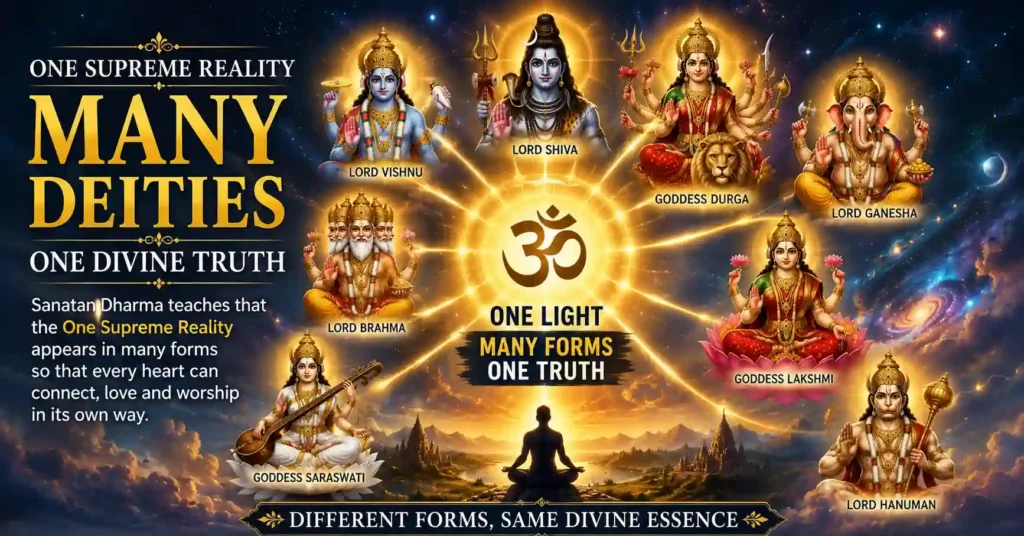
The heart of Sanatan Dharma has always been the same. The many deities are not separate competing gods but different manifestations of one eternal Divine Reality, allowing devotees to connect with the Supreme in ways that suit their faith and devotion.
Did You Know?
The famous phrase “33 crore gods” does not appear in the Vedas. The earliest Vedic texts describe 33 Devas, representing cosmic powers that govern different aspects of creation.
Common Misconceptions About Many Deities in Sanatan Dharma
Many misunderstandings about Sanatan Dharma arise because its teachings are often viewed through the lens of other religious traditions. Here are some of the most common misconceptions:
| Misconception | Reality in Sanatan Dharma |
|---|---|
| Hindus worship many separate Gods. | The many deities are different manifestations of the One Supreme Reality. |
| There are 33 crore Gods. | The Vedas describe 33 Devas, representing divine categories or cosmic powers. |
| Different deities compete with one another. | Every deity represents a unique divine quality and works in harmony with the cosmic order. |
| Worshipping one deity means rejecting others. | Devotees may choose an Ishta Devata while respecting all divine forms. |
Understanding these teachings helps us appreciate the inclusive philosophy of Sanatan Dharma. The many deities do not divide the Divine. Instead, they allow people with different temperaments, traditions, and spiritual paths to connect with the same eternal Truth.
One Truth, Many Names: The Rigvedic View of the Divine
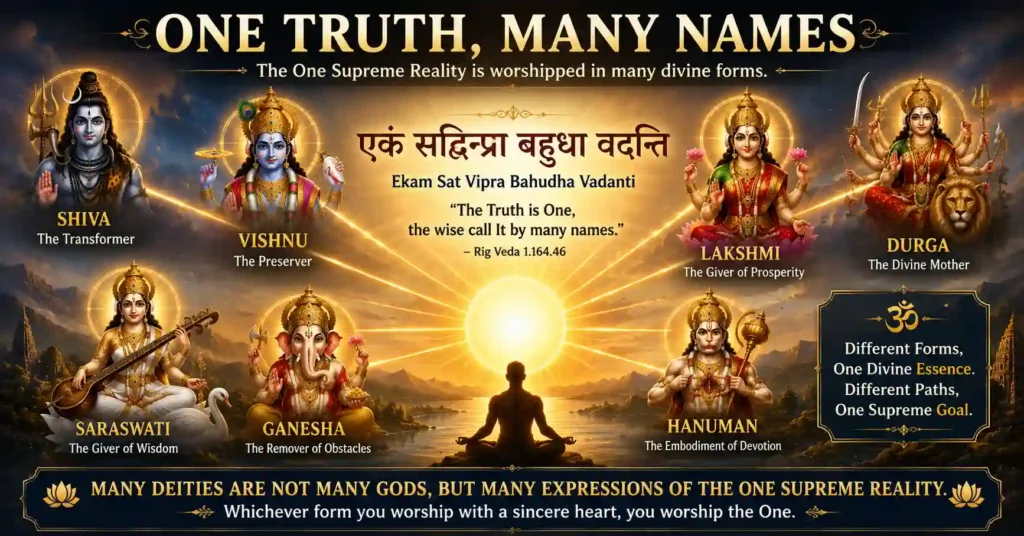
The Rigveda beautifully explains why there are many deities in Sanatan Dharma through one timeless verse:
एकं सद्विप्रा बहुधा वदन्ति
Ekam Sat Vipra Bahudha Vadanti
“Truth is One; the wise describe it in many ways.”
(Rigveda 1.164.46)
This verse teaches that there is One Supreme Reality, but different sages and devotees understand and worship that Reality through different names and forms. This is one of the key reasons why do Hindus have so many gods, even though the Divine is ultimately one.
Think of water. It appears as rain, a river, an ocean, or a stream, yet its essence remains the same. In the same way, the Supreme appears as Shiva, Vishnu, Devi, Ganesha, Surya, and many other divine forms, allowing every devotee to connect with the Divine in a personal and meaningful way.
Sanatan Dharma does not see these forms as separate competing gods. Instead, they are different manifestations of the One Supreme Reality, each reflecting unique divine qualities such as wisdom, compassion, protection, strength, or prosperity.
Deva, Devata and Bhagwan: What Is the Difference?
One reason many people become confused about Sanatan Dharma is that the words Deva, Devata, and Bhagwan are often used as if they mean exactly the same thing. While they are closely related, they have slightly different meanings in Hindu philosophy.
Deva refers to a divine being or cosmic power that performs a specific function in maintaining the universe. The 33 Devas, for example, represent different divine principles described in the Vedic scriptures.
Devata is a broader and more commonly used term for a deity worshipped with devotion. Devotees may worship Lord Ganesha, Maa Durga, Lord Shiva, Lord Vishnu, or other Devatas according to their faith and spiritual inclination.
Bhagwan refers to the Supreme Lord who possesses complete divine qualities such as knowledge, strength, compassion, glory, and wisdom. Different traditions of Sanatan Dharma understand Bhagwan in different ways, yet all agree that the many divine forms ultimately arise from the One Supreme Reality.
Understanding these terms makes it easier to understand why do Hindus have so many gods. The many deities are not independent supreme beings but different manifestations and expressions through which devotees experience and worship the same eternal Divine.
What Do the Hindu Scriptures Say About Many Deities?
The idea of one Divine Reality expressed through many forms is not limited to a single scripture. It is a recurring theme throughout the sacred texts of Sanatan Dharma.
| Scripture | Teaching |
|---|---|
| Rigveda (1.164.46) | “Truth is One; the wise describe it in many ways.” |
| Brihadaranyaka Upanishad | Explains the concept of the 33 Devas as divine powers rather than countless separate gods. |
| Bhagavad Gita (4.11) | Lord Krishna teaches that people approach Him in different ways, and He responds to each according to their devotion. |
| Bhagavad Gita (7.21) | The Supreme strengthens the faith of devotees who worship different divine forms with sincerity. |
Taken together, these teachings show that the many deities in Sanatan Dharma are not contradictory. They reveal the same eternal Truth through different names, forms, and paths of worship, making the Divine accessible to people of different temperaments and spiritual journeys.
Understanding Divine Energies
In Sanatan Dharma, Brahma, Vishnu, and Mahesh (Shiva) represent the three cosmic functions of the universe: creation, preservation, and transformation. They are not separate supreme powers but different expressions of the One Supreme Reality, each performing a unique role in the cosmic order.
| Term | Meaning |
|---|---|
| Brahman | The ultimate, infinite Reality from which everything originates. |
| Bhagwan | The Supreme Lord worshipped through different divine forms. |
| Deva | A divine cosmic power that performs a specific universal function. |
| Devata | A deity worshipped by devotees as a manifestation of the Divine. |
| Ishta Devata | A devotee’s personally chosen deity for worship and spiritual practice. |
Similarly, Maa Lakshmi, Maa Saraswati, and Maa Durga represent divine energies that bless the world with prosperity, wisdom, and strength. These forms help devotees connect with the Divine through qualities that inspire and guide everyday life.
Rather than dividing God into many beings, Sanatan Dharma teaches that these divine forms reveal different aspects of the same eternal Truth. This understanding helps answer why do Hindus have so many gods. The many deities are not different Gods competing with one another but different ways of experiencing and worshipping the One Supreme Reality.
Just as one white light appears in many colours through a prism, the One Divine appears in many forms so that every devotee can choose a path that resonates with their heart and devotion.
A Story That Explains the Unity Behind the Divine Forms
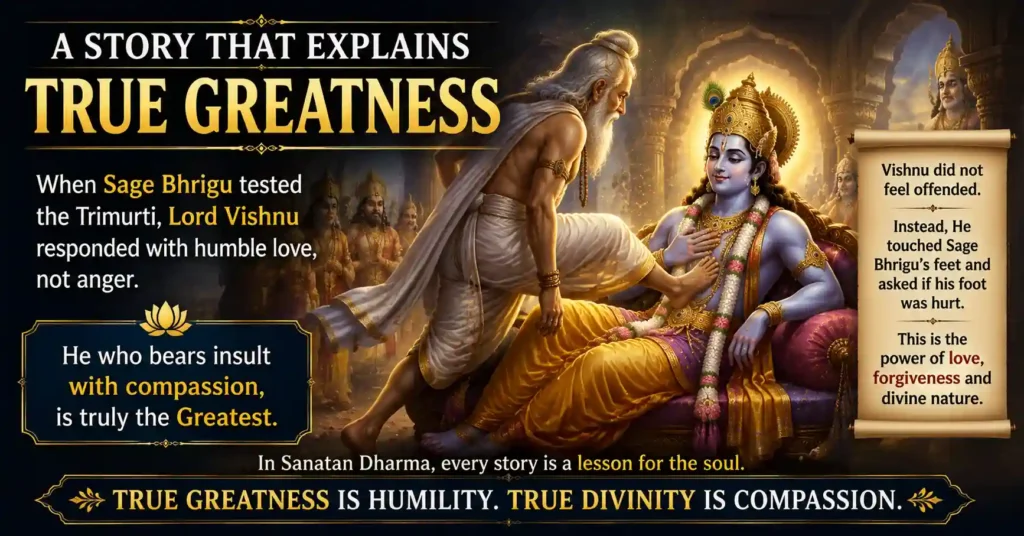
One well-known story from the Puranas beautifully explains the unity behind the many deities in Sanatan Dharma. Long ago, a group of rishis wished to understand who among Brahma, Vishnu, and Mahesh (Shiva) was the greatest. They requested Maharshi Bhrigu to seek the answer.
Bhrigu first visited Lord Brahma but did not offer Him the customary respect. Brahma became displeased, though He controlled His anger. The sage then went to Lord Shiva. Shiva welcomed him with affection, but Bhrigu’s harsh words provoked His anger.
Finally, Bhrigu reached Vaikuntha, where Lord Vishnu was resting. To test Him, the sage kicked Vishnu’s chest. Instead of reacting with anger, Vishnu gently rose, held Bhrigu’s feet, and asked whether the sage had hurt himself. His compassion and humility deeply moved Bhrigu.
The story teaches that the greatness of the Divine is revealed through qualities such as love, compassion, patience, and forgiveness. Rather than proving one deity is superior to another, it reminds us that every divine form guides us toward the One Supreme Reality. Each form reflects different divine qualities, helping devotees connect with God according to their faith, devotion, and spiritual path.
Why Many Divine Forms Bring Us Closer to the One Supreme Reality
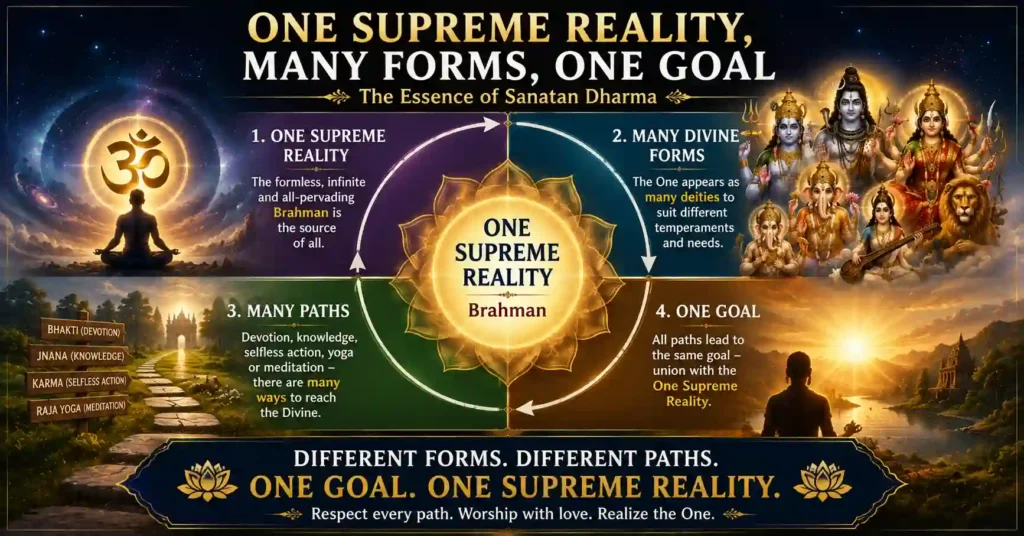
Sanatan Dharma teaches that God is one, eternal, infinite, and beyond all limitations. The many deities are not separate Gods but different manifestations of the One Supreme Reality, making it easier for every devotee to understand, love, and worship the Divine.
Just as one sun shines through countless rays and one ocean gives rise to many rivers, the Supreme expresses itself through many divine forms. This is why Hindus worship many deities, yet believe in one eternal Truth.
Every devotee has a unique spiritual journey. Some feel a deep connection with Lord Shiva, others with Lord Vishnu, Maa Durga, Lord Ganesha, or another deity. Sanatan Dharma embraces this diversity while teaching that every sincere path ultimately leads to the same Divine.
When we understand this philosophy, we realise that the many deities in Sanatan Dharma do not divide God. Instead, they reveal the infinite nature of the One Supreme Reality and bring Him closer to every heart.
Why Different People Worship Different Deities
One of the greatest strengths of Sanatan Dharma is that it allows every person to build a personal relationship with the Divine. Not everyone is inspired by the same qualities, so different devotees naturally feel drawn to different deities.
Someone seeking wisdom may worship Maa Saraswati, while another praying for courage may turn to Maa Durga. A devotee beginning a new journey may seek the blessings of Lord Ganesha, while others feel a deep spiritual connection with Lord Shiva, Lord Vishnu, or Lord Krishna.
This diversity does not mean there are many competing Gods. It reflects the compassionate nature of the One Supreme Reality, which allows every seeker to approach the Divine in the way that best suits their heart and spiritual temperament.
For this reason, Sanatan Dharma encourages devotees to respect all divine forms, even while worshipping their own Ishta Devata or chosen deity. Every sincere path, when followed with faith and devotion, ultimately leads towards the same eternal Truth.
How This Philosophy Promotes Harmony and Respect
One of the most beautiful teachings of Sanatan Dharma is that unity does not require uniformity. People may worship different deities, follow different traditions, or chant different mantras, yet all sincere devotion is respected because every path ultimately leads to the same Divine.
This philosophy encourages mutual respect rather than religious competition. A devotee of Lord Shiva can honour Lord Vishnu, a worshipper of Maa Durga can bow before Lord Ganesha, and followers of different sampradayas can live together with harmony while remaining devoted to their chosen path.
This inclusive vision has helped Sanatan Dharma flourish for thousands of years. It reminds us that diversity in worship is not a weakness but a reflection of the infinite nature of the One Supreme Reality.
Why This Teaching Matters in Modern Life
Understanding why there are many deities in Sanatan Dharma is not just about learning religious history. It also teaches us an important lesson for modern life: unity can exist alongside diversity.
People have different personalities, cultures, languages, and spiritual needs. Just as different devotees feel connected to different deities, people also find inspiration through different paths, traditions, and ways of worship. Sanatan Dharma respects this diversity while reminding us that the ultimate Truth remains one.
This philosophy also encourages tolerance, mutual respect, and peaceful coexistence. Instead of arguing over which form of God is superior, it inspires us to recognise the Divine in every sincere act of devotion.
In today’s world, where differences often create division, this timeless teaching reminds us that many paths can lead to the same destination. That is one of the greatest spiritual messages of Sanatan Dharma.
Conclusion
Sanatan Dharma does not teach that there are many separate Gods with competing powers. Instead, it explains that the One Supreme Reality expresses itself through many divine forms, allowing every devotee to connect with the Divine according to their faith, temperament, and spiritual path. This is the true answer to the question, “Why do Hindus have so many gods?”
When we understand this timeless wisdom, the many deities in Sanatan Dharma are no longer a source of confusion. They become a beautiful expression of one eternal Truth, reminding us that while the paths may be many, the destination is always the same.
If you enjoyed this article, explore more articles in our Sanatan Wisdom & Philosophy category to discover the timeless teachings, scriptures, and spiritual insights that continue to guide millions of people on their journey towards the Divine.
Key Takeaways
- Sanatan Dharma teaches that the Divine is one but can be worshipped through many forms.
- The 33 Devas represent divine powers, not 33 crore separate gods.
- The word koti originally means category or class, not crore.
- Different deities symbolize different divine qualities while remaining expressions of the One Supreme Reality.
- Every sincere path of devotion ultimately leads to the same eternal Truth.
Suggested Reading
If you enjoyed learning why there are many deities in Sanatan Dharma, you may also like exploring these related topics. Together, these articles explain the core principles of Sanatan Dharma, the nature of the soul, karma, time, the five elements, and the ultimate goal of human life, helping you build a deeper understanding of Hindu philosophy.
1. Sanatan Dharma Meaning: What Is Sanatan Dharma and Its Core Principles
https://thesanatantales.com/sanatan-dharma-meaning/
2. Atma and Parmatma: Understanding the Soul and the Supreme
https://thesanatantales.com/atma-and-parmatma/
3. Karma Kya Hai Aur Kaise Kaam Karta Hai
https://thesanatantales.com/karma-kya-hai/
4. Kaal in Sanatan Dharma: The Eternal Science of Time, Yugas and Cosmic Cycles
https://thesanatantales.com/kaal-in-sanatan-dharma/
5. What Are the Four Purusharthas? A Simple Guide to Dharma, Artha, Kama and Moksha
https://thesanatantales.com/four-purusharthas/
6. Detachment in Hindu Philosophy: The Deep Meaning of Vairagya and Inner Freedom
https://thesanatantales.com/detachment-in-hindu-philosophy/
7. Panchbhoota: The 5 Elements of Life and Their Deep Spiritual Meaning
https://thesanatantales.com/panchbhoota/
8. Vaitarni Nadi: What Happens After Death and How the Soul Crosses It
https://thesanatantales.com/vaitarni-nadi/
9. Hindu Deities (Wikipedia)
https://en.wikipedia.org/wiki/Hindu_deities
FAQs
Are there really 33 crore gods in Hinduism?
No. This is one of the most common misconceptions about Sanatan Dharma. Ancient scriptures describe 33 Devas, which represent 33 divine categories or cosmic powers, not 33 crore separate gods.
The confusion arose because the Sanskrit word koti originally meant category or class, but over time it came to be interpreted as crore. The core teaching of Sanatan Dharma has always remained the same: the many deities represent different manifestations of the One Supreme Reality.
Why do Hindus have so many gods?
Sanatan Dharma teaches that the Divine is one, eternal, and infinite, but can be worshipped through many forms. Different deities represent different divine qualities such as wisdom, strength, compassion, prosperity, or protection.
This allows every devotee to choose a form of worship that best matches their faith, temperament, and spiritual journey while ultimately worshipping the same Supreme Reality.
Who are the 33 Devas?
According to the Brihadaranyaka Upanishad, the 33 Devas consist of 8 Vasus, 11 Rudras, 12 Adityas, Indra, and Prajapati.
These Devas symbolize the natural forces, cosmic principles, and divine energies that sustain the universe. They are not separate supreme gods but different expressions of the One Divine.
Is Hinduism polytheistic or monotheistic?
Sanatan Dharma does not fit neatly into modern religious labels such as polytheism or monotheism. It teaches that there is One Supreme Reality (Brahman) that can be worshipped through many divine forms.
This philosophy is beautifully expressed in the Rigvedic verse “Ekam Sat Vipra Bahudha Vadanti”, which means, “Truth is One; the wise describe it in many ways.”
Why do Hindus worship different deities for different needs?
Different deities represent different aspects of the same Divine. For example, Maa Lakshmi is associated with prosperity, Maa Saraswati with wisdom, Lord Ganesha with new beginnings, and Lord Shiva with transformation.
Devotees worship the deity whose qualities inspire or guide them at a particular stage of life. This diversity of worship reflects the richness of Sanatan Dharma rather than belief in many independent gods.
Why are there different forms of the same deity in different regions?
Sanatan Dharma has evolved over thousands of years across different regions, languages, and traditions. As a result, the same deity may be worshipped with different names, forms, festivals, and local customs.
Despite these regional variations, the underlying philosophy remains unchanged. Every form is respected as a manifestation of the same Divine Reality.
What does 'Ekam Sat Vipra Bahudha Vadanti' mean?
The famous Rigvedic verse “Ekam Sat Vipra Bahudha Vadanti” means, “Truth is One; the wise describe it in many ways.” It teaches that although people worship the Divine through different names and forms, the ultimate Reality is one.
This verse is one of the foundational principles that explains why Sanatan Dharma embraces many deities while affirming the unity of the Supreme.
Can I worship one deity and still respect all other deities?
Yes. Sanatan Dharma encourages devotees to develop a personal relationship with their Ishta Devata, or chosen deity, while respecting all other divine forms.
Whether someone worships Lord Shiva, Lord Vishnu, Maa Durga, Lord Ganesha, or any other deity, all sincere devotion is ultimately directed towards the One Supreme Reality. This inclusive approach is one of the unique strengths of Sanatan Dharma.
Glossary of Important Terms
| Term | Meaning |
|---|---|
| Sanatan Dharma | The eternal way of life and spiritual philosophy that teaches the timeless truths about the Divine, the universe, and righteous living. |
| Deva | A divine being or celestial power that represents a particular aspect of the Supreme Reality and helps maintain cosmic order. |
| Bhagwan | A respectful term for the Supreme Lord or Divine Being, worshipped in various forms such as Vishnu, Shiva, Devi, and others. |
| Brahman | The ultimate, infinite, formless, and eternal Reality from which the entire universe originates and into which it ultimately returns. |
| One Supreme Reality | The central teaching of Sanatan Dharma that all divine forms are expressions of one eternal, all-pervading Divine Truth. |
| 33 Devas | The thirty-three divine powers described in the Brihadaranyaka Upanishad, consisting of the 8 Vasus, 11 Rudras, 12 Adityas, Indra, and Prajapati. |
| Koti | A Sanskrit word meaning category, class, or type. It was later misunderstood to mean crore, leading to the popular myth of 33 crore gods. |
| Vasus | Eight divine powers associated with the natural elements and forces that support life and the universe. |
| Rudras | Eleven divine forms representing life force, transformation, and the inner energies of living beings. |
| Adityas | Twelve solar deities symbolizing the Sun’s movement through the twelve months and the cycle of time. |
| Indra | King of the Devas and the deity associated with rain, thunder, and the maintenance of cosmic order in the Vedic tradition. |
| Prajapati | The lord of creation who represents the creative power responsible for the origin and continuation of life. |
| Ekam Sat Vipra Bahudha Vadanti | A famous Rigvedic verse meaning “Truth is One; the wise describe it in many ways.” It expresses the unity behind the many divine forms worshipped in Sanatan Dharma. |
| Ishta Devata | A devotee’s chosen deity with whom they feel the deepest personal and spiritual connection while respecting all other divine forms. |
About the Author
Yateendra Chaturvedi is a spiritual writer, researcher, devotee, and the founder of The Sanatan Tales. With over 35 years of professional experience and a lifelong interest in Sanatan Dharma, he writes about Hindu deities, temples, scriptures, festivals, Mahavidyas, sacred stories, rituals, and living traditions that continue to guide and inspire devotees across India.
Drawing from traditional scriptures, regional beliefs, temple traditions, devotional literature, and historical sources, he aims to present authentic, well-researched, and easy-to-understand content for modern readers. His work focuses on preserving spiritual wisdom, explaining sacred traditions, and helping seekers develop a deeper understanding of India’s rich spiritual heritage.
Through The Sanatan Tales, Yateendra strives to make the timeless teachings of Sanatan Dharma simple, meaningful, and relevant for today’s generation while maintaining respect for traditional sources, regional practices, and diverse spiritual perspectives.
Learn More About Yateendra Chaturvedi →
https://thesanatantales.com/about-the-author/
References & Sources
This article is based on the teachings of Sanatan Dharma as explained in the Vedas, Upanishads, Bhagavad Gita, Puranas, and other respected Hindu scriptures. It also draws upon traditional commentaries, widely accepted philosophical interpretations, and the rich spiritual heritage preserved through the guru-shishya (teacher-disciple) tradition.
Note: Sanatan Dharma encompasses diverse philosophical schools, traditions, and paths of worship. Interpretations and practices may vary across different sampradayas and lineages. The purpose of this article is not to promote any one viewpoint as the only truth, but to present widely accepted teachings in a simple, balanced, and easy-to-understand manner for readers seeking to understand the timeless wisdom of Sanatan Dharma.
Read More Interesting Articles on Sanatan Dharma