Time is something we all experience every moment. Clocks measure it, calendars record it, and our lives seem to move with it. But in Kaal in Sanatan Dharma, time is far more than hours, days, or years.
Kaal in Sanatan Dharma is an eternal cosmic force that governs creation, preservation, and dissolution. It shapes the journey of every living being, ripens karma, and guides the universe through endless cycles of birth, growth, decay, and renewal.
Ancient Hindu scriptures describe time as divine, not mechanical. From the smallest fraction of a second to the lifespan of Brahma, every moment has its place within the vast rhythm of Kaal in Sanatan Dharma.
Understanding this timeless concept changes the way we look at life. Fear of the future becomes lighter, attachment to the past begins to fade, and every experience gains a deeper spiritual meaning.
In this article, you will discover the meaning of Kaal and Samay, the concept of Kala Chakra, the four Yugas, Vedic time calculation, Manvantaras, Pralaya, the relationship between time and karma, and how the soul ultimately transcends time through Moksha.
Kaal in Sanatan Dharma at a Glance
| Aspect | Overview |
|---|---|
| Meaning of Kaal | The eternal cosmic principle of time that governs creation, preservation and dissolution. |
| Kala Chakra | The endless cycle of creation, destruction and renewal. |
| Current Age | We are living in Kali Yuga, the fourth and final Yuga of the current Mahayuga. |
| Divine Forms | Mahakal, Maa Kali and Kala Bhairava symbolize different aspects of time. |
| Cosmic Time | Hindu scriptures describe time from tiny units like Truti to vast Kalpas and Manvantaras. |
| Kaal and Karma | Time allows every action to mature and bear its appropriate result. |
| Ultimate Goal | Through Self-realization and Moksha, the soul becomes Kalateet, beyond time. |
Table of Contents
ToggleMeaning of Kaal and Samay
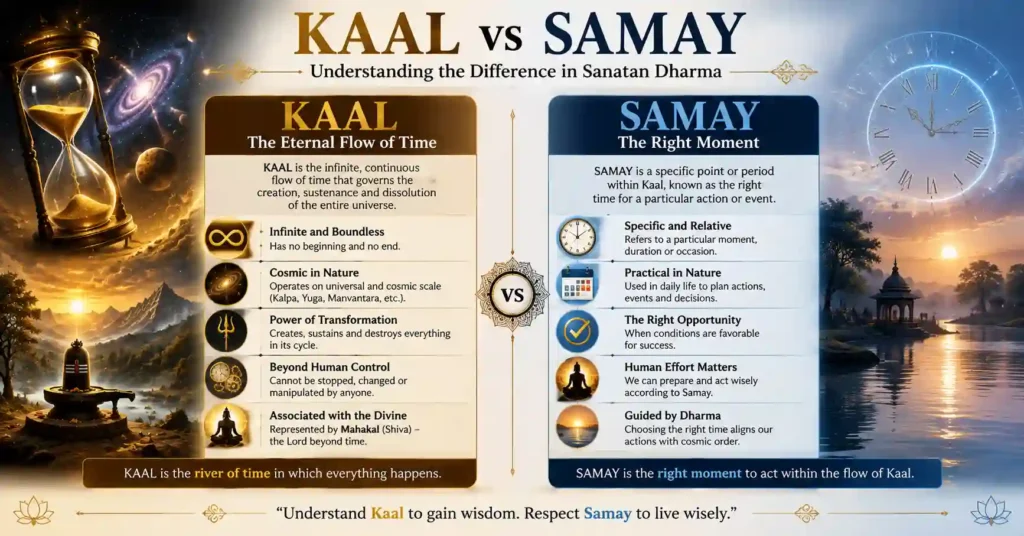
The Sanskrit word Kaal carries profound meaning. It means time, but it also means death. Why both? Because time eventually dissolves everything that is born. Nothing in the material world remains untouched by Kaal.
In Kaal in Sanatan Dharma, time is not merely a way to measure days and years. It is the divine force that governs creation, change, growth, decay, and dissolution. Everything exists within its eternal flow.
The word Samay means the right moment or the proper time for an action. It represents timing within the larger flow of Kaal. In simple words, Samay is a point, while Kaal is the river that carries every moment forward.
This distinction is central to understanding Kaal in Sanatan Dharma. Kaal is eternal and universal, while Samay refers to the appropriate moment within that infinite cycle.
In the Bhagavad Gita (11.32), Lord Krishna declares:
“I am Time, the destroyer of worlds.”
This is not merely poetic language. It reveals a profound spiritual truth that Kaal in Sanatan Dharma is not separate from the Divine. Time itself is an expression of Ishvara, carrying every soul and every universe through the endless cycle of creation, preservation, and dissolution.
Scriptural References to Kaal
The concept of Kaal appears throughout Hindu scriptures, where time is described as a divine principle governing both the universe and human life.
Some important scriptural references include:
| Scripture | Teaching about Kaal |
|---|---|
| Bhagavad Gita 11.32 | Lord Krishna declares, “I am Time,” revealing Kaal as a divine power that transforms the universe. |
| Bhagavad Gita 10.30 | Krishna says, “Among those who measure, I am Time,” showing that time itself is one of His manifestations. |
| Bhagavata Purana | Describes Kaal as the force through which the Supreme Lord creates, sustains, and dissolves the universe. |
| Vishnu Purana | Explains cosmic cycles such as Yugas, Manvantaras, and Kalpas, all governed by Kaal. |
| Shiva Purana | Describes Lord Shiva as Mahakal, the One who exists beyond time and presides over creation and dissolution. |
Together, these scriptures present Kaal in Sanatan Dharma not merely as a measure of passing moments but as a sacred principle that operates under the will of the Supreme Reality.
Kaal as Divine Power: Mahakal and Kali
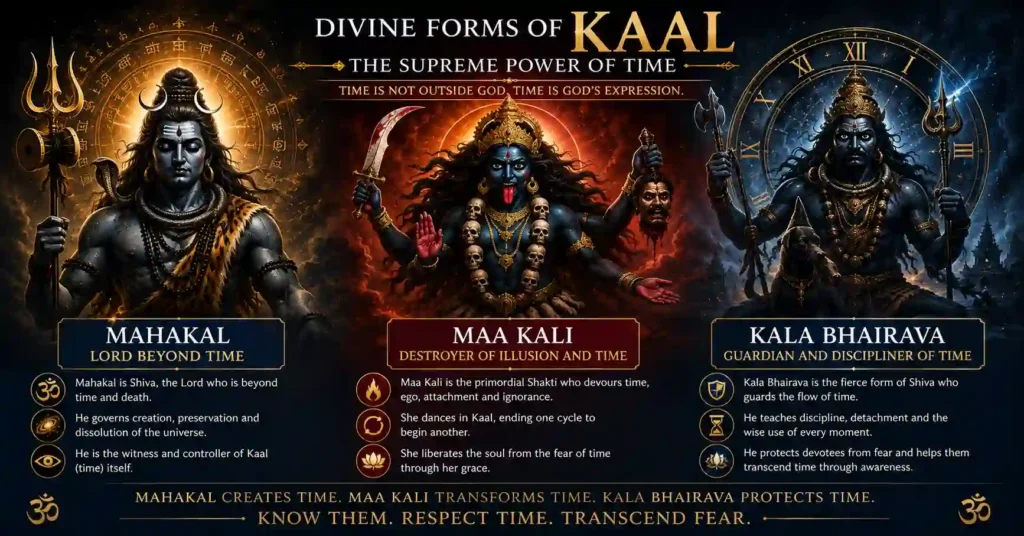
Shiva is worshipped as Mahakal, the Lord beyond time. Time does not control Him. Instead, He governs time itself and remains untouched by its endless flow. This is why Mahakal symbolizes the eternal Reality that exists beyond birth and death.
Maa Kali also derives her name from the same Sanskrit root, Kaal. She represents the unstoppable power of time that destroys ignorance, ego, attachment, and illusion, making way for spiritual transformation and renewal.
According to Sanatan Dharma, Brahma creates within time, Vishnu preserves the universe through time, and Shiva dissolves creation when the cosmic cycle comes to an end. Together, they reveal how time governs every stage of existence.
This shows that Kaal in Sanatan Dharma is not a blind or random force. It is a divine principle that operates with purpose, wisdom, and cosmic order under the guidance of Ishvara.
Kala Bhairava: The Guardian of Time
Kala Bhairava is a fierce and powerful manifestation of Lord Shiva, representing the sharp, disciplined, and protective aspect of time. He reminds us that time is sacred and that every action has its proper moment.
In Varanasi, Kala Bhairava is worshipped as the guardian of the holy city. Symbolically, this teaches that no one can escape the power of time, whether king, sage, or ordinary person. Every living being lives within the eternal flow of Kaal.
Yet devotees do not worship Kala Bhairava out of fear. They worship Him with reverence because He teaches discipline, responsibility, and spiritual awareness.
His teachings remind us that:
- Time should be respected, not wasted.
- Life is temporary, so every moment should be meaningful.
- Fear fades when we surrender to the Divine.
In Kaal in Sanatan Dharma, Kala Bhairava is not merely a fierce deity. He is a constant reminder that living with awareness, discipline, and devotion is the path to overcoming the fear of time and death.
Kala Chakra: The Cyclical Nature of Time
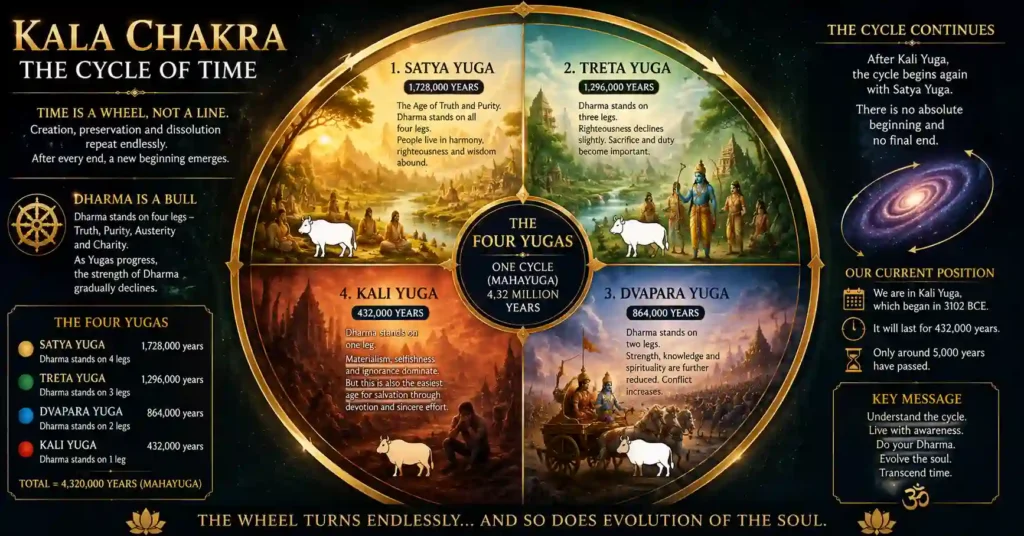
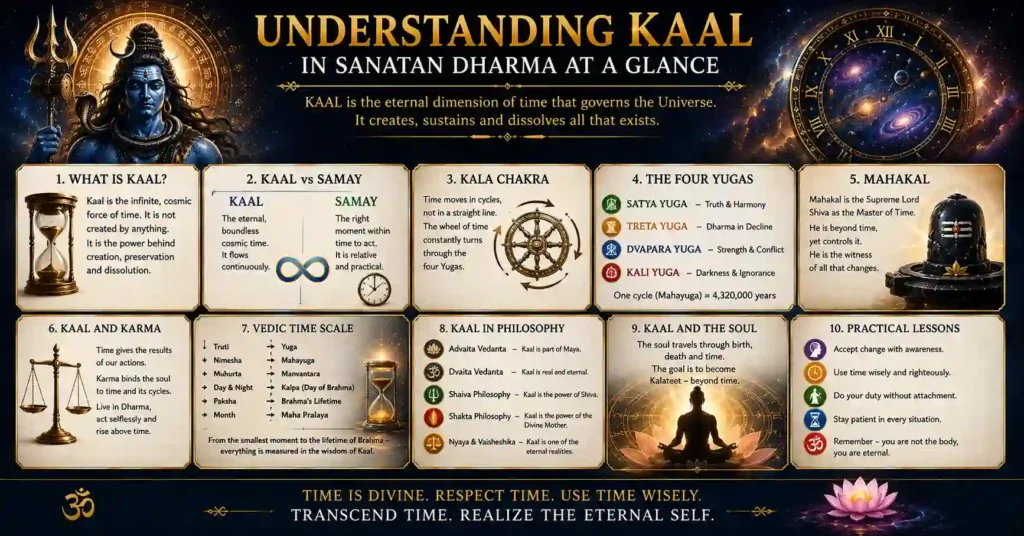
Modern thinking often views time as a straight line with a beginning and an end. In contrast, Sanatan Dharma understands time as a continuous wheel, known as Kala Chakra, where every ending becomes the seed of a new beginning.
Creation, preservation, and dissolution are not one-time events. They repeat endlessly through divine cosmic cycles. There is no absolute beginning and no final ending, only the eternal rhythm of existence.
The rising and setting of the sun, the changing seasons, the cycle of birth and death, and the four Yugas all reflect the working of Kala Chakra. Nature itself reminds us that change is constant and renewal always follows decline.
This cyclical understanding is central to Kaal in Sanatan Dharma. It teaches that nothing in the universe is permanent except the eternal Self, which remains beyond the changing wheel of time.
Yugas and the Gradual Decline of Dharma
Time does not simply pass. According to Kaal in Sanatan Dharma, it also influences the quality of human consciousness and the strength of Dharma in every age.
The scriptures symbolize Dharma as a bull standing on four legs, representing Truth (Satya), Purity (Shaucha), Austerity (Tapas), and Charity (Dana). With each Yuga, one leg weakens, reflecting the gradual decline of righteousness.
| Yuga | State of Dharma |
|---|---|
| Satya Yuga | All four legs stand firm, and Dharma is complete. |
| Treta Yuga | One leg weakens, and Dharma stands on three legs. |
| Dvapara Yuga | Two legs remain, showing a balance between Dharma and Adharma. |
| Kali Yuga | Only one leg remains, commonly identified as Charity (Dana). |
Scriptures also describe longer lifespans, greater physical strength, and higher spiritual awareness in the earlier Yugas. Whether these descriptions are understood literally or symbolically, they convey the same message that spiritual clarity gradually declines as time moves through the Yuga cycle.
According to traditional Hindu chronology, we are currently living in Kali Yuga, which began in 3102 BCE. It is said to last 432,000 years, and only about 5,000 years have passed so far.
This perspective reminds us that the present age is only a small part of a much larger cosmic cycle. More importantly, it teaches that even during Kali Yuga, living a life of Dharma, devotion, and self-discipline remains the path to spiritual progress.
Vedic Time Calculation: From Subtle Units to Cosmic Spans
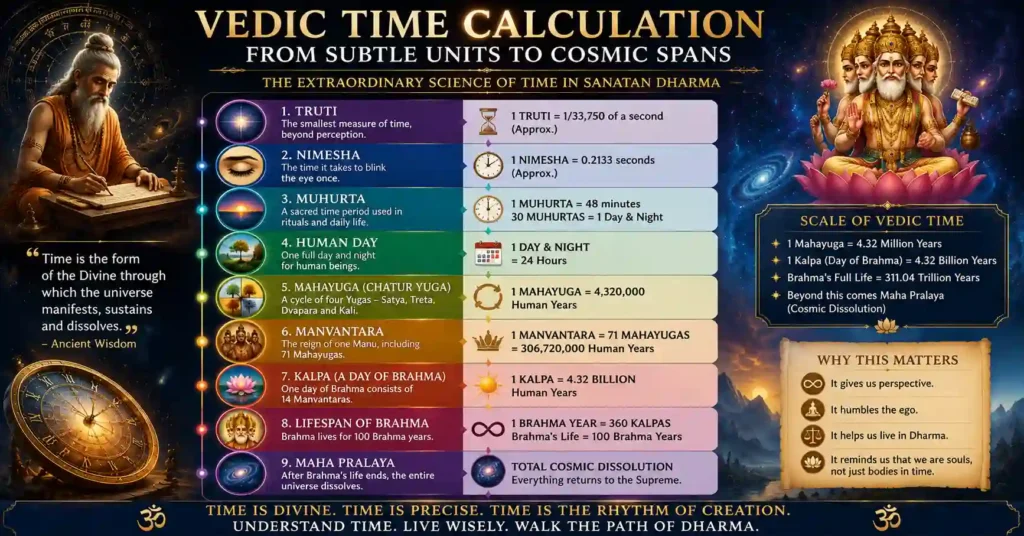
Ancient sages described time with remarkable precision, from the smallest measurable moments to vast cosmic cycles spanning billions of years. This detailed system reflects the unique understanding of Kaal in Sanatan Dharma.
The following table shows how time expands from tiny units to the lifespan of the universe according to traditional Hindu cosmology.
| Unit of Time | Description |
|---|---|
| Truti | One of the smallest units of time described in ancient texts. |
| Nimesha | A tiny unit traditionally associated with the blink of an eye. |
| Muhurta | Equals 48 minutes. |
| Mahayuga | One complete cycle of the four Yugas lasting 4.32 million years. |
| Kalpa | One thousand Mahayugas, equal to one day of Brahma (4.32 billion human years). |
| Lifetime of Brahma | One hundred divine years of Brahma. |
| Maha Pralaya | The great cosmic dissolution after Brahma’s lifespan ends. |
This vast system shows the extraordinary depth of Kaal in Sanatan Dharma. It presents time as an ordered cosmic framework that governs creation, preservation, dissolution, and renewal across the universe.
Manvantara and Our Present Cosmic Location
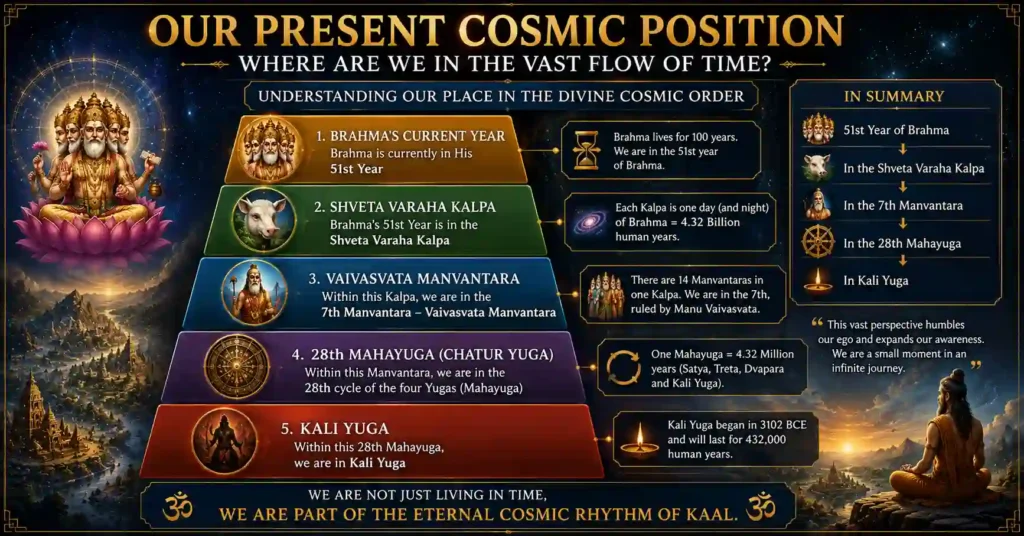
Each Kalpa, or one day of Brahma, is divided into 14 Manvantaras, with each Manvantara ruled by a different Manu, the progenitor of humanity.
According to traditional Hindu cosmology, our present position in the cosmic timeline is as follows:
| Cosmic Level | Current Position |
|---|---|
| Brahma’s Age | 51st year |
| Current Kalpa | Shveta Varaha Kalpa |
| Current Manvantara | 7th Manvantara (Vaivasvata Manvantara) |
| Current Mahayuga | 28th Mahayuga |
| Current Yuga | Kali Yuga |
This cosmic perspective is an important part of Kaal in Sanatan Dharma. It reminds us that human history is only a tiny chapter within an immense cycle of creation that stretches across billions of years.
Rather than making life insignificant, this understanding inspires humility. It encourages us to focus on living with Dharma, knowing that every action becomes part of a much greater cosmic journey.
Relativity of Time Across Realms
Sanatan scriptures describe time as flowing differently across different Lokas or realms of existence. This shows that the experience of time is not the same everywhere in creation.
According to traditional Hindu texts, one day of the Devas is equal to one human year. This illustrates the vast difference between earthly time and the passage of time in higher realms.
A well-known example is the story of King Kakudmi, who visited Brahmaloka with his daughter to seek Lord Brahma’s guidance. When they returned to Earth, many generations had already passed, showing how time moved differently in the two realms.
This perspective is another unique aspect of Kaal in Sanatan Dharma. It teaches that time is experienced differently across the universe and reminds us that the Divine creation extends far beyond ordinary human perception.
Kaal in Different Schools of Hindu Philosophy
Sanatan Dharma does not limit the understanding of Kaal to a single philosophical viewpoint. Different schools explain time in their own way, while all accepting its importance in the cosmic order.
| Philosophical School | Understanding of Kaal |
|---|---|
| Advaita Vedanta | Kaal belongs to the world of Maya. The ultimate reality, Brahman, is beyond time and change. |
| Vishishtadvaita | Time is a real and eternal aspect of God’s creation that exists under the control of Narayana. |
| Dvaita Vedanta | Kaal is a real principle created and governed by the Supreme Lord, while souls remain distinct from God. |
| Shaiva Tradition | Lord Shiva as Mahakal is beyond time and governs all cycles of creation and dissolution. |
| Shakta Tradition | Maa Kali represents the dynamic power of time that removes ignorance and transforms creation. |
Although these traditions explain Kaal differently, they all agree on one essential truth: time is not independent of the Divine. It is a sacred principle through which the universe functions and spiritual evolution unfolds.
Understanding these perspectives helps us appreciate the richness of Kaal in Sanatan Dharma. Instead of viewing time merely as a physical measurement, Sanatan Dharma invites us to see it as a profound spiritual reality connected to both the universe and the eternal Self.
Four Types of Pralaya
According to Hindu scriptures, Pralaya does not occur in just one form. Time brings dissolution at different levels, from the constant changes we experience every day to the complete dissolution of the universe.
The four types of Pralaya are:
| Type | Meaning |
|---|---|
| Nitya Pralaya | The continuous process of change and decay that happens every moment in the material world. |
| Naimittika Pralaya | The cosmic dissolution that takes place at the end of one day of Brahma. |
| Prakritika Pralaya | The complete dissolution of the universe when Brahma’s lifespan comes to an end. |
| Atyantika Pralaya | The final liberation of the individual soul through Moksha, ending the cycle of birth and death. |
Among these, Atyantika Pralaya holds the greatest spiritual significance. When the soul realizes its true nature and attains Moksha, it becomes free from the cycle of birth, death, and the binding influence of time.
This teaching is one of the deepest aspects of Kaal in Sanatan Dharma. While cosmic dissolution affects the universe, spiritual liberation frees the individual soul forever.
Kaal and Karma
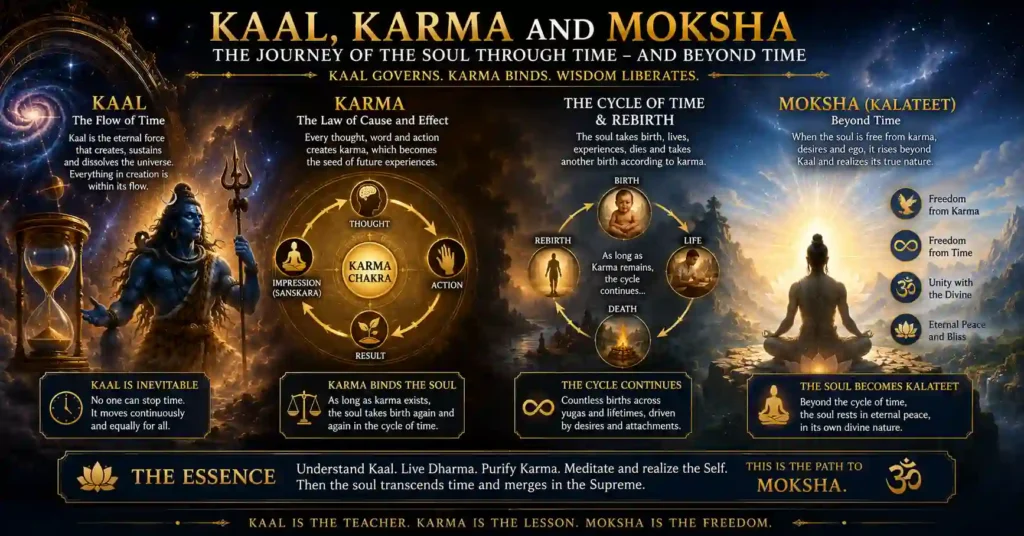
Kaal and karma work together in the divine order of the universe. Every action creates a cause, and time allows that cause to mature into its appropriate result.
Just as a fruit ripens only in its proper season, the results of karma appear only when the right Samay arrives. Good or bad, every action bears fruit at the appropriate time according to the law of karma.
This understanding of Kaal in Sanatan Dharma teaches patience, responsibility, and faith in divine justice. Instead of expecting immediate results, it encourages us to perform our duties with sincerity and leave the outcome to the natural flow of time.
Lessons from Kaal in Everyday Life
Understanding Kaal in Sanatan Dharma is not only about learning cosmic time cycles. It also teaches us how to live with greater wisdom, patience, and inner balance in everyday life.
Some practical lessons from Kaal include:
- Accept change with grace. Joy and sorrow are temporary because everything moves with time.
- Be patient. Every action bears fruit when the right Samay arrives.
- Value the present moment. Time once passed cannot be brought back.
- Perform your duties sincerely. Focus on righteous action rather than immediate results.
- Remember life’s impermanence. This helps reduce ego, attachment, and unnecessary worries.
- Use time for spiritual growth. Daily prayer, meditation, self-study, and seva become meaningful when practiced consistently.
The wisdom of Kaal in Sanatan Dharma reminds us that while we cannot stop time, we can choose how we live within it. A life guided by Dharma, devotion, and awareness makes every moment spiritually valuable.
Sacred Time Periods in Daily Life
In Kaal in Sanatan Dharma, time is not merely measured, it is revered. Different periods of the day are believed to carry distinct spiritual qualities, making certain moments especially suitable for specific activities.
Some of the most significant sacred time periods include:
| Sacred Time | Spiritual Significance |
|---|---|
| Brahma Muhurta | The period before sunrise, considered ideal for meditation, prayer, yoga, and spiritual study. |
| Rahu Kaal | Traditionally regarded as unsuitable for beginning new ventures or important activities. |
| Nishit Kaal | The sacred period around midnight, associated with certain forms of worship, meditation, and tantric sadhana. |
These divisions remind us that time is not viewed as empty or ordinary in Sanatan Dharma. Every moment carries its own spiritual significance and offers opportunities for growth, reflection, and devotion.
By living in harmony with these sacred rhythms, we learn to use time wisely and deepen our connection with the Divine.
Spiritual Goal: Becoming Beyond Time
The ultimate goal of spiritual life is not to control time but to transcend it. While the body lives within time, the true Self is eternal and untouched by birth, aging, or death.
When a person realizes the Atman, he becomes Kalateet, meaning “beyond time.” The body continues to exist in the world, but consciousness is no longer bound by the changing cycles of Kaal.
This state is known as Moksha, the highest goal of Sanatan Dharma. It is freedom from the cycle of birth and death, where the soul realizes its eternal unity with the Supreme Reality.
The deepest teaching of Kaal in Sanatan Dharma is that time governs the universe, but it can never bind the eternal Self. Realizing this truth is the path to lasting peace and liberation.
Why Understanding Kaal Matters
Understanding Kaal in Sanatan Dharma is more than learning about cosmic time. It changes the way we see ourselves, our relationships, and the events of life.
When we realize that everything in the material world changes with time, we become less attached to success and less discouraged by failure. We learn to accept both joy and sorrow as temporary phases of a much larger journey.
This wisdom also teaches humility. Human life, however important it may seem, is only a small part of the vast cosmic cycles described in the Hindu scriptures. At the same time, every good action, every prayer, and every act of compassion has lasting spiritual value.
Ultimately, Kaal in Sanatan Dharma encourages us to live with patience, perform our duties with sincerity, and focus on spiritual growth rather than temporary achievements. By understanding time, we begin to value the eternal Self that exists beyond it.
Conclusion
Kaal in Sanatan Dharma is the eternal rhythm that governs creation, preservation, dissolution, and renewal. It shapes karma, guides destiny, and reminds us that every moment has a purpose within the divine order.
From the smallest unit of time to vast cosmic cycles, from the four Yugas to Moksha, the wisdom of Sanatan Dharma teaches that time is far more than a measure of days and years. It is a sacred force that supports both the universe and our spiritual journey.
Time eventually changes everything in the material world, but the Atman, the true Self, remains eternal and untouched.
To understand Kaal in Sanatan Dharma is to live with patience, responsibility, and wisdom. To transcend Kaal through Self-realization is to attain true freedom and everlasting peace.
Suggested Reading
Understanding Kaal in Sanatan Dharma becomes even more meaningful when explored alongside other core teachings of Sanatan Dharma. The following articles will help you deepen your understanding of Karma, Atman, Shakti, Dharma, Vairagya, and the spiritual wisdom that guides the soul towards self-realization and Moksha.
- Karma: Meaning, Types, Philosophy and How It Works in Sanatan Dharma
https://thesanatantales.com/karma-meaning-types-and-how-it-works/ - Atma and Parmatma: Meaning, Relationship and Their Role in Sanatan Dharma
https://thesanatantales.com/atma-and-parmatma/ - Forgiveness for Unintentional Sins in Sanatan Dharma: Meaning, Karma and Scriptural Remedies
https://thesanatantales.com/forgiveness-for-unintentional-sins-in-sanatan-dharma/ - Shakti in Sanatan Dharma: Meaning, Forms, Philosophy and Spiritual Significance
https://thesanatantales.com/shakti-in-sanatan-dharma/ - Sanatan Dharma Meaning: What Is Sanatan Dharma and Its Core Principles
https://thesanatantales.com/sanatan-dharma-meaning/ - Why Do Hindus Have So Many Gods? The Truth Behind Many Deities in Sanatan Dharma
https://thesanatantales.com/why-do-hindus-have-so-many-gods/ - Detachment in Hindu Philosophy: Meaning, Vairagya and the Path to Inner Freedom
https://thesanatantales.com/detachment-in-hindu-philosophy/ Hindu Units of Time (Wikipedia)
FAQs
What is Kaal in Sanatan Dharma?
Kaal in Sanatan Dharma refers to the eternal principle of time that governs creation, preservation, dissolution, and renewal. It is not merely a way to measure hours or years but a divine force that influences the universe, karma, and the journey of every living being.
According to Hindu philosophy, everything in the material world exists within the flow of Kaal, while the eternal Self (Atman) remains beyond its influence.
What is the difference between Kaal and Samay?
Although both words relate to time, they have different meanings. Kaal is the infinite and universal flow of time that governs the cosmos, whereas Samay refers to the right moment or appropriate timing for an action.
In simple terms, Samay is a single moment within the endless river of Kaal. Understanding this difference helps explain why Hindu scriptures emphasize performing the right action at the right time.
Why did Lord Krishna say, "I am Time" in the Bhagavad Gita?
In the Bhagavad Gita (11.32), Lord Krishna declares, “I am Time, the destroyer of worlds.” Through this statement, He reveals His universal form and explains that time is one of the Divine powers through which creation, change, and dissolution take place.
The verse reminds us that every living being and every event unfolds according to the divine order, encouraging humility, acceptance, and faith in God’s plan.
Which Yuga are we living in now?
According to traditional Hindu chronology, we are currently living in Kali Yuga, the fourth and final Yuga of the present Mahayuga. Hindu scriptures state that Kali Yuga began in 3102 BCE and will continue for 432,000 years.
Although this age is associated with a decline in Dharma and spiritual awareness, the scriptures also teach that sincere devotion, righteous living, and remembrance of God remain powerful paths to spiritual progress.
What is Kala Chakra in Sanatan Dharma?
Kala Chakra, or the Wheel of Time, represents the cyclical nature of existence in Sanatan Dharma. Instead of viewing time as a straight line, Hindu philosophy describes creation as an endless cycle of birth, preservation, dissolution, and renewal.
This principle is reflected in the four Yugas, the changing seasons, the cycle of birth and death, and the repeated creation and dissolution of the universe.
How does Kaal influence karma?
Kaal and karma work together according to the divine order of the universe. Every action creates karma, but its results appear only when the proper time arrives.
Just as a seed takes time to grow into a tree, karma matures through the flow of time. This understanding teaches patience, responsibility, and trust in the natural law of cause and effect.
Why is Shiva called Mahakal?
Lord Shiva is known as Mahakal, meaning “the Great Lord of Time.” Unlike all living beings, Shiva is beyond the control of time and remains eternal even when the universe is dissolved.
As Mahakal, He represents the Supreme Reality that transcends birth, death, and the endless cycles of creation and destruction.
Can a person go beyond time according to Sanatan Dharma?
Yes. Sanatan Dharma teaches that while the body lives within time, the true Self (Atman) is eternal. Through Self-realization and Moksha, a person becomes Kalateet, meaning “beyond time.”
This does not mean escaping the physical world but realizing one’s true spiritual nature, which is never born and never dies.
What are the four types of Pralaya?
Hindu scriptures describe four types of Pralaya, or dissolution. Nitya Pralaya refers to the constant changes taking place in the world every moment, while Naimittika Pralaya occurs at the end of one day of Brahma.
Prakritika Pralaya marks the complete dissolution of the universe at the end of Brahma’s lifespan. Atyantika Pralaya is the highest form, representing Moksha, where the soul becomes free from the cycle of birth and death.
Why is understanding Kaal important in daily life?
Understanding Kaal in Sanatan Dharma helps us see life from a broader spiritual perspective. It teaches that every experience, whether joyful or difficult, unfolds at the right time according to the law of karma.
This wisdom encourages patience, reduces attachment to temporary situations, and inspires us to live with Dharma, devotion, and awareness of the eternal Self.
Glossary of Important Terms
| Term | Meaning |
|---|---|
| Kaal | The eternal principle of time in Sanatan Dharma that governs creation, preservation, dissolution, and renewal. |
| Samay | The right or appropriate moment for an action within the larger flow of Kaal. |
| Kala Chakra | The Wheel of Time representing the endless cycle of creation, preservation, dissolution, and rebirth. |
| Yuga | One of the four cosmic ages that repeat in cycles: Satya, Treta, Dvapara, and Kali Yuga. |
| Mahayuga | One complete cycle of the four Yugas lasting 4.32 million human years. |
| Kalpa | One day of Lord Brahma, consisting of one thousand Mahayugas (4.32 billion human years). |
| Manvantara | A major division of a Kalpa, each ruled by a Manu, the progenitor of humanity. |
| Mahakal | A form of Lord Shiva who is the Lord beyond time and the ruler of Kaal. |
| Kala Bhairava | A fierce manifestation of Lord Shiva representing the protective, disciplined, and transformative aspect of time. |
| Moksha | Liberation from the cycle of birth and death and realization of the eternal Self. |
| Kalateet | A state of being beyond time, attained through Self-realization and Moksha. |
| Pralaya | Dissolution of the universe or the ending of a cycle of creation, occurring at different cosmic and spiritual levels. |
| Atman | The eternal Self or soul that is beyond birth, death, and the influence of time. |
| Karma | The universal law of cause and effect in which every action produces corresponding results. |
| Brahma Muhurta | The sacred period before sunrise, considered the most auspicious time for meditation, prayer, and spiritual practice. |
| Rahu Kaal | A daily time period traditionally considered unsuitable for beginning important new activities. |
| Nishit Kaal | The sacred period around midnight associated with certain forms of worship, meditation, and spiritual practices. |
About the Author
Yateendra Chaturvedi is a spiritual writer, researcher, devotee, and the founder of The Sanatan Tales. With over 35 years of professional experience and a lifelong interest in Sanatan Dharma, he writes about Hindu deities, temples, scriptures, festivals, Mahavidyas, sacred stories, rituals, and living traditions that continue to guide and inspire devotees across India.
Drawing from traditional scriptures, regional beliefs, temple traditions, devotional literature, and historical sources, he aims to present authentic, well-researched, and easy-to-understand content for modern readers. His work focuses on preserving spiritual wisdom, explaining sacred traditions, and helping seekers develop a deeper understanding of India’s rich spiritual heritage.
Through The Sanatan Tales, Yateendra strives to make the timeless teachings of Sanatan Dharma simple, meaningful, and relevant for today’s generation while maintaining respect for traditional sources, regional practices, and diverse spiritual perspectives.
Learn More About Yateendra Chaturvedi →
https://thesanatantales.com/about-the-author/
References & Sources
This article is based on teachings, beliefs, and traditions followed within various schools of Sanatan Dharma, along with traditional knowledge preserved through scriptures, religious literature, and the guru-disciple tradition. It also draws upon widely accepted spiritual interpretations and insights from authentic religious and study sources.
Note: Beliefs, interpretations, and practices may vary across different sampradayas, traditions, and philosophical schools within Sanatan Dharma. The purpose of this article is not to present any one viewpoint as the absolute truth, but to explain widely accepted spiritual and religious perspectives in a simple, respectful, and easy-to-understand manner.
Read More Interesting Articles on Sanatan Dharma