In many Hindu homes, the Janeu is seen every day, resting quietly across the body. Simple in appearance and traditionally made of cotton, this sacred thread is far more than a religious symbol. For the wearer, it serves as a daily reminder to live with awareness, self-discipline, and responsibility.
Known in Sanskrit as Yajnopavita, this sacred thread is received during the Upanayan Sanskar, one of the Sixteen Hindu Sanskars. From the Vedic period to the present day, it has represented a commitment to knowledge, righteous conduct, and a life guided by Dharma.
But what is the true meaning of the Yajnopavita, and why do Hindus continue to wear this sacred thread today? Is it merely a ritual, or does it carry a deeper spiritual purpose?
In this article, you’ll discover the meaning and symbolism of the sacred thread, the importance of the Upanayan Sanskar, the significance of its three strands, traditional rules for wearing it, its connection with the Gayatri Mantra, and why this timeless Vedic tradition continues to inspire spiritual discipline and righteous living in the modern world.
In this article, we explore the meaning, symbolism, rules, Upanayan Sanskar, and spiritual significance of Janeu (Yajnopavita), along with its relevance in modern life and the timeless values it represents.
Table of Contents
ToggleWhat Is Janeu (Yajnopavita)?
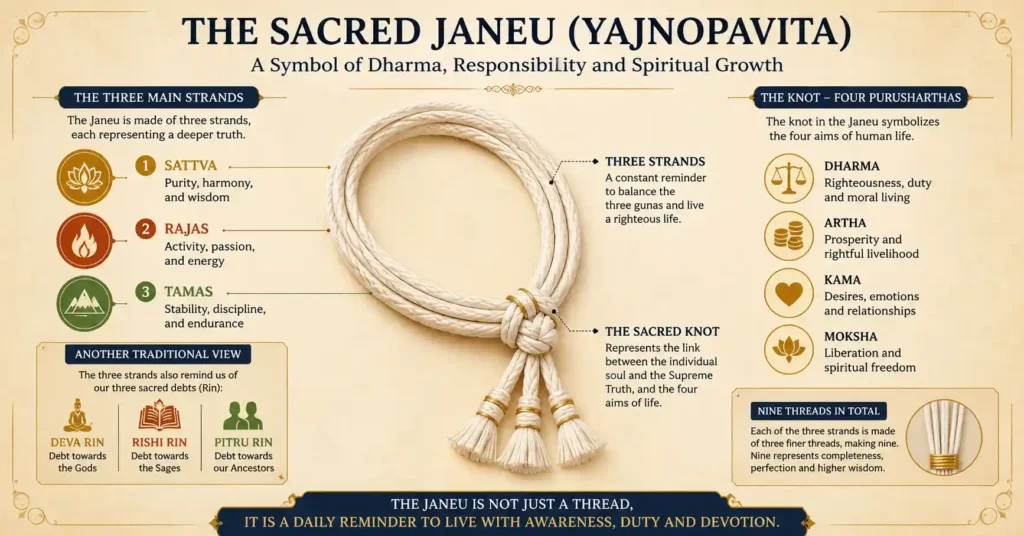
Yajnopavita, commonly known as the sacred thread in Hinduism, is worn across the body over the left shoulder and under the right arm. Traditionally made of cotton, it is received during the Upanayan Sanskar, marking the beginning of a life dedicated to learning, discipline, and spiritual growth.
The Sanskrit word Yajnopavita is derived from two words: Yajna, meaning sacrifice or sacred offering, and Upavita, meaning “that which is worn close to the body.” Together, the term refers to a sacred thread that reminds the wearer to remain devoted to Dharma, knowledge, and righteous living.
In Sanatan Dharma, Yajna does not refer only to a Vedic fire ritual. It also represents the spirit of selfless action, duty, and offering one’s thoughts, words, and deeds for a higher purpose. The Yajnopavita therefore serves as a constant reminder to live with awareness, self-control, and responsibility.
More than an external symbol, the Sacred Thread in Hinduism represents an inner commitment to purity of thought, ethical conduct, and lifelong learning. Its significance is rooted in the Vedic way of life, where spiritual discipline was considered just as important as worldly knowledge.
Did You Know?
The Janeu (Yajnopavita) is one of the oldest continuously practised spiritual traditions in the world. Its origins can be traced back to the Vedic period, where it symbolised the beginning of formal education, self-discipline, and a life dedicated to Dharma.
Even today, millions of Hindus continue to wear this sacred thread, preserving the timeless values of knowledge, responsibility, and righteous living that have been passed down through generations.
Why Is the Yajnopavita Worn?
Many people wonder why Hindus continue to wear the Janeu in the modern age. The answer lies not in the thread itself but in the values it represents. The Yajnopavita is worn as a lifelong reminder to pursue knowledge, maintain purity in thought and action, and fulfil one’s duties with sincerity.
Receiving the sacred thread during Upanayan Sanskar marks the beginning of a disciplined life. Traditionally, it signifies a commitment to learning, self-control, and the daily practice of Dharma. It reminds the wearer that true spiritual growth comes through right conduct rather than external appearance.
In Sanatan Dharma, the Yajnopavita is never meant to be a symbol of pride or social status. Instead, it encourages humility, responsibility, and respect for one’s teachers, parents, society, and the Divine. Its purpose is to inspire inner transformation rather than outward recognition.
Worn close to the body every day, the Sacred Thread in Hinduism serves as a constant reminder that virtues such as honesty, compassion, discipline, and selfless service should remain close to the heart. In this way, this sacred tradition continues to guide millions of devotees toward a life rooted in Dharma and spiritual awareness.
What Is Upanayan Sanskar and Why Is It Important?
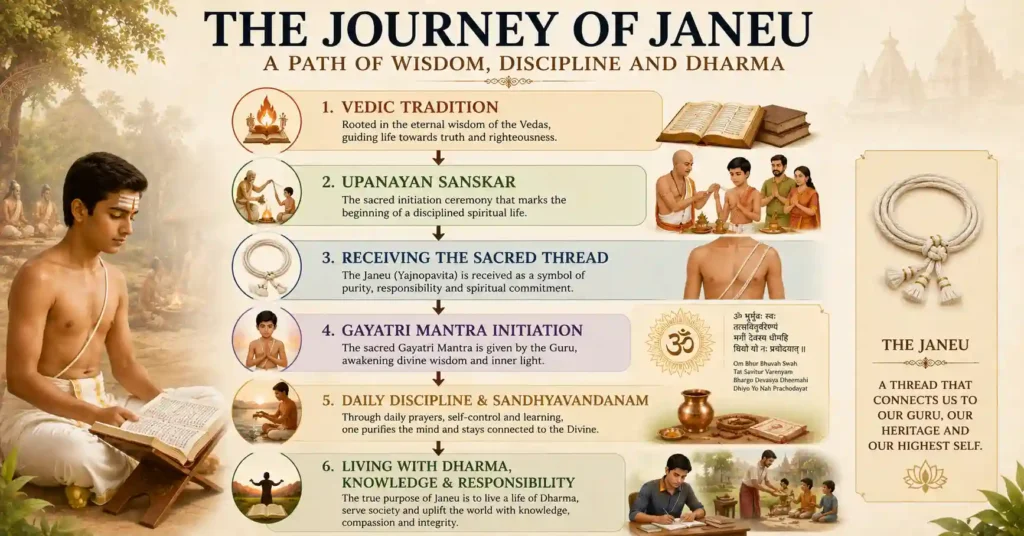
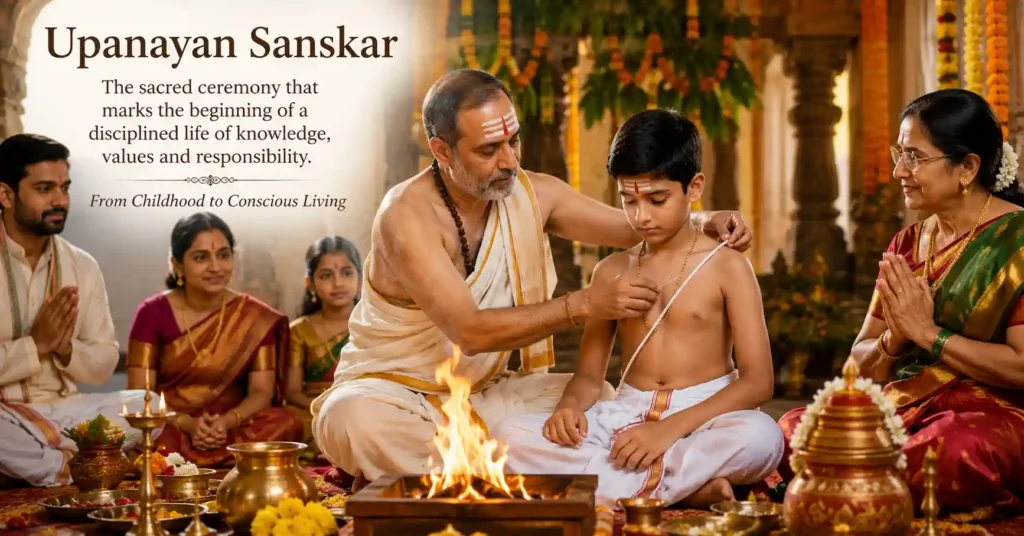
The Upanayan Sanskar is the sacred ceremony in which a child traditionally receives the Yajnopavita (sacred thread). It is one of the Sixteen Hindu Sanskars (Shodasha Samskaras) and marks the beginning of a disciplined life devoted to learning, spiritual growth, and righteous living.
The Sanskrit word Upanayan means “to bring closer.” Traditionally, it signifies bringing the child closer to the Guru, sacred knowledge, and the path of Dharma. From this stage onward, the student is encouraged to cultivate self-discipline, humility, and a lifelong love for learning.
After the ceremony, the child is known as a Dwij, meaning “twice-born.” The first birth is physical, while the second represents an awakening to intellectual, moral, and spiritual responsibilities. It is not a mark of superiority but a reminder that true growth comes through knowledge, character, and disciplined living.
The Upanayan Sanskar also marks the beginning of Gayatri Mantra initiation and the practice of Sandhyavandanam, which nurture devotion, mindfulness, and self-reflection. The sacred thread received during this ceremony becomes a lifelong reminder of these spiritual commitments.
Yajnopavita vs Upanayan Sanskar: What Is the Difference?
| Janeu (Yajnopavita) | Upanayan Sanskar |
|---|---|
| The sacred thread worn by the individual. | The sacred initiation ceremony in which the Yajnopavita is traditionally bestowed. |
| A symbol of knowledge, discipline, and Dharma. | A rite of passage marking the beginning of Vedic learning and responsibility. |
| Worn daily after initiation. | Performed once as one of the Sixteen Hindu Sanskars (Shodasha Samskaras). |
| Serves as a lifelong reminder of spiritual duties. | Marks the formal beginning of a disciplined spiritual and educational life. |
Although closely connected, the Janeu and Upanayan Sanskar are not the same. Upanayan Sanskar is the sacred initiation ceremony, while the Yajnopavita is the sacred thread received during that ceremony.
Who Traditionally Receives the Yajnopavita?
Traditionally, the Janeu (Yajnopavita) is received during the Upanayan Sanskar by those entering a disciplined life of learning, spiritual practice, and responsibility. The ceremony marks a commitment to knowledge, self-control, and righteous conduct rather than being merely the wearing of a sacred thread.
Different Hindu traditions and communities have followed different customs regarding Upanayan Sanskar and the wearing of the Yajnopavita. While these practices may vary, the underlying purpose remains the same: to encourage a life guided by Dharma, learning, and ethical living.
In Sanatan Dharma, true spiritual progress is measured by one’s character, actions, and devotion. The values symbolised by the Yajnopavita—humility, discipline, purity, and responsibility—are respected across Hindu traditions, regardless of regional customs.
The purpose of such rituals has never been simply to create an external identity. Their deeper aim is inner refinement, helping individuals cultivate wisdom, self-discipline, and a sincere commitment to righteous living.
Note: The customs regarding who undergoes Upanayan Sanskar and wears the Yajnopavita differ among Hindu communities, sampradayas, and regional traditions. The practices described here reflect the traditional understanding followed in many Vedic traditions.
What Do the Three Strands of the Yajnopavita Symbolise?
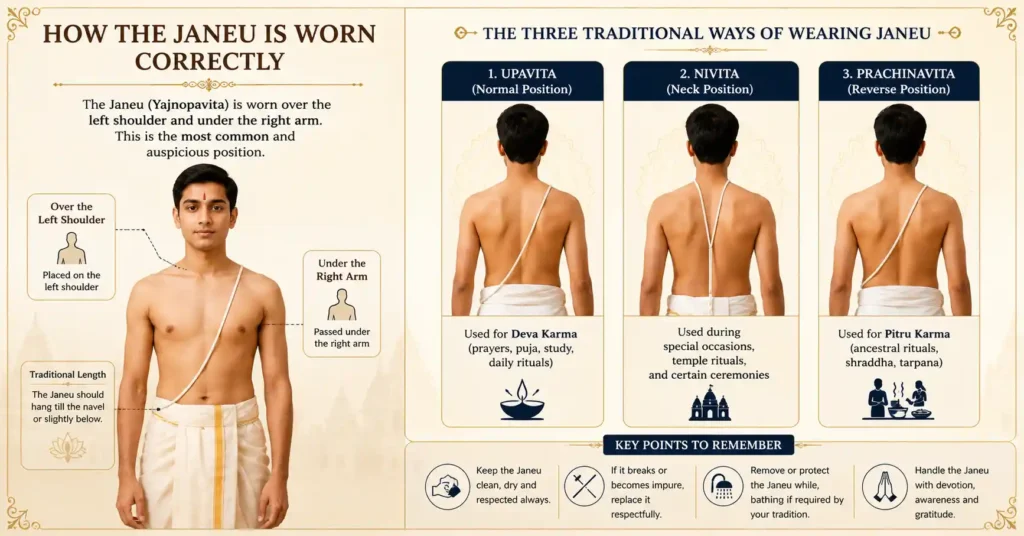
The Yajnopavita is made of three main strands, each carrying profound spiritual symbolism. Rather than being an ordinary thread, this sacred thread serves as a daily reminder of the duties, values, and responsibilities that guide a righteous life.
According to the traditional Vedic understanding, the three strands represent the Three Debts (Rin) that every individual is expected to honour throughout life:
| Three Debts | Meaning |
|---|---|
| Rishi Rin | Gratitude to the sages who preserved and passed on sacred knowledge. |
| Deva Rin | Reverence for the Divine and the natural forces that sustain life. |
| Pitru Rin | Duty towards parents, ancestors, and future generations. |
Each of the three strands is woven from three finer threads, making nine threads in total. Traditional interpretations associate them with completeness, harmony, and the integration of physical, mental, and spiritual life.
The sacred knot, often known as the Brahma Granthi, symbolises the unity of spiritual knowledge and the unbroken bond between the individual and the Divine. Some traditions also associate it with the pursuit of the four Purusharthas—Dharma (righteousness), Artha (prosperity), Kama (rightful desires), and Moksha (liberation). These interpretations may vary across different sampradayas and regional traditions.
At a Glance: Symbolism of the Sacred Thread
| Symbol | Represents |
|---|---|
| Three Strands | The Three Debts—Rishi Rin, Deva Rin, and Pitru Rin |
| Three Gunas | Sattva, Rajas, and Tamas |
| Nine Threads | Completeness, harmony, and balance in life |
| Sacred Knot (Brahma Granthi) | Unity, spiritual wisdom, and dedication to Dharma |
Traditional Rules for Wearing the Yajnopavita
Traditional Hindu texts describe certain guidelines for the Janeu (Yajnopavita), including its length and the way it should be worn. These guidelines are intended to preserve the sanctity of the sacred thread and maintain uniformity during religious practices.
In some Grihya Sutras and traditional lineages, the length of the Yajnopavita is described using angula (finger-width) measurements. However, these measurements may vary across different sampradayas, regions, and family traditions. There is no single standard followed by every Hindu community.
The purpose of these traditional guidelines is not rigid calculation but mindful observance. They remind the wearer that even small details of spiritual life should be approached with sincerity, discipline, and respect.
Ultimately, the true significance of the Yajnopavita lies not in its exact length but in the values it represents—Dharma, self-discipline, purity, and lifelong learning. A sacred thread becomes meaningful when its ideals are reflected in one’s thoughts and actions.
Note: The traditional measurements and methods of wearing the Yajnopavita differ among Vedic schools, sampradayas, and regional traditions. Devotees are encouraged to follow the customs of their Guru, family, or sampradaya.
Traditional Ways of Wearing the Yajnopavita
The Janeu (Yajnopavita) is traditionally worn in different ways depending on the religious ceremony being performed. These methods are described in various Vedic traditions and Grihya Sutras.
| Style | How It Is Worn | Traditionally Used For |
|---|---|---|
| Upavita | Over the left shoulder and under the right arm | Daily worship, yajna, temple rituals, and other auspicious ceremonies |
| Nivita | Around the neck like a garland | Certain forms of study, meditation, and specific traditional practices |
| Prachinavita | Over the right shoulder and under the left arm | Rituals performed for ancestors, such as Shraddha and Pitru Karya |
The exact customs may differ among sampradayas, family traditions, and regional practices. Devotees are encouraged to follow the guidance of their Guru, family elders, or the traditions of their sampradaya when observing these practices.
What Is the Connection Between the Yajnopavita and the Gayatri Mantra?
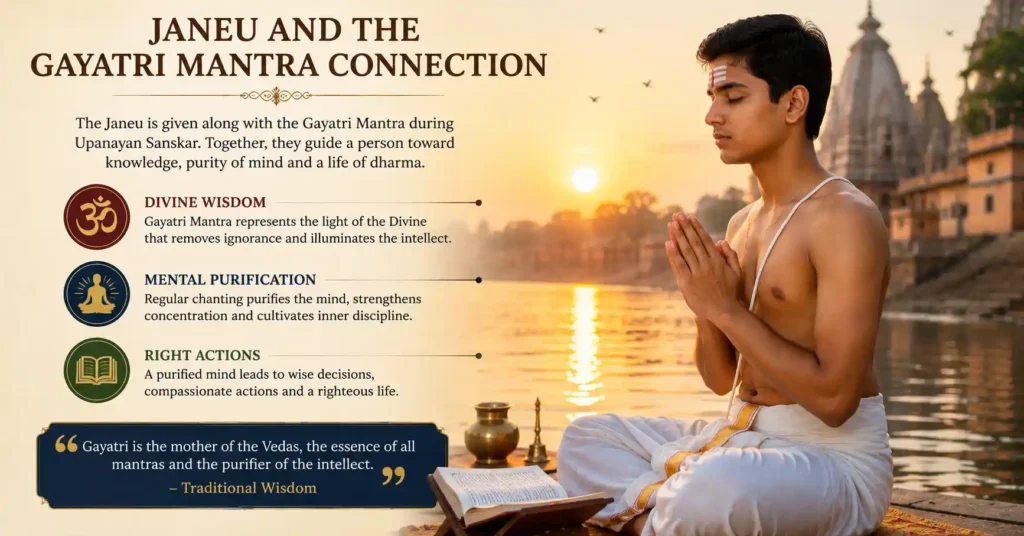
The Yajnopavita and the Gayatri Mantra share a close spiritual connection in Sanatan Dharma. During the Upanayan Sanskar, the sacred thread is traditionally bestowed along with initiation into the Gayatri Mantra, marking the beginning of a life dedicated to learning, self-discipline, and spiritual growth.
The Gayatri Mantra, found in the Rig Veda (3.62.10), is one of the most revered Vedic mantras. It is a prayer for wisdom, inner illumination, and righteous understanding. Through its regular recitation, the seeker aspires to purify the mind, sharpen the intellect, and align thoughts and actions with Dharma.
After receiving the Yajnopavita, many Vedic traditions encourage the daily chanting of the Gayatri Mantra as part of Sandhyavandanam. This practice helps cultivate mindfulness, devotion, and a disciplined spiritual routine.
The Yajnopavita serves as an outward reminder of the vows taken during Upanayan Sanskar, while the Gayatri Mantra nurtures the inner transformation those vows are meant to inspire. Together, they encourage a life rooted in knowledge, ethical conduct, and spiritual awareness.
Key Connection at a Glance
| Element | Significance |
|---|---|
| Yajnopavita (Sacred Thread) | Symbol of commitment to Dharma, discipline, and righteous living |
| Gayatri Mantra | Prayer for wisdom, purity, and inner enlightenment |
| Upanayan Sanskar | Sacred initiation ceremony that traditionally unites both |
| Daily Sandhyavandanam | Gayatri chanting reinforces the ideals represented by the sacred thread |
Scriptural References to the Yajnopavita
The Janeu (Yajnopavita) and Upanayan Sanskar are described in several ancient Hindu scriptures. While customs may vary across different Vedic schools and regional traditions, these texts collectively emphasise the importance of spiritual education, disciplined living, and righteous conduct.
Some of the principal scriptural references include:
| Scripture | Traditional Significance |
|---|---|
| Rig Veda (3.62.10) | Contains the Gayatri Mantra, traditionally imparted during the Upanayan Sanskar. |
| Yajur Veda | Describes Vedic rituals and the significance of the Yajnopavita in sacrificial ceremonies. |
| Manusmriti (Chapter 2) | Explains the Upanayan Sanskar, student life, and the duties associated with the sacred thread. |
| Apastamba Grihya Sutra and Ashvalayana Grihya Sutra | Provide traditional guidelines for the Upanayan Sanskar and the wearing of the Yajnopavita. |
| Dharmashastra literature | Discusses the ethical responsibilities, discipline, and conduct expected after receiving the Yajnopavita. |
Although customs have evolved over time, the central message found across these scriptures remains unchanged: the Yajnopavita symbolises learning, self-discipline, devotion, and a life guided by Dharma.
Living with the Yajnopavita: Responsibilities and Daily Discipline
Receiving the Yajnopavita is not the end of a ceremony but the beginning of a lifelong commitment. While outward life may continue as before, the real transformation is expected to take place within. The sacred thread serves as a constant reminder to live with awareness, humility, and self-discipline.
A person wearing the Yajnopavita is traditionally encouraged to speak truthfully, perform daily duties sincerely, respect parents and teachers, and strive for purity in thought, word, and action. It reminds the wearer that spiritual growth is reflected through conduct rather than appearance.
The Yajnopavita is treated with respect and kept clean. If it becomes worn out or breaks, it is traditionally replaced through the prescribed customs of one’s family or Guru. The emphasis is on reverence and mindfulness, not fear or superstition.
In Sanatan Dharma, rituals are meaningful only when they inspire positive character and righteous living. Simply wearing the sacred thread does not fulfil its purpose. Its true significance lies in practising the values it represents every day through honesty, compassion, self-restraint, and selfless service.
Daily Values Inspired by the Sacred Thread
- Live with truthfulness and integrity.
- Practice self-discipline and humility.
- Respect parents, teachers, and elders.
- Perform daily duties with sincerity.
- Strive for continuous learning and spiritual growth.
Common Misconceptions About the Yajnopavita
The Yajnopavita is often misunderstood as merely a religious thread or a symbol of social identity. In reality, Sanatan Dharma describes it as a sacred reminder of spiritual discipline, learning, and responsibility. Its true significance lies not in the thread itself but in the values and duties it represents.
| Misconception | Traditional Understanding |
|---|---|
| The sacred thread is only an external symbol. | It represents inner discipline, knowledge, and righteous living. |
| Simply wearing the Yajnopavita brings spiritual merit. | Its true value lies in living according to the principles of Dharma. |
| The Yajnopavita is a symbol of social superiority. | Traditional teachings emphasise humility, responsibility, and ethical conduct rather than status. |
| All Hindu communities follow identical customs. | Rituals and practices vary among sampradayas, regional traditions, and family lineages. |
The essence of the Yajnopavita is not the thread itself but the values it inspires. Across Hindu traditions, it is respected as a reminder to cultivate knowledge, discipline, compassion, and spiritual awareness.
Is the Yajnopavita Still Relevant in Modern Life?
In today’s fast-paced world, many people question the relevance of ancient traditions and rituals. Yet the Yajnopavita was never meant to belong to a particular era. Its true significance lies not in the thread itself but in the timeless values it represents.
The Yajnopavita reminds its wearer to live with integrity, self-discipline, and mindfulness. These principles are just as meaningful today as they were in the Vedic age. Whether a person is a student, professional, homemaker, or spiritual seeker, the ideals of responsibility, ethical conduct, and continuous learning remain universally relevant.
Rather than asking people to withdraw from the world, Sanatan Dharma encourages them to fulfil their responsibilities with honesty, compassion, and awareness. The sacred thread serves as a quiet reminder that spiritual growth can take place while living an active and purposeful life.
In the modern world, the value of the Yajnopavita is best understood not as an external identity but as a commitment to lifelong learning, moral character, and conscious living. When these ideals are practised sincerely, this timeless Vedic tradition continues to inspire people across generations.
Why This Sacred Tradition Remains Relevant Today
- Encourages self-discipline and ethical living.
- Inspires mindfulness in daily actions.
- Promotes lifelong learning and personal growth.
- Reminds us to fulfil our duties with honesty and compassion.
- Connects timeless Vedic values with modern life.
Conclusion
The Yajnopavita is far more than a sacred thread. It represents a lifelong commitment to knowledge, discipline, humility, and righteous living. When understood in its true spirit, it becomes a constant reminder that real spirituality is reflected not merely in external symbols but in one’s thoughts, actions, and character.
Its true significance does not lie in the thread itself but in the values it inspires. Whether understood through the Upanayan Sanskar, the wisdom of the Gayatri Mantra, or the principles of conscious living, the Yajnopavita encourages a life guided by self-discipline, compassion, and spiritual awareness.
In a world filled with constant distractions, this timeless Vedic tradition continues to remind us that lasting transformation begins within. When its ideals are lived sincerely, the sacred thread becomes not just a tradition to wear, but a lifelong path toward wisdom, character, and inner growth.

Suggested Reading
The sacred thread represents discipline, knowledge, and spiritual responsibility in Sanatan Dharma. To deepen your understanding of Hindu rituals, traditions, and spiritual practices, explore these related articles from Sanatan Tales.
What is Kul Devta and Kul Devi and Why It Matters in Every Family
https://thesanatantales.com/kul-devta-and-kul-devi-meaning/Rudraksha: Meaning, Types and Spiritual Benefits
https://thesanatantales.com/rudraksha-meaning-types-benefits/Why Abhishek is Done to Shivling: Meaning, Story, and Spiritual Truth
https://thesanatantales.com/why-abhishek-is-done-to-shivling/Panchopchar Pujan: Meaning, Vidhi and the Five Sacred Offerings
https://thesanatantales.com/panchopchar-pujan/Why Offerings Are Returned as Prasad in Hindu Rituals
https://thesanatantales.com/why-offerings-are-returned-as-prasad/Kumari Puja in Navratri: Honouring Kanya as Divine Shakti
https://thesanatantales.com/kumari-puja-in-navratri-guide/What is Havan and Why It Is Important in Sanatan Dharma
https://thesanatantales.com/what-is-havan/How to Do Daily Puja at Home in Sanatan Dharma
https://thesanatantales.com/daily-puja-at-home/Janeu (The Sacred Thread) – Wikipedia
https://en.wikipedia.org/wiki/Janeu_(sacred_thread)
FAQs
What is the meaning of Yajnopavita in Hinduism?
The Yajnopavita, also known as the sacred thread, is traditionally received during the Upanayan Sanskar in many Hindu traditions. More than an external symbol, it represents a lifelong commitment to knowledge, self-discipline, and righteous living.
It reminds the wearer to follow Dharma, honour teachers and parents, pursue lifelong learning, and perform duties with sincerity. Its true significance lies not in wearing the thread but in living by the values of Dharma, self-discipline, and ethical conduct through one’s thoughts, words, and actions.
Why is the Yajnopavita worn in Hinduism?
The Yajnopavita, traditionally received during the Upanayan Sanskar, is worn as a reminder of one’s spiritual and moral responsibilities. It marks the beginning of a disciplined life dedicated to learning, ethical conduct, and devotion.
The sacred thread encourages the wearer to cultivate self-control, humility, truthfulness, and compassion. It reminds a person that spiritual growth comes through righteous actions rather than outward appearance.
For this reason, it is respected not as a symbol of status but as a lifelong commitment to the principles of Sanatan Dharma.
What is the significance of the three strands of the Yajnopavita?
The three sacred strands carry profound spiritual symbolism in Sanatan Dharma. The most widely accepted interpretation is that they represent the Three Debts (Rishi Rin, Deva Rin, and Pitru Rin) that every individual is expected to honour throughout life.
Many Hindu traditions also associate the three strands with the Three Gunas i.e. Sattva, Rajas, and Tamas, which influence human nature and behaviour.
Together, these interpretations remind the wearer that the sacred thread is a symbol of gratitude, self-discipline, balance, and spiritual awareness, encouraging a life guided by Dharma.
What is the connection between the Yajnopavita and the Gayatri Mantra?
The Yajnopavita and the Gayatri Mantra are closely connected through the Upanayan Sanskar. During this sacred initiation ceremony, the sacred thread is traditionally bestowed along with initiation into the Gayatri Mantra.
The sacred thread serves as an outward reminder of spiritual commitment, while the Gayatri Mantra nurtures inner wisdom, clarity, and devotion. Many Vedic traditions encourage its daily recitation during Sandhyavandanam.
Together, they inspire a life guided by knowledge, self-discipline, and Dharma.
Can anyone receive the Yajnopavita?
The customs regarding who undergoes Upanayan Sanskar and receives the sacred thread differ among Hindu communities, sampradayas, and regional traditions. These practices have evolved over time and may vary from one family tradition to another.
Regardless of these differences, the values symbolised by the sacred thread—discipline, humility, knowledge, and righteous conduct—are respected across Sanatan Dharma.
Anyone wishing to follow this tradition should seek guidance from their Guru, family elders, or the customs followed within their own sampradaya.
What should you do if the Janeu breaks?
If the sacred thread becomes worn out or breaks, it is traditionally replaced according to the customs followed by one’s family, Guru, or spiritual lineage. This is generally regarded as a normal part of preserving its sanctity.
Most Hindu traditions do not consider a broken sacred thread to be a sign of misfortune. Instead, it is replaced respectfully, without fear or superstition, following the appropriate traditional practices.
The focus remains on living according to the values it represents—Dharma, self-discipline, humility, and righteous conduct—rather than on the thread itself.
Is wearing the Janeu still relevant in modern life?
Yes. Although this sacred tradition originated in the Vedic period, its message remains timeless. It encourages self-discipline, ethical living, lifelong learning, and a sense of responsibility towards family, society, and the Divine.
Whether one is a student, professional, homemaker, or spiritual seeker, these values continue to offer practical guidance in everyday life.
The true relevance of the sacred thread lies not in the thread itself but in the ideals it inspires and the character it helps build.
Is wearing the Janeu enough for spiritual growth?
No. In Sanatan Dharma, spiritual growth depends on one’s thoughts, actions, and character rather than on external symbols alone. The sacred thread serves as a reminder of the vows undertaken during the Upanayan Sanskar.
Its true purpose is fulfilled only when the wearer practises truthfulness, humility, self-discipline, compassion, and devotion in daily life.
When these values are sincerely lived, the sacred thread becomes much more than a ritual—it becomes a lifelong guide towards wisdom, inner growth, and righteous living.
Glossary of Important Terms
| Term | Revised Meaning |
|---|---|
| Janeu | The sacred thread worn by many Hindus after the Upanayan Sanskar as a symbol of discipline, knowledge, and spiritual responsibility. |
| Yajnopavita | The Sanskrit term for the sacred thread. It literally means “that which is worn during yajna” and signifies a life dedicated to Dharma and learning. |
| Upanayan Sanskar | One of the sixteen Hindu Sanskars in which a child is initiated into Vedic learning and traditionally receives the sacred thread along with the Gayatri Mantra. |
| Dwij (Dvija) | Literally meaning “twice-born,” it refers to the spiritual and intellectual rebirth that begins with the Upanayan Sanskar. |
| Gayatri Mantra | One of the most revered Vedic mantras, traditionally taught during the Upanayan Sanskar to inspire wisdom, purity, and spiritual enlightenment. |
| Sandhyavandanam | A daily Vedic prayer and meditation practice, often performed at dawn, noon, and dusk, which traditionally includes the chanting of the Gayatri Mantra. |
| Dharma | The eternal principle of righteousness, duty, and ethical living that guides individuals towards a balanced and meaningful life. |
| Yajna | A sacred offering or act of selfless devotion. Beyond fire rituals, it also represents performing one’s duties with dedication and without selfish motives. |
| Guru | A spiritual teacher who imparts knowledge, wisdom, and guidance on the path of Dharma and self-realisation. |
| Three Debts (Rishi Rin, Deva Rin, Pitru Rin) | The three sacred obligations in Hindu tradition: gratitude to sages (Rishi Rin), the Divine (Deva Rin), and parents and ancestors (Pitru Rin). |
| Three Gunas | The three fundamental qualities of nature—Sattva (purity and harmony), Rajas (activity and passion), and Tamas (inertia and ignorance). |
| Brahma Granthi | The sacred knot in the sacred thread, symbolising spiritual unity, sacred knowledge, and the wearer’s commitment to Dharma. |
| Purusharthas | The four aims of human life in Sanatan Dharma: Dharma (righteousness), Artha (prosperity), Kama (rightful desires), and Moksha (liberation). |
| Angula | A traditional unit of measurement based on the width of a finger, mentioned in ancient texts for various ritual purposes, including guidelines related to the sacred thread. |
| Shodasha Samskaras | The sixteen sacred rites of passage in Sanatan Dharma that guide an individual from birth to the final stages of life, with Upanayan Sanskar being one of them. |
| Vedas | The oldest and most authoritative sacred scriptures of Hinduism, forming the foundation of Vedic knowledge, rituals, and philosophy. |
| Rig Veda | The oldest of the four Vedas and the source of the Gayatri Mantra (Rig Veda 3.62.10), one of the most sacred hymns in Hinduism. |
| Sanatan Dharma | The eternal spiritual tradition commonly known as Hinduism, based on timeless principles of Dharma, knowledge, devotion, and righteous living. |
About the Author
Yateendra Chaturvedi is a spiritual writer, researcher, devotee, and the founder of The Sanatan Tales. With over 35 years of professional experience and a lifelong interest in Sanatan Dharma, he writes about Hindu deities, temples, scriptures, festivals, Mahavidyas, sacred stories, rituals, and living traditions that continue to guide and inspire devotees across India.
Drawing from traditional scriptures, regional beliefs, temple traditions, devotional literature, and historical sources, he aims to present authentic, well-researched, and easy-to-understand content for modern readers. His work focuses on preserving spiritual wisdom, explaining sacred traditions, and helping seekers develop a deeper understanding of India’s rich spiritual heritage.
Through The Sanatan Tales, Yateendra strives to make the timeless teachings of Sanatan Dharma simple, meaningful, and relevant for today’s generation while maintaining respect for traditional sources, regional practices, and diverse spiritual perspectives.
Learn More About Yateendra Chaturvedi →
https://thesanatantales.com/about-the-author/
References & Sources
This article is based on traditional beliefs and practices followed within Sanatan Dharma, along with insights from Hindu scriptures, Puranas, Itihasas, Smritis, traditional commentaries, spiritual literature, and other authentic religious and cultural study sources. It also draws upon knowledge preserved through the guru-shishya (guru-disciple) tradition and the living customs followed across different regions of India.
Note: Beliefs, interpretations, rituals, and spiritual practices may vary among different sampradayas, sects, lineages, and regional traditions within Sanatan Dharma. The purpose of this article is not to establish any single viewpoint as the absolute truth, but to present widely accepted religious, cultural, and spiritual perspectives in a simple, balanced, and easy-to-understand manner.
Read More Interesting Articles on Sanatan Dharma