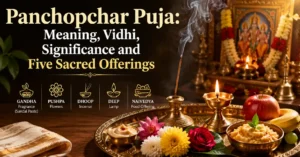
Daily worship is an integral part of Sanatan Dharma, and millions of devotees perform it every day with faith and devotion. Among the simplest and most meaningful forms of daily worship is Panchopchar Puja, a sacred ritual in which five offerings are made to the deity as an expression of love, gratitude, and reverence.
Although the ritual appears simple, each offering carries profound spiritual symbolism rooted in Hindu scriptures and centuries-old traditions. Whether performed at home or in a temple, Panchopchar Puja reminds us that sincere devotion is more important than elaborate rituals.
In this guide, you will learn the meaning of Panchopchar Puja, the significance of its five sacred offerings, the complete Panchopchar Puja Vidhi, the required samagri, its scriptural foundation, the difference between Panchopchar and Shodashopchar Puja, the best time to perform it, and answers to common questions.
Whether you are a beginner or a regular devotee, this guide will help you perform Panchopchar Puja with greater understanding and devotion.
Quick Facts About Panchopchar Puja
| Aspect | Details |
|---|---|
| Meaning | Worship performed with five sacred offerings |
| Number of Offerings | Five (Pancha Upacharas) |
| Five Offerings | Gandha, Pushpa, Dhoop, Deep, Naivedya |
| Best For | Daily worship at home |
| Time Required | About 5–15 minutes |
| Suitable For | Beginners and experienced devotees |
| Commonly Worshipped Deities | Shiva, Vishnu, Durga, Lakshmi, Ganesha, Krishna, Hanuman and others |
| Purpose | To express devotion, gratitude, and reverence to the Divine |
| Elaborate Alternative | Shodashopchar Puja (Sixteen Offerings) |
Table of Contents
ToggleWhat Is Panchopchar Puja? Meaning and Significance
The word Pancha means five, while Upachara refers to the respectful services or offerings made to a deity during worship. Therefore, Panchopchar Puja literally means a form of worship performed through five sacred offerings offered with devotion and reverence.
In Hindu ritual traditions, worship follows a structured sequence of offerings known as Upacharas. These offerings symbolize welcoming, honoring, and expressing gratitude to the deity. Depending on the occasion, the number of Upacharas may vary, with Panchopchar Pujan representing the simplest and most commonly practiced form of daily worship.
Unlike Shodashopchar Puja, which consists of sixteen ceremonial offerings and is usually performed during festivals or special rituals, Panchopchar Puja focuses on five essential offerings. This makes it ideal for daily worship at home while preserving the spiritual essence of traditional Hindu rituals.
The practice is widely followed across Smarta, Shaiva, Vaishnava, and Shakta traditions. Although simple in form, it is considered a complete act of devotion because Hindu scriptures emphasize that the sincerity of the devotee is more important than the number of ritual offerings.
You may also come across names such as Panchopchar Pujan, Panchopachar Puja, Panchopchar Puja Vidhi, or Five Upachara Puja. While the spellings may differ, they all refer to the same sacred practice of worship through five essential offerings.
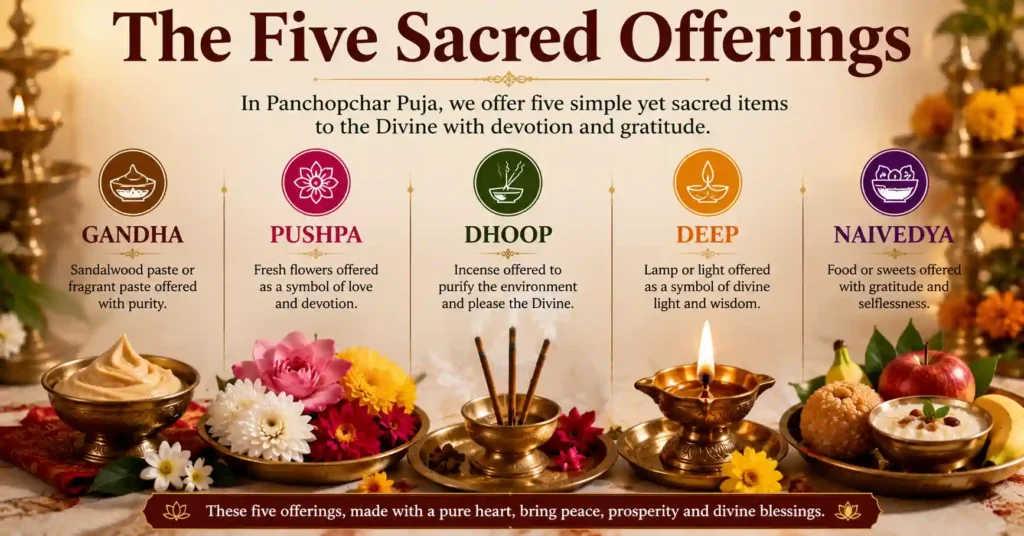
The Five Sacred Offerings in Panchopchar Puja
The heart of Panchopchar Puja lies in its five sacred offerings, known as the Pancha Upacharas. Although these offerings appear simple, each represents a deeper spiritual value and expresses the devotee’s love, gratitude, and surrender to the Divine.
Together, these five Upacharas transform an ordinary act of worship into a meaningful spiritual practice that engages the senses, mind, and heart.
| Sacred Offering | Meaning and Symbolism |
|---|---|
| Gandha (Sandal Paste or Fragrance) | Sandalwood paste or sacred fragrance is offered to the deity as a symbol of purity, peace, and a calm mind. It reminds devotees to approach God with humility and inner serenity. |
| Pushpa (Flowers) | Flowers represent love, devotion, and surrender. Different traditions offer different sacred leaves or flowers, such as Bilva leaves in Shaiva worship, Tulsi leaves in Vaishnava worship, and red flowers in Shakta worship. Offering flowers symbolizes dedicating one’s pure thoughts and heartfelt devotion to the Divine. |
| Dhoop (Incense) | Incense purifies the surroundings and creates a peaceful atmosphere for prayer. The rising fragrance and smoke symbolize the devotee’s prayers and spiritual aspirations ascending towards the Divine. |
| Deep (Lamp) | Lighting a lamp represents the victory of knowledge over ignorance. The flame symbolizes divine wisdom, hope, and the inner light that guides a devotee on the spiritual path. For this reason, offering a lamp remains one of the most important parts of Hindu worship. |
| Naivedya (Food Offering) | Food is first offered to the deity as an expression of gratitude and the recognition that all nourishment comes from the Divine. Once offered, it becomes Prasada, which is received with reverence as the blessings of God. |
Each of these offerings carries both an outer ritual and an inner spiritual meaning. While the hands perform the ritual, the heart offers devotion, gratitude, purity, knowledge, and surrender.
Together, these five offerings engage almost every aspect of worship. The fragrance of Gandha, the beauty of Pushpa, the aroma of Dhoop, the light of Deep, and the nourishment of Naivedya symbolize offering our senses, thoughts, actions, and gratitude to the Divine. This is why these five Upacharas have remained the foundation of simple Hindu worship for centuries.
Did You Know?
In Hindu tradition, the number five (Pancha) holds deep spiritual significance. It is associated with the five elements (Pancha Mahabhutas), five senses (Pancha Jnanendriyas), five vital energies (Pancha Pranas), and five sacred offerings (Pancha Upacharas) used in daily worship.
This symbolism reminds devotees that every aspect of life can be dedicated to the Divine through sincere devotion.
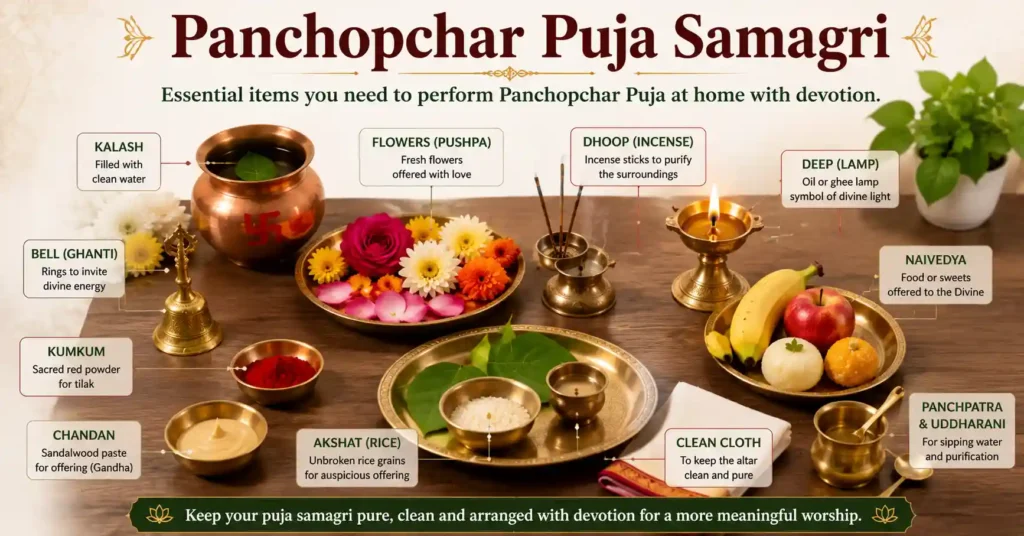
Panchopchar Puja Samagri: Essential Items Required
Performing Panchopchar Puja does not require expensive or elaborate arrangements. The ritual is designed to be simple, making it suitable for daily worship at home. Most of the required items are commonly available in Hindu households.
The following Panchopchar Puja Samagri is used during the worship:
| Samagri | Purpose in the Puja |
|---|---|
| Gandha (Sandal paste or fragrance) | Symbolizes purity, peace, and respect while offering fragrance to the deity. |
| Fresh flowers or sacred leaves | Express love, devotion, and surrender. Tulsi, Bilva leaves, or fresh flowers may be offered according to the deity being worshipped. |
| Dhoop or incense sticks | Purifies the surroundings and creates a calm, devotional atmosphere. |
| Oil or ghee lamp (Deep) | Represents divine light, wisdom, and the removal of ignorance. |
| Naivedya (Fruits, sweets, or simple homemade food) | Offered as gratitude to the Divine before being received as Prasada. |
Unlike elaborate temple rituals, Panchopchar Pujan does not require complex preparations or costly materials. Even simple offerings made with sincerity are considered spiritually meaningful.
If a particular item is unavailable, devotees may offer a suitable alternative with genuine faith. Hindu scriptures consistently emphasize that bhakti (devotion) and a pure heart are more important than ritual grandeur.
Can This Form of Worship Be Performed for Any Deity?
Yes. This simple method of worship can be offered to almost any Hindu deity, including Lord Ganesha, Lord Shiva, Lord Vishnu, Goddess Lakshmi, Goddess Durga, Lord Hanuman, Lord Krishna, Lord Rama, and Surya Dev. The sequence of five sacred offerings remains the same, while the prayers, mantras, flowers, or sacred leaves may vary according to the deity being worshipped.
For example, Bilva leaves are traditionally offered to Lord Shiva, Tulsi leaves to Lord Vishnu and Lord Krishna, and red flowers are commonly offered to Goddess Durga. These customs reflect the unique traditions associated with different deities while preserving the essence of worship.
The most important offering is sincere devotion. Regardless of the deity, worship performed with faith, humility, and a pure heart is considered spiritually meaningful in Sanatan Dharma.
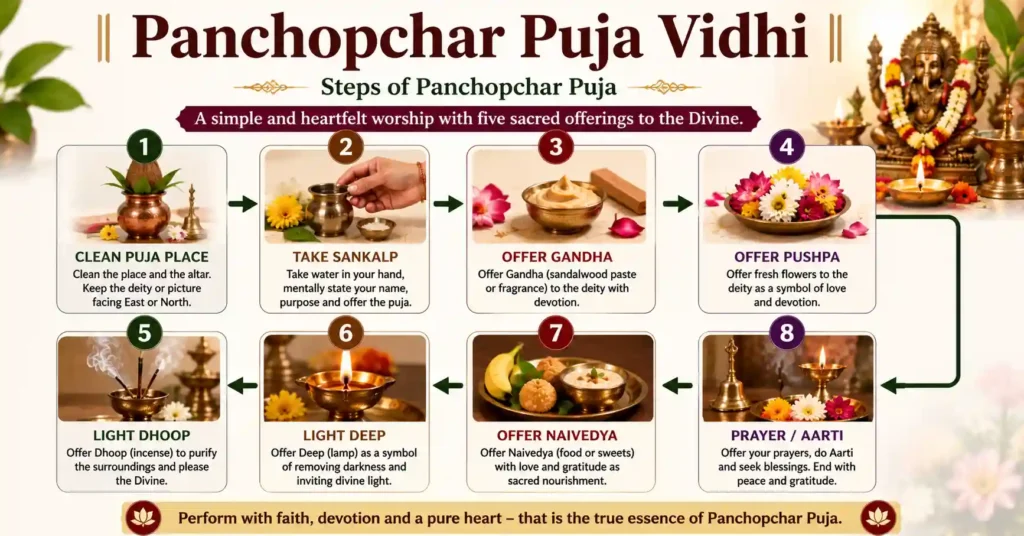
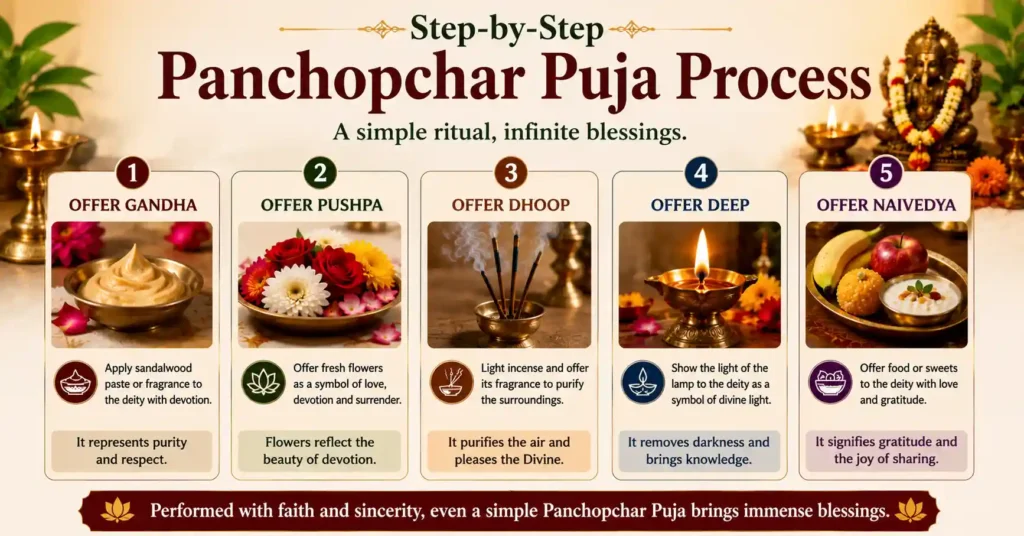
How to Perform Panchopchar Puja: Step-by-Step Vidhi
Many devotees wonder how to perform Panchopchar Puja correctly at home. The good news is that this daily worship follows a simple sequence that anyone can practice with sincerity. While traditions may vary slightly, the following Panchopchar Puja Vidhi is widely followed across Hindu households.
Step-by-Step Panchopchar Puja Vidhi
- Prepare the worship space
Clean the puja area, place the deity or idol respectfully, light the lamp if desired, and sit with a calm and focused mind. - Take a Sankalp (Sacred Intention)
Offer a silent prayer and mentally dedicate the worship to the deity. A simple and sincere intention is sufficient. - Offer Gandha (Sandal Paste or Fragrance)
Apply sandalwood paste or offer a sacred fragrance as a symbol of purity, respect, and inner peace. - Offer Pushpa (Flowers or Sacred Leaves)
Offer fresh flowers, Tulsi, Bilva leaves, or other sacred leaves according to the deity being worshipped. This symbolizes love, devotion, and surrender. - Offer Dhoop (Incense)
Light incense and offer it to the deity. The fragrant smoke represents the purification of the surroundings and the devotee’s prayers rising towards the Divine. - Offer Deep (Lamp)
Light an oil or ghee lamp to symbolize divine knowledge, hope, and the removal of ignorance. - Offer Naivedya (Food Offering)
Offer fruits, sweets, milk, or simple homemade food with gratitude. After the offering, it is received as Prasada. - Conclude with Prayer or Aarti
End the worship with a prayer, mantra chanting, nama japa, or an aarti. Spend a few moments in silent meditation before concluding the puja.
This Panchopchar Pujan method is simple, balanced, and spiritually complete for daily worship. While many devotees recite traditional mantras during each offering, repeating the name of the deity with faith and devotion is equally meaningful. In Sanatan Dharma, the sincerity of one’s heart is considered more important than performing every ritual perfectly.
Simple Mantras for Panchopchar Puja
While elaborate Vedic mantras are traditionally recited during worship, they are not essential for performing Panchopchar Puja with devotion. If you are a beginner, you may simply chant the name of your Ishta Devata while offering each of the five Upacharas.
If you wish to include simple Sanskrit offering mantras, the following are commonly used:
| Offering | Simple Mantra |
|---|---|
| Gandha | ॐ गन्धं समर्पयामि। |
| Pushpa | ॐ पुष्पं समर्पयामि। |
| Dhoop | ॐ धूपं समर्पयामि। |
| Deep | ॐ दीपं दर्शयामि। |
| Naivedya | ॐ नैवेद्यं निवेदयामि। |
After completing the five offerings, you may chant your favourite mantra, recite an aarti, or simply repeat the divine name in Nama Japa. Spending a few moments in silent prayer and gratitude completes the worship beautifully.
Remember that Hindu scriptures consistently teach that bhakti (devotion) is more important than perfect pronunciation. Even a simple and sincere prayer offered with faith is considered pleasing to the Divine.
Scriptural and Spiritual Significance of Panchopchar Puja
Hindu scriptures describe different forms of worship based on the occasion, tradition, and level of ritual detail. The Agamas, Puranas, and various temple traditions prescribe elaborate methods of worship while also recognizing simpler forms suitable for daily devotion.
The Bhagavad Gita (9.26) beautifully emphasizes that the Lord lovingly accepts even a leaf, a flower, a fruit, or water when they are offered with sincere devotion. This teaching highlights that the spirit of worship is more important than the grandeur of the ritual.
Temple ceremonies often follow Shodashopchar Puja, which includes sixteen offerings and detailed rituals performed by trained priests. In contrast, Panchopchar Puja focuses on the five essential offerings that express reverence, gratitude, and hospitality towards the deity, making it ideal for daily worship at home.
According to traditional Hindu understanding, the deity is worshipped as an honoured guest. Offering Gandha, Pushpa, Dhoop, Deep, and Naivedya is not merely a ritual sequence but a heartfelt expression of respect, love, gratitude, and surrender.
Many spiritual teachers also explain that these five offerings carry a deeper symbolic meaning. They are often associated with the Pancha Mahabhutas (five elements), Pancha Jnanendriyas (five senses), Pancha Pranas (five vital energies), and the five Koshas, representing the complete human personality.
From this perspective, the ritual becomes much more than an external act of worship. Each offering symbolizes surrendering one’s body, mind, senses, energy, and ego at the feet of the Divine, transforming daily worship into a path of inner purification and spiritual growth.
At the same time, Hindu scriptures repeatedly remind devotees that rituals derive their true value from bhakti (devotion). Even the simplest worship, when performed with faith, humility, and a pure heart, is considered pleasing to the Divine.
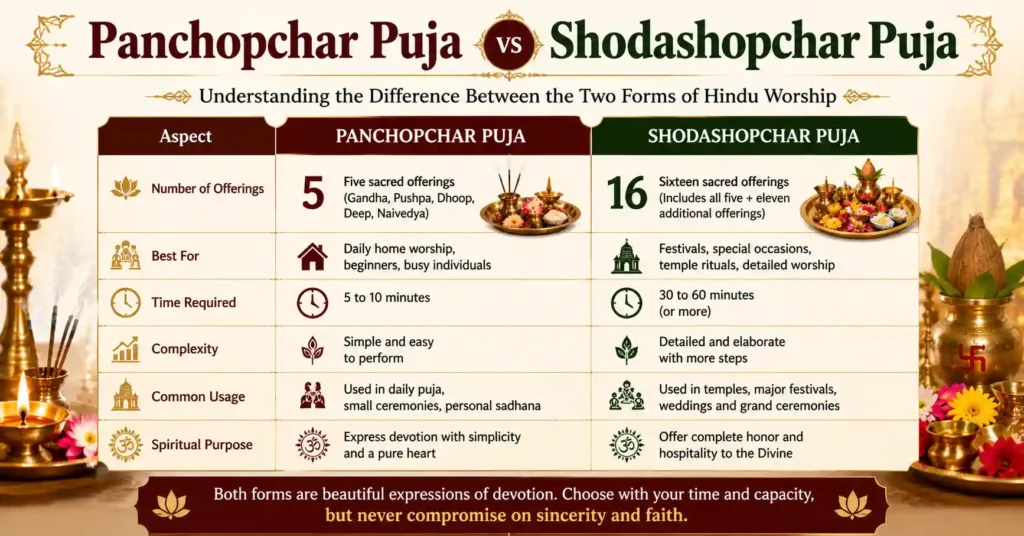
Panchopchar Puja vs Shodashopchar Puja: What's the Difference?
Many devotees wonder whether Panchopchar Puja is less significant than Shodashopchar Puja. In reality, the main difference lies in the number of ritual offerings and the level of ceremonial detail, not in the sincerity of worship.
Shodashopchar Puja consists of sixteen traditional offerings, including invocation (Avahana), offering a seat (Asana), washing the deity’s feet, ceremonial bathing (Snana), clothing, ornaments, fragrance, flowers, incense, lamp, food offerings, and concluding prayers. It is commonly performed during temple ceremonies, festivals, special vratas, and major religious occasions.
Panchopchar Pujan, on the other hand, focuses on the five essential offerings: Gandha, Pushpa, Dhoop, Deep, and Naivedya. Its simplicity makes it ideal for daily worship at home while preserving the spiritual essence of traditional Hindu rituals.
| Aspect | Panchopchar Puja | Shodashopchar Puja |
|---|---|---|
| Offerings | Five | Sixteen |
| Purpose | Daily home worship | Festivals, temple rituals, special occasions |
| Time Required | 5–15 minutes | 30–60 minutes or more |
| Complexity | Simple and easy to perform | More elaborate with detailed procedures |
| Suitable For | Individuals and families | Priests and devotees performing special ceremonies |
| Spiritual Goal | Loving daily devotion | Complete ceremonial worship |
The spiritual value of both forms remains the same. Hindu scriptures consistently teach that devotion, faith, and sincerity are more important than the number of ritual offerings. Whether you perform Panchopchar Puja or Shodashopchar Puja, worship offered with a pure heart is considered equally pleasing to the Divine.
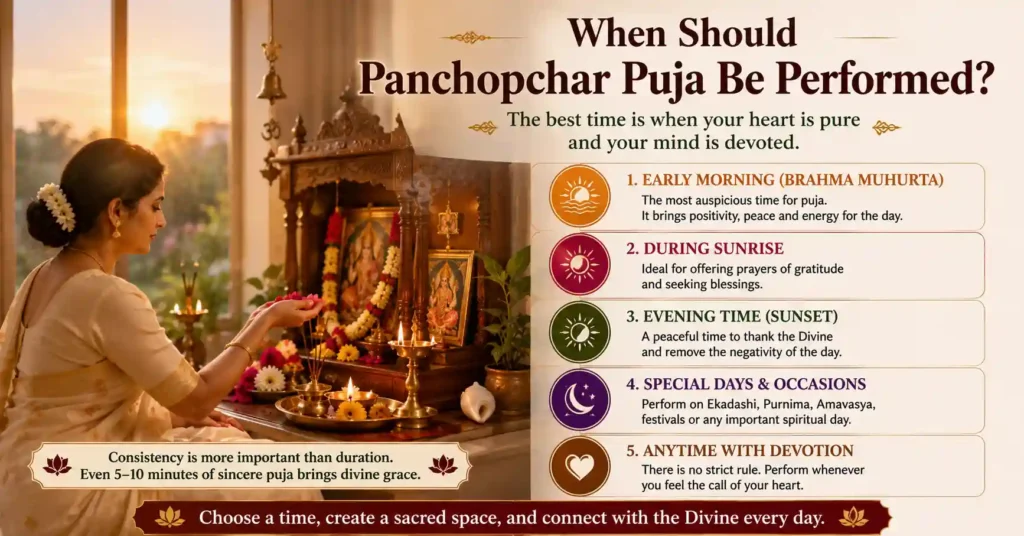
When Should You Perform Panchopchar Puja?
One of the greatest strengths of Panchopchar Puja is its simplicity and flexibility. Unlike elaborate rituals that require extensive preparations, this form of worship can be performed daily with minimal time and materials, making it suitable for devotees of all ages.
Traditionally, the early morning (Brahma Muhurta or after sunrise) is considered the most auspicious time for worship because the mind is calm and focused. However, many devotees also perform the puja in the evening before lighting the household lamp. The most important aspect is to worship with sincerity and a peaceful mind.
You can perform Panchopchar Puja on the following occasions:
| Occasion | Why It Is Suitable |
|---|---|
| Daily morning worship | Begins the day with devotion and positive energy. |
| Evening prayer | A time to express gratitude and seek inner peace after the day’s activities. |
| Vratas and fasting days | Enhances the spiritual observance of special vows. |
| Festivals such as Navratri, Shravan or Ganesh Chaturthi | Offers a simple yet complete method of worship during sacred occasions. |
| While travelling | Can be performed with minimal materials or even through mental worship. |
| When time is limited | Allows devotees to maintain a regular spiritual practice despite a busy schedule. |
For beginners, this is one of the easiest ways to establish a daily spiritual routine. Even a few minutes of sincere worship each day can strengthen devotion, cultivate inner discipline, and help develop a lifelong connection with the Divine.
Spiritual Benefits of Panchopchar Puja
Regular Panchopchar Puja is more than a daily ritual. When performed with faith and consistency, it gradually nurtures inner discipline, mental peace, and a deeper connection with the Divine. The true benefits are experienced through regular practice rather than a single act of worship.
Beyond its spiritual importance, a regular worship routine also brings positive changes to daily life. Spending a few quiet minutes in prayer encourages mindfulness, helps create a sense of calm, and allows devotees to begin or end the day with gratitude and a positive outlook.
Over time, this daily discipline can strengthen patience, self-awareness, and emotional balance. While these benefits arise naturally through sincere practice, Hindu traditions remind us that the primary purpose of worship is to deepen our relationship with the Divine rather than seek material rewards.
Some of the key spiritual benefits include:
- Develops devotion and gratitude by encouraging devotees to offer every act of worship with humility and reverence.
- Brings mental peace as the fragrance of incense, the light of the lamp, and quiet prayer help calm the mind.
- Builds spiritual discipline through a simple daily routine that strengthens consistency in worship.
- Encourages mindfulness by helping the devotee remain fully present during prayer.
- Deepens the connection with the Divine through regular remembrance, prayer, and self-surrender.
Each of the five offerings also carries a deeper inner message:
- Deep (lamp) reminds us to replace ignorance with wisdom and hope.
- Pushpa (flowers) inspires purity, humility, and loving devotion.
- Gandha (fragrance) symbolizes a calm and purified mind prepared for prayer.
- Dhoop (incense) represents the uplifting of thoughts and aspirations towards the Divine.
- Naivedya (food offering) teaches gratitude and the spirit of selfless offering before receiving life’s blessings.
Over time, the ritual naturally shifts from external actions to inner transformation. What begins as a simple daily practice gradually becomes a lifelong habit of devotion, mindfulness, and spiritual awareness, reminding devotees of the Divine presence in every aspect of life.
Beginner's Tips for Daily Worship
If you are new to daily worship, begin with a simple routine instead of trying to follow every ritual perfectly. Even spending 5 to 10 minutes in sincere prayer each day is a meaningful way to build a lifelong spiritual habit.
Choose a clean and peaceful place for worship, keep your puja items ready, and maintain regularity. A consistent daily practice is more beneficial than performing elaborate rituals only on special occasions.
Do not worry if you cannot remember Sanskrit mantras. Offering prayers in your own language with faith, gratitude, and devotion is equally meaningful. Over time, your understanding and confidence will naturally grow through regular practice.
Important Note
The procedure described in this guide reflects a widely followed method of worship in Sanatan Dharma. However, the sequence of offerings, mantras, and customs may vary based on family traditions, regional practices, temple traditions, or the sampradaya (spiritual lineage) that a devotee follows.
For example, some families may include additional offerings, recite specific stotras, or follow the guidance of their Guru or family priest. These variations are a natural part of the rich diversity of Hindu worship.
The essence of every form of worship remains the same: offering sincere devotion, gratitude, and reverence to the Divine. Respecting one’s family traditions while worshipping with faith is always encouraged.
Final Thoughts
Panchopchar Puja is one of the simplest yet most meaningful forms of worship in Sanatan Dharma. Rooted in scriptural tradition, it beautifully combines spiritual symbolism with a practical approach that fits into everyday life.
Through the five sacred offerings of Gandha, Pushpa, Dhoop, Deep, and Naivedya, devotees express reverence, gratitude, humility, and complete surrender to the Divine. These simple acts remind us that true worship is not measured by elaborate rituals but by the sincerity of our hearts.
Whether you are beginning your spiritual journey or have been performing daily worship for years, Panchopchar Puja offers a timeless path to cultivate devotion, inner peace, and spiritual discipline.
Even a few minutes of sincere worship each day can strengthen your connection with the Divine and bring sacredness into everyday life.
May this ancient practice inspire you to make daily worship a joyful habit and experience the peace, grace, and blessings that arise from heartfelt devotion.
Key Takeaways
- Panchopchar Puja is one of the simplest forms of daily Hindu worship.
- The five sacred offerings are Gandha, Pushpa, Dhoop, Deep, and Naivedya.
- Devotion and sincerity are considered more important than elaborate rituals.
- The ritual can be performed for almost any Hindu deity.
- Morning and evening are both suitable times for daily worship.
- Even simple offerings made with faith are spiritually meaningful.
- Regular worship nurtures discipline, gratitude, inner peace, and devotion.
Suggested Reading
If you found this guide on Panchopchar Puja helpful, you may also enjoy these related articles on daily worship, Hindu rituals, mantras, havan, prasad, and other sacred practices of Sanatan Dharma:
Puja in Sanatan Dharma: Meaning, Vidhi, Bhav and Spiritual Significance
https://thesanatantales.com/puja-in-sanatan-dharma/
Daily Puja at Home: Simple Step-by-Step Guide for Everyday Worship
https://thesanatantales.com/daily-puja-at-home/
Mantra Japa: Meaning, Benefits and How to Practice Daily
https://thesanatantales.com/mantra-japa/
Prasad in Hinduism: Why Food Offered to God Becomes Sacred
https://thesanatantales.com/prasad-in-hinduism/
Tilak in Hinduism: Meaning, Types and Spiritual Significance
https://thesanatantales.com/tilak-in-hinduism/
Kalash (Purna Kalasha): Meaning, Symbolism and Importance in Hindu Worship
https://thesanatantales.com/kalash-in-hinduism/
Havan: Meaning, Benefits and Step-by-Step Procedure
https://thesanatantales.com/havan-meaning-procedure-benefits/
What is Panchopachara Puja? (Quora)
https://www.quora.com/What-is-Panchopachara-Puja
These articles will help you deepen your understanding of Panchopchar Puja, daily Hindu worship, mantra chanting, havan, prasad, and other sacred rituals of Sanatan Dharma, enabling you to perform your daily spiritual practices with greater knowledge, devotion, and understanding.
FAQs
What is Panchopchar Puja in Hinduism?
Panchopchar Puja is a traditional Hindu method of worship in which five sacred offerings are made to the deity: Gandha (fragrance), Pushpa (flowers), Dhoop (incense), Deep (lamp), and Naivedya (food offering). These five Upacharas symbolize respect, gratitude, and devotion.
It is one of the simplest forms of daily worship and is widely practiced in homes across India. Although brief, it preserves the spiritual essence of traditional Hindu rituals and is accepted in Shaiva, Vaishnava, Shakta, and Smarta traditions.
What are the five offerings in Panchopchar Puja?
The five sacred offerings are Gandha, Pushpa, Dhoop, Deep, and Naivedya. Each offering represents a different aspect of devotion and symbolizes purity, love, wisdom, gratitude, and surrender to the Divine.
Together, these five Upacharas make the worship complete while keeping it simple enough for daily practice. Their deeper symbolism reminds devotees to offer not only physical items but also a pure heart and sincere devotion.
How do you perform Panchopchar Puja at home?
To perform Panchopchar Puja, begin by cleaning the worship area and offering a simple prayer or Sankalp. Then offer sandal paste, flowers, incense, a lamp, and food to the deity in the traditional sequence.
You may conclude the worship with an aarti, mantra chanting, or simple nama japa. The ritual usually takes only a few minutes and can be performed by anyone with faith and devotion.
What is the difference between Panchopchar Puja and Shodashopchar Puja?
The main difference is the number of ritual offerings. Panchopchar Puja includes five essential offerings, while Shodashopchar Puja consists of sixteen detailed ceremonial offerings performed during elaborate worship.
Both forms are spiritually significant. Panchopchar Puja is generally preferred for daily household worship, whereas Shodashopchar Puja is commonly performed during festivals, temple rituals, and special religious ceremonies.
Can Panchopchar Puja be performed every day?
Yes. Panchopchar Puja is specifically designed for daily worship and can be performed every morning or evening. Its simple procedure makes it suitable even for people with busy schedules.
Regular practice helps develop discipline, gratitude, and a deeper connection with the Divine. Consistency in worship is considered more important than performing elaborate rituals occasionally.
Is it necessary to chant mantras during Panchopchar Puja?
No. While traditional mantras enrich the worship experience, they are not compulsory. Devotees may chant simple prayers, stotras, or the name of their chosen deity with sincerity.
Hindu scriptures emphasize that bhakti (devotion) and pure intention are more important than perfect pronunciation or lengthy recitations.
What if one or more items are not available for Panchopchar Puja?
If a particular offering is unavailable, you may use a suitable substitute or offer it mentally. This form of worship, known as Manasika Puja, is recognized in Hindu traditions as an expression of sincere devotion.
The true purpose of Panchopchar Puja is to cultivate love and reverence for the Divine. Therefore, faith and intention always hold greater importance than expensive materials.
Can women perform Panchopchar Puja?
Yes. Women can perform Panchopchar Puja as part of their daily worship. There is no universal scriptural restriction preventing women from offering the five sacred Upacharas.
Certain family or regional customs may differ, but Hindu philosophy places greater importance on devotion, purity of intention, and respect for tradition than on rigid ritual restrictions.
What are the benefits of performing Panchopchar Puja?
Regular Panchopchar Puja helps cultivate devotion, inner peace, gratitude, and spiritual discipline. The daily practice encourages mindfulness while strengthening the devotee’s relationship with the Divine.
Each of the five offerings also carries symbolic meaning, reminding devotees to purify their thoughts, express gratitude, and surrender their ego through sincere worship.
Why is Panchopchar Puja important in daily Hindu worship?
Panchopchar Puja preserves the essence of traditional Hindu worship in a simple and practical form. It enables devotees to perform meaningful daily worship without requiring elaborate rituals or extensive preparations.
Its simplicity makes it accessible to people of all ages while maintaining the spiritual values of Sanatan Dharma. Over time, this daily practice nurtures devotion, discipline, and a constant remembrance of the Divine in everyday life.
Glossary of Important Terms
| Term | Meaning |
|---|---|
| Panchopchar Puja | A simple form of Hindu worship that involves offering five sacred items to a deity as an expression of devotion. |
| Upachara | A respectful offering or act of service performed during Hindu worship to honor the deity. |
| Gandha | Fragrant sandalwood paste, kumkum, or other sacred fragrance offered to the deity as a symbol of purity and respect. |
| Pushpa | Fresh flowers offered during worship to express love, devotion, and gratitude. |
| Dhoop | Incense offered during puja to purify the surroundings and create a spiritually uplifting atmosphere. |
| Deep (Diya) | A lit oil lamp symbolizing divine light, wisdom, and the removal of ignorance. |
| Naivedya | Food or fruits lovingly offered to the deity before being received as Prasada. |
| Prasada | Sanctified food that has been offered to the deity and is then distributed as a divine blessing. |
| Sankalp | A sacred resolve or intention made before beginning a religious ritual or worship. |
| Aarti | A devotional ritual in which a lit lamp is waved before the deity while singing hymns or prayers. |
| Bhakti | Loving devotion and complete surrender to God, considered the heart of all forms of worship. |
| Mantra | A sacred sound, word, or verse chanted during worship to invoke divine blessings and aid spiritual concentration. |
| Nama Japa | The repeated chanting of the divine name as a simple yet powerful spiritual practice. |
| Manasika Puja | Mental worship in which offerings are made through sincere visualization and devotion when physical materials are unavailable. |
| Shodashopchar Puja | A more elaborate form of worship involving sixteen traditional offerings made to the deity. |
| Murti | The sacred idol or image of a deity worshipped as a representation of the Divine Presence. |
| Ishta Devata | A devotee’s chosen or personal deity with whom they share a special spiritual connection. |
| Sanatan Dharma | The eternal spiritual tradition commonly known as Hinduism, based on timeless principles, scriptures, and dharma. |
About the Author
Yateendra Chaturvedi is a spiritual writer, researcher, devotee, and the founder of The Sanatan Tales. With over 35 years of professional experience and a lifelong interest in Sanatan Dharma, he writes about Hindu deities, temples, scriptures, festivals, Mahavidyas, sacred stories, rituals, and living traditions that continue to guide and inspire devotees across India.
Drawing from traditional scriptures, regional beliefs, temple traditions, devotional literature, and historical sources, he aims to present authentic, well-researched, and easy-to-understand content for modern readers. His work focuses on preserving spiritual wisdom, explaining sacred traditions, and helping seekers develop a deeper understanding of India’s rich spiritual heritage.
Through The Sanatan Tales, Yateendra strives to make the timeless teachings of Sanatan Dharma simple, meaningful, and relevant for today’s generation while maintaining respect for traditional sources, regional practices, and diverse spiritual perspectives.
Learn More About Yateendra Chaturvedi →
https://thesanatantales.com/about-the-author/
References & Sources
This article is based on traditional Hindu scriptures, widely accepted beliefs and practices of Sanatan Dharma, Puranic literature, Smriti texts, traditional commentaries, and insights preserved through various spiritual traditions. It also draws upon commonly followed customs, devotional practices, and respected religious study sources.
Note: Beliefs, rituals, and interpretations may vary across different regions, traditions, sects, and lineages within Sanatan Dharma. The purpose of this article is to present broadly accepted spiritual and religious perspectives in a simple, informative, and accessible manner, without claiming any single interpretation as the absolute or only viewpoint.
Read More Interesting Articles on Sanatan Dharma