Havan is one of the oldest and most sacred rituals in Sanatan Dharma. Also known as Homa or Homam, this Vedic fire ritual involves offering natural ingredients such as ghee, grains, herbs, and sacred wood into a consecrated fire while chanting mantras. It symbolizes devotion, purification, and surrender to the Divine.
In Vedic tradition, Agni (the sacred fire) is regarded as the messenger between devotees and the Divine. It is believed that sincere offerings made into the sacred fire are carried to the deities, fostering inner purification, harmony, and spiritual upliftment. Similar fire rituals are also practiced in Jain and Buddhist traditions, each following its own customs and traditions.
The ritual is performed using a Havan Kund, sacred offerings, pure ghee, and Vedic mantras. It is commonly conducted during marriages, Griha Pravesh (housewarming), festivals, childbirth ceremonies, and other auspicious occasions. Many families also perform this sacred ceremony at home as part of their daily or weekly spiritual practice.
More than an external act of worship, it reminds us to offer our ego, fears, and negativity into the flames while nurturing faith, gratitude, and selfless devotion. In this way, the ritual becomes a timeless bridge between human effort and divine grace.
In this article, you will learn its meaning, spiritual significance, step-by-step procedure, essential materials, key benefits, and how this ancient Vedic practice can be performed with devotion, even at home. Whether you are a beginner or a devotee, this guide will help you understand and practice this sacred tradition with confidence.
Quick Facts
| Quick Facts | |
|---|---|
| Sanskrit Name | Havan (हवन), Homa (होम) |
| Meaning | Sacred Vedic Fire Ritual |
| Mentioned In | Vedas, especially the Rigveda |
| Main Deity | Agni |
| Purpose | Worship, purification, gratitude, and prayer |
| Common Offerings | Ghee, herbs, grains, and sacred offerings |
| Performed During | Festivals, Griha Pravesh, marriages, daily worship, and other auspicious ceremonies |
Table of Contents
ToggleWhat is Havan? Meaning and Spiritual Significance
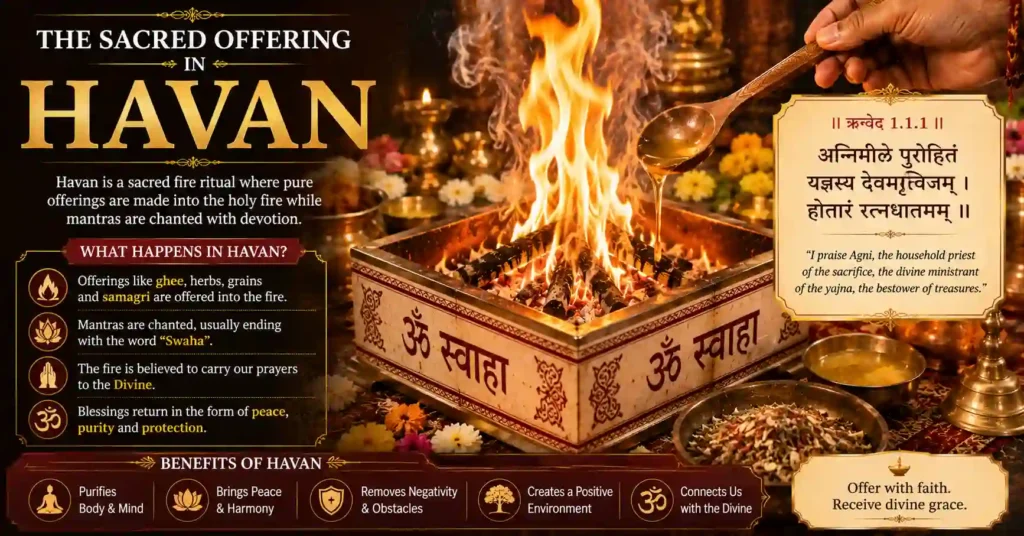
To truly understand this sacred Vedic ritual, one must look beyond the fire and appreciate its deeper purpose. The word “Havan” comes from the Sanskrit root “Hu” (हु), which means “to offer” or “to make a sacred offering.” In the Vedic tradition, every offering is made with devotion, humility, and selfless intention.
More than placing ghee, herbs, or grains into the sacred fire, the ceremony symbolizes surrendering one’s ego, fears, worries, and negative thoughts. Just as fire transforms every offering into subtle energy, it reminds us that sincere devotion can transform the mind and purify the heart.
In Sanatan Dharma, Agni is revered as the divine messenger who carries offerings to the deities. The Vedas describe Agni as the bridge between humanity and the Divine, making every offering an act of prayer, gratitude, and spiritual connection.
Rather than being merely an external ceremony, this ancient spiritual practice nurtures inner peace, self-discipline, and harmony while strengthening one’s relationship with the Divine. Its true essence lies not only in the ritual itself but in the purity of intention behind every offering.
Why is Fire Sacred in This Vedic Ritual?
In Sanatan Dharma, fire is far more than a physical element. Revered as Agni, it symbolizes purity, transformation, wisdom, and spiritual illumination. The Rigveda itself opens with a hymn in praise of Agni, highlighting its central role in Vedic worship.
Nothing impure survives in fire, and everything offered into the sacred flame is transformed. For this reason, it represents the purification of negative thoughts, ego, and attachments, inspiring devotees to cultivate inner peace and righteous living.
Just as a small lamp can dispel darkness, even a simple fire offering performed with sincere devotion can inspire clarity, positivity, and spiritual strength. It reminds us that lasting transformation always begins within.
According to the Vedic tradition, the sacred flame serves as the divine messenger that carries prayers and offerings to the deities. This is why it is revered not merely as an element of nature but as a living symbol of divine presence.
Where devotion burns with sincerity, peace, harmony, and divine grace naturally follow.
Did You Know?
In the Vedic tradition, Agni is the only deity who receives offerings directly through the sacred fire and symbolically carries them to the other deities.
This is one of the reasons why Vedic fire rituals continue to hold a central place in Sanatan Dharma, representing devotion, purification, and the connection between humanity and the Divine.
essential part of Hindu worship even today.
How is the Sacred Fire Ritual Performed?
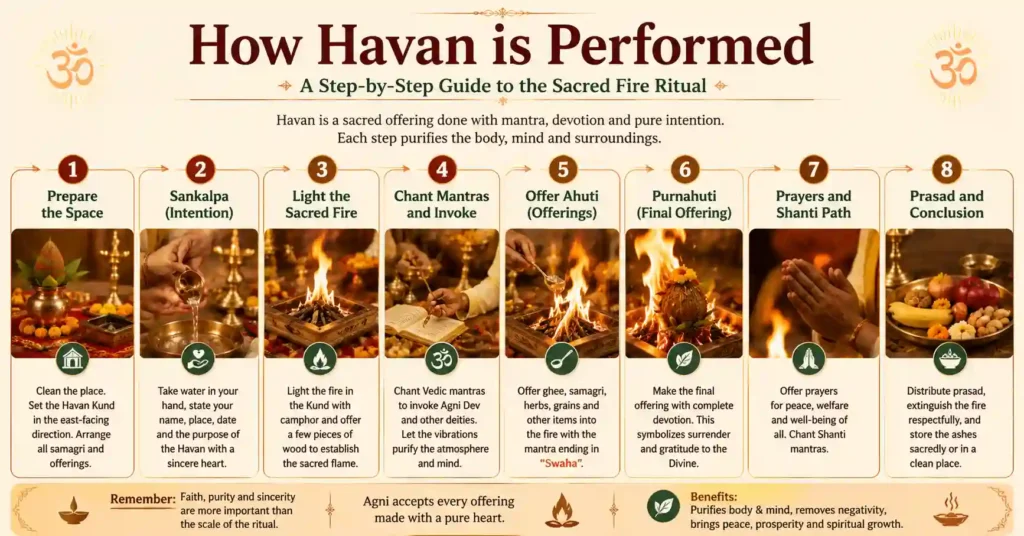
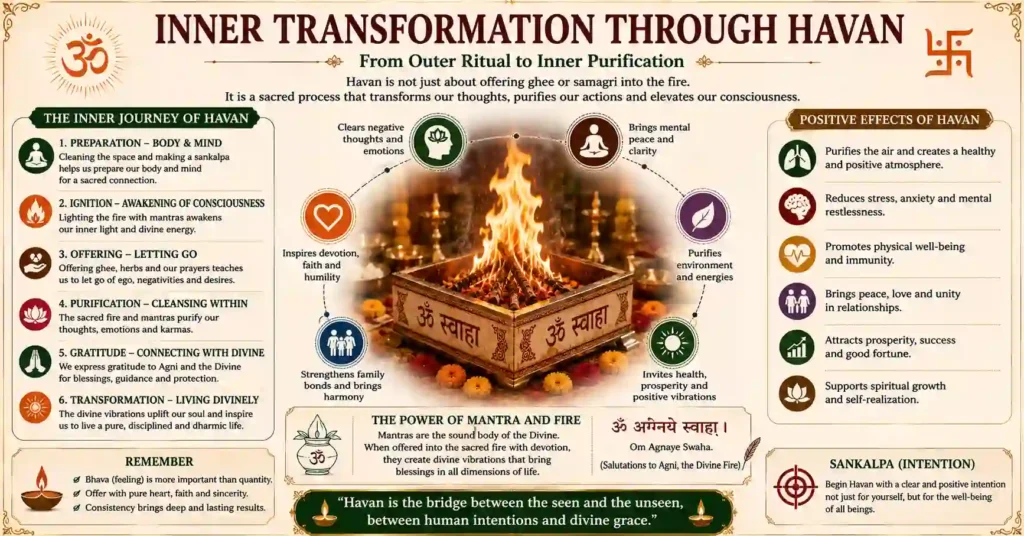
The ceremony begins by preparing a clean, peaceful, and well-ventilated space. A Havan Kund, traditionally made of clay, copper, or metal, is placed at the center as the sacred altar. After making a Sankalpa (a heartfelt intention or prayer), the fire is kindled using clean wood, traditionally from the mango or peepal tree.
Once the sacred flame is established, pure ghee and a blend of herbs, grains, seeds, dried flowers, and other natural offerings are gently placed into the fire while Vedic mantras are chanted. Each offering is usually accompanied by the word “Swaha,” expressing complete surrender and dedication to the Divine.
The rhythmic chanting of mantras, the gentle glow of Agni, and the soothing fragrance of the herbal offerings together create a peaceful and spiritually uplifting atmosphere. These elements help devotees cultivate concentration, devotion, and mindfulness throughout the ceremony.
Beyond its external form, this ancient Vedic practice encourages inner transformation. As every offering is made with faith and gratitude, the mind gradually becomes calmer, breathing deepens, and negative thoughts begin to fade. More than a sacred ceremony, it is a path toward self-purification, inner peace, and a deeper connection with the Divine.
How to Perform Havan at Home: Step-by-Step Guide
Performing this sacred ritual at home does not require elaborate arrangements. With a clean space, the right materials, and sincere devotion, families can carry out this ancient Vedic practice safely and meaningfully.
| Step | What to Do |
|---|---|
| Clean the space | Choose a clean, quiet, and well-ventilated place. Place the Havan Kund on a heat-resistant surface, preferably facing east or north. |
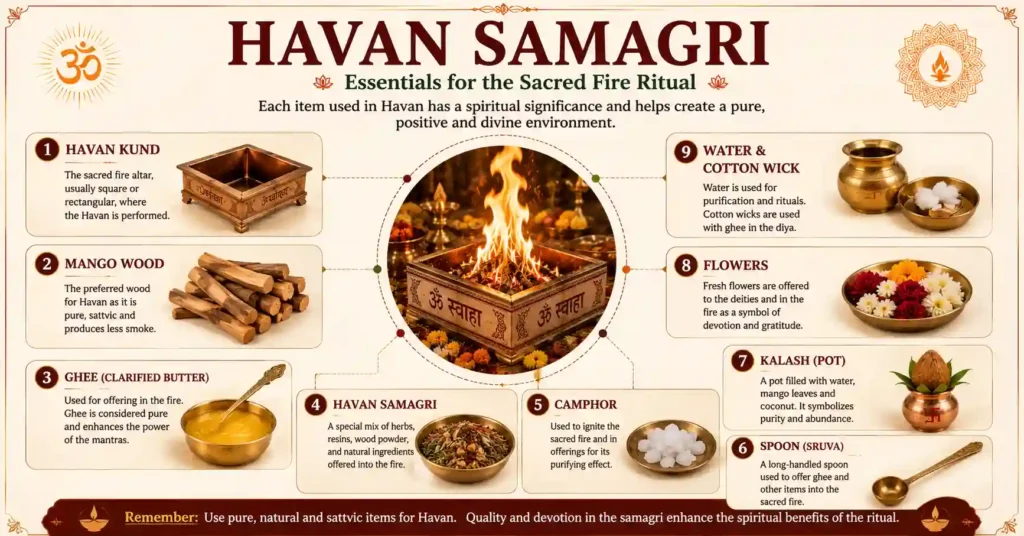
| Gather the essentials | Keep the Kund, pure ghee, a mixture of herbs, grains, seeds, dried flowers, wooden sticks (preferably mango wood), camphor, a spoon, water, flowers, and a small plate ready before beginning. |
| Take a Sankalpa | Offer a sincere prayer and state your intention, whether for gratitude, peace, prosperity, or spiritual growth. |
| Light the sacred fire | Ignite the fire using camphor and dry wood. Allow it to burn steadily before making any offerings. |
| Chant mantras | Invoke Agni with simple mantras such as Om Agnaye Namah or follow the prayers prescribed by your tradition. |
| Offer Ahuti | Offer small portions of pure ghee and the prepared herbal mixture into the sacred fire while chanting “Swaha.” Make each offering slowly and with devotion. |
| Conclude the ritual | Perform the Purnahuti (final offering), pray for the well-being of all, chant Om Shanti Shanti Shantih, and allow the fire to extinguish naturally. |
If you are performing this sacred fire ritual at home for the first time, keep the ceremony simple. Focus on devotion, correct intention, and safety rather than trying to follow an elaborate procedure. As your understanding grows, you can gradually learn additional mantras and traditional practices.
Benefits of This Sacred Vedic Practice
In today’s fast-paced and demanding world, finding moments of peace has become increasingly difficult. This ancient Vedic practice offers an opportunity to pause, quiet the mind, and reconnect with oneself through prayer, devotion, and mindful chanting.
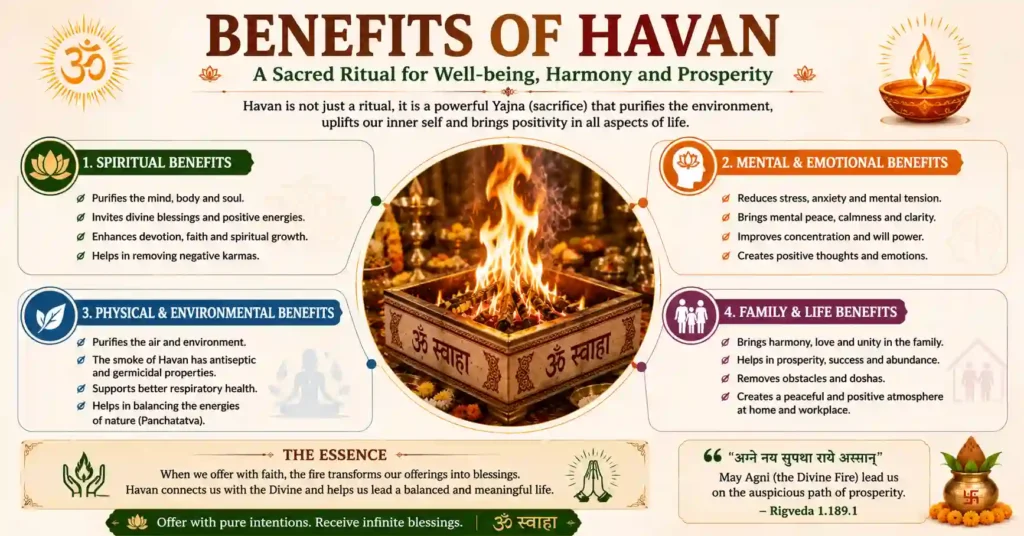
Its benefits are valued on both spiritual and personal levels. In Sanatan Dharma, the sacred fire ceremony is believed to purify the mind, strengthen positive thoughts, and create an atmosphere of harmony and devotion. Many families perform this ritual regularly to seek blessings, express gratitude, and cultivate inner balance.
Some scientific studies have explored the effects of the herbal ingredients used in traditional fire rituals, suggesting they may help reduce certain airborne microbes for a limited period under specific conditions. However, more research is needed to fully understand these effects. The primary purpose of this practice remains spiritual rather than medicinal.
Many devotees share that after participating in the ceremony, they feel calmer, emotionally lighter, and mentally refreshed. The peaceful environment created by Vedic mantras, sacred offerings, and collective prayer often brings a sense of positivity and well-being to the home.
Although no ritual can instantly change external circumstances, it can inspire a more positive outlook through faith, discipline, and serenity. This inner transformation is what has made the practice meaningful across generations and continues to keep it relevant in modern life.
Difference Between Havan, Homa and Yajna
The terms Havan, Homa, and Yajna are often used interchangeably because all three involve sacred fire offerings. However, they differ in their purpose, scale, and traditional method of worship.
| Aspect | Havan | Homa | Yajna |
|---|---|---|---|
| Meaning | A simple sacred fire ritual performed with offerings and Vedic mantras. | A Vedic fire ritual performed with specific mantras for a particular spiritual objective. | A larger Vedic sacrificial ceremony dedicated to the welfare of individuals, society, or the universe. |
| Purpose | Promotes inner peace, purification, devotion, and spiritual well-being. | Performed for healing, protection, prosperity, removal of obstacles, or other specific intentions. | Conducted for collective welfare, harmony, prosperity, and the fulfillment of sacred duties. |
| Scale | Usually suitable for homes and temples. | May be simple or elaborate depending on the tradition. | Generally larger and often conducted by multiple priests. |
| Common Occasions | Daily worship, festivals, Griha Pravesh, marriages, and family ceremonies. | Special Vedic ceremonies, remedial worship, and spiritual observances. | Major religious events, temple ceremonies, community gatherings, and Vedic sacrifices. |
Although their names, methods, and scale differ, all three traditions are rooted in the same Vedic philosophy. Each expresses devotion, gratitude, and surrender through sacred offerings into Agni, symbolizing the timeless connection between human effort and divine grace.
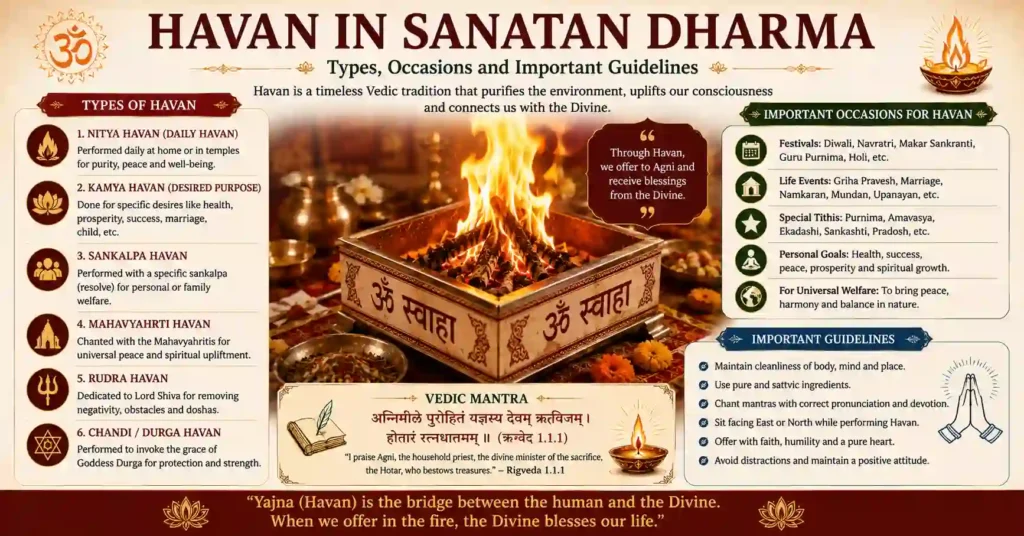
Common Types of Havan in Sanatan Dharma
Sacred fire rituals are performed for different spiritual purposes and occasions. While their core principles remain the same, the mantras, offerings, and ceremonial practices may vary according to the tradition and the intention behind the worship.
| Type | Purpose |
|---|---|
| Griha Pravesh | Performed before entering a new home to seek divine blessings, peace, and positive energy. |
| Gayatri | Dedicated to Goddess Gayatri for wisdom, spiritual growth, and mental clarity. |
| Maha Mrityunjaya | Performed while chanting the Maha Mrityunjaya Mantra to pray for health, protection, and inner strength. |
| Navagraha | Conducted to seek the blessings of the nine planetary deities (Navagrahas) and promote harmony according to traditional beliefs. |
| Lakshmi | Dedicated to Goddess Lakshmi for prosperity, abundance, and well-being. |
| Durga | Dedicated to Goddess Durga, especially during Navratri, seeking courage, protection, and divine grace. |
| Ganesh | Performed before important beginnings to seek Lord Ganesha’s blessings for wisdom and the removal of obstacles. |
Although each ceremony has a specific purpose, the true essence of every sacred fire ritual remains the same: offering prayers with devotion, expressing gratitude, and strengthening one’s connection with the Divine. The choice of ritual usually depends on family traditions, guidance from a qualified priest, or the occasion being observed.
Common Mantras Chanted During Havan
Vedic mantras are an essential part of every sacred fire ritual. They invoke divine blessings, purify the mind, and help devotees perform the ceremony with devotion and concentration. Although the choice of mantra may vary according to the purpose of the worship, a few are commonly recited in most Vedic fire ceremonies.
| Mantra | Meaning | When It Is Chanted |
|---|---|---|
| ॐ अग्नये नमः Om Agnaye Namah | I bow to Agni, the sacred fire, who represents purity, light, and transformation. | At the beginning of the ceremony to invoke Agni. |
| ॐ स्वाहा Om Swaha | I offer this with complete devotion and surrender. | Chanted while offering ghee or sacred herbal offerings into the fire. |
| ॐ शान्तिः शान्तिः शान्तिः Om Shanti Shanti Shantih | May there be peace in the body, mind, and the entire universe. | Usually recited at the conclusion of the ceremony. |
| गायत्री मंत्र Om Bhur Bhuvah Swaha… | A prayer seeking divine wisdom, knowledge, and spiritual enlightenment. | Commonly recited during Gayatri worship and many daily Vedic fire ceremonies. |
Even chanting a simple mantra such as “Om Agnaye Namah” with faith before beginning the ceremony helps calm the mind, deepen concentration, and prepare the heart for sincere worship. The true power of these sacred chants lies not only in their words but also in the devotion, faith, and intention with which they are recited.
Best Practices for a Meaningful and Safe Sacred Fire Ritual
Whether you are participating in a traditional ceremony or performing this sacred fire ritual at home, following a few simple practices can make the experience more meaningful, safe, and spiritually fulfilling.
| Recommended Practices | Why It Matters |
|---|---|
| Begin with a clear Sankalpa (intention). | A sincere intention brings focus and devotion to the ceremony. |
| Use clean and natural offering materials. | Pure ingredients are traditionally preferred for sacred offerings. |
| Chant mantras with attention and faith. | Devotion and sincerity are considered more important than perfect pronunciation. |
| Maintain a calm and respectful atmosphere. | A peaceful environment helps improve concentration and spiritual connection. |
| Offer ghee and the prepared herbal mixture gently into the sacred fire. | Offerings should be made with reverence rather than in haste. |
| Keep the Havan Kund in a safe, well-ventilated place. | Ensures both safety and comfort throughout the ceremony. |
| Allow the fire to extinguish naturally after Purnahuti. | This reflects respect for Agni and marks the completion of the ritual. |
Practices to Avoid
- Avoid performing the ceremony in anger, haste, or with a distracted mind.
- Do not use plastic, chemical-based substances, or artificial materials as offerings.
- Never leave the sacred fire unattended, especially while performing the ritual at home.
- Avoid creating excessive smoke by adding too much ghee or herbal offerings at once.
- Do not treat this spiritual practice as a mere formality; approach it with faith, gratitude, and mindfulness.
Safety Precautions for the Sacred Fire Ritual
Although this sacred fire ritual is a deeply spiritual practice, it also involves an open flame. Following a few basic safety measures helps ensure that the ceremony remains peaceful, respectful, and safe for everyone present.
| Precaution | Why It Is Important |
|---|---|
| Keep the Havan Kund on a stable, heat-resistant surface. | Prevents accidental tipping or fire hazards. |
| Perform the ceremony in a well-ventilated area. | Maintains good airflow and helps prevent excessive smoke buildup. |
| Use only natural offering materials and pure ghee. | Helps avoid harmful fumes from artificial or chemical-based substances. |
| Keep children and pets at a safe distance. | Reduces the risk of accidental burns or disturbances. |
| Keep a bucket of water or a fire extinguisher nearby. | Provides added safety in case of an emergency. |
| Do not leave the sacred fire unattended. | Ensures the ceremony is completed safely and responsibly. |
| Allow the fire to cool completely before disposing of the ashes. | Prevents accidental burns and reduces the risk of fire. |
Note: The sacredness of this ancient Vedic practice is best preserved when devotion is accompanied by care and responsibility. Simple safety precautions allow everyone to participate with peace of mind while respecting both the ritual and the sacred fire.
When Is the Best Time to Perform This Sacred Fire Ritual?
There is no single fixed time to perform this sacred fire ritual. Many devotees choose to observe it daily, weekly, or on auspicious occasions such as festivals, Griha Pravesh, marriages, birthdays, or before beginning an important new chapter in life. Performing the ceremony at home is also a cherished tradition in many families.
Traditionally, Brahma Muhurta (before sunrise) and the morning hours are considered the most auspicious for Vedic worship. However, the ceremony may also be performed at other suitable times, depending on family traditions, guidance from a qualified priest, or personal convenience.
More important than the day or time is the spirit with which the ceremony is performed. In Sanatan Dharma, devotion, sincerity, and a pure intention are valued far more than elaborate arrangements or grand ceremonies.
Even a simple fire offering made with faith, natural ingredients, and heartfelt prayers can become a deeply meaningful act of worship. The true sanctity of the practice lies not in wealth or grandeur but in the devotee’s sincerity, gratitude, and unwavering faith.
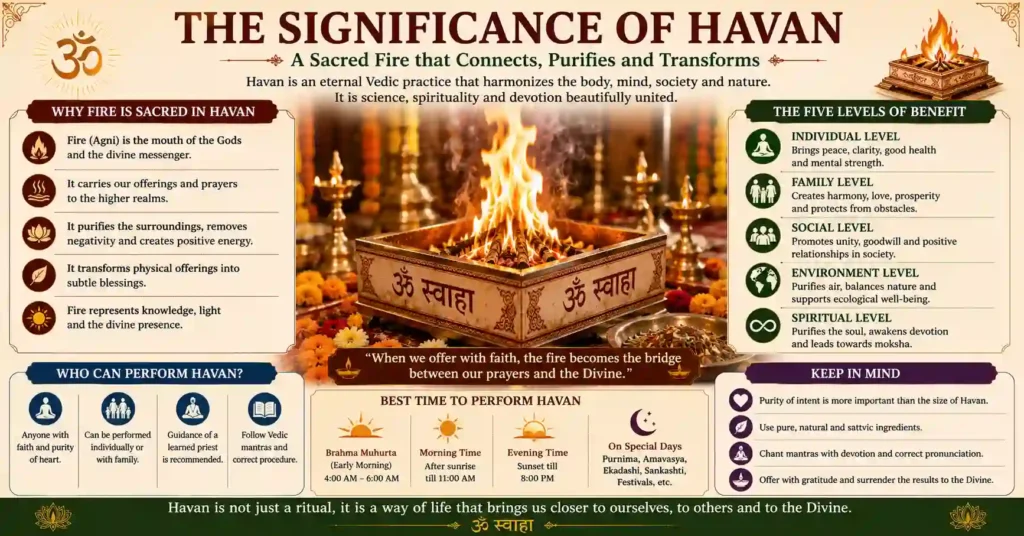
Can Anyone Perform This Sacred Fire Ritual?
One of the most common questions among beginners is whether this sacred fire ritual can only be performed by priests. The answer is no. In Sanatan Dharma, devotion, sincerity, and respect for tradition are considered far more important than social status or elaborate arrangements.
A simple ceremony at home can be performed by individuals or families after learning the basic procedure and chanting appropriate mantras. Many households across India regularly observe this practice during festivals, birthdays, Griha Pravesh, and other auspicious occasions.
For elaborate Vedic ceremonies involving detailed scriptural procedures, families often invite a qualified priest (Purohit) to ensure everything is performed according to tradition. This is especially common for weddings, major Yajnas, temple rituals, and other important religious ceremonies.
Whether performed independently or under the guidance of a priest, the true value of Havan lies in faith, humility, and the intention behind every sacred offering.
Key Takeaways
- Havan is one of the oldest Vedic fire rituals in Sanatan Dharma.
- Agni symbolizes purity, transformation, and divine connection.
- A simple Havan at home can be performed with faith and basic preparations.
- Devotion and sincere intention are more important than elaborate rituals.
- The true purpose of Havan is inner purification and spiritual growth.
Conclusion
Havan teaches a timeless truth: true transformation begins within. Every sacred offering into Agni reminds us to let go of fear, ego, anger, and negativity while embracing faith, gratitude, and inner peace.
More than lighting a sacred fire or following tradition, this ancient Vedic practice nurtures self-discipline, mindfulness, and a deeper connection with the Divine. Whether performed in a temple or at home, its true essence lies in devotion rather than grandeur.
As the Vedic tradition reminds us, the greatest offering is not what we place into the fire but the sincerity with which we offer our thoughts, actions, and intentions. Performed with a pure heart, this sacred ceremony becomes a journey of inner purification, spiritual growth, and lasting harmony.
May the sacred flame of Agni continue to illuminate your path with wisdom, peace, and divine blessings.
Suggested Reading
If you found this guide on Havan helpful, you may also enjoy these related articles on Sanatan Dharma rituals, daily worship, sacred traditions, and spiritual practices:
Puja in Sanatan Dharma: Meaning, Vidhi, Bhav and Spiritual Significance
https://thesanatantales.com/puja-in-sanatan-dharma/
Daily Puja at Home: Simple Step-by-Step Guide for Everyday Worship
https://thesanatantales.com/daily-puja-at-home/
Panchopchar Pujan: The Five Sacred Offerings in Hindu Worship
https://thesanatantales.com/panchopchar-pujan/
Mantra Japa: Meaning, Benefits and How to Practice Daily
https://thesanatantales.com/mantra-japa-meaning-method-rules/
How to Perform Abhishek to Shivling: Complete Vidhi and Significance
https://thesanatantales.com/abhishek-to-shivling/
Prasad in Hinduism: Why Food Offered to God Becomes Sacred
https://thesanatantales.com/prasad-in-hinduism/
Tilak in Hinduism: Meaning, Types and Spiritual Significance
https://thesanatantales.com/tilak-in-hinduism/
Janeu (Yajnopavita): Meaning, Rules and Spiritual Importance
https://thesanatantales.com/janeu-yajnopavita-meaning-rules-significance/
Rudraksha: Meaning, Benefits and How to Wear It
https://thesanatantales.com/rudraksha-meaning-types-benefits/
Kalash (Purna Kalasha): Meaning, Symbolism and Importance in Hindu Worship
https://thesanatantales.com/kalash-in-hinduism/
Homa (Ritual)
https://en.wikipedia.org/wiki/Homa_(ritual)
These articles will help you deepen your understanding of Havan, daily worship, Vedic rituals, mantra chanting, sacred symbols, and the timeless spiritual traditions of Sanatan Dharma, making them ideal companions to your study and practice of this sacred fire ritual.
FAQs
What is Havan?
Havan is a sacred Vedic fire ritual in Sanatan Dharma in which offerings such as ghee, herbs, grains, and Havan Samagri are made into a consecrated fire while chanting mantras. It is also known as Homa or Homam.
The ritual symbolizes devotion, purification, gratitude, and surrender to the Divine. According to Vedic tradition, Agni carries these sacred offerings to the deities, making Havan a spiritual practice that strengthens one’s connection with God.
Why is Havan important in Sanatan Dharma?
Havan holds a special place in Sanatan Dharma because it represents selfless offering, inner purification, and spiritual transformation. It reminds devotees to let go of ego, negativity, and attachments while cultivating faith and gratitude.
The Vedas describe Agni as the divine messenger between humans and the Divine. This is why Havan is performed during festivals, marriages, Griha Pravesh, and many other auspicious occasions.
What is the difference between Havan, Homa, and Yajna?
Although these terms are often used interchangeably, they are not exactly the same. Havan generally refers to a simple fire ritual performed at home or in temples for peace and spiritual well-being.
Homa is usually performed with specific Vedic mantras for a particular purpose, while Yajna is a larger Vedic ceremony conducted for the welfare of society or the community. All three share the same principle of offering through the sacred fire.
Can Havan be performed at home?
Yes. A simple Havan at home can be performed by families using a clean Havan Kund, pure ghee, natural Havan Samagri, and appropriate mantras.
While elaborate Vedic ceremonies may require the guidance of a qualified priest, many households regularly perform simple Havan with devotion. Sincerity and reverence are considered more important than complexity.
What items are required for Havan?
The basic items include a Havan Kund, mango or other sacred wood, pure ghee, Havan Samagri, camphor, a spoon for offerings, water, flowers, and a small vessel (Kalash) if required.
Depending on the purpose of the ceremony, additional items may be included according to family traditions or the guidance of a priest.
What are the benefits of Havan?
The benefits of Havan are primarily spiritual. It helps create an atmosphere of devotion, encourages mindfulness, and inspires inner peace through mantra chanting and sacred offerings.
Many devotees also experience a sense of emotional calm and positivity after participating in the ritual. Traditional beliefs further associate Havan with harmony, gratitude, and spiritual well-being.
Which mantra is commonly chanted during Havan?
One of the most common mantras is “Om Agnaye Namah” (ॐ अग्नये नमः), which is recited to invoke Agni, the sacred fire.
During the offering of ghee and Havan Samagri, the word “Swaha” is commonly chanted. Many Havan rituals also include the Gayatri Mantra and conclude with “Om Shanti Shanti Shantih” for peace.
What is the best time to perform Havan?
Traditionally, the morning hours, especially Brahma Muhurta and sunrise, are considered the most auspicious for performing Havan because they promote calmness and concentration.
However, the ritual may also be performed on festivals, special occasions, or whenever a devotee wishes to pray with faith and devotion. The purity of intention is considered more important than the exact time.
Can anyone perform Havan?
Yes. Anyone who approaches the ritual with respect, devotion, and a sincere heart can participate in Havan. It is not limited by age, wealth, or social status.
For complex Vedic ceremonies, families may seek the guidance of a knowledgeable priest. However, a simple home Havan can be performed by devotees after learning the proper procedure.
Is Havan mentioned in the Vedas?
Yes. Havan has its roots in the Vedas, particularly the Rigveda, where Agni is praised as the divine priest and messenger who carries offerings to the deities.
For thousands of years, sacred fire rituals have remained an integral part of Vedic worship and continue to be practiced across many traditions within Sanatan Dharma.
Glossary of Important Terms
| Term | Meaning |
|---|---|
| Havan | A sacred Vedic fire ritual in which offerings are made into a consecrated fire while chanting mantras to seek divine blessings and inner purification. |
| Agni | The Vedic deity of fire, revered as the divine messenger who carries offerings and prayers from devotees to the deities. |
| Homa (Homam) | Another name for Havan, especially used in South India. It generally refers to a Vedic fire ritual performed for a specific spiritual purpose. |
| Yajna | A larger Vedic sacrificial ceremony performed for the welfare of individuals, society, or the universe through sacred fire offerings and mantras. |
| Havan Kund | A specially designed fire altar, usually made of clay, copper, or metal, in which the sacred fire is kindled during Havan. |
| Havan Samagri | A sacred mixture of herbs, grains, seeds, dried flowers, and other natural ingredients offered into the fire during Havan. |
| Ahuti | A sacred offering of ghee, herbs, or other materials placed into the fire while chanting mantras during the ritual. |
| Swaha | A sacred word chanted while making offerings into the fire, symbolizing complete surrender and dedication to the Divine. |
| Sankalpa | A heartfelt intention or spiritual resolve made before beginning a religious ritual or worship. |
| Purnahuti | The final and most significant offering made at the conclusion of a Havan, symbolizing the successful completion of the ritual. |
| Mantra | A sacred sound, word, or verse from the Vedas or other scriptures recited during worship to invoke divine blessings and focus the mind. |
| Gayatri Mantra | One of the most revered Vedic mantras, dedicated to Savitr, the divine source of light and wisdom, often chanted during Havan. |
| Rigveda | The oldest of the four Vedas and the primary scripture that contains hymns dedicated to Agni and many other Vedic deities. |
| Brahma Muhurta | The auspicious period before sunrise, traditionally regarded as the ideal time for meditation, mantra chanting, and Vedic rituals. |
| Sanatan Dharma | The eternal spiritual tradition commonly known as Hinduism, encompassing Vedic teachings, rituals, philosophy, and a way of righteous living. |
About the Author
Yateendra Chaturvedi is a spiritual writer, researcher, devotee, and the founder of The Sanatan Tales. With over 35 years of professional experience and a lifelong interest in Sanatan Dharma, he writes about Hindu deities, temples, scriptures, festivals, Mahavidyas, sacred stories, rituals, and living traditions that continue to guide and inspire devotees across India.
Drawing from traditional scriptures, regional beliefs, temple traditions, devotional literature, and historical sources, he aims to present authentic, well-researched, and easy-to-understand content for modern readers. His work focuses on preserving spiritual wisdom, explaining sacred traditions, and helping seekers develop a deeper understanding of India’s rich spiritual heritage.
Through The Sanatan Tales, Yateendra strives to make the timeless teachings of Sanatan Dharma simple, meaningful, and relevant for today’s generation while maintaining respect for traditional sources, regional practices, and diverse spiritual perspectives.
Learn More About Yateendra Chaturvedi →
https://thesanatantales.com/about-the-author/
References & Sources
This article is based on the teachings, beliefs, and practices of Sanatan Dharma as described in traditional Hindu scriptures, Vedic literature, and long-standing religious customs. It also draws upon knowledge preserved through temple traditions, family practices, and the guru-disciple lineage, along with insights from respected spiritual and religious study sources.
Note: Rituals, interpretations, and methods of worship may vary across different regions, sampradayas (traditions), and schools of thought within Sanatan Dharma. The purpose of this article is not to present any one tradition as the only authoritative view, but to explain widely accepted beliefs and practices related to Havan in a simple, respectful, and accessible manner for readers.
Read More Interesting Articles on Sanatan Dharma