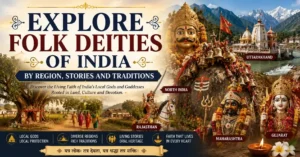
The Folk Deities in North India are not distant gods remembered only through ancient scriptures or grand temples. They are living guardians whose presence continues to shape the everyday lives of villages, farming communities, forests, and mountain settlements. For millions of devotees, these local deities remain protectors, guides, healers, and symbols of hope.
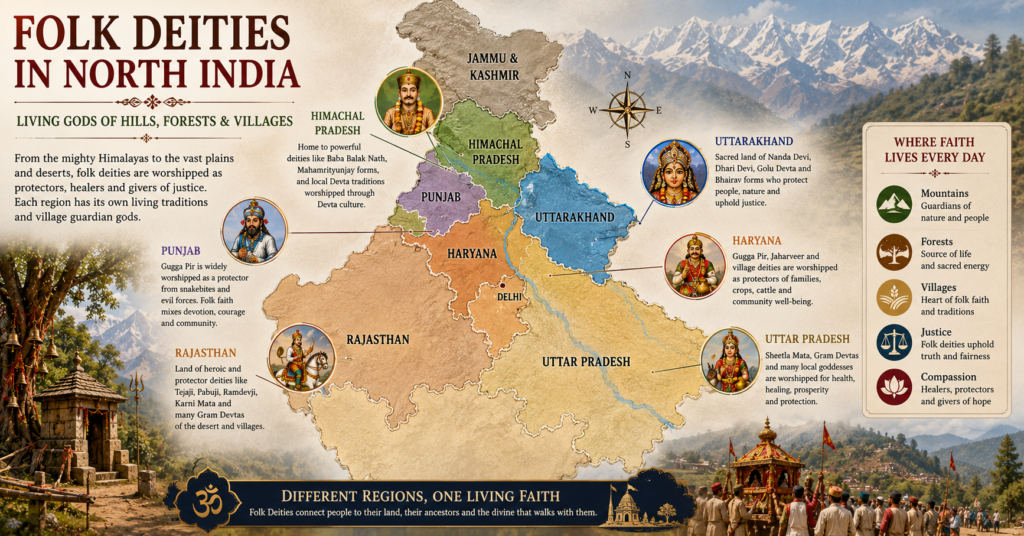
From the snow-clad Himalayas of Uttarakhand and Himachal Pradesh to the plains of Uttar Pradesh, Haryana, Punjab, and the deserts of Rajasthan, generations have worshipped these North Indian Folk Deities with unwavering faith. Every region has its own Gram Devta, Kul Devta, guardian goddess, or heroic folk deity whose blessings are sought for justice, prosperity, good harvests, and community well-being.
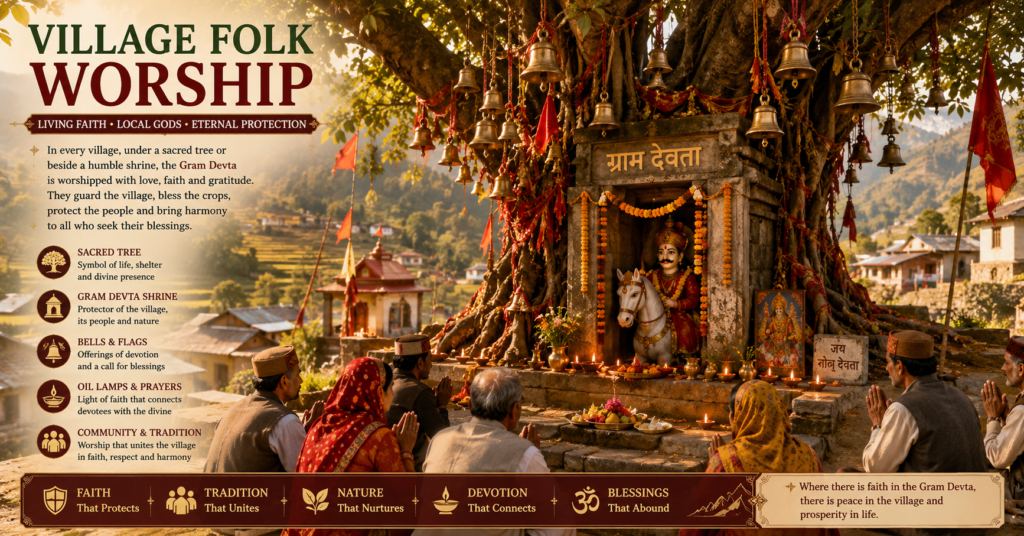
Unlike many Puranic deities whose stories are preserved in sacred texts, the Village Deities of North India live through oral traditions, local legends, annual fairs, village festivals, and everyday worship. Their sacred shrines, often found beneath ancient trees, on hilltops, beside rivers, or at village boundaries, reflect a spiritual tradition that has evolved alongside the land and its people.
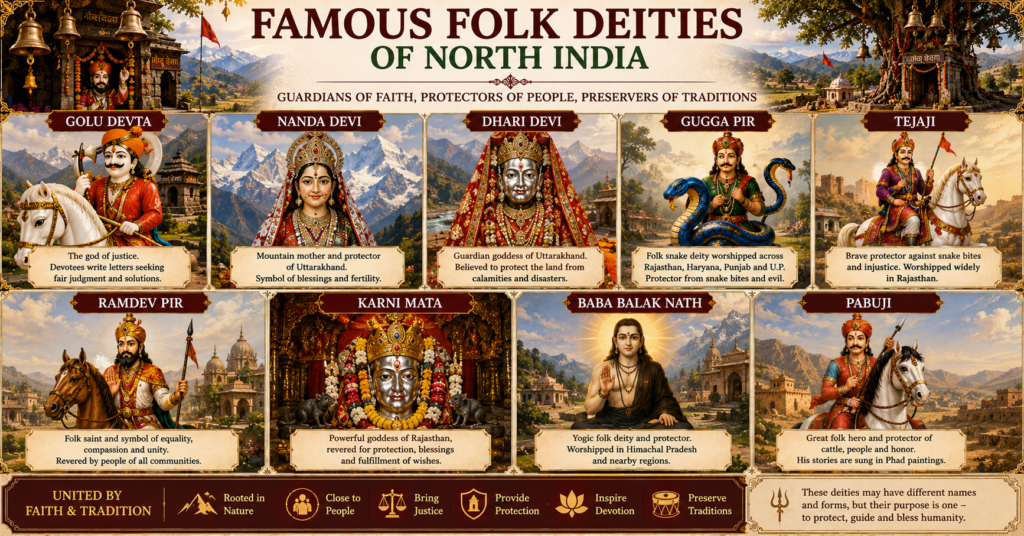
Whether it is Golju Devta, revered as the god of justice, Nanda Devi, the beloved mountain mother of Uttarakhand, Gugga Pir, the protector against snake bites, Tejaji, the heroic guardian of Rajasthan, or Baba Balak Nath, the yogic saint of Himachal Pradesh, each deity represents a unique expression of devotion within Sanatan Dharma.
Together, these Regional Deities of North India reveal how faith, nature, community, and spirituality have remained deeply interconnected for centuries. Their worship continues to preserve India’s rich cultural heritage while strengthening the bond between people, their land, and their traditions.
In this guide, you will explore the history, significance, worship practices, major Folk Deities in North India, and their enduring place within Sanatan Dharma. You will also discover why these living traditions continue to inspire faith, preserve cultural heritage, and unite communities across generations.
Quick Facts
| Aspect | Details |
|---|---|
| Also Known As | Gram Devta, Kul Devta, Village Deities, Regional Deities |
| Primary Regions | Uttarakhand, Himachal Pradesh, Rajasthan, Uttar Pradesh, Haryana, Punjab |
| Associated With | Village protection, justice, healing, agriculture, forests, mountains, rivers |
| Major Traditions | Gram Devta worship, Kul Devta worship, Jagar, village fairs, Doli Yatra |
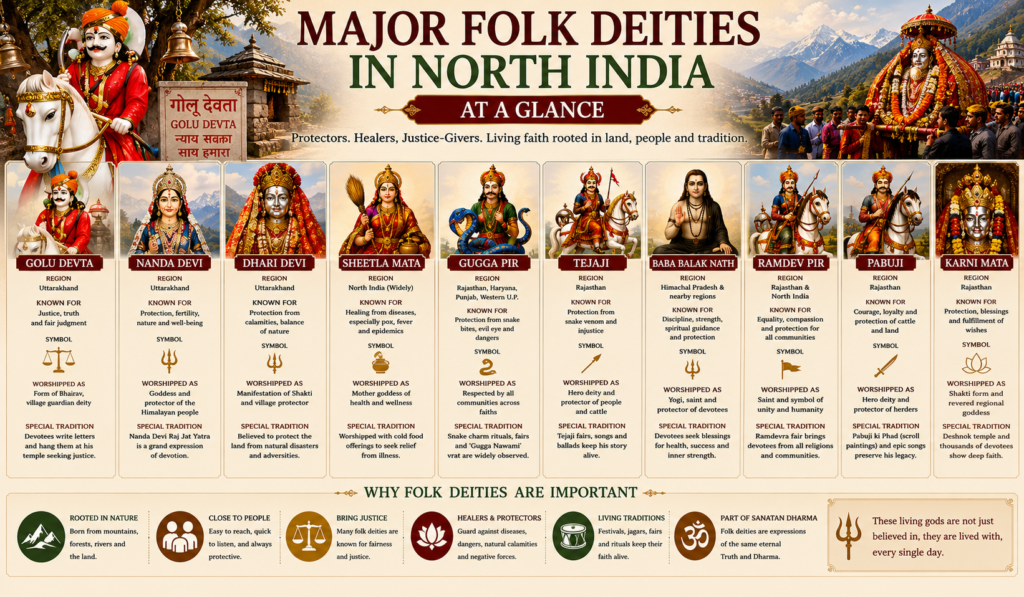
| Major Deities | Golju Devta, Nanda Devi, Dhari Devi, Gugga Pir, Tejaji, Pabuji, Baba Balak Nath, Karni Mata, Ramdev Pir, Sheetla Mata |
| Connected With | Shiva, Shakti, Bhairav, Vishnu and regional Hindu traditions |
| Main Festivals | Gugga Navami, Teja Dashami, Nanda Devi Raj Jat, Sheetla Ashtami, Ramdevra Fair and regional village festivals |
| Significance | Protecting villages, preserving culture, strengthening community identity, and expressing living traditions of Sanatan Dharma |
Table of Contents
ToggleLiving Faith Rooted in Land and Community
For generations, villagers have turned to the Folk Deities in North India during illness, drought, natural disasters, family hardships, and times of uncertainty. These guardian deities are worshipped not only for divine blessings but also for protection, justice, healing, and the well-being of the entire community.
Their worship is simple, heartfelt, and deeply personal. A bell tied to a sacred tree, a letter placed before a village shrine, a lamp lit with devotion, or a silent prayer offered before a Gram Devta reflects a relationship built on trust rather than elaborate rituals.
Across North India, these Regional Deities of North India are closely connected to the land they protect. Many are believed to watch over forests, rivers, mountains, grazing fields, crops, and village boundaries. This close bond between nature and faith has helped preserve local traditions and strengthen community life for centuries.
Over time, many local deities became associated with forms of Shiva, Shakti, Bhairava, and other Hindu deities, while continuing to retain their unique regional identity. This natural blending of local traditions with mainstream Sanatan Dharma demonstrates the inclusive and evolving nature of Hindu worship.
Through this article, you will discover the famous North India Folk Gods, the regions where they are worshipped, their unique traditions, and the important role they continue to play in preserving India’s spiritual and cultural heritage. Rather than forgotten legends, these deities remain living symbols of faith that continue to inspire millions across North India.
Nature Worship and Folk Deities in North India
The worship of Folk Deities in North India is deeply intertwined with nature. Across villages and mountain communities, rivers, forests, ancient trees, springs, rocks, caves, and hilltops are often regarded as sacred because they are believed to be the dwelling places of local guardian deities.
This close relationship reflects one of the oldest principles of Sanatan Dharma: nature is not merely a resource but a sacred manifestation of the Divine. By honouring the deity associated with a particular landscape, devotees also express gratitude and respect for the natural world that sustains their lives.
Many village traditions continue to protect sacred groves, water sources, and forests because they are considered the abode of the local Gram Devta or guardian goddess. In this way, the worship of folk deities has not only preserved spiritual traditions but has also encouraged communities to live in harmony with nature for generations.
What Are Folk Deities in North India?
Folk Deities in North India are local gods and goddesses who have been worshipped by communities for generations. Their stories are preserved through oral traditions, local legends, village festivals, and family customs rather than relying solely on ancient scriptures.
These Village Deities of North India are revered as protectors of villages, forests, rivers, cattle, crops, children, and community life. Devotees seek their blessings for good harvests, justice, health, prosperity, and protection from natural and unforeseen dangers.
Unlike distant cosmic deities, these North Indian Folk Deities are believed to remain closely connected with the people they protect. Their shrines are often located beneath sacred trees, on hilltops, beside rivers, or at village boundaries, making them an integral part of everyday life.
Many of these local deities are also identified with forms of Shiva, Shakti, Bhairava, or other Hindu deities, while preserving their own regional identity and traditions. This unique blend of local faith and Sanatan Dharma reflects the diversity and inclusiveness of Hindu worship across North India.
Their enduring popularity shows that faith is not sustained only through temples or scriptures but also through community memory, shared traditions, and generations of devotion. That is why the worship of Regional Deities of North India continues to thrive even today.
Why Did Folk Deities Become Important in North India?
North India’s diverse landscape played a significant role in shaping its spiritual traditions. Snow-covered mountains, dense forests, mighty rivers, fertile plains, and vast deserts often made life challenging and unpredictable. Communities looked for divine protection against disease, wild animals, natural disasters, crop failures, and other hardships.
Over time, the Folk Deities in North India became trusted guardians of villages and families. People believed these local deities watched over their land, livestock, water sources, harvests, and village boundaries. Their blessings were sought before sowing crops, beginning important journeys, or celebrating community festivals.
Unlike distant divine figures, these Village Deities of North India were seen as ever-present protectors who shared the joys and struggles of everyday life. This close relationship gave people emotional strength, hope, and a deep sense of security during difficult times.
The worship of these North Indian Folk Deities also strengthened social bonds. Annual fairs, village rituals, and collective prayers brought entire communities together, preserving local traditions and passing them from one generation to the next.
Even today, this enduring faith continues across North India, where Regional Deities of North India remain symbols of protection, cultural identity, and the timeless connection between people, nature, and Sanatan Dharma.
Historical Roots of Folk Deity Worship in North India
The worship of Folk Deities in North India has evolved over thousands of years alongside the development of villages, agriculture, pastoral life, and regional kingdoms. Long before large temple complexes became common, local communities looked upon nature, heroic ancestors, village protectors, and guardian spirits as sacred forces that watched over their lives.
As Sanatan Dharma developed, many of these regional traditions gradually became connected with the worship of Shiva, Shakti, Vishnu, Bhairav, and other Hindu deities. Rather than disappearing, local beliefs were respectfully absorbed into the broader spiritual framework of Hinduism while preserving their unique customs and identities.
Historical records, temple traditions, inscriptions, and oral narratives show that many folk deities were once remembered as courageous rulers, saints, warriors, or spiritual guardians whose lives inspired lasting devotion. Others have always been worshipped as manifestations of divine power closely associated with rivers, forests, mountains, and sacred landscapes.
Today, this centuries-old tradition continues across North India, demonstrating how Sanatan Dharma has preserved local cultures while embracing diverse expressions of faith within one enduring spiritual tradition.
How Folk Deities Vary Across North India
Although united by the values of Sanatan Dharma, the Folk Deities in North India reflect the unique geography, history, and culture of each region. Every community developed its own guardian deities to address local needs, occupations, and ways of life.
In the Himalayan states of Uttarakhand and Himachal Pradesh, many North Indian Folk Deities are worshipped as protectors of mountains, forests, rivers, and villages. Deities such as Golju Devta, Nanda Devi, Dhari Devi, and Baba Balak Nath continue to play an important role in regional faith and community life.
Across Rajasthan, heroic warriors and snake protectors occupy a special place in folk tradition. Tejaji, Pabuji, Ramdev Pir, and Karni Mata are revered for their courage, compassion, and miraculous powers, with annual fairs drawing thousands of devotees.
In Uttar Pradesh, Haryana, and neighbouring regions, many Village Deities of North India are associated with healing, justice, fertility, and the protection of families and farmlands. Gugga Pir, local Gram Devtas, and village guardian goddesses continue to be worshipped through community festivals and age-old traditions.
Despite these regional differences, all Regional Deities of North India share a common purpose. They protect their communities, preserve local customs, strengthen social harmony, and keep alive a spiritual heritage that has been passed down through generations.
Common Characteristics of Folk Deities in North India
Although every region has its own traditions, many Folk Deities in North India share several common characteristics that distinguish them from broader scriptural worship.
Most are regarded as guardian deities who protect villages, families, forests, rivers, mountains, livestock, crops, or sacred boundaries. Devotees often turn to them during illness, natural disasters, family crises, or before important life events, seeking guidance, protection, and blessings.
Unlike deities whose worship is primarily centred on scriptures, folk deities are closely connected with local history and community memory. Their stories are preserved through oral traditions, folk songs, village festivals, legends, and rituals that have been passed from one generation to the next.
Many are also associated with universal Hindu deities such as Shiva, Shakti, Vishnu, or Bhairav. Rather than replacing mainstream Hindu worship, they enrich it by expressing the Divine through the culture, geography, and traditions of each region.
These shared characteristics explain why North Indian Folk Deities continue to occupy a unique place in Sanatan Dharma, preserving both spiritual devotion and India’s diverse cultural heritage.
Famous Folk Deities of North India
Golju Devta: The God of Justice
Golju Devta, also known as Golu Devta, is one of the most revered Folk Deities in North India, especially in the Kumaon region of Uttarakhand. He is widely worshipped as the god of justice, truth, and righteous judgment, and thousands of devotees visit his temples every year seeking fair resolution to their problems.
According to local tradition, Golju Devta is regarded as an incarnation of Lord Bhairava, a guardian form of Lord Shiva. His most famous shrine, the Chitai Golu Devta Temple near Almora, is known for the thousands of bells and handwritten petitions offered by devotees. People believe that sincere prayers and written appeals placed before the deity are heard, and justice is eventually delivered.
His enduring popularity reflects the deep faith that Village Deities of North India continue to inspire, where divine justice is seen as accessible, personal, and closely connected with everyday life.
Nanda Devi: The Beloved Mountain Goddess
Nanda Devi is one of the most revered Folk Deities in North India, especially in the Himalayan state of Uttarakhand. Worshipped as the divine daughter of the mountains and a compassionate mother goddess, she is regarded as the protector of villages, families, livestock, and the fragile Himalayan landscape.
Deeply associated with Shakti, Nanda Devi symbolizes purity, fertility, prosperity, and the nurturing power of nature. Her worship is closely connected with local traditions, seasonal festivals, and the agricultural life of the region, reflecting the deep bond between the people and the Himalayas.
The famous Nanda Devi Raj Jat Yatra, held approximately once every twelve years, is one of the most sacred pilgrimages in the Himalayas. Thousands of devotees undertake this challenging journey to honour the goddess, expressing unwavering faith and preserving centuries-old traditions that continue to define the spiritual heritage of Uttarakhand.
Today, Nanda Devi remains a powerful symbol of devotion, resilience, and cultural identity, illustrating how Regional Deities of North India continue to inspire faith while preserving the rich traditions of Sanatan Dharma.
Dhari Devi: The Guardian Goddess of the Himalayas
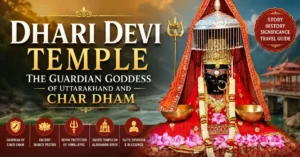
Dhari Devi is one of the most revered Folk Deities in North India, worshipped as the guardian goddess of Uttarakhand. Her ancient temple stands on the banks of the Alaknanda River, and devotees believe she protects the region from natural calamities while watching over pilgrims travelling to the sacred Char Dham shrines.
Regarded as a powerful manifestation of Shakti, Dhari Devi embodies both fierce protection and compassionate motherhood. She is worshipped for safety, prosperity, and the well-being of families, and many devotees seek her blessings before undertaking spiritual journeys through the Himalayas.
Local traditions hold that the goddess maintains harmony between nature and human life. Her enduring worship reflects the deep respect that Himalayan communities have for both the divine feminine and the natural world, making her one of the most cherished Village Deities of North India.
Sheetla Mata: The Goddess of Healing and Protection
Sheetla Mata is one of the most widely worshipped Folk Deities in North India, especially in Rajasthan, Haryana, Uttar Pradesh, Delhi, and parts of Punjab. Revered as the goddess of healing, she is believed to protect devotees from infectious diseases, particularly smallpox, fever, and other epidemics.
Considered a compassionate form of Shakti, Sheetla Mata has long been worshipped for the health and well-being of families and communities. Devotees observe Sheetla Ashtami, offering simple food prepared a day earlier as a mark of devotion and gratitude while praying for good health and protection.
Her worship reflects how Village Deities of North India provided comfort, hope, and spiritual strength during times of disease and uncertainty. Even today, millions of devotees continue to seek her blessings, making Sheetla Mata an enduring symbol of healing, faith, and maternal care within Sanatan Dharma.
Gugga Pir (Gogaji): The Protector Against Snake Bites
Gugga Pir, also known as Gogaji, is one of the most revered Folk Deities in North India, especially in Rajasthan, Haryana, Punjab, and western Uttar Pradesh. He is honoured as a heroic warrior-saint and is widely believed to protect devotees from snake bites and poisonous creatures.
According to regional traditions, Gugga Pir was blessed with extraordinary spiritual powers and became a symbol of courage, compassion, and protection. During Gugga Navami, thousands of devotees visit his shrines, offer prayers, and seek his blessings for the safety and well-being of their families.
One of the most remarkable aspects of Gugga Pir’s worship is its inclusive nature. He is revered by both Hindus and Muslims, making him a unique example of the shared cultural heritage of North India. His enduring popularity reflects how Regional Deities of North India continue to unite communities through faith, devotion, and mutual respect.
Tejaji: The Heroic Protector of Rajasthan
Tejaji is one of the most revered Folk Deities in North India and a celebrated folk hero of Rajasthan. Remembered for his courage, honesty, and unwavering commitment to his word, he is worshipped as a symbol of righteousness and selfless sacrifice.
According to local tradition, Tejaji fulfilled his promise even at the cost of his own life, earning the blessings to protect devotees from snake bites and venom. Farmers, cattle herders, and rural communities especially revere him as a guardian of livestock, crops, and village life.
Every year, devotees gather during Teja Dashami to honour his memory through prayers, fairs, and traditional rituals. His enduring legacy reflects the values of truth, bravery, and compassion, making him one of the most respected Regional Deities of North India and an enduring inspiration in Rajasthan’s folk traditions.
Baba Balak Nath: The Revered Yogi of Himachal Pradesh
Baba Balak Nath is one of the most respected Folk Deities in North India, particularly in Himachal Pradesh, Punjab, Haryana, and neighbouring regions. Revered as an eternal celibate yogi and a devoted follower of Lord Shiva, he is worshipped as a protector, spiritual guide, and granter of blessings.
His most famous shrine, Deotsidh Temple in Himachal Pradesh, attracts millions of devotees every year. People visit the temple seeking strength, discipline, good health, prosperity, and success while offering prayers with deep faith and devotion.
The life and teachings of Baba Balak Nath inspire values of self-control, humility, and unwavering devotion. His enduring popularity reflects how Regional Deities of North India continue to guide communities through spiritual wisdom while preserving the rich folk traditions of Sanatan Dharma.
Ramdev Pir: The Saint of Equality and Compassion
Ramdev Pir, also known as Ramdevji, is one of the most beloved Folk Deities in North India, particularly in Rajasthan and neighbouring states. Revered as a saint, social reformer, and miracle worker, he is remembered for his compassion, humility, and dedication to serving humanity.
According to local traditions, Ramdev Pir devoted his life to helping the poor, protecting the oppressed, and promoting equality among all people. His teachings emphasize devotion, kindness, selfless service, and the belief that every individual deserves dignity and respect, regardless of caste or social background.
The annual Ramdevra Fair in Rajasthan attracts thousands of devotees from different communities and faiths. His widespread worship reflects the inclusive spirit of Regional Deities of North India, where faith transcends social boundaries and continues to unite people through compassion, harmony, and shared devotion.
Pabuji: The Heroic Protector of Rajasthan
Pabuji is one of the most revered Folk Deities in North India and a legendary folk hero of Rajasthan. Celebrated for his courage, loyalty, and selfless sacrifice, he is especially worshipped by pastoral communities as the protector of cattle, camels, and village life.
His inspiring deeds have been preserved through the Pabuji Ki Phad, a traditional painted scroll that is narrated by folk storytellers known as Bhopas. These performances keep his heroic legacy alive and form an important part of Rajasthan’s rich oral and cultural heritage.
For devotees, Pabuji represents bravery, honour, and the duty to protect both people and livestock. His enduring worship demonstrates how Regional Deities of North India continue to preserve local history, inspire moral values, and strengthen the cultural identity of rural communities.
Karni Mata: The Revered Goddess of Rajasthan
Karni Mata is one of the most revered Folk Deities in North India and is worshipped across Rajasthan as a powerful manifestation of Shakti. She is honoured as a compassionate protector, spiritual guide, and miracle-working goddess whose blessings are sought for courage, prosperity, and protection.
Her famous Karni Mata Temple at Deshnoke, near Bikaner, is renowned for its sacred rats, which devotees regard as blessed and treat with great reverence. The temple attracts pilgrims from across India and remains one of Rajasthan’s most distinctive centres of folk devotion.
Karni Mata is also closely associated with the history of the Rajput kingdoms, where she was revered as a divine guardian and advisor. Her enduring worship demonstrates how Regional Deities of North India have shaped not only religious traditions but also the cultural heritage, history, and identity of the communities they continue to protect.
The Influence of Bhairav in North Indian Folk Traditions
The worship of Bhairav is deeply woven into the traditions of Folk Deities in North India. Across villages in Uttarakhand, Himachal Pradesh, Uttar Pradesh, Rajasthan, and other regions, Bhairav is revered as a Gram Devta, Kshetrapal, or guardian deity who protects the village, its people, livestock, and sacred boundaries. His presence reflects the ancient belief that every community is watched over by a divine protector.
Devotees worship Bhairav in many forms, including Kaal Bhairav, Batuk Bhairav, and numerous local village manifestations that often have unique names and traditions. While each region preserves its own customs, all these forms are associated with protection, courage, justice, and the removal of negative influences.
The Ashta Bhairava tradition, which describes eight forms of Bhairava guarding the eight directions, has also influenced many local beliefs. Although villagers may not always follow the complete Puranic tradition, the idea of Bhairav as a guardian of sacred spaces and community life remains deeply embedded in folk worship.
In several parts of Uttarakhand, Golju Devta (Golu Devta) is regarded as a manifestation of Bhairav, particularly for his role as the dispenser of justice and protector of the righteous. This beautifully illustrates how Regional Deities of North India naturally blend with the broader traditions of Sanatan Dharma, where local guardian gods and Puranic deities complement rather than replace one another.
Did You Know?
Many Folk Deities in North India are worshipped only within specific villages, valleys, or mountain regions and may not be widely known outside their local communities.
Despite this, some of these guardian deities have been revered continuously for centuries, with their traditions preserved through oral storytelling, annual festivals, folk music, and community rituals rather than written scriptures.
How Are Folk Deities Worshipped in North India?
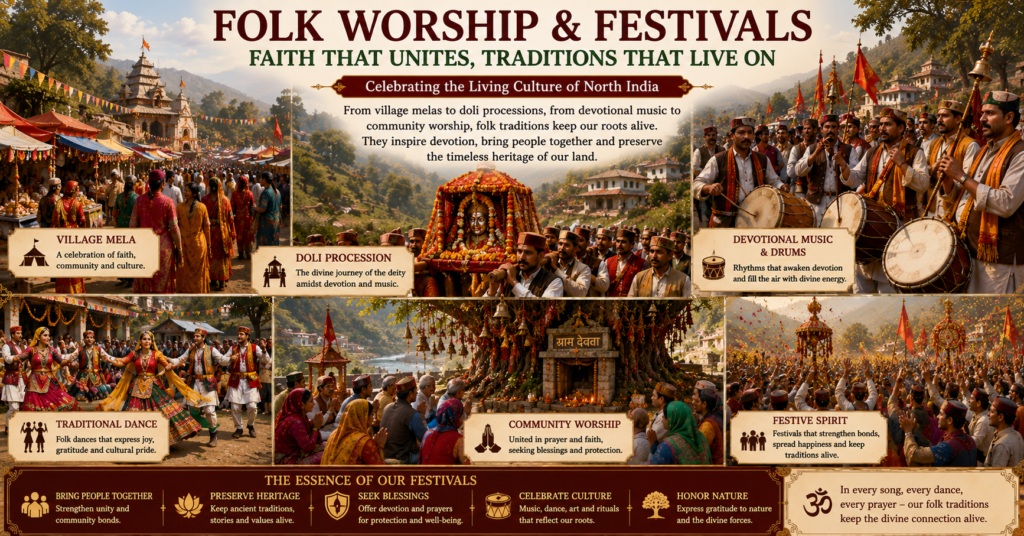
The worship of Folk Deities in North India is simple, personal, and deeply rooted in local traditions. Unlike elaborate temple rituals, devotion is often expressed through small village shrines, sacred stones, trees, bells, flags, and earthen lamps. These sacred spaces become gathering places where communities offer prayers with humility and faith.
Common offerings include flowers, incense, coconuts, milk, sweets, grains, and seasonal produce. In many villages, devotees also perform Jagar, folk songs, devotional music, and community prayers to honour the local deity and seek blessings for health, protection, good harvests, and family well-being.
Village fairs and annual festivals play an important role in preserving these traditions. During these celebrations, devotees gather for processions, folk dances, music, and collective worship, strengthening social bonds while passing cultural traditions from one generation to the next.
The essence of folk worship lies not in strict rituals but in sincere devotion. Across the hills, forests, and villages of North India, people believe that genuine faith, gratitude, and respect for the guardian deity are more important than elaborate ceremonies, making these traditions accessible to everyone.
Sacred Places Associated with Folk Deities in North India
The worship of Folk Deities in North India is closely connected with sacred places that reflect the natural and cultural landscape of each region. Unlike many grand temple complexes, these holy sites are often simple village shrines, hilltop temples, sacred groves, ancient trees, riversides, caves, or boundary shrines that have been revered for generations.
Many famous pilgrimage sites dedicated to folk deities continue to attract thousands of devotees every year. The Chitai Golu Devta Temple in Uttarakhand is renowned for petitions seeking justice, while Dhari Devi Temple is revered as the guardian of the Char Dham region. The Karni Mata Temple at Deshnoke is famous for its sacred rats, the Deotsidh Temple honours Baba Balak Nath in Himachal Pradesh, and Ramdevra in Rajasthan draws devotees from across India during its annual fair.
For local communities, these sacred places are more than places of worship. They preserve oral traditions, strengthen cultural identity, and serve as gathering places where festivals, community rituals, and devotional practices continue to keep the living heritage of Sanatan Dharma alive.
Folk Festivals and Community Traditions
The vibrant traditions of Folk Deities in North India come alive during village fairs, seasonal festivals, and community celebrations. These gatherings are far more than religious events. They bring families and entire villages together to honour their guardian deity, celebrate local heritage, and strengthen social bonds.
Devotional songs, traditional drums, folk dances, processions, and collective prayers form the heart of these festivals. In many regions, devotees fulfil vows, carry sacred palanquins (dolis), perform Jagar rituals, and participate in community feasts, expressing gratitude for protection, good harvests, health, and prosperity.
These celebrations also play a vital role in preserving oral traditions. Stories of local heroes, village gods, and ancestral guardians are passed from one generation to the next through songs, storytelling, and ritual performances, ensuring that centuries-old beliefs remain a living part of everyday life.
Beyond their religious significance, these festivals foster unity, shared identity, and cultural continuity. They demonstrate how Regional Deities of North India continue to connect faith, tradition, and community, keeping the region’s rich folk heritage alive for future generations.
Folk Deities and Puranic Gods: Understanding the Difference
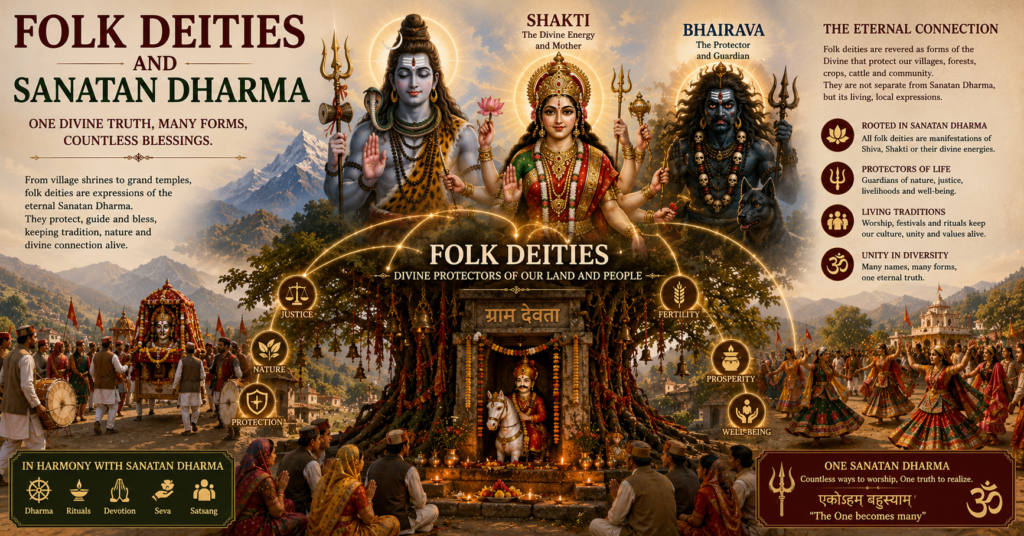
At first glance, Folk Deities in North India and the deities described in the Puranas may appear different, but both are integral to the living tradition of Sanatan Dharma. Rather than existing in separate paths, they complement one another and reflect different expressions of the same spiritual heritage.
Puranic deities such as Shiva, Vishnu, Devi, Ganesha, and Hanuman are worshipped through sacred scriptures, established temples, and rituals that are followed across India. Their stories are preserved in texts like the Puranas, Ramayana, and Mahabharata, giving them a universal place in Hindu worship.
Folk deities, on the other hand, are remembered through local legends, oral traditions, village customs, and the lived experiences of communities. Their worship is closely connected with specific regions, where they are revered as protectors of villages, forests, rivers, mountains, families, and livelihoods.
The two traditions often merge naturally. Many Regional Deities of North India are regarded as manifestations, devotees, or guardians associated with Shiva, Shakti, Bhairav, Vishnu, or other Puranic deities. This harmonious relationship shows how Sanatan Dharma embraces both universal spiritual teachings and local expressions of faith, allowing diverse traditions to flourish together while preserving the cultural identity of each region.
Why Folk Deities Still Matter Today
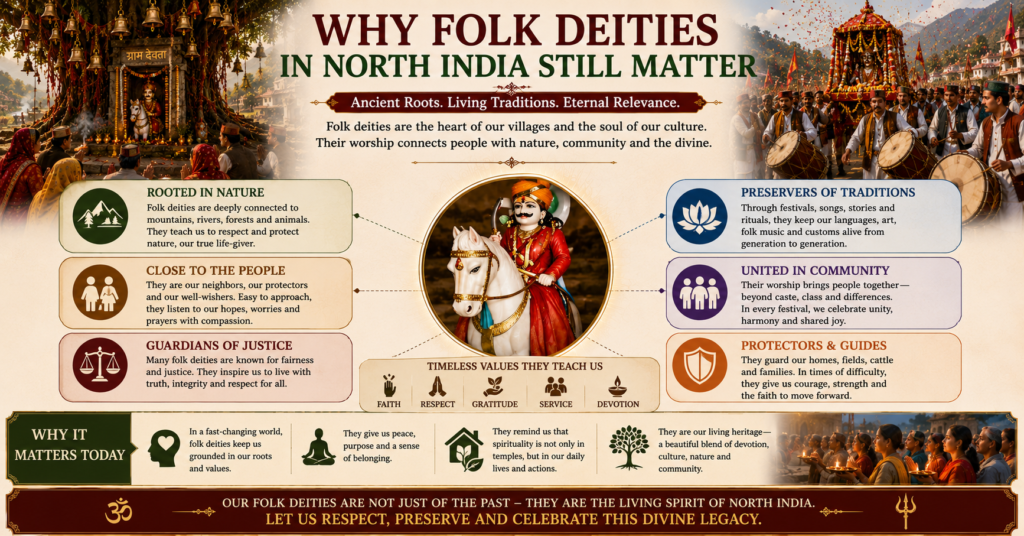
Despite rapid urbanisation and changing lifestyles, Folk Deities in North India continue to hold a meaningful place in the lives of millions. In villages, towns, and even among people living far from their ancestral homes, devotion to these guardian deities remains a source of faith, identity, and emotional strength.
Many devotees turn to their Gram Devta, Kul Devta, or local guardian deity during important moments such as marriage, childbirth, illness, new beginnings, or times of uncertainty. This enduring connection reflects a belief that these deities continue to protect families, guide communities, and bless those who approach them with sincere devotion.
Beyond religious worship, folk deities preserve local history, oral traditions, and cultural identity. Annual festivals, village rituals, and community gatherings keep ancient customs alive while strengthening relationships between generations and reinforcing a shared sense of belonging.
In today’s fast-changing world, Regional Deities of North India continue to inspire values of trust, justice, courage, compassion, and respect for nature. Their enduring presence reminds us that faith is not only preserved in scriptures and grand temples but also in the everyday lives, stories, and traditions of ordinary people.
Challenges in Preserving Folk Traditions
Despite their enduring popularity, many traditions associated with Folk Deities in North India face growing challenges in the modern world. Rapid urbanisation, migration from villages, changing lifestyles, and the gradual decline of oral storytelling have made it difficult to preserve many regional customs and legends.
In some areas, ancient shrines, folk songs, ritual performances, and community festivals are slowly disappearing as younger generations move away from their ancestral villages. Since many of these traditions were passed down orally rather than through written records, valuable cultural knowledge can be lost if it is not preserved.
At the same time, temples, local communities, researchers, and cultural organisations are making important efforts to document these traditions, restore historic shrines, and keep regional festivals alive. Digital archives, books, documentaries, and educational initiatives are also helping introduce younger generations to India’s rich folk heritage.
Preserving these traditions is about more than protecting history. It helps safeguard the living cultural and spiritual heritage of Sanatan Dharma, ensuring that the wisdom, values, and community spirit embodied by North India’s folk deities continue to inspire future generations.
How Folk Deities Strengthen Sanatan Dharma
The relationship between Folk Deities in North India and Sanatan Dharma is one of harmony rather than separation. Local guardian deities are not viewed as alternatives to the worship of Shiva, Vishnu, Devi, or other Puranic gods. Instead, they are understood as protectors, manifestations, devoted followers, or regional expressions of the same eternal spiritual tradition.
Across North India, many villages worship their Gram Devta or Kul Devta alongside major Hindu deities. Festivals, pilgrimages, and family rituals often include both forms of worship, reflecting the inclusive nature of Sanatan Dharma, where local customs and universal spiritual teachings coexist naturally.
This integration has helped preserve India’s diverse cultural heritage for centuries. While scriptures provide timeless spiritual wisdom, folk traditions keep that wisdom rooted in the daily lives of ordinary people through local stories, festivals, and community worship.
The enduring reverence for Regional Deities of North India demonstrates that Sanatan Dharma is a living tradition that embraces diversity without losing its spiritual foundation. It continues to evolve through both sacred texts and the vibrant faith of communities, ensuring that devotion remains meaningful across every region and generation.
Conclusion
Folk Deities in North India reveal the living and evolving spirit of Sanatan Dharma. They show that faith is not confined to sacred texts or grand temples but also flourishes through village traditions, oral stories, community worship, and everyday life.
Whether worshipped as Gram Devtas, Kul Devtas, guardian deities, or local manifestations of Shiva, Shakti, and Bhairav, these revered figures continue to protect, inspire, and unite communities across generations. Their traditions preserve regional history while strengthening values such as justice, compassion, courage, gratitude, and harmony with nature.
The enduring devotion to these Regional Deities of North India reminds us that Sanatan Dharma has always embraced diversity. It grows with people, adapts to local cultures, and welcomes many paths of worship while remaining rooted in the same timeless spiritual foundation.
By understanding and preserving these sacred traditions, we also preserve an important part of India’s cultural and spiritual heritage. The worship of folk deities is not merely a remembrance of the past, but a vibrant expression of living Sanatan Dharma that continues to guide and enrich countless lives today.
Suggested Reading
If you enjoyed learning about Folk Deities in North India, you may also like these in-depth articles exploring regional deities, village traditions, and the rich spiritual heritage of Sanatan Dharma:
- Gram Devta, Kshetrapal and Bhairav: India’s Living Tradition of Guardian Deities
https://thesanatantales.com/gram-devta-india/ - Hero Deities of Rajasthan: Tejaji, Pabuji, and Folk Warriors of Truth
https://thesanantales.com/hero-deities-of-rajasthan/ - Himalayan Folk Deities: Living Devta Traditions of Uttarakhand and Himachal
https://thesanantales.com/himalayan-folk-deities/ - Golu Devta: The God of Justice in Uttarakhand
https://thesanantales.com/goludevta-folk-god-of-justice/ - Nanda Devi: The Beloved Folk Goddess of Uttarakhand
https://thesanatantales.com/nanda-devi-story-raj-jat-yatra-worship/ - Dhari Devi Temple: Guardian Goddess of Uttarakhand
https://thesanantales.com/dhari-devi-temple/ - Gugga Pir (Gogaji): The Folk Hero and Snake Protector
https://thesanantales.com/gugga-pir/ - Khandoba: The Warrior God of Maharashtra
https://thesanantales.com/khandoba-god-jejuri-temple-story/
These articles will help you discover how local traditions, guardian deities, and regional beliefs continue to enrich the living heritage of Sanatan Dharma across India.
FAQs
What are folk deities in North India?
Folk deities in North India are local guardian gods and goddesses worshipped by communities in specific regions, villages, or families. They are closely connected with local history, nature, and cultural traditions rather than being worshipped uniformly across India.
Many of these deities are believed to protect villages, bless harvests, guard forests and rivers, heal illnesses, or uphold justice. Their stories have been preserved through oral traditions, village rituals, festivals, and community worship for generations.
How are folk deities different from Puranic deities?
Puranic deities such as Shiva, Vishnu, Devi, Ganesha, and Hanuman are described in sacred scriptures like the Puranas, Ramayana, and Mahabharata and are worshipped throughout India.
Folk deities, on the other hand, are deeply rooted in regional traditions. They are remembered through local legends, village customs, and community experiences. In many cases, they are regarded as manifestations, guardians, or devoted followers of major Hindu deities rather than separate religious figures.
Who are some famous folk deities in North India?
North India is home to many revered folk deities, each associated with a particular region and community. Some of the best-known include Golju Devta, Nanda Devi, Dhari Devi, Gugga Pir (Gogaji), Tejaji, Pabuji, Karni Mata, Baba Balak Nath, Ramdev Pir, and Sheetla Mata.
Each deity has unique legends, festivals, and forms of worship, reflecting the cultural diversity and spiritual richness of different parts of North India.
What is the role of Gram Devta and Kul Devta in North India?
A Gram Devta is the guardian deity of a village, believed to protect its people, land, crops, and livestock from natural and spiritual dangers.
A Kul Devta or Kul Devi is the ancestral deity of a family or clan. Many Hindu families continue to worship their Kul Devta during important occasions such as weddings, naming ceremonies, housewarming rituals, and annual family prayers, regardless of where they live today.
Why are folk deities important in Sanatan Dharma?
Folk deities demonstrate the inclusive and living nature of Sanatan Dharma. They preserve local traditions while remaining connected to the broader worship of Shiva, Shakti, Vishnu, Bhairav, and other Hindu deities.
Their worship reflects the belief that the Divine can be experienced in many forms. This harmony between regional traditions and scriptural teachings has allowed Sanatan Dharma to flourish across diverse cultures and geographical regions for thousands of years.
How are folk deities worshipped in North India?
The worship of Folk Deities in North India varies from one region to another. Devotees may offer flowers, lamps, coconuts, sweets, milk, or sacred cloth at village shrines, temples, sacred trees, or natural sites such as rivers and hilltops.
Community festivals, local fairs, devotional songs, Jagar ceremonies, processions, and seasonal rituals are also important aspects of worship. These traditions strengthen both spiritual faith and community bonds.
Are folk deities still worshipped today?
Yes. Despite rapid urbanisation, devotion to Folk Deities in North India remains strong across villages, towns, and even among people living in cities.
Many families continue to visit their ancestral shrines, participate in annual village festivals, and seek blessings from their Gram Devta or Kul Devta during important life events. These traditions continue to preserve cultural identity while strengthening faith across generations.
Can people from outside a region worship local folk deities?
Yes. Most folk deities are revered for their compassion and protection rather than being limited to a particular caste or community. Visitors and devotees from different regions often visit famous shrines to seek blessings with respect and sincerity.
However, local customs, temple traditions, and community practices should always be respected while offering prayers. Learning about the history and significance of a regional deity also helps devotees appreciate the rich cultural heritage associated with that tradition.
Glossary of Important Terms
| Term | Meaning |
|---|---|
| Folk Deity | A regional or local deity worshipped by a specific community, village, or cultural group through traditional customs and oral traditions. |
| Gram Devta | The guardian deity of a village, believed to protect its people, land, crops, and overall well-being. |
| Kul Devta / Kul Devi | The ancestral deity worshipped by a particular family, lineage, or clan, especially during important family ceremonies. |
| Kshetrapal | Literally “Protector of the Region.” A guardian deity believed to safeguard a specific area, temple, forest, or sacred land. |
| Bhairav | A fierce and protective manifestation of Lord Shiva, widely worshipped as a guardian deity and protector of sacred places. |
| Jagar | A traditional ritual of Uttarakhand in which devotional songs, music, and chanting invoke local deities or ancestral spirits. |
| Devta | A Sanskrit term meaning “deity” or “divine being.” In folk traditions, it often refers to a local guardian god. |
| Kul Parampara | The hereditary tradition of worshipping a family’s ancestral deity across generations. |
| Oral Tradition | The practice of preserving history, legends, and religious beliefs through storytelling, songs, and folk performances instead of written texts. |
| Puranic Deities | Hindu gods and goddesses whose stories and worship are primarily described in scriptures such as the Puranas, Ramayana, and Mahabharata. |
| Manifestation (Avatar or Roop) | A form or appearance through which a deity expresses divine power. Many folk deities are regarded as manifestations of Shiva, Shakti, or Vishnu. |
| Mela | A traditional religious fair where devotees gather for worship, rituals, cultural performances, and community celebrations. |
| Doli Yatra | A ceremonial procession in which the idol or sacred palanquin of a deity is carried through villages during festivals. |
| Sanatan Dharma | The eternal spiritual tradition of Hinduism that embraces diverse philosophies, rituals, deities, and paths to the Divine. |
| Sacred Grove | A protected patch of forest or natural landscape regarded as holy because of its association with a local deity or guardian spirit. |
About the Author
Yateendra Chaturvedi is a spiritual writer, researcher, devotee, and the founder of The Sanatan Tales. With over 35 years of professional experience and a lifelong interest in Sanatan Dharma, he writes about Hindu deities, temples, scriptures, festivals, Mahavidyas, sacred stories, rituals, and living traditions that continue to guide and inspire devotees across India.
Drawing from traditional scriptures, regional beliefs, temple traditions, devotional literature, and historical sources, he aims to present authentic, well-researched, and easy-to-understand content for modern readers. His work focuses on preserving spiritual wisdom, explaining sacred traditions, and helping seekers develop a deeper understanding of India’s rich spiritual heritage.
Through The Sanatan Tales, Yateendra strives to make the timeless teachings of Sanatan Dharma simple, meaningful, and relevant for today’s generation while maintaining respect for traditional sources, regional practices, and diverse spiritual perspectives.
Learn More About Yateendra Chaturvedi →
https://thesanatantales.com/about-the-author/
References & Sources
This article is based on beliefs and traditions followed within Sanatan Dharma, regional folk traditions, local customs, oral histories, temple practices, and insights drawn from religious texts, cultural studies, and historical research. It also incorporates knowledge preserved through community traditions, devotional practices, and the guru-disciple tradition where relevant.
Note: Beliefs, legends, and methods of worship associated with folk deities may vary across different regions, communities, and traditions of India. The purpose of this article is not to establish any single version as the absolute truth, but to present widely accepted cultural, historical, and spiritual perspectives in a simple, respectful, and accessible manner.
Explore More Fascinating Topics from Sanatan Dharma