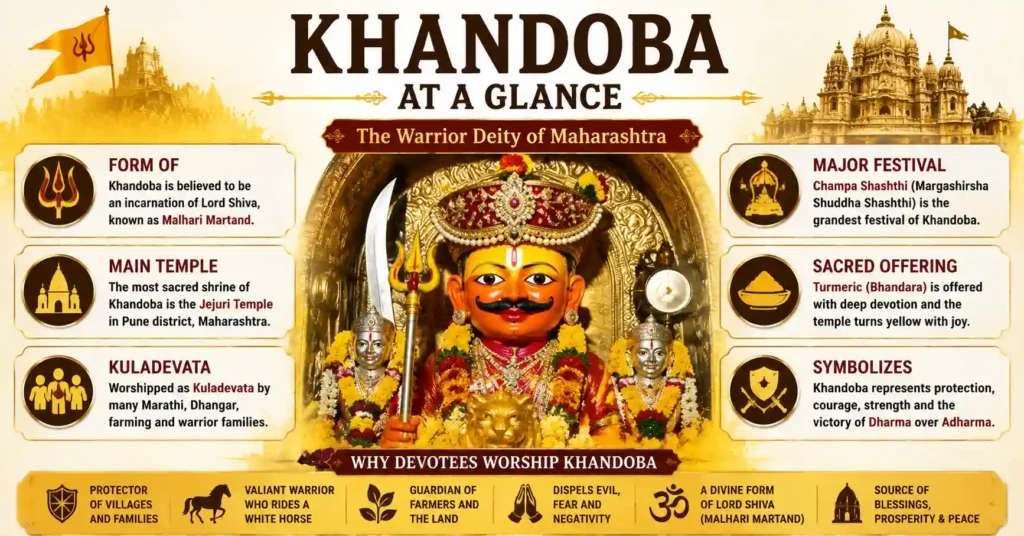
Khandoba is one of the most revered folk deities of Maharashtra and parts of Karnataka, worshipped as a courageous warrior, protector, and compassionate guardian of his devotees. Believed to be a powerful form of Lord Shiva, he is lovingly known as Malhari Martand.
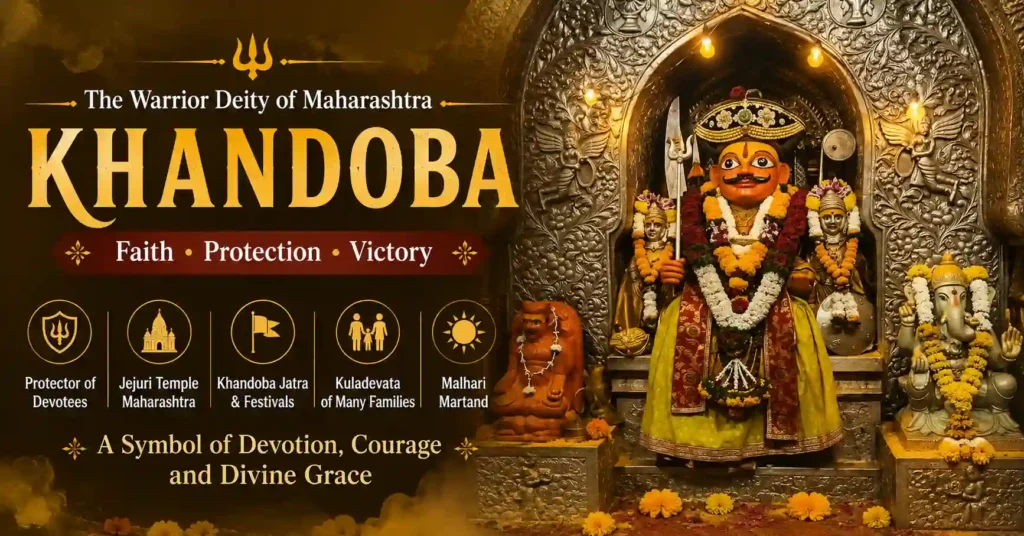
He is especially associated with the sacred Jejuri Temple, the most important pilgrimage site dedicated to his worship. Millions of devotees visit this holy shrine every year to seek his blessings and celebrate his enduring spiritual legacy.
For countless families, Khandoba is not just a deity but their Kuladevata (family deity). His blessings are sought before marriages, farming, travel, business, and other important milestones in life.
He is regarded as the protector of villages, cattle, and rural communities, making his worship deeply rooted in the cultural traditions of Maharashtra. His devotion reflects a unique blend of faith, tradition, and everyday life.
The worship of Khandoba beautifully combines Shaiva philosophy with vibrant folk traditions. From the famous Champa Shashthi festival and the turmeric-filled celebrations at Jejuri to the timeless legend of his victory over the demons Malla and Mani, his worship continues to inspire millions.
In this article, you will discover the story of Khandoba, the significance of Jejuri Temple, the importance of Champa Shashthi and Khandoba Jatra, his role as a Kuladevata, and the spiritual meaning behind this beloved guardian deity.
Quick Facts About Khandoba
| Aspect | Details |
|---|---|
| Primary Name | Lord Khandoba |
| Also Known As | Malhari Martand, Martanda Bhairava, Mailara |
| Form of | Lord Shiva |
| Principal Temple | Jejuri Temple, Pune, Maharashtra |
| Major Festival | Champa Shashthi |
| Sacred Offering | Turmeric (Bhandara) |
| Vehicle (Vahana) | White Horse |
| Primary Weapon | Sword and Trident |
| Kuladevata Of | Many Marathi, Dhangar, farming, and pastoral families |
| Regions of Worship | Maharashtra and Karnataka |
| Symbolizes | Courage, Protection, Justice, Prosperity, Victory of Dharma |
Table of Contents
ToggleWho Is Khandoba?
Khandoba is worshipped as a fearless warrior deity, compassionate protector, and revered Kuladevata by millions of devotees across Maharashtra and parts of Karnataka. Believed to be a powerful form of Lord Shiva, he is lovingly known as Malhari Martand and is regarded as the guardian of villages, cattle, farmers, and rural communities.
According to regional traditions, Lord Shiva manifested as Khandoba to restore dharma by defeating the demons Malla and Mani, who had spread fear and suffering among sages and ordinary people. His victory symbolizes the triumph of righteousness over evil and continues to inspire devotees even today.
Over the centuries, he has become much more than a warrior deity. Devotees worship him as a divine protector who blesses families with courage, prosperity, good health, and success while guiding them through life’s challenges with compassion and strength.
For his followers, he is not a distant god but a living presence who listens to sincere prayers and stands beside them in times of joy and hardship. This deep personal bond, combined with the vibrant traditions of Jejuri Temple and the annual Champa Shashthi festival, has made his worship one of the most cherished living traditions in Maharashtra and beyond.
The Sacred Story of Lord Malhari Martand
The story of Khandoba is deeply rooted in the rich blend of Shaiva traditions and the folk heritage of Maharashtra. According to the Mallari Mahatmya and regional beliefs, Lord Shiva manifested as Malhari Martand to destroy the powerful demons Malla and Mani, whose tyranny had disturbed sages, devotees, and innocent people.
Mounted on a white horse and armed with divine weapons, he fought a fierce battle against the demons. After defeating Malla and Mani, he restored peace, protected dharma, and became a symbol of courage, justice, and divine protection. This victory is commemorated every year during the Champa Shashthi festival with great devotion.
Over the centuries, his legend spread across Maharashtra and parts of Karnataka through temple traditions, folk songs, and oral storytelling. Farmers, shepherds, and village communities embraced him as their guardian deity, believing he watched over their families, cattle, crops, and livelihoods.
Today, he is worshipped not only as a victorious warrior but also as a compassionate protector who stands beside his devotees in every stage of life. His story beautifully combines the timeless teachings of Sanatan Dharma with the living traditions of rural India, making him one of the most beloved folk deities in the region.
Why Is Malhari Martand One of His Most Sacred Names?
The name Malhari Martand holds deep spiritual and symbolic meaning in the worship of Khandoba. The word “Malhari” means the destroyer of the demon Malla, referring to Lord Shiva’s victory over the demons Malla and Mani, who had spread fear and injustice across the land.
The title “Martand” is traditionally associated with the Sun (Surya) and represents divine light, energy, and the victory of truth over darkness. Together, the name Malhari Martand symbolizes the radiant power of Lord Shiva, who protects righteousness and restores balance whenever evil threatens the world.
For devotees, this sacred name is much more than a title. It reminds them that he is both a fearless warrior and a compassionate protector who destroys negativity while guiding his devotees toward courage, justice, and spiritual strength.
Even today, devotees lovingly chant the name “Malhari Martand” during prayers, festivals, and the Khandoba Jatra, expressing their faith in the divine guardian who continues to protect families and uphold dharma.
The Battle with Malla and Mani
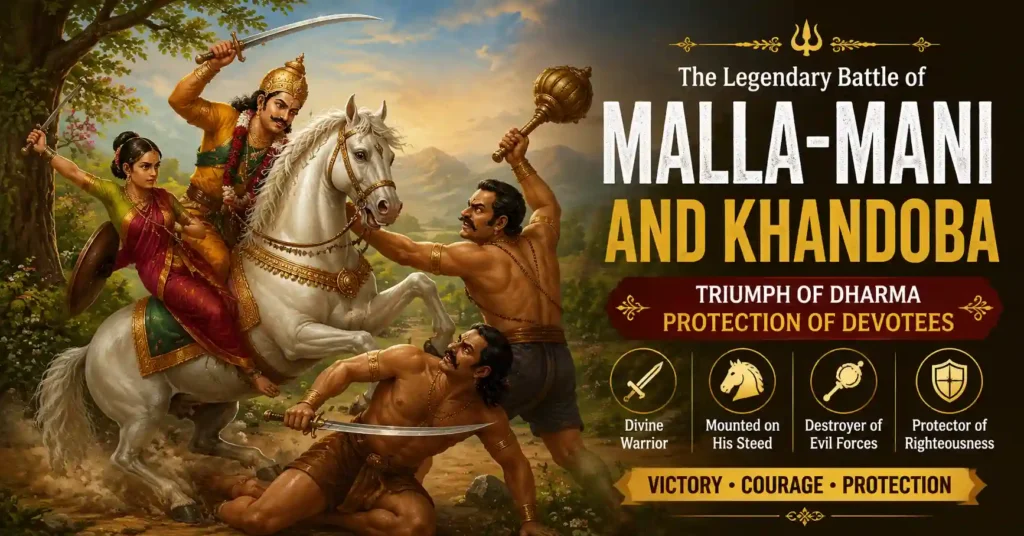
According to the Mallari Mahatmya and long-standing regional traditions, the demons Malla and Mani became powerful through severe penance and began troubling sages, devotees, and innocent people. Their growing arrogance disturbed peace and threatened the practice of dharma across the region.
Hearing the prayers of the sages, Lord Shiva manifested as Malhari Martand to restore righteousness. Mounted on a white horse and carrying divine weapons, he challenged the demons in a fierce battle that remains one of the defining legends of his worship.
After an intense struggle, he defeated Malla, bringing an end to the demon’s tyranny. Before his death, Malla is believed to have sought forgiveness and prayed that devotees would remember him along with the deity. This belief continues to be reflected in several local traditions associated with his worship.
The demon Mani also surrendered before Malhari Martand and sought his blessings. According to popular tradition, the Lord accepted his repentance and granted him a place in his service, symbolizing that sincere devotion and repentance can lead to divine grace.
The victory over Malla and Mani is celebrated every year during Champa Shashthi. For devotees, this sacred event represents the eternal triumph of righteousness over evil, truth over arrogance, and divine compassion over hatred.
Khandoba as the Family Deity (Kuladevata)
For countless families across Maharashtra and parts of Karnataka, Khandoba is worshipped as their Kuladevata (family deity), a divine guardian whose blessings are sought from one generation to the next. His worship forms an integral part of family traditions and is passed down as a sacred legacy.
Devotees offer prayers to him before important milestones such as marriages, housewarming ceremonies, farming activities, business ventures, travel, and other significant life events. They believe that his blessings bring protection, prosperity, harmony, and success.
As a Kuladevata, he is regarded as a constant source of strength who watches over his devotees through every stage of life. Many families make regular pilgrimages to Jejuri Temple or nearby temples dedicated to Malhari Martand to fulfil vows, express gratitude, and seek his continued guidance.
This deep spiritual bond goes beyond ritual worship. It reflects unwavering faith, family unity, and a living tradition that has kept devotion to him alive in countless homes for centuries.
Mhalsa and Banai: The Divine Consorts
Khandoba’s family traditions are closely associated with his two principal consorts, Mhalsa and Banai. Together, they represent different aspects of society and symbolize the inclusive nature of his worship.
| Consort | Background | Symbolic Significance |
|---|---|---|
| Mhalsa | Believed to be an incarnation of Goddess Parvati and traditionally associated with a merchant family. | Represents prosperity, order, family life, and divine grace. |
| Banai | Revered as a pastoral goddess closely associated with the Dhangar (shepherd) community. | Symbolizes simplicity, rural life, nature, and devotion. |
The traditions surrounding Mhalsa and Banai reflect the harmony between different communities that worship Malhari Martand. Their stories have been preserved through folklore, devotional songs, and regional traditions across Maharashtra and Karnataka.
For devotees, these sacred traditions highlight his role as a deity who embraces people from all walks of life. This inclusive spirit has helped make his worship one of the most cherished folk traditions in western India.
Who Worships Him as Their Kuladevata?
The worship of Khandoba is deeply rooted in Maharashtra and parts of Karnataka, where he is revered by people from diverse communities and backgrounds. He is especially worshipped by Marathi families, farmers, cattle herders, the Dhangar community, and many Lingayat and Veerashaiva devotees, who honour him as a powerful form of Lord Shiva.
For many devotees, he is both a Kuladevata and a guardian deity who protects families, livestock, crops, and livelihoods. His worship reflects a close connection with rural life, where faith and everyday living have remained closely intertwined for centuries.
One of the most remarkable aspects of his tradition is its inclusive nature. His devotees come from different castes and communities, united by shared faith, gratitude, and devotion. In several regions, people from diverse religious and social backgrounds also pay their respects to Malhari Martand as a revered local guardian, highlighting the broad cultural appeal of his worship.
Today, the vibrant celebrations at Jejuri Temple, the observance of Champa Shashthi, and the annual Khandoba Jatra continue to bring together thousands of devotees, preserving one of Maharashtra’s most enduring and cherished living traditions.
Iconography and Sacred Symbols
Khandoba’s divine form is filled with powerful symbols that reflect his role as a warrior, protector, and guardian deity. Every element of his iconography carries a deeper spiritual meaning and has become an important part of his worship across Maharashtra and Karnataka.
| Sacred Symbol | Spiritual Meaning |
|---|---|
| White Horse | Represents courage, purity, strength, and his readiness to protect devotees. |
| Sword (Khadga) | Symbolizes the destruction of evil, victory over injustice, and the protection of dharma. |
| Trident (Trishul) | Represents Lord Shiva’s divine power and the balance of creation, preservation, and destruction. |
| Turmeric (Bhandara) | Signifies prosperity, divine blessings, victory, purity, and auspiciousness. It is the most distinctive offering at Jejuri Temple. |
| Dog | Symbolizes loyalty, vigilance, and unwavering protection. It reminds devotees of faithfulness and selfless service. |
| Royal Attire | Reflects his status as a divine king and guardian of his people. |
These sacred symbols are not merely artistic features. They express the values of courage, righteousness, protection, compassion, and unwavering faith that continue to inspire millions of devotees today.
Jejuri Temple: The Sacred Home of Khandoba
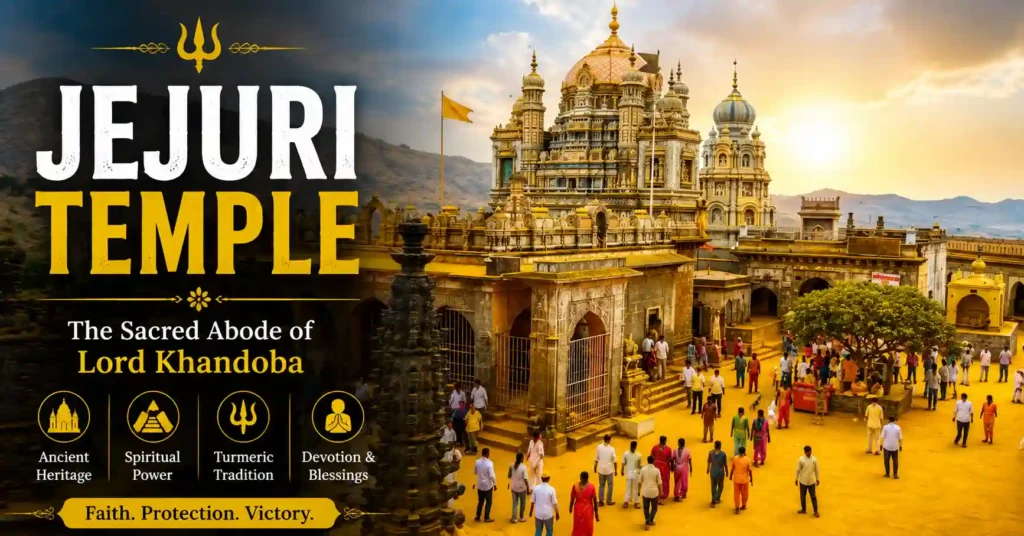
The Jejuri Temple is the most sacred pilgrimage site dedicated to Khandoba. Located about 50 kilometres southeast of Pune in Maharashtra, this hilltop temple is regarded as the spiritual centre of his worship.
For centuries, devotees have climbed its stone steps to seek the blessings of their beloved Kuladevata. The temple overlooks the surrounding countryside, symbolising his role as the divine guardian of villages, families, and farmlands.
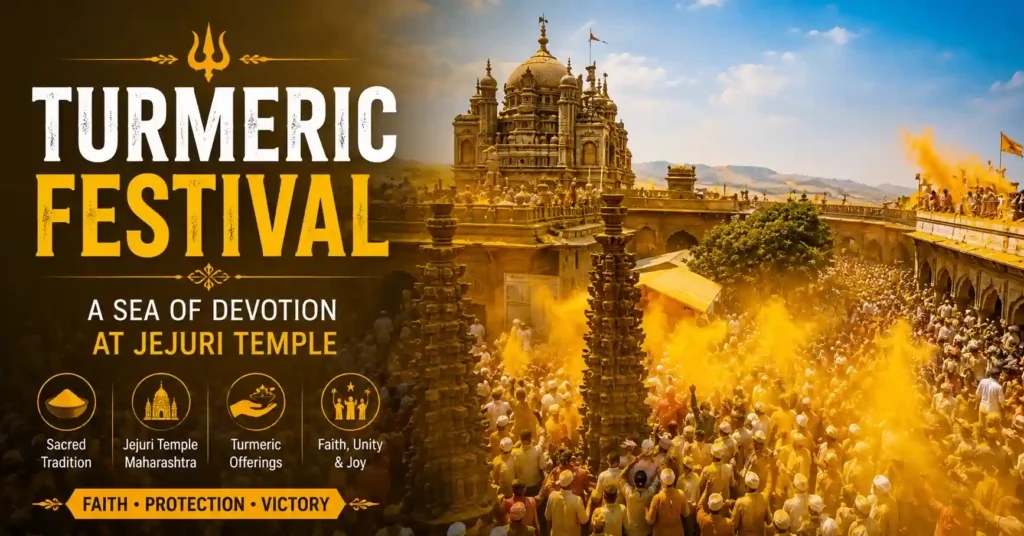
One of the temple’s most unique traditions is the offering of bhandara (turmeric powder). During daily worship and major festivals like Champa Shashthi, devotees joyfully shower turmeric throughout the temple complex.
The entire temple turns golden, creating a breathtaking sight that symbolizes victory, prosperity, divine energy, and his blessings. This centuries-old tradition has made Jejuri Temple one of Maharashtra’s most iconic pilgrimage destinations.
Throughout the year, thousands of pilgrims visit the temple to pray for happy marriages, healthy children, successful harvests, protection, and inner peace. Its vibrant atmosphere and living traditions leave every devotee with a deeply spiritual experience.
Why Is Turmeric (Bhandara) Offered?
Turmeric, locally known as Bhandara, is the most sacred offering made to Khandoba. At Jejuri Temple, devotees joyfully shower turmeric during worship as a symbol of divine blessings, prosperity, victory, and protection.
According to local traditions, the golden colour of turmeric represents his radiant divine energy and triumph over the forces of evil. During major festivals such as Champa Shashthi and the Falgun Mela, the entire temple complex is covered in a golden cloud of turmeric, creating one of Maharashtra’s most iconic spiritual celebrations.
For devotees, offering Bhandara is an act of gratitude and surrender. They believe it brings happiness, abundance, good health, and the blessings of their beloved Kuladevata, making it one of the most cherished rituals in his worship.
Did You Know?
- Millions of devotees worship him as their Kuladevata.
- The famous Jejuri Temple is often called the Golden Temple of Maharashtra because of the massive use of turmeric (Bhandara).
- He is popularly known as Malhari Martand, a victorious form of Lord Shiva.
- Champa Shashthi celebrates his victory over the demons Malla and Mani.
Khandoba Jatra and Jejuri Yatra
Every year, thousands of devotees participate in the Khandoba Jatra, travelling to Jejuri Temple with unwavering faith and devotion. The pilgrimage is filled with devotional songs, prayers, the chanting of “Malhari Martand”, and the traditional offering of bhandara (turmeric powder).
For devotees, the Jejuri Yatra is much more than a physical journey. It is a sacred pilgrimage that represents surrender, gratitude, and a deep spiritual connection with their beloved Kuladevata.
Many pilgrims undertake the yatra to fulfil vows, seek blessings for their families, or express gratitude for answered prayers. The shared devotion, vibrant celebrations, and centuries-old traditions make this pilgrimage one of the most cherished religious gatherings in Maharashtra.
As devotees climb the sacred steps of Jejuri and offer prayers to the deity, they experience a profound sense of peace and belonging. This living tradition continues to strengthen faith and preserve the rich cultural heritage associated with his worship.
Falgun Mela at Jejuri
The Falgun Mela at Jejuri is one of the most vibrant festivals dedicated to Khandoba. Celebrated during the Hindu month of Falgun (February or March), it attracts thousands of devotees from Maharashtra, Karnataka, and neighbouring states.
During the mela, the temple comes alive with devotional songs, traditional processions, and continuous prayers. Devotees gather in large numbers to seek his blessings and participate in the sacred rituals.
One of the most spectacular traditions of the festival is the joyful showering of bhandara (turmeric powder). The temple complex is covered in a golden hue, creating a breathtaking sight that symbolizes victory, prosperity, divine energy, and gratitude.
For many devotees, attending the Falgun Mela is both a spiritual pilgrimage and a celebration of Maharashtra’s rich cultural heritage. The festival strengthens the bond between the deity and his devotees while preserving centuries-old traditions that continue to inspire generations.
Important Festivals and Mela Dates of Khandoba
The worship of Khandoba is marked by several vibrant festivals and annual fairs that attract thousands of devotees to Jejuri Temple and other temples dedicated to Malhari Martand across Maharashtra and Karnataka.
| Festival | Hindu Month | Usual Time | Significance |
|---|---|---|---|
| Champa Shashthi | Margashirsha | November–December | Celebrates his victory over the demons Malla and Mani. |
| Falgun Mela | Falgun | February–March | One of the largest annual gatherings at Jejuri Temple, known for bhandara (turmeric) celebrations and devotional processions. |
| Somvati Amavasya | Varies | Several times a year | Considered highly auspicious for special darshan and worship at Jejuri Temple. |
| Weekly Sunday Worship | Every Week | Throughout the Year | Sundays are regarded as especially sacred by many devotees and witness larger gatherings at temples. |
These festivals are not only religious celebrations but also important cultural events that preserve Maharashtra’s rich folk traditions. They bring together devotees from different communities, strengthening the centuries-old bond of faith, devotion, and gratitude towards the deity.
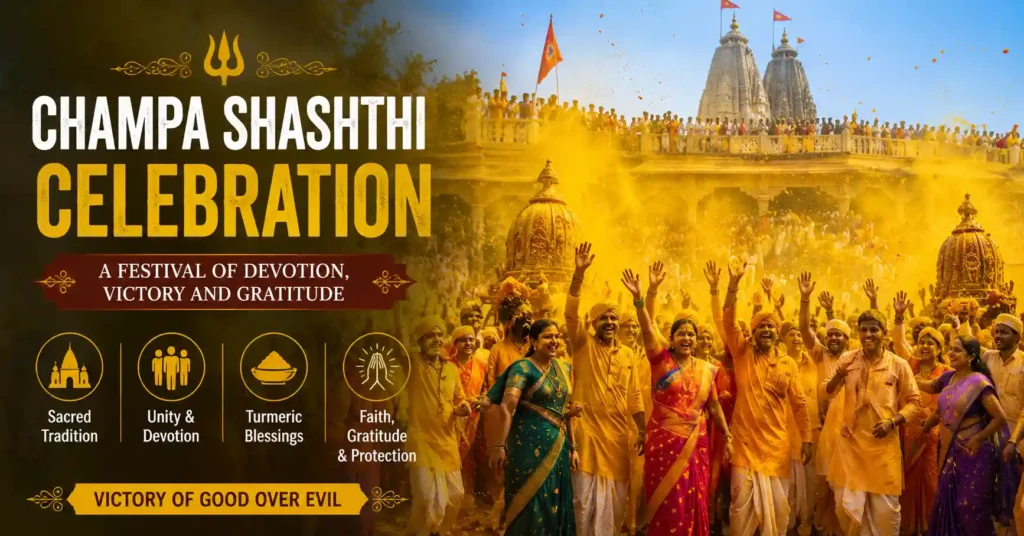
Champa Shashthi: The Biggest Festival of Khandoba
Champa Shashthi is the most important festival dedicated to Khandoba and is celebrated with immense devotion across Maharashtra and parts of Karnataka. It commemorates his victory over the demons Malla and Mani, symbolizing the triumph of dharma over evil.
The festival is observed over six days, during which many devotees observe a vrat (fast), offer prayers, and participate in special rituals. The celebrations conclude on Shashthi, the sixth day of the bright fortnight of the Margashirsha month.
Homes and temples dedicated to Malhari Martand resonate with devotional songs, bhajans, and traditional folk music during this sacred period. Families gather to perform puja and express their gratitude for his protection, guidance, and blessings.
Thousands of devotees also visit Jejuri Temple during Champa Shashthi to seek divine grace and witness the grand celebrations. The festival remains one of the most cherished expressions of faith, preserving the rich spiritual and cultural heritage of his worship.
The Spiritual Significance of His Worship
The spiritual significance of Khandoba lies in his unique balance of courage, justice, and compassion. Devotees worship him as a fearless protector who removes obstacles, safeguards families, and upholds dharma in everyday life.
As a revered Kuladevata, he is believed to bless his devotees with strength, prosperity, good health, and guidance during difficult times. His worship inspires faith, resilience, and the confidence to face life’s challenges with courage.
For many devotees, he is more than a warrior deity. They speak to him like a trusted guardian, sharing their worries, hopes, and gratitude through heartfelt prayers and acts of devotion.
This deep personal connection has kept his worship alive for centuries. It continues to unite families and communities, making him one of the most beloved folk deities in the spiritual traditions of Maharashtra and Karnataka.
Interesting Facts Every Devotee Should Know
His worship is filled with unique traditions that make Khandoba one of the most distinctive folk deities in Sanatan Dharma.
- He is worshipped as a form of Lord Shiva, especially in Maharashtra and parts of Karnataka.
- Jejuri Temple is considered the most important pilgrimage site dedicated to him.
- The offering of bhandara (turmeric powder) is one of the most distinctive rituals in his worship.
- Champa Shashthi is the biggest festival celebrating his victory over the demons Malla and Mani.
- Millions of devotees worship him as their Kuladevata, seeking his blessings for family, prosperity, and protection.
- He is also known by the names Malhari Martand, Martanda Bhairava, and Mailara in different regions and traditions.
These fascinating traditions have helped preserve his worship for centuries, making him one of the most beloved guardian deities in western India.
Rituals and Forms of Worship
His worship is simple, heartfelt, and deeply rooted in family traditions. Devotees seek his blessings for protection, prosperity, good health, and success while expressing their gratitude through prayers and offerings.
Common forms of worship include:
- Offering bhandara (turmeric powder), the most sacred offering associated with his worship.
- Performing aarti and chanting devotional hymns in homes and temples.
- Offering flowers, coconuts, and naivedya as symbols of devotion.
- Observing vrat (fast) during Champa Shashthi and other auspicious occasions.
- Visiting Jejuri Temple or nearby temples dedicated to Malhari Martand to fulfil vows (navas) and seek divine blessings.
For many devotees, these rituals are not merely religious practices but heartfelt expressions of faith that strengthen their bond with the deity. They continue to preserve a living spiritual tradition that has been passed down through generations.
Major Sacred Offerings
Devotees express their faith through simple yet meaningful offerings. Each offering carries a symbolic meaning and reflects gratitude, devotion, and prayers for divine blessings.
| Offering | Spiritual Significance |
|---|---|
| Turmeric (Bhandara) | The most sacred offering, symbolizing prosperity, victory, purity, and divine blessings. |
| Coconut | Represents surrender of the ego and seeking divine grace. |
| Flowers | Offered as a mark of devotion, respect, and gratitude. |
| Incense & Diyas | Symbolize purity, light, and the removal of negativity. |
| Naivedya (Food Offering) | Offered before being shared as Prasad, expressing gratitude to the deity. |
| Traditional Vows (Navas) | Many devotees fulfil their vows by visiting Jejuri Temple after their prayers are answered. |
Devotees also participate in aarti, chant the sacred name of “Malhari Martand”, and offer heartfelt prayers for the well-being of their families. These traditions have been followed for generations and continue to strengthen the spiritual bond between the deity and his devotees.
Khandoba Festival Dates, Tithi and Panchang (2027)
Devotees planning to visit Jejuri Temple during the major festivals can use the following dates. While the Gregorian dates change every year, the Tithi remains the same according to the Hindu Panchang.
| Festival | Date (2027) | Tithi / Panchang | Significance |
|---|---|---|---|
| Champa Shashthi | 4 December 2027 | Margashirsha Shukla Shashthi | Celebrates the victory of Malhari Martand over the demons Malla and Mani. |
| Falgun Mela | Feb–Mar 2027* | Falgun Month | Grand annual fair at Jejuri Temple, known for bhandara (turmeric) celebrations, devotional processions, and special rituals. |
Note: The exact dates of the Falgun Mela are announced each year by Jejuri Temple and may vary according to the temple’s festival calendar and the Hindu Panchang.
How to Reach Jejuri Temple
Jejuri Temple is located in Jejuri town, Pune district, Maharashtra, and is one of the most important pilgrimage destinations dedicated to Khandoba. The temple is easily accessible by road, rail, and air, making it convenient for devotees visiting from different parts of India.
Distance from Major Cities
| City | Approximate Distance |
|---|---|
| Pune | 50 km |
| Mumbai | 210 km |
| Satara | 95 km |
| Solapur | 170 km |
How to Reach
By Road
Jejuri is well connected by state highways and can be reached by MSRTC buses, private buses, taxis, or self-drive vehicles from Pune, Mumbai, Satara, and nearby towns.
By Train
Jejuri has its own railway station on the Pune–Miraj railway line, with regular train services connecting it to Pune and other major cities in Maharashtra.
By Air
The nearest airport is Pune International Airport, about 60 km from Jejuri. From the airport, taxis and buses are readily available to reach the temple.
Local Transport
Auto-rickshaws, taxis, and shared vehicles are available from Jejuri Railway Station and the town centre to the base of the temple hill. From there, devotees climb the historic stone steps leading to the sacred shrine.
Quick Pilgrim Tips
- Wear comfortable footwear for climbing the temple steps.
- Carry drinking water, especially during summer.
- Expect large crowds during Champa Shashthi and the Falgun Mela.
- Protect cameras and mobile phones from bhandara (turmeric powder) during festival celebrations.
- Dress modestly and follow temple customs.
Jejuri Temple Location on Google Map
If you are planning a pilgrimage to Jejuri Temple, using Google Maps can make your journey easier. The temple is located in Jejuri, Purandar Taluka, Pune district, Maharashtra, and is well connected by road and rail. You can use the map below for accurate navigation to the temple entrance before starting your pilgrimage. The temple is situated atop a hill and is reached by climbing a flight of stone steps.
Food, Dining and Stay Near Jejuri Temple
Pilgrims visiting Jejuri Temple will find a variety of accommodation and dining options in and around the town. Whether you are planning a day trip or an overnight stay, the town offers basic facilities to ensure a comfortable and convenient pilgrimage.
Stay Options
Visitors can choose from:
- Budget hotels and lodges near the temple
- Dharamshalas managed by local trusts
- Guest houses suitable for families and groups
- Premium hotels in Pune, approximately one hour from Jejuri
Food and Dining
Jejuri has several vegetarian restaurants, local eateries, and snack stalls serving authentic Maharashtrian cuisine. During major festivals such as Champa Shashthi and the Falgun Mela, many devotees also organize Annadan (free community meals) and distribute Mahaprasad to pilgrims.
Popular local dishes include:
- Maharashtrian Thali
- Puran Poli
- Misal Pav
- Poha
- Tea and traditional snacks
It is advisable to carry drinking water and plan your visit early during major festivals, as accommodation, restaurants, and temple premises become crowded due to the large number of pilgrims.
Darshan, Aarti Timings and Best Time to Visit
Before planning your visit to Jejuri Temple, it is helpful to know the darshan timings, aarti schedule, and the best time to visit. While devotees can seek his blessings throughout the year, visiting during major festivals such as Champa Shashthi and the Falgun Mela offers a truly vibrant and unforgettable spiritual experience.
Darshan Timings
- The temple generally remains open for darshan from 5:00 AM to 9:00 PM, though timings may vary on festival days and special occasions.
Aarti Timings
- Regular aartis are performed throughout the day.
- During Champa Shashthi, the Falgun Mela, and other major festivals, special pujas and aartis are conducted, attracting large numbers of devotees.
Best Time to Visit
- October to March offers pleasant weather and is considered the best time to visit Jejuri Temple.
- Visit during Champa Shashthi to witness the grand bhandara (turmeric) celebrations, or choose weekday mornings if you prefer a quieter and more peaceful darshan.
A Living Tradition of Faith and Protection
Khandoba is much more than a revered folk deity. For millions of devotees across Maharashtra and Karnataka, he is a divine guardian, a compassionate Kuladevata, and a timeless symbol of courage, justice, and unwavering faith.
From the sacred Jejuri Temple and the vibrant celebrations of Champa Shashthi to the centuries-old traditions of the Khandoba Jatra, his worship continues to unite families and communities. These living traditions preserve a rich spiritual heritage that has been passed down through generations.
Whether devotees seek protection, prosperity, guidance, or inner strength, he remains a constant source of hope and inspiration. His timeless story and enduring blessings remind us that faith, righteousness, and devotion always triumph over fear, adversity, and the forces of darkness.
Suggested Reading
If you found this article on Khandoba helpful, you may also enjoy exploring other revered folk deities, regional temples, and sacred pilgrimage sites of Sanatan Dharma. These articles offer deeper insights into India’s rich devotional traditions and the living faith of millions of devotees.
Folk Deities of India: Living Faith of the People
https://thesanatantales.com/folk-deities-of-india/
Khatu Shyam Ji: History, Story, Temple, Darshan and Spiritual Significance
https://thesanatantales.com/khatu-shyam-baba/
Sanwariya Seth Temple: History, Darshan & Visitor Guide
https://thesanatantales.com/sanwariya-seth-temple-mandfiya/
Salasar Balaji Temple: Story, Darshan & Travel Guide
https://thesanatantales.com/salasar-balaji-temple/
Hero Deities of Rajasthan: Tejaji, Pabuji & Folk Warriors
https://thesanatantales.com/hero-deities-of-rajasthan/
Goludevta: The Folk God of Justice in Uttarakhand
https://thesanatantales.com/goludevta-folk-god-of-justice/
Folk Deities of North India: Living Gods of Hills, Forests, and Villages
https://thesanatantales.com/folk-deities-of-north-india/
Folk Deities of Uttarakhand and Himachal: Gods of Hills and Forests
https://thesanatantales.com/folk-deities-of-uttarakhand-and-himachal/
Lord Khandoba (Wikipedia)
FAQs
Who is Khandoba?
Khandoba is a revered folk deity worshipped primarily in Maharashtra and parts of Karnataka. He is widely believed to be a powerful manifestation of Lord Shiva who appeared to protect sages, villages, cattle, and devotees from evil forces.
Also known as Malhari Martand, he is worshipped as a warrior, guardian, and Kuladevata (family deity) by millions of devotees. His most famous temple is located at Jejuri, where pilgrims gather throughout the year to seek blessings for prosperity, protection, and spiritual well-being.
Why is Khandoba called Malhari Martand?
The name Malhari Martand reflects his divine mission. Malhari means “the slayer of the demon Malla,” while Martand is associated with the radiant power of the Sun. Together, the name symbolizes the victorious form of Lord Shiva who destroyed the demons Malla and Mani and restored dharma.
Devotees lovingly chant this sacred name during prayers, festivals, and pilgrimages as a reminder of his courage, compassion, and divine protection.
Why is Jejuri Temple famous?
Jejuri Temple is the most important shrine dedicated to Khandoba and is one of Maharashtra’s most sacred pilgrimage destinations. The temple is especially famous for the tradition of offering bhandara (turmeric powder), which turns the entire temple complex golden during major festivals.
Thousands of devotees visit Jejuri every year to seek blessings, fulfil vows (navas), and participate in celebrations such as Champa Shashthi and the Falgun Mela.
Why is turmeric offered to Khandoba?
Turmeric, known as bhandara, is the most sacred offering made to Khandoba. It symbolizes prosperity, victory, purity, and divine blessings.
During festivals and special rituals, devotees joyfully shower turmeric throughout Jejuri Temple, creating its iconic golden appearance. Offering bhandara is considered an expression of gratitude and devotion, and many devotees believe it brings happiness, protection, and abundance into their lives through his blessings.
What is Champa Shashthi and why is it celebrated?
Champa Shashthi is the most important festival dedicated to Khandoba. It commemorates his victory over the demons Malla and Mani, symbolizing the triumph of righteousness over evil.
The festival is observed over six days, during which devotees perform special prayers, observe vrat (fasts), and visit temples dedicated to Malhari Martand. The grand celebrations at Jejuri Temple attract thousands of pilgrims from across India every year.
Who are Mhalsa and Banai?
According to regional traditions, Mhalsa and Banai are the two principal consorts of Khandoba. Mhalsa is regarded as an incarnation of Goddess Parvati and represents prosperity and family life, while Banai is closely associated with the Dhangar community and symbolizes simplicity, rural traditions, and devotion.
Their stories reflect the inclusive nature of his worship, bringing together people from different communities and preserving centuries-old devotional traditions across Maharashtra and Karnataka.
Who worships Khandoba as their Kuladevata?
Khandoba is worshipped as a Kuladevata by many families in Maharashtra, Karnataka, and neighbouring regions. His devotees include Marathi families, the Dhangar community, farmers, cattle herders, and several other communities.
Families seek his blessings before marriages, housewarming ceremonies, farming activities, business ventures, and other important milestones, believing that he offers lifelong protection, prosperity, and guidance.
What is the best time to visit Jejuri Temple?
Jejuri Temple can be visited throughout the year, but the best time is from October to March, when the weather is pleasant and ideal for climbing the temple’s historic stone steps. Devotees who wish to experience the temple’s vibrant spiritual atmosphere often plan their visit during Champa Shashthi or the Falgun Mela, when grand processions, special rituals, and the famous bhandara (turmeric) celebrations take place.
If you prefer a quieter and more peaceful darshan, consider visiting on a weekday morning outside the major festival season. This allows you to spend more time in prayer and explore the temple without large crowds.
How can I reach Jejuri Temple?
Jejuri Temple is located in Pune district, Maharashtra, about 50 kilometres southeast of Pune. It is well connected by road, rail, and air, making it convenient for pilgrims from across the country.
The town has its own railway station on the Pune–Miraj line, while regular MSRTC buses, private buses, and taxis operate from Pune and nearby cities. The nearest airport is Pune International Airport, about 60 kilometres away. From the railway station or town centre, devotees can easily reach the temple by auto-rickshaw, taxi, or shared vehicle, followed by a climb up the historic stone steps leading to the shrine.
What are the main offerings made to Khandoba?
Devotees offer bhandara (turmeric powder), coconuts, flowers, incense, and naivedya as symbols of faith and gratitude. Many also perform aarti, chant devotional hymns, observe vrat during Champa Shashthi, and fulfil personal vows (navas) by visiting Jejuri Temple.
These simple yet meaningful traditions continue to strengthen the spiritual bond between the deity and his devotees while preserving centuries-old customs that remain an integral part of Sanatan Dharma.
Glossary of Important Terms
| Term | Meaning |
|---|---|
| Khandoba | A revered folk deity worshipped as a powerful form of Lord Shiva, especially in Maharashtra and Karnataka. |
| Malhari Martand | A sacred name of Khandoba meaning the victorious slayer of the demon Malla and the radiant divine protector. |
| Jejuri Temple | The most important temple dedicated to Khandoba, located in Pune district, Maharashtra. |
| Kuladevata | The ancestral or family deity worshipped for generations, whose blessings are sought during important life events. |
| Bhandara | Sacred turmeric powder offered to Khandoba, symbolizing prosperity, victory, purity, and divine blessings. |
| Champa Shashthi | The most important festival of Khandoba, celebrating his victory over the demons Malla and Mani. |
| Jatra | A traditional religious fair or pilgrimage associated with a temple or deity. |
| Falgun Mela | The annual fair held at Jejuri during the Hindu month of Falgun, attracting thousands of devotees. |
| Malla and Mani | The demons defeated by Khandoba, symbolizing the triumph of righteousness over evil. |
| Mhalsa | One of Khandoba’s principal consorts, revered as an incarnation of Goddess Parvati. |
| Banai | Khandoba’s second principal consort, closely associated with the Dhangar (shepherd) community and rural traditions. |
| Navas | A sacred vow made by devotees, often fulfilled after prayers are answered. |
| Aarti | A devotional ritual in which lamps are offered to the deity while hymns and prayers are sung. |
| Darshan | The sacred act of seeing and receiving the blessings of a deity in a temple. |
| Mahaprasad | Sanctified food offered to the deity and later distributed among devotees as a blessing. |
About the Author
Yateendra Chaturvedi is a spiritual writer, researcher, devotee, and the founder of The Sanatan Tales. With over 35 years of professional experience and a lifelong interest in Sanatan Dharma, he writes about Hindu deities, temples, scriptures, festivals, Mahavidyas, sacred stories, rituals, and living traditions that continue to guide and inspire devotees across India.
Drawing from traditional scriptures, regional beliefs, temple traditions, devotional literature, and historical sources, he aims to present authentic, well-researched, and easy-to-understand content for modern readers. His work focuses on preserving spiritual wisdom, explaining sacred traditions, and helping seekers develop a deeper understanding of India’s rich spiritual heritage.
Through The Sanatan Tales, Yateendra strives to make the timeless teachings of Sanatan Dharma simple, meaningful, and relevant for today’s generation while maintaining respect for traditional sources, regional practices, and diverse spiritual perspectives.
Learn More About Yateendra Chaturvedi →
https://thesanatantales.com/about-the-author/
Sources and Traditional References
This article is based on the beliefs, traditions, and devotional practices associated with the worship of Khandoba in Maharashtra and Karnataka. The information has been compiled from traditional Shaiva literature, regional folklore, temple traditions, the Mallari Mahatmya, and insights from various religious and spiritual study sources related to Sanatan Dharma.
Note: The stories, customs, rituals, and interpretations associated with Khandoba may vary across different regions, communities, and spiritual traditions. The purpose of this article is not to establish any one belief as the absolute truth, but to present widely accepted religious, cultural, and devotional perspectives in a simple, respectful, and easy-to-understand manner.
Explore More Fascinating Topics from Sanatan Dharma