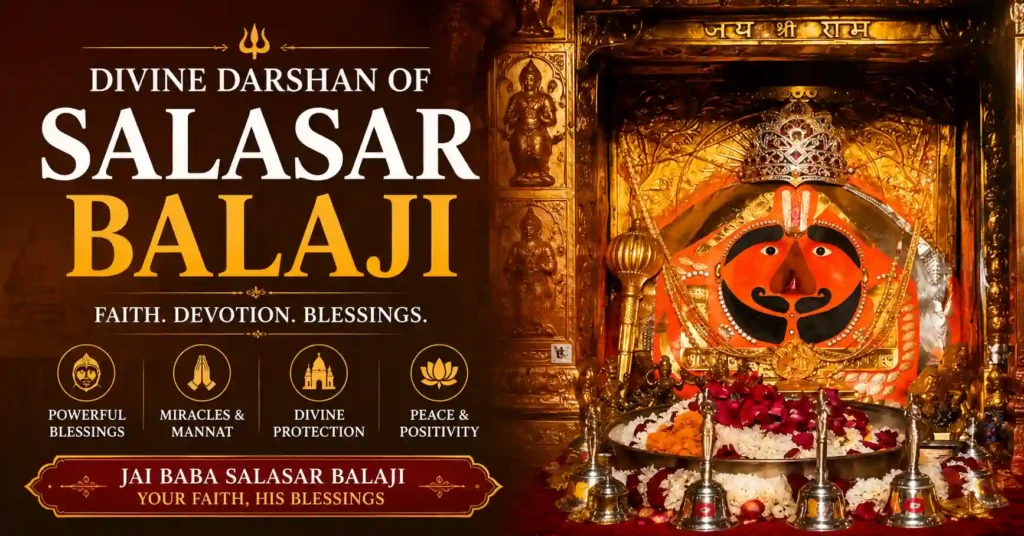
Salasar Balaji in Rajasthan is one such sacred destination where faith, devotion, and hope come together. Every year, millions of devotees travel to the Salasar Balaji Temple seeking blessings, offering prayers, and fulfilling their heartfelt mannat.
Dedicated to Lord Hanuman in his unique bearded form, this temple has become one of the most revered pilgrimage sites in India.
People arrive carrying worries, silent prayers, and hopes for a better tomorrow. Many believe that Salasar Balaji listens to sincere devotion and blesses those who come with faith.
Whether you are planning your first Salasar Balaji Darshan or wish to understand the temple’s history, miracles, and spiritual significance, this sacred place offers an experience that goes beyond rituals.
In this guide, you will discover the story of Salasar Balaji, why the temple is famous, its unique idol, darshan timings, festivals, travel information, and the traditions that continue to inspire millions of devotees from across India.
Salasar Balaji at a Glance
| Quick Facts | Details |
|---|---|
| Temple Name | Salasar Balaji Temple |
| Deity | Lord Hanuman (Balaji) |
| Location | Salasar, Churu District, Rajasthan |
| State | Rajasthan, India |
| Established | 1754 CE (According to temple tradition) |
| Associated Saint | Sant Mohan Das Ji |
| Famous For | Unique Hanuman idol with a beard and moustache, Nariyal Bandhna tradition, fulfilment of mannat |
| Best Time to Visit | October to March |
| Major Festivals | Chaitra Purnima Mela, Ashwin Purnima Mela, Hanuman Jayanti |
| Auspicious Days | Tuesdays and Saturdays |
| Popular Offerings | Coconut (Nariyal), Chola, Sindoor, Flowers and Prasad |
| Nearest Railway Station | Sujangarh (27 km) |
| Nearest Airport | Jaipur International Airport (Approx. 175 km) |
| Ideal Visit Duration | Half Day to One Day |
| Nearby Pilgrimage Sites | Khatu Shyam Ji Temple, Jeen Mata Temple, Rani Sati Dadi Temple, Harshnath Temple |
Table of Contents
ToggleSpiritual Significance of Salasar Balaji
Salasar Balaji holds a special place in the hearts of millions of devotees who visit this sacred Hanuman temple with faith, hope, and devotion. Located in Rajasthan, the temple is believed to be a place where sincere prayers are heard and blessings are received.
For many pilgrims, a visit to Salasar Balaji is not just a religious journey but a deeply personal spiritual experience.
One of the unique aspects of Salasar Balaji is the simplicity of worship. Devotees believe that you do not need elaborate rituals or perfect prayers to seek Lord Hanuman’s blessings.
People stand before Balaji, fold their hands, and pray with complete faith. Some offer words, while others remain silent, believing that heartfelt devotion reaches the Lord without the need for explanation.
A long-standing tradition at the Salasar Balaji Temple is to make a mannat with complete trust. Many devotees believe that Balaji blesses those who pray with a pure heart by giving them strength, courage, and guidance during difficult times.
When their wishes are fulfilled, they return to offer their gratitude, continuing a tradition of faith that has been followed for generations.
What makes Salasar Balaji truly unique is the personal connection devotees experience during darshan. Lord Hanuman is worshipped here as a compassionate protector who removes obstacles, grants inner strength, and stands by His devotees in every phase of life.
This deep sense of faith and closeness is why millions of pilgrims return to Salasar Balaji again and again, seeking peace, blessings, and spiritual strength.
Salasar Balaji in Sanatan Dharma
In Sanatan Dharma, Lord Hanuman is revered as the ideal devotee of Lord Rama and a symbol of unwavering faith, courage, humility, and selfless service. Worshipping Hanuman is believed to strengthen devotion, remove fear, and inspire righteousness in daily life.
At Salasar Balaji, Lord Hanuman is lovingly worshipped as Balaji, a name used with deep affection and reverence in Rajasthan and several parts of North India. Devotees believe that Balaji protects those who surrender with sincere faith and gives them the strength to overcome life’s challenges.
Hanuman worship is closely associated with the ideals of bhakti (devotion), seva (selfless service), courage, discipline, and complete dedication to dharma. These timeless values continue to inspire millions of devotees who visit Salasar Balaji seeking not only blessings but also inner strength and spiritual guidance.
The temple is especially crowded on Tuesdays and Saturdays, which are traditionally considered the most auspicious days for worshipping Lord Hanuman. Devotees also recite the Hanuman Chalisa, Sundara Kanda, and Bajrang Baan as part of their personal devotion, believing that these sacred prayers help cultivate courage, peace, and unwavering faith.
For many pilgrims, Salasar Balaji is not merely a place to seek the fulfilment of wishes. It is a sacred reminder of Lord Hanuman’s eternal message of devotion, humility, service, and unwavering faith in the Divine.
Story of Salasar Balaji
According to the long-standing temple tradition, the story of Salasar Balaji began in the village of Asota in Rajasthan in the 18th century. It is believed that a farmer was ploughing his field when his plough struck a hard object.
As he dug into the ground, he discovered a sacred idol of Lord Hanuman. News of this extraordinary discovery quickly spread through the surrounding villages, and devotees gathered to witness what they believed was a divine event.
On the very same day, the priest serving Balaji in Salasar, Mohan Das Ji, is believed to have received a divine dream. According to temple tradition, Lord Hanuman instructed him that the newly discovered idol in Asota should be brought to Salasar and worshipped there.
When people from Asota shared the news of the idol’s discovery, the priest saw it as the fulfilment of the divine message he had received.
The idol was then respectfully carried in a grand procession from Asota to Salasar, accompanied by devotees chanting the name of Lord Hanuman. After its installation, the temple gradually became an important centre of Hanuman worship.
Over the years, the fame of Salasar Balaji Temple spread across Rajasthan and neighbouring states, attracting devotees seeking blessings, protection, and the fulfilment of their mannat.
Today, this sacred story continues to inspire millions of pilgrims. Whether viewed as a historical tradition or an act of divine grace, it remains at the heart of the faith associated with Salasar Balaji.
For devotees, the story is not merely about the discovery of an idol but about the beginning of a spiritual legacy that continues to draw countless worshippers to this revered Hanuman temple.
Temple History and Architecture of Salasar Balaji
According to temple tradition, the present-day Salasar Balaji Temple was established in 1754 CE (Vikram Samvat 1811) after the sacred idol of Lord Hanuman was brought from the village of Asota to Salasar.
The temple’s early development is closely associated with Sant Mohan Das Ji, who is revered as the first priest and one of the most devoted followers of Balaji. Under his guidance, the temple gradually became an important centre of Hanuman worship, attracting devotees from Rajasthan and neighbouring regions.
What began as a small place of worship has grown into one of India’s most visited Hanuman temples. Today, Salasar Balaji welcomes millions of pilgrims every year who come to seek Lord Hanuman’s blessings, fulfil their mannat, and participate in the temple’s vibrant spiritual traditions.
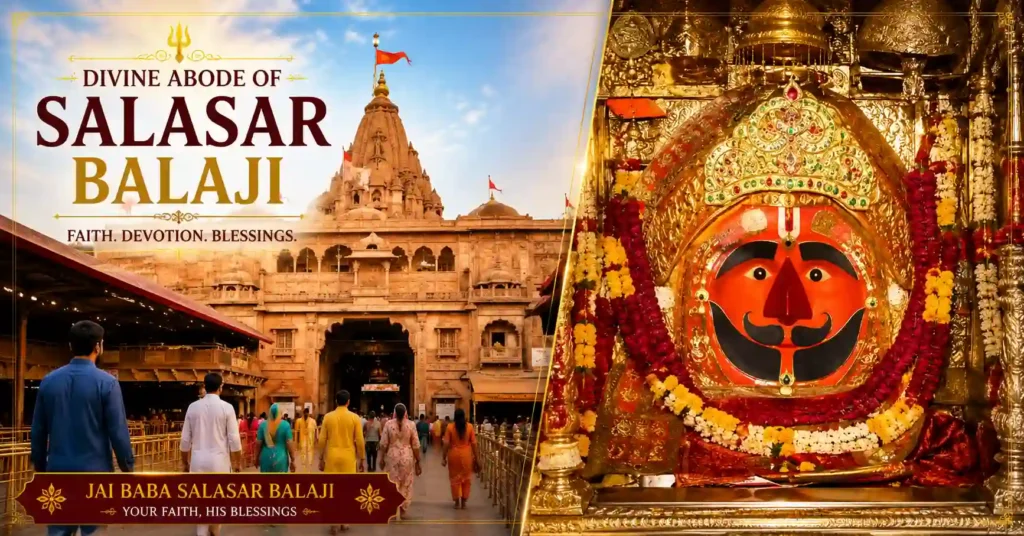
The temple showcases a blend of traditional Rajasthani temple architecture and modern construction. Its beautifully decorated entrance, intricately carved marble work, spacious prayer halls, and well-maintained temple complex create a peaceful atmosphere for devotees.
The sanctum sanctorum (garbhagriha) houses the revered idol of Salasar Balaji, where devotees gather throughout the day for darshan and prayers.
One of the temple’s most remarkable features is the unique idol of Lord Hanuman with a beard and moustache, a form rarely seen in other Hanuman temples. This distinctive appearance has become the identity of Salasar Balaji and is one of the primary reasons why the temple attracts pilgrims from across India.
Over the years, the temple complex has been expanded to accommodate the growing number of visitors. Today, it includes spacious waiting areas, facilities for devotees, dharamshalas, and arrangements for managing large crowds during major festivals such as Chaitra Purnima and Ashwin Purnima.
Despite these developments, the temple continues to preserve its traditional devotional atmosphere, where faith and simplicity remain at the heart of every pilgrimage.
Did You Know? Interesting Facts About Salasar Balaji
- The idol of Salasar Balaji is one of the very few Hanuman idols in India that depicts Lord Hanuman with a beard and moustache.
- According to temple tradition, the sacred idol was discovered in the village of Asota before being brought to Salasar.
- Sant Mohan Das Ji is traditionally regarded as the first priest and one of the earliest devotees associated with the temple.
- Every year, lakhs of devotees visit Salasar Balaji during the Chaitra Purnima and Ashwin Purnima fairs.
- The Nariyal Bandhna tradition has become one of the temple’s most recognised devotional practices, with devotees returning to untie the coconut after they believe their mannat has been fulfilled.
- Many pilgrims include Khatu Shyam Ji, Salasar Balaji, and Jeen Mata Temple in a single pilgrimage, popularly known as the Khatu–Salasar–Jeen Mata circuit.
- Despite welcoming millions of visitors each year, the temple continues to preserve its atmosphere of devotion, simplicity, and community service.
Why Is Salasar Balaji Famous?
Salasar Balaji is one of the most famous Hanuman temples in India and a revered pilgrimage destination in Rajasthan. Every year, millions of devotees visit the temple to seek Lord Hanuman’s blessings, offer prayers, and fulfil their mannat.
The temple is known not only for its spiritual atmosphere but also for the unwavering faith that devotees have carried here for generations.
One of the most distinctive features of Salasar Balaji Temple is the unique idol of Lord Hanuman. Unlike the traditional depictions found in most Hanuman temples, the idol at Salasar has a beard and moustache, giving Balaji a mature and majestic appearance.
This rare form is considered unique and is one of the main reasons devotees from across India are drawn to the temple.
Another reason for the temple’s popularity is the long-standing belief that sincere prayers offered at Salasar Balaji are answered. Devotees come seeking strength during difficult times, success in their endeavours, good health, and peace of mind.
Many return to the temple to offer thanks after they believe their wishes have been fulfilled, keeping the tradition of mannat alive.
The temple is also famous for its vibrant fairs held on Chaitra Purnima and Ashwin Purnima, when lakhs of pilgrims gather to participate in worship and seek Balaji’s blessings.
Combined with its rich temple traditions, spiritual significance, and the deep faith of millions of devotees, these factors have made Salasar Balaji one of the most visited Hanuman pilgrimage sites in India.
Interesting Facts About Salasar Balaji
Salasar Balaji is one of India’s most revered Hanuman temples, and many fascinating traditions make it different from other pilgrimage destinations. Here are some interesting facts every devotee should know.
| Fact | Details |
|---|---|
| Unique Idol | The idol of Lord Hanuman has a beard and moustache, a rare form not commonly seen in other Hanuman temples. |
| Temple Tradition | According to temple tradition, the idol was discovered in the village of Asota before being brought to Salasar. |
| Established in 1754 CE | The present temple is believed to have been established in 1754 CE (Vikram Samvat 1811) under the guidance of Sant Mohan Das Ji. |
| Famous Nariyal Bandhna Ritual | Devotees tie a coconut while making a mannat and return to untie it after their wish is fulfilled. |
| Lakhs of Pilgrims | Millions of devotees visit Salasar Balaji every year, especially during Chaitra Purnima and Ashwin Purnima. |
| Major Hanuman Pilgrimage | Salasar Balaji is considered one of the most important Hanuman pilgrimage centres in North India. |
| Popular Pilgrimage Circuit | Many devotees visit Khatu Shyam Ji, Salasar Balaji, and Jeen Mata Temple as part of a single spiritual journey. |
| Living Tradition of Faith | The temple is known not only for its history but also for its vibrant devotional traditions that continue to inspire generations of devotees. |
These unique traditions, combined with the unwavering faith of millions of devotees, have made Salasar Balaji one of the most visited and spiritually significant Hanuman temples in India.
Unique Features of the Salasar Balaji Murti
The murti of Salasar Balaji is one of the most distinctive and revered idols of Lord Hanuman in India. Unlike the traditional depictions of Hanuman as a youthful celibate warrior, the idol at Salasar Balaji Temple has a beard and moustache, giving Balaji a mature, dignified, and compassionate appearance.
This rare form immediately captures the attention of devotees and has become one of the temple’s defining features.
According to temple tradition, the idol was not sculpted for the temple but was discovered in the village of Asota and later brought to Salasar following a divine vision received by the temple priest.
Because of this sacred origin, many devotees regard the murti with deep reverence and believe it carries a special spiritual presence. While some devotees consider the idol to be divinely manifested, this belief is rooted in local temple tradition rather than documented historical evidence.
Standing before the murti during Salasar Balaji Darshan is often described as a deeply moving experience. Many devotees feel a sense of peace, comfort, and inner strength as they offer their prayers.
They believe that Lord Hanuman listens with compassion, offering courage and guidance to those who approach Him with sincere faith.
For countless pilgrims, the uniqueness of the murti is not limited to its appearance. It represents the living presence of Salasar Balaji, whose blessings, protection, and unwavering grace continue to inspire millions of devotees who visit this sacred Hanuman temple every year.
How Salasar Balaji Differs from Other Famous Hanuman Temples
Unlike many famous Hanuman temples across India, Salasar Balaji is known for several distinctive traditions and features that make it a unique pilgrimage destination. While every Hanuman temple reflects devotion to Lord Hanuman, Salasar Balaji has developed its own identity through centuries of temple traditions and unwavering faith.
| Feature | Salasar Balaji | Most Hanuman Temples |
|---|---|---|
| Appearance of the Idol | Lord Hanuman with a beard and moustache | Usually depicted without a beard and with a youthful appearance |
| Temple Tradition | Idol traditionally believed to have been discovered in Asota and brought to Salasar | Most idols are consecrated during temple construction |
| Popular Ritual | Nariyal Bandhna (tying a coconut while making a mannat) | Offerings vary according to local traditions |
| Major Annual Events | Chaitra Purnima and Ashwin Purnima Melas | Festivals differ from temple to temple |
| Pilgrimage Circuit | Often combined with Khatu Shyam Ji and Jeen Mata Temple | Usually visited independently |
These unique traditions have made Salasar Balaji one of the most respected Hanuman pilgrimage centres in India, attracting millions of devotees each year.
Miracles and Devotees' Beliefs at Salasar Balaji
Faith in Salasar Balaji is deeply rooted in the personal experiences of millions of devotees who have visited this sacred Hanuman temple over the years. While miracles cannot be scientifically verified, countless pilgrims believe that Lord Hanuman blesses those who pray with sincerity, devotion, and unwavering faith.
These experiences have become an important part of the temple’s living tradition and continue to inspire devotees from across India.
One of the most well-known traditions at Salasar Balaji Temple is Nariyal Bandhna (tying a coconut). According to temple tradition, devotees tie a coconut within the temple premises while making a mannat, or heartfelt wish.
Once they believe their prayer has been answered, they return to untie the coconut and offer thanks to Balaji. For many devotees, this ritual symbolises complete faith, patience, and gratitude rather than simply asking for material blessings.
Many pilgrims share personal stories of finding strength during difficult times, overcoming challenges, recovering from illness, or experiencing peace after visiting Salasar Balaji. These accounts are passed down through families and communities, strengthening the temple’s reputation as a place of hope and divine grace.
However, these experiences are matters of personal faith and should be understood as devotees’ beliefs rather than documented miracles.
For many visitors, the greatest miracle of Salasar Balaji is the inner transformation they experience. A peaceful mind, renewed courage, and stronger faith often become the true blessings they carry home after darshan.
Whether seeking answers, comfort, or spiritual strength, devotees believe that Lord Hanuman’s compassionate presence continues to guide and protect those who surrender with a sincere heart.
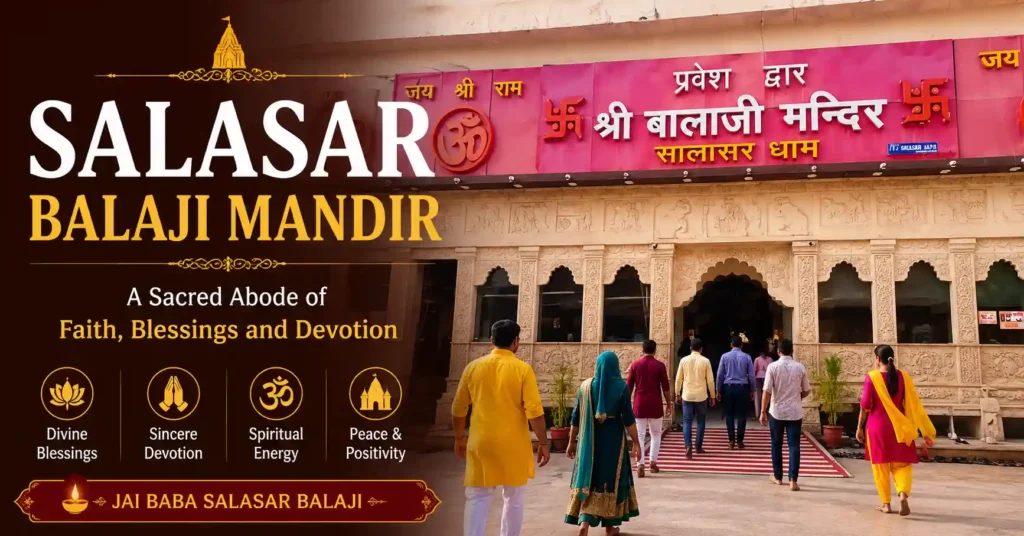
Salasar Balaji Darshan Timings, Aarti and Rituals
Visiting Salasar Balaji is a deeply spiritual experience for devotees seeking Lord Hanuman’s blessings. The temple welcomes pilgrims from early morning until late evening, and thousands of devotees visit every day. Tuesdays, Saturdays, Hanuman Jayanti, and the annual fairs witness the highest footfall, so planning your visit accordingly can make your darshan more comfortable.
Salasar Balaji Darshan Timings
| Activity | Timings* |
|---|---|
| Temple Opens | Early Morning |
| Morning Darshan | From early morning onwards |
| Morning Aarti | Around 4:00 AM to 5:00 AM |
| Evening Aarti | Shortly after sunset |
| Temple Closes | Late evening after the final rituals |
Timings may change during festivals, special occasions, or temple events. It is advisable to verify the latest schedule before planning your visit.
Rituals at Salasar Balaji Temple
Devotees visiting Salasar Balaji Temple commonly participate in the following rituals:
- Offer coconut (Nariyal Bandhna) while making a mannat.
- Offer chola, sindoor, flowers, and prasad to Lord Hanuman.
- Attend the morning or evening aarti for a more devotional experience.
- Recite the Hanuman Chalisa, Bajrang Baan, or other Hanuman prayers.
- Offer prayers with devotion and gratitude after darshan.
If you are planning your Salasar Balaji Darshan, visiting early in the morning on weekdays usually offers shorter queues and a peaceful atmosphere. During Chaitra Purnima, Ashwin Purnima, Tuesdays, Saturdays, and Hanuman Jayanti, lakhs of devotees visit the temple, so waiting times can be significantly longer.
The essence of worship at Salasar Balaji lies in sincere devotion rather than elaborate rituals. Devotees believe that offering heartfelt prayers with faith is the most meaningful way to seek Lord Hanuman’s blessings.
Offerings Made at Salasar Balaji
Offering prayers at Salasar Balaji is an expression of devotion rather than a ritual obligation. Devotees bring various offerings to Lord Hanuman as a symbol of gratitude, faith, and surrender. While no offering is compulsory, the following are among the most common traditions followed at the temple.
| Offering | Significance |
|---|---|
| Coconut (Nariyal) | Offered while making a mannat or as an expression of gratitude after a wish is fulfilled. |
| Chola | A sacred cloth offered to Lord Hanuman as a mark of devotion and respect. |
| Sindoor | Symbolises strength, protection, and Lord Hanuman’s unwavering devotion to Lord Rama. |
| Flowers and Garlands | Offered as a gesture of love, reverence, and worship. |
| Laddu and Other Prasad | Distributed among devotees after being offered to the deity. |
Most devotees also spend a few moments in silent prayer after darshan or recite the Hanuman Chalisa before leaving the temple. According to temple tradition, the true offering is not measured by its material value but by the sincerity, humility, and devotion with which it is made.
Before purchasing offerings, devotees are encouraged to follow the temple’s guidelines and obtain puja items only from authorised or local shops around the temple complex.
How to reach salasar balaji temple
Salasar Balaji is located in the Churu district of Rajasthan and is well connected by road, rail, and air. Whether you are travelling from Rajasthan or another part of India, reaching the temple is convenient. Here’s a quick guide to help you plan your pilgrimage.
Distance from Major Cities
| City | Approximate Distance |
|---|---|
| Jaipur | 170 km |
| Delhi | 320 km |
| Bikaner | 180 km |
| Jodhpur | 240 km |
| Sikar | 110 km |
| Churu | 90 km |
| Ajmer | 190 km |
By Road
Salasar Balaji is easily accessible by road from major cities in Rajasthan and neighbouring states. Regular Rajasthan Roadways (RSRTC) and private buses operate from Jaipur, Delhi, Sikar, Bikaner, Ajmer, and other cities. Private taxis and self-drive vehicles are also popular options, with good road connectivity throughout the journey.
By Train
The nearest railway stations are:
- Sujangarh Railway Station – about 27 km
- Lakshmangarh Railway Station – about 30 km
Both stations are connected to several cities in Rajasthan. From the railway station, taxis, auto-rickshaws, and shared jeeps are readily available to reach Salasar Balaji Temple.
By Air
The nearest airports are:
- Jaipur International Airport – about 175 km
- Kishangarh (Ajmer) Airport – about 190 km
From the airport, you can hire a taxi or board a bus to reach Salasar.
Local Transport
Local transport is easily available from nearby railway stations and bus stands. Devotees can choose from:
- Auto-rickshaws
- Taxis
- Shared jeeps
- Local buses
Most hotels and dharamshalas near the temple can also help arrange local transportation if required.
As you get closer to Salasar, you will notice a growing number of pilgrims travelling in the same direction. The shared chants of “Jai Shri Balaji”, roadside temples, and devotional atmosphere make the journey itself feel like a part of the pilgrimage.
Salasar Balaji Temple Location on Google Maps
Planning your journey becomes much easier with the map below. Use it to find the exact location of Salasar Balaji Temple, explore nearby roads, parking areas, and plan the most convenient route before your visit.
Temple Facilities and Accommodation at Salasar Balaji
The Salasar Balaji Temple offers a range of facilities to ensure that devotees have a comfortable and convenient pilgrimage. Over the years, the temple town has developed excellent infrastructure to accommodate the large number of pilgrims who visit throughout the year, especially during Chaitra Purnima, Ashwin Purnima, Tuesdays, Saturdays, and Hanuman Jayanti.
Facilities Available Near the Temple
| Facility | Details |
|---|---|
| Dharamshalas | Several affordable dharamshalas managed by trusts and charitable organisations are available for devotees. |
| Hotels & Guest Houses | Budget and mid-range hotels are located within walking distance of the temple. |
| Parking | Designated parking areas are available for cars, buses, and two-wheelers near the temple. |
| Food & Prasad Shops | Numerous restaurants, tea stalls, and shops selling prasad, coconuts, chola, sindoor, and religious items are located around the temple. |
| Drinking Water & Toilets | Basic public facilities are available for pilgrims near the temple complex. |
| Wheelchair Access | Most parts of the temple complex are accessible, though elderly devotees may require assistance during crowded days. |
If you are visiting during the Chaitra Purnima Mela or Ashwin Purnima Mela, it is advisable to book your accommodation well in advance, as hotels and dharamshalas fill up quickly.
Travelling during weekdays generally offers a more relaxed experience with better availability of rooms and shorter waiting times for darshan.
Most devotees prefer staying overnight so they can attend the early morning aarti and experience the peaceful atmosphere before the temple becomes crowded.
Accessibility for Senior Citizens and Differently Abled Devotees
The Salasar Balaji Temple receives devotees of all ages, including senior citizens and differently abled visitors. Over the years, facilities around the temple have improved to make the pilgrimage more convenient for everyone.
- The temple is easily accessible by road.
- Most approach routes are level and suitable for elderly pilgrims.
- Wheelchairs may be available through local arrangements or accompanying family members.
- Seating areas are available at various points around the temple complex.
- During festivals and weekends, senior citizens are advised to visit early in the morning to avoid long queues.
- Carry essential medicines, drinking water, and comfortable footwear, especially during the summer months.
If you are travelling with elderly family members, planning your visit on a weekday and avoiding peak festival days can make the darshan experience more comfortable and less physically demanding.
Best Time to Visit Salasar Balaji
Choosing the right time to visit Salasar Balaji can make your pilgrimage more comfortable and spiritually fulfilling. Although the temple remains open to devotees throughout the year, the weather, crowd levels, and festivals can greatly influence your experience.
Best Time to Visit Salasar Balaji
| Time | What to Expect | Recommendation |
|---|---|---|
| October to March | Pleasant weather, comfortable for sightseeing and darshan |  Best time to visit Best time to visit |
| April to June | Hot summer temperatures, especially during the afternoon | Visit early morning or evening |
| July to September | Occasional rainfall with relatively fewer crowds | Suitable for peaceful darshan |
| Chaitra Purnima & Ashwin Purnima | Grand annual fairs with lakhs of devotees | Best for experiencing temple traditions, but expect long queues |
The winter months from October to March are considered the best time to visit Salasar Balaji. The pleasant weather makes travelling comfortable, allowing devotees to enjoy darshan and explore the temple without the intense heat of Rajasthan.
If you wish to witness the temple at its most vibrant, plan your visit during the Chaitra Purnima Mela or Ashwin Purnima Mela. These are the two most important festivals celebrated at Salasar Balaji Temple, attracting lakhs of pilgrims from across India.
The atmosphere comes alive with devotional singing, religious processions, and special worship ceremonies. However, accommodation fills up quickly, and waiting times for darshan can be significantly longer.
For devotees seeking a quieter and more peaceful experience, weekdays and early morning hours are ideal. Visiting outside major festivals allows you to have a more relaxed Salasar Balaji Darshan with shorter queues and ample time for prayer and meditation.

Festivals and Special Days at Salasar Balaji
Festivals at Salasar Balaji transform the temple into a vibrant centre of devotion, attracting lakhs of pilgrims from Rajasthan and across India. These special occasions are marked by elaborate worship, devotional singing, religious processions, and an atmosphere filled with faith and celebration.
Major Festivals at Salasar Balaji
| Festival / Occasion | Significance |
|---|---|
| Chaitra Purnima Mela | The largest annual fair, attracting lakhs of devotees who come for darshan, prayers, and to fulfil their mannat. |
| Ashwin Purnima Mela | Another major pilgrimage festival celebrated with special aartis, devotional programmes, and large gatherings of devotees. |
| Hanuman Jayanti | Celebrates the birth of Lord Hanuman with special pujas, recitation of the Hanuman Chalisa, and devotional events. |
| Every Tuesday & Saturday | Considered the most auspicious days for Hanuman worship. The temple receives a significantly higher number of devotees seeking blessings and darshan. |
The Chaitra Purnima and Ashwin Purnima fairs are the most important events at Salasar Balaji Temple.
During these festivals, the temple town comes alive with continuous chanting of Lord Hanuman’s name, devotional music, religious discourses, and thousands of pilgrims waiting patiently for darshan. The spiritual atmosphere during these days is truly unforgettable.
Apart from the annual fairs, Tuesdays and Saturdays hold special significance as these days are traditionally dedicated to Lord Hanuman.
Devotees visit Salasar Balaji to offer chola, sindoor, coconut (Nariyal Bandhna), and prayers, believing that sincere devotion on these auspicious days brings strength, protection, and the fulfilment of heartfelt wishes.
If you plan to visit during these festivals or special days, it is advisable to book your accommodation well in advance and be prepared for larger crowds and longer waiting times for darshan.
Nearby Places to Visit from Salasar Balaji
Many devotees combine their Salasar Balaji pilgrimage with visits to other renowned temples in Rajasthan. These sacred destinations are located within a comfortable driving distance and are often covered as part of a spiritual circuit. Visiting these temples together allows devotees to seek the blessings of different deities while experiencing Rajasthan’s rich religious heritage.
Popular Temples Near Salasar Balaji
| Temple | Approx. Distance | Why Visit |
|---|---|---|
| Khatu Shyam Ji Temple | 110 km | One of the most revered temples dedicated to Khatu Shyam Ji, an incarnation of Barbarika, attracting millions of devotees every year. |
| Jeen Mata Temple | 100 km | A famous Shakti temple dedicated to Goddess Jeen Mata, especially crowded during Navratri. |
| Rani Sati Dadi Temple, Jhunjhunu | 115 km | A well-known temple dedicated to Rani Sati Dadi and an important pilgrimage site in Shekhawati. |
| Harshnath Temple, Sikar | 120 km | An ancient Lord Shiva temple situated on the Aravalli hills, known for its historical and spiritual significance. |
Many pilgrims begin their journey at Khatu Shyam Ji, continue to Salasar Balaji, and then visit Jeen Mata Temple. This pilgrimage route is popularly known as the Khatu Shyam–Salasar–Jeen Mata circuit and is considered highly auspicious by devotees.
If you are travelling from Jaipur or Delhi, all these temples can be comfortably covered over two to three days, making the journey both spiritually enriching and convenient.
One-Day and Two-Day Salasar Balaji Pilgrimage Itinerary
Whether you have one day or an entire weekend, you can plan a meaningful pilgrimage around Salasar Balaji.
One-Day Itinerary
| Time | Suggested Plan |
|---|---|
| Early Morning | Reach Salasar Balaji for Mangala Aarti or early darshan |
| Morning | Offer prayers and participate in temple rituals |
| Afternoon | Visit nearby markets and enjoy local vegetarian food |
| Evening | Attend Sandhya Aarti before returning |
Two-Day Itinerary
Day 1
- Salasar Balaji Darshan
- Temple market
- Evening Aarti
- Overnight stay in Salasar
Day 2
- Khatu Shyam Ji Temple
- Jeen Mata Temple
- Return journey
This itinerary allows devotees to experience some of Rajasthan’s most important pilgrimage destinations in a comfortable and well-planned manner.
The Spiritual Experience at Salasar Balaji
For many devotees, the most memorable part of visiting Salasar Balaji is not the grand temple or the crowd, but the deep sense of peace they experience during darshan. The moment they stand before Lord Hanuman’s unique idol, many feel a quiet connection that is difficult to express in words.
Every devotee experiences Salasar Balaji differently. Some stand silently with folded hands, while others close their eyes in prayer or recite the Hanuman Chalisa. Many simply gaze at the murti, believing that Lord Hanuman understands every prayer, even those that remain unspoken.
Despite the thousands of pilgrims visiting the temple each day, there is a unique feeling of calm and devotion within the temple premises. The sound of temple bells, devotional chants, and the collective faith of devotees create an atmosphere that encourages prayer, gratitude, and self-reflection.
For many, Salasar Balaji Darshan is not only about seeking the fulfilment of a wish. It is also an opportunity to find inner strength, peace of mind, and renewed faith. Whether devotees come with worries, gratitude, or simply a desire to offer prayers, they often leave with a feeling of comfort and spiritual reassurance.
This personal and heartfelt experience is one of the reasons why millions of devotees return to Salasar Balaji again and again, believing that the blessings of Lord Hanuman continue to guide and protect them throughout their lives.
Tips for a Peaceful Darshan at Salasar Balaji
A little preparation can make your Salasar Balaji Darshan more comfortable and spiritually fulfilling. Whether you are visiting for the first time or returning after fulfilling a mannat, following a few simple guidelines will help you enjoy a peaceful pilgrimage.
Tips for a Comfortable Darshan
- Visit early in the morning if you prefer shorter queues and a quieter atmosphere.
- Wear comfortable and modest clothing suitable for a place of worship.
- Keep your belongings secure and carry only essential items, especially during festival days.
- Follow the instructions of the temple authorities and volunteers to ensure a smooth darshan experience.
- Maintain cleanliness and help preserve the sanctity of the temple premises.
- Be patient during busy days such as Tuesdays, Saturdays, Hanuman Jayanti, Chaitra Purnima, and Ashwin Purnima, when large crowds are expected.
- If you have made a mannat, follow the temple’s traditional procedures while offering coconut, chola, sindoor, or prasad.
Above all, remember that a visit to Salasar Balaji is more than a pilgrimage. It is an opportunity to pause, offer your prayers with sincerity, and experience the peace that comes from complete faith in Lord Hanuman. Many devotees believe that the true blessing of darshan is not only the fulfilment of wishes but also the inner strength and confidence they carry home after their visit.
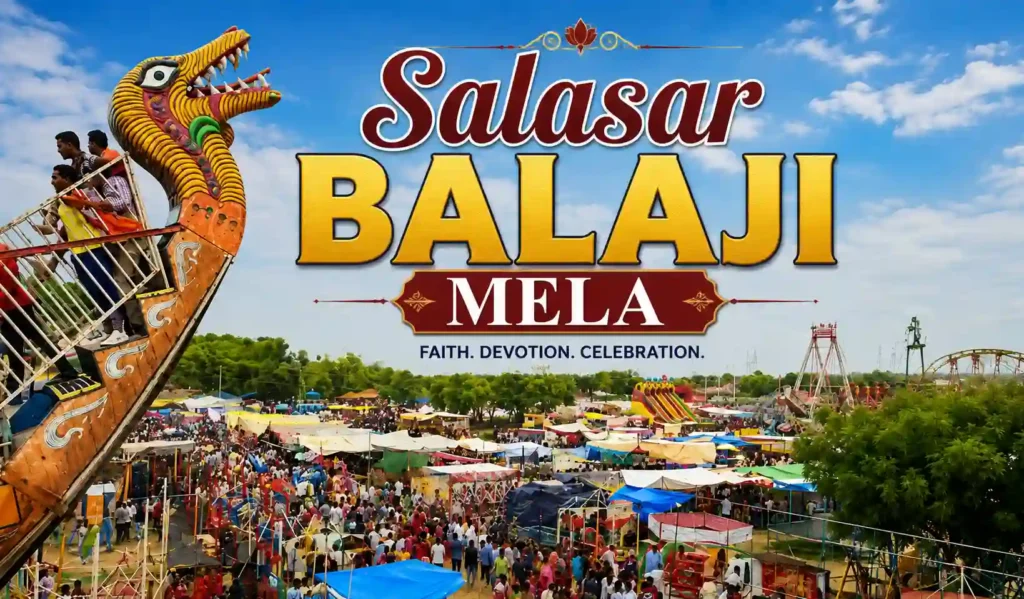
Dos and Don'ts for Visitors at Salasar Balaji
Following a few simple guidelines helps maintain the peaceful atmosphere of Salasar Balaji Temple and ensures a smooth darshan experience for everyone.
| Dos | Don’ts |
|---|---|
| Dress modestly and respectfully. | Avoid pushing or jumping queues during darshan. |
| Follow the instructions of temple staff and volunteers. | Do not litter inside or around the temple premises. |
| Keep mobile phones on silent mode whenever possible. | Avoid loud conversations inside the temple. |
| Offer prayers patiently and respect other devotees. | Do not touch restricted areas or cross security barriers. |
| Purchase offerings from authorised local shops if required. | Do not carry prohibited items as per temple regulations. |
| Keep the temple premises clean and use designated waste bins. | Avoid photography or videography in areas where it is prohibited. |
The most important tradition at Salasar Balaji is to approach Lord Hanuman with humility, patience, and sincere devotion. Respecting the temple’s customs not only makes your own pilgrimage more meaningful but also helps preserve the sanctity of this sacred place for every devotee.
Key Takeaways
- Salasar Balaji is one of the most revered Hanuman temples in India, attracting millions of devotees every year.
- The temple is famous for its unique idol of Lord Hanuman with a beard and moustache, a rare form not commonly found elsewhere.
- According to temple tradition, the sacred idol was discovered in the village of Asota and later installed at Salasar under the guidance of Sant Mohan Das Ji.
- The Nariyal Bandhna tradition is one of the temple’s most cherished customs, symbolising faith, hope, and gratitude.
- Chaitra Purnima and Ashwin Purnima are the temple’s biggest annual festivals, drawing lakhs of pilgrims from across the country.
- The best time to visit Salasar Balaji Temple is between October and March, when the weather is pleasant for darshan and travel.
- Many devotees combine their pilgrimage with visits to Khatu Shyam Ji, Jeen Mata Temple, and other nearby sacred sites.
- Above all, Salasar Balaji is not just a place of worship but a spiritual destination where devotees seek courage, peace, protection, and a deeper connection with Lord Hanuman.
Conclusion
The journey to Salasar Balaji is much more than a visit to a famous Hanuman temple. It is an opportunity to experience centuries of faith, devotion, and living traditions that continue to inspire millions of devotees.
From the unique bearded idol of Lord Hanuman and the sacred story of the temple to its vibrant festivals, peaceful darshan, and heartfelt rituals, every aspect of Salasar Balaji Temple reflects the enduring power of devotion.
Whether you visit to seek blessings, fulfil a mannat, or simply experience the spiritual atmosphere, Salasar Balaji offers a sense of peace and inner strength that stays with you long after your pilgrimage ends.
For many devotees, the greatest blessing is not only the fulfilment of their wishes but also the faith, courage, and hope they carry back home.
If you are planning a pilgrimage to Rajasthan, make Salasar Balaji a part of your spiritual journey. Visit with an open heart, respect the temple traditions, and allow the experience to deepen your connection with Lord Hanuman.
Jai Shri Balaji!
Suggested Reading
If you enjoyed learning about Salasar Balaji, you may also like exploring these sacred temples and pilgrimage destinations across India. Each of these articles offers the history, spiritual significance, darshan information, and travel guidance to help you continue your spiritual journey.
- Khatu Shyam Ji Temple: Story, Darshan and Spiritual Significance
https://thesanatantales.com/khatu-shyam-baba-darshan-guide-2026/ - Mahakaleshwar Jyotirlinga Ujjain: Story, Bhasma Aarti, Darshan and Travel Guide
https://thesanatantales.com/mahakaleshwar-jyotirlinga-ujjain/ - Kedarnath Dham: Complete Yatra, Darshan and Travel Guide
https://thesanatantales.com/kedarnath-dham-yatra-guide/ - Sanwariya Seth Temple: Story, Miracles, Darshan and Travel Guide
https://thesanatantales.com/sanwariya-seth-temple-mandfiya/ - Vindhyavasini Devi: Story, Temple and Vindhyachal Darshan Guide
https://thesanatantales.com/vindhyavasini-devi/ - Maa Sharda Maihar: Story, Temple, Darshan and Travel Guide
https://thesanatantales.com/maa-sharda-maihar/ - Ambaji Temple Gujarat: Story, Darshan and Travel Guide
https://thesanatantales.com/ambaji-temple-banaskantha/ - Khandoba God: Story, Jejuri Temple, Jatra, Mela Dates and Spiritual Significance
https://thesanatantales.com/khandoba-god-jejuri-temple-story/ Salasar Balaji (Wikipedia)
https://en.wikipedia.org/wiki/Salasar_Balaji_Temple (en.wikipedia.org)
FAQs
What is Salasar Balaji famous for?
Salasar Balaji is famous for its unique temple dedicated to Lord Hanuman in Rajasthan. Unlike most Hanuman idols, the murti at Salasar Balaji has a beard and moustache, making it one of the most distinctive forms of the deity.
The temple is also renowned for the centuries-old tradition of Nariyal Bandhna (tying a coconut while making a mannat), its grand fairs on Chaitra Purnima and Ashwin Purnima, and the deep faith of millions of devotees who visit every year seeking Lord Hanuman’s blessings.
Which deity is worshipped at Salasar Balaji Temple?
The presiding deity of Salasar Balaji Temple is Lord Hanuman, who is lovingly worshipped as Balaji. According to temple tradition, the sacred idol was discovered in the village of Asota and later installed in Salasar. Devotees worship Lord Hanuman here as a symbol of strength, courage, protection, devotion, and the remover of obstacles. Pilgrims from across India visit the temple to seek His blessings for peace, prosperity, and spiritual strength.
What are the Salasar Balaji Darshan timings?
The temple generally opens early in the morning and remains accessible to devotees until late evening. Morning aarti is usually held between 4:00 AM and 5:00 AM, while the evening aarti takes place shortly after sunset. Timings may vary during festivals and special religious occasions, so it is advisable to check the latest schedule before planning your visit. Visiting early in the morning on weekdays usually offers a more peaceful darshan experience with shorter queues.
What is the significance of the coconut (Nariyal Bandhna) tradition at Salasar Balaji?
One of the most popular traditions at Salasar Balaji is Nariyal Bandhna, in which devotees tie a coconut within the temple premises while making a heartfelt mannat or wish. According to temple tradition, devotees return to untie the coconut and offer thanks after they believe their prayer has been fulfilled. While this practice is based on devotional belief rather than scriptural instruction, it remains one of the most cherished customs followed by pilgrims visiting the temple.
When is the best time to visit Salasar Balaji?
The best time to visit Salasar Balaji is from October to March, when Rajasthan experiences pleasant weather that makes travel and darshan comfortable. Devotees who wish to experience the temple’s grand celebrations often visit during the Chaitra Purnima Mela and Ashwin Purnima Mela, when lakhs of pilgrims gather for special worship. If you prefer a quieter pilgrimage, plan your visit on a weekday and arrive early in the morning.
How can I reach Salasar Balaji Temple?
Salasar Balaji Temple is located in Rajasthan’s Churu district and is well connected by road, rail, and air. The nearest railway stations are Sujangarh and Lakshmangarh, while Jaipur International Airport is the nearest major airport. Regular buses, taxis, and private vehicles connect Salasar with Jaipur, Delhi, Bikaner, Sikar, Ajmer, and other cities, making the temple easily accessible for pilgrims from across India.
Can I visit Khatu Shyam Ji and Salasar Balaji on the same trip?
Yes. Many devotees combine Khatu Shyam Ji, Salasar Balaji, and Jeen Mata Temple into a single pilgrimage. This spiritual circuit is one of the most popular temple routes in Rajasthan. Depending on your travel schedule, all three temples can usually be visited comfortably over two to three days, allowing devotees to experience some of the state’s most revered pilgrimage destinations.
Are there any dress code or visitor guidelines at Salasar Balaji Temple?
There is no strict dress code, but devotees are encouraged to wear clean, modest, and comfortable clothing suitable for a place of worship. Visitors should maintain discipline in the queue, follow the temple authorities’ instructions, avoid carrying unnecessary luggage, and respect the temple’s customs and sanctity. During festivals and weekends, arriving early can help reduce waiting time for darshan.
Glossary of Important Terms
| Term | Meaning |
|---|---|
| Salasar Balaji | A famous temple dedicated to Lord Hanuman, located in Salasar, Churu district of Rajasthan. |
| Balaji | A revered name of Lord Hanuman in several parts of North India, especially in Rajasthan. |
| Lord Hanuman | The devoted follower of Lord Rama, worshipped as the symbol of strength, courage, devotion, and protection. |
| Murti | The sacred idol or divine image of a deity worshipped in a temple. |
| Darshan | The sacred act of seeing and receiving the blessings of a deity in a temple. |
| Mannat | A heartfelt vow or wish made to a deity with faith, often fulfilled by offering prayers or thanksgiving. |
| Nariyal Bandhna | A popular temple tradition in which devotees tie a coconut while making a mannat and untie it after their wish is believed to be fulfilled. |
| Aarti | A devotional ritual in which lamps are offered to the deity while hymns and prayers are sung. |
| Prasad | Food or other offerings first presented to the deity and then distributed among devotees as a sacred blessing. |
| Chola | A ceremonial cloth and sacred offering made to Lord Hanuman as an expression of devotion. |
| Sindoor | Sacred vermilion offered to Lord Hanuman, symbolising devotion, strength, and divine blessings. |
| Chaitra Purnima | The full moon day in the Hindu month of Chaitra, when one of the largest annual fairs is held at Salasar Balaji. |
| Ashwin Purnima | The full moon day in the Hindu month of Ashwin, celebrated with another major fair at Salasar Balaji Temple. |
| Hanuman Chalisa | A revered devotional hymn of 40 verses composed by Goswami Tulsidas in praise of Lord Hanuman. |
| Hanuman Jayanti | The festival celebrating the birth of Lord Hanuman, observed with special prayers and celebrations across India. |
| Pilgrimage (Tirth Yatra) | A spiritual journey undertaken by devotees to visit sacred temples and holy places. |
| Swayambhu | A Sanskrit term meaning “self-manifested.” It refers to a deity or idol believed by tradition to have appeared naturally rather than being carved by human hands. |
| Asota | A village in Rajasthan associated with the traditional account of the discovery of the Salasar Balaji idol before it was brought to Salasar. |
| Mohan Das Ji | The saint and first priest traditionally associated with the establishment and early worship of Salasar Balaji Temple. |
| Rajasthan Pilgrimage Circuit | A popular pilgrimage route that often includes Khatu Shyam Ji, Salasar Balaji, and Jeen Mata Temple. |
About the Author
Yateendra Chaturvedi is a spiritual writer, researcher, devotee, and the founder of The Sanatan Tales. With over 35 years of professional experience and a lifelong interest in Sanatan Dharma, he writes about Hindu deities, temples, scriptures, festivals, Mahavidyas, sacred stories, rituals, and living traditions that continue to guide and inspire devotees across India.
Drawing from traditional scriptures, regional beliefs, temple traditions, devotional literature, and historical sources, he aims to present authentic, well-researched, and easy-to-understand content for modern readers. His work focuses on preserving spiritual wisdom, explaining sacred traditions, and helping seekers develop a deeper understanding of India’s rich spiritual heritage.
Through The Sanatan Tales, Yateendra strives to make the timeless teachings of Sanatan Dharma simple, meaningful, and relevant for today’s generation while maintaining respect for traditional sources, regional practices, and diverse spiritual perspectives.
Learn More About Yateendra Chaturvedi →
https://thesanatantales.com/about-the-author/
References & Sources
This article is based on traditional beliefs, temple traditions, historical references, devotional literature, regional customs, and information gathered from various religious, cultural, and travel study sources related to Salasar Balaji. Some topics discussed in this article are also inspired by oral traditions, local folklore, and practices followed by devotees over generations.
Note: The history, legends, miracles, methods of worship, darshan procedures, and religious practices associated with Salasar Balaji may vary according to temple traditions, regional beliefs, and individual devotional practices. The purpose of this article is not to present any single tradition or belief as the absolute truth, but to provide a balanced, respectful, and easy-to-understand overview based on commonly accepted religious, historical, and cultural perspectives.
Explore More Fascinating Topics from Sanatan Dharma