
Have you ever noticed something very simple, yet very easy to overlook?
The air you breathe is the same air moving through the trees. The warmth you feel on your skin is the same fire that sustains life. The water you drink, the earth beneath your feet, and the space around you are not separate from you.
According to Sanatan Dharma, this deep connection is known as Panchbhoota, the five fundamental elements that form the entire universe and every living being. These elements are Earth (Prithvi), Water (Jala), Fire (Agni), Air (Vayu), and Space (Akasha).
Ancient scriptures, Ayurveda, Yoga, and spiritual traditions teach that these Panch Mahabhutas influence not only the physical world but also our body, mind, emotions, and spiritual growth.
When you begin to understand the wisdom of the Five Elements, something changes quietly. You stop seeing yourself as separate from nature and start recognizing your place within it.
In this article, you will learn the meaning of Panchbhoota, the role of the five elements in Sanatan Dharma, their connection with the human body, Ayurveda, chakras, sacred Shiva temples, and practical ways to bring balance into daily life.
Quick Facts
| Aspect | Details |
|---|---|
| Meaning | Panchbhoota means the Five Fundamental Elements of Nature |
| Sanskrit Name | Pancha Mahabhutas |
| Five Elements | Earth (Prithvi), Water (Jala), Fire (Agni), Air (Vayu), Space (Akasha) |
| Mentioned In | Vedas, Upanishads, Bhagavad Gita, Puranas, Ayurveda, Yoga |
| Significance | Explains the connection between nature, the human body, and consciousness |
| Ayurveda Connection | Forms the basis of Vata, Pitta, and Kapha Doshas |
| Yoga Connection | Associated with chakras and energy balance |
| Sacred Temples | Panch Bhoota Sthalams dedicated to Lord Shiva |
| Spiritual Teaching | Humans and nature are expressions of the same Five Elements |
Table of Contents
ToggleWhat is Panchbhoota in Sanatan Dharma?
The word Panchbhoota comes from two Sanskrit words. Panch means five, and Bhoota means elements or fundamental forms of nature. Together, Panchbhoota refers to the five basic elements that make up the entire universe.
These five elements are Earth (Prithvi), Water (Jala), Fire (Agni), Air (Vayu), and Space (Akasha). In Sanatan Dharma, they are also known as the Panch Mahabhutas or Panch Tatva.
According to ancient wisdom, everything in creation is formed from these Five Elements. Mountains, rivers, plants, animals, and even the human body are expressions of the same elemental forces working in different ways.
Ancient scriptures such as the Taittiriya Upanishad, Chandogya Upanishad, and the Bhagavad Gita describe the universe as an interconnected whole in which all forms of life arise from the same cosmic source. The Panchbhoota doctrine helps explain how this creation manifests and functions.
The concept of Panchbhoota is not limited to philosophy. It forms the foundation of Ayurveda, Yoga, meditation, temple traditions, and many daily spiritual practices followed across India.
The five elements are believed to exist both in the outer world and within every human being. This is why understanding Panchbhoota is considered an important step toward understanding nature, health, and one’s own inner self.
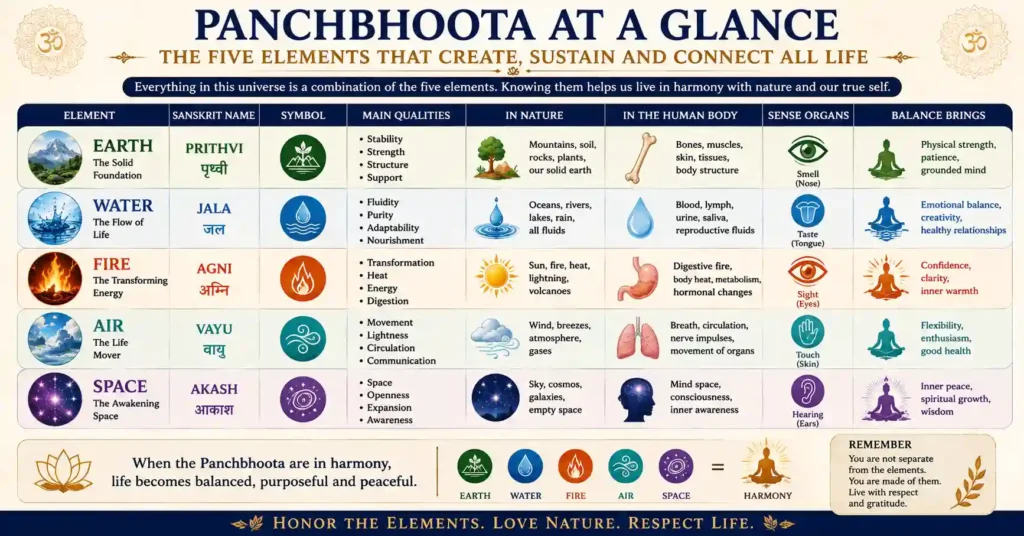
Panchbhoota at a Glance
| Element | Sanskrit Name | Represents |
|---|---|---|
| Earth | Prithvi | Stability and structure |
| Water | Jala | Flow and nourishment |
| Fire | Agni | Energy and transformation |
| Air | Vayu | Movement and vitality |
| Space | Akasha | Openness and awareness |
When you understand Panchbhoota, you are not merely learning an ancient concept. You are discovering a timeless way of seeing the deep connection between yourself, nature, and the universe.
Panchbhoota in Hindu Scriptures
The concept of Panchbhoota is deeply rooted in the sacred literature of Sanatan Dharma. Various scriptures explain how the universe emerges from the Five Elements and how these elements are connected with both creation and human life.
While different texts approach the subject from different perspectives, they collectively emphasize the interconnectedness of nature, the human body, and consciousness.
| Scripture | Contribution to the Understanding of Panchbhoota |
|---|---|
| Vedas | Introduce the foundations of cosmic creation and natural forces |
| Taittiriya Upanishad | Explains the process of creation and the emergence of the elements |
| Chandogya Upanishad | Discusses the unity underlying all forms of existence |
| Bhagavad Gita | Describes the material nature composed of various elements |
| Puranas | Present the Five Elements through stories, symbolism, and devotional teachings |
| Ayurveda Texts | Explain how the Panch Mahabhutas influence health and well-being |
The Bhagavad Gita teaches that the material world operates through different aspects of nature, while the Upanishads explore the deeper relationship between creation and consciousness.
Ayurveda, Yoga, and temple traditions later expanded these teachings into practical systems that continue to influence spiritual and daily life across India.
Together, these sources show that Panchbhoota is not an isolated concept but a foundational principle woven throughout the philosophical, spiritual, and cultural traditions of Sanatan Dharma.
Panchbhoota and the Creation of the Universe
According to the philosophical traditions of Sanatan Dharma, the universe did not emerge randomly. Creation is understood as a gradual unfolding from subtle reality to the visible world.
Ancient texts describe how the material universe manifests through the Panchbhoota or Five Great Elements. These elements become the building blocks of all physical existence.
The process is often explained as a movement from the subtle to the gross.
The Traditional Order of Manifestation
| Stage | Description |
|---|---|
| Akasha (Space) | The first element, providing the field for creation |
| Vayu (Air) | Movement arises within space |
| Agni (Fire) | Energy, light, and transformation emerge |
| Jala (Water) | Fluidity and cohesion develop |
| Prithvi (Earth) | Solid forms and physical structures appear |
This sequence symbolizes how creation gradually becomes more tangible and visible.
The Five Elements are therefore not viewed merely as physical substances. They represent fundamental principles through which the universe expresses itself.
The same process is believed to operate within the human body. Just as the cosmos is formed through the Panch Mahabhutas, the human being is also considered a miniature reflection of the larger universe.
For this reason, many spiritual traditions describe the relationship between the individual and the cosmos as one of deep unity rather than separation.
Panchbhoota and the Cycle of Life and Death
According to Sanatan Dharma, the physical body is formed from the Panchbhoota, and after death, it eventually returns to these same Five Elements.
This teaching highlights the temporary nature of the physical body while emphasizing the eternal nature of the soul (Atman).
Ancient scriptures explain that while the body changes, ages, and eventually perishes, the soul continues its journey beyond physical existence.
Return of the Five Elements
| Element | Return to Nature |
|---|---|
| Earth (Prithvi) | Returns to the earth |
| Water (Jala) | Returns to water sources and moisture |
| Fire (Agni) | Returns through heat and transformation |
| Air (Vayu) | Merges with the atmosphere |
| Space (Akasha) | Remains the field in which all existence unfolds |
This understanding is reflected in many Hindu funeral traditions, where the body is respectfully returned to nature through cremation and related rites.
The philosophy behind these practices is not one of loss alone but of transformation. Just as the elements come together to support life, they eventually return to the larger cycle of creation.
The teachings of Panch Mahabhutas remind us that while physical forms are temporary, nature itself continues in an endless cycle of creation, preservation, and dissolution.
This perspective encourages acceptance, gratitude, and a deeper appreciation of life’s interconnected nature.
The Deeper Meaning of the Five Elements
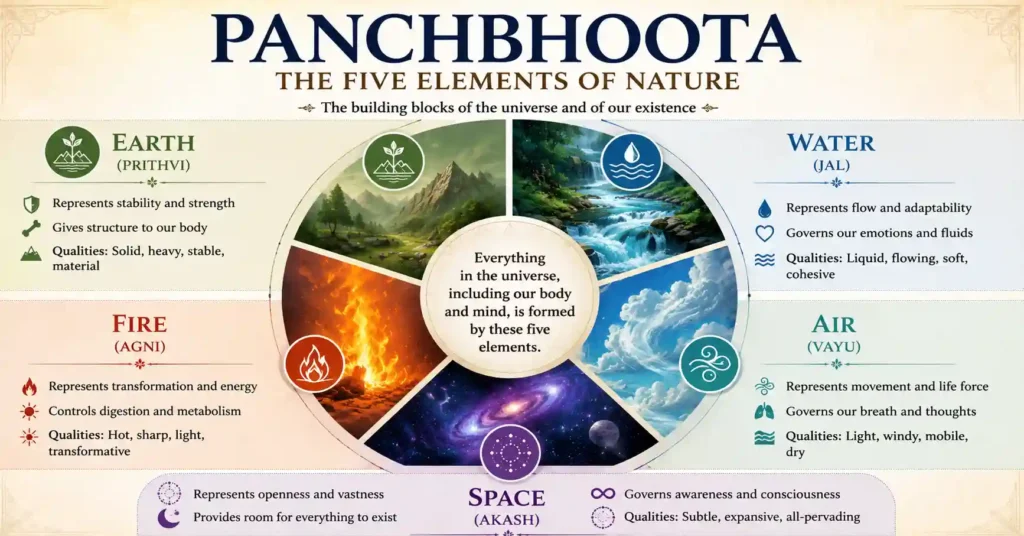
The Panchbhoota are not merely physical substances found in nature. In Sanatan Dharma, they are seen as fundamental energies that shape both the outer world and our inner experience.
Each of the Panch Mahabhutas carries unique qualities that influence the body, mind, emotions, and spiritual life. Understanding these elements helps us better understand ourselves and our relationship with nature.
| Element | Sanskrit Name | Represents | Associated Qualities |
|---|---|---|---|
| Earth | Prithvi | Stability | Strength, grounding, patience |
| Water | Jala | Flow | Emotions, adaptability, nourishment |
| Fire | Agni | Transformation | Energy, digestion, determination |
| Air | Vayu | Movement | Breath, thoughts, creativity |
| Space | Akasha | Openness | Awareness, stillness, expansion |
Earth (Prithvi)
Earth represents stability, structure, and support. It is reflected in the physical body through bones, muscles, and tissues.
When the earth element is balanced, a person feels grounded, secure, and steady. An excess of this element may create heaviness, stubbornness, or resistance to change.
Water (Jala)
Water symbolizes flow, adaptability, and connection. It is associated with emotions, relationships, and the body’s fluids.
A balanced water element promotes compassion and emotional harmony. When disturbed, it may lead to emotional overwhelm, attachment, or instability.
Fire (Agni)
Fire represents transformation and the power to change. It governs digestion, vitality, enthusiasm, and inner strength.
Balanced fire brings clarity, confidence, and purposeful action. Excessive fire can manifest as anger, impatience, or restlessness.
Air (Vayu)
Air symbolizes movement and activity. It is present in breathing, circulation, communication, and the movement of thoughts.
When balanced, air encourages creativity, flexibility, and mental clarity. When imbalanced, it may contribute to anxiety, overthinking, or scattered attention.
Space (Akasha)
Space is the subtlest of the Five Elements. It is not empty nothingness but the field in which all existence unfolds.
Silence, awareness, and inner stillness are associated with the space element. Without space, the other four elements would have no room to exist or interact.
Together, these Five Elements form the foundation of creation. They constantly interact within nature and within us, influencing our physical health, emotional well-being, and spiritual growth. Understanding their deeper meaning allows us to live with greater balance and harmony.
How Panchbhoota Exists Within the Human Body
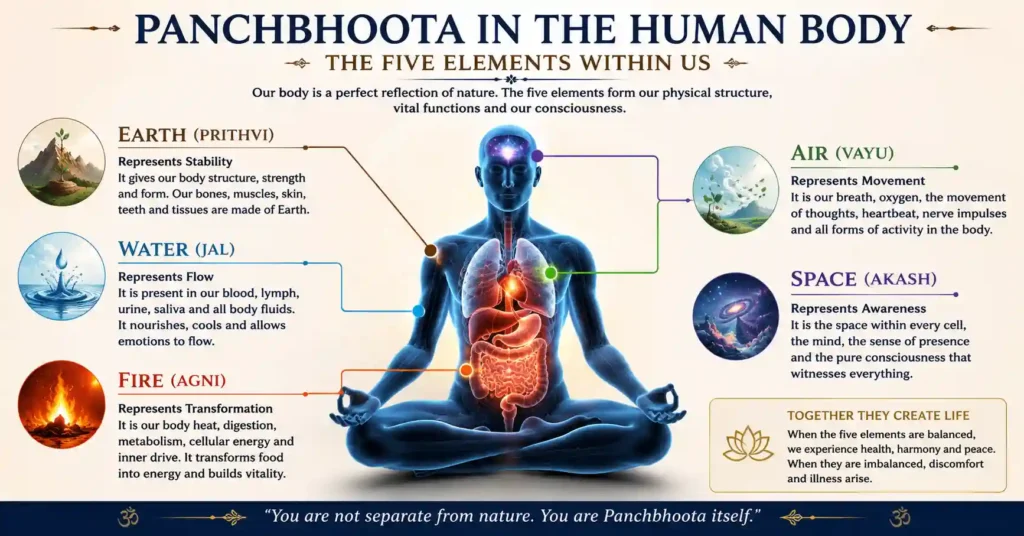
According to Sanatan Dharma, the human body is not separate from nature. It is a living expression of the same Panchbhoota that make up the universe.
The ancient sages taught that the Panch Mahabhutas exist both in the external world and within every individual. This is why the body is often described as a miniature reflection of creation itself.
Each of the Five Elements performs a unique role in maintaining life and supporting physical, mental, and spiritual well-being.
| Element | Presence in the Human Body | Function |
|---|---|---|
| Earth (Prithvi) | Bones, muscles, skin, tissues | Provides structure and stability |
| Water (Jala) | Blood, saliva, lymph, body fluids | Nourishes and supports life |
| Fire (Agni) | Digestion, metabolism, body heat | Enables transformation and energy |
| Air (Vayu) | Breath, circulation, nerve impulses | Supports movement and activity |
| Space (Akasha) | Body cavities, mind, awareness | Creates room for growth and perception |
The earth element gives the body its physical form and strength. It is responsible for stability, endurance, and the feeling of being grounded.
The water element maintains balance through blood, fluids, and nourishment. It helps the body adapt, heal, and sustain life.
The fire element governs digestion, metabolism, and vitality. It transforms food into energy and supports clarity, determination, and action.
The air element is reflected in breathing, circulation, and movement. It allows thoughts, signals, and life-force energy to flow throughout the body.
The space element is the most subtle. It exists in the spaces within the body and is associated with awareness, perception, and consciousness.
This connection between the body and the Five Elements is not merely symbolic. It forms the foundation of many traditional systems, including Ayurveda and Yoga, which teach that physical and mental well-being depend on maintaining harmony among these elemental forces.
When the Panchbhoota remain balanced, life tends to feel healthier, calmer, and more aligned. When they become disturbed, that imbalance may be reflected in both the body and the mind.
Panchbhoota and the Five Senses
According to Sanatan Dharma, the Panchbhoota are not only connected with the physical world but also with the way we experience life through our senses.
Ancient philosophical systems teach that each element is associated with a particular sensory perception. Together, these senses help us interact with the world around us.
Relationship Between the Five Elements and the Senses
| Element | Sense | Perception |
|---|---|---|
| Space (Akasha) | Ear | Sound |
| Air (Vayu) | Skin | Touch |
| Fire (Agni) | Eyes | Sight |
| Water (Jala) | Tongue | Taste |
| Earth (Prithvi) | Nose | Smell |
The element of space is associated with sound because sound travels through space. This is why hearing is linked with Akasha.
The air element relates to touch and movement. The sensation of wind against the skin is a simple example of this connection.
The fire element is associated with sight because light makes vision possible. Without light, the eyes cannot perceive form and color.
The water element relates to taste. Moisture is necessary for the tongue to recognize different flavors.
The earth element is connected with smell because physical substances carry distinct fragrances and scents.
This relationship between the Five Elements and the senses reminds us that every experience is connected to the natural forces that sustain life. It also reflects the holistic view of Sanatan Dharma, where the body, mind, senses, and nature are deeply interconnected.
Why Balance of Panchbhoota Is Important
According to Sanatan Dharma, Ayurveda, and Yoga, health is not simply the absence of illness. True well-being arises when the Panchbhoota, or Five Elements, remain in harmony within the body and mind.
Each element performs a specific role in supporting life. When these elemental forces are balanced, a person naturally experiences greater stability, energy, clarity, and inner peace.
However, when one element becomes excessive or deficient, imbalance can begin to affect physical health, emotions, thoughts, and overall well-being.
| Element | When Balanced | Possible Signs of Imbalance |
|---|---|---|
| Earth (Prithvi) | Stability, strength, patience | Heaviness, sluggishness, resistance to change |
| Water (Jala) | Emotional balance, adaptability | Emotional dryness, attachment, mood fluctuations |
| Fire (Agni) | Energy, confidence, clarity | Anger, irritation, impatience |
| Air (Vayu) | Creativity, flexibility, alertness | Anxiety, overthinking, restlessness |
| Space (Akasha) | Awareness, openness, peace | Feeling disconnected or unfocused |
For example, excessive fire may manifest as anger, frustration, or impatience. Too much air can lead to anxiety, excessive thinking, or mental restlessness.
Similarly, an excess of earth may create feelings of heaviness or lethargy, while an imbalance in water can affect emotional stability and the ability to connect with others.
Ancient healing systems such as Ayurveda focus on restoring balance among the Panch Mahabhutas rather than merely treating symptoms. The goal is to bring the body, mind, and natural rhythms back into harmony.
When the Five Elements remain balanced, life feels more natural. The body functions efficiently, emotions flow more smoothly, and the mind becomes calmer and clearer.
This inner harmony is considered an important foundation for both personal well-being and spiritual growth. In many traditions of Sanatan Dharma, a balanced life begins with a balanced relationship with the Five Elements.
Panchbhoota and Our Daily Life Connection
Many people think the Panchbhoota are ancient philosophical concepts found only in scriptures. In reality, the Five Elements are present in every moment of daily life.
From the air we breathe to the food we eat, our lives constantly interact with the Panch Mahabhutas. Whether we realize it or not, we depend on these elemental forces for our physical, mental, and emotional well-being.
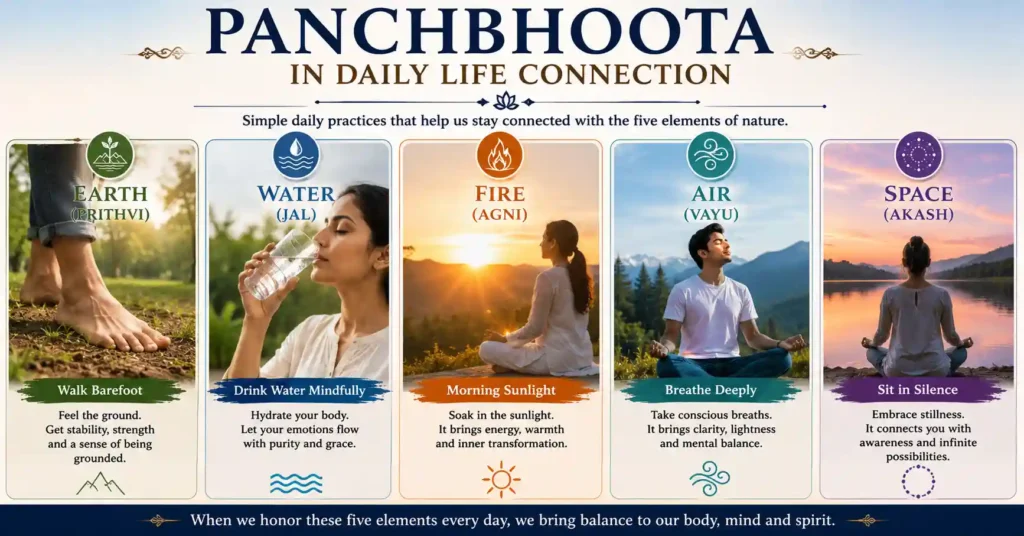
Simple daily activities can help us reconnect with the natural balance of the Five Elements.
| Element | Daily Connection |
|---|---|
| Earth (Prithvi) | Walking barefoot, gardening, spending time in nature |
| Water (Jala) | Drinking water mindfully, rivers, rain, bathing |
| Fire (Agni) | Sunlight, cooking, digestion, warmth |
| Air (Vayu) | Breathing, fresh air, movement, exercise |
| Space (Akasha) | Silence, meditation, reflection, prayer |
Walking barefoot on natural ground can create a sense of stability and connection with the earth element. Spending time among trees, mountains, or gardens often brings a feeling of calm and grounding.
The water element supports life through every sip of water we drink. It also reminds us to remain flexible, adaptable, and emotionally balanced.
The warmth of the sun, the energy generated by digestion, and the flame of a lamp all reflect the presence of the fire element, which symbolizes transformation and vitality.
Every breath connects us to the air element. Deep breathing, physical activity, and time spent in fresh air can help restore clarity and mental balance.
The space element is often overlooked, yet it is present in moments of silence, prayer, meditation, and self-reflection. It creates room for awareness and inner peace.
The truth is that you do not need to search for the Five Elements. You are already living with them every day. Recognizing their presence can help deepen your connection with nature, bring greater mindfulness into daily life, and foster a sense of harmony within yourself and the world around you.
Panchbhoota in Daily Rituals and Traditions
The influence of Panchbhoota can be seen throughout the rituals, festivals, temple traditions, and daily worship practices of Sanatan Dharma. Many customs that have been followed for centuries reflect the presence and symbolism of the Five Elements.
These rituals are not performed merely as customs. They serve as reminders of the relationship between human life, nature, and the divine.
| Element | Ritual Connection | Symbolic Meaning |
|---|---|---|
| Earth (Prithvi) | Prasad, flowers, grains | Nourishment, stability, gratitude |
| Water (Jala) | Abhishek, offering water, holy rivers | Purity, surrender, flow |
| Fire (Agni) | Diya, Aarti, Yajna | Transformation, light, divine energy |
| Air (Vayu) | Incense, chanting, sacred sounds | Movement, life force, devotion |
| Space (Akasha) | Silence, meditation, temple sanctity | Awareness, presence, spiritual connection |
Lighting a diya or participating in Aarti honors the fire element. Fire is seen as a purifier that transforms offerings and symbolizes the light of knowledge that removes ignorance.
Offering water during worship reflects the qualities of the water element. It represents purity, humility, and the continuous flow of life. Sacred rivers such as the Ganga are also revered as expressions of this elemental power.
Prasad, flowers, fruits, and grains symbolize the earth element, reminding devotees of nature’s abundance and the importance of gratitude for all forms of nourishment.
The fragrance of incense spreading through the air reflects the air element. It symbolizes the subtle movement of prayers, devotion, and positive vibrations.
The space element is experienced in the silence of a temple, during meditation, or in moments of prayerful stillness. It creates the inner environment where awareness and spiritual reflection can arise.
Seen through the lens of the Panch Mahabhutas, these rituals become more than religious practices. They serve as a bridge between the individual, nature, and the Divine, reminding devotees that the same Five Elements present in the universe also exist within every human being.
Sacred Panchbhoota Temples of Shiva and Their Locations
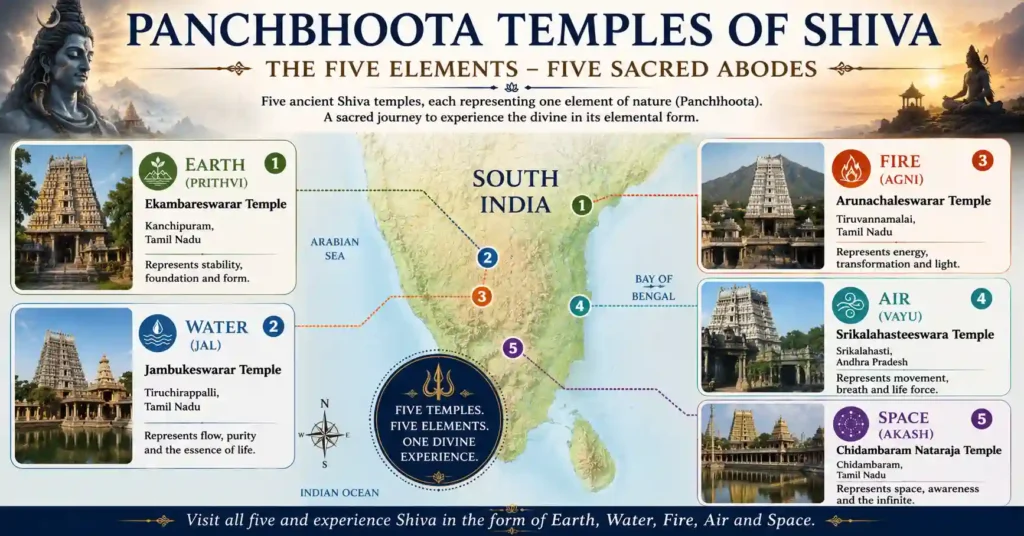
One of the most remarkable expressions of Panchbhoota in Sanatan Dharma is found in the Panch Bhoota Sthalams, five ancient Shiva temples in South India that are dedicated to the Five Elements of Nature.
In these sacred temples, Lord Shiva is worshipped as the embodiment of Earth, Water, Fire, Air, and Space. Together, these temples symbolize the belief that the entire universe is sustained by the Panch Mahabhutas.
The Five Panchbhoota Temples
| Element | Temple | Location |
|---|---|---|
| Earth (Prithvi) | Ekambareswarar Temple | Kanchipuram, Tamil Nadu |
| Water (Jala) | Jambukeswarar Temple | Tiruchirappalli, Tamil Nadu |
| Fire (Agni) | Arunachaleswarar Temple | Tiruvannamalai, Tamil Nadu |
| Air (Vayu) | Srikalahasteeswara Temple | Srikalahasti, Andhra Pradesh |
| Space (Akasha) | Chidambaram Nataraja Temple | Chidambaram, Tamil Nadu |
Each temple highlights a specific element through its traditions, legends, architecture, and forms of worship.
The Ekambareswarar Temple represents the earth element and is associated with stability, fertility, and the nurturing power of nature.
The Jambukeswarar Temple symbolizes water and is known for a sacred underground stream that continuously flows near the Shiva Linga.
The Arunachaleswarar Temple represents fire and is closely associated with Lord Shiva’s infinite pillar of light. The famous Karthigai Deepam festival celebrates this connection.
The Srikalahasteeswara Temple is dedicated to the air element. It is renowned for a lamp flame that is said to flicker continuously despite the absence of noticeable airflow.
The Chidambaram Nataraja Temple represents space, the most subtle of the Five Elements. Here, Lord Shiva is worshipped as Nataraja, the Cosmic Dancer, symbolizing the infinite nature of consciousness and creation.
These temples are not merely places of worship. They are living representations of the Five Elements and remind devotees of the deep connection between the divine, nature, and human life.
For many pilgrims, visiting the Panch Bhoota Sthalams is also a spiritual journey through the elemental forces that shape both the universe and the human experience.
Did You Know?
According to temple traditions, the Panch Bhoota Sthalams represent the Five Elements in their purest form.
Together, these sacred Shiva temples symbolize the belief that the entire universe is permeated by the Divine through Earth, Water, Fire, Air, and Space.
Panchbhoota and the Chakra Connection
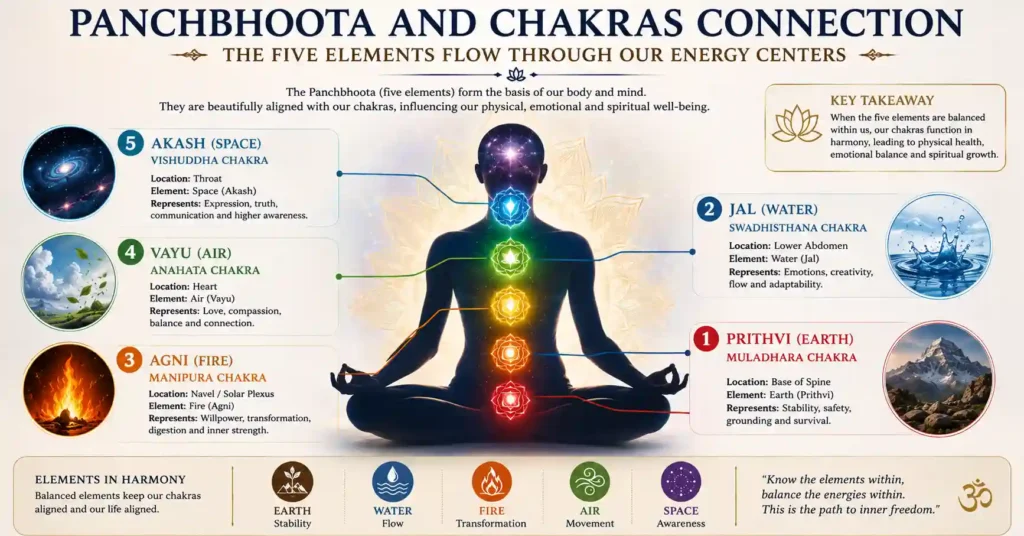
In Yogic traditions, the Panchbhoota are closely connected with the chakra system, the energy centers believed to influence physical, emotional, and spiritual well-being.
Each of the Five Elements is associated with a particular chakra and represents specific qualities that shape our thoughts, emotions, and actions. When these energies are balanced, they support harmony within the body and mind.
Panchbhoota and Chakras
| Element | Chakra | Location | Represents |
|---|---|---|---|
| Earth (Prithvi) | Muladhara (Root Chakra) | Base of the spine | Stability, security, grounding |
| Water (Jala) | Swadhisthana (Sacral Chakra) | Lower abdomen | Emotions, creativity, relationships |
| Fire (Agni) | Manipura (Solar Plexus Chakra) | Navel region | Confidence, energy, transformation |
| Air (Vayu) | Anahata (Heart Chakra) | Center of the chest | Love, compassion, balance |
| Space (Akasha) | Vishuddha (Throat Chakra) | Throat region | Expression, awareness, communication |
The earth element is linked to the Root Chakra and provides a sense of stability and connection with the physical world. A balanced earth element helps a person feel secure and grounded.
The water element corresponds to the Sacral Chakra and influences emotions, creativity, and adaptability. It encourages healthy emotional expression and meaningful relationships.
The fire element is associated with the Solar Plexus Chakra, the center of personal power and transformation. It supports confidence, motivation, and determination.
The air element relates to the Heart Chakra and symbolizes love, compassion, and emotional balance. It helps create harmony in relationships and encourages openness toward others.
The space element is connected with the Throat Chakra and represents openness, awareness, and communication. It provides the inner space needed for self-expression and spiritual growth.
While different yogic traditions may offer varying interpretations, the underlying principle remains the same: the Panch Mahabhutas influence the flow of energy within the body. Becoming aware of this connection can help cultivate greater balance, self-awareness, and inner harmony.
Panchbhoota and Yoga
Yoga teaches that the human body and the natural world are governed by the same Panchbhoota or Five Elements. For this reason, many yogic practices aim to bring these elemental energies into balance.
According to yogic philosophy, physical health, mental clarity, and spiritual growth become easier when the Panch Mahabhutas function harmoniously within the body.
Practices such as asanas, pranayama, meditation, and mindfulness help cultivate awareness of these elemental forces.
| Yogic Practice | Elemental Connection |
|---|---|
| Grounding Asanas | Earth (Prithvi) |
| Fluid Movements | Water (Jala) |
| Core Strength Practices | Fire (Agni) |
| Pranayama | Air (Vayu) |
| Meditation | Space (Akasha) |
Pranayama, or conscious breath control, is especially associated with the air element because breath is considered the carrier of life force or Prana.
Meditation helps cultivate the qualities of Akasha, creating inner space, silence, and awareness beyond constant mental activity.
Many yogic traditions also include practices such as Bhuta Shuddhi, which means purification of the elements. These practices are intended to harmonize the Five Elements and support spiritual development.
The ultimate goal is not merely physical fitness but a deeper experience of balance, self-awareness, and unity with the natural order of life.
Panchbhoota in Ayurveda and Health
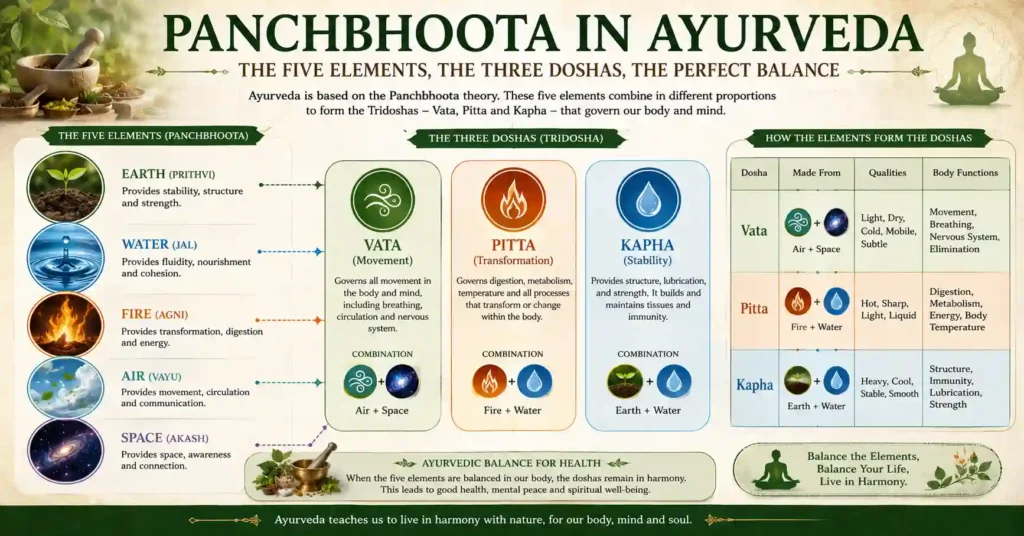
In Ayurveda, the ancient system of holistic healing, the Panchbhoota or Five Elements form the foundation of the human body and the natural world. According to Ayurvedic wisdom, everything in creation is composed of varying combinations of Earth, Water, Fire, Air, and Space.
These elements combine to create the three Doshas or biological energies that govern physical and mental functions. The balance of these doshas is considered essential for maintaining good health and overall well-being.
Panchbhoota and the Three Doshas
| Dosha | Elements | Primary Functions |
|---|---|---|
| Vata | Air + Space | Movement, breathing, circulation, nervous system |
| Pitta | Fire + Water | Digestion, metabolism, energy production |
| Kapha | Earth + Water | Structure, strength, stability, nourishment |
The Vata Dosha is formed by the Air and Space elements and is responsible for movement within the body, including breathing, circulation, and communication between the nervous system and organs.
The Pitta Dosha arises from Fire and Water. It governs digestion, metabolism, body temperature, and the body’s ability to transform food into energy.
The Kapha Dosha is created by Earth and Water. It provides stability, strength, lubrication, and support for bodily tissues.
According to Ayurveda, health is not merely the absence of disease. True wellness occurs when the Panch Mahabhutas and the doshas remain in balance. When this harmony is disturbed, physical discomfort, emotional stress, or mental imbalance may gradually develop.
For this reason, traditional Ayurvedic healing focuses on restoring balance through proper diet, lifestyle, daily routines, herbal remedies, and mindful living rather than simply addressing symptoms.
The Ayurvedic understanding of Panchbhoota highlights a profound idea: human health and the health of nature are deeply interconnected. When we live in harmony with the Five Elements, we naturally move closer to balance, vitality, and well-being.
Panchbhoota and Nature's Rhythm
The Panchbhoota are not static forces. They are constantly active in nature, shaping the rhythms of life and creation.
The earth remains steady beneath our feet. Water flows through rivers and oceans. Fire transforms and renews. Air moves continuously across the world, while space provides the vast field in which everything exists.
Nature operates through the dynamic interaction of these Five Elements. Seasons change, plants grow, rivers flow, and life evolves through their constant balance and movement.
| Element | Natural Expression | Life Lesson |
|---|---|---|
| Earth (Prithvi) | Mountains, soil, forests | Stability and patience |
| Water (Jala) | Rivers, rain, oceans | Adaptability and flow |
| Fire (Agni) | Sunlight, heat, transformation | Growth and change |
| Air (Vayu) | Wind, breath, movement | Flexibility and freedom |
| Space (Akasha) | Sky, silence, vastness | Awareness and acceptance |
Human life follows a similar rhythm.
Some days feel steady and grounded like the earth element. At other times, life flows smoothly like water, bringing change and new experiences.
There are moments filled with enthusiasm and determination, reflecting the energy of fire. At other times, thoughts move rapidly like air, creating activity and movement within the mind.
Then there are moments of silence and reflection that resemble space, reminding us that stillness is also a natural part of life.
Understanding the rhythm of the Panch Mahabhutas helps us see that change is not something to fear. Just as nature moves through different seasons and cycles, human life also passes through periods of growth, transformation, activity, and rest.
When we recognize this natural flow, we become less resistant to change and more accepting of life’s experiences. In this way, the wisdom of the Five Elements teaches not only how nature works but also how to live with greater balance, patience, and harmony.
Panchbhoota and Environmental Awareness
The wisdom of Panchbhoota teaches that human beings are not separate from nature. The same Five Elements that exist within us also exist in rivers, forests, mountains, oceans, and the sky.
This understanding encourages a sense of responsibility toward the natural world. When nature is respected, the balance of the elements is preserved. When it is harmed, that balance is disturbed.
For example, polluted water affects the water element, poor air quality impacts the air element, and environmental destruction weakens the connection between humans and the natural world.
Ancient traditions often viewed nature not as a resource to be exploited but as something sacred and worthy of respect.
| Element | Environmental Connection |
|---|---|
| Earth (Prithvi) | Soil, forests, mountains, agriculture |
| Water (Jala) | Rivers, lakes, rainfall, oceans |
| Fire (Agni) | Sunlight, energy, transformation |
| Air (Vayu) | Wind, atmosphere, breath of life |
| Space (Akasha) | Vastness of nature and cosmic order |
The teachings of Panch Mahabhutas remind us that caring for nature is also a way of caring for ourselves. The health of the environment and the well-being of humanity are deeply interconnected.
Even small actions such as conserving water, planting trees, reducing waste, and living mindfully reflect the spirit of harmony that lies at the heart of the Five Elements.
Panchbhoota and Inner Awareness
The wisdom of Panchbhoota is not limited to understanding nature. It also offers a way to better understand ourselves.
When you begin to observe the Five Elements in daily life, you naturally become more aware of your inner state. You start noticing how your thoughts, emotions, energy, and reactions change from moment to moment.
For example, your breath often changes with your state of mind. During stress or anxiety, breathing may become fast and shallow. During calm moments, it becomes slow and steady.
Similarly, emotions rise and fall like the water element, while motivation and determination can feel strong and intense like fire. At times, you may feel grounded and stable like earth, and at other times restless and constantly moving like air.
| Element | Inner Experience |
|---|---|
| Earth (Prithvi) | Stability, patience, groundedness |
| Water (Jala) | Emotions, adaptability, sensitivity |
| Fire (Agni) | Motivation, confidence, determination |
| Air (Vayu) | Thoughts, movement, creativity |
| Space (Akasha) | Silence, awareness, inner stillness |
One of the most profound aspects of the Panch Mahabhutas is the element of space (Akasha). It represents the quiet awareness that exists behind thoughts and emotions.
There are moments when the mind becomes still, and for a brief time, there is no struggle, no distraction, and no need to control anything. In many spiritual traditions, this inner stillness is considered a doorway to deeper awareness.
As you become more conscious of the Five Elements within yourself, you begin to observe your experiences rather than react to them automatically. This simple shift can bring greater clarity, acceptance, and emotional balance.
The teachings of Panchbhoota remind us that every feeling, thought, and experience is part of a natural process. When we understand this, we spend less time fighting ourselves and more time understanding ourselves.
A Simple Scientific Reflection
While Panchbhoota is a spiritual and philosophical concept, some of its observations can be appreciated from a modern perspective as well.
The human body contains minerals and physical structures that reflect the earth element. A large portion of the body is composed of water, while body heat and metabolic processes resemble the transformative nature of fire.
Life depends on oxygen and breathing, which relate to the air element, and all physical existence takes place within space.
| Element | Modern Reflection |
|---|---|
| Earth (Prithvi) | Bones, minerals, physical structure |
| Water (Jala) | Blood, fluids, hydration |
| Fire (Agni) | Body heat, metabolism, energy production |
| Air (Vayu) | Breathing, oxygen exchange |
| Space (Akasha) | Physical space and the body’s internal cavities |
It is important to remember that the Panch Mahabhutas are not scientific elements in the modern chemical sense. Rather, they are a traditional framework used to understand the relationship between nature, the human body, and consciousness.
Whether viewed through a spiritual lens or as a symbolic way of understanding life, the Five Elements continue to offer valuable insights into the interconnectedness of all existence.
The Spiritual Connection of Panchbhoota
In Sanatan Dharma, the teachings of Panchbhoota extend beyond the physical world. They also offer a deeper understanding of our spiritual nature and our connection with the universe.
The Five Elements are believed to shape the body and influence the mind, but the true purpose of this knowledge is to help us move beyond identification with the physical world and recognize the deeper reality that exists within.
When the Panch Mahabhutas remain balanced, the mind naturally becomes calmer and more focused. As mental restlessness decreases, awareness becomes clearer and inner peace arises more easily.
There are moments when a person feels peaceful without any obvious reason. In such moments, there is less mental noise and greater presence. Many spiritual traditions describe this state as a glimpse of one’s deeper nature.
| Element | Spiritual Quality |
|---|---|
| Earth (Prithvi) | Stability and patience |
| Water (Jala) | Compassion and emotional balance |
| Fire (Agni) | Transformation and inner strength |
| Air (Vayu) | Freedom and openness |
| Space (Akasha) | Awareness and spiritual expansion |
The element of space (Akasha) holds special significance because it represents openness, silence, and the vast field of awareness in which all experiences arise. It reminds us that beyond changing thoughts and emotions, there is a deeper stillness within.
The wisdom of Panch Tatva teaches that human beings are not separate from nature. The same elements that exist in mountains, rivers, forests, and the sky also exist within us.
As this understanding deepens, spirituality becomes less about seeking something outside and more about recognizing the connection that has always been present.
In this way, Panchbhoota serves as a bridge between the outer world and the inner self, guiding us toward greater harmony, self-awareness, and a deeper appreciation of the unity of all life
Simple Ways to Balance Panchbhoota in Daily Life
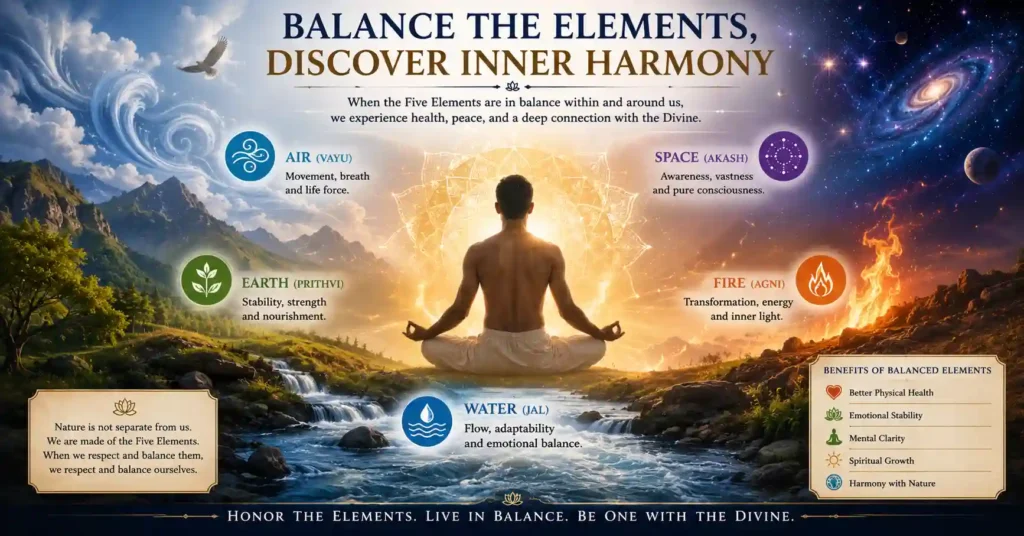
The wisdom of Panchbhoota is not meant to remain a philosophical concept. It can be applied through simple daily habits that help maintain harmony between the body, mind, and nature.
Small, mindful actions performed regularly can strengthen your connection with the Five Elements and promote a greater sense of balance and well-being.
| Element | Simple Practice | Benefit |
|---|---|---|
| Earth (Prithvi) | Walk barefoot on grass or soil | Promotes grounding and stability |
| Water (Jala) | Drink water mindfully and stay hydrated | Supports balance and emotional flow |
| Fire (Agni) | Spend time in gentle sunlight | Encourages vitality and energy |
| Air (Vayu) | Practice deep breathing or pranayama | Calms the mind and improves focus |
| Space (Akasha) | Sit quietly in silence or meditation | Enhances awareness and inner peace |
Spending time in nature is one of the simplest ways to reconnect with the Panch Mahabhutas. A walk in a garden, forest, or park can help restore a sense of harmony and calm.
Drinking water consciously can remind us of the importance of flow, adaptability, and nourishment in daily life.
A few minutes of sunlight each day can help us appreciate the transformative energy represented by the fire element. Similarly, mindful breathing helps strengthen our connection with the air element, which is associated with movement and vitality.
Creating moments of silence through prayer, meditation, or quiet reflection allows us to experience the spaciousness of Akasha, the element of awareness and inner stillness.
These practices may seem simple, but their impact can be profound. The teachings of Panchbhoota remind us that balance is often found not through dramatic changes, but through small acts of awareness practiced consistently in everyday life.
Key Takeaways
- Panchbhoota refers to the Five Fundamental Elements: Earth, Water, Fire, Air, and Space.
- These Panch Mahabhutas are considered the building blocks of the universe and the human body in Sanatan Dharma.
- The Five Elements influence physical health, emotions, mental balance, and spiritual growth.
- Ayurveda uses the Panchbhoota concept to explain the formation of the three doshas: Vata, Pitta, and Kapha.
- Yogic traditions connect the Five Elements with chakras, energy balance, and inner awareness.
- The famous Panch Bhoota Sthalams of Lord Shiva symbolize the sacred presence of each element.
- Hindu rituals, worship practices, and festivals often reflect the symbolism of the Five Elements.
- Understanding Panchbhoota encourages harmony with nature, mindfulness in daily life, and a deeper appreciation of the interconnectedness of all existence.
Conclusion
The wisdom of Panchbhoota teaches that the Five Elements are not distant concepts found only in ancient scriptures. They are present in every aspect of life, from the breath we take and the water we drink to the thoughts we think and the space we inhabit.
In Sanatan Dharma, the Panch Mahabhutas form the foundation of creation and influence the body, mind, emotions, and spiritual journey. They remind us that human beings and nature are deeply interconnected.
Understanding the Five Elements helps us see life from a broader perspective. It encourages balance, mindfulness, gratitude, and a deeper appreciation of the natural world around us.
You do not need to master complex philosophies to benefit from this wisdom. Simply becoming aware of the presence of Earth, Water, Fire, Air, and Space in daily life can be a powerful first step.
The moment you become aware of your breath, your body, and your surroundings, you begin to reconnect with something timeless and natural.
You are not separate from nature. You are an expression of Panchbhoota itself.
Suggested Reading
The wisdom of Panchbhoota is closely connected with many other teachings of Sanatan Dharma. If you would like to deepen your understanding of nature, spirituality, self-awareness, and the path to inner balance, the following articles may be helpful.
Karma Yoga: Meaning, Principles and How to Practice It
https://thesanatantales.com/karma-yoga-meaning/Sattva, Rajas and Tamas: Understanding the Three Gunas
https://thesanatantales.com/sattva-rajas-tamas/Purusharthas: The Four Goals of Human Life in Sanatan Dharma
https://thesanatantales.com/purusharthas/Ahankara: Ego in Spiritual Life, Meaning & How to Overcome It
https://thesanatantales.com/ahankara-meaning/Sthitpragya: Meaning, Qualities and Bhagavad Gita Teachings
https://thesanatantales.com/sthitpragya-meaning/Does the Soul Choose Its Next Journey? Rebirth, Karma & Consciousness
https://thesanatantales.com/silence-and-awareness-connection/Sanatan Dharma: Meaning, Origin, Core Principles and Way of Life
https://thesanatantales.com/what-is-dharma/
Pancha Bhuta (Wikipedia)
https://en.wikipedia.org/wiki/Pancha_Bhuta
FAQs
What is Panchbhoota in Sanatan Dharma?
Panchbhoota refers to the five fundamental elements of nature that form the basis of all creation according to Sanatan Dharma. The word comes from two Sanskrit terms: Pancha meaning five and Bhuta meaning elements or fundamental substances.
These five elements are Earth (Prithvi), Water (Jala), Fire (Agni), Air (Vayu), and Space (Akasha). Ancient scriptures teach that everything in the universe, including the human body, is composed of these elements in different proportions.
The concept of Panchbhoota is found in the Upanishads, Puranas, Yoga, Ayurveda, and various spiritual traditions. It helps explain the connection between nature, the body, the mind, and spiritual growth.
What are the five elements of Panchbhoota?
The five elements of Panchbhoota are Earth, Water, Fire, Air, and Space. Each element represents a unique quality that supports life and creation.
Earth (Prithvi) represents stability, structure, and strength.
Water (Jala) represents flow, nourishment, and emotions.
Fire (Agni) represents energy, transformation, and digestion.
Air (Vayu) represents movement, breath, and communication.
Space (Akasha) represents openness, awareness, and the field in which everything exists.
Together, these Five Elements create balance and maintain harmony in both nature and human life.
How does Panchbhoota relate to the human body?
According to Sanatan Dharma and Ayurveda, the human body is a reflection of the same Five Elements that exist in nature.
The earth element is seen in bones, muscles, and tissues. Water exists in blood, lymph, and body fluids. Fire governs digestion, metabolism, and body heat. Air controls breathing, circulation, and movement. Space exists in the body’s cavities and is associated with awareness and perception.
This understanding explains why changes in nature can influence physical and emotional well-being. It also forms the basis of many traditional healing practices.
Why is balance among the Five Elements important?
The balance of Panchbhoota is considered essential for physical health, emotional stability, mental clarity, and spiritual well-being.
When the elements remain in harmony, a person often feels energetic, calm, focused, and emotionally balanced. However, an excess or deficiency of a particular element may contribute to imbalance.
For example, too much fire may lead to irritability or anger, while excessive air may create restlessness or anxiety. Traditional systems such as Ayurveda focus on restoring elemental balance to support overall wellness.
What is the connection between Panchbhoota and Ayurveda?
Ayurveda is deeply rooted in the concept of Panchbhoota. The Five Elements combine to form the three doshas: Vata, Pitta, and Kapha.
Vata is formed by Air and Space, Pitta by Fire and Water, and Kapha by Earth and Water. These doshas regulate various functions of the body and mind.
Ayurvedic treatments, dietary recommendations, and lifestyle practices are designed to maintain balance among these elemental energies and promote long-term health.
What are the Panch Bhoota Sthalams?
The Panch Bhoota Sthalams are five ancient Shiva temples in South India, each dedicated to one of the Five Elements.
These sacred temples are:
- Ekambareswarar Temple (Earth) in Kanchipuram
- Jambukeswarar Temple (Water) in Tiruchirappalli
- Arunachaleswarar Temple (Fire) in Tiruvannamalai
- Srikalahasteeswara Temple (Air) in Srikalahasti
- Chidambaram Nataraja Temple (Space) in Chidambaram
Together, these temples symbolize the presence of Lord Shiva in the elemental forces that sustain creation.
How are Panchbhoota and chakras connected?
In Yogic traditions, each element is associated with a specific energy center or chakra within the body.
The Earth element is linked with the Root Chakra, Water with the Sacral Chakra, Fire with the Solar Plexus Chakra, Air with the Heart Chakra, and Space with the Throat Chakra.
This relationship helps explain how physical, emotional, and spiritual energies interact. Many meditation and yoga practices focus on balancing these elemental energies to improve overall well-being.
How can I balance Panchbhoota in daily life?
Balancing the Five Elements does not always require complex spiritual practices. Small daily habits can help create greater harmony.
Spending time in nature can strengthen the earth element. Drinking enough water supports the water element. Moderate sunlight nourishes the fire element. Deep breathing practices connect with the air element. Meditation and moments of silence help cultivate the space element.
Consistent awareness of these simple practices can gradually bring balance to the body and mind.
Is Panchbhoota a scientific concept?
Panchbhoota is primarily a spiritual and philosophical framework rather than a scientific classification of matter.
However, many people find symbolic similarities between the Five Elements and modern observations about the human body. For example, the body contains minerals, water, heat, breath, and physical spaces.
While the concept should not be viewed as modern science, it remains an influential way of understanding the relationship between nature, health, and consciousness.
What is the spiritual significance of Panchbhoota?
The spiritual significance of Panchbhoota lies in its teaching that human beings are not separate from nature. The same elements that exist in mountains, rivers, forests, and the sky also exist within every person.
This understanding encourages humility, self-awareness, and a deeper appreciation for the interconnectedness of life.
Many spiritual traditions teach that when the Five Elements are balanced, the mind becomes calmer and awareness expands naturally. As a result, Panchbhoota is often viewed as a bridge between the physical world and spiritual realization.
Glossary of Important Terms
| Term | Meaning |
|---|---|
| Panchbhoota | The five fundamental elements of nature in Sanatan Dharma: Earth, Water, Fire, Air, and Space. |
| Pancha Mahabhutas | Sanskrit term meaning the “Five Great Elements” that form the basis of creation and human existence. |
| Prithvi | The Earth element, representing stability, strength, structure, and grounding. |
| Jala (Jal) | The Water element, representing flow, nourishment, adaptability, and emotions. |
| Agni | The Fire element, representing energy, transformation, digestion, and vitality. |
| Vayu | The Air element, representing movement, breath, circulation, and mental activity. |
| Akasha (Akash) | The Space element, representing openness, awareness, sound, and the field in which everything exists. |
| Sanatan Dharma | The eternal spiritual tradition commonly known as Hinduism, emphasizing harmony between the individual, nature, and the Divine. |
| Ayurveda | The ancient Indian system of holistic healing based on balancing the body’s natural energies and the Five Elements. |
| Dosha | The three biological energies in Ayurveda: Vata, Pitta, and Kapha, formed from combinations of the Five Elements. |
| Vata Dosha | The Ayurvedic energy formed by Air and Space, governing movement, breathing, and the nervous system. |
| Pitta Dosha | The Ayurvedic energy formed by Fire and Water, governing digestion, metabolism, and transformation. |
| Kapha Dosha | The Ayurvedic energy formed by Earth and Water, governing structure, stability, and nourishment. |
| Chakra | An energy center in Yogic traditions believed to influence physical, emotional, and spiritual well-being. |
| Muladhara Chakra | The Root Chakra associated with the Earth element and feelings of stability and security. |
| Swadhisthana Chakra | The Sacral Chakra associated with the Water element, emotions, creativity, and relationships. |
| Manipura Chakra | The Solar Plexus Chakra associated with the Fire element, confidence, and personal power. |
| Anahata Chakra | The Heart Chakra associated with the Air element, love, compassion, and emotional balance. |
| Vishuddha Chakra | The Throat Chakra associated with the Space element, communication, and self-expression. |
| Panch Bhoota Sthalams | Five sacred Shiva temples in South India, each representing one of the Five Elements. |
| Bhuta Shuddhi | A Yogic and spiritual practice aimed at purifying and balancing the Five Elements within the body. |
| Prana | The vital life force or energy that flows through all living beings and is closely connected with breath. |
| Meditation | A spiritual practice of focused awareness used to calm the mind and cultivate inner balance. |
| Yoga | A spiritual discipline that seeks harmony between body, mind, and consciousness through various practices. |
| Consciousness | The state of awareness that allows a person to perceive, experience, and understand reality. |
| Inner Awareness | The ability to observe thoughts, emotions, and experiences with mindfulness and clarity. |
About the Author
Yateendra Chaturvedi is a spiritual writer, researcher, devotee, and the founder of The Sanatan Tales. With over 35 years of professional experience and a lifelong interest in Sanatan Dharma, he writes about Hindu deities, temples, scriptures, festivals, Mahavidyas, sacred stories, rituals, and living traditions that continue to guide and inspire devotees across India.
Drawing from traditional scriptures, regional beliefs, temple traditions, devotional literature, and historical sources, he aims to present authentic, well-researched, and easy-to-understand content for modern readers. His work focuses on preserving spiritual wisdom, explaining sacred traditions, and helping seekers develop a deeper understanding of India’s rich spiritual heritage.
Through The Sanatan Tales, Yateendra strives to make the timeless teachings of Sanatan Dharma simple, meaningful, and relevant for today’s generation while maintaining respect for traditional sources, regional practices, and diverse spiritual perspectives.
Learn More About Yateendra Chaturvedi →
https://thesanatantales.com/about-the-author/
References & Sources
This article is based on teachings, concepts, and interpretations found in various scriptures, philosophical traditions, spiritual texts, and cultural practices associated with Sanatan Dharma. It also draws upon traditional knowledge preserved through generations of teachers, practitioners, and devotional communities.
The content has been presented in a simple and accessible manner to help readers understand the topic from a spiritual, philosophical, and cultural perspective.
Note: Beliefs, interpretations, and practices may vary across different traditions, sects, lineages, and schools of thought within Sanatan Dharma. The purpose of this article is to provide general information and spiritual insights, not to establish any single interpretation as the only authoritative view. Readers are encouraged to explore original scriptures and seek guidance from qualified teachers for deeper understanding.
Read More Interesting Articles on Sanatan Dharma