Artha in Sanatan Dharma is one of the most important yet often misunderstood concepts in Hindu philosophy. Many people associate spirituality with renunciation and simplicity, leading them to wonder whether wealth and spiritual growth can truly go together. However, Sanatan Dharma presents a more balanced view of life.
In Hindu philosophy, Artha in Sanatan Dharma refers to the pursuit of material well-being, prosperity, security, and resources needed to fulfill one’s responsibilities. It is recognized as one of the four Purusharthas, or fundamental goals of human life, alongside Dharma, Kama, and Moksha.
Rather than rejecting wealth, Sanatan Dharma teaches that wealth should be earned ethically, used responsibly, and guided by Dharma. When understood correctly, Artha in Sanatan Dharma supports family life, social stability, charitable actions, and even spiritual progress.
The confusion often arises when people mistake wealth for greed or attachment. Hindu teachings do not condemn prosperity itself. Instead, they caution against becoming controlled by desires, ego, or excessive attachment to possessions.
In this article, you will learn what Artha in Sanatan Dharma means, why it is considered one of the four Purusharthas, how it relates to Dharma and Moksha, what Hindu scriptures say about wealth, and how prosperity and spirituality can coexist in a balanced and meaningful life.
By understanding Artha in Sanatan Dharma, we gain a deeper appreciation of how Sanatan Dharma encourages both material responsibility and inner growth, creating harmony between worldly success and spiritual wisdom.
Artha in Sanatan Dharma at a Glance
| Aspect | Overview |
|---|---|
| Meaning of Artha | Material prosperity, resources, security, and worldly well-being |
| Place in Hindu Philosophy | One of the Four Purusharthas (life goals) |
| Related Concepts | Dharma, Kama, Moksha |
| Main Purpose | Supporting a responsible and balanced life |
| Scriptural Basis | Mentioned in Dharma Shastras, Mahabharata, Arthashastra, and other Hindu texts |
| Spiritual View | Wealth is accepted when guided by Dharma |
| Ideal Example | King Janaka, the enlightened ruler |
| Key Teaching | Earn ethically, use responsibly, remain unattached |
Did You Know?
- Artha is one of the four Purusharthas, the fundamental goals of human life in Hindu philosophy.
- The word Artha includes not only wealth but also resources, security, influence, and material well-being.
- Sanatan Dharma does not reject prosperity; it teaches that wealth should be earned and used according to Dharma.
- Ancient Hindu texts such as the Mahabharata and Arthashastra discuss the importance of Artha for both individuals and society.
- King Janaka is often cited as an example of someone who possessed great wealth while remaining spiritually enlightened.
- Artha is considered a support for Dharma, family responsibilities, charity, and social stability.
Table of Contents
ToggleWhat Is Artha in Sanatan Dharma?
Artha in Sanatan Dharma refers to the pursuit of material well-being, prosperity, resources, security, and the means required to live a responsible life. It is one of the four Purusharthas, the fundamental goals of human life in Hindu philosophy.
The concept of Artha goes beyond money alone. It includes wealth, education, skills, influence, livelihood, and all resources that help an individual fulfill personal, family, and social responsibilities.
Sanatan Dharma recognizes that material needs are a natural part of human life. Therefore, Artha is not viewed as something negative or unspiritual. Instead, it is considered an essential support for living with dignity, stability, and purpose.
However, Artha in Sanatan Dharma is meant to be guided by Dharma. Wealth and success should be acquired through honest means and used in ways that benefit both the individual and society.
When pursued with wisdom and balance, Artha becomes a tool for supporting family, serving others, performing charitable acts, and creating the stability needed for spiritual growth.
This understanding shows that Sanatan Dharma does not reject prosperity. Rather, it teaches that material success and inner development can coexist when wealth is guided by ethical principles and higher values.
What Does the Word Artha Mean?
The word Artha comes from Sanskrit and broadly means “meaning,” “purpose,” “value,” or “that which is sought.” In everyday life, it is often associated with wealth, resources, and material prosperity, but its meaning is much wider than money alone.
In the context of Artha in Sanatan Dharma, the term refers to all the resources and means that help a person live a stable, productive, and responsible life. This includes wealth, livelihood, knowledge, skills, influence, and social standing.
Ancient Hindu texts recognize that human beings require food, shelter, security, education, and economic stability to fulfill their duties. Artha represents the legitimate pursuit of these necessities through righteous means.
The deeper meaning of Artha in Sanatan Dharma is not accumulation for its own sake. Rather, it is the responsible acquisition and use of resources that support Dharma, family obligations, social welfare, and personal growth.
Because Artha also means “purpose” or “meaning,” some scholars explain that it reflects not only what a person possesses but also what gives direction and value to life. This broader understanding makes Artha an important part of a balanced and meaningful existence.
Why Is Artha One of the Four Purusharthas?
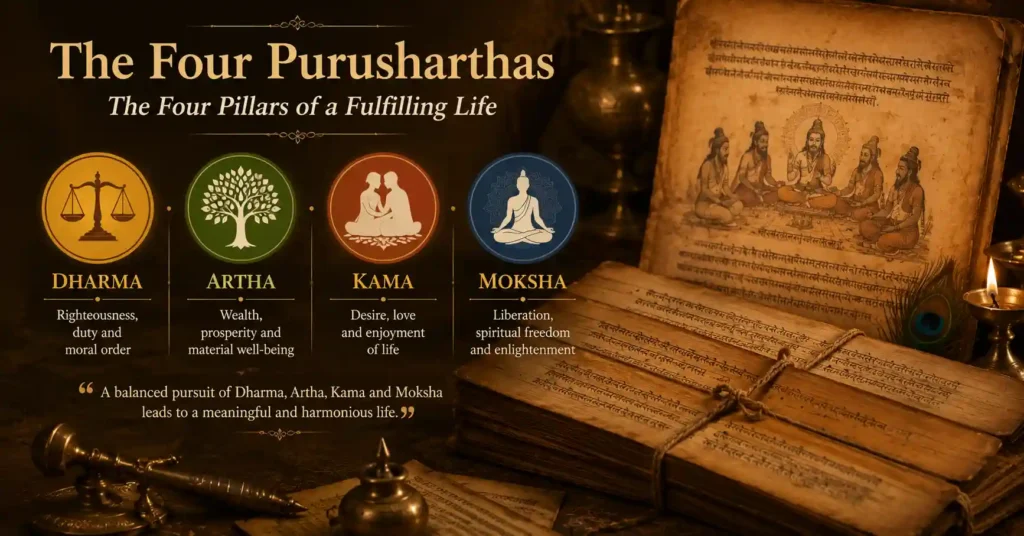
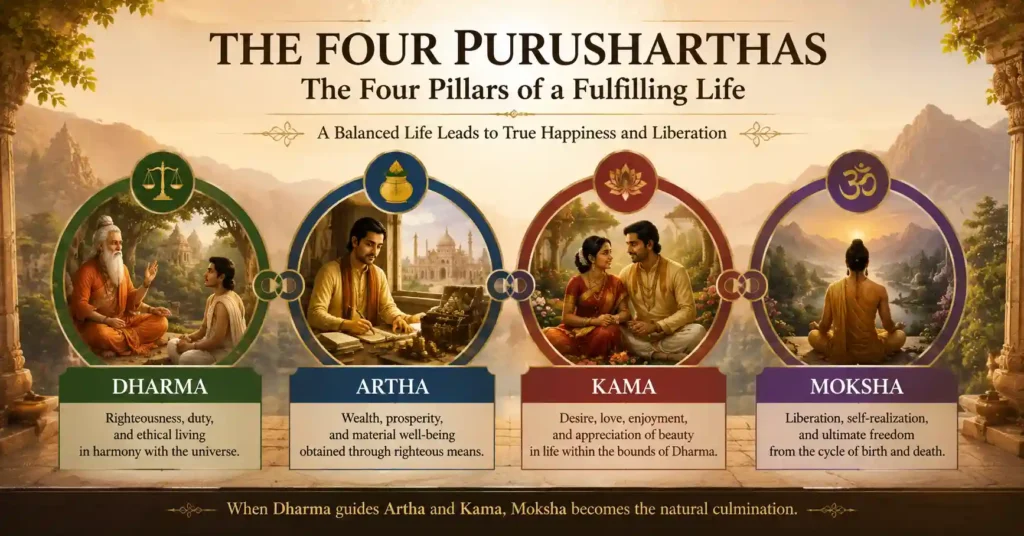
In Hindu philosophy, human life is guided by four fundamental goals known as the Purusharthas: Dharma (righteous living), Artha (material prosperity), Kama (legitimate desires), and Moksha (spiritual liberation). Together, they provide a balanced framework for living a meaningful and purposeful life.
Artha in Sanatan Dharma is included among the Four Purusharthas because material resources are necessary for fulfilling one’s duties and responsibilities. Without financial stability and security, it becomes difficult to care for family, support society, pursue education, or engage in charitable acts.
Sanatan Dharma recognizes that spiritual growth does not happen in isolation from everyday life. People need food, shelter, healthcare, education, and livelihood. Artha helps create the foundation that allows individuals to perform their Dharma and contribute positively to the world.
However, Artha is not placed above Dharma. Hindu teachings emphasize that wealth should be acquired through honest and ethical means. When Artha is guided by Dharma, it becomes a source of stability, service, and personal growth rather than greed or exploitation.
The inclusion of Artha in Sanatan Dharma among the Purusharthas shows that Hindu philosophy does not reject worldly life. Instead, it encourages people to pursue prosperity responsibly while remaining mindful of higher values and spiritual goals.
In this way, Artha serves as a bridge between practical living and spiritual development. It supports a balanced life where material success, moral responsibility, and inner growth can exist together.
What Is the Relationship Between Dharma and Artha?
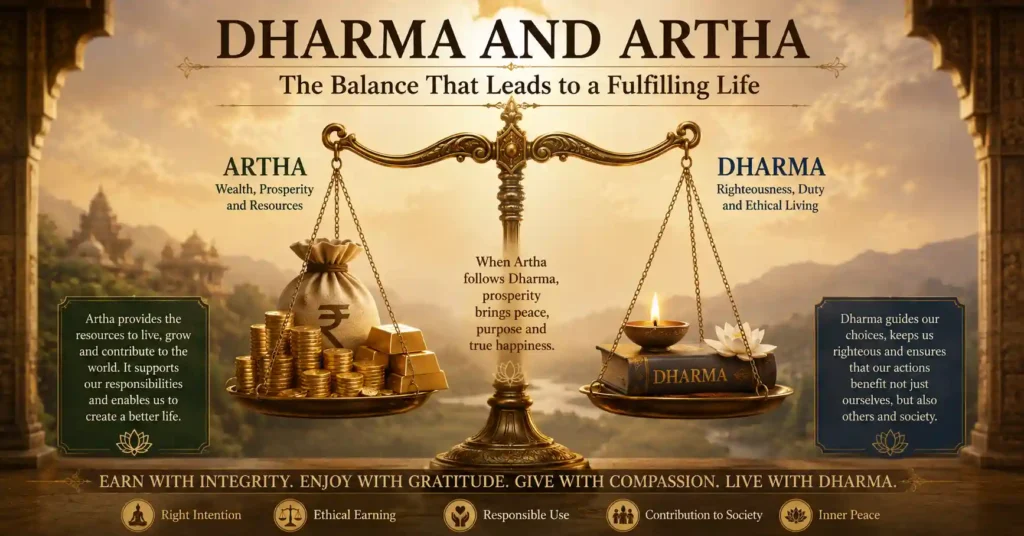
In Sanatan Dharma, Dharma and Artha are closely connected and are meant to support one another. While Dharma represents righteousness, ethics, and moral responsibility, Artha refers to the resources and prosperity needed to fulfill those responsibilities.
The relationship between Dharma and Artha teaches that wealth should not be pursued at any cost. Instead, Artha in Sanatan Dharma must be earned through honest effort, ethical conduct, and respect for others. Wealth acquired through deception, exploitation, or injustice is considered contrary to Dharma.
Dharma acts as a guiding principle for Artha. It helps individuals decide how wealth should be earned, managed, and used. When prosperity is guided by Dharma, it contributes to personal well-being, family stability, social harmony, and charitable activities.
At the same time, Artha supports Dharma by providing the means to perform duties and responsibilities. Caring for one’s family, helping those in need, supporting education, maintaining places of worship, and contributing to society often require material resources.
Ancient Hindu teachings do not view wealth and righteousness as opposing forces. Instead, they emphasize balance. A person should neither neglect material responsibilities in the name of spirituality nor abandon ethical values in the pursuit of wealth.
This balanced approach is one of the key teachings of Artha in Sanatan Dharma. Prosperity becomes meaningful when it serves a higher purpose and remains aligned with Dharma.
In simple terms, Dharma shows the right path, while Artha provides the resources needed to walk that path. Together, they help create a life that is both materially stable and spiritually grounded.
How Does Artha Differ From Kama and Moksha?
To understand Artha in Sanatan Dharma, it is helpful to see how it relates to the other Purusharthas, especially Kama and Moksha. While all three are important goals of life, they serve different purposes.
Artha focuses on material well-being, security, prosperity, and the resources needed to live responsibly. It includes wealth, livelihood, education, skills, and everything that supports a stable life.
Kama refers to desires, enjoyment, love, relationships, and the appreciation of life’s pleasures. It includes emotional fulfillment, artistic expression, beauty, and happiness. Sanatan Dharma does not reject desires but teaches that they should be pursued within the boundaries of Dharma.
While Artha provides the means, Kama often represents the experiences and enjoyments that those means can support. For example, earning a livelihood relates to Artha, while enjoying family life, friendships, and cultural pursuits relates to Kama.
Moksha, on the other hand, is the highest spiritual goal in Hindu philosophy. It refers to liberation from the cycle of birth and death and the realization of one’s true spiritual nature. Unlike Artha and Kama, which deal primarily with worldly life, Moksha focuses on ultimate freedom and self-realization.
The relationship among these goals is not one of competition but of balance. Artha in Sanatan Dharma provides stability, Kama brings fulfillment, and Moksha offers spiritual liberation. When guided by Dharma, all three can coexist in a harmonious life.
Ancient Hindu teachings emphasize that people should not become trapped by either wealth or desires. Artha and Kama are valuable parts of life, but they are meant to support a higher journey rather than become life’s sole purpose.
This balanced framework is one of the unique strengths of Sanatan Dharma. It recognizes both worldly responsibilities and spiritual aspirations, encouraging individuals to pursue prosperity, enjoyment, and liberation in a balanced and ethical manner.
What Does Hindu Philosophy Say About Wealth?
Hindu philosophy takes a balanced view of wealth. Rather than treating prosperity as inherently good or bad, it focuses on how wealth is earned, used, and understood. This perspective forms the foundation of Artha in Sanatan Dharma.
Unlike some common misconceptions, Sanatan Dharma does not teach that spirituality requires poverty. Wealth is recognized as a legitimate and necessary part of life when it is acquired through righteous means and used responsibly.
The concept of Artha in Sanatan Dharma acknowledges that material resources help individuals fulfill their duties toward family, society, and future generations. Financial stability can support education, healthcare, charitable activities, religious practices, and community welfare.
Hindu scriptures often emphasize that wealth should remain a tool rather than become an obsession. Problems arise not from wealth itself but from greed, attachment, pride, and the misuse of resources. When prosperity becomes the sole purpose of life, it can distract a person from Dharma and spiritual growth.
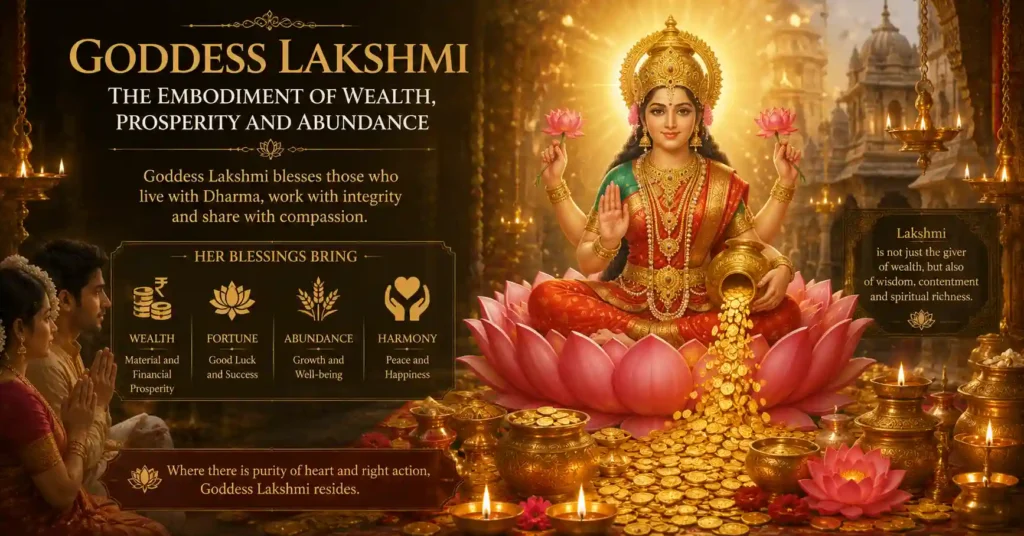
The worship of Goddess Lakshmi, the deity of prosperity and abundance, further reflects the Hindu view of wealth. Lakshmi is not merely associated with money but also with harmony, generosity, good fortune, and well-being. Her presence symbolizes prosperity that is aligned with virtue and righteousness.
In Hindu tradition, Goddess Lakshmi is closely associated with Dharma. Prosperity is considered auspicious when it is earned through honest effort, used responsibly, and directed toward the welfare of others. This symbolism reminds us that wealth should not be separated from ethical values. The ideal of Artha in Sanatan Dharma is not the accumulation of riches for their own sake, but the responsible use of prosperity in harmony with Dharma.
Ancient Hindu texts repeatedly stress that wealth should serve a meaningful purpose. Prosperity becomes valuable when it supports Dharma, helps others, and contributes to personal and social well-being.
This balanced approach explains why Artha in Sanatan Dharma is included among the Four Purusharthas. Wealth is neither rejected nor glorified. Instead, it is viewed as a responsibility that should be guided by wisdom, ethical conduct, and higher values.
For this reason, Hindu philosophy encourages people to pursue success and prosperity without becoming attached to them. Material achievement and spiritual development are not seen as opposing paths when both are guided by Dharma.
Hindu View of Wealth at a Glance
| Aspect | Hindu Perspective |
|---|---|
| Wealth (Artha) | A legitimate goal of life when pursued ethically |
| Source of Wealth | Honest effort guided by Dharma |
| Purpose of Wealth | Supporting family, society, and spiritual growth |
| Goddess Lakshmi | Symbol of prosperity aligned with righteousness |
| Main Warning | Greed, attachment, and misuse of wealth |
| Ultimate Goal | Balance between material well-being and higher values |
This understanding forms the basis of Artha in Sanatan Dharma, where prosperity is respected as a useful and necessary part of life but is always guided by Dharma and higher purpose.
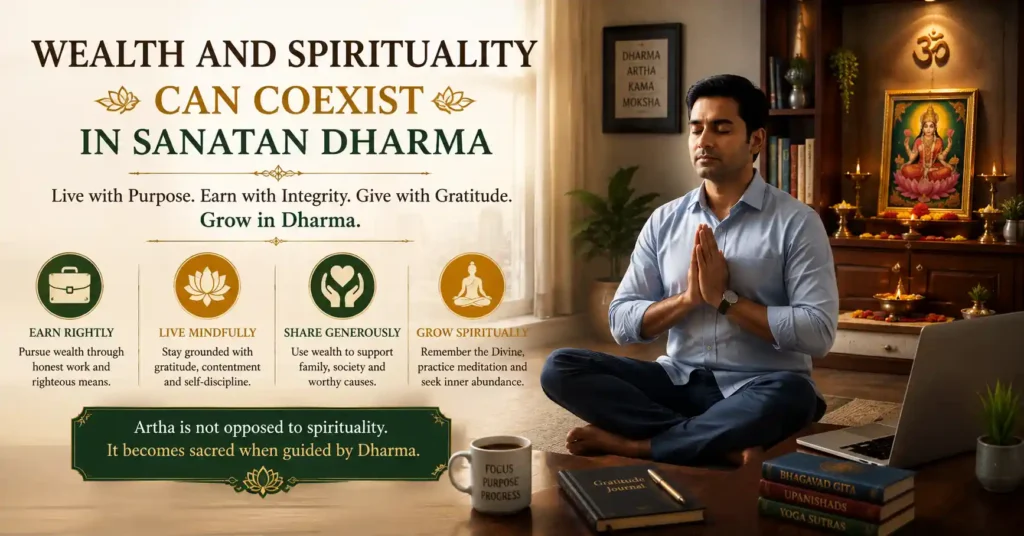
Can Wealth and Spirituality Coexist in Sanatan Dharma?
Yes, Sanatan Dharma teaches that wealth and spirituality can coexist when both are guided by Dharma. In fact, the concept of Artha in Sanatan Dharma was developed to show that material prosperity has a legitimate place in a balanced human life.
A common misconception is that spiritual growth requires abandoning wealth and worldly responsibilities. While some individuals choose the path of renunciation, Hindu philosophy does not present it as the only route to spiritual progress.
Many respected figures in Hindu tradition were householders who fulfilled family, social, and professional responsibilities while pursuing higher spiritual ideals. Their lives demonstrate that spiritual wisdom is determined by one’s inner attitude rather than the amount of wealth one possesses.
The real challenge is not wealth itself but attachment to wealth. A person may own significant resources yet remain humble, generous, and detached. At the same time, someone with very little wealth may still be consumed by greed, envy, or constant craving.
This distinction is central to understanding Artha in Sanatan Dharma. Hindu teachings encourage individuals to use prosperity as a means of supporting Dharma, serving others, and creating stability rather than using it solely for personal gain.
Spirituality and wealth work together when prosperity is earned ethically, managed responsibly, and shared generously. Wealth can help support families, educate children, care for those in need, preserve cultural traditions, and contribute to religious and charitable activities.
The Bhagavad Gita also teaches the importance of performing one’s duties without becoming excessively attached to results. This principle allows people to engage fully in worldly life while maintaining inner balance and spiritual awareness.
Sanatan Dharma therefore does not ask people to choose between success and spirituality. Instead, it encourages a balanced approach where material achievement supports righteous living and spiritual development.
In this way, Artha in Sanatan Dharma becomes not an obstacle to spiritual growth but a valuable tool when guided by wisdom, self-discipline, and Dharma.
What Can We Learn From King Janaka About Artha?
Among the many examples found in Hindu tradition, King Janaka is often regarded as one of the finest illustrations of the proper understanding of Artha in Sanatan Dharma. He was a powerful ruler, a wealthy king, and at the same time a highly respected spiritual seeker.
Janaka governed a prosperous kingdom, fulfilled his duties as a ruler, and managed immense resources. Yet he remained known for his wisdom, self-control, and detachment. His life challenged the belief that spiritual growth requires abandoning worldly responsibilities.
In many Hindu texts and traditions, Janaka is presented as an ideal Rajarshi, or philosopher-king. He demonstrated that one can actively participate in worldly life while remaining inwardly free from excessive attachment.
The story of King Janaka teaches that wealth itself is not the problem. The real issue is whether a person becomes controlled by wealth, status, and possessions. Janaka possessed great prosperity, but his identity was not dependent on it.
His example perfectly reflects the relationship between Dharma and Artha. He used resources to govern justly, support society, and fulfill his responsibilities. Wealth served Dharma rather than personal greed.
King Janaka also reminds us that spiritual wisdom is measured by inner awareness, not by external circumstances. A person can live in a palace and still cultivate detachment, just as someone living simply can remain attached to desires and possessions.
For modern readers, Janaka’s life offers an important lesson. Success, career growth, business achievements, and financial prosperity do not automatically conflict with spiritual development. What matters is maintaining balance, ethical conduct, and self-awareness.
The example of King Janaka reinforces one of the central teachings of Artha in Sanatan Dharma: prosperity becomes meaningful when it is guided by Dharma and accompanied by inner detachment.
Rather than choosing between wealth and spirituality, Janaka’s life shows how both can coexist in harmony when worldly success is viewed as a responsibility rather than a source of ego.

What Does the Bhagavad Gita Teach About Wealth and Duty?
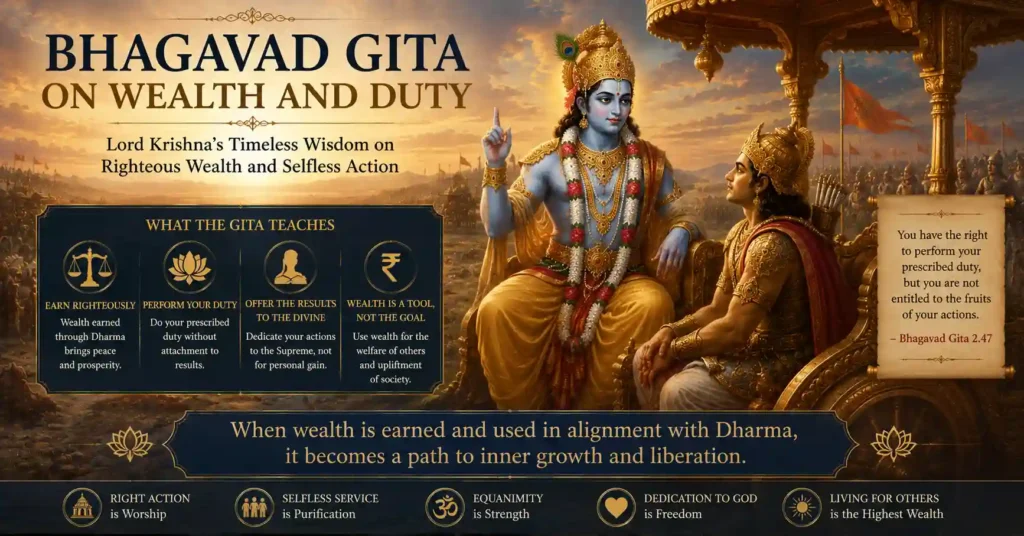
The Bhagavad Gita does not condemn wealth or material success. Instead, it teaches that people should perform their duties sincerely while remaining free from excessive attachment to the results. This principle is central to understanding Artha in Sanatan Dharma.
The Gita was delivered on the battlefield of Kurukshetra, where Arjuna faced a conflict between worldly responsibilities and spiritual concerns. Lord Krishna did not ask him to abandon his duties. Instead, He instructed Arjuna to act according to Dharma with wisdom and selflessness.
One of the Gita’s most important teachings is Karma Yoga, the path of selfless action. According to this teaching, individuals should work diligently, fulfill their responsibilities, and strive for excellence without becoming obsessed with success, wealth, or personal gain.
The principle of Karma Yoga is clearly expressed in Bhagavad Gita 2.47, where Lord Krishna teaches that a person has the right to perform their duties but should not become attached to the fruits of their actions. This teaching does not reject success or prosperity. Instead, it encourages people to focus on righteous effort while maintaining inner balance regardless of the outcome.
This does not mean wealth is unimportant. The Gita recognizes that people must engage with the world, support their families, and contribute to society. However, material prosperity should be viewed as a result of righteous action rather than the ultimate purpose of life.
The teachings of the Gita align closely with Artha in Sanatan Dharma. Wealth is acceptable when it is earned honestly, used responsibly, and guided by Dharma. Problems arise when greed, ego, and attachment begin to control a person’s decisions.
Lord Krishna repeatedly emphasizes qualities such as self-control, moderation, generosity, and equanimity. These qualities help individuals enjoy prosperity without becoming dependent on it for their happiness or sense of identity.
From the perspective of Artha in Sanatan Dharma, Karma Yoga offers a practical approach to wealth and success. It teaches that prosperity may be pursued through honest effort and responsible action, but personal worth should never depend solely on material achievements. Wealth becomes beneficial when it serves Dharma rather than ego.
The Gita also teaches that true success is not measured solely by external achievements. Inner peace, wisdom, devotion, and alignment with Dharma are equally important aspects of a meaningful life.
For modern readers, the Bhagavad Gita offers a practical lesson: pursue your career, business, profession, or responsibilities with dedication, but do not allow wealth or status to define your self-worth. Perform your duties sincerely and accept results with balance and gratitude.
In this way, the Bhagavad Gita presents a balanced vision of Artha in Sanatan Dharma, where material prosperity and spiritual growth can coexist when guided by Dharma and free from unhealthy attachment.
What Happens When Artha Is Pursued Without Dharma?
In Sanatan Dharma, Artha and Dharma are meant to work together. When wealth, power, or success are pursued without ethical principles, Artha loses its proper purpose and can become a source of suffering rather than well-being.
The concept of Artha in Sanatan Dharma does not encourage the accumulation of wealth at any cost. Prosperity gained through dishonesty, exploitation, corruption, or greed is considered contrary to Dharma because it harms both the individual and society.
When Artha is separated from Dharma, a person may become increasingly attached to material possessions, status, and personal gain. This attachment often leads to fear, anxiety, competition, and dissatisfaction, even when external success has been achieved.
Hindu philosophy teaches that wealth alone cannot provide lasting happiness. Without moral values and self-discipline, the pursuit of prosperity can create endless desires that are never fully satisfied. The more one acquires, the more one may crave.
Ancient Hindu texts frequently warn against allowing greed to dominate life. Excessive attachment to wealth can weaken compassion, damage relationships, and distract individuals from higher goals such as self-improvement, service, and spiritual growth.
The epics of the Mahabharata and Ramayana contain several examples of how the misuse of power and wealth can lead to conflict, suffering, and downfall. These stories illustrate the importance of keeping Artha aligned with Dharma.
By contrast, when wealth is earned and used responsibly, it becomes a force for good. It can support families, strengthen communities, promote education, assist those in need, and contribute to the welfare of society.
The lesson is not that wealth is dangerous, but that wealth without wisdom can become harmful. This is why Artha in Sanatan Dharma is always placed under the guidance of Dharma rather than being pursued as an independent goal.
Ultimately, Sanatan Dharma teaches that prosperity should serve a higher purpose. When Artha is guided by righteousness, it contributes to both worldly success and inner growth. When separated from Dharma, it can become a source of imbalance and suffering.
Quick Comparison: Artha With Dharma vs Artha Without Dharma
| Artha Guided by Dharma | Artha Without Dharma |
|---|---|
| Ethical earning | Dishonest gain |
| Responsible use of wealth | Self-centered accumulation |
| Supports family and society | Exploits others for profit |
| Encourages generosity | Encourages greed |
| Creates stability and trust | Creates conflict and insecurity |
| Supports spiritual growth | Strengthens attachment and ego |
Common Misconceptions About Artha
Because Artha is often translated simply as “wealth,” many people develop an incomplete understanding of its role in Hindu philosophy. In reality, Artha in Sanatan Dharma is a much broader concept that includes resources, security, responsibility, and the means needed to live a balanced life.
One common misconception is that Artha refers only to money. While financial prosperity is part of Artha, the concept also includes knowledge, skills, influence, livelihood, and the resources required to fulfill one’s duties toward family and society.
Another misunderstanding is that spirituality and wealth cannot coexist. Some people assume that a spiritual person must reject material success. However, Sanatan Dharma recognizes Artha as one of the Four Purusharthas, showing that prosperity has a legitimate place in human life when guided by Dharma.
Many also believe that pursuing wealth is inherently selfish. Hindu philosophy does not condemn prosperity itself. Instead, it teaches that wealth should be acquired ethically and used responsibly. Artha becomes problematic only when it is driven by greed, ego, or attachment.
A further misconception is that renunciation is the only path to spiritual growth. While some individuals choose a life of renunciation, Hindu tradition also honors householders, leaders, scholars, and rulers who achieved spiritual wisdom while actively participating in worldly life.
Some people view Artha and Moksha as opposing goals. In reality, Sanatan Dharma encourages balance. Material prosperity can provide the stability needed to pursue higher knowledge, perform one’s duties, and engage in spiritual practices.
Another common mistake is assuming that success alone is a sign of good Artha. Hindu teachings emphasize that the source and use of wealth are just as important as the wealth itself. Prosperity gained through unethical means is not considered aligned with the true spirit of Artha in Sanatan Dharma.
Understanding these misconceptions helps reveal the deeper meaning of Artha. It is not a philosophy of accumulation but a philosophy of responsible prosperity guided by Dharma and directed toward a meaningful life.
Common Misconceptions vs Traditional Understanding
| Misconception | Traditional Understanding |
|---|---|
| Artha means only money | Artha includes wealth, resources, security, skills, and livelihood |
| Spirituality requires poverty | Wealth and spirituality can coexist when guided by Dharma |
| Pursuing wealth is selfish | Ethical prosperity can support family, society, and service |
| Renunciation is the only spiritual path | Householders can also progress spiritually |
| Artha opposes Moksha | Artha can support a balanced path toward higher goals |
| Success alone defines Artha | Dharma determines whether prosperity is meaningful |
How Can Artha Be Practiced in Modern Life?
The principles of Artha in Sanatan Dharma remain relevant even in today’s fast-changing world. While lifestyles and professions have evolved, the need for financial stability, responsible living, and ethical prosperity continues to be an important part of human life.
Practicing Artha does not simply mean earning more money. It means acquiring and managing resources in a way that supports personal well-being, family responsibilities, social contribution, and spiritual growth.
One of the most important ways to practice Artha in Sanatan Dharma is by earning a livelihood through honest and ethical means. Whether a person is a business owner, employee, professional, farmer, or entrepreneur, Dharma should guide financial decisions.
Financial planning is another practical aspect of Artha. Saving responsibly, avoiding unnecessary debt, preparing for the future, and managing resources wisely help create stability and reduce anxiety.
Artha can also be practiced through generosity and service. Hindu tradition encourages using a portion of one’s resources to help those in need, support community welfare, contribute to religious activities, and promote education and social development.
Modern life often encourages constant consumption and comparison. The teachings of Artha in Sanatan Dharma remind us that prosperity should serve a purpose rather than become a source of endless desire. Contentment and gratitude are just as important as achievement.
Balancing work and personal life is another way to apply Artha wisely. Material success should not come at the cost of health, relationships, ethical values, or inner peace. True prosperity includes emotional and spiritual well-being alongside financial security.
Technology, education, and professional skills can also be viewed as forms of Artha. Developing knowledge and abilities helps individuals create value, support their families, and contribute positively to society.
Ultimately, practicing Artha in Sanatan Dharma means creating a balanced life where wealth is respected but not worshipped. Prosperity becomes meaningful when it supports Dharma, strengthens relationships, encourages generosity, and contributes to both worldly success and inner growth.
Practical Ways to Practice Artha in Daily Life
| Practice | How It Reflects Artha in Sanatan Dharma |
|---|---|
| Earn honestly | Aligns wealth with Dharma |
| Manage finances wisely | Creates stability and security |
| Support family responsibilities | Fulfills personal duties |
| Continue learning and skill-building | Builds valuable resources |
| Give to charity and service | Uses wealth for the welfare of others |
| Avoid excessive greed | Maintains balance and contentment |
| Balance work and spiritual life | Harmonizes prosperity and inner growth |
| Use resources responsibly | Reflects mindful stewardship of wealth |

Key Takeaways
- Artha in Sanatan Dharma refers to material prosperity, resources, security, and the means needed to live a responsible and meaningful life.
- Artha is one of the Four Purusharthas, alongside Dharma, Kama, and Moksha, making it an essential part of Hindu philosophy.
- Sanatan Dharma does not reject wealth. Instead, it teaches that prosperity should be earned ethically and used responsibly.
- The relationship between Dharma and Artha is central to Hindu teachings. Wealth should always be guided by righteousness and moral values.
- Artha includes more than money. It also encompasses knowledge, skills, influence, opportunities, and other resources that support personal and social well-being.
- Hindu philosophy teaches that wealth itself is not a barrier to spirituality. Attachment, greed, and misuse of wealth are the real obstacles.
- The life of King Janaka demonstrates that material prosperity and spiritual wisdom can coexist when a person remains detached and duty-focused.
- The Bhagavad Gita encourages people to fulfill their responsibilities while remaining free from excessive attachment to success and material rewards.
- Artha in Sanatan Dharma becomes meaningful when it supports family, society, charity, self-development, and spiritual growth.
- The ultimate goal is balance, where prosperity serves Dharma and contributes to a life of purpose, harmony, and inner growth.
Conclusion
Artha in Sanatan Dharma is far more than the pursuit of wealth. It represents the responsible acquisition and use of resources that help individuals fulfill their duties, support their families, contribute to society, and live with stability and purpose.
As one of the Four Purusharthas, Artha occupies an important place in Hindu philosophy. Sanatan Dharma recognizes that material well-being is a natural and necessary part of life, but it also teaches that prosperity should always remain guided by Dharma.
The relationship between Dharma and Artha reminds us that wealth is not judged solely by how much is accumulated, but by how it is earned and used. When prosperity serves higher values, it becomes a force for personal growth, social welfare, and spiritual development.
The examples of King Janaka and the teachings of the Bhagavad Gita show that material success and spiritual wisdom are not opposing paths. What truly matters is maintaining balance, self-discipline, and freedom from excessive attachment.
Ultimately, Artha in Sanatan Dharma encourages a balanced approach to life where wealth is respected but not worshipped, enjoyed but not clung to, and used as a means to support both worldly responsibilities and higher spiritual aspirations.
When guided by Dharma, Artha becomes not merely a source of prosperity but a pathway toward a more meaningful, harmonious, and purposeful life.
Suggested Reading
To deepen your understanding of Artha in Sanatan Dharma, explore these related topics from The Sanatan Tales. Together, they explain how Dharma, Karma, Moksha, and other key concepts help create a balanced and meaningful life.
What Is Dharma and Why Is It Important?
https://thesanatantales.com/what-is-dharma-and-why-is-it-important/
What Is Karma According to Sanatan Dharma?
https://thesanatantales.com/what-is-karma-according-to-sanatan-dharma/
What Is Moksha in Hinduism?
https://thesanatantales.com/what-is-moksha-and-how-is-it-attained/
What Are the Four Purusharthas in Hindu Philosophy?
https://thesanatantales.com/purusharthas/
What Is Brahman? Meaning, Nature and Spiritual Significance in Hinduism
https://thesanatantales.com/what-is-brahman/
Brahma Muhurat: Meaning, Time, Benefits and Spiritual Significance
https://thesanatantales.com/brahma-muhurta-meaning-time-significance/
What Is Maya in Hinduism?
https://thesanatantales.com/what-is-maya-in-hindu-philosophy/
Artha (Wikipedia)
https://en.wikipedia.org/wiki/Artha
These articles will help you gain a deeper understanding of Artha in Sanatan Dharma and its role within the broader philosophy of Sanatan Dharma.
FAQs
What is Artha in Sanatan Dharma?
Artha in Sanatan Dharma refers to material prosperity, resources, security, and the means required to live a responsible and meaningful life. It is one of the four Purusharthas, or fundamental goals of human life in Hindu philosophy.
Artha is not limited to money alone. It also includes livelihood, education, skills, influence, property, and other resources that help a person fulfill personal, family, and social responsibilities.
Sanatan Dharma views Artha as a legitimate pursuit when it is guided by Dharma and used for constructive purposes.
Why is Artha important in Hindu philosophy?
Artha is important because human beings need stability, security, and resources to perform their duties and responsibilities. Hindu philosophy recognizes that a balanced life requires both material well-being and spiritual growth.
Without sufficient resources, it becomes difficult to care for family members, contribute to society, pursue education, or support charitable activities. For this reason, Artha in Sanatan Dharma is considered a necessary part of a meaningful life rather than something to be avoided.
Is Artha only about earning money?
No. This is one of the most common misunderstandings about Artha in Sanatan Dharma.
While wealth is an important aspect of Artha, the concept is much broader. It includes economic security, professional skills, knowledge, social stability, influence, and the resources needed to live with dignity and responsibility.
In Sanskrit, the word “Artha” can also mean purpose, meaning, value, or objective. Therefore, Artha is not merely about accumulating money but about acquiring the means necessary to support a purposeful life.
How does Artha relate to Dharma?
The relationship between Dharma and Artha is one of the central teachings of Hindu philosophy.
Dharma provides the ethical foundation that guides the pursuit of wealth and prosperity. It teaches that resources should be acquired honestly, used responsibly, and directed toward beneficial purposes.
When Artha is guided by Dharma, prosperity can support family welfare, charitable work, social harmony, and spiritual development. Without Dharma, the pursuit of wealth can easily turn into greed, exploitation, or attachment.
Can wealth and spirituality coexist in Sanatan Dharma?
Yes. Sanatan Dharma does not teach that wealth and spirituality are enemies.
Many respected figures in Hindu tradition, including King Janaka, lived prosperous lives while remaining spiritually advanced. Their examples show that spiritual growth depends more on inner awareness and detachment than on the amount of wealth a person possesses.
The real challenge is not wealth itself but attachment to wealth. A person can be wealthy and spiritual if prosperity is earned ethically, used wisely, and not allowed to become the center of life.
What does the Bhagavad Gita teach about Artha?
The Bhagavad Gita teaches that people should perform their duties sincerely without becoming excessively attached to the results of their actions.
Lord Krishna does not ask Arjuna to abandon worldly responsibilities. Instead, He teaches Karma Yoga, which encourages dedicated action guided by Dharma and free from selfish attachment.
This teaching supports the idea that Artha in Sanatan Dharma is acceptable when it serves duty, responsibility, and righteous living rather than ego and greed.
Is pursuing wealth considered spiritual in Hinduism?
Pursuing wealth can be spiritual when it is done ethically and in accordance with Dharma.
Hindu philosophy does not view prosperity as inherently corrupting. Instead, it teaches that wealth can become a powerful tool for supporting family, helping others, preserving culture, practicing charity, and fulfilling social responsibilities.
The spiritual value of wealth depends not on how much one owns but on how it is earned, used, and understood.
What happens when Artha is pursued without Dharma?
When Artha is separated from Dharma, the pursuit of wealth can become driven by greed, selfishness, and attachment.
Ancient Hindu teachings repeatedly emphasize that prosperity without ethical guidance often leads to imbalance, dissatisfaction, and conflict. Wealth acquired through dishonest or harmful means is not considered true Artha in the traditional sense.
Sanatan Dharma therefore teaches that material success should always remain connected to moral responsibility and higher values.
Is Artha more important than Moksha?
No. Hindu philosophy generally regards Moksha as the highest spiritual goal because it represents liberation from the cycle of birth and death.
However, this does not make Artha unimportant. The Four Purusharthas are designed to work together. Artha provides stability and support for worldly life, while Moksha represents the ultimate spiritual aspiration.
A balanced life respects both material responsibilities and spiritual growth.
How can Artha be practiced in modern life?
Modern individuals can practice Artha in Sanatan Dharma by earning honestly, managing resources responsibly, developing useful skills, supporting family members, and contributing positively to society.
Practicing Artha also includes financial discipline, charitable giving, continuous learning, and maintaining balance between professional success and personal well-being.
The goal is not simply to accumulate wealth but to use prosperity as a tool for creating a stable, ethical, and meaningful life.
Glossary of Important Terms
| Term | Meaning |
|---|---|
| Artha | Artha in Sanatan Dharma refers to material prosperity, resources, security, and the means needed to live a responsible and meaningful life. It is one of the Four Purusharthas. |
| Purushartha | The four fundamental goals of human life in Hindu philosophy: Dharma, Artha, Kama, and Moksha. |
| Dharma | Righteousness, duty, ethics, and moral responsibility that guide how wealth should be earned and used. |
| Kama | Legitimate desires, enjoyment, happiness, love, and emotional fulfillment pursued within the boundaries of Dharma. |
| Moksha | Spiritual liberation from the cycle of birth and death and realization of one’s true nature. |
| Lakshmi | The Hindu goddess of wealth, prosperity, abundance, and good fortune. She symbolizes prosperity aligned with Dharma. |
| Karma | The law of action and consequence. Every action creates results that influence future experiences. |
| Karma Yoga | The path of selfless action taught in the Bhagavad Gita, where duties are performed without attachment to results. |
| Detachment (Vairagya) | The ability to remain inwardly free from excessive attachment to wealth, possessions, status, or outcomes. |
| King Janaka | The enlightened ruler of Mithila, often cited as an ideal example of balancing wealth, duty, and spiritual wisdom. |
| Grihastha | The householder stage of life in which individuals earn wealth, raise families, and contribute to society. |
| Rajarshi | A king who possesses the wisdom and spiritual insight of a sage. King Janaka is a classic example. |
| Arthashastra | An ancient Sanskrit text traditionally attributed to Chanakya (Kautilya) that discusses governance, economics, administration, and statecraft. |
| Prosperity | A state of material well-being, stability, and abundance that supports responsible living and personal growth. |
| Righteous Wealth | Wealth earned through honest effort and ethical conduct in accordance with Dharma. |
| Spiritual Growth | The process of developing self-awareness, wisdom, inner peace, and a deeper understanding of the Self. |
| Material Well-Being | Financial security and access to resources needed to fulfill personal, family, and social responsibilities. |
| Four Purusharthas | The four aims of life in Hindu philosophy: Dharma (duty), Artha (prosperity), Kama (desire), and Moksha (liberation). |
| Householder Path | A spiritual path that combines family life, work, responsibility, and inner growth rather than renunciation. |
| Bhagavad Gita | One of Hinduism’s most revered scriptures, teaching Dharma, selfless action, devotion, and spiritual wisdom. |
About the Author
Yateendra Chaturvedi is a spiritual writer, researcher, devotee, and the founder of The Sanatan Tales. With over 35 years of professional experience and a lifelong interest in Sanatan Dharma, he writes about Hindu deities, temples, scriptures, festivals, Mahavidyas, sacred stories, rituals, and living traditions that continue to guide and inspire devotees across India.
Drawing from traditional scriptures, regional beliefs, temple traditions, devotional literature, and historical sources, he aims to present authentic, well-researched, and easy-to-understand content for modern readers. His work focuses on preserving spiritual wisdom, explaining sacred traditions, and helping seekers develop a deeper understanding of India’s rich spiritual heritage.
Through The Sanatan Tales, Yateendra strives to make the timeless teachings of Sanatan Dharma simple, meaningful, and relevant for today’s generation while maintaining respect for traditional sources, regional practices, and diverse spiritual perspectives.
Learn More About Yateendra Chaturvedi →
https://thesanatantales.com/about-the-author/
References & Sources
This article is based on concepts, teachings, and philosophical principles found within Sanatan Dharma, including insights drawn from Hindu scriptures, traditional commentaries, spiritual literature, and widely accepted Hindu thought. It reflects ideas associated with key concepts such as Dharma, Artha, Karma, Moksha, and the broader framework of the Purusharthas.
The content has been presented in a simple and accessible manner to help readers understand traditional Hindu perspectives on wealth, responsibility, ethical living, and spiritual growth. References may include scriptural teachings, historical traditions, philosophical interpretations, and knowledge preserved through generations of teachers, scholars, practitioners, and spiritual communities.
Note: Interpretations of Hindu philosophy may vary across different traditions, sampradayas, schools of thought, regions, and individual practitioners. The purpose of this article is not to present any single interpretation as the definitive view, but to provide a balanced overview of commonly accepted perspectives within Sanatan Dharma. Hindu philosophy embraces diverse paths of knowledge, devotion, action, meditation, and self-realization, and readers are encouraged to explore these traditions further through study and personal reflection.
Latest from The Sanatan Tales