
The Chausath Yogini tradition is one of the most fascinating and unique streams within Shakta tradition and Sanatan Dharma. Revered as powerful manifestations of Shakti, these divine feminine energies hold a special place in Tantric philosophy, sacred temple architecture, and spiritual symbolism.
Unlike the widely worshipped forms of Devi, the Yoginis belong to an ancient spiritual tradition closely associated with Bhairava, cosmic energy, and inner transformation. Their worship flourished in medieval India, leaving behind remarkable circular temples that continue to inspire devotees, historians, and spiritual seekers.
Ancient shrines at Morena, Jabalpur, and Hirapur preserve this extraordinary heritage. Their unique open-air circular design reflects profound ideas about the universe, sacred geometry, and the dynamic power of the Divine Mother.
In this comprehensive guide, you will discover the story of the Chausath Yogini, their origin, names, symbolism, famous temples, role in Tantra, relationship with Bhairava, spiritual significance, and enduring place in Sanatan Dharma. Whether you are a devotee, traveller, or curious learner, this article will help you understand one of India’s most remarkable spiritual traditions.
Chausath Yogini at a Glance
| Aspect | Details |
|---|---|
| Tradition | Shakta and Tantric traditions of Sanatan Dharma |
| Meaning | Sixty-four divine manifestations of Shakti |
| Primary Deity | Divine Mother (Shakti) with Bhairava as guardian |
| Associated Philosophy | Tantra, Shakti worship, Shiva-Shakti unity |
| Famous Temples | Morena, Jabalpur and Hirapur |
| Temple Style | Circular, open-air shrines with 64 niches |
| Historical Period | Mainly 9th to 12th century CE |
| Main Symbolism | Cosmic energy, transformation and spiritual awakening |
| Spiritual Goal | Self-realization through the Divine Feminine |
Table of Contents
ToggleWho Are the Chausath Yoginis?
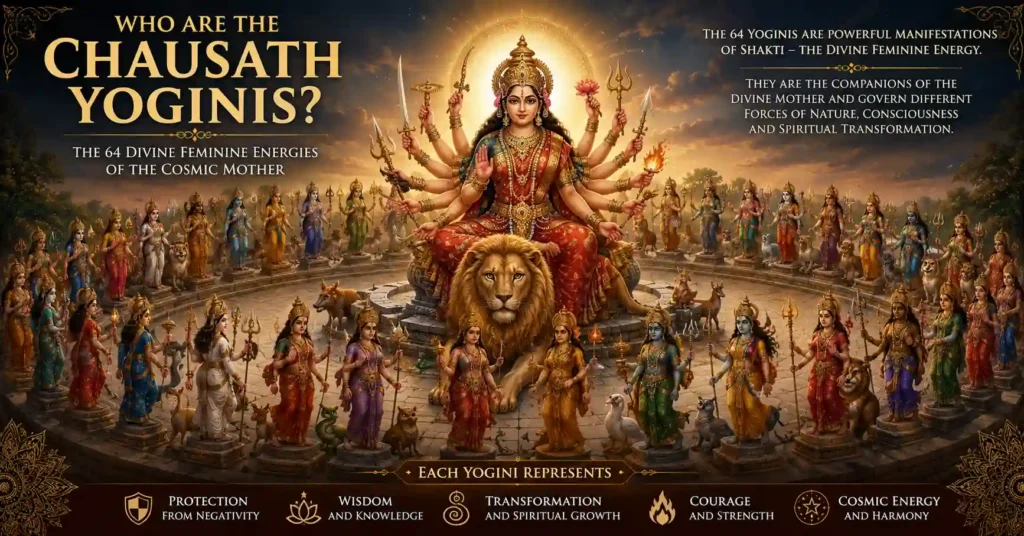
In Hindu spiritual traditions, the Chausath Yoginis are revered as powerful manifestations of Shakti, the divine feminine energy that sustains creation. They occupy a unique place within the Shakta and Tantric traditions, where they are honoured as embodiments of spiritual power, wisdom, and transformation.
The word Yogini traditionally refers to a spiritually accomplished woman or a divine feminine being endowed with extraordinary yogic powers. In sacred texts and temple traditions, the sixty-four Yoginis are described as celestial energies who serve and accompany the Supreme Goddess in her cosmic functions.
Rather than being independent deities, they represent different aspects of the Divine Mother. Many traditions associate them with forms of Durga, Kali, Parvati, and Adi Shakti, each expressing a distinct dimension of the universal feminine principle.
In Tantric philosophy, the Yoginis are closely connected with Bhairava, the fierce form of Lord Shiva. Together, they symbolize the inseparable union of Shiva and Shakti, representing consciousness and cosmic energy working in perfect harmony.
Each Yogini embodies a unique spiritual quality or force of nature. Some represent protection and courage, while others symbolize wisdom, prosperity, transformation, healing, or the destruction of ignorance and negative energies.
Collectively, these sixty-four divine beings form a sacred circle known as the Yogini Mandala. This mystical assembly reflects the infinite expressions of the Divine Feminine and illustrates how one supreme power manifests in many forms to guide, protect, and uplift the universe.
What Is the Origin of the Chausath Yoginis?
The origin of the Chausath Yoginis is described through several Shakta, Puranic, and Tantric traditions. While the stories vary across regions and scriptures, they all convey the same spiritual truth: the Yoginis emerged from the infinite power of the Divine Mother to restore cosmic balance.
Yoginis Born from the Power of Devi
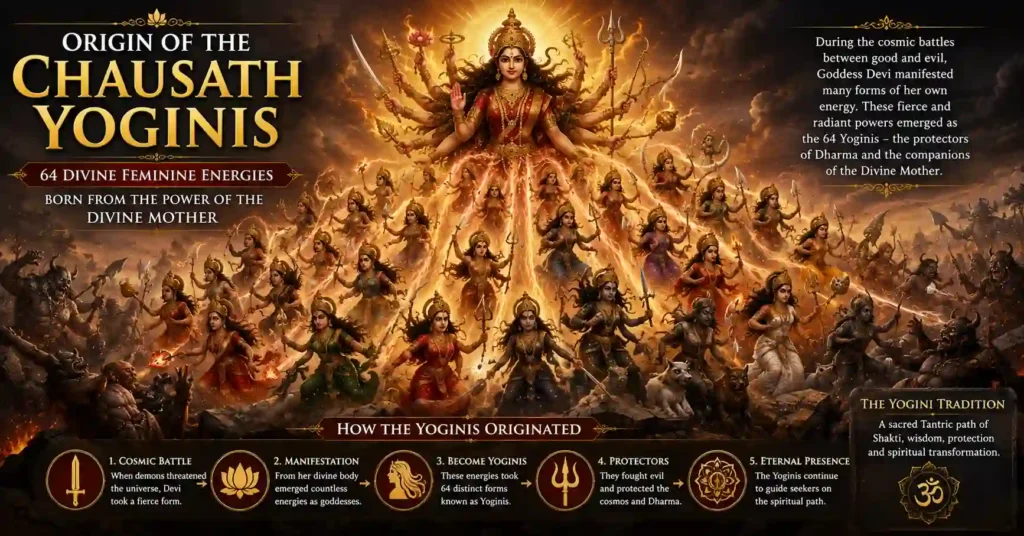
According to many Shakta traditions, the Divine Mother manifested countless forms of her own energy during cosmic battles against powerful demons that threatened the universe. Each manifestation possessed unique powers and a specific role in protecting Dharma.
These fierce feminine energies fought alongside the Goddess, helping her overcome the forces of darkness and restore harmony. Over time, these divine manifestations came to be revered as the sixty-four Yoginis, each representing a distinct aspect of Shakti.
Rather than being separate goddesses, they are understood as different expressions of the one Supreme Goddess. This reflects a central teaching of Sanatan Dharma: the One Divine Reality can manifest in countless forms while remaining one in essence.
Yoginis Manifested During Durga's Battle
Another popular tradition describes the Yoginis as fierce warrior goddesses who emerged from the body of Goddess Durga during her battle against powerful demon armies. Each divine manifestation carried a unique weapon, power, and purpose in the cosmic struggle between Dharma and Adharma.
These fearless feminine energies fought alongside the Goddess, destroying negative forces and protecting the universe. After the victory, they came to be revered as the Yoginis, who continue to symbolize divine protection, courage, and the triumph of righteousness.
This tradition highlights an important belief in Shakta philosophy: whenever evil threatens cosmic order, the Divine Mother manifests countless forms of Shakti to restore balance and uphold Dharma.
The Yoginis as Companions of Bhairava
Tantric traditions describe the Yoginis as the divine companions and attendants of Bhairava, the fierce and protective form of Lord Shiva. He is regarded as their guardian, guide, and the presiding deity who channels their spiritual energies.
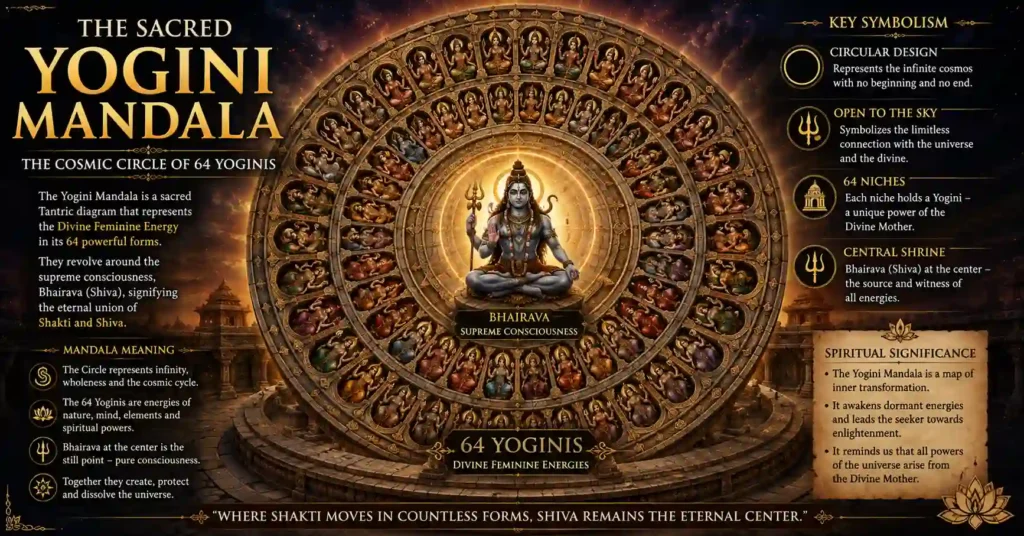
In many ancient Yogini temples, Bhairava or Shiva occupies the central shrine, while the sixty-four Yoginis are arranged in a circular mandala around him. This unique layout is one of the defining features of Yogini temple architecture.
Spiritually, this sacred arrangement symbolizes the eternal union of Shiva and Shakti. Shiva represents pure consciousness, while Shakti represents the dynamic cosmic energy that creates, sustains, and transforms the universe. Together, they express the inseparable principles upon which all existence depends.
The Yoginis in Tantric Scriptures
The tradition of the sixty-four Yoginis is preserved primarily in Tantric literature rather than in the early Vedic scriptures. These texts describe them as powerful manifestations of Shakti, associated with advanced spiritual practices, sacred rituals, and the awakening of higher consciousness.
Several important Tantric works refer to the Yoginis and their spiritual significance, including:
- Brahmayamala Tantra
- Rudrayamala Tantra
- Yogini Tantra
- Various Kaula and Shakta Tantras
Most of these scriptures were composed between the 8th and 12th centuries CE, a period when Tantric traditions flourished across many parts of India. During this time, Yogini worship became closely associated with sacred temples, esoteric philosophy, and the worship of the Divine Feminine.
These texts present the Yoginis not merely as deities but as symbolic expressions of cosmic energy, spiritual transformation, and the many dimensions of Shakti that guide seekers on the path to higher realization.
The Chausath Yoginis in Hindu Scriptures and Temple Traditions
The Chausath Yogini tradition is found primarily in Tantric literature and temple traditions rather than in the four Vedas. While the Vedas establish the foundations of Sanatan Dharma, many later spiritual traditions, including Shakta Tantra, developed through Agamas, Tantras, and regional devotional practices.
Some Puranic texts describe the Divine Mother manifesting numerous forms of Shakti to restore cosmic balance. Although they may not always list all sixty-four Yoginis by name, these narratives support the broader belief that the Divine Mother expresses herself through countless divine energies.
Over time, temple traditions, regional legends, and Tantric scriptures preserved and expanded the worship of the Yoginis. Together, they form an important part of the living spiritual heritage of Shakta and Tantric traditions within Sanatan Dharma.
The Rise of the Yogini Tradition
Historians often describe this movement as the Yogini cult, using the term cult in its academic sense to refer to a distinctive religious tradition centred on the worship of specific deities. Within Sanatan Dharma, however, it is more appropriately understood as the Yogini tradition or Yogini worship.
This spiritual tradition flourished mainly between the 9th and 13th centuries CE, particularly in:
- Central India
- Odisha
- Parts of Rajasthan
- Madhya Pradesh
During this period, kings, local rulers, and royal patrons commissioned magnificent temples dedicated to the sixty-four Yoginis. These shrines became important centres of Shakta worship, Tantric practices, meditation, and spiritual learning.
The survival of these ancient temples offers valuable evidence of the rich philosophical, artistic, and architectural heritage associated with the Yogini tradition, many aspects of which continue to inspire devotees and scholars today.
The Symbolic Meaning of the Yoginis in Tantra
In Tantric philosophy, the tradition of the sixty-four Yoginis extends far beyond the worship of divine feminine beings. It represents the countless forms of Shakti, the universal energy that creates, sustains, and transforms all existence.
Each Yogini embodies a unique aspect of this cosmic power. Some symbolize knowledge, wisdom, and spiritual awakening, while others represent protection, courage, healing, creativity, prosperity, transformation, or the destruction of ignorance and negative forces.
On a deeper level, the Yoginis also symbolize the hidden energies within the human body and mind. Tantric teachings describe the spiritual journey as the awakening and harmonious integration of these inner powers, leading the seeker towards greater self-awareness and higher consciousness.
Rather than worshipping many unrelated goddesses, the Yogini tradition teaches that all these diverse energies ultimately arise from the One Supreme Shakti. This reflects the central philosophy of Sanatan Dharma that the One Divine Reality manifests in countless forms to sustain the universe.
Why Is the Number 64 Sacred?
In Tantric philosophy, the number 64 carries deep symbolic significance. Rather than being an arbitrary number, it represents the completeness and diversity of Shakti, the infinite power through which the universe functions.
Traditionally, the sixty-four Yoginis are understood as eight groups of eight divine energies, forming a sacred mandala associated with the eight directions (Ashta Dik) and the harmony of the cosmos. This arrangement symbolizes balance, protection, and the interconnected nature of creation.
Many spiritual traditions also associate the number 64 with completeness and mastery. It appears in concepts such as the 64 arts (Chatushashti Kalas), symbolizing the full expression of knowledge, creativity, and human potential.
In the Yogini tradition, the number therefore represents the limitless manifestations of the Divine Feminine. Together, these sacred energies remind seekers that all aspects of creation arise from one Supreme Shakti, expressing itself in countless forms.
Connection with the Sixty-Four Traditional Arts
Another traditional interpretation associates the sixty-four Yoginis with the Chatushashti Kalas (64 Arts) of ancient India. This symbolic connection reflects the belief that divine energy is expressed not only through worship but also through every form of knowledge, creativity, and human excellence.
The 64 Arts include a wide range of skills such as:
- Music
- Dance
- Poetry
- Painting
- Storytelling
- Strategy
- Craftsmanship
- Spiritual knowledge
Together, these arts represent the complete development of the human personality. They remind seekers that true spirituality embraces creativity, wisdom, discipline, and refined living alongside devotion.
Although the Yoginis and the 64 Arts are distinct traditions, both symbolize completeness, diversity, and the limitless expressions of Shakti. This shared symbolism highlights the holistic vision of Sanatan Dharma, where spiritual growth and cultural excellence are seen as complementary paths.
Complete List of the 64 Yoginis and Their Spiritual Significance
The names of the sixty-four Yoginis vary slightly across different Tantric traditions, regional texts, and temple traditions. This reflects the rich diversity of Shakta worship that developed across various parts of India over many centuries.
Among the surviving temples, the Hirapur Chausath Yogini Temple in Odisha preserves one of the most respected and widely referenced traditional lists. Although some names differ in other traditions, the spiritual significance of the Yoginis remains consistent.
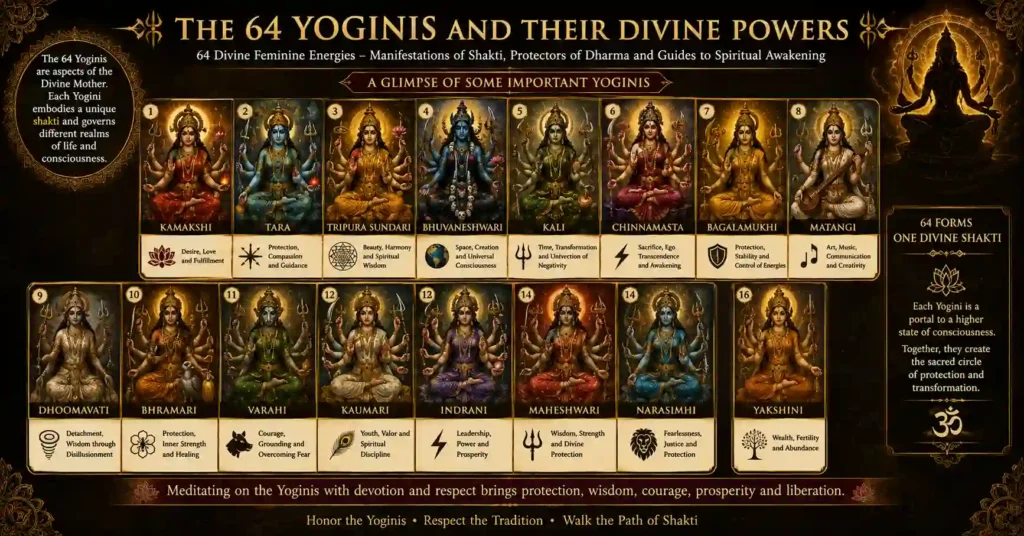
Each Yogini represents a distinct manifestation of Shakti, symbolizing qualities such as protection, wisdom, courage, prosperity, transformation, healing, and cosmic harmony. Together, they form the sacred Yogini Mandala, expressing the many dimensions of the Divine Feminine within the universe.
Studying these names is not simply an exercise in memorization. It offers insight into the symbolic language of Tantric philosophy, helping devotees and spiritual seekers understand how one Supreme Shakti manifests through many divine energies.
The table below presents a traditional list of the 64 Yoginis along with the spiritual qualities or blessings commonly associated with each one.
Note: The names and sequence of the Yoginis may vary across different Tantric texts, regional traditions, and temples. The list below follows one of the most widely accepted traditional compilations associated with the Hirapur Chausath Yogini Temple in Odisha. The symbolic meanings are simplified to help readers understand the spiritual qualities commonly associated with each Yogini.
| No. | Yogini Name | Spiritual Significance |
|---|---|---|
| 1 | Bahurupa | Divine manifestations |
| 2 | Tara | Protection & liberation |
| 3 | Narmada | Purification & flow |
| 4 | Yamuna | Purity & devotion |
| 5 | Shanti | Peace & harmony |
| 6 | Varuni | Vitality & inner strength |
| 7 | Kshemankari | Welfare & protection |
| 8 | Aindri | Courage & authority |
| 9 | Varahi | Strength & protection |
| 10 | Ranveera | Fearlessness & valor |
| 11 | Vanara-Mukhi | Agility & intelligence |
| 12 | Vaishnavi | Preservation & balance |
| 13 | Kalaratri | Protection from evil |
| 14 | Vaidyaroopa | Healing & wellness |
| 15 | Charchika | Obstacle removal |
| 16 | Betali | Guardian energy |
| 17 | Chinnamastika | Transformation & awakening |
| 18 | Vrishabahana | Stability & Dharma |
| 19 | Jwala Kamini | Purification & passion |
| 20 | Ghatavara | Ritual protection |
| 21 | Karakali | Fierce transformation |
| 22 | Saraswati | Knowledge & wisdom |
| 23 | Birupa | Mystical transformation |
| 24 | Kauveri | Prosperity & abundance |
| 25 | Bhaluka | Endurance & strength |
| 26 | Narasimhi | Justice & protection |
| 27 | Biraja | Purity & radiance |
| 28 | Vikatanna | Obstacle removal |
| 29 | Mahalakshmi | Wealth & prosperity |
| 30 | Kaumari | Courage & youthfulness |
| 31 | Maha Maya | Cosmic illusion |
| 32 | Rati | Love & harmony |
| 33 | Karkari | Strength & protection |
| 34 | Sarpashya | Kundalini energy |
| 35 | Yakshini | Abundance & blessings |
| 36 | Vinayaki | Wisdom & success |
| 37 | Vindya Balini | Mountain strength |
| 38 | Veera Kumari | Valor & courage |
| 39 | Maheshwari | Shiva’s divine power |
| 40 | Ambika | Motherly protection |
| 41 | Kamiyani | Devotion & harmony |
| 42 | Ghatabari | Sacred knowledge |
| 43 | Stutee | Devotion & grace |
| 44 | Kali | Liberation & transformation |
| 45 | Uma | Compassion & purity |
| 46 | Narayani | Divine protection |
| 47 | Samudraa | Cosmic depth |
| 48 | Brahmani | Creation & wisdom |
| 49 | Jwala Mukhi | Fiery transformation |
| 50 | Agneyei | Fire & purification |
| 51 | Aditi | Infinite motherhood |
| 52 | Chandrakanti | Calmness & beauty |
| 53 | Vayubega | Speed & life force |
| 54 | Chamunda | Evil destruction |
| 55 | Murati | Divine manifestation |
| 56 | Ganga | Spiritual purification |
| 57 | Dhumavati | Detachment & wisdom |
| 58 | Gandhari | Discipline & strength |
| 59 | Sarva Mangala | Auspicious blessings |
| 60 | Ajita | Invincibility |
| 61 | Surya Putri | Vitality & illumination |
| 62 | Vayu Veena | Cosmic vibration |
| 63 | Aghora | Fearlessness & transcendence |
| 64 | Bhadrakali | Motherly protection |
What Do These 64 Yoginis Represent?
Although each Yogini has a distinct name, form, and symbolism, they are not regarded as separate or unrelated goddesses. Instead, they are understood as different manifestations of the Supreme Shakti, each expressing a unique aspect of divine energy.
Together, they represent the full spectrum of creation, including wisdom, courage, protection, prosperity, healing, transformation, discipline, compassion, and spiritual awakening. Their collective presence illustrates the Tantric understanding that one universal consciousness manifests through countless forms and energies.
For devotees and spiritual seekers, contemplating these Yoginis is not merely about remembering sixty-four names. It is an invitation to recognize the many qualities of the Divine Mother and to cultivate those same virtues within one’s own life.
The Unique Architecture of Yogini Temples
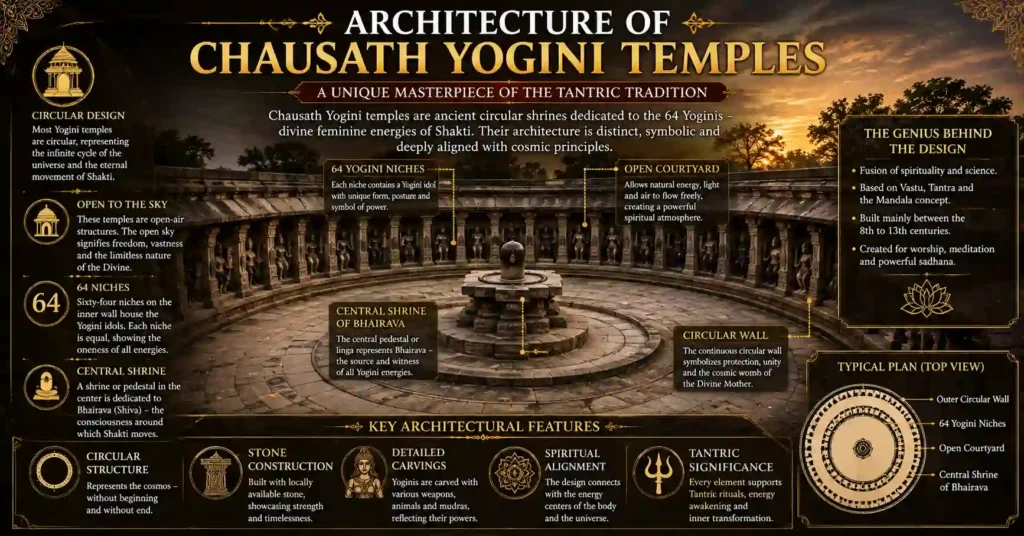
One of the most remarkable features of Yogini temples is their distinctive circular, open-air architecture, unlike the traditional design of most Hindu temples. This unique layout reflects profound spiritual ideas found in Tantric philosophy and sacred geometry.
Along the circular outer wall are sixty-four individual niches or chambers, each originally housing the image of a Yogini. At the centre stands a shrine dedicated to Lord Shiva or Bhairava, symbolizing the spiritual union of Shiva and Shakti, consciousness and cosmic energy.
Most of these temples have no roof, allowing devotees to worship beneath the open sky. Many scholars believe this design represents the limitless nature of the universe and the direct connection between the Divine, nature, and the cosmos.
The circular arrangement is often interpreted as the Yogini Mandala, where every Yogini occupies an equal place around the central deity. This symbolizes harmony, completeness, and the continuous flow of divine energy throughout creation.
Beyond their religious importance, these temples are remarkable examples of early medieval Indian architecture, combining spiritual symbolism with exceptional artistic craftsmanship. Their design continues to attract devotees, historians, archaeologists, and architecture enthusiasts from around the world.
Influence of the Chausath Yogini Tradition on Indian Art and Architecture
The surviving Chausath Yogini temples are not only sacred places of worship but also outstanding examples of early medieval Indian architecture. Their circular design, open-air layout, and beautifully carved sculptures are unlike those of most traditional Hindu temples.
Historians and art scholars regard these temples as important milestones in the development of Shakta temple architecture and Tantric sacred spaces. The intricate carvings of the Yoginis also provide valuable insights into the artistic styles, symbolism, and craftsmanship of their time.
Today, these monuments continue to attract devotees, historians, archaeologists, architects, and art enthusiasts. They preserve a unique blend of spirituality, sculpture, and architectural innovation that forms an important part of India’s cultural heritage.
Why Are Yogini Temples Open to the Sky?
Many ancient Yogini temples are remarkable for having no roof, a feature that sets them apart from most Hindu temples. This open-air design has long fascinated devotees, historians, and archaeologists.
According to traditional belief, the Yoginis are celestial or sky-moving (Khechari) divine beings whose spiritual energies move freely through the cosmos. The open roof is therefore believed to symbolize an unobstructed connection between the temple, the sky, and the infinite universe.
From a Tantric perspective, the roofless design also reflects the limitless nature of Shakti. It emphasizes that divine energy cannot be confined within physical boundaries but pervades all of creation.
While historians continue to study the architectural and ritual significance of these temples, devotees regard the open sky as a powerful reminder of the boundless presence of the Divine Feminine.
The Symbolism of Animal-Headed Yoginis
Many Yogini sculptures display unusual forms, including animal heads such as lions, boars, elephants, owls, serpents, and birds. These distinctive features are rich in symbolism and reflect the profound spiritual vision of Tantric art.
Rather than depicting ordinary physical forms, these animal characteristics represent powerful natural forces, instincts, and divine qualities present within creation. Each form conveys a particular aspect of Shakti, expressing courage, wisdom, strength, protection, transformation, or heightened awareness.
For example, the lion symbolizes courage and royal power, the boar represents strength and protection, the owl signifies wisdom and intuitive knowledge, while the elephant reflects stability, intelligence, and spiritual strength. Together, these symbols illustrate the many dimensions of the Divine Feminine.
In Tantric philosophy, these forms remind seekers that every aspect of nature, whether gentle or fierce, can become a means of spiritual growth when understood as an expression of the one universal Shakti.
Famous Chausath Yogini Temples in India
Ancient Yogini temples are among the most remarkable examples of Tantric architecture in India. Their unique circular design and spiritual symbolism make them unlike most traditional Hindu temples.
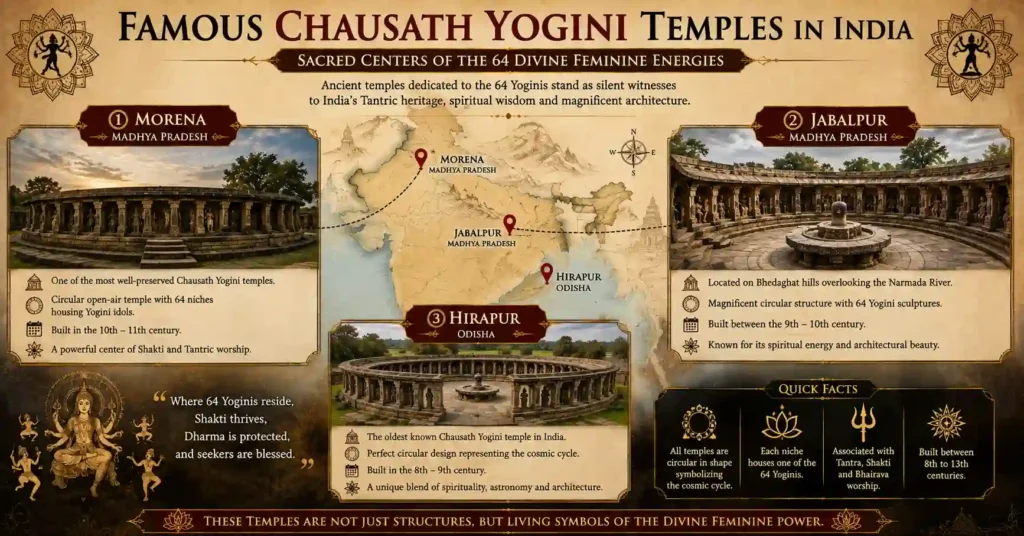
Only a few of these sacred shrines have survived the passage of time. Among them, the temples at Morena, Jabalpur, and Hirapur are the best known and continue to preserve the rich heritage of the Yogini tradition.
Chausath Yogini Temple, Morena (Madhya Pradesh)
Located in the Morena district of Madhya Pradesh, this is one of the largest and best-known Yogini temples in India. Built around the 11th century CE by the Kachchhapaghata dynasty, it is renowned for its impressive circular design and elevated hilltop location.
The temple originally housed sixty-four Yogini shrines surrounding a central shrine dedicated to Lord Shiva. Many historians also believe that its circular layout influenced the design of the Indian Parliament building, although this remains a subject of discussion.
Chausath Yogini Temple, Jabalpur (Madhya Pradesh)
Situated near the famous Marble Rocks of Bhedaghat, this temple overlooks the scenic Narmada Valley. It is believed to have been built by the Kalachuri rulers during the 10th century and remains an important centre of historical and religious significance.
Unlike many other Yogini temples, the central shrine here is dedicated to Lord Shiva and Goddess Parvati, symbolizing the eternal union of Shiva and Shakti. The temple also offers breathtaking panoramic views of the surrounding landscape.
Hirapur Chausath Yogini Temple (Odisha)
Located near Bhubaneswar, the Hirapur Chausath Yogini Temple is one of the best-preserved and most spiritually significant Yogini shrines in India. Although smaller in size than the Morena temple, it retains many original Yogini sculptures, making it an invaluable treasure of India’s sacred heritage.
Its roofless circular structure reflects the distinctive architectural style of Yogini temples. Because of its remarkable state of preservation, the Hirapur temple is widely regarded as one of the most authentic places for studying the Yogini tradition, Tantric art, and Shakta worship.
Temple Comparison
| Temple | Location | Approx. Period | Known For |
|---|---|---|---|
| Morena | Madhya Pradesh | 11th century CE | Largest circular Yogini temple |
| Jabalpur | Madhya Pradesh | 10th century CE | Narmada Valley location and Shiva-Parvati shrine |
| Hirapur | Odisha | 9th century CE | Best-preserved Yogini sculptures and Tantric heritage |
Bhairava and the Yogini Tradition
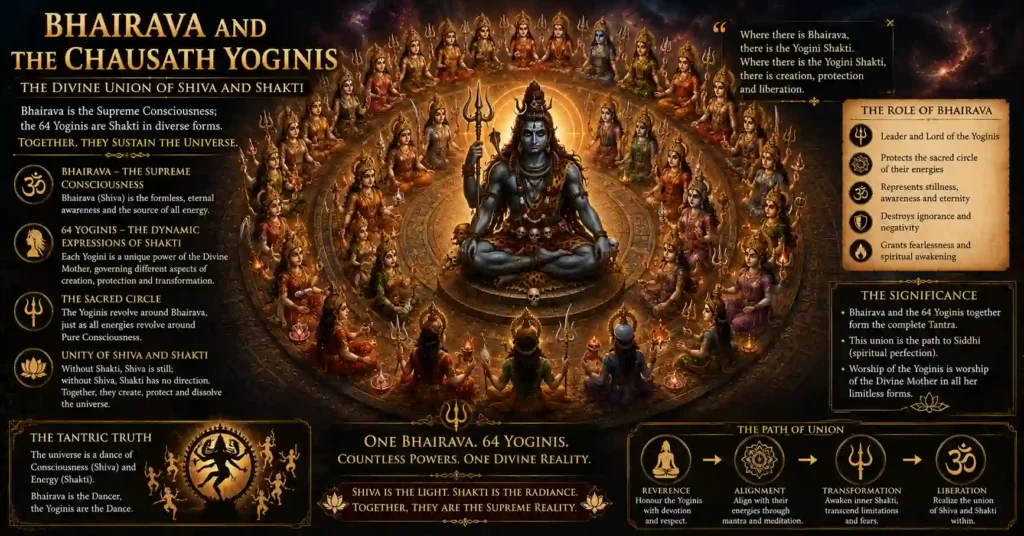
Bhairava represents the fierce, protective aspect of Lord Shiva and is traditionally regarded as the guardian and spiritual guide of the Yoginis. In Tantric traditions, he symbolizes fearlessness, spiritual discipline, and the protection of sacred knowledge.
In many ancient Yogini temples, Bhairava occupies the central shrine while the Yoginis are arranged around him in a sacred circle. This sacred layout symbolizes the eternal union of Shiva and Shakti, where pure consciousness and divine energy exist in perfect harmony.
For devotees, Bhairava is not only a protector but also the spiritual force that guides seekers beyond fear, ignorance, and ego toward higher realization.
Chausath Yogini Worship and Sadhana
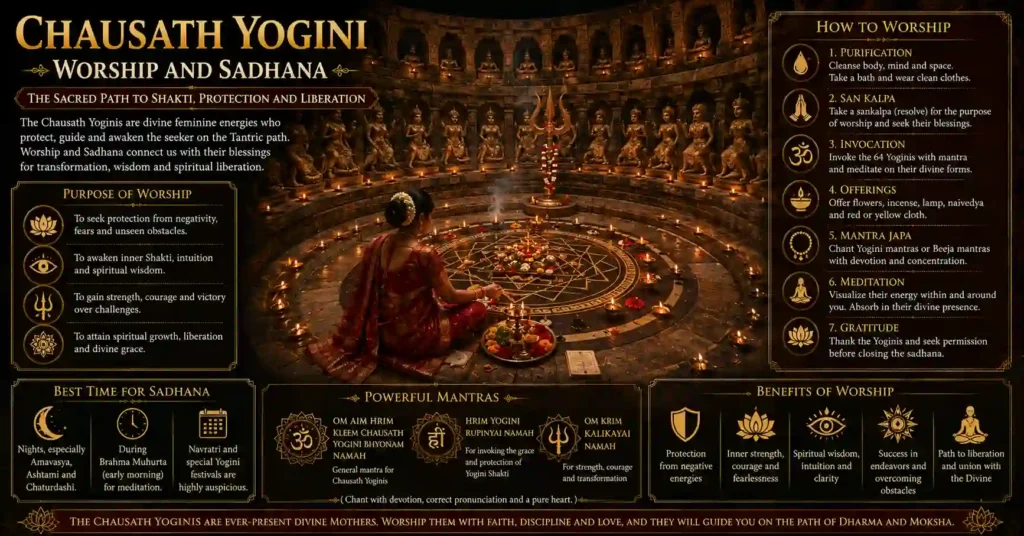
Traditional Yogini worship combines devotion with inner spiritual practice. It may include mantra chanting, meditation on the Yogini Mandala, and offerings made to the Divine Mother as expressions of reverence and surrender.
In Tantric traditions, these practices are intended to cultivate self-discipline, spiritual awareness, and a deeper connection with Shakti. Meditation on the Yoginis is understood as a symbolic journey towards awakening the divine energies within oneself.
Many traditional practices are performed only under the guidance of a qualified Guru, as advanced Yogini sadhana forms part of the Guru-Shishya Parampara. For most devotees, prayer, meditation, and respectful contemplation of the Divine Mother remain the most appropriate ways to honour this sacred tradition.
Common Misconceptions About Yogini Worship
Some people mistakenly associate Yogini worship with dark or occult practices because of its connection with Tantric traditions. However, this is an oversimplification that does not reflect the broader understanding of the tradition within Sanatan Dharma.
At its core, the Yogini tradition is a path of Shakti worship, spiritual discipline, meditation, and inner transformation. Its ultimate aim is self-realization, awakening higher consciousness, and experiencing the Divine through the many manifestations of the Divine Mother.
Like many spiritual paths, Tantric practices range from simple devotional worship to advanced disciplines. Traditionally, the deeper forms of Yogini sadhana are undertaken only under the guidance of a qualified Guru, while most devotees express their devotion through prayer, meditation, and reverence for the Divine Mother.
Archaeological Evidence of the Yogini Tradition
Archaeological discoveries have confirmed that the Yogini tradition was once widespread across different parts of India. Several ancient Yogini temples, many dating from the 9th to 12th centuries CE, continue to stand as remarkable examples of India’s spiritual and architectural heritage.
Excavations and historical studies have uncovered beautifully carved Yogini sculptures, inscriptions, and temple remains in regions such as Madhya Pradesh, Odisha, and Chhattisgarh. These findings provide valuable insights into the development of Shakta and Tantric traditions during the early medieval period.
Today, these temples are protected as important cultural and archaeological monuments. They preserve not only exceptional craftsmanship but also the rich philosophical and spiritual legacy of the Yogini tradition for future generations.
Influence of the Chausath Yogini Tradition on Indian Culture
The influence of the Chausath Yogini tradition extends beyond temples and spiritual practices. Its symbolism has inspired Indian sculpture, temple architecture, classical art, and religious iconography for centuries.
The circular temple layouts, expressive Yogini sculptures, and representations of the Divine Feminine continue to be studied by historians, artists, and architects as important examples of India’s cultural and artistic heritage.
Today, the surviving Yogini temples stand not only as places of worship but also as living monuments that preserve the rich spiritual, artistic, and historical legacy of Sanatan Dharma for future generations.
Legacy of the Chausath Yogini Tradition
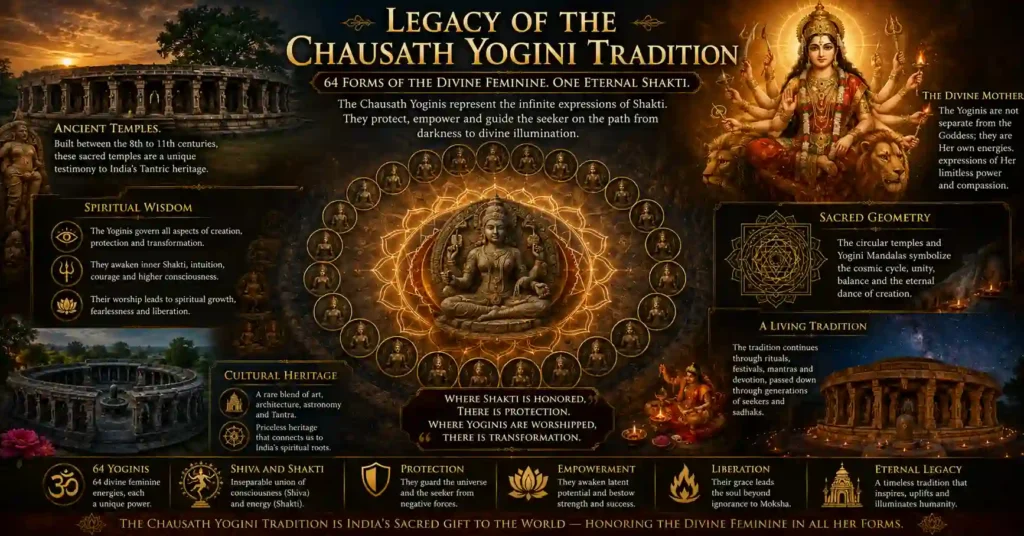
Today, the Yogini tradition is studied not only by historians and archaeologists but also by devotees and spiritual seekers as an important part of India’s sacred heritage. Its temples, sculptures, and philosophical teachings continue to inspire research and spiritual exploration.
Although active Yogini worship is now limited to a few traditions, the symbolism of the Yoginis remains deeply woven into Shakta philosophy, Tantric practices, and the broader understanding of Shakti in Sanatan Dharma.
The surviving temples at Morena, Jabalpur, and Hirapur stand as living reminders of this extraordinary legacy. They preserve a unique blend of spirituality, art, architecture, and sacred symbolism that continues to fascinate people from around the world.
Chausath Yogini in Modern Spirituality
Although the ancient Yogini temples belong to a bygone era, the spiritual ideals they represent continue to remain relevant. The Yoginis symbolize courage, wisdom, self-discipline, compassion, transformation, and the limitless power of Shakti, qualities that continue to inspire seekers in everyday life.
Today, many people explore the Yogini tradition not only through temple visits and scriptural study but also through meditation, yoga, and a deeper appreciation of the Divine Feminine. While traditional Yogini sadhana remains a specialized path, its underlying philosophy encourages inner growth, self-awareness, and spiritual balance.
In this way, the legacy of the Yoginis extends beyond ancient temples. It continues to remind us that the journey towards self-realization begins with awakening the divine qualities that already exist within every individual.
Conclusion
The Chausath Yogini tradition reveals one of the most fascinating chapters in the spiritual heritage of Sanatan Dharma. These divine feminine energies represent the many manifestations of Shakti, expressing the creative, protective, transformative, and liberating forces that sustain the universe.
Their ancient temples, sacred symbolism, and Tantric philosophy remind us that spirituality extends beyond rituals to a deeper understanding of consciousness, nature, and the Divine. The Yoginis illustrate how one Supreme Reality can manifest through countless forms while remaining eternally one.
Whether viewed through the lens of devotion, philosophy, history, or sacred art, the Yogini tradition continues to inspire seekers across generations. It stands as a timeless reminder of the profound wisdom, spiritual diversity, and enduring legacy of the Divine Mother within Sanatan Dharma.
Key Takeaways
- Chausath Yoginis are sixty-four divine manifestations of Shakti, representing the many forms of the Divine Mother in Shakta and Tantric traditions.
- They symbolize protection, wisdom, transformation, prosperity, courage, and the limitless expressions of divine feminine energy.
- The famous Chausath Yogini temples at Morena, Jabalpur, and Hirapur are renowned for their unique circular, open-air architecture and rich spiritual symbolism.
- The Yogini tradition is closely connected with Bhairava, sacred geometry, and the philosophy of Shiva-Shakti, reflecting the unity of consciousness and cosmic energy.
- Beyond mythology and temple worship, the Yoginis continue to inspire devotees, scholars, and spiritual seekers as a timeless symbol of India’s spiritual, artistic, and cultural heritage.
Suggested Reading
To understand the Chausath Yogini tradition more deeply, it is helpful to explore the broader teachings of Shakti, Sanatan Dharma, Tantric philosophy, and the spiritual principles that guide the path towards self-realization. The following articles will help you continue your journey.
Shakti in Sanatan Dharma: Meaning, Forms, Philosophy and Spiritual Significance
https://thesanatantales.com/shakti-in-sanatan-dharma/
Sanatan Dharma: Meaning, Origin, Core Principles and Way of Life
https://thesanatantales.com/sanatan-dharma-meaning/
Kaal in Sanatan Dharma: Meaning, Yugas, Cosmic Time and Kala Chakra
https://thesanatantales.com/kaal-in-sanatan-dharma/
Why Do Hindus Have So Many Gods? The Truth Behind Many Deities in Sanatan Dharma
https://thesanatantales.com/why-do-hindus-have-so-many-gods/
Karma: Meaning, Types, Philosophy and How It Works in Sanatan Dharma
https://thesanatantales.com/karma/
Atma and Parmatma: Meaning, Relationship and Their Role in Sanatan Dharma
https://thesanatantales.com/atma-and-parmatma/
Dasa Mahavidya: The Ten Wisdom Goddesses of Sanatan Dharma
https://thesanatantales.com/das-mahavidya/
Kundalini Shakti: Signs of Awakening and Spiritual Meaning
https://thesanatantales.com/kundalini-shakti-signs-awakening/
Chausath Yogini Temple, Mitaoli (Wikipedia)
https://en.wikipedia.org/wiki/Chausath_Yogini_Temple,_Mitaoli
FAQs
Who are the Chausath Yoginis?
The Chausath Yoginis are sixty-four divine feminine beings revered in Shakta and Tantric traditions of Sanatan Dharma. They are regarded as different manifestations of Shakti, the universal creative energy that sustains the cosmos.
Rather than being separate goddesses, they represent various aspects of wisdom, protection, transformation, courage, prosperity, and spiritual awakening. Together, they form the sacred Yogini Mandala, symbolizing the infinite expressions of the Divine Mother.
What is the significance of the Chausath Yoginis in Sanatan Dharma?
The Yoginis symbolize the many dimensions of Shakti, showing that one Supreme Divine Energy manifests in countless forms. Their tradition teaches that every force in nature and every stage of spiritual growth reflects the presence of the Divine Mother.
Their philosophy also emphasizes the balance of Shiva and Shakti, the harmony of consciousness and energy, and the journey towards self-realization.
Why are there exactly 64 Yoginis?
In Tantric philosophy, the number 64 represents completeness and the limitless expressions of divine energy. The Yoginis are traditionally arranged as eight groups of eight, forming a sacred mandala associated with cosmic harmony and the eight directions.
The number is also linked with the Chatushashti Kalas (64 Arts), symbolizing the fullness of knowledge, creativity, and human potential.
Are the Chausath Yoginis different from the Dasha Mahavidyas?
Yes. The Dasha Mahavidyas are ten principal forms of the Divine Mother, each representing a profound aspect of spiritual wisdom. The Yoginis are a separate but related tradition that reflects the many manifestations of Shakti in Tantric worship.
Although both belong to the broader Shakta tradition, they have different origins, symbolism, and roles in spiritual practice.
Where are the famous Chausath Yogini temples located?
Some of the most important surviving temples are located at Morena and Jabalpur in Madhya Pradesh, and Hirapur near Bhubaneswar in Odisha.
These temples are renowned for their circular, roofless architecture, remarkable sculptures, and their importance in the history of Shakta and Tantric traditions.
Why do many Yogini temples have no roof?
According to traditional belief, the Yoginis are celestial or Khechari divine beings whose energies move freely through the cosmos. The open-air design symbolizes an unobstructed connection between the temple, the sky, and the universe.
Scholars also view this unique architecture as an important feature of medieval Tantric temple design, reflecting sacred geometry and cosmic symbolism.
Is Yogini worship the same as Tantra?
Not exactly. Yogini worship is one important tradition within the broader framework of Tantric spirituality. Tantra includes many philosophical schools, rituals, meditation practices, and methods of spiritual discipline beyond the worship of the Yoginis.
For most devotees, reverence for the Divine Mother through prayer, meditation, and devotion remains the primary form of worship.
Can anyone perform Chausath Yogini sadhana?
Simple forms of devotion, such as prayer, mantra chanting, and meditation on the Divine Mother, may be practiced with sincerity and respect. However, advanced Yogini sadhana described in traditional Tantric texts is generally undertaken only under the guidance of a qualified Guru.
This emphasis on the Guru-Shishya Parampara helps preserve both the spiritual integrity and the proper understanding of these sacred practices.
What do the animal-headed Yoginis symbolize?
Many Yogini sculptures feature animal heads such as lions, boars, owls, elephants, or serpents. These forms are symbolic rather than literal and represent different qualities of nature and consciousness.
They express attributes such as courage, wisdom, protection, strength, transformation, and heightened awareness, illustrating the many dimensions of Shakti.
Why is the Chausath Yogini tradition still important today?
The Yogini tradition continues to inspire devotees, historians, archaeologists, artists, and spiritual seekers. Its temples, sculptures, philosophy, and symbolism preserve a unique chapter of India’s spiritual and cultural heritage.
Even today, the tradition reminds us that the Divine can be experienced through many forms, while ultimately pointing towards one universal reality expressed through Shakti.
Glossary of Important Terms
| Term | Meaning |
|---|---|
| Chausath Yogini | The sixty-four divine feminine manifestations of Shakti worshipped in Shakta and Tantric traditions. |
| Yogini | A divine feminine being or spiritually accomplished female associated with yogic power and Shakti. |
| Shakti | The supreme divine energy that creates, sustains, and transforms the universe. |
| Shakta Tradition | A major tradition of Sanatan Dharma that worships the Divine Mother (Devi) as the Supreme Reality. |
| Tantra | A spiritual tradition that uses meditation, mantra, rituals, and symbolic practices for spiritual realization. |
| Bhairava | A fierce form of Lord Shiva regarded as the guardian and spiritual guide of the Yoginis. |
| Yogini Mandala | The sacred circular arrangement of the Yoginis representing cosmic harmony and the many expressions of Shakti. |
| Shiva and Shakti | The inseparable cosmic principles of pure consciousness (Shiva) and divine energy (Shakti). |
| Guru-Shishya Parampara | The traditional teacher-disciple lineage through which sacred spiritual knowledge is transmitted. |
| Mantra | A sacred sound, word, or verse repeated during meditation and worship to focus the mind and invoke divine blessings. |
| Sadhana | A disciplined spiritual practice undertaken to attain self-realization and spiritual growth. |
| Khechari | Literally “sky-moving”; a traditional term used for celestial beings or divine energies that move through the subtle realms. |
| Sacred Geometry | Symbolic geometric patterns used in spiritual traditions to represent cosmic order and divine energy. |
| Chatushashti Kalas | The traditional sixty-four arts of ancient India, symbolizing complete knowledge, creativity, and human excellence. |
| Self-realization | The direct experience of one’s true spiritual nature and unity with the Divine. |
About the Author
Yateendra Chaturvedi is a spiritual writer, researcher, devotee, and the founder of The Sanatan Tales. With over 35 years of professional experience and a lifelong interest in Sanatan Dharma, he writes about Hindu deities, temples, scriptures, festivals, Mahavidyas, sacred stories, rituals, and living traditions that continue to guide and inspire devotees across India.
Drawing from traditional scriptures, regional beliefs, temple traditions, devotional literature, and historical sources, he aims to present authentic, well-researched, and easy-to-understand content for modern readers. His work focuses on preserving spiritual wisdom, explaining sacred traditions, and helping seekers develop a deeper understanding of India’s rich spiritual heritage.
Through The Sanatan Tales, Yateendra strives to make the timeless teachings of Sanatan Dharma simple, meaningful, and relevant for today’s generation while maintaining respect for traditional sources, regional practices, and diverse spiritual perspectives.
Learn More About Yateendra Chaturvedi →
https://thesanatantales.com/about-the-author/
References & Sources
This article is based on widely accepted beliefs, scriptures, traditional practices, and philosophical teachings followed across various traditions of Sanatan Dharma. It also draws upon insights from classical Hindu texts, temple traditions, scholarly studies, and other reliable spiritual and historical sources.
Note: Beliefs, interpretations, and religious practices may vary among different sampradayas, sects, regions, and spiritual lineages within Sanatan Dharma. The purpose of this article is not to present any one interpretation as the absolute truth, but to explain commonly accepted perspectives in a simple, balanced, and accessible manner for educational and spiritual understanding.
Read More Interesting Articles on Sanatan Dharma




Thanx for yoour efforts to provide very informative article.
Thanks for you encouragement.