Time changes. Civilizations rise and fall. Ideas evolve. Yet some truths continue to guide humanity across generations. Sanatan Dharma is one such timeless tradition. More than a religion, it is an eternal way of life that teaches how to live with righteousness, wisdom, compassion, and inner peace.
Often called the world’s oldest living spiritual tradition, Sanatan Dharma offers universal principles that go beyond culture, geography, and time. Its teachings encourage us to understand our true nature, perform our duties selflessly, respect all forms of life, and seek lasting happiness through self-realization.
Many people ask, What is Sanatan Dharma? Is it the same as Hinduism? Why is it called eternal? What are its core principles, and how does it remain relevant in modern life? Understanding these questions helps us appreciate not only its philosophy but also its practical guidance for everyday living.
In this comprehensive guide, you will discover the meaning of Sanatan Dharma, its origin, core principles, scriptural foundation, universal values, the relationship between Sanatan Dharma and Hinduism, the four Purusharthas, different paths of Yoga, and how this timeless wisdom continues to inspire millions across the world. Whether you are a beginner or a spiritual seeker, this article will help you understand why this eternal tradition remains as relevant today as it was thousands of years ago.
Sanatan Dharma at a Glance
| Aspect | Details |
|---|---|
| Meaning | The eternal way of life based on righteousness, truth, and spiritual wisdom. |
| Origin | Ancient Vedic tradition with no single founder or beginning. |
| Main Goal | Moksha (liberation through self-realization). |
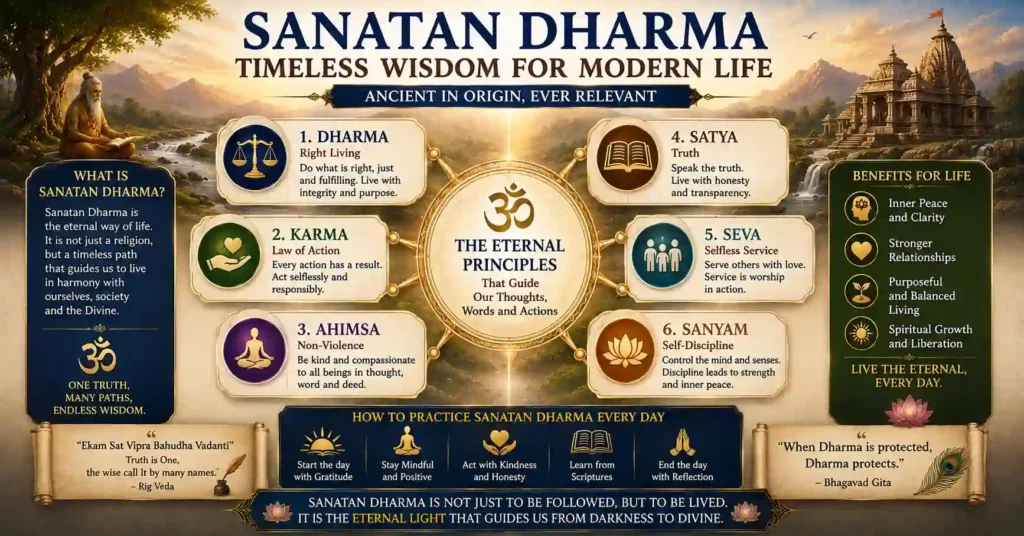
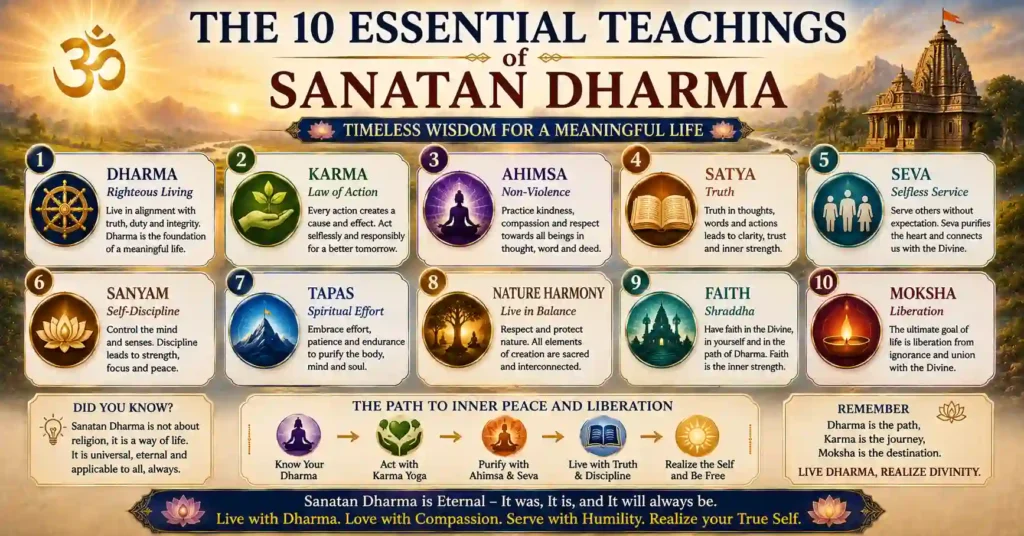
| Core Principles | Dharma, Karma, Rebirth, Moksha, Satya, and Ahimsa. |
| Sacred Scriptures | Vedas, Upanishads, Bhagavad Gita, Ramayana, Mahabharata, and Puranas. |
| Main Paths | Bhakti Yoga, Karma Yoga, Jnana Yoga, and Raja Yoga. |
| Four Goals of Life | Dharma, Artha, Kama, and Moksha (Purusharthas). |
| Ultimate Teaching | Live righteously, realize the Self, and attain harmony with the Supreme Reality. |
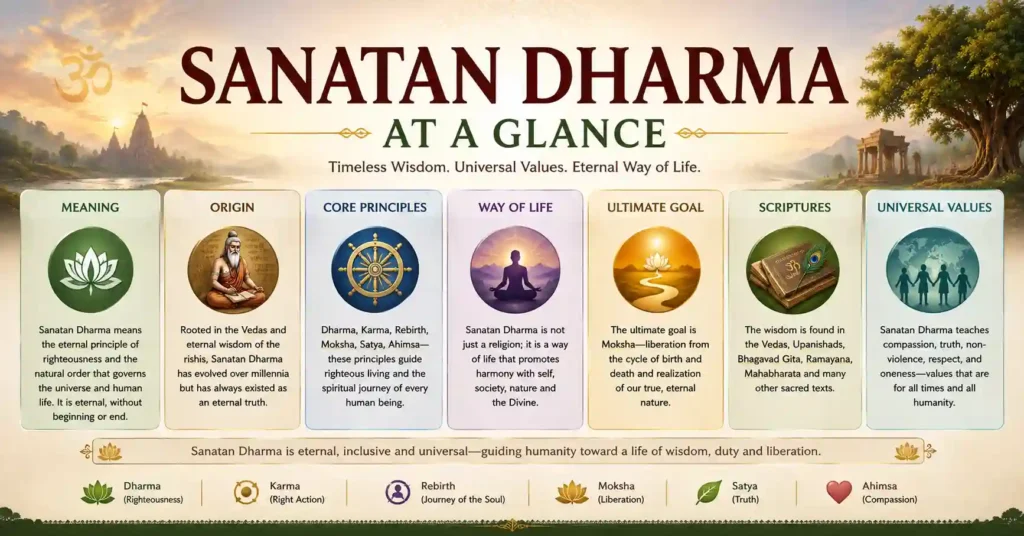
Table of Contents
ToggleIn a Nutshell
Sanatan Dharma is the eternal way of life that teaches righteous living, compassion, truth, self-discipline, and spiritual growth.
Rooted in the Vedas and other sacred scriptures, it guides individuals towards self-realization through Dharma, Karma, devotion, knowledge, meditation, and selfless action.
Rather than being limited to rituals, it offers timeless principles that remain relevant in every age.
What Does Sanatan Dharma Mean?
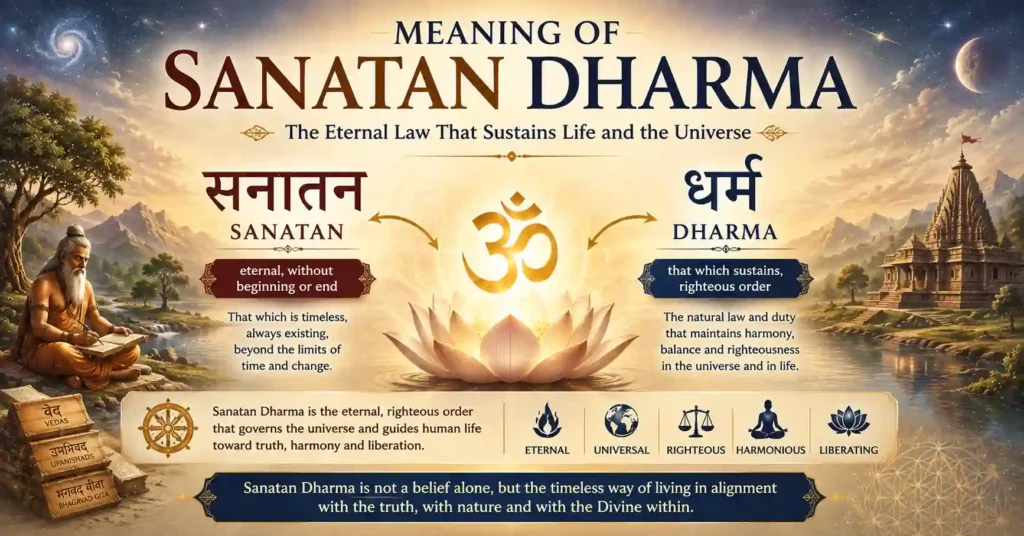
The word Sanatan Dharma is made up of two Sanskrit words that together express a profound spiritual truth.
Sanatan means eternal, without beginning or end. It refers to that which exists beyond time and remains unchanged through every age.
Dharma means that which sustains. It includes righteousness, moral duty, natural law, and the cosmic order that maintains harmony in the universe.
Dharma is often translated as “religion,” but that translation does not fully capture its true meaning. Religion usually refers to a system of beliefs, rituals, or traditions associated with a particular founder or historical event.
Dharma is much broader. It represents the inherent nature of all existence. Fire burns, water flows, and the sun rises every day. That is their dharma because it reflects their natural function.
In the same way, qualities such as truthfulness, compassion, gratitude, self-discipline, and selfless service are considered the natural dharma of human beings. Living according to these values brings harmony to both the individual and society.
Therefore, the meaning of Sanatan Dharma is the eternal law that governs the universe and guides righteous living. It is not limited to rituals or beliefs but offers timeless principles that help every individual live with wisdom, balance, and spiritual awareness.
Is Sanatan Dharma the Same as Hinduism?
This is one of the most common questions asked by people trying to understand the meaning of Sanatan Dharma.
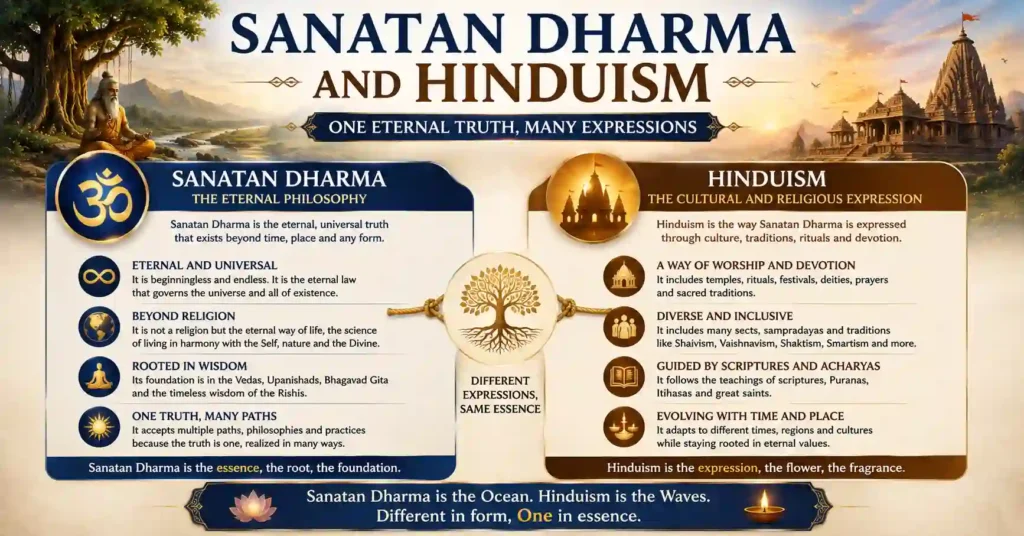
The word Hindu developed much later in history. It is derived from the river Sindhu, which flowed through the northwestern part of the Indian subcontinent. Persian and other foreign travelers pronounced Sindhu as Hindu, and over time, the term Hinduism became a cultural and civilizational identity for the spiritual traditions that originated in India.
However, the followers of this ancient tradition did not originally describe their way of life as Hinduism. They referred to it as Sanatan Dharma, meaning the eternal Dharma or the timeless path of righteous living.
Although the two terms are closely related, they are not identical.
| Hinduism | Sanatan Dharma |
|---|---|
| A cultural and civilizational identity. | The eternal spiritual philosophy and universal way of life. |
| A commonly used modern term. | The traditional Sanskrit name found in spiritual literature. |
| Includes diverse customs, festivals, and regional traditions. | Provides the timeless principles that guide those traditions. |
Unlike many world religions, this eternal tradition has no single founder, no single mandatory scripture, no central religious authority, and no concept of forced conversion. Instead, it embraces multiple philosophies, scriptures, devotional traditions, and spiritual paths while encouraging every individual to seek truth through personal experience and righteous living.
This inclusive approach is one of the reasons it has continued to evolve while preserving its timeless wisdom for thousands of years.
What Is the Origin of Sanatan Dharma?
One of the most unique aspects of Sanatan Dharma is that its beginning cannot be traced to a specific date, person, or historical event.
Its wisdom is preserved in the ancient Vedas, especially the hymns of the Rig Veda, which are regarded as the oldest sacred scriptures. The Upanishads further explore profound questions about the Self (Atman), Brahman, and the ultimate nature of reality.
The Bhagavad Gita explains how to live a righteous life through Dharma, Karma, devotion, and self-realization. The Ramayana and Mahabharata illustrate these eternal principles through inspiring stories, moral choices, and real-life dilemmas.
Yet, none of these scriptures are regarded as the starting point of this timeless tradition. Instead, they are understood as revelations of eternal truths realized by ancient rishis through deep meditation and spiritual experience.
For this reason, the Vedas are traditionally described as Apaurusheya, meaning “not of human origin.” They are regarded as revealed wisdom rather than teachings created by any individual.
This understanding explains why the eternal Dharma is viewed as timeless and universal. It is not considered an invented doctrine but a body of spiritual wisdom discovered through realization and preserved for the benefit of humanity.
The Significance of Om in Sanatan Dharma
Among all sacred symbols, Om (ॐ) is regarded as the most fundamental in Sanatan Dharma. It is considered the primordial sound from which creation emerged and represents the eternal presence of the Supreme Reality.
The Vedas and Upanishads describe Om as a symbol of the unity of Atman (the individual Self) and Brahman (the Supreme Reality). For this reason, many prayers, mantras, and meditation practices begin with the chanting of Om.
More than a sacred syllable, Om reminds spiritual seekers that all forms of life are connected through one universal consciousness. It symbolizes creation, preservation, dissolution, and the eternal cycle of existence.
For millions of devotees, chanting Om is a simple yet powerful spiritual practice that helps cultivate inner peace, concentration, and awareness.
Frequently Quoted Scriptures on Sanatan Dharma
The wisdom of Sanatan Dharma is preserved in many sacred scriptures. Each text explains different aspects of spiritual life, philosophy, devotion, and righteous living.
| Scripture | Main Focus |
|---|---|
| Vedas | The oldest sacred scriptures containing hymns, prayers, and spiritual knowledge. |
| Upanishads | Philosophical teachings about Atman, Brahman, and the nature of reality. |
| Bhagavad Gita | A practical guide to Dharma, Karma, devotion, Yoga, and self-realization. |
| Ramayana | Demonstrates the ideals of Dharma through the life of Lord Rama. |
| Mahabharata | Explores moral dilemmas, duty, justice, and human nature through an epic narrative. |
| Puranas | Explain spiritual truths through stories of gods, sages, and sacred traditions. |
Together, these scriptures present a complete vision of spiritual life, helping seekers understand both timeless philosophy and its practical application.
Core Principles of Sanatan Dharma
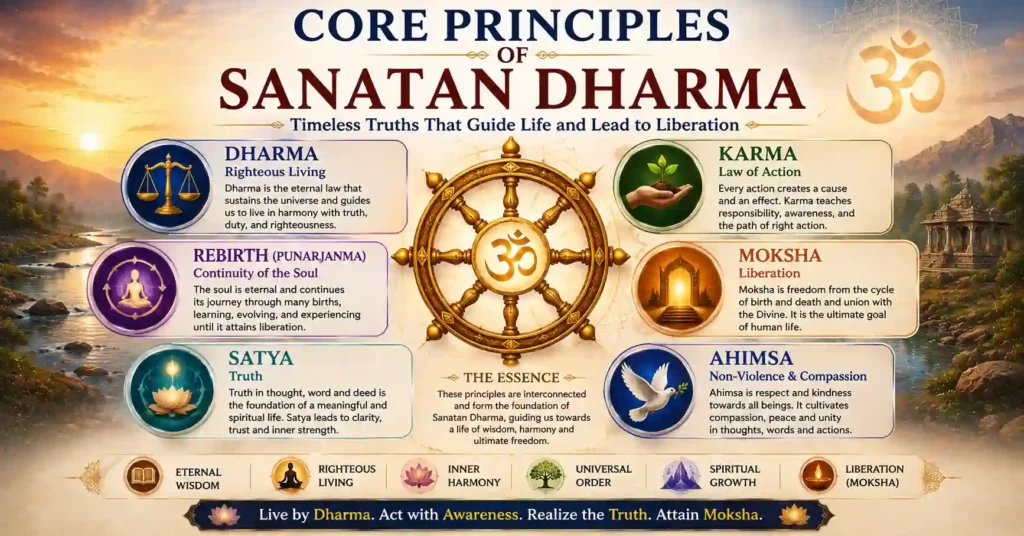
To understand what is Sanatan Dharma, we must first understand its foundational principles. These are not rigid commandments or fixed rules. Instead, they are timeless values that guide individuals towards righteous living, inner growth, and self-realization.
1. Dharma
Dharma means living with righteousness, moral responsibility, and a sense of duty. It encourages every individual to act according to truth, justice, and the greater good.
2. Karma
Karma is the universal law of cause and effect. Every thought, word, and action creates consequences that shape our present and future experiences.
3. Rebirth
According to Hindu philosophy, the soul (Atman) is eternal. It passes through multiple births and deaths, learning, evolving, and progressing on its spiritual journey.
4. Moksha
Moksha is the highest goal of life. It is the state of liberation from the cycle of birth and death, where the soul realizes its true nature and attains union with the Supreme Reality.
5. Satya and Ahimsa
Satya (truthfulness) and Ahimsa (non-violence) are two of the highest moral virtues. Together, they encourage honesty, compassion, respect for all living beings, and harmony in society.
Core Principles at a Glance
| Principle | Meaning |
|---|---|
| Dharma | Living with righteousness and moral responsibility |
| Karma | Every action produces corresponding results |
| Rebirth | The soul continues its spiritual journey through many lives |
| Moksha | Liberation from the cycle of birth and death |
| Satya | Commitment to truth in thought, word, and action |
| Ahimsa | Non-violence, compassion, and respect for all life |
Together, these timeless principles form the spiritual foundation of this eternal tradition. They continue to guide millions of people in leading a life of wisdom, compassion, self-discipline, and spiritual growth.
The Four Purusharthas: The Four Goals of Human Life
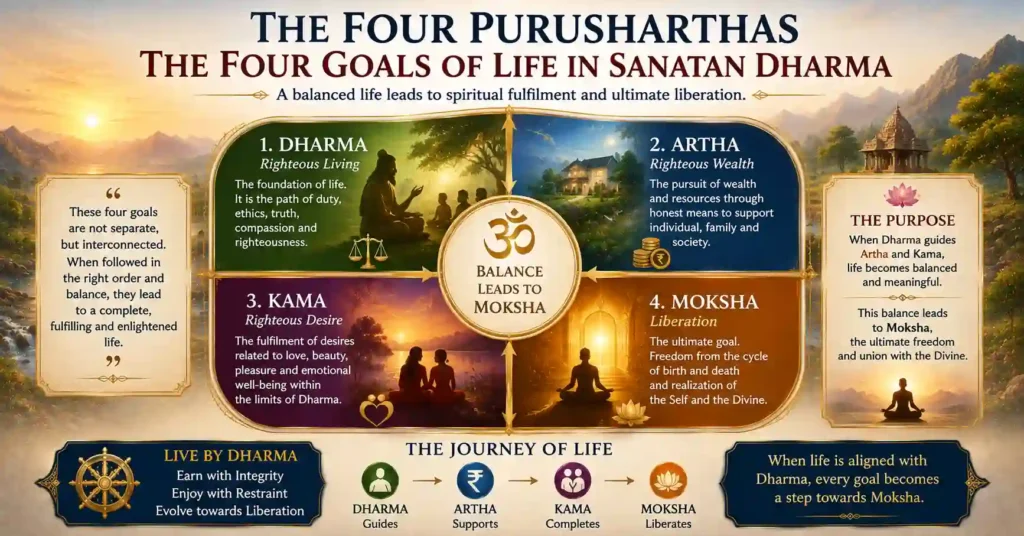
Sanatan Dharma teaches that human life is not meant to be lived without purpose. Ancient sages described four noble goals, known as the Purusharthas, which help a person live a balanced, meaningful, and spiritually fulfilling life.
These four goals are not separate from one another. Instead, they complement each other and guide an individual from worldly responsibilities to ultimate liberation.
| Purushartha | Meaning | Purpose |
|---|---|---|
| Dharma | Righteous living and moral duty | Builds character and harmony |
| Artha | Wealth and prosperity | Supports family and society through honest means |
| Kama | Desires and enjoyment | Encourages healthy and responsible fulfilment of life’s pleasures |
| Moksha | Spiritual liberation | Frees the soul from the cycle of birth and death |
Sanatan Dharma teaches that Artha and Kama should always be pursued under the guidance of Dharma. When life is lived with wisdom, self-discipline, and compassion, it gradually leads towards Moksha, the highest goal of human existence.
This balanced approach explains why the tradition is not opposed to worldly life. Instead, it teaches people how to fulfil their responsibilities while continuing their spiritual journey.
The Four Paths of Yoga in Sanatan Dharma
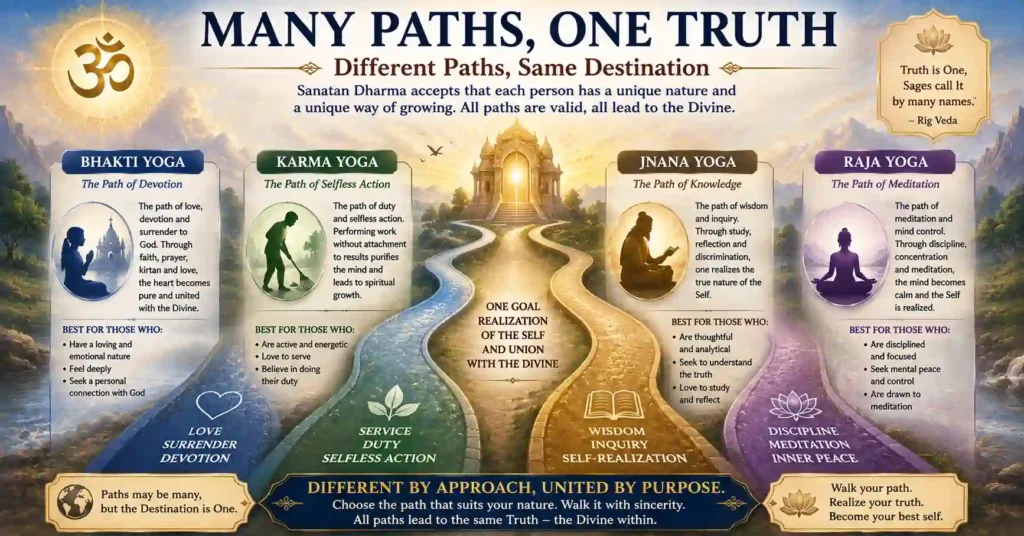
Sanatan Dharma recognizes that every individual has a unique nature and spiritual temperament. For this reason, it offers different paths to realize the same ultimate truth rather than insisting on a single approach.
The four classical paths of Yoga are:
| Path | Focus | Best Suited For |
|---|---|---|
| Bhakti Yoga | Devotion and love for the Divine | Those who express spirituality through faith and worship |
| Karma Yoga | Selfless action without attachment to results | Those who serve others through duty and responsibility |
| Jnana Yoga | Knowledge, inquiry, and self-reflection | Those who seek truth through study and contemplation |
| Raja Yoga | Meditation and mastery of the mind | Those who pursue inner discipline and spiritual practice |
Although these paths appear different, they ultimately lead towards the same goal: self-realization and union with the Supreme Reality. Many spiritual seekers naturally combine elements of more than one path throughout their lives.
This inclusive approach is one of the defining strengths of Sanatan Dharma, allowing every individual to progress according to their nature, abilities, and stage of spiritual growth.
Why Is Sanatan Dharma Called Eternal?
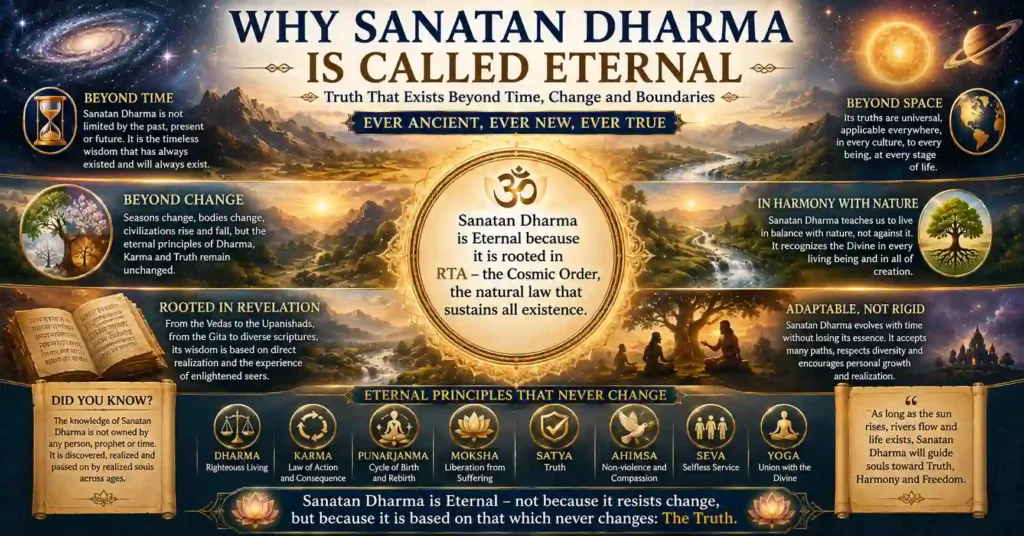
Sanatan Dharma is called eternal because it is not dependent on a single founder, historical event, or period in time. Its principles are believed to be universal truths that remain relevant across every age.
According to Hindu philosophy, the universe moves through recurring cosmic cycles known as Satya Yuga, Treta Yuga, Dvapara Yuga, and Kali Yuga. Civilizations change, societies evolve, and eras come and go, but eternal values continue to guide humanity.
Compassion never becomes outdated. Truth never loses its importance. Meditation remains a path to inner peace, and moral responsibility continues to shape a meaningful life.
While the outer forms of worship, customs, and social practices may adapt with time and place, the inner principles remain unchanged. This ability to preserve timeless wisdom while adapting to changing circumstances is one of the defining characteristics of this eternal tradition.
That is why it is known as Sanatan, meaning eternal. Its teachings are regarded as universal, timeless, and applicable to every generation, regardless of culture, nationality, or era.
How Does Sanatan Dharma Influence Everyday Life?
One of the greatest strengths of Sanatan Dharma is that it is not limited to philosophy, scriptures, or temple rituals. It is a practical way of life that inspires people to live with compassion, discipline, gratitude, and respect every day.
Its timeless values are reflected in simple daily actions that help create harmony within the individual, the family, society, and nature.
| Daily Practice | Spiritual Significance |
|---|---|
| Touching the feet of elders | Honouring wisdom, humility, and gratitude |
| Respecting rivers, trees, and animals | Living in harmony with nature and all life |
| Celebrating festivals | Strengthening family bonds, devotion, and community spirit |
| Practising Yoga and meditation | Cultivating inner peace, self-discipline, and self-awareness |
| Offering gratitude before meals | Recognising the interconnectedness of life |
| Fulfilling family responsibilities | Performing one’s Dharma with sincerity and love |
These practices may appear simple, but they reflect profound spiritual values that have been passed down through generations.
In many Indian homes, such traditions are not viewed as rituals alone. They are lived naturally as part of everyday life, making this timeless philosophy practical, meaningful, and deeply rooted in daily living.
Is Sanatan Dharma a Religion or a Way of Life?
This is one of the most frequently asked questions by people trying to understand what is Sanatan Dharma. The simplest answer is that it is both a spiritual tradition and a way of life.
It includes temples, rituals, festivals, sacred scriptures, and devotional practices. At the same time, it teaches ethics, self-discipline, compassion, meditation, self-inquiry, and the pursuit of self-realization.
The Upanishads encourage seekers to question, reflect, and discover truth through direct experience. The Bhagavad Gita presents a profound dialogue between Lord Krishna and Arjuna, showing that spiritual wisdom grows through understanding rather than blind acceptance.
Throughout history, countless rishis, saints, and spiritual teachers have contemplated, debated, meditated, and shared their realizations. This rich tradition of inquiry has allowed the eternal teachings to remain relevant across different ages and cultures.
Rather than demanding blind belief, this timeless philosophy encourages every individual to seek truth through knowledge, devotion, righteous action, and personal experience. That openness is one of the reasons it continues to inspire millions of people around the world.
Common Misconceptions About Sanatan Dharma
Many misunderstandings arise because the philosophy is often viewed only through rituals or popular beliefs. A closer look at its scriptures and teachings reveals a much deeper and more universal perspective.
| Misconception | Reality |
|---|---|
| It worships many unrelated gods. | It recognizes one Supreme Reality (Brahman), worshipped through many divine forms according to different paths and traditions. |
| It is a rigid religion with fixed beliefs. | It embraces diverse spiritual paths, including Bhakti Yoga, Karma Yoga, Jnana Yoga, and Raja Yoga, allowing seekers to choose the path best suited to their nature. |
| It is only mythology. | Its epics and Puranas use stories and symbolism to convey profound spiritual, philosophical, and ethical truths. |
| It belongs only to one community or region. | Its timeless values, such as truth, compassion, self-discipline, and righteous living, are universal and relevant to all humanity. |
Rather than presenting a single rigid belief system, this ancient tradition encourages inquiry, personal experience, and spiritual growth. Its teachings can be understood on symbolic, philosophical, and practical levels, making them meaningful for both everyday life and the pursuit of self-realization.
Why Is Sanatan Dharma Relevant Today?
Modern life moves at a fast pace. Stress, anxiety, constant comparison, and uncertainty have become part of everyday living. In such a world, timeless spiritual wisdom offers a sense of balance and purpose.
The teachings of Sanatan Dharma encourage inner peace, self-awareness, personal responsibility, compassion, and harmony with nature. These principles help individuals lead a balanced life while remaining connected to their values.
Today, the world increasingly embraces ideas such as mindfulness, sustainable living, yoga, meditation, and holistic well-being. These are not new concepts but have been part of the Vedic tradition for thousands of years.
More importantly, this timeless philosophy reminds us that lasting happiness comes not from external achievements alone but from understanding ourselves, performing our duties with sincerity, and living in harmony with others.
Understanding these eternal teachings is not about political or cultural identity. It is about reconnecting with universal values that nurture inner peace, stronger relationships, responsible living, and the pursuit of self-realization.
The Universal Message of Sanatan Dharma
Although Sanatan Dharma originated in ancient India, its message is universal. It teaches values that are relevant to every human being, regardless of nationality, culture, or background.
Its wisdom encourages people to seek truth, perform their duties with sincerity, respect all forms of life, and cultivate compassion, self-discipline, and inner peace. These principles help create harmony not only within the individual but also in families, society, and the natural world.
Rather than asking everyone to follow the same path, it recognises that different people have different temperaments, abilities, and spiritual journeys. This spirit of acceptance and mutual respect has allowed its teachings to remain meaningful across thousands of years.
Ultimately, Sanatan Dharma reminds us that lasting happiness is found not in possessions or status but in understanding our true nature and living in harmony with the eternal principles that sustain life.
Conclusion
It is the eternal path of truth, righteousness, wisdom, and spiritual growth. More than a set of beliefs or rituals, it is a timeless way of life that has guided countless seekers towards inner peace, self-realization, and harmony with the world around them.
Its teachings encourage us to live with compassion, perform our duties sincerely, respect all forms of life, and seek the highest truth through knowledge, devotion, meditation, and selfless action.
Ancient in origin yet timeless in relevance, this eternal tradition continues to inspire millions across generations.
It is vast, yet personal.
It is timeless, yet ever relevant.
It is rooted in eternal truth, and that is why it is called Sanatan.
Ultimately, its wisdom is not meant to be admired from a distance but lived through our thoughts, actions, and character. When these timeless principles become part of everyday life, their true meaning is experienced rather than simply understood.
Suggested Reading
If you found this guide on Sanatan Dharma helpful, explore these related articles to deepen your understanding of its timeless philosophy, core principles, and spiritual teachings. Together, they explain concepts such as Karma, Atman, Kaal, Shakti, Vairagya, and the path to self-realization and Moksha.
Karma: Meaning, Types, Philosophy and How It Works in Sanatan Dharma
https://thesanatantales.com/karma/
Atma and Parmatma: Meaning, Relationship and Their Role in Sanatan Dharma
https://thesanatantales.com/atma-and-parmatma/
Kaal in Sanatan Dharma: Meaning, Yugas, Cosmic Time and Kala Chakra
https://thesanatantales.com/kaal-in-sanatan-dharma/
Shakti in Sanatan Dharma: Meaning, Forms, Philosophy and Spiritual Significance
https://thesanatantales.com/shakti-in-sanatan-dharma/
Forgiveness for Unintentional Sins in Sanatan Dharma: Meaning, Karma and Scriptural Remedies
https://thesanatantales.com/forgiveness-for-unintentional-sins-in-sanatan-dharma/
Why Do Hindus Have So Many Gods? The Truth Behind Many Deities in Sanatan Dharma
https://thesanatantales.com/why-do-hindus-have-so-many-gods/
Detachment in Hindu Philosophy: Meaning, Vairagya and the Path to Inner Freedom
https://thesanatantales.com/detachment-in-hindu-philosophy/
Sanātana Dharma (Wikipedia)
https://en.wikipedia.org/wiki/San%C4%81tana_Dharma
FAQs
What is Sanatan Dharma?
Sanatan Dharma is the eternal way of life based on universal truths, righteousness, and spiritual wisdom. The word Sanatan means eternal, while Dharma refers to the natural law, moral responsibility, and principles that sustain harmony in the universe.
Unlike a belief system centred on a single founder or historical event, it provides timeless guidance for living a balanced, ethical, and spiritually meaningful life.
What is the meaning of Sanatan Dharma?
The meaning of Sanatan Dharma is the eternal Dharma that governs both the universe and human life. It teaches that every individual should live according to truth, compassion, self-discipline, and righteous action.
Its purpose is not merely external worship but inner transformation that ultimately leads to self-realization and Moksha.
Is Sanatan Dharma the same as Hinduism?
The two terms are closely related but not identical. Hinduism is the modern cultural and civilizational identity for the diverse spiritual traditions that originated in India.
Sanatan Dharma is the traditional Sanskrit name for the eternal philosophy and universal principles that form the foundation of those traditions.
Why is it called Sanatan or eternal?
It is called Sanatan because its teachings are considered timeless and universal. They are not limited to one period, community, or historical event.
While societies and customs may evolve, values such as truth, compassion, Dharma, and selfless service remain relevant in every age.
What are the core principles of Sanatan Dharma?
Its foundational principles include Dharma (righteous living), Karma (law of action and consequence), Rebirth, Moksha (liberation), Satya (truthfulness), and Ahimsa (non-violence).
Together, these principles guide individuals towards ethical living, spiritual growth, and harmony with all forms of life.
What are the main scriptures of Sanatan Dharma?
The principal scriptures include the Vedas, Upanishads, Bhagavad Gita, Ramayana, Mahabharata, and the Puranas.
Each text explains different aspects of spiritual knowledge, Dharma, devotion, philosophy, and practical living, making the tradition rich and diverse.
What is the ultimate goal of Sanatan Dharma?
The highest goal is Moksha, the liberation of the soul from the cycle of birth and death.
This is achieved through righteous living, selfless action, devotion, meditation, knowledge, and realizing the true nature of the Self (Atman) and the Supreme Reality (Brahman).
Can anyone follow Sanatan Dharma?
Yes. Its teachings are based on universal values rather than nationality, language, or ethnicity.
Anyone who sincerely wishes to live with truth, compassion, self-discipline, and spiritual awareness can learn from its timeless wisdom and apply its principles in daily life.
How is Sanatan Dharma relevant in today's world?
Its teachings address many modern challenges by promoting mindfulness, ethical living, environmental harmony, self-awareness, and personal responsibility.
In a fast-paced world, these timeless principles help individuals find inner peace, build meaningful relationships, and lead a balanced life.
How can a beginner start learning about Sanatan Dharma?
A good beginning is to understand its basic concepts such as Dharma, Karma, Atman, Moksha, and the teachings of the Bhagavad Gita.
Reading authentic scriptures, learning from knowledgeable teachers, practising meditation, and applying values like truthfulness, compassion, and selfless service in daily life are practical first steps on the spiritual journey.
Glossary of Important Terms
| Term | Meaning |
|---|---|
| Sanatan Dharma | The eternal way of life based on universal truth, righteousness, and spiritual wisdom. |
| Dharma | Righteous living, moral duty, and the natural order that sustains harmony in the universe. |
| Sanatan | A Sanskrit word meaning eternal, timeless, and without beginning or end. |
| Karma | The universal law that every action has corresponding consequences. |
| Moksha | Liberation of the soul from the cycle of birth and death through self-realization. |
| Atman | The eternal Self or soul that exists beyond the physical body. |
| Brahman | The Supreme Reality or infinite universal consciousness from which everything originates. |
| Rebirth (Punarjanma) | The belief that the soul takes multiple births to continue its spiritual journey. |
| Vedas | The oldest sacred scriptures of the Vedic tradition, regarded as revealed spiritual knowledge. |
| Upanishads | Philosophical texts that explain the nature of the Self, Brahman, and ultimate reality. |
| Bhagavad Gita | A sacred dialogue between Lord Krishna and Arjuna that teaches Dharma, Karma, devotion, and self-realization. |
| Purusharthas | The four goals of life: Dharma, Artha, Kama, and Moksha. |
| Yoga | A spiritual discipline that helps unite the individual self with the Supreme through different paths such as Bhakti, Karma, Jnana, and Raja Yoga. |
| Satya | Truthfulness in thought, speech, and action. |
| Ahimsa | Non-violence and compassion towards all living beings. |
| Rishi | An enlightened sage who realized spiritual truths through meditation and deep contemplation. |
| Apaurusheya | A Sanskrit term meaning “not of human origin,” traditionally used to describe the Vedas as revealed knowledge. |
| Self-realization | The direct realization of one’s true nature as the eternal Atman beyond the body and mind. |
About the Author
Yateendra Chaturvedi is a spiritual writer, researcher, devotee, and the founder of The Sanatan Tales. With over 35 years of professional experience and a lifelong interest in Sanatan Dharma, he writes about Hindu deities, temples, scriptures, festivals, Mahavidyas, sacred stories, rituals, and living traditions that continue to guide and inspire devotees across India.
Drawing from traditional scriptures, regional beliefs, temple traditions, devotional literature, and historical sources, he aims to present authentic, well-researched, and easy-to-understand content for modern readers. His work focuses on preserving spiritual wisdom, explaining sacred traditions, and helping seekers develop a deeper understanding of India’s rich spiritual heritage.
Through The Sanatan Tales, Yateendra strives to make the timeless teachings of Sanatan Dharma simple, meaningful, and relevant for today’s generation while maintaining respect for traditional sources, regional practices, and diverse spiritual perspectives.
Learn More About Yateendra Chaturvedi →
https://thesanatantales.com/about-the-author/
References & Sources
This article is based on the teachings, philosophies, scriptures, and traditional knowledge of Sanatan Dharma, including insights from the Vedas, Upanishads, Bhagavad Gita, Puranas, Itihasas, and other respected Hindu scriptures, along with widely accepted interpretations preserved through traditional spiritual learning and scholarly study.
Note: Beliefs, interpretations, and spiritual practices may vary across different traditions, sampradayas, sects, and schools of thought within Sanatan Dharma. The purpose of this article is not to present any single interpretation as the absolute truth, but to explain widely accepted spiritual and philosophical concepts in a simple, respectful, and easy-to-understand manner.
Read More Interesting Articles on Sanatan Dharma