The idea of a soul contract often arises when people try to understand the deeper meaning behind their life experiences. A soul contract is commonly described as a spiritual agreement connected to relationships, challenges, and lessons that shape the soul’s journey across lifetimes.
Many people encounter experiences that seem difficult to explain. Some relationships feel unusually strong from the beginning, while certain challenges keep repeating despite sincere efforts to move forward.
Questions such as “Why do certain patterns return in my life?”, “Why do some relationships affect me so deeply?” or “Is there a purpose behind these experiences?” have been explored by spiritual traditions for centuries.
One idea often discussed in modern spirituality is the soul contract. This concept suggests that some life experiences may be connected to lessons, relationships, and circumstances that support spiritual growth and inner development.
In Sanatan Dharma, similar ideas are often understood through the principles of karma, rebirth, samskaras, and prarabdha karma. While the term soul contract does not traditionally appear in Hindu scriptures, many people find parallels between this concept and the karmic journey of the soul.
In this article, we will explore soul contract meaning, its relationship with karma and past lives, the role of pain and life lessons, whether souls choose important relationships before birth, and how these ideas can be understood through a Sanatan perspective.
Soul Contract at a Glance
| Aspect | Explanation |
|---|---|
| Meaning | A modern spiritual concept suggesting that certain experiences, relationships, and life lessons may contribute to the soul’s growth and evolution. |
| Related Sanatan Concepts | Karma, Dharma, Samskaras, Rebirth (Punarjanma), Samsara, and the Soul’s Journey. |
| Found in Hindu Scriptures? | The exact term Soul Contract is not found in traditional Hindu scriptures, but similar ideas are often discussed through karma and rebirth. |
| Main Purpose | To understand life experiences, personal growth, and spiritual development from a deeper perspective. |
| Connection with Karma | Karma explains how past actions may influence present experiences, while a soul contract is often viewed as a framework for understanding those experiences. |
| Connection with Past Lives | Some spiritual traditions believe that certain experiences and relationships may be linked to lessons carried across lifetimes. |
| Role of Samskaras | Samskaras are subtle impressions from past actions and experiences that may influence thoughts, habits, emotions, and behavior. |
| Role of Prarabdha Karma | Prarabdha Karma refers to the portion of past karma that is believed to unfold in the current lifetime. |
| Karmic Relationships | Relationships that may bring important lessons related to love, forgiveness, responsibility, growth, or self-awareness. |
| Does It Mean Life Is Predetermined? | No. Most spiritual perspectives emphasize that free will and personal choices continue to shape life and future karma. |
| View of Pain and Challenges | Difficult experiences are often seen as opportunities for learning, growth, reflection, and spiritual evolution rather than punishment. |
| Importance of Dharma | Dharma guides how a person responds to life’s circumstances through ethical choices, responsibility, and right action. |
| Spiritual Lesson | Greater awareness, self-understanding, compassion, and personal growth through life’s experiences. |
| Key Takeaway | Whether viewed through the idea of a soul contract or through karma and rebirth, life can be understood as a journey of learning, growth, and spiritual development. |
💡 Did You Know?
The concept of a Soul Contract is a modern spiritual idea that suggests certain relationships, experiences, and life lessons may play a role in the soul’s growth. While the term itself is not found in traditional Hindu scriptures, Sanatan Dharma explores similar themes through karma, samskaras, rebirth, and dharma.
According to these teachings, life’s challenges and opportunities are not always viewed as random events. Instead, they may be connected to the soul’s ongoing journey of learning, growth, and spiritual evolution across many lifetimes.
Table of Contents
ToggleWhat Is a Soul Contract?
A soul contract is a modern spiritual concept that suggests certain relationships, experiences, and challenges may play an important role in the soul’s growth and evolution. According to this view, some life events are not entirely random but may be connected to deeper lessons and karmic patterns.
The idea of a soul contract is commonly found in contemporary spiritual teachings. It is often used to explain why certain people enter our lives, why some relationships feel unusually significant, and why particular experiences seem to repeat over time.
Traditional Sanatan Dharma does not usually use the term soul contract. Instead, it explains life through concepts such as karma, samskaras, dharma, rebirth, and the soul’s journey across many lifetimes.
Although the language is different, both perspectives seek to understand why specific experiences, relationships, and life lessons appear in our lives. Both also emphasize that actions, choices, and past impressions can influence the circumstances we encounter.
For the purpose of this article, the term soul contract is being used as a simple way to explore the connection between karma, life lessons, karmic relationships, personal growth, and the soul’s journey through different experiences and lifetimes.
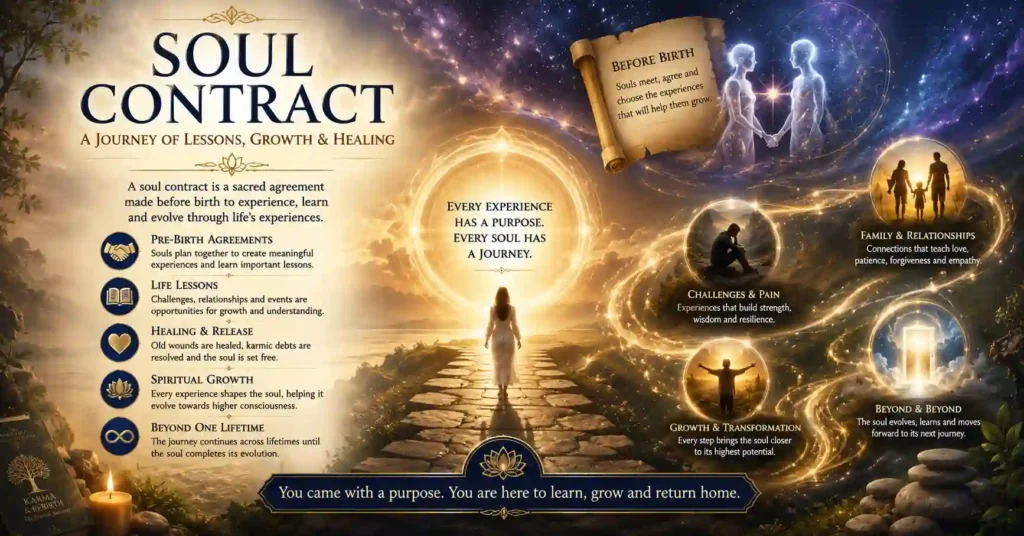
Karma, Samskaras and the Soul's Journey Across Lifetimes
In Sanatan Dharma, the soul is not believed to begin with a single lifetime. It continues its journey through many births and deaths in a cycle known as samsara.
During this journey, every action, thought, and experience leaves subtle impressions called samskaras. These impressions become part of the soul’s accumulated tendencies and can influence behavior, emotions, preferences, and reactions in future lives.
Because of these samskaras, certain life lessons may appear repeatedly. Similar situations, challenges, or relationship patterns can return until the underlying lesson is understood or the karmic influence is resolved.
This process is not traditionally viewed as punishment. Instead, it is seen as part of the soul’s ongoing journey of growth, learning, and spiritual evolution.
The law of karma teaches that every action creates consequences. While some results appear immediately, others may unfold over time and even continue across multiple lifetimes.
From this perspective, present circumstances are not always isolated events. They may be connected to past actions, accumulated samskaras, and the soul’s continuing journey through rebirth.
Seen through this lens, the idea of a soul contract can be understood as a modern way of exploring how karma, samskaras, and past life experiences may influence the lessons, relationships, and opportunities that appear in life.
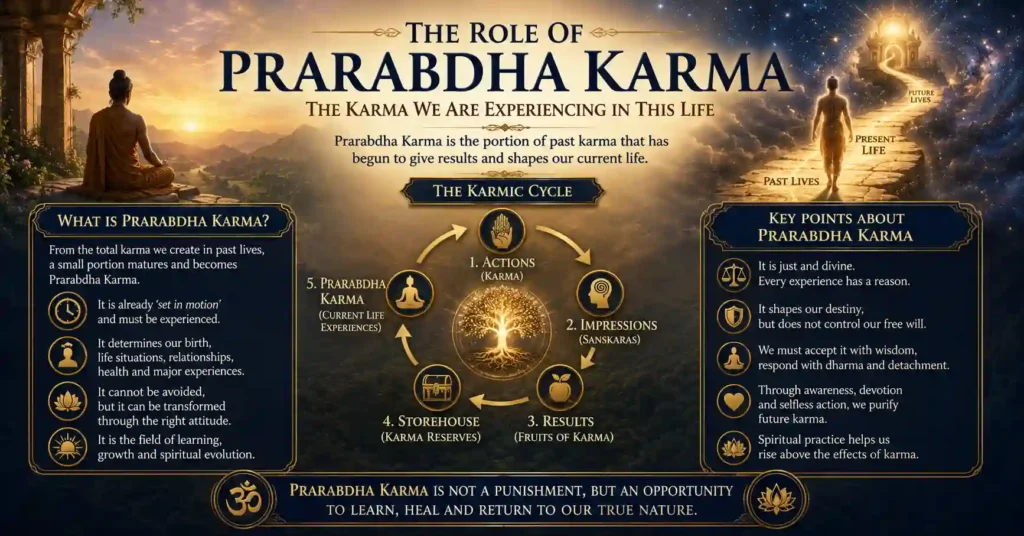
The Role of Prarabdha Karma in Life Experiences
In Sanatan Dharma, Prarabdha Karma refers to the portion of accumulated karma that has begun to bear fruit in the present lifetime. It is often understood as the karma responsible for certain circumstances, experiences, and situations that unfold during this birth.
According to this understanding, some relationships, opportunities, strengths, and challenges may arise as part of this karmic unfolding. These experiences are not necessarily rewards or punishments but opportunities for learning, growth, and spiritual development.
While a person may not always control the circumstances they encounter, they can choose how they respond to them. Their thoughts, actions, and decisions continue to create new karma that influences the future.
For this reason, karma is not viewed as blind fate or fixed destiny. Sanatan Dharma emphasizes personal responsibility, self-awareness, and right action as important parts of the soul’s journey.
When viewed through this lens, the concept of a soul contract can be seen as a modern way of understanding how past karma, present experiences, and future growth may be connected.
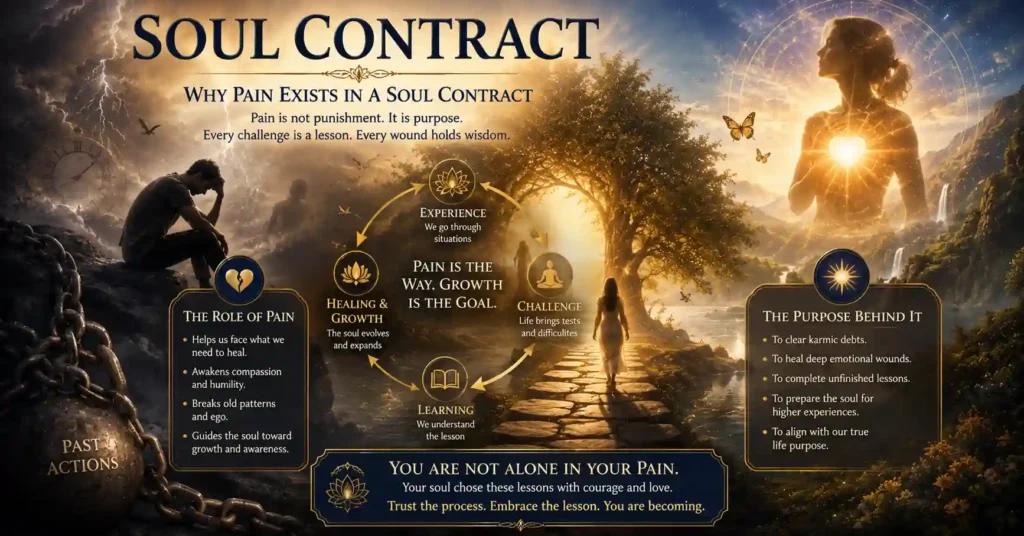
Why Pain and Challenges Are Often Part of Life's Lessons
One of the most common questions people ask is why life sometimes brings experiences that feel painful, unfair, or difficult to understand.
Different spiritual traditions offer different answers. In Sanatan Dharma, challenges are often viewed through the lens of karma, growth, and the soul’s ongoing journey rather than as random events.
Many people find that their most meaningful lessons emerge during life’s hardest moments. Difficult experiences can encourage self-reflection, inner strength, compassion, and a deeper understanding of oneself.
A heartbreak may teach emotional maturity. A failure may build resilience and humility. A loss may reveal what truly matters and inspire a new direction in life.
This does not mean that suffering is always beneficial or that every painful experience has an obvious lesson. Life’s challenges are real, and their meaning may not be immediately clear.
However, when people reflect on the past, they often discover that periods of struggle contributed to important growth, wisdom, or personal transformation.
From the perspective of a soul contract, such experiences may be viewed as opportunities for learning and evolution. From the perspective of karma, they may be connected to the soul’s continuing journey across lifetimes.
Seen in this way, pain is not necessarily interpreted as punishment. Instead, it can become part of a larger process of learning, growth, and spiritual development.
Why Pain Is Not Always a Punishment
When discussing karma and a soul contract, it is important to remember one thing: pain is not always a punishment.
Not every difficulty can be explained through past-life actions, and not every painful experience is the result of a karmic lesson unfolding. Life is often more complex than a simple chain of cause and effect.
Sanatan Dharma teaches that karma influences life, but it does not encourage people to judge themselves or others whenever hardship occurs. Human experiences are shaped by many factors, including personal choices, circumstances, relationships, and the actions of others.
Spiritual teachings can help people find meaning in suffering, but they should never become a source of guilt, shame, or self-blame. The purpose of these ideas is understanding and self-awareness, not judgment.
Many challenges may never have clear answers. Yet difficult experiences can still inspire reflection, compassion, resilience, and wisdom.
Sometimes healing begins not by asking who is at fault, but by asking what can be learned from the experience and how one can move forward with greater understanding.
Karmic Relationships and Life Lessons
Some relationships feel different from the very beginning. There may be an instant connection, a strong emotional pull, or a sense that the person has entered your life for a deeper reason.
In many spiritual traditions, these are sometimes described as karmic relationships. The idea is that certain people may play an important role in our growth, healing, self-understanding, and life lessons.
Not every relationship requires a spiritual explanation. However, some connections leave a lasting impact and seem to influence the direction of our lives in meaningful ways.
Through these relationships, people may learn valuable lessons about love, attachment, forgiveness, boundaries, responsibility, compassion, and self-worth.
Some individuals remain part of our lives for many years, while others appear only for a brief period. Yet both can leave a lasting impression and contribute to personal growth.
From the perspective of a soul contract, such relationships may be viewed as opportunities for learning and evolution. From the perspective of karma, they may reflect deeper connections shaped by past actions and experiences.
Understanding relationships through this lens can sometimes reduce confusion and encourage greater awareness, acceptance, and compassion when facing difficult experiences.
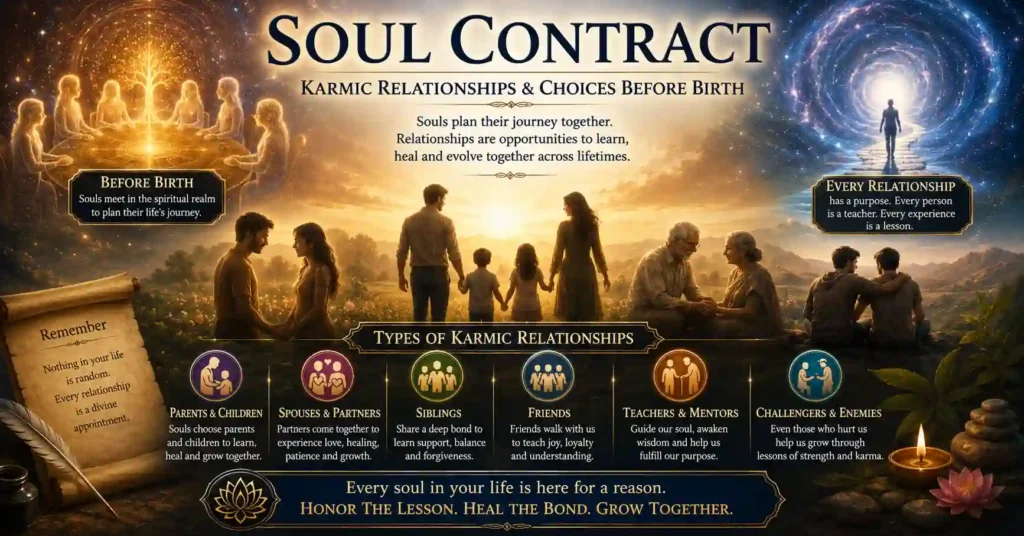
Do Souls Choose Parents, Family and Important Relationships Before Birth?
One question often discussed in spiritual circles is whether souls choose their parents, family members, spouses, or important relationships before birth.
The idea is commonly associated with modern interpretations of a soul contract. According to this view, souls may enter life with certain lessons to learn and may encounter specific people who play an important role in that journey.
Some spiritual teachings suggest that parents, siblings, spouses, relatives, friends, teachers, and even rivals may become part of a soul’s experience because of unfinished karmic connections or opportunities for growth. These relationships may help individuals learn lessons related to love, responsibility, forgiveness, compassion, patience, or self-awareness.
From the perspective of Sanatan Dharma, life circumstances are generally explained through karma, samskaras, rebirth, and the soul’s ongoing journey through many lifetimes. Actions performed in previous lives may influence the people, situations, and relationships encountered in the present one.
Important Note: Traditional Hindu scriptures do not explicitly state that souls consciously choose every parent, spouse, sibling, friend, or life event before birth. This idea is more commonly found in modern spiritual interpretations. Sanatan Dharma generally explains birth circumstances and relationships through karma, samskaras, rebirth, and the unfolding of Prarabdha Karma.
Whether viewed through the idea of a soul contract or through the lens of karma and rebirth, many spiritual traditions share the view that important relationships can contribute to learning, growth, and the evolution of the soul.
Samskaras and Repeating Life Patterns
Sometimes certain patterns seem to appear repeatedly in life.
A person may find themselves facing similar situations again and again, feeling drawn to certain kinds of people, or experiencing emotional reactions that seem stronger than the situation itself.
There may also be fears, strengths, preferences, habits, or tendencies that feel deeply rooted within them, even when the reason is not immediately clear.
In Sanatan Dharma, such tendencies are often linked to samskaras, the subtle impressions created by thoughts, actions, and experiences. These impressions are believed to remain within the mind and continue influencing future behavior and choices.
Samskaras can shape how people think, react, form relationships, make decisions, and respond to life’s challenges. Over time, they may contribute to recurring patterns and familiar experiences.
This does not mean every pattern has a spiritual or mystical explanation. Many patterns can arise from upbringing, environment, habits, and personal experiences.
However, becoming aware of recurring patterns can encourage deeper self-understanding and more conscious decision-making.
From the perspective of karma and the soul’s journey, some repeating experiences may also be viewed as opportunities for learning, growth, and greater awareness.
Soul Contract, Karma and Free Will
One of the most important questions people ask is whether a soul contract or karma determines everything that happens in life.
In both modern spiritual teachings and Sanatan thought, the answer is generally no. While certain experiences, circumstances, and life lessons may form part of a person’s journey, they do not remove the freedom to make choices.
Life may bring relationships, opportunities, challenges, and turning points into our path. However, how we respond to them remains our responsibility.
Two people can face the same difficulty and emerge in very different ways. One may become bitter and discouraged, while the other develops resilience, wisdom, and inner strength.
This idea is also reflected in the Bhagavad Gita. In Chapter 2, Verse 47, Lord Krishna teaches that individuals have a right to perform their actions, but not complete control over the results. The verse highlights the importance of focusing on one’s duties and choices rather than becoming attached to outcomes.
This is where free will becomes important. Circumstances may influence a person, but they do not completely define them. Every thought, decision, and action continues to create new karma and shape future experiences.
In Sanatan Dharma, karma is not viewed as fixed destiny. Personal effort, awareness, and right action remain important parts of spiritual growth and self-development.
Seen through this perspective, a soul contract may describe certain lessons or experiences, but free will continues to influence how those lessons are understood and lived.
How Karma and Dharma Work Together
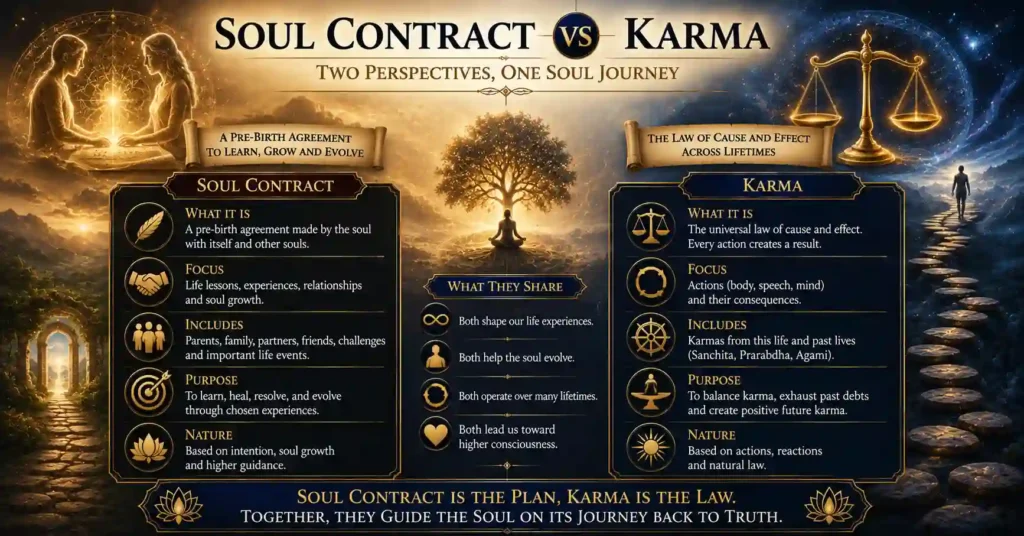
Karma helps explain how past actions may influence present experiences. Dharma helps guide how we respond to those experiences in the present moment.
Life does not always give us complete control over every situation. Some challenges, opportunities, and relationships arise in ways we may not fully understand.
Yet even in those moments, we are not powerless. Sanatan Dharma teaches that every person has the ability to act with awareness, wisdom, and responsibility.
Every choice made with honesty, compassion, self-discipline, and right intention becomes part of shaping future experiences. In this way, present actions continue to create new karma.
This is why both karma and dharma are important. Karma may help explain certain circumstances we encounter, while dharma helps guide the decisions we make when facing them.
Rather than focusing only on the past, Sanatan teachings encourage people to live with awareness in the present. Understanding karma can provide insight, while following dharma can help create a more meaningful and balanced path forward.
Seen through this perspective, spiritual growth is not only about understanding why experiences happen. It is also about how we choose to respond to them.
Awareness, Growth and the Soul's Journey
One idea shared by many spiritual traditions is that awareness can change the way people experience life.
While a person may not be able to control every situation that arises, they can become more aware of their thoughts, reactions, habits, and patterns.
This awareness often creates space for reflection and understanding. Instead of reacting automatically, people may begin responding with greater clarity and intention.
Over time, greater self-awareness can influence decisions, relationships, and the way challenges are approached. It can also help individuals recognize patterns that may have previously gone unnoticed.
Many spiritual traditions suggest that growth in awareness can reduce the tendency to repeat the same mistakes or respond to situations in the same way. This is often viewed as an important part of personal and spiritual development.
Such growth does not remove every difficulty from life. Challenges continue to arise, but they may be understood and approached differently.
From the perspective of karma and the soul’s journey, awareness can become an important step toward learning, growth, and a deeper understanding of life’s experiences.
Self-Reflection and Spiritual Understanding
Many spiritual traditions place great importance on self-reflection as a way of understanding life’s experiences more deeply.
This process does not necessarily require complex rituals or dramatic changes. It often begins with a willingness to observe one’s thoughts, emotions, habits, and recurring patterns with greater awareness.
By reflecting on experiences more carefully, people may gain new insights into their reactions, relationships, choices, and personal growth.
Rather than viewing events only as isolated incidents, spiritual traditions often encourage a broader perspective that considers learning, self-understanding, and inner development.
Questions about the meaning of life experiences, recurring challenges, and personal growth have been explored in many philosophical and spiritual traditions throughout history.
From the perspective of karma and the soul’s journey, self-reflection can help individuals better understand their experiences and the lessons they may draw from them.
For this reason, self-awareness and reflection are often regarded as important aspects of spiritual understanding and personal growth.
Understanding Life Through a Spiritual Perspective
Many spiritual traditions suggest that the way people interpret their experiences can influence how they understand their lives.
From a spiritual perspective, life is often viewed as more than a series of isolated events. Relationships, challenges, successes, and setbacks may all contribute to a person’s growth, understanding, and inner development.
Each individual follows a unique path shaped by different circumstances, choices, experiences, and karmic influences. As a result, no two journeys unfold in exactly the same way.
This perspective does not remove the reality of pain or difficulty. Instead, it encourages a broader understanding of life’s experiences and the lessons that may emerge from them over time.
When viewed through the lens of karma, dharma, and the soul’s journey, even challenging experiences can become opportunities for reflection, learning, and greater self-awareness.
Many people find that experiences which once seemed confusing or difficult to accept later contribute to wisdom, maturity, and a deeper understanding of themselves and their lives.
Key Takeaways
- A soul contract is a modern spiritual concept that suggests certain relationships, experiences, and life lessons may contribute to the soul’s growth and evolution.
- While the term soul contract is not found in traditional Hindu scriptures, similar ideas are often explored through karma, samskaras, rebirth, and dharma.
- In Sanatan Dharma, karma explains how past actions may influence present experiences, while dharma guides how we respond to those experiences.
- Prarabdha Karma refers to the portion of past karma that is believed to unfold in the current lifetime through various circumstances, opportunities, and challenges.
- Samskaras are subtle impressions created by past experiences that can influence thoughts, habits, emotions, relationships, and recurring life patterns.
- Difficult experiences are not always viewed as punishment. Many spiritual traditions see them as opportunities for learning, self-understanding, and personal growth.
- Some relationships may have a profound impact on our lives and are often described as karmic relationships because of the lessons they bring.
- Sanatan Dharma teaches that karma influences life, but it does not remove free will. Personal choices, awareness, and actions continue to shape the future.
- Self-reflection and greater awareness can help people recognize recurring patterns and respond to life’s challenges with more wisdom and understanding.
- Whether viewed through the idea of a soul contract or through traditional karmic philosophy, life can be understood as a journey of learning, growth, and spiritual evolution.
Conclusion
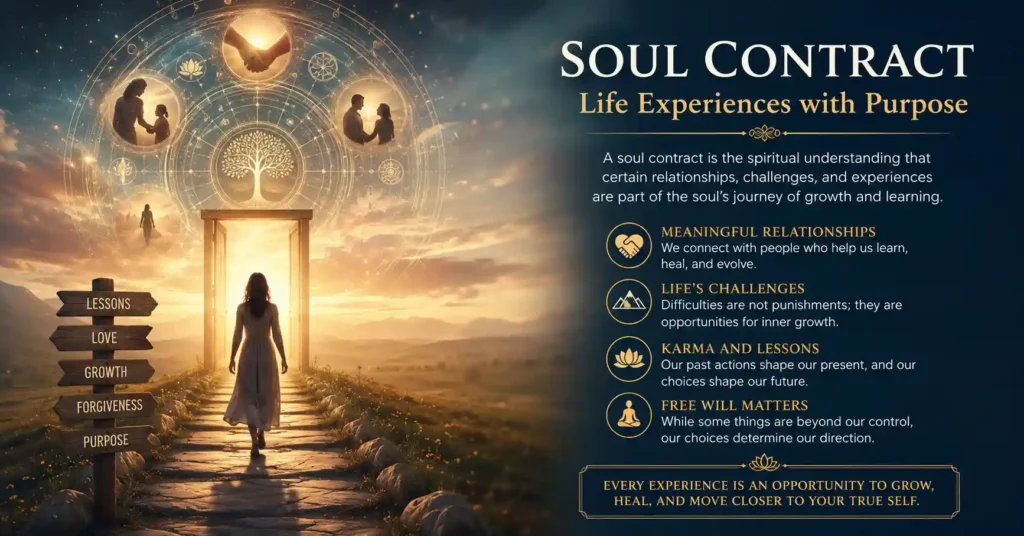
The concept of a soul contract, along with ideas about karma, past lives, and life purpose, offers one way of understanding human experiences through a deeper spiritual lens.
It suggests that life may involve more than chance alone and that some relationships, challenges, and turning points can contribute to learning, growth, and self-understanding.
At the same time, these ideas do not imply that every difficulty has a simple explanation or that all of life’s questions can be fully answered. Human experiences are often complex, and different spiritual traditions offer different perspectives on their meaning.
In Sanatan Dharma, concepts such as karma, samskaras, rebirth, and dharma provide a framework for understanding how actions, experiences, and choices may influence the soul’s journey across lifetimes.
Whether viewed through the idea of a soul contract or through traditional karmic philosophy, these teachings encourage deeper reflection on life’s experiences and the lessons that may emerge from them.
Ultimately, the value of these concepts lies not in providing certainty about every event, but in offering a way to explore life with greater awareness, understanding, and perspective.
Suggested Reading
The concept of a soul contract is closely connected to karma, rebirth, self-awareness, and spiritual growth. To understand the deeper meaning of a soul contract, it can be helpful to explore related teachings from Sanatan Dharma that discuss karma, the soul’s journey, inner transformation, and the purpose behind life’s experiences.
Karma: Meaning, Types, Philosophy and How It Works in Sanatan Dharma
https://thesanatantales.com/karma/
Forgiveness for Unintentional Sins in Sanatan Dharma: Meaning, Karma and Scriptural Remedies
https://thesanatantales.com/forgiveness-for-unintentional-sins/
Detachment in Hindu Philosophy: Meaning, Vairagya and the Path to Inner Freedom
https://thesanatantales.com/detachment-in-hindu-philosophy/
Overthinking: Why Your Mind Never Stops and How to Calm a Restless Mind
https://thesanatantales.com/overthinking-why-your-mind-never-stops/
Does the Soul Choose Its Next Journey? Rebirth, Karma and Consciousness in Sanatan Dharma
https://thesanatantales.com/does-the-soul-choose-its-next-journey/
Spiritual Awakening in Sanatan Dharma: Meaning, Signs and Beginner’s Guide
https://thesanatantales.com/spiritual-awakening/
What Is Inner Peace? A Sanatan Perspective on Calmness and Stability
https://thesanatantales.com/what-is-inner-peace/
What is the definition of a soul contract?
https://www.quora.com/What-is-the-definition-of-a-soul-contract/
FAQs
What Is a Soul Contract?
A soul contract is a modern spiritual concept that suggests certain relationships, experiences, and life lessons may be connected to the soul’s growth and evolution. According to this idea, some important events in life are not entirely random but may carry a deeper purpose.
Traditional Sanatan Dharma does not use the term soul contract. Instead, it explains life through concepts such as karma, samskaras, rebirth, and dharma. Many people see similarities between these teachings and the modern idea of a soul contract.
From this perspective, a soul contract can be understood as a way of exploring how life experiences, relationships, and karmic influences may contribute to personal and spiritual growth.
Is the Concept of a Soul Contract Found in Hindu Scriptures?
The exact term soul contract does not appear in Hindu scriptures.
However, Sanatan Dharma discusses related ideas through karma, samskaras, rebirth, and the soul’s journey across many lifetimes. These teachings explain how past actions can influence future experiences and how the soul continues to evolve through different births.
For this reason, some people draw parallels between the idea of a soul contract and traditional karmic philosophy, even though the terminology is different.
How Is a Soul Contract Connected to Karma?
A soul contract and karma are often discussed together because both attempt to explain why certain experiences, relationships, and challenges appear in life.
In Sanatan Dharma, karma refers to the law of cause and effect. Actions create consequences that may influence present and future experiences.
The idea of a soul contract suggests that some lessons and relationships may form part of a broader journey of growth. When viewed through a Sanatan lens, these experiences are often understood through karma, samskaras, and rebirth rather than through pre-birth agreements alone.
Can a Soul Contract Influence Relationships?
According to spiritual teachings, some relationships may feel unusually significant because they contribute to important life lessons and personal growth. These are often described as karmic relationships.
Such relationships may involve parents, siblings, spouses, friends, mentors, or even brief encounters that leave a lasting impact.
While not every relationship requires a spiritual explanation, some connections can influence a person’s beliefs, choices, emotional development, and understanding of themselves.
Do Souls Choose Their Parents Before Birth?
This is a belief found in some spiritual traditions and modern interpretations of soul contracts. The idea suggests that souls may choose certain family circumstances to experience specific lessons and opportunities for growth.
Sanatan Dharma does not clearly state that souls consciously select their parents before birth. Instead, it explains birth circumstances primarily through karma and the soul’s ongoing journey through samsara.
As a result, this question remains a matter of spiritual interpretation rather than established scriptural teaching.
Why Do Some Life Challenges Keep Repeating?
In Sanatan Dharma, recurring patterns are often associated with samskaras, which are subtle impressions created by past thoughts, actions, and experiences.
These impressions can influence habits, emotional reactions, decisions, and behavior patterns. As a result, similar situations may appear repeatedly until a person develops greater awareness or responds differently.
Not every repeating pattern has a spiritual cause, but recurring experiences can sometimes provide opportunities for learning and self-understanding.
Is Pain Always the Result of Past-Life Karma?
No. Sanatan Dharma does not teach that every painful experience is a direct punishment for past-life actions.
Life is influenced by many factors, including personal choices, circumstances, relationships, and the actions of others. Karma is only one part of a much larger picture.
Spiritual teachings can help people find meaning in difficult experiences, but they should not be used to create guilt, shame, or self-blame.
Does a Soul Contract Remove Free Will?
Most spiritual interpretations of a soul contract do not suggest that life is completely predetermined. Instead, they describe certain experiences as opportunities for learning and growth while still allowing freedom of choice.
Similarly, Sanatan Dharma teaches that karma influences life but does not eliminate personal responsibility. Thoughts, actions, and decisions continue to shape future experiences.
This balance between karma and free will is an important part of spiritual growth.
What Is the Difference Between a Soul Contract and Dharma?
A soul contract is generally described as a spiritual agreement related to lessons, experiences, and relationships.
Dharma, on the other hand, is a central concept in Sanatan Dharma that refers to righteous living, responsibility, duty, and ethical action.
While a soul contract focuses on experiences that may arise in life, dharma focuses on how a person chooses to respond to those experiences.
What Can We Learn from the Idea of a Soul Contract?
Whether viewed through the modern concept of a soul contract or through traditional teachings on karma and rebirth, both perspectives encourage deeper reflection on life’s experiences.
They invite people to think about personal growth, relationships, recurring patterns, and the lessons that may emerge from challenges.
Rather than providing all the answers, these ideas offer a framework for exploring life with greater awareness, understanding, and perspective.
Glossary of Important Terms
| Term | Meaning |
|---|---|
| Soul Contract | A modern spiritual concept suggesting that certain relationships, experiences, and life lessons may play a role in the soul’s growth and evolution. |
| Karma | The law of cause and effect in Sanatan Dharma. Every thought, action, and intention creates consequences that influence present and future experiences. |
| Prarabdha Karma | The portion of accumulated karma that has begun to bear fruit in the current lifetime and influences present circumstances and experiences. |
| Samskaras | Subtle impressions created by past thoughts, actions, and experiences. These impressions can shape behavior, habits, emotions, and future choices. |
| Dharma | One’s righteous duty, responsibility, and way of living in harmony with truth, ethics, and cosmic order. |
| Samsara | The continuous cycle of birth, death, and rebirth through which the soul evolves over many lifetimes. |
| Rebirth (Punarjanma) | The belief that the soul takes new births after death as part of its ongoing journey through samsara. |
| Soul’s Journey | The ongoing process of growth, learning, and spiritual evolution experienced by the soul across multiple lifetimes. |
| Karmic Relationships | Relationships believed to carry important lessons, growth opportunities, or unresolved karmic connections from past experiences. |
| Past Life Karma | The effects of actions performed in previous lifetimes that may influence present experiences and circumstances. |
| Spiritual Growth | The process of developing greater awareness, wisdom, compassion, and understanding through life experiences. |
| Free Will | The ability to make conscious choices and decisions, even while being influenced by karma and life circumstances. |
| Life Lessons | Experiences, challenges, and opportunities that contribute to personal development, wisdom, and self-understanding. |
| Inner Transformation | Deep personal change that occurs through self-awareness, reflection, learning, and spiritual development. |
| Self-Reflection | The practice of examining one’s thoughts, emotions, actions, and experiences to gain deeper understanding and awareness. |
| Consciousness | The awareness and knowing principle associated with the soul and its experience of life. |
| Destiny | The circumstances and experiences that unfold in life, often viewed as being influenced by karma and past actions. |
| Compassion | The ability to understand and respond to the suffering of oneself and others with kindness and empathy. |
| Awareness | A state of mindful observation and understanding of one’s thoughts, emotions, actions, and life experiences. |
| Spiritual Evolution | The gradual development of the soul toward greater wisdom, self-realization, and understanding through many lifetimes. |
About the Author
Yateendra Chaturvedi is a spiritual writer, researcher, devotee, and the founder of The Sanatan Tales. With over 35 years of professional experience and a lifelong interest in Sanatan Dharma, he writes about Hindu deities, temples, scriptures, festivals, Mahavidyas, sacred stories, rituals, and living traditions that continue to guide and inspire devotees across India.
Drawing from traditional scriptures, regional beliefs, temple traditions, devotional literature, and historical sources, he aims to present authentic, well-researched, and easy-to-understand content for modern readers. His work focuses on preserving spiritual wisdom, explaining sacred traditions, and helping seekers develop a deeper understanding of India’s rich spiritual heritage.
Through The Sanatan Tales, Yateendra strives to make the timeless teachings of Sanatan Dharma simple, meaningful, and relevant for today’s generation while maintaining respect for traditional sources, regional practices, and diverse spiritual perspectives.
Learn More About Yateendra Chaturvedi →
https://thesanatantales.com/about-the-author/
References & Sources
This article is based on spiritual concepts, philosophical teachings, and traditional beliefs commonly associated with Sanatan Dharma. It draws upon ideas related to karma, dharma, rebirth, samskaras, self-awareness, and the soul’s journey as understood through Hindu philosophy and broader spiritual traditions.
The article also incorporates perspectives found in contemporary spiritual discussions on soul contracts and personal growth, while presenting them in a way that can be compared with traditional Sanatan teachings.
Note: Spiritual beliefs, interpretations, and philosophical viewpoints may differ across scriptures, traditions, teachers, regions, and individual practitioners. The purpose of this article is not to establish any single interpretation as absolute truth, but to present commonly discussed perspectives in a simple, balanced, and reader-friendly manner. Readers are encouraged to explore different sources and traditions to develop their own understanding of these subjects.
Explore More Fascinating Topics from Sanatan Dharma