
In today’s fast-paced world, many people struggle to choose between success and peace of mind. They work hard to achieve their goals, build successful careers, and create a better future, yet often feel stressed, overwhelmed, or emotionally exhausted along the way. This creates a common question: Can ambition and peace truly exist together?
Many assume that ambition naturally leads to pressure, competition, and constant striving. Others believe that inner peace is possible only by reducing goals and expectations. However, Sanatan Dharma offers a different perspective. It teaches that ambition and peace are not opposites. When guided by Dharma, self-awareness, and right action, both can support a meaningful and balanced life.
The challenge is not choosing between ambition and peace, but learning how to pursue success without losing emotional balance, contentment, and inner harmony. True achievement becomes more fulfilling when it is accompanied by clarity, mindfulness, and peace of mind.
In this article, you will learn what Sanatan Dharma teaches about ambition and peace, why these two often seem to conflict, practical ways to balance personal goals with inner well-being, and how principles such as Dharma, Karma, and mindful living can help create lasting success without sacrificing peace.
Ambition and Peace at a Glance
| Aspect | Key Insight |
|---|---|
| Main Idea | Ambition and peace do not have to be opposites. Both can coexist when guided by awareness and Dharma. |
| What Is Ambition? | The desire to grow, achieve goals, and create a meaningful life. |
| What Is Inner Peace? | A state of mental calmness, emotional balance, and contentment regardless of external circumstances. |
| Common Mistake | Believing that happiness depends entirely on success, recognition, or achievements. |
| Root Cause of Stress | Attachment to outcomes, comparison with others, and constant pressure to achieve more. |
| Sanatan Dharma View | Ambition is not discouraged. It should be aligned with Dharma and pursued without excessive attachment. |
| Bhagavad Gita Teaching | Focus on sincere effort while accepting that results are not always within your control. |
| Role of Dharma | Dharma helps ensure that goals are ethical, meaningful, and beneficial to oneself and others. |
| Warning Signs of Imbalance | Constant dissatisfaction, anxiety, comparison, guilt during rest, and difficulty enjoying the present moment. |
| Benefits of Balance | Greater peace of mind, emotional stability, fulfillment, focus, and healthier relationships. |
| Daily Practices | Prayer, meditation, mantra japa, gratitude, mindful breathing, and self-reflection. |
| Simple Reminder | Do your best, but do not allow every result to determine your self-worth or peace of mind. |
| Key Takeaway | True success is not only about achievements. It is also about the peace, balance, and inner strength you carry within. |
Table of Contents
ToggleWhy Ambition and Peace Often Feel Opposed
Ambition itself is not the problem. The desire to grow, improve our lives, and achieve meaningful goals is a natural part of human development. In many cases, ambition motivates learning, service, creativity, and personal growth.
The difficulty begins when success gradually becomes the foundation of our identity. Instead of seeing achievements as part of life’s journey, we start using them to measure our self-worth.
Many people begin to believe that happiness will arrive only after reaching the next milestone, receiving recognition, or accomplishing a specific goal. As a result, peace of mind becomes dependent on future outcomes rather than present awareness.
When this happens, success is no longer experienced as a process of growth. It becomes a constant pursuit of validation. This often creates comparison, impatience, and the feeling that we are always falling behind.
In such a state, even small setbacks can feel overwhelming. Rest may bring guilt, and moments that should be enjoyed are overshadowed by thoughts about what still remains to be achieved.
From the perspective of Sanatan Dharma, the real challenge is not ambition itself but attachment to results. The goal is not the source of suffering. The suffering begins when our happiness becomes completely dependent on achieving that goal.
This is why many people appear successful on the outside yet continue to feel restless within. They have achieved what they wanted, but inner fulfillment remains elusive.
Understanding this difference is the first step toward cultivating ambition and peace together. When success is pursued with awareness rather than attachment, it becomes possible to strive for excellence without sacrificing emotional balance, contentment, and inner harmony.
Common Misconceptions About Ambition and Inner Peace
Many people assume that ambition and inner peace cannot exist together. As a result, they may feel forced to choose between personal success and emotional well-being. However, Sanatan Dharma offers a more balanced perspective.
The following misconceptions often create unnecessary confusion:
| Misconception | Reality |
|---|---|
| Peace means giving up ambition. | Inner peace and ambition can coexist when goals are pursued with awareness and balance. |
| Spiritual people should avoid success. | Sanatan Dharma encourages meaningful success that is aligned with Dharma. |
| Success automatically brings happiness. | Lasting peace comes from self-awareness, contentment, and inner balance, not achievements alone. |
| Ambition is always selfish. | Dharmic ambition can benefit family, society, and the wider community. |
| Rest slows success. | Proper rest and reflection often improve focus, clarity, and long-term growth. |
| Failure means personal worth is lost. | Setbacks are opportunities for learning, growth, and self-improvement. |
Understanding these misconceptions can help us develop a healthier relationship with achievement. The goal is not to eliminate ambition but to ensure that it supports growth without disturbing inner peace.
When viewed through the lens of Dharma, ambition becomes less about proving our worth and more about expressing our potential with responsibility, purpose, and awareness.

Signs That Ambition Is Disturbing Your Inner Peace
Healthy ambition encourages growth, learning, and meaningful achievement. However, when ambition becomes excessive, it can slowly begin to drain the joy and peace from everyday life. This change often happens so gradually that we may not notice it at first.
Sometimes the signs are subtle. You may achieve something you once dreamed of, yet still feel unsatisfied. You may find yourself constantly comparing your progress with others and wondering whether you are falling behind.
Common signs that balance may be slipping include:
- Feeling unsatisfied even after reaching important goals
- Frequently comparing yourself with others
- Finding it difficult to rest without guilt
- Constantly thinking about the next achievement
- Struggling to be fully present during family time or personal moments
Rest can start to feel uncomfortable, and even good days may seem incomplete because the mind quickly moves to the next goal instead of appreciating the present moment.
Over time, ambition may stop serving your well-being and begin controlling your thoughts. Success no longer feels like a meaningful journey. Instead, it starts to feel like a race that never truly ends.
When ambition begins creating anxiety, exhaustion, or constant dissatisfaction, it may be a sign that balance is being lost. Recognizing these patterns is often the first step toward restoring inner peace and emotional balance.
What the Bhagavad Gita Teaches About Ambition and Peace
One of the beautiful teachings of the Bhagavad Gita is that desire, effort, and responsibility are not rejected. In fact, Shri Krishna encourages Arjuna to fulfill his Dharma rather than withdraw from life’s challenges. The lesson is not about escaping action but learning how to act with the right understanding.
On the battlefield of Kurukshetra, Arjuna felt confused, fearful, and overwhelmed by the situation before him. Shri Krishna did not ask him to abandon his duties. Instead, He taught him how to act without becoming emotionally attached to success or failure.
This teaching is known as Karma Yoga, the path of selfless action. In Bhagavad Gita 2.47, Shri Krishna explains that while we have control over our actions, we do not have complete control over their results. This wisdom does not reduce effort. Rather, it frees the mind from the constant burden of worrying about outcomes.
When we begin to understand this teaching, our relationship with success starts to change. We continue working hard, pursuing goals, and striving for excellence, but our peace of mind no longer depends entirely on whether every plan unfolds exactly as expected.
When effort is sincere and the results are surrendered to Ishwar, the mind becomes lighter. There is less anxiety, less fear, and less pressure to control every situation. Ambition remains, but it is guided by awareness rather than attachment.
Perhaps this is why the Bhagavad Gita remains so relevant today. It teaches that ambition and peace do not have to be opposites. Through Dharma, right action, and inner detachment, it becomes possible to pursue meaningful success while maintaining emotional balance and inner peace.
This wisdom forms the spiritual foundation for creating lasting ambition and peace in daily life.

How Dharma, Karma and Bhakti Create Inner Balance
In Sanatan Dharma, lasting inner balance is often supported by the combined wisdom of Dharma, Karma, and Bhakti. While each has its own role, together they help a person pursue success without losing peace of mind.
Dharma provides direction. It helps us understand what is right, responsible, and meaningful in a particular situation. When our goals are aligned with Dharma, we are less likely to experience inner conflict because our actions reflect our values and principles.
Karma provides action. It reminds us that growth requires effort, discipline, and responsibility. Rather than remaining passive, we are encouraged to perform our duties sincerely and give our best to the work before us.
Bhakti provides inner support. Through prayer, devotion, gratitude, or remembrance of the Divine, Bhakti helps calm the mind and reduce excessive attachment to outcomes. It reminds us that our worth is not determined solely by success or failure.
When these three principles work together, life becomes more balanced. Dharma guides our choices, Karma inspires constructive action, and Bhakti helps preserve inner peace throughout the journey.
This is one of the reasons Sanatan Dharma does not see success and spirituality as opposites. A person can pursue meaningful goals, fulfill responsibilities, and continue growing while remaining connected to deeper values, faith, and self-awareness.
Purpose-Driven Ambition vs Pressure-Driven Ambition
There is a subtle but important difference between being driven by purpose and being driven by pressure, even though both may look similar from the outside.
| Purpose-Driven Ambition | Pressure-Driven Ambition |
|---|---|
| Inspired by meaning and growth | Driven by fear, insecurity, or validation |
| Enjoys the journey | Focuses only on outcomes |
| Learns from setbacks | Feels defeated by setbacks |
| Supports emotional balance | Creates stress and exhaustion |
| Brings fulfillment | Creates constant dissatisfaction |
A purpose-driven person moves forward with clarity, enthusiasm, and a sense of meaning. They work hard because they are inspired by growth, contribution, or a worthwhile goal.
A person driven by pressure may appear equally ambitious, but underneath there is often fear, insecurity, or a constant need for validation. While both individuals may pursue similar goals, their inner experience is very different.
This is why it is helpful to pause occasionally and reflect on what is motivating us. Are we working toward something that genuinely matters, or are we trying to prove our worth through achievements and external recognition?
There is no need for self-judgment if the answer feels uncomfortable. The purpose of this reflection is not criticism but awareness. In many cases, awareness is the first step toward restoring emotional balance and peace of mind.
When we understand what is truly driving our actions, it becomes easier to maintain ambition and peace together. Growth continues, but it no longer comes at the cost of inner stability, contentment, and personal well-being.
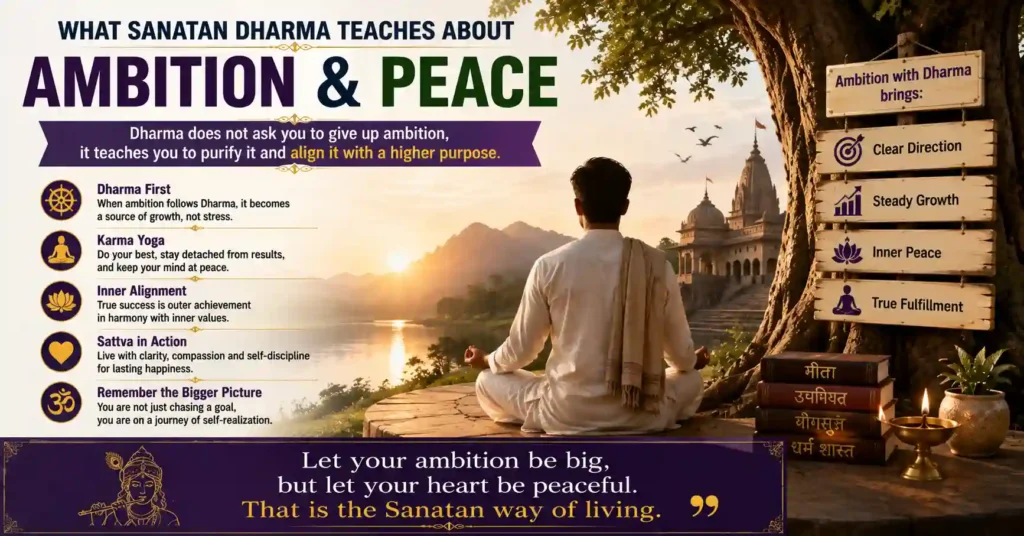
What True Balance Looks Like in Everyday Life
Real balance is not about reducing your dreams or lowering your ambitions. It is about pursuing them with a healthier mindset.
A balanced person still works hard, sets meaningful goals, and strives for growth. The difference is that their sense of self-worth is not completely tied to every success or setback.
Some days go well, and some do not. Yet there is a quiet stability within. They learn from challenges, appreciate progress, and continue moving forward without becoming overwhelmed by every outcome.
This is what ambition and peace often look like in everyday life. Growth continues, but it is supported by self-awareness, emotional balance, and peace of mind rather than constant pressure and inner conflict.
Simple Practices to Maintain Ambition and Peace
Peace does not mean giving up your goals or becoming inactive. It means remaining inwardly stable while moving through the successes, challenges, and uncertainties of life.
You can build a career, grow a business, pursue education, or work toward a meaningful purpose. Ambition itself is not the problem. The real challenge is remembering that your identity extends beyond your achievements.
This is why it helps to reconnect with your inner anchor each day.
Simple ways to reconnect with your inner anchor:
- Mantra japa
- Silent prayer
- Mindful breathing
- Daily meditation
- Reading a verse from the Bhagavad Gita
The practice itself is less important than its purpose. These moments help create self-awareness and remind us that our worth is not determined solely by success, recognition, or external results.
Even a few quiet minutes each day can improve emotional balance and peace of mind. They create space between constant striving and inner well-being.
When ambition is guided by gratitude, Dharma, and a higher purpose, it begins to feel lighter. Work no longer becomes a burden that must constantly prove your value. Instead, it becomes an expression of sincere effort and personal growth.
Over time, success and inner peace stop pulling in opposite directions. They begin to support one another. This is where ambition and peace become a natural part of daily life rather than a difficult balance to maintain.
Practical Ways to Balance Ambition and Peace in Daily Life
Creating a balance between ambition and peace does not usually require dramatic life changes. More often, it begins with small shifts in the way we move through our day.
When you are working, give your attention fully to the task in front of you. And when the work is done, allow yourself permission to step away from it. Many people carry their responsibilities into every moment of the day, and over time this becomes mentally exhausting.
Simple habits that can support greater inner balance include:
- Spending a few moments in silence before checking your phone
- Offering a short prayer before starting the day
- Practicing gratitude before sleep
- Taking a few mindful breaths during stressful moments
- Setting aside time for self-reflection
These small practices help bring the mind back to the present and create a greater sense of emotional balance and peace of mind.
One helpful reminder is to tell yourself, “I will do my best, and I will leave the rest in God’s hands.” This simple shift does not reduce effort. Instead, it reduces the unnecessary pressure that comes from trying to control every outcome.
When we remember that we are responsible for our actions but not for every result, the mind begins to relax. Ambition remains, but it is no longer carrying the weight of constant anxiety.
Over time, these small practices can help create lasting inner stability. Success remains important, but it is supported by awareness, gratitude, and a deeper sense of peace.

When Success Becomes the Center of Life
Many people begin their journey with good intentions. They want to create a better life for themselves, support their families, and achieve meaningful goals. These aspirations are natural and often come from a sincere desire to grow.
However, somewhere along the way, life can start revolving around the next target, promotion, achievement, or milestone.
Gradually, health is postponed, relationships receive less attention, and moments of rest begin to feel unproductive. The mind remains focused on what comes next instead of appreciating what is already present.
Slowly, success becomes the center of everything.
The problem is not ambition itself. The problem is forgetting that life is larger than any single achievement. True fulfillment comes not only from reaching goals but also from nurturing relationships, well-being, gratitude, and inner peace along the journey.
The Role of Dharma in Balancing Ambition and Peace
In Sanatan Dharma, ambition is not viewed as something negative. The question is not whether you have goals, but whether those goals are aligned with Dharma.
Dharma gives direction to desire and purpose to action. It helps us understand whether our ambitions are leading toward a meaningful life or simply pulling us into constant restlessness and dissatisfaction.
From time to time, it is helpful to pause and reflect:
- Is this goal aligned with my values?
- Will achieving it bring genuine fulfillment or only temporary satisfaction?
- Am I growing in a way that allows me to remain at peace with myself?
When ambition is rooted in the right intentions, the mind naturally feels lighter. There is less inner conflict because success is no longer disconnected from conscience, responsibility, and personal values.
Dharmic ambition is not limited to monks or spiritual teachers. It can be expressed through everyday work and responsibilities.
| Profession | Example of Dharmic Ambition |
|---|---|
| Doctor | Serving patients with honesty and compassion |
| Teacher | Helping students learn and grow |
| Entrepreneur | Creating value and meaningful opportunities |
| Artist | Inspiring others through creativity and expression |
In each of these examples, success is connected with contribution and responsibility rather than personal gain alone. The work becomes part of something larger than the individual.
This is why ambition aligned with Dharma often feels different. Instead of disturbing inner peace, it helps cultivate character, purpose, fulfillment, and a deeper sense of meaning.

💡 Did You Know?
The idea of balancing Ambition and Peace is not new. It has been an important theme in Sanatan Dharma for thousands of years. The Bhagavad Gita teaches that human beings are meant to perform their duties, pursue meaningful goals, and contribute to society, but without becoming excessively attached to success or failure.
This teaching, known as Karma Yoga, encourages sincere effort while maintaining inner balance. Interestingly, Sanatan wisdom does not ask people to abandon ambition or withdraw from the world. Instead, it teaches that ambition becomes healthier and more fulfilling when it is guided by Dharma, gratitude, and self-awareness.
In this way, success and inner peace are not seen as opposites. When pursued with the right understanding, they can support each other and lead to a more balanced, purposeful, and fulfilling life.
When You Feel Pulled Between Success and Peace
Sometimes, even after understanding these ideas, the mind can feel tired. There are days when responsibilities feel heavier than usual, and maintaining balance seems more difficult.
During such moments, try not to judge yourself too harshly. Rest is not weakness, and slowing down for a while does not mean you have failed. Every journey includes periods of movement as well as periods of pause.
Even Arjuna experienced confusion on the battlefield before receiving guidance. His clarity did not come from pushing harder. It came when he paused, listened, and became open to deeper wisdom.
In the same way, when you feel torn between success and inner peace, give yourself a moment of stillness. Sit quietly, take a few slow breaths, and listen to what your heart is trying to tell you.
Very often, it will not ask you to abandon your goals or stop growing. It will simply remind you to move forward with greater balance, awareness, and trust.
Sometimes that gentle reminder is all we need to find our way again.

Small Daily Habits That Support Inner Balance
Balance is rarely created through dramatic changes. More often, it grows through small habits practiced consistently over time.
Simple moments of awareness throughout the day can help create a greater sense of peace and stability.
Examples include:
- Spending a few quiet minutes in the morning before checking your phone
- Offering a short prayer before beginning work
- Taking a conscious pause when the mind feels rushed or overwhelmed
- Reflecting with gratitude before going to sleep
These practices may seem simple, yet they gently remind us that life is not only about achieving more. It is also about experiencing the journey with awareness, gratitude, and presence.
Over time, these small daily habits can help create a healthier relationship with success, making it easier to pursue meaningful goals while maintaining inner peace and emotional balance.
Conclusion: Success and Inner Peace Can Coexist
Success can make life more comfortable, and there is nothing wrong with wanting to grow, achieve, and create something meaningful. Ambition, when guided in the right direction, can inspire learning, contribution, and personal growth.
However, comfort alone does not always bring peace. Lasting stability comes when the mind remains calm and grounded even as life continues to change.
One of the most important lessons of Sanatan Dharma is that you do not have to choose between success and inner well-being. Ambition and peace can coexist when goals are pursued with awareness, Dharma, and the right intentions.
When ambition is guided by purpose rather than fear, it becomes lighter. Success stops feeling like a burden that must constantly prove your worth and becomes a meaningful journey of growth and contribution.
Perhaps the goal is not to become less ambitious. Perhaps the goal is to grow without losing the part of yourself that can still sit quietly, breathe deeply, and appreciate the present moment.
In the end, true success is not measured only by achievements, wealth, or recognition. It is also reflected in the peace of mind, emotional balance, and inner strength you carry within.
When ambition and peace walk together, life becomes not only successful but also meaningful, balanced, and deeply fulfilling. And perhaps that is the kind of success truly worth striving for.
Key Takeaways
- Ambition and peace can coexist when success is pursued with awareness, balance, and the right intentions.
- Sanatan Dharma does not discourage ambition. It teaches that goals should be aligned with Dharma and pursued without excessive attachment.
- The Bhagavad Gita’s teaching of Karma Yoga encourages sincere effort while accepting that results are not always within our control.
- Unhealthy ambition often shows itself through constant comparison, anxiety, dissatisfaction, and difficulty enjoying the present moment.
- Purpose-driven ambition creates fulfillment, while pressure-driven ambition often creates stress and emotional exhaustion.
- Daily practices such as prayer, meditation, gratitude, and self-reflection help maintain inner stability even during demanding periods.
- True success is not measured only by achievements. It is also reflected in peace of mind, emotional balance, character, and inner strength.
- A lasting balance between ambition and peace develops through small, consistent choices made with awareness each day.
Suggested reading
If you enjoyed learning about Ambition and Peace, you may also find the following articles helpful. They explore practical Sanatan teachings on inner peace, mindful living, spiritual growth, and daily habits that support a healthier relationship between success and well-being.
Together, these practices can help you cultivate Ambition and Peace in everyday life and create a more balanced, purposeful, and fulfilling journey. As you continue exploring these topics, you may discover that Ambition and Peace are not opposites but two qualities that can support each other when guided by awareness and Dharma.
Daily Spiritual Habits: 7 Simple Sanatan Practices for Inner Peace
https://thesanatantales.com/daily-spiritual-habits/
Mudras: A Simple Practice for Balance, Awareness and Well-Being
https://thesanatantales.com/mudras-benefits-daily-life/
Daily Sattvik Routine for Working Professionals: Simple Habits for a Peaceful Life
https://thesanatantales.com/daily-sattvik-routine-for-working-professional/
Digital Detox: How to Find Inner Peace in a Digital World
https://thesanatantales.com/digital-detox-inner-peace/
Sanatan Living: Finding Balance in a Fast-Paced World
https://thesanatantales.com/sanatan-living/
Karma and Life Lessons: What Your Experiences Are Teaching You
https://thesanatantales.com/karma-and-life-lessons/
Daily Meditation: Benefits, Meaning and Simple Ways to Start
https://thesanatantales.com/daily-meditation/
Home Mandir: Simple Setup Ideas, Vastu Tips and Daily Rituals
https://thesanatantales.com/home-mandir/
How do I balance between ambition and inner peace?
https://www.quora.com/How-do-I-balance-between-ambition-and-inner-peace
FAQs
1. Can ambition and peace really exist together?
Yes. One of the biggest misconceptions is that a person must choose between success and inner peace. Sanatan Dharma does not teach that ambition is wrong. Instead, it teaches that ambition should be guided by Dharma, right intention, and self-awareness.
The real problem is not having goals. The problem begins when happiness, self-worth, and peace become completely dependent on achieving those goals.
A person can work hard, pursue meaningful success, and continue growing while maintaining emotional balance. The Bhagavad Gita teaches that effort and inner peace can coexist when we focus on our actions rather than becoming attached to every outcome.
2. What does the Bhagavad Gita teach about balancing ambition and peace?
The Bhagavad Gita teaches the principle of Karma Yoga, which means performing one’s duties sincerely without becoming attached to success or failure.
Shri Krishna does not ask Arjuna to abandon action. Instead, He teaches him to act with dedication while remaining mentally balanced regardless of the outcome.
This wisdom helps reduce anxiety because it shifts attention from things we cannot fully control to the quality of our effort. We continue striving for excellence, but our peace no longer depends entirely on results.
3. How do I know if my ambition is becoming unhealthy?
Unhealthy ambition often reveals itself through constant stress, comparison, and dissatisfaction.
You may notice that achievements bring only temporary happiness before the mind immediately moves to the next goal. Rest may feel uncomfortable, and you may struggle to enjoy family time, personal relationships, or simple moments of life.
When success becomes the primary source of identity and self-worth, inner peace often begins to suffer. Recognizing these patterns early can help restore a healthier relationship with achievement and personal growth.
4. Does inner peace mean becoming less ambitious?
No. Inner peace does not mean giving up goals, responsibilities, or aspirations.
A peaceful person can still be highly motivated, productive, and successful. The difference is that their motivation comes from purpose, contribution, and growth rather than fear, insecurity, or the need for constant validation.
In fact, many people perform better when they are calm because their energy is focused on the task itself rather than on worrying about future outcomes.
5. How can I pursue success without becoming attached to results?
A practical approach is to focus on what is within your control and gradually release what is not.
You can control your effort, preparation, discipline, and sincerity. However, many factors influencing results remain outside your control.
The Bhagavad Gita teaches that attachment to outcomes often creates anxiety and fear. By giving your best effort and accepting that results may not always unfold exactly as planned, it becomes easier to work with confidence while maintaining peace of mind.
6. What role does Dharma play in balancing ambition and peace?
Dharma helps ensure that ambition moves in the right direction.
It encourages us to ask important questions: Is this goal aligned with my values? Will it benefit others as well as myself? Am I pursuing success in a way that allows me to remain honest, responsible, and at peace with myself?
When ambition is aligned with Dharma, success often feels more meaningful because it is connected with purpose, contribution, and integrity rather than personal gain alone.
7. What are some simple daily practices that can help maintain inner peace?
Inner peace is usually strengthened through small daily habits rather than dramatic life changes.
Helpful practices may include:
- Daily prayer or mantra japa
- Meditation or mindful breathing
- Reading a verse from the Bhagavad Gita
- Practicing gratitude before sleep
- Spending a few quiet minutes in self-reflection
These practices help create awareness and provide a stable inner foundation even during busy or demanding periods.
8. Why do successful people sometimes feel unhappy despite achieving their goals?
External success and inner fulfillment are not always the same thing.
Achievements can improve comfort, status, or financial security, but they do not automatically provide lasting peace. When happiness depends entirely on reaching the next milestone, satisfaction often remains temporary.
Sanatan teachings remind us that lasting contentment comes from balancing outer achievement with inner growth, self-awareness, gratitude, and spiritual understanding.
9. Can ambition be considered spiritual in Sanatan Dharma?
Yes, when it is aligned with Dharma and used for a meaningful purpose.
A teacher educating students, a doctor caring for patients, an entrepreneur creating opportunities, or an artist inspiring others can all express ambition in a dharmic way.
Sanatan Dharma does not reject achievement. It encourages people to pursue their responsibilities and talents while remaining connected to higher values and inner awareness.
10. What is the simplest way to start creating more balance in daily life?
Begin with small, consistent changes.
Set aside a few minutes each day for silence, prayer, meditation, or reflection. Create moments where you step back from constant striving and reconnect with yourself.
Over time, these small habits help develop self-awareness and emotional balance. As awareness grows, it becomes easier to pursue goals without losing sight of what truly matters.
The journey toward ambition and peace is rarely created through one major decision. More often, it develops through small choices repeated with patience, consistency, and awareness each day.
Glossary of Important Terms
| Term | Meaning |
|---|---|
| Ambition | The desire to grow, achieve goals, improve one’s life, and accomplish meaningful objectives. |
| Inner Peace | A state of mental calmness, emotional balance, and contentment that is not easily disturbed by external circumstances. |
| Dharma | One’s righteous duty, moral responsibility, and way of living in harmony with ethical and spiritual principles. |
| Karma | The universal principle that actions create consequences, influencing future experiences and personal growth. |
| Karma Yoga | The path of selfless action taught in the Bhagavad Gita, where a person performs duties sincerely without attachment to results. |
| Bhagavad Gita | One of the most respected Hindu scriptures, containing the teachings of Shri Krishna on duty, wisdom, devotion, and spiritual growth. |
| Attachment (Asakti) | Excessive emotional dependence on outcomes, possessions, relationships, or achievements that can disturb inner peace. |
| Detachment (Vairagya) | Maintaining inner balance and clarity without becoming excessively attached to success, failure, or worldly outcomes. |
| Self-Awareness | The ability to observe one’s thoughts, emotions, motivations, and actions with honesty and understanding. |
| Contentment (Santosha) | A state of inner satisfaction and gratitude that does not depend entirely on external achievements or possessions. |
| Purpose | A meaningful reason or higher intention that guides actions, decisions, and life goals. |
| Mindfulness | Paying attention to the present moment with awareness, without excessive judgment or distraction. |
| Meditation (Dhyana) | A spiritual and mental practice that helps develop concentration, awareness, inner calm, and self-understanding. |
| Mantra Japa | The repeated chanting or mental repetition of a sacred mantra or divine name to focus the mind and deepen spiritual awareness. |
| Gratitude | The practice of appreciating blessings, opportunities, and experiences rather than focusing only on what is lacking. |
| Fulfillment | A deep sense of meaning, satisfaction, and purpose that comes from living in alignment with one’s values and aspirations. |
| Peace of Mind | A feeling of emotional stability and mental ease that allows a person to face life’s challenges with greater calmness. |
| Emotional Balance | The ability to respond to situations with stability and awareness rather than being overwhelmed by emotions. |
| Success | The achievement of personal, professional, spiritual, or life goals. In Sanatan Dharma, success is ideally aligned with Dharma and inner well-being. |
| Sanatan Dharma | The eternal spiritual tradition of India that emphasizes Dharma, Karma, self-realization, devotion, wisdom, and harmonious living. |
About the Author
Yateendra Chaturvedi is a spiritual writer, researcher, devotee, and the founder of The Sanatan Tales. With over 35 years of professional experience and a lifelong interest in Sanatan Dharma, he writes about Hindu deities, temples, scriptures, festivals, Mahavidyas, sacred stories, rituals, and living traditions that continue to guide and inspire devotees across India.
Drawing from traditional scriptures, regional beliefs, temple traditions, devotional literature, and historical sources, he aims to present authentic, well-researched, and easy-to-understand content for modern readers. His work focuses on preserving spiritual wisdom, explaining sacred traditions, and helping seekers develop a deeper understanding of India’s rich spiritual heritage.
Through The Sanatan Tales, Yateendra strives to make the timeless teachings of Sanatan Dharma simple, meaningful, and relevant for today’s generation while maintaining respect for traditional sources, regional practices, and diverse spiritual perspectives.
Learn More About Yateendra Chaturvedi →
https://thesanatantales.com/about-the-author/
References & Sources
This article is based on widely accepted teachings, principles, and values associated with Sanatan Dharma. It draws upon traditional spiritual wisdom, philosophical concepts, devotional practices, yogic teachings, and insights that have been preserved and shared through generations. The content also reflects perspectives commonly found in Hindu scriptures, spiritual literature, and the broader cultural and philosophical heritage of Sanatan Dharma.
Note: Interpretations, beliefs, and practices may vary across different traditions, sampradayas, regions, teachers, and individual paths within Sanatan Dharma. The purpose of this article is not to present any single interpretation as the only truth, but to share commonly understood perspectives in a simple, practical, and reader-friendly manner. Sanatan Dharma embraces diverse paths of knowledge, devotion, self-discipline, meditation, service, and spiritual growth, allowing individuals to follow the approach that resonates with their nature and understanding.
Explore More Fascinating Topics from Sanatan Dharma