
There comes a time when something begins changing within, even though nothing seems different on the outside. You still wake up each morning, follow your routine, and interact with the same people. Life appears normal, yet something inside feels quietly transformed.
You may find yourself sitting with friends and family, smiling, talking, and participating in everyday activities. Yet beneath the surface, there is a feeling that is difficult to explain. It is not sadness, depression, or a dislike of people. Instead, it is a subtle sense that your relationship with life is beginning to shift.
This experience is often described as spiritual loneliness. It can arise during periods of inner growth, self-discovery, and spiritual awakening. Many seekers begin wondering why they feel distant from old patterns, interests, or conversations that once felt familiar.
Some days bring peace and clarity. On other days, there is a feeling of standing between who you were and who you are becoming. This phase can feel confusing, especially when life appears unchanged from the outside.
In this article, you will understand the deeper meaning of spiritual loneliness, why it often appears during a spiritual awakening journey, how it differs from ordinary loneliness, and what Sanatan Dharma teaches about this important stage of inner transformation.
If you have been experiencing spiritual loneliness, know that you are not alone. For many seekers, this quiet phase becomes an important part of spiritual growth, leading to greater self-awareness, inner peace, and a deeper connection with the Divine.
Spiritual Loneliness At a Glance
| Aspect | Summary |
|---|---|
| Meaning | A feeling of inner distance that can arise during spiritual growth, even when surrounded by people. |
| Common Trigger | Spiritual awakening, self-discovery, deeper questioning, or inner transformation. |
| How It Feels | Feeling different, misunderstood, disconnected, or unable to fully explain what is happening within. |
| Main Cause | Inner growth begins changing your awareness, values, and perspective on life. |
| Not the Same As | Emotional loneliness caused by a lack of companionship or social connection. |
| Signs | Desire for solitude, deeper self-reflection, changing priorities, and reduced interest in superficial distractions. |
| Role of Vairagya | Helps loosen attachments to habits, desires, and expectations that no longer support growth. |
| Role of Sakshi Bhav | Encourages observing thoughts and emotions without becoming overwhelmed by them. |
| Common Challenges | Feeling misunderstood, questioning old beliefs, uncertainty, and emotional ups and downs. |
| What Helps | Silence, prayer, self-reflection, nature, journaling, mantra chanting, and mindful awareness. |
| Spiritual Benefit | Greater self-awareness, inner clarity, emotional maturity, and connection with the Divine. |
| Sanatan Dharma View | Often seen as a natural phase of inner transformation rather than a problem to be fixed. |
| Long-Term Outcome | Deeper peace, authentic relationships, stronger self-understanding, and spiritual growth. |
| Key Lesson | What feels like loneliness may actually be an invitation to know yourself more deeply. |
Table of Contents
ToggleWhy Does Spiritual Loneliness Arise During Spiritual Awakening?
Spiritual loneliness often appears because the awakening journey begins within. The deepest changes do not happen in the outside world first. They unfold quietly in your awareness, often so gradually that you may not notice them at the beginning.
Over time, your thoughts, priorities, and interests begin to shift. Questions that once seemed important may no longer hold the same meaning, while deeper questions about purpose, truth, and self-discovery start emerging.
Meanwhile, life around you continues much as before. Family, friends, work, and daily responsibilities remain familiar. Yet your inner experience is changing, creating a gap between what is happening within and what others can see.
This stage of the spiritual awakening journey can feel confusing. You may sense that you are moving beyond old ways of thinking, but the new understanding has not fully settled yet. As a result, you can feel disconnected from familiar patterns without fully knowing where you belong.
Many seekers experience this form of spiritual loneliness. It is not necessarily a sign of isolation or rejection. More often, it is a natural part of inner transformation, where old beliefs slowly fade and a deeper awareness begins to emerge.
With time, many people realise that this phase was not a setback. It was a bridge between who they once were and the person they were gradually becoming.

You Start Seeing Life Through a Different Perspective
One of the early signs of a spiritual awakening journey is that you begin looking at life through a different lens. Questions that once seemed unimportant suddenly become meaningful. You may start reflecting more deeply on happiness, purpose, relationships, suffering, and what truly brings lasting fulfilment.
At the same time, some things that once excited you may no longer feel as engaging. Conversations, goals, or pursuits that previously occupied much of your attention can begin to feel less satisfying. This does not mean you are becoming detached from life. It often means your awareness is moving toward deeper understanding.
As self-awareness grows, you begin noticing patterns that were previously overlooked. Your reactions, habits, and motivations become easier to recognise. You may also gain a clearer understanding of the behaviour and choices of others.
The world around you remains the same, yet your experience of it begins to change. What once seemed obvious may now raise deeper questions. What once felt important may no longer hold the same value.
During this transition, spiritual loneliness can naturally arise. As your perspective shifts inward, it may feel as though fewer people understand the changes taking place within you. This is often a temporary part of personal transformation and spiritual growth.
Why Relationships May Feel Different During Spiritual Awakening
This can be one of the most challenging parts of a spiritual awakening journey. The people you love are still the same, and your care, respect, and affection for them remain unchanged. Yet something in your experience of those relationships begins to shift.
You may find yourself wanting to share what is happening within, but the experience can be difficult to describe. At times, even you may struggle to fully understand the changes taking place in your own awareness.
As a result, a subtle distance can sometimes appear. This does not happen because relationships are failing or because anyone has done something wrong. It often happens because your inner world is evolving faster than your ability to express it.
During periods of spiritual loneliness, you may feel that few people truly understand what you are experiencing. The challenge is not always a lack of connection. It is often the feeling of moving through an inner transformation that others cannot easily see.
Many seekers worry that they are becoming disconnected from family and friends. In reality, they are often becoming more self-aware. Relationships may feel different for a time, but that does not mean they are being lost.
As spiritual growth continues, many relationships naturally adapt and deepen. What initially feels like distance can eventually become a more authentic and meaningful connection with both yourself and others.

Your Inner World Becomes Deeper
As the spiritual awakening journey unfolds, your relationship with solitude often begins to change. There may have been a time when being alone felt uncomfortable or unproductive. Now, moments of silence can feel peaceful, meaningful, and even restorative.
You may no longer feel the same urge to fill every empty moment with noise, entertainment, or constant activity. A quiet evening of reflection can sometimes feel more fulfilling than endless distractions or stimulation.
At the same time, this shift can feel unfamiliar. Some days, silence brings clarity and inner peace. On other days, it may feel as though something within is asking for your attention, even though you cannot yet understand what it is.
This experience is common during periods of spiritual loneliness. What appears to be emptiness on the surface is often the beginning of a deeper connection with yourself. As awareness grows, you become more comfortable observing your thoughts, emotions, and inner experiences without immediately reacting to them.
A deeper inner world takes time to understand. Many insights do not arrive through effort or constant searching. They emerge gradually through self-awareness, reflection, patience, and inner silence.
What feels like spiritual loneliness today may actually be an invitation to know yourself more deeply. In many cases, it becomes an important step toward greater spiritual growth, self-discovery, and a stronger connection with the Divine.
Vairagya and the Quiet Phase of Spiritual Awakening
In Sanatan Dharma, there is a profound concept known as Vairagya, often translated as detachment. However, Vairagya does not mean rejecting the world, avoiding responsibilities, or withdrawing from life. It is the natural loosening of attachments that no longer support your spiritual growth.
As the spiritual awakening journey unfolds, certain things that once felt extremely important may begin losing their hold on the mind. The need for constant approval becomes weaker, distractions lose some of their attraction, and old desires may no longer feel as urgent as they once did.
At first, this change can feel confusing. You may wonder why familiar interests are fading or why activities that once brought excitement no longer create the same response. Many people mistake this phase for spiritual loneliness, when in reality something deeper may be taking place.
Often, it is not loneliness at all. It is space. Space to observe yourself more honestly, space to discover what truly matters, and space to develop a deeper connection with the Divine.
This quiet phase is also closely connected with Sakshi Bhav, the practice of witnessing your thoughts and emotions without becoming completely identified with them. As awareness grows, you begin observing desires, fears, and attachments more clearly rather than being controlled by them.
While this period can feel uncomfortable, it often becomes the foundation for greater clarity, inner peace, and self-awareness. Many seekers later realise that what felt like loss was actually the beginning of inner freedom.
In many spiritual traditions, periods of solitude are not viewed as problems to be fixed. They are seen as opportunities for reflection and deeper understanding. What appears to be separation from the world can gradually become a deeper relationship with yourself, your true nature, and the Divine.

Did You Know?
Many spiritual traditions describe a phase where a seeker feels temporarily disconnected from old interests, habits, or ways of thinking. In Sanatan Dharma, this is often viewed as part of inner transformation rather than a sign that something is wrong.
What feels like spiritual loneliness may sometimes be the mind adjusting to a deeper level of awareness and self-understanding.
Why the Need for Validation Begins to Fade
One of the quieter shifts that occurs during a spiritual awakening journey is a gradual reduction in the need for external validation. For much of life, it is natural to seek approval, appreciation, and acceptance from others. We often measure ourselves through the opinions and reactions of the people around us.
As awareness deepens, your attention slowly begins turning inward. Instead of constantly seeking confirmation from others, you become more interested in understanding your own thoughts, values, and inner experiences.
This does not mean you stop caring about people or their feelings. Rather, your sense of self becomes less dependent on outside approval. The opinions of others may still matter, but they no longer define your worth or direction in life.
During periods of spiritual loneliness, this shift can feel uncomfortable. Old patterns of interaction may begin changing, especially if they were built around seeking validation, recognition, or acceptance.
You may find yourself choosing authenticity over approval and truth over social comfort. While this often brings a greater sense of freedom, it can also create temporary feelings of isolation as you learn to feel secure in your own understanding.
Over time, many seekers discover that this change is not about becoming distant from others. It is about developing a stronger connection with themselves. As self-awareness grows, the need for constant validation naturally gives way to greater inner confidence, clarity, and peace.
Old Emotions Often Surface During Spiritual Growth
A common misunderstanding is that spiritual growth brings only peace, clarity, and positive experiences. In reality, a spiritual awakening journey often brings hidden emotions into awareness before deeper healing can occur.
Old wounds, disappointments, fears, and memories may begin surfacing unexpectedly. Experiences that seemed forgotten can suddenly return, causing confusion and emotional discomfort.
This surprises many seekers. They expect awakening to feel uplifting all the time, yet find themselves facing emotions they believed had already been resolved. During periods of spiritual loneliness, these emotional waves can sometimes feel even more intense.
However, this process is often a sign of healing rather than a sign that something is wrong. What remains hidden cannot be fully understood, accepted, or released.
As awareness deepens, unresolved experiences naturally rise to the surface. This gives you an opportunity to observe them with greater compassion and understanding instead of continuing to suppress them.
In Sanatan Dharma, self-awareness and inner observation are important parts of transformation. By honestly facing what is within, you create space for greater clarity, emotional balance, and inner peace.
Although this phase can feel heavy at times, something valuable is happening beneath the surface. You are gradually letting go of what no longer serves your growth and making space for a more authentic version of yourself to emerge.

This Phase Is a Natural Part of Spiritual Awakening
When spiritual loneliness appears during spiritual growth, many people assume they are doing something wrong. They may wonder whether they have become too withdrawn, too different, or somehow disconnected from the people around them.
In reality, this phase is often a natural part of the spiritual awakening journey. Every meaningful transformation involves a period where old beliefs, habits, and ways of seeing life begin fading while a new understanding is still taking shape.
It can feel like standing at a doorway between two chapters of life. You have moved beyond one way of being, but you have not yet fully settled into the next. This in-between space can feel uncertain, confusing, and at times lonely.
Yet it is often within this space that some of the deepest inner growth takes place. As familiar identities and attachments loosen, greater self-awareness begins to emerge.
Many spiritual traditions recognise periods of solitude, reflection, and inner questioning as important stages of transformation. In Sanatan Dharma, growth often involves moving from external identification toward a deeper understanding of the self.
What feels like spiritual loneliness today may actually be helping you develop patience, inner strength, and a more authentic connection with your true nature. With time, many seekers realise that this phase was not an obstacle on the path. It was part of the path itself.
What Sanatan Dharma Teaches About the True Self
One of the core teachings of Sanatan Dharma is that our true nature is the Atman, the eternal Self that exists beyond the body, mind, emotions, and changing life circumstances. While thoughts, feelings, and identities constantly change, the Atman remains unchanged.
The Bhagavad Gita teaches that our true nature is beyond changing thoughts, emotions, and external circumstances. As awareness deepens, a seeker gradually learns to identify less with temporary experiences and more with the eternal Self. This shift in understanding is one of the foundations of spiritual growth in Sanatan Dharma.
During a spiritual awakening journey, attention gradually shifts from the outer world toward this deeper inner reality. You begin questioning old identities and recognising that you are more than your roles, achievements, possessions, or social image.
This transition is not always easy. As old ways of understanding yourself begin fading, spiritual loneliness can sometimes arise. The familiar identity starts loosening, but the deeper truth of who you are has not yet been fully realised.
In Sanatan Dharma, this phase is often viewed as part of inner growth rather than a problem to be fixed. As awareness deepens, the feeling of separation gradually begins to reduce. You become less identified with temporary experiences and more connected to the deeper Self within.
Over time, this understanding brings greater clarity, inner peace, and a stronger sense of connection with life and the Divine.
Why Does Spiritual Awakening Sometimes Feel Lonely?
This is one of the most common questions seekers ask. If awakening is meant to bring peace, clarity, and deeper understanding, why does it sometimes lead to spiritual loneliness?
Part of the answer lies in the way awakening changes your relationship with yourself. As awareness expands, you begin noticing thoughts, habits, beliefs, and emotional patterns that were previously hidden beneath routine, distraction, and constant activity.
This deeper awareness can create a temporary feeling of separation. Not because you are truly alone, but because you are beginning to see life from a different perspective than before. The way you understand yourself, relationships, and the world may start changing.
During this stage, old sources of comfort may no longer feel as satisfying, while your new understanding is still taking shape. This can create an in-between phase where you feel connected to neither the old nor the new.
Many people describe this experience as spiritual loneliness, but it is often a sign of inner transformation rather than isolation. You are learning to relate to life from a deeper level of awareness.
That is why many seekers feel alone during a spiritual awakening journey. In most cases, it is not a permanent destination. It is a temporary stage that gradually gives way to greater clarity, self-awareness
Spiritual Loneliness vs Emotional Loneliness
At first glance, spiritual loneliness and emotional loneliness can feel very similar. Both may create a sense of distance, emptiness, or isolation. Yet their deeper causes are often quite different.
Emotional loneliness usually arises from a lack of connection, companionship, support, or understanding from other people. There is often a desire for someone to fill the emptiness or provide a sense of belonging.
Spiritual loneliness, on the other hand, can exist even when you are surrounded by family, friends, and meaningful relationships. The feeling comes less from missing company and more from moving through an inner transformation that few people around you fully understand.
There may be times when you genuinely enjoy solitude and still experience spiritual loneliness. The longing is not always for another person. Often, it is a longing for deeper meaning, greater self-understanding, or a stronger connection with the Divine.
This is why many seekers encounter spiritual loneliness during a spiritual awakening journey. As old ways of seeing life begin to change, there can be a temporary feeling of standing between what was familiar and what is still emerging.
Recognising this difference is important. When you understand the nature of your experience, it often becomes less frightening and easier to navigate. What appears to be loneliness may actually be part of a deeper process of self-discovery, awareness, and spiritual growth.
Quick Comparison
| Emotional Loneliness | Spiritual Loneliness |
|---|---|
| Often linked to lack of connection with others | Often linked to inner transformation |
| Seeks companionship and support | Seeks deeper meaning and understanding |
| Usually relationship-focused | Usually awareness-focused |
| Can occur due to isolation | Can occur even when surrounded by people |
| Often relieved through connection | Often eased through self-awareness and inner growth |
| Primarily emotional in nature | Primarily spiritual and existential in nature |

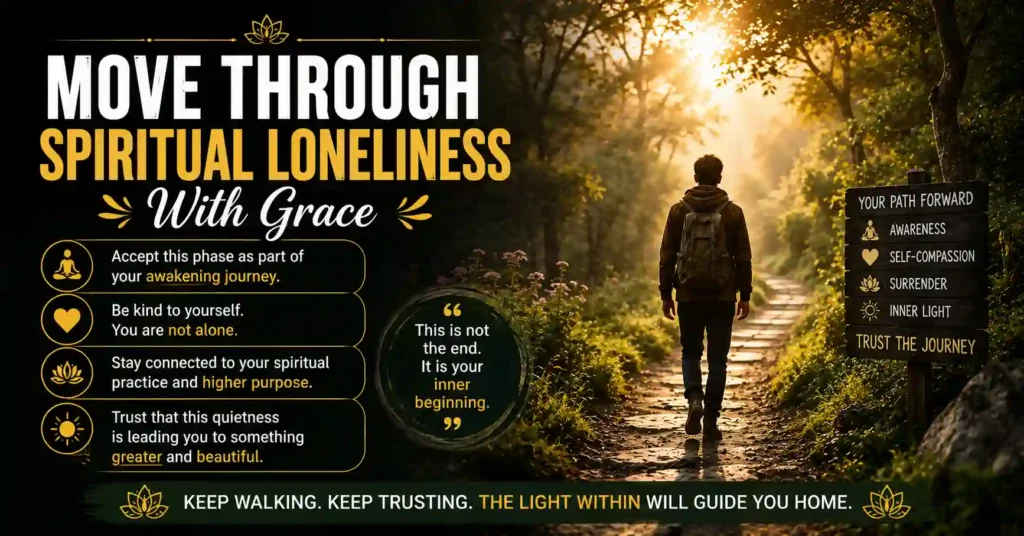
How to Move Through Spiritual Loneliness with Grace
When spiritual loneliness arises, it is natural to want relief from the discomfort. Many people try to return to familiar habits, stay constantly busy, or distract themselves from what they are feeling.
Others begin comparing their journey with that of other seekers. They may wonder whether they are progressing correctly or question why their experience feels different from what they expected.
These reactions are understandable, but they often make the process more difficult. A spiritual awakening journey is not a race, and it does not unfold in the same way for everyone. Each person’s path is shaped by their own experiences, lessons, and stage of growth.
Instead of resisting the experience, it can be helpful to approach it with patience and self-compassion. Spend time in quiet reflection, observe your thoughts without judging them, and allow yourself to sit with uncertainty without demanding immediate answers.
In Sanatan Dharma, inner growth is often seen as a gradual unfolding rather than a sudden event. Clarity develops over time through awareness, reflection, and sincere self-observation.
The more gently you allow the process to unfold, the easier it becomes to move through periods of spiritual loneliness. What initially feels uncomfortable can slowly become a source of wisdom, resilience, and deeper self-understanding.
The Gift Hidden Within Spiritual Loneliness
When you are in the middle of spiritual loneliness, it can feel confusing and even unnecessary. You may wonder why spiritual growth cannot happen without periods of uncertainty, distance, or inner questioning.
Yet many of life’s deepest transformations happen in quiet spaces. A seed grows beneath the soil long before anyone sees the plant. In the same way, inner change often unfolds away from noise, attention, and external validation.
This phase creates space for reflection and self-discovery. It encourages you to question old beliefs, examine long-held assumptions, and understand yourself with greater honesty and awareness.
What initially feels like emptiness can gradually become an opportunity for deeper insight. As distractions lose their hold, you become more aware of what truly matters and what brings lasting meaning to your life.
Many seekers later realise that spiritual loneliness was not simply about feeling alone. It was an invitation to develop a stronger relationship with themselves, their true nature, and the Divine.
What feels uncomfortable today may eventually become one of the most meaningful parts of your spiritual awakening journey. In time, the loneliness often gives way to greater clarity, inner peace, and a deeper sense of purpose.
Practical Ways to Navigate Spiritual Loneliness
One of the most important things you can do during periods of spiritual loneliness is stop fighting every uncomfortable feeling. The more you resist what is happening within, the heavier and more confusing the experience often becomes.
Instead of forcing yourself to feel differently, try supporting yourself through simple practices such as:
- Spend time in nature to quiet the mind and regain perspective.
- Sit in silence for a few minutes each day without distractions.
- Write down your thoughts and feelings in a journal.
- Chant a mantra or offer a simple prayer if it resonates with you.
- Practice Sakshi Bhav (witness awareness) by observing thoughts without reacting to them.
- Limit unnecessary digital noise and create space for reflection.
- Stay connected with trusted family and friends rather than isolating yourself completely.
These small acts of awareness may not remove spiritual loneliness overnight, but they can help you move through it with greater clarity, patience, and understanding.
It is also important to remain connected to daily life. Spiritual growth does not require abandoning relationships, responsibilities, work, or simple joys. In Sanatan Dharma, inner growth and worldly duties can exist in harmony.
As self-awareness deepens, you gradually learn how to honour your inner transformation while continuing to participate fully in life.
The Transformation That Follows Spiritual Loneliness
At some point, a quiet shift begins to take place. The spiritual loneliness that once felt heavy no longer affects you in the same way. The constant need to understand every experience starts softening, and you become more comfortable with uncertainty.
What once felt like emptiness gradually begins to feel like space. Space to breathe, reflect, and simply be present with yourself.
As awareness deepens, you stop viewing every uncomfortable feeling as a problem that needs to be fixed. Instead, you begin accepting each experience as part of your inner growth and transformation.
Many seekers discover that spiritual loneliness does not always disappear completely. Rather, their relationship with it changes. What once felt frightening begins to feel meaningful.
This shift often marks an important stage in the spiritual awakening journey. You begin trusting the process more deeply and relying less on constant answers or external reassurance.
Over time, the loneliness that once seemed like an obstacle can become a source of wisdom, self-awareness, and inner peace. What began as a difficult phase gradually reveals itself as an important part of spiritual growth.
A Deeper Connection Begins to Emerge
One of the surprising aspects of a spiritual awakening journey is that connection often returns, but not always in the way you expected. Instead of seeking more connections, you may begin seeking more meaningful ones.
Relationships often become deeper and more authentic. Conversations that once stayed on the surface may begin exploring values, purpose, self-discovery, and inner growth. Presence becomes more valuable than constant interaction.
At the same time, your relationship with yourself grows stronger. As self-awareness develops, you begin trusting your inner wisdom more than before. There is less urgency to search for answers everywhere because you have learned to listen more carefully to your own experience.
For many seekers, this period also strengthens their connection with the Divine. What may have once felt like a belief or concept gradually becomes a living relationship built through trust, surrender, devotion, and awareness.
This is often when spiritual loneliness begins to transform. The feeling of separation slowly gives way to a deeper sense of belonging, not necessarily to a group or identity, but to life itself.
Over time, the spiritual loneliness that marked the beginning of the journey often gives way to a quieter and more stable sense of connection, inner peace, and spiritual maturity.

Key Takeaways
- Spiritual loneliness is a common experience during spiritual awakening and inner transformation.
- It often arises when your inner world begins changing faster than your outer life.
- Spiritual loneliness is different from emotional loneliness and can occur even when you are surrounded by people.
- As awareness grows, old beliefs, habits, interests, and attachments may gradually lose their hold on the mind.
- In Sanatan Dharma, concepts such as Vairagya and Sakshi Bhav can help you navigate this phase with greater clarity and balance.
- Periods of solitude and reflection are often natural stages of spiritual growth rather than signs that something is wrong.
- Practices such as silence, prayer, mantra chanting, self-reflection, journaling, and spending time in nature can provide support during this journey.
- Spiritual loneliness often creates space for self-discovery, healing, and a deeper understanding of life.
- Over time, what feels like loneliness can transform into greater self-awareness, inner peace, and spiritual maturity.
- The ultimate lesson is that spiritual loneliness is not always about being separated from others. It can be an invitation to build a deeper connection with yourself and the Divine.
Conclusion
Spiritual loneliness can be one of the most unexpected parts of a spiritual awakening journey. As awareness expands, there may be periods when you feel different from those around you, even though life on the surface appears unchanged.
If you have been experiencing spiritual loneliness, remember that this phase is more common than many seekers realise. It often appears when old patterns, beliefs, and attachments begin fading while a deeper understanding of yourself is still emerging.
Over time, what feels like loneliness often reveals a deeper purpose. It creates space for self-discovery, reflection, healing, and spiritual growth. It encourages you to look within rather than constantly seeking answers outside yourself.
Be patient with the process. Not every insight arrives immediately, and not every question needs an instant answer. Inner transformation unfolds gradually through awareness, acceptance, and experience.
One day, you may look back and realise that spiritual loneliness was never pulling you away from life. Instead, it was quietly guiding you toward greater self-awareness, inner peace, and a deeper connection with the Divine.
Suggested Reading
If the topic of spiritual loneliness resonated with you, these related articles can help you explore other aspects of inner growth, self-awareness, spiritual awakening, and practical wisdom from Sanatan Dharma. Together, they offer guidance for understanding the mind, strengthening inner resolve, finding peace in daily life, and deepening your connection with your true self.
Intention vs Ritual: What Matters More in Sanatan Dharma?
https://thesanatantales.com/intention-vs-ritual/How to Live in the Present Moment: A Simple Path to Inner Peace
https://thesanatantales.com/how-to-live-in-the-present-moment/Letting Go in Sanatan Dharma: Finding Peace Beyond Attachment
https://thesanatantales.com/letting-go-in-sanatan-dharma/Sankalpa in Sanatan Dharma: The Ancient Power of Inner Resolve
https://thesanatantales.com/sankalpa-in-sanatan-dharma/Feeling Spiritually Lost? What to Do According to Sanatan Dharma
https://thesanatantales.com/what-to-do-when-spiritually-lost/How to Stay Calm During Difficult Times: Spiritual Wisdom from Sanatan Dharma
https://thesanatantales.com/stay-calm-during-difficult-times/Spiritual Restlessness: Causes, Meaning, and Why the Mind Feels Restless Even After Prayer
https://thesanatantales.com/spiritual-restlessness/How Does Spiritual Loneliness Feel Like?
https://www.quora.com/How-does-spiritual-loneliness-feel-like
FAQs
What is spiritual loneliness?
Spiritual loneliness is a feeling that can arise when your inner growth begins moving faster than your outer life. You may be surrounded by family, friends, and daily activities, yet still feel that something within is changing in a way that is difficult to explain.
Unlike ordinary loneliness, it is not always caused by a lack of companionship. It often appears when deeper questions about life, purpose, truth, and self-discovery begin emerging during a spiritual awakening journey.
Why does spiritual loneliness happen during spiritual awakening?
As awareness expands, old beliefs, habits, interests, and ways of relating to life may begin changing. At the same time, the people and environment around you often remain the same.
This can create a temporary feeling of being misunderstood or disconnected. Many seekers experience this phase because they are moving through an inner transformation that others cannot easily see or understand.
How is spiritual loneliness different from emotional loneliness?
Emotional loneliness usually comes from missing connection, companionship, or support from other people. There is often a desire for someone to fill the emptiness.
Spiritual loneliness is different. It can arise even when you have loving relationships and supportive people around you. The longing is often for deeper meaning, greater self-understanding, or a stronger connection with the Divine rather than simply for company.
Is spiritual loneliness a sign that something is wrong?
In most cases, no. Many spiritual traditions describe periods of solitude, self-reflection, and inner questioning as natural stages of growth.
While the experience can feel uncomfortable, it is often a sign that old patterns are fading and a deeper awareness is emerging. What feels confusing today may later be recognised as an important part of your spiritual development.
Can spiritual loneliness bring positive changes?
Yes. Although it may feel challenging at first, spiritual loneliness often encourages deeper self-awareness, reflection, and personal growth.
Many seekers discover that this phase helps them understand themselves more honestly, develop inner strength, and build a more meaningful relationship with the Divine. Over time, what once felt like loneliness can become a source of clarity and wisdom.
How can I navigate spiritual loneliness in a healthy way?
Rather than fighting the experience, try approaching it with patience and awareness. Helpful practices may include:
- Spending time in nature
- Sitting in silence each day
- Journaling your thoughts and experiences
- Practising prayer or mantra chanting
- Observing thoughts through Sakshi Bhav (witness awareness)
- Staying connected with trusted family and friends
These practices may not remove spiritual loneliness immediately, but they can help you move through it with greater calmness and understanding.
Can spiritual loneliness exist even when I enjoy solitude?
Yes. Enjoying solitude and experiencing spiritual loneliness are not the same thing.
You may genuinely appreciate quiet time, reflection, and being alone, yet still feel that you are moving through an inner transition that few people understand. This is why many seekers value solitude while simultaneously experiencing a deeper longing for meaning, truth, or spiritual connection.
What does Sanatan Dharma teach about spiritual loneliness?
Sanatan Dharma encourages self-awareness, Vairagya (healthy detachment), Sakshi Bhav (witness awareness), prayer, and devotion as ways to navigate inner transformation.
Rather than viewing every difficult phase as a problem, Sanatan wisdom often sees such experiences as opportunities for deeper understanding and spiritual growth. What appears to be loneliness may sometimes be an invitation to know your true nature more deeply
How do I know if I am experiencing spiritual loneliness or just going through a difficult phase?
A difficult phase is usually connected to a specific life situation, challenge, or emotional struggle.
Spiritual loneliness often feels different. It is commonly accompanied by deeper questioning, a desire for meaning, growing self-awareness, changing priorities, and a sense that your inner world is evolving. If these signs are present, the experience may be part of a broader spiritual awakening journey rather than ordinary loneliness.
Glossary of Important Terms
| Term | Meaning |
|---|---|
| Spiritual Loneliness | A feeling of inner distance or isolation that can arise during spiritual growth, even when surrounded by people. |
| Spiritual Awakening | A process of deeper self-awareness and transformation that changes how a person sees life, themselves, and the world. |
| Awareness | The ability to observe thoughts, emotions, and experiences with greater clarity and consciousness. |
| Self-Awareness | Understanding your own thoughts, emotions, habits, motivations, and inner patterns. |
| Vairagya | A Sanatan Dharma concept meaning healthy detachment from unnecessary attachments and desires that no longer support growth. |
| Sakshi Bhav | Witness awareness. The practice of observing thoughts, emotions, and experiences without becoming completely identified with them. |
| Solitude | The state of being alone by choice for reflection, contemplation, or inner growth. |
| Inner Transformation | Gradual changes in understanding, values, awareness, and consciousness that occur through spiritual growth. |
| Spiritual Growth | The ongoing journey of developing wisdom, self-understanding, inner peace, and a deeper connection with the Divine. |
| Inner Peace | A state of mental and emotional calmness that arises from acceptance, awareness, and balance. |
| Self-Discovery | The process of understanding one’s true nature, values, purpose, and inner self. |
| Divine | The higher spiritual reality, Supreme Consciousness, or God as understood in Sanatan Dharma. |
| Reflection | Quiet contemplation that helps a person understand thoughts, experiences, and life lessons more deeply. |
| Consciousness | The fundamental awareness that allows a person to experience, perceive, and understand life. |
| Detachment | Remaining involved in life without becoming overly attached to outcomes, possessions, or expectations. |
| Inner Silence | A calm state in which mental noise reduces and deeper awareness becomes more accessible. |
| Spiritual Path | A personal journey of self-improvement, self-realisation, and connection with higher truth. |
| Purpose | A deeper sense of meaning and direction that guides a person’s life and actions. |
| Devotion (Bhakti) | Loving remembrance, faith, and surrender toward the Divine. |
| Self-Realisation | The direct understanding of one’s true spiritual nature beyond the ego, roles, and temporary identities. |
About the Author
Yateendra Chaturvedi is a spiritual writer, researcher, devotee, and the founder of The Sanatan Tales. With over 35 years of professional experience and a lifelong interest in Sanatan Dharma, he writes about Hindu deities, temples, scriptures, festivals, Mahavidyas, sacred stories, rituals, and living traditions that continue to guide and inspire devotees across India.
Drawing from traditional scriptures, regional beliefs, temple traditions, devotional literature, and historical sources, he aims to present authentic, well-researched, and easy-to-understand content for modern readers. His work focuses on preserving spiritual wisdom, explaining sacred traditions, and helping seekers develop a deeper understanding of India’s rich spiritual heritage.
Through The Sanatan Tales, Yateendra strives to make the timeless teachings of Sanatan Dharma simple, meaningful, and relevant for today’s generation while maintaining respect for traditional sources, regional practices, and diverse spiritual perspectives.
Learn More About Yateendra Chaturvedi →
https://thesanatantales.com/about-the-author/
References & Sources
This article is based on commonly understood concepts, teachings, and principles found within Sanatan Dharma. It draws upon traditional spiritual wisdom, philosophical ideas, devotional practices, yogic insights, and teachings that have been shared and preserved through generations.
The content also reflects perspectives that are widely discussed in spiritual literature, personal reflection, and traditional approaches to self-awareness, inner growth, and the search for deeper meaning in life.
Note: Interpretations, practices, and spiritual experiences may vary among different traditions, lineages, teachers, regions, and individuals. The purpose of this article is not to present any single viewpoint as the only truth, but to share commonly accepted spiritual perspectives in a simple, practical, and reader-friendly manner. Sanatan Dharma embraces diverse paths of knowledge, devotion, meditation, self-inquiry, and inner transformation.
Explore More Fascinating Topics from Sanatan Dharma