
In Sanatan Dharma, human life is never seen as perfect or flawless. While trying to live rightly, people often cause harm without intention or awareness. Such actions are known as unintentional sins, or Ajnata Paap.
Many devotees quietly carry guilt in their hearts, wondering about forgiveness for unintentional sins and whether God truly notices such mistakes. The ancient scriptures approach this concern with remarkable compassion.
Instead of fear or punishment, they offer clarity, balance, and gentle correction.
In this article, you will learn what forgiveness for unintentional sins means in Sanatan Dharma, why intention is more important than action in karma, the scriptural teachings on Ajnata Paap, and the practical ways to seek inner purification through Dharma, Prayaschitta, charity, Naam Sankirtan, and sincere devotion.
Quick Facts About Forgiveness for Unintentional Sins
| Aspect | Details |
|---|---|
| Meaning | Seeking spiritual purification for harm caused unknowingly or without intention. |
| Sanskrit Term | Ajnata Paap (Unintentional Sins) |
| Main Principle | Intention plays a key role in determining the karmic effect of an action. |
| Scriptural Guidance | Bhagavad Gita, Bhagavat Purana, and traditional teachings of Sanatan Dharma. |
| Ways to Seek Forgiveness | Prayer, Dharma, Prayaschitta, charity, Naam Sankirtan, and righteous living. |
| Ultimate Goal | Inner purification, spiritual growth, and progress towards Moksha. |
Table of Contents
ToggleWhat Are Unintentional Sins in Sanatan Dharma?
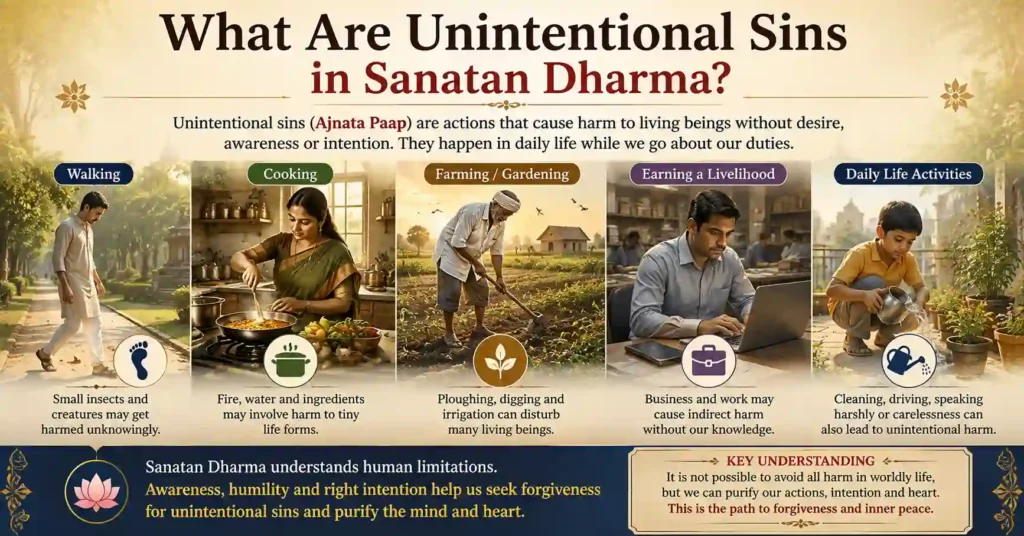
Unintentional sins in Sanatan Dharma, also known as Ajnata Paap, are actions that cause harm without desire, planning, or conscious intention. Such actions may occur while walking, cooking, travelling, earning a livelihood, farming, or simply carrying out everyday responsibilities.
Sanatan Dharma recognizes that complete non-violence is almost impossible for a householder. Even ordinary activities may unknowingly affect other living beings or the environment. Because there is no harmful intention, these actions are not viewed in the same way as deliberate wrongdoing.
However, the scriptures also teach that every action leaves a subtle impression on the mind and influences one’s karma. For this reason, devotees are encouraged to cultivate awareness, compassion, and righteous conduct while sincerely seeking forgiveness for unintentional sins through prayer, self-reflection, and acts of Dharma.
Common Examples of Unintentional Sins
- Accidentally harming insects while walking or cleaning.
- Causing harm during cooking, farming, or daily household work.
- Hurting someone’s feelings through careless words spoken without malice.
- Damaging nature or other living beings unknowingly during daily activities.
These examples remind us that the goal of Sanatan Dharma is not to create fear or guilt but to develop greater awareness, compassion, and responsibility in everyday life.
Intentional vs Unintentional Sins
| Aspect | Unintentional Sins (Ajnata Paap) | Intentional Sins |
|---|---|---|
| Intention | Harm occurs without awareness or desire. | Harm is caused knowingly or deliberately. |
| Karmic Effect | Creates lighter karmic impressions. | Creates stronger karmic consequences. |
| Examples | Accidentally harming insects, careless words, unintended damage. | Violence, deception, theft, or knowingly causing suffering. |
| Scriptural Approach | Encourages awareness, prayer, charity, and self-improvement. | Requires sincere repentance, Prayaschitta, and a commitment to change. |
| Spiritual Goal | Develop greater mindfulness and compassion. | Transform harmful tendencies and return to the path of Dharma. |
Why Does Intention Matter More Than Action?
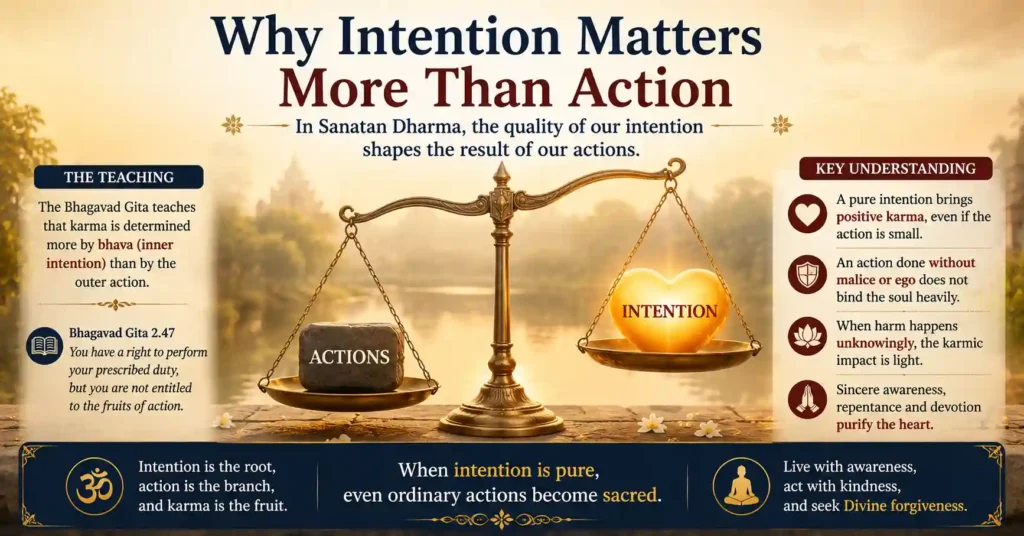
In Sanatan Dharma, karma is influenced not only by our actions but also by the intention behind them. A central teaching of Hindu philosophy is that actions performed with compassion, honesty, and selflessness have different karmic effects than those driven by greed, anger, or hatred.
The Bhagavad Gita explains that actions performed without ego, attachment, or selfish desire do not bind the soul in the same way as deliberate wrongdoing. It is the inner motive, or Bhava, that gives an action its true spiritual significance.
When harm occurs unknowingly, the karmic burden is lighter because there is no intention to cause suffering. This compassionate understanding helps remove unnecessary fear and encourages seekers to focus on self-improvement rather than guilt.
Understanding this principle is essential to forgiveness for unintentional sins. Instead of living with regret, Sanatan Dharma encourages sincere repentance, righteous living, and devotion as the path to inner purification and spiritual growth.
Key Teachings
- Intention shapes the karmic result of an action.
- Unintentional harm carries a lighter karmic burden than deliberate wrongdoing.
- Sincere repentance and self-improvement are more valuable than living with guilt.
- Awareness, Dharma, and devotion help purify the mind and strengthen spiritual progress.
A Timeless Question Asked by Maharaj Parikshit
The question of forgiveness for unintentional sins is not new. It was raised thousands of years ago in the Bhagavat Purana, where Maharaj Parikshit asked Shukdev Ji how human beings could avoid sin when everyday life itself involves unseen harm.
As a king and a sincere seeker of truth, Maharaj Parikshit understood that people often cause injury to living beings without any intention. While walking, cooking, farming, or carrying out daily duties, some form of harm may occur unknowingly.
He therefore asked a profound question: If every action in worldly life can create some form of violence or karma, is liberation (Moksha) still possible for an ordinary person?
This timeless question continues to resonate even today. It reminds us that Sanatan Dharma does not ignore human limitations but provides compassionate guidance for those who sincerely seek forgiveness for unintentional sins and wish to live according to Dharma.
Shukdev Ji's Compassionate Answer
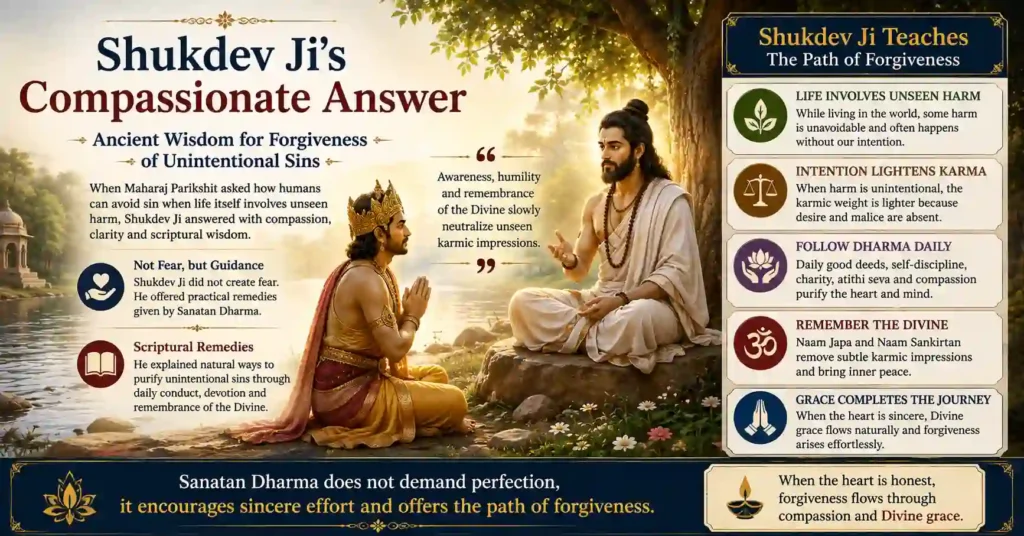
Shukdev Ji responded with reassurance rather than fear. He explained that Sanatan Dharma does not expect human beings to live without making any mistakes. Instead, it provides compassionate and practical ways to seek forgiveness for unintentional sins committed during everyday life.
According to his teachings, unintentional paap (Ajnata Paap) can be purified through righteous living, sincere devotion, and constant remembrance of the Divine. These practices are not meant as punishment but as gentle forms of Prayaschitta that gradually purify the mind and heart.
Shukdev Ji emphasized that awareness, humility, gratitude, and devotion help reduce the subtle karmic impressions created unknowingly. As a person’s thoughts and actions become more aligned with Dharma, the chances of causing harm also naturally decrease.
His compassionate message reminds us that the purpose of Sanatan Dharma is not to fill people with guilt but to guide them towards inner purification, spiritual growth, and a life lived with greater awareness.
Forgiveness for Unintentional Sins Through Daily Conduct
Shukdev Ji explains that simple acts performed with sincerity become silent yajnas, helping purify the mind and reduce the subtle effects of unintentional sins. These daily practices are not complicated rituals but expressions of compassion, gratitude, and Dharma.
Respecting all forms of life, offering food to the Divine before eating, feeding animals or birds, speaking the truth, serving guests, and remembering God are all considered acts of inner purification. Performed with humility, they become a natural form of Prayaschitta in everyday life.
These practices help seekers gradually cultivate awareness and kindness. Instead of living with guilt, they encourage a life guided by righteousness and devotion, making forgiveness for unintentional sins a continuous process of spiritual growth.
Examples of Daily Practices
- Offer food to the Divine before meals.
- Feed birds, cows, or other animals whenever possible.
- Speak truthfully and avoid causing unnecessary harm.
- Welcome and serve guests with respect and kindness.
- Remember God daily through prayer, gratitude, or meditation.
These simple actions remind us that spiritual progress is built through consistent, selfless living. Over time, they purify the mind, reduce future mistakes, and strengthen our connection with Dharma and the Divine.
Atithi Seva and Charity with a Pure Heart
In Sanatan Dharma, Atithi Seva (serving guests) and Daan (charity) are regarded as sacred acts that purify both the heart and the mind. Serving guests, helping those in need, feeding animals, or supporting a worthy cause with compassion are all considered expressions of Dharma.
The scriptures teach that the value of charity is measured by the intention behind it, not by the amount given. Even a small offering made with humility, gratitude, and without the desire for recognition carries great spiritual merit.
Such selfless acts help reduce the subtle karmic effects of unintentional sins by cultivating kindness, generosity, and compassion. They gradually replace selfishness with selfless service, bringing the seeker closer to inner purity and Divine grace.
Acts of Charity That Reflect Dharma
- Offer food or essentials to those in need.
- Feed cows, birds, or other animals with compassion.
- Welcome and serve guests with respect.
- Support genuine charitable or religious causes according to your ability.
- Give without expecting praise, recognition, or rewards.
These simple acts remind us that forgiveness for unintentional sins is not achieved through fear but through a life guided by compassion, generosity, and sincere devotion.

What If These Practices Are Not Possible Every Day?
Sanatan Dharma is both practical and compassionate. It recognizes that modern life comes with responsibilities, busy schedules, and personal limitations that may make it difficult to follow every spiritual practice each day.
If certain practices cannot be performed regularly, there is no need to live with fear or guilt. What truly matters is a sincere heart, honest self-reflection, and a genuine desire to improve one’s thoughts, words, and actions.
The path to forgiveness for unintentional sins is not based on rigid perfection. It is built through steady effort, righteous living, and continuous remembrance of the Divine. Every sincere step taken towards Dharma strengthens the mind and supports spiritual progress.
Whenever possible, simply offer a heartfelt prayer, express gratitude, chant the Divine Name, or perform a small act of kindness. Even these simple actions help cultivate inner purity and keep the seeker connected to God with faith and humility.
Other Gentle Ways to Seek Forgiveness
Apart from daily worship and charity, Sanatan Dharma also recommends gentle practices that help purify the mind and support forgiveness for unintentional sins. These include self-discipline, mindful fasting, periods of silence, ethical living, and honest self-reflection.
These practices are not meant as punishment. Instead, they help calm the mind, reduce distractions, and strengthen one’s commitment to Dharma. As awareness grows, a person naturally becomes more careful in thoughts, words, and actions.
The scriptures describe such inner discipline as a form of Tapasya and Prayaschitta. When performed with humility and sincerity, these practices gradually weaken negative tendencies, purify subtle karmic impressions, and encourage lasting spiritual growth.
Simple Practices for Inner Purification
- Observe occasional fasting with devotion and self-control.
- Spend a few moments each day in silence and self-reflection.
- Speak truthfully and act with kindness.
- Avoid actions that knowingly cause harm to others.
- Pray sincerely and seek guidance from the Divine.
These gentle practices remind us that spiritual purification is a gradual journey. Through consistent effort and sincere devotion, the burden of unintentional sins slowly fades, bringing greater peace, wisdom, and inner strength.
Naam Sankirtan: The Simplest and Highest Path to Forgiveness
Many scriptures describe Naam Sankirtan, the heartfelt chanting of the Divine Name, as one of the most compassionate and effective ways to seek forgiveness for unintentional sins, especially in the present age of Kali Yuga.
Sanatan Dharma teaches that chanting the Divine Name with faith, devotion, and sincerity purifies the mind and gradually removes subtle karmic impressions that may have accumulated unknowingly. Through constant remembrance of God, fear and guilt are replaced by peace, hope, and trust in Divine grace.
Unlike complicated rituals, Naam Sankirtan is open to everyone. It can be practised at home, while travelling, during daily work, or in quiet moments of prayer. The scriptures emphasize that sincere devotion is more important than elaborate ceremonies.
As Bhakti deepens, the heart becomes purer, awareness increases, and one’s actions naturally become more compassionate and aligned with Dharma. In this way, Naam Sankirtan not only helps in forgiveness for unintentional sins but also guides the seeker towards lasting inner peace and spiritual growth.
Simple Ways to Practise Naam Sankirtan
- Chant your chosen Divine Name with faith every day.
- Join devotional bhajans or kirtans whenever possible.
- Repeat the Divine Name silently during daily activities.
- Chant with gratitude rather than fear or guilt.
- Let devotion inspire righteous thoughts and actions.
Through sincere remembrance of the Divine, Naam Sankirtan transforms the mind, purifies the heart, and strengthens the seeker’s journey towards inner purity, Divine grace, and ultimately Moksha.

Did You Know?
Sanatan Dharma teaches that sincere repentance is always more powerful than guilt. The purpose of spiritual practices is not to punish a person for past mistakes but to awaken greater awareness, compassion, and devotion.
Every sincere step towards Dharma helps purify the mind and supports spiritual growth.
Conclusion
Sanatan Dharma approaches forgiveness for unintentional sins with wisdom, compassion, and a deep understanding of human life. It recognizes that while mistakes may happen unknowingly, every person has the opportunity to grow through awareness, righteous living, and sincere devotion.
By cultivating the right intention, following Dharma, practising selfless actions, remembering the Divine, and chanting God’s holy name, the subtle effects of unintentional sins gradually become purified. These practices transform guilt into self-improvement and fear into faith.
The scriptures remind us that God does not expect perfection but sincerity. A humble heart, honest repentance, and a genuine desire to live according to Dharma are the true foundations of forgiveness for unintentional sins.
Ultimately, the goal is not merely to remove the burden of past actions but to live with greater compassion, awareness, and inner peace. As the mind becomes purer and devotion deepens, every step taken with sincerity brings the seeker closer to Divine grace, self-realization, and Moksha.
A Thought to Remember
“Sanatan Dharma teaches that true forgiveness begins with a sincere heart. When intention is pure, actions become more mindful, the mind becomes calmer, and every step taken with faith brings us closer to inner peace and the Divine.”
Key Takeaways
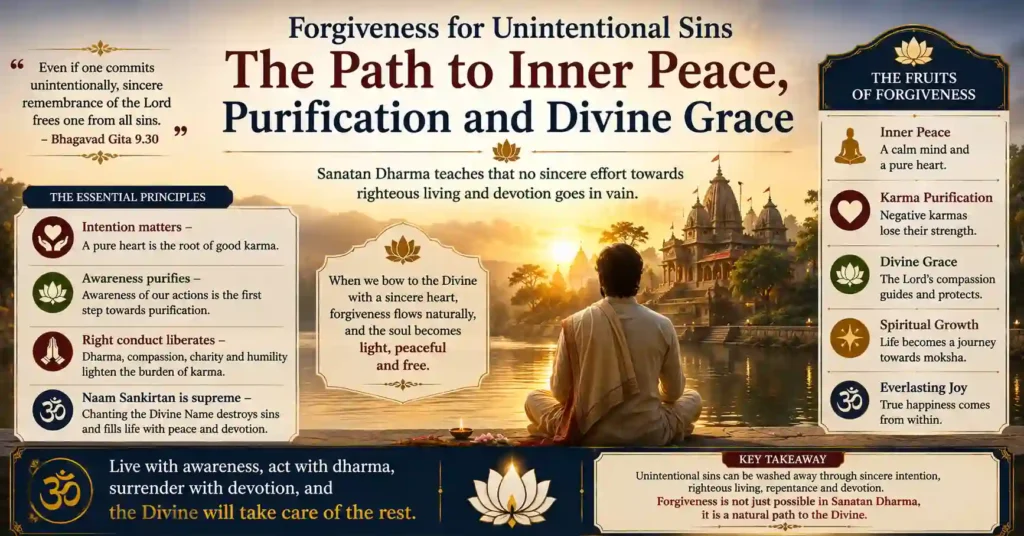
- Forgiveness for unintentional sins is based on compassion, not fear.
- Ajnata Paap refers to harm caused unknowingly or without harmful intention.
- In Sanatan Dharma, intention plays a major role in determining the karmic effect of an action.
- Daily practices such as prayer, charity, Dharma, Prayaschitta, and Naam Sankirtan help purify the mind.
- God values sincerity, repentance, and self-improvement more than perfection.
- Spiritual growth comes through awareness, devotion, and righteous living, gradually leading towards inner peace and Moksha.
Suggested Reading
Understanding forgiveness for unintentional sins becomes even more meaningful when explored alongside other core teachings of Sanatan Dharma. The following articles will help you deepen your understanding of karma, Dharma, Shakti, the soul, devotion, and the timeless wisdom that guides righteous living, inner purification, and spiritual growth.
Karma: Meaning, Types, Philosophy and How It Works in Sanatan Dharma
https://thesanatantales.com/karma-meaning-types-and-how-it-works/
Atma and Parmatma: Meaning, Relationship and Their Role in Sanatan Dharma
https://thesanatantales.com/atma-and-parmatma/
Shakti in Sanatan Dharma: Meaning, Forms, Philosophy and Spiritual Significance
https://thesanatantales.com/shakti-in-sanatan-dharma/
What Is Detachment in Hindu Philosophy? A Powerful Path to Inner Freedom
https://thesanatantales.com/detachment-in-hindu-philosophy/
Kaal in Sanatan Dharma: The Eternal Science of Time, Yugas and Cosmic Cycles
https://thesanatantales.com/kaal-in-sanatan-dharma/
Sanatan Dharma Meaning: What Is Sanatan Dharma and Its Core Principles
https://thesanatantales.com/sanatan-dharma-meaning/
Why Do Hindus Have So Many Gods? The Truth Behind Many Deities in Sanatan Dharma
https://thesanatantales.com/why-do-hindus-have-so-many-gods/
Forgiveness (Wikipedia)
https://en.wikipedia.org/wiki/Forgiveness
FAQs
What is forgiveness for unintentional sins in Sanatan Dharma?
Forgiveness for unintentional sins in Sanatan Dharma refers to the spiritual process of purifying the subtle karmic effects of actions that cause harm without intention, awareness, or selfish motive. Such actions are known as Ajnata Paap.
The scriptures explain that while these actions may create subtle karmic impressions, they are not treated in the same way as deliberate wrongdoing. Through sincere repentance, righteous living, devotion, charity, prayer, and remembrance of God, a seeker gradually purifies the mind and progresses towards inner peace.
What are unintentional sins according to Sanatan Dharma?
Unintentional sins are actions that unknowingly cause harm to other living beings or the environment during the course of everyday life. They may occur while walking, cooking, farming, travelling, earning a livelihood, or performing household duties.
Sanatan Dharma acknowledges that complete non-violence is difficult in worldly life. Instead of creating fear or guilt, it encourages greater awareness, compassion, and responsibility so that future actions become more mindful and aligned with Dharma.
Does intention matter more than action in karma?
Yes. One of the fundamental teachings of Sanatan Dharma is that the intention behind an action greatly influences its karmic result. The Bhagavad Gita teaches that actions performed without ego, hatred, or selfish desire do not bind the soul in the same way as deliberate harmful actions.
When harm happens unknowingly, the karmic burden is lighter because there was no intention to cause suffering. This compassionate understanding encourages self-improvement rather than self-condemnation.
How can I seek forgiveness for unintentional sins every day?
The scriptures recommend simple daily practices rather than complicated rituals. These include offering sincere prayers, remembering the Divine, chanting God’s holy name, speaking truthfully, helping those in need, feeding animals, practising charity, and living according to Dharma.
Even small acts performed with humility and devotion help purify the mind. Over time, these practices reduce negative karmic impressions and strengthen one’s spiritual growth.
Is Naam Sankirtan the best remedy for unintentional sins?
Many Hindu scriptures describe Naam Sankirtan, the heartfelt chanting of the Divine Name, as one of the most compassionate and effective remedies, especially in Kali Yuga.
Chanting with faith, devotion, and sincerity purifies the heart, strengthens devotion, and gradually removes subtle karmic impressions. Rather than relying on fear, Naam Sankirtan fills the mind with peace, trust, and Divine grace.
What if I cannot perform spiritual practices every day?
Sanatan Dharma is compassionate and understands that modern responsibilities may prevent people from following every spiritual practice daily. The tradition values sincerity and steady effort more than rigid perfection.
If you are unable to perform regular rituals, you can still pray sincerely, remember God, practise kindness, speak truthfully, and live according to Dharma. Even small daily efforts made with a pure heart are spiritually meaningful.
Can charity and good deeds reduce the effects of unintentional sins?
Yes. The scriptures regard Daan (charity) and Atithi Seva (serving guests) as powerful expressions of compassion and selfless service. Helping those in need, feeding animals, supporting worthy causes, and serving others without expecting anything in return help cultivate humility and kindness.
Although charity does not erase karma like a transaction, it purifies the heart, encourages righteous living, and supports the seeker’s journey towards forgiveness for unintentional sins and inner purification.
Does God forgive unintentional sins in Sanatan Dharma?
Sanatan Dharma teaches that God is compassionate and understands the difference between deliberate wrongdoing and mistakes committed without intention. The purpose of spiritual life is not to live in fear but to grow in awareness, devotion, and righteousness.
When a person sincerely repents, strives to improve, follows Dharma, and remembers the Divine with faith, the heart gradually becomes purified. Through Divine grace, honest effort, and spiritual discipline, the burden of unintentional sins slowly fades, bringing lasting peace and spiritual progress.
Glossary of Important Terms
| Term | Meaning |
|---|---|
| Forgiveness for Unintentional Sins | The process of seeking spiritual purification for harm caused unknowingly through sincere repentance, righteous living, and devotion. |
| Ajnata Paap | A Sanskrit term meaning unintentional sins or actions that cause harm without awareness, intention, or desire. |
| Karma | The universal law of cause and effect, where every thought, word, and action produces corresponding results. |
| Dharma | The righteous way of living that upholds truth, compassion, duty, and moral responsibility. |
| Prayaschitta | Spiritual practices of repentance and self-purification performed to reduce the effects of wrong actions and strengthen inner transformation. |
| Bhava | The inner intention, attitude, or feeling behind an action, which greatly influences its karmic result. |
| Bhakti | Loving devotion and surrender to the Divine through faith, prayer, worship, and remembrance. |
| Naam Sankirtan | The devotional chanting of the Divine Name, regarded as a powerful means of purifying the mind and deepening one’s connection with God. |
| Tapasya | Spiritual discipline and self-restraint practised to purify the mind, strengthen character, and progress on the spiritual path. |
| Daan | Selfless charity or giving performed without pride or expectation of reward as an expression of compassion and Dharma. |
| Atithi Seva | The sacred practice of welcoming and serving guests with respect, kindness, and generosity. |
| Moksha | Liberation from the cycle of birth and death (Samsara) through self-realization and union with the Supreme. |
| Samsara | The continuous cycle of birth, death, and rebirth experienced by the soul until liberation is attained. |
| Divine Grace | The compassionate blessings of God that help purify the heart, strengthen devotion, and support spiritual progress. |
| Inner Purification | The gradual cleansing of the mind from ignorance, attachment, guilt, and negative tendencies through Dharma, devotion, and righteous living. |
About the Author
Yateendra Chaturvedi is a spiritual writer, researcher, devotee, and the founder of The Sanatan Tales. With over 35 years of professional experience and a lifelong interest in Sanatan Dharma, he writes about Hindu deities, temples, scriptures, festivals, Mahavidyas, sacred stories, rituals, and living traditions that continue to guide and inspire devotees across India.
Drawing from traditional scriptures, regional beliefs, temple traditions, devotional literature, and historical sources, he aims to present authentic, well-researched, and easy-to-understand content for modern readers. His work focuses on preserving spiritual wisdom, explaining sacred traditions, and helping seekers develop a deeper understanding of India’s rich spiritual heritage.
Through The Sanatan Tales, Yateendra strives to make the timeless teachings of Sanatan Dharma simple, meaningful, and relevant for today’s generation while maintaining respect for traditional sources, regional practices, and diverse spiritual perspectives.
Learn More About Yateendra Chaturvedi →
https://thesanatantales.com/about-the-author/
References & Sources
This article is based on widely accepted beliefs, philosophies, and teachings of Sanatan Dharma, along with insights drawn from Hindu scriptures, traditional spiritual literature, and respected religious study sources. It also reflects concepts that have been preserved and explained through various spiritual traditions and the guru-disciple lineage.
Note: Beliefs, interpretations, and spiritual practices may vary across different traditions, sects, and schools of thought within Sanatan Dharma. This article is intended to present commonly accepted spiritual perspectives in a simple, balanced, and easy-to-understand manner, rather than promote any single interpretation as the only absolute truth.
Read More Interesting Articles on Sanatan Dharma