
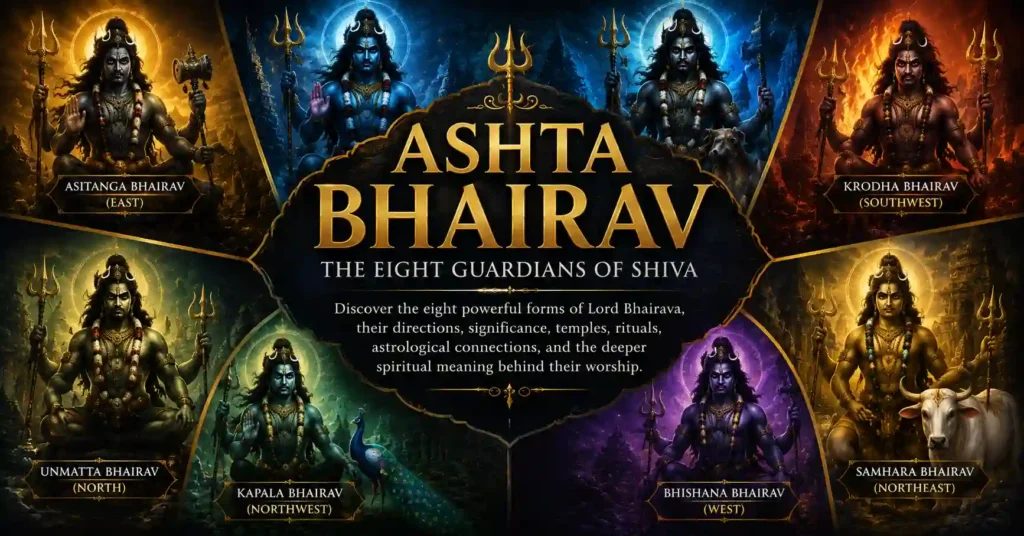
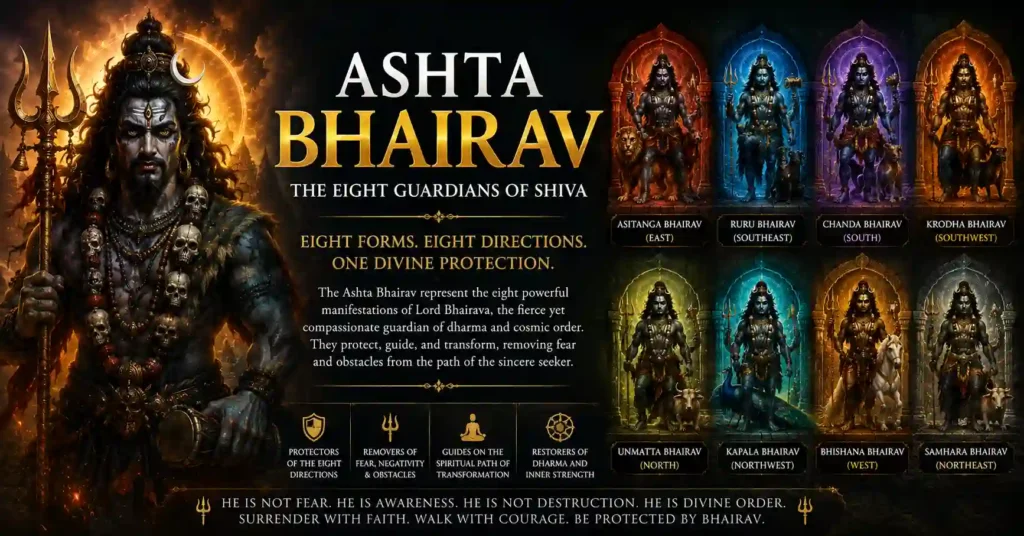
Ashta Bhairav refers to the eight principal forms of Bhairava, the fierce and protective manifestation of Lord Shiva.
In Shaiva and Tantric traditions, these eight Bhairavas are revered as the guardians of the eight directions, preserving cosmic order and protecting sacred space.
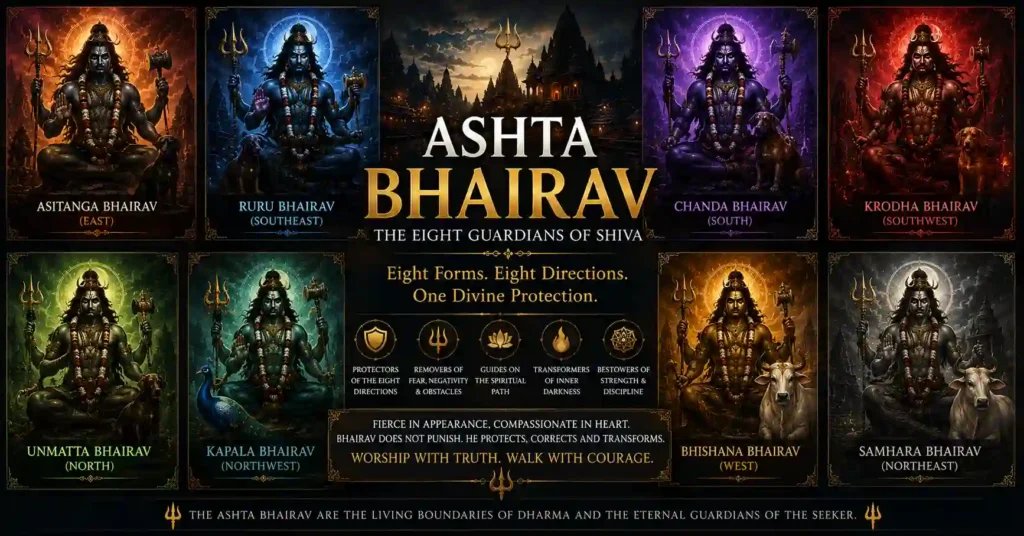
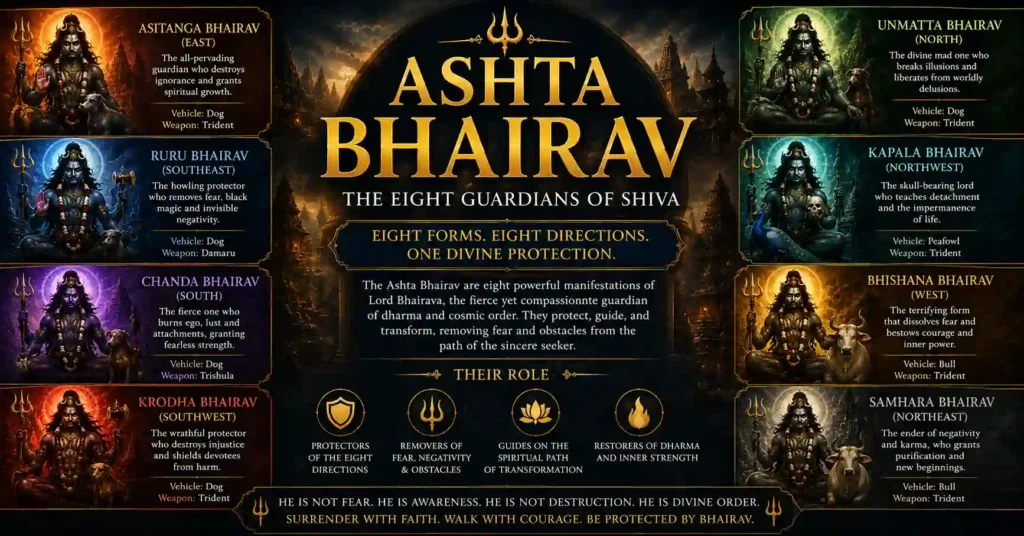
Each Bhairava governs a specific direction and embodies a unique aspect of discipline, protection, transformation, and spiritual awareness.
Together, they represent Shiva’s power to remove obstacles, regulate cosmic balance, and guide seekers on the path of self-realization.
Though fierce in appearance, the Ashta Bhairav are regarded as compassionate protectors who help devotees overcome fear, ignorance, negative influences, and inner limitations.
Table of Contents
ToggleOrigin of Ashta Bhairav in Shaiva Tradition
The origin of Ashta Bhairav is rooted in Shaiva and Tantric traditions, where Bhairava is understood as a fierce manifestation of Lord Shiva’s protective and corrective power.
While different texts describe Bhairava in different ways, a common tradition connects his appearance to the episode in which Shiva severed one of Brahma’s heads to remove pride and restore cosmic order.
Over time, Bhairava worship developed into several streams across India. Shaiva Agamas, Bhairava Tantras, and regional traditions describe multiple forms of Bhairava serving distinct cosmic functions.
Among these manifestations, the Ashta Bhairav emerged as the eight directional guardians who protect sacred space, uphold dharma, and regulate spiritual boundaries.
Rather than being separate deities, the eight Bhairavas are generally understood as specialized expressions of one Bhairava consciousness, each governing a particular direction, energy, and aspect of spiritual discipline.
The Eight Forms of Bhairav and Their Directions
Each Bhairava has a distinct nature, direction, vehicle, and spiritual role. Together, the Ashta Bhairav protect the eight directions of the cosmos and guide devotees through different stages of inner transformation.
| Bhairava | Direction | Traditional Color | Vehicle (Vahana) | Represents |
|---|---|---|---|---|
| Asitanga Bhairava | East | White | Swan | Wisdom and spiritual clarity |
| Ruru Bhairava | Southeast | Light Blue | Bull | Knowledge and disciplined learning |
| Chanda Bhairava | South | Red | Peacock | Courage and decisive action |
| Krodha Bhairava | Southwest | Dark Blue | Garuda | Transformation of anger and negativity |
| Unmatta Bhairava | West | Golden | Horse | Freedom from ego and attachment |
| Kapala Bhairava | Northwest | Yellow | Elephant | Karma, responsibility, and self-reflection |
| Bhishana Bhairava | North | Red | Lion | Fearlessness and divine protection |
| Samhara Bhairava | Northeast | Radiant like lightning | Dog | Transformation and spiritual renewal |
Traditional Sanskrit Names of the Ashta Bhairav
• Asitāṅga Bhairava (असिताङ्ग भैरव)
• Ruru Bhairava (रुरु भैरव)
• Caṇḍa Bhairava (चण्ड भैरव)
• Krodha Bhairava (क्रोध भैरव)
• Unmatta Bhairava (उन्मत्त भैरव)
• Kapāla Bhairava (कपाल भैरव)
• Bhīṣaṇa Bhairava (भीषण भैरव)
• Saṃhāra Bhairava (संहार भैरव)
While transliterations may vary across regions and traditions, these names refer to the same eight principal manifestations of Bhairava.
While transliterations may vary across regions and traditions, these names refer to the same eight principal manifestations of Bhairava.
Asitanga Bhairava (East)
Asitanga Bhairava represents clarity, wisdom, and spiritual awakening. Devotees worship him to cultivate higher understanding, creativity, and purity of thought. His association with the East symbolizes new beginnings and the illumination of consciousness.
Ruru Bhairava (Southeast)
Ruru Bhairava is associated with knowledge, discipline, and righteous guidance. He teaches that learning should lead to wisdom rather than pride and is often invoked for mental clarity, stability, and responsible decision-making.
Chanda Bhairava (South)
Chanda Bhairava embodies courage, determination, and the strength to confront adversity. His fierce nature reminds devotees that spiritual growth often requires facing challenges directly rather than avoiding them.
Krodha Bhairava (Southwest)
Krodha Bhairava symbolizes the disciplined transformation of anger and destructive emotions. Rather than encouraging aggression, he teaches the proper channeling of strength in the service of dharma and personal growth.
Unmatta Bhairava (West)
Unmatta Bhairava represents freedom from ego, attachment, and limiting beliefs. His unconventional nature encourages seekers to move beyond rigid thinking and discover deeper spiritual truths.
Kapala Bhairava (Northwest)
Kapala Bhairava is associated with karma, accountability, and the impermanent nature of worldly life. His symbolism encourages self-reflection and awareness of the consequences of one’s actions.
Bhishana Bhairava (North)
Bhishana Bhairava represents fearlessness, protection, and resilience. Devotees seek his blessings to overcome fear, negative influences, and uncertainty while remaining steadfast on the spiritual path.
Samhara Bhairava (Northeast)
Samhara Bhairava symbolizes transformation through dissolution. He is associated with the destruction of ignorance, the burning of past karmic burdens, and the renewal that follows spiritual surrender.
Together, the Ashta Bhairav represent a complete spiritual journey, guiding devotees from ignorance to wisdom, fear to courage, and limitation to greater awareness.
Symbolic Meaning of the Eight Bhairavas
Beyond their role as guardians of the eight directions, the Ashta Bhairav also symbolize the inner journey of spiritual growth.
Each Bhairava represents a quality, challenge, or transformation that seekers encounter on the path toward greater awareness and self-mastery.
| Bhairava | Symbolic Meaning |
|---|---|
| Asitanga Bhairava | Represents spiritual awakening, wisdom, and the purification of perception. He reminds seekers that true growth begins with clarity of thought and the ability to see beyond illusion. |
| Ruru Bhairava | Symbolizes disciplined knowledge and righteous guidance. His energy teaches that learning should lead to wisdom, humility, and responsible action rather than pride. |
| Chanda Bhairava | Embodies courage, determination, and decisive action. He encourages devotees to face challenges directly and uphold dharma even during difficult circumstances. |
| Krodha Bhairava | Represents the transformation of anger into strength and protection. He teaches the disciplined use of powerful emotions in service of higher goals. |
| Unmatta Bhairava | Challenges attachment, ego, and rigid thinking. His symbolism reminds seekers that spiritual truth often lies beyond conventional assumptions and self-imposed limitations. |
| Kapala Bhairava | Represents impermanence, karma, and personal responsibility. He encourages reflection on the consequences of actions and the temporary nature of worldly achievements. |
| Bhishana Bhairava | Symbolizes fearlessness in the face of adversity. His fierce appearance teaches devotees to remain steady, courageous, and focused amid uncertainty. |
| Samhara Bhairava | Embodies transformation through dissolution. He represents the destruction of ignorance and harmful tendencies so that spiritual renewal may take place. |
Together, the Ashta Bhairav illustrate a complete path of inner transformation, guiding seekers from ignorance to wisdom, fear to courage, and limitation to greater spiritual awareness.
Relationship Between Ashta Bhairav and the 64 Bhairavas
Many devotees encounter references to both Ashta Bhairav and Chausath Bhairav (the 64 Bhairavas) and wonder about the difference between them.
Traditional Bhairava worship often describes the eight principal Bhairavas as the primary manifestations from whom sixty-four Bhairavas emerge.
In this understanding, each of the Ashta Bhairav presides over a group of eight subordinate Bhairavas, creating the larger system of sixty-four forms.
This arrangement symbolizes the expansion of Shiva’s protective power throughout all directions and levels of existence.
While the Ashta Bhairav function as the chief guardians of the cosmos, the sixty-four Bhairavas represent more specialized energies associated with protection, transformation, sacred geography, and spiritual practice.
Different tantric lineages may describe these relationships differently, but the principle remains similar: the sixty-four Bhairavas are viewed as extensions of the eight principal Bhairavas.
Kala Bhairav and the Supreme Authority of Time
All eight Bhairavas are traditionally understood to function under the authority of Kala Bhairav, the form of Bhairava associated with time (kala), discipline, and karmic justice.
While the Ashta Bhairav guard the eight directions, Kala Bhairav is regarded as their chief and the ultimate guardian of cosmic order.
In Hindu traditions, time is not viewed merely as a measure of hours and years. Time governs creation, growth, change, decay, and renewal.
As the Lord of Time, Kala Bhairav represents the power that ensures all beings eventually face the consequences of their actions and move through the cycles of life according to divine law.
Kala Bhairav holds a special place in Kashi (Varanasi), where he is revered as the Kotwal of Kashi, the divine guardian and protector of the sacred city.
Local traditions maintain that pilgrims should seek his blessings alongside those of Lord Vishwanath, acknowledging his role as the keeper of order and spiritual discipline.
Within the broader Bhairava tradition, the Ashta Bhairav are often seen as extensions of Kala Bhairav’s protective power, carrying his guardianship into all eight directions of the cosmos.
Ashta Bhairav Yatra in Kashi
In Varanasi (Kashi), the Ashta Bhairav are not viewed merely as symbolic deities but as living guardians of the sacred city. Devotees undertake the Ashta Bhairav Yatra, a pilgrimage that involves visiting temples dedicated to the eight Bhairavas, each associated with a specific direction and protective function.
The yatra is traditionally performed to seek protection, remove obstacles, and receive the blessings of Bhairava for spiritual progress. Many devotees believe that visiting all eight shrines helps cultivate discipline, courage, and a deeper connection with the sacred geography of Kashi.
Bhairava is especially revered in Varanasi as the Kotwal of Kashi, the divine guardian and protector of the city. According to local tradition, even pilgrims who come for the blessings of Lord Vishwanath are encouraged to pay their respects to Bhairava, acknowledging his role as the protector of the holy city.
A well-known temple tradition holds that the symbolic keys of certain temples are offered to Bhairava at night and received back in the morning, reflecting the belief that he watches over Kashi when all others rest. Whether understood literally or symbolically, this tradition expresses the deep faith devotees place in Bhairava’s guardianship.
Important Ashta Bhairav Temples Across India
While Kashi remains the most prominent center of Ashta Bhairav worship, devotion to the eight Bhairavas extends across many regions of India and Nepal.
Depending on local traditions, the Bhairavas may be worshipped collectively as guardians of the eight directions or individually as powerful manifestations of Shiva associated with protection, justice, transformation, and spiritual discipline.
Some temples preserve the complete Ashta Bhairav tradition through pilgrimage circuits and ritual worship, while others focus on a specific Bhairava form connected to local Shaiva, Shakta, or Tantric practices.
These temples are not merely places of worship but living centers of faith where ancient traditions, regional customs, and devotional practices continue to shape the understanding of Bhairava in everyday life.
The following sites represent some of the most important centers associated with Ashta Bhairav worship and Bhairava traditions across the Indian subcontinent.
Collective Ashta Bhairav Worship Sites
The following places preserve traditions in which the Ashta Bhairav are honored collectively rather than as isolated forms.
These sacred centers are known for pilgrimage traditions, protective rituals, temple worship, and the preservation of Bhairava-related practices.
Kashi (Varanasi), Uttar Pradesh
Kashi is widely regarded as the most important center of Ashta Bhairav worship. The famous Ashta Bhairav Yatra connects eight temples dedicated to the directional forms of Bhairava, creating a sacred protective circuit around the city.
Key features include:
The traditional Ashta Bhairav pilgrimage route
Kala Bhairava’s role as the Kotwal (guardian) of Kashi
Strong links with Kashi Vishwanath traditions
Ancient Shaiva and Tantric influences
Many devotees believe that honoring the Ashta Bhairav helps complete the spiritual experience of Kashi by acknowledging the city’s divine protectors.
Ujjain, Madhya Pradesh
Ujjain has long been associated with Bhairava worship through its connection with Mahakaleshwar Jyotirlinga and ancient Shaiva traditions. The city is considered an important Bhairava kshetra, where Bhairava is worshipped as both a guardian and a regulator of time.
Important aspects include:
Association with Mahakal and Kala Bhairava traditions
Presence of powerful Bhairava temples
Links to Tantric and ascetic lineages
Rituals focused on protection, discipline, and spiritual transformation
Kathmandu Valley (Nepal)
The Kathmandu Valley, particularly Kathmandu and Bhaktapur, preserves one of the most vibrant living Bhairava traditions in South Asia. Among Newar communities, Bhairava worship is deeply woven into religious life, festivals, and local culture.
Notable features include:
Sacred Bhairava processions and festivals
Traditional masked representations of Bhairava
Community protection rituals
Strong connections with Tantric and Shakta traditions
These traditions demonstrate how Bhairava worship continues to remain a living and evolving practice while preserving ancient spiritual foundations.
Major Individual Ashta Bhairav Temples (Form-wise)
While some sacred centers honor the complete Ashta Bhairav tradition, many temples focus on a single form of Bhairava. These temples preserve important regional traditions and are often associated with specific aspects of Bhairava worship.
Kala Bhairav Temple, Ujjain
One of the most famous Bhairava temples in India, the Kala Bhairav Temple of Ujjain is closely connected with the Mahakal tradition. Devotees visit the shrine seeking protection, discipline, and spiritual strength. The temple plays an important role in the broader Bhairava worship traditions of central India.
Batuk Bhairav Temple, Kashi
Batuk Bhairav is worshipped as a youthful and approachable form of Bhairava. The temple is especially popular among devotees seeking protection, removal of obstacles, and guidance in daily life. It remains an important part of Kashi’s wider Bhairava tradition.
Chand Bhairav Temple, Durga Kund, Kashi
Traditionally associated with Chanda Bhairava, this shrine forms part of the sacred Bhairava landscape of Varanasi. Its proximity to important Shakti temples reflects the close relationship between Bhairava and goddess traditions in the city.
Kapala Bhairav (Laat Bhairav), Varanasi
Kapala Bhairav, popularly known as Laat Bhairav, is one of the significant Bhairava shrines of Kashi. Local traditions associate the deity with protection, discipline, and the consequences of one’s actions, reflecting themes commonly connected with Bhairava worship.
Krodha Bhairav Traditions in Maharashtra and Karnataka
In several Shaiva and Nath traditions, Krodha Bhairav is revered as a fierce protector who symbolizes the transformation of anger into strength and righteous action. Shrines associated with this form can be found in different parts of western and southern India.
Bhishana Bhairav Traditions in Eastern India
In parts of Bengal and Odisha, Bhishana Bhairav is often associated with protective forms of Shiva and regional Shakta traditions. His worship reflects the strong historical connection between Bhairava devotion and sacred goddess sites.
Samhara Bhairav and Cremation-Ground Traditions
Samhara Bhairav is frequently associated with themes of transformation, impermanence, and spiritual renewal. Traditions connected with this form are often found near cremation grounds and sacred tantric centers, particularly in parts of eastern India and Nepal.
Regional Traditions of Ashta Bhairav Worship
Although the Ashta Bhairav are revered throughout the Hindu world, their worship takes different forms across regions. These local traditions reflect centuries of spiritual practice while preserving the core understanding of Bhairava as a protector, guardian, and manifestation of Shiva.
Northern India
In Kashi and much of North India, Bhairava is primarily worshipped as the guardian of sacred space and the protector of pilgrims.
Key features include:
- The famous Ashta Bhairav Yatra in Varanasi
- Kala Bhairava’s role as the Kotwal (guardian) of Kashi
- Strong connections with temple traditions and pilgrimage practices
- Emphasis on protection, discipline, and spiritual accountability
Ujjain and Central India
In Ujjain, Bhairava worship is closely linked with the Mahakaleshwar tradition and ancient Shaiva practices.
Common themes include:
- Bhairava as a kshetrapala (guardian deity)
- Rituals connected with Mahakal worship
- Protection from obstacles and negative influences
- Association with time, karma, and spiritual discipline
Bengal and Eastern India
In Bengal, Odisha, and nearby regions, Bhairava worship often appears alongside Shakta traditions.
Characteristics include:
- Connections with Shakti Peethas
- Bhairava serving as the guardian of Devi temples
- Tantric influences in ritual practices
- Integration with local goddess traditions
Nepal Valley
Among Newar communities in Kathmandu and Bhaktapur, Bhairava worship remains one of the most vibrant living traditions.
Important features include:
- Large Bhairava festivals and processions
- Sacred masks representing Bhairava forms
- Community rituals tied to protection and prosperity
- Preservation of ancient tantric customs
Southern India
In parts of Tamil Nadu, Karnataka, and Andhra Pradesh, Bhairava is commonly worshipped as a temple guardian and protector of sacred boundaries.
Devotees often seek:
- Protection from obstacles
- Justice in difficult situations
- Removal of fear and negativity
- Blessings for travel and safety
What These Traditions Have in Common
Despite regional differences, most traditions recognize Bhairava as:
- A guardian of sacred places
- A protector of devotees
- A remover of obstacles
- A manifestation of Shiva’s corrective and protective power
Tantra, Astrology, and Inner Cleansing
The Ashta Bhairav occupy an important place in several Shaiva and Tantric traditions, where they are revered as protectors of sacred space, guardians of spiritual practice, and forces of transformation.
Their worship extends beyond ritual observance and is often connected with both spiritual discipline and inner growth.
Ashta Bhairav in Tantra
In many tantric lineages, Bhairava is invoked before rituals, mantra practices, and meditation to remove obstacles and establish spiritual protection. The Ashta Bhairav are often viewed as guardians of the eight directions, preserving the sanctity of sacred space and supporting the practitioner’s spiritual journey.
Ashta Bhairav and Astrology
Certain traditions associate different forms of Bhairava with specific planetary influences, elements, and manifestations of Shakti. Because these correspondences vary across texts and lineages, devotees may encounter different interpretations. As a result, Bhairava worship is sometimes recommended during challenging astrological periods, particularly those connected with Saturn (Shani), Rahu, or Ketu.
Inner Cleansing and Spiritual Transformation
Beyond tantra and astrology, the deeper purpose of Bhairava worship is inner transformation. Devotees believe that the Ashta Bhairav help overcome the inner obstacles that hinder spiritual growth, including:
Fear
Ego
Anger
Attachment
Pride
Ignorance
For many practitioners, worship of the Ashta Bhairav is less about seeking material gains and more about cultivating courage, self-discipline, awareness, and surrender to the divine will.
Temple Ritual Differences Devotees Should Know
Not all Bhairava temples follow the same customs, rituals, or offerings. Because Bhairava worship developed across different Shaiva, Shakta, and Tantric traditions, practices can vary significantly from one temple to another.
For example:
Some temples permit only simple offerings such as oil lamps, flowers, and prayers.
Certain shrines maintain traditions involving specific ritual offerings preserved within their lineage.
Some temples observe restrictions on entry or worship during particular times, except on important occasions such as Kalashtami.
Ritual procedures, dress codes, and devotional practices may differ according to local customs and temple regulations.
These differences should not be viewed as contradictions. Rather, they reflect the diversity of Bhairava worship across regions, spiritual lineages, and historical traditions. A temple may function primarily as a public place of devotion, a guardian shrine (kshetrapala), or a center connected with specific Tantric practices.
For devotees and pilgrims, the most important principle is respect for local tradition. Following the customs of the temple and the guidance of its priests helps preserve the sanctity of the shrine and the continuity of its spiritual heritage.
Scriptural Foundations and Traditional Understanding
References to Bhairava and his various manifestations appear across several Shaiva, Tantric, and regional traditions.
While the exact classification of the Ashta Bhairav varies among lineages, the concept of Bhairava as a guardian, protector, and transformative force is deeply rooted in Hindu sacred literature.
Important sources associated with Bhairava worship include:
Shaiva Agamas
Rudrayamala Tantra
Various Bhairava Tantras
Tantrasara
Regional Shaiva and Shakta traditions
The idea of the Ashta Bhairav as directional guardians is especially preserved within tantric traditions, where the eight Bhairavas protect sacred space, ritual boundaries, and spiritual practice. Their role as guardians of the eight directions reflects a broader Hindu understanding of cosmic order and divine protection.
Kashmir Shaivism presents Bhairava as the supreme state of consciousness itself, particularly in the Vijnana Bhairava Tantra. Meanwhile, many Shakta traditions describe Bhairava as a kshetrapala (guardian deity) who protects sacred spaces and accompanies manifestations of the Divine Mother.
Because Bhairava worship evolved across multiple regions and spiritual lineages, devotees may encounter variations in names, associations, iconography, and ritual practices. These differences reflect the richness and diversity of living Hindu traditions rather than contradiction.
Understanding Bhairava in Kashmir Shaivism
Among all philosophical traditions associated with Bhairava, Kashmir Shaivism offers one of the deepest interpretations. Rather than viewing Bhairava solely as a fierce deity, it understands Bhairava as the highest state of consciousness itself.
Texts such as the Vijnana Bhairava Tantra describe Bhairava as limitless awareness that transcends fear, separation, and duality. In this tradition, Bhairava is not merely an external divine figure but the ultimate reality present within every being.
From this perspective, Bhairava’s fierce appearance carries a symbolic meaning. It represents the destruction of ignorance, false identity, and limitation rather than physical aggression. His role is to awaken seekers to their true nature and lead them beyond fear.
When viewed through the lens of Kashmir Shaivism, the Ashta Bhairav can be understood as symbolic expressions of the many ways divine consciousness protects, guides, and transforms the spiritual journey.
Key Teachings Associated with Bhairava
- Bhairava represents supreme consciousness.
- Fearlessness arises through self-realization.
- Spiritual awakening requires moving beyond ego and limitation.
- Divine protection begins with inner transformation.
- Liberation comes through direct recognition of one’s true nature.
Ashta Bhairav and the Ashta Matrikas
In many Shakta and Tantric traditions, the Ashta Bhairav are closely associated with the Ashta Matrikas, the eight divine mother goddesses who embody protective and transformative aspects of Shakti.
The Bhairavas are often regarded as the guardians and counterparts of the Matrikas. Together they symbolize the union of Shiva and Shakti in maintaining cosmic balance.
While the Matrikas represent dynamic divine power, the Bhairavas serve as the protective consciousness that directs and stabilizes that power.
Different scriptures and regional traditions assign varying pairings between individual Bhairavas and Matrikas. For this reason, devotees may encounter differences in temple traditions and tantric texts.
Despite these variations, the underlying principle remains the same: Bhairava and Shakti operate together rather than separately.
Understanding this relationship helps explain why Bhairava worship frequently appears alongside goddess traditions, Shakti Peethas, and tantric forms of Devi worship.
Tantric Elements as Preserved in Tradition
Many traditional understandings of the Ashta Bhairav have been preserved through Tantric lineages, where Bhairava is revered as both a protector and a guide on the spiritual path.
In these traditions, the eight Bhairavas are often associated with the protection of sacred space, ritual boundaries, and disciplined spiritual practice.
Certain Tantric traditions describe the Ashta Bhairav as guardians of the eight directions who help establish spiritual focus and symbolic protection during worship, meditation, and mantra practice.
Their role is not merely external but also psychological and spiritual, representing the safeguarding of awareness against distraction, fear, and inner instability.
Some advanced Bhairava traditions include practices such as mantra recitation, protective hymns (kavacha), symbolic contemplation of impermanence, and rituals performed at specific times or locations.
However, such practices are traditionally undertaken only under the guidance of a qualified teacher and within an established lineage.
For most devotees, the significance of these tantric elements lies not in complex rituals but in the deeper principles they convey: discipline, fearlessness, self-transformation, and devotion to the Divine.
Astrological and Karmic Layer
In certain astrological and tantric traditions, different forms of Bhairava are associated with planetary influences, karmic patterns, and periods of intense personal transformation.
Because these correspondences vary across lineages and texts, devotees may encounter different interpretations regarding the relationship between the Ashta Bhairav and specific planets.
For this reason, Bhairava worship is often recommended during challenging phases associated with Saturn (Shani), Rahu, or Ketu, as well as during periods of uncertainty, obstacles, or significant life changes.
The emphasis is not on avoiding karma but on developing the strength, clarity, and discipline needed to face it wisely.
In this understanding, Bhairava is not feared as a punishing force. Rather, he is approached as a guardian of cosmic order and a conscious regulator of karmic consequences.
His role is not to erase the results of one’s actions but to help devotees cultivate awareness, responsibility, and spiritual resilience while moving through them.
From this perspective, Bhairava worship becomes less about seeking quick solutions and more about developing the courage to meet life’s challenges with steadiness and faith.
The Deeper Spiritual Meaning of Ashta Bhairav
At a deeper level, the Ashta Bhairav are not merely guardians of physical directions. Many Shaiva traditions understand them as guardians of consciousness itself.
Kashmir Shaivism, in particular, interprets Bhairava as the limitless awareness that exists beyond fear, limitation, and duality.
From this perspective, the eight Bhairavas symbolize the protection of spiritual awareness as it moves through different experiences and stages of life.
Their fierce forms are not intended to inspire fear but to reveal truth. They confront attachment, ego, ignorance, and inner disorder.
In this sense, Bhairava is not merely a deity outside the devotee but also a force of transformation within.
For sincere seekers, the journey through the Ashta Bhairav can be understood as a journey from confusion to clarity, from fear to courage, and from limited identity to deeper spiritual awareness.
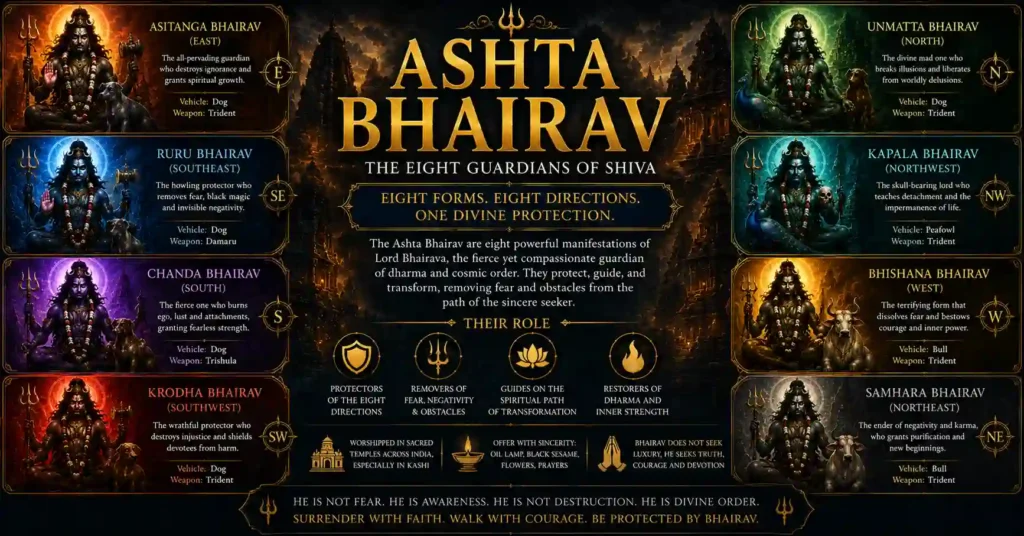
When and How They Are Worshipped
Kala Bhairav Jayanti and every Kalashtami are considered especially auspicious occasions for Bhairava worship.
Many devotees also offer prayers on Sundays, Tuesdays, and during important personal milestones when seeking protection, guidance, or inner strength.
Worship of the Ashta Bhairav is often simple and devotional in nature. Common offerings include:
Oil lamps (deepa)
Black sesame seeds
Flowers
Incense
Fruits and other traditional offerings
Sincere prayers and mantra recitation
Many devotees visit Bhairava temples, perform circumambulation (pradakshina), recite Bhairava stotras, or engage in quiet meditation. The specific rituals may vary according to local customs, temple traditions, and spiritual lineages.
At its heart, Bhairava worship is not centered on elaborate offerings but on sincerity, discipline, and devotion. Devotees approach Bhairava seeking courage, protection, self-awareness, and the strength to face life’s challenges with steadiness and faith. In this sense, Bhairava is believed to value truthfulness and inner transformation more than outward display or luxury.
Conclusion: What Ashta Bhairav Ultimately Teach
The Ashta Bhairav are far more than eight directional guardians. Across Shaiva, Shakta, and Tantric traditions, they represent protection, discipline, transformation, and the preservation of cosmic order.
Whether encountered through temple worship, the Ashta Bhairav Yatra of Kashi, regional traditions, or deeper spiritual teachings, they reveal different dimensions of Bhairava’s role in guiding and protecting seekers.
At a deeper level, the Ashta Bhairav are not eight separate gods demanding eight separate prayers. They are eight expressions of a single divine reality, each reflecting a different aspect of awareness, responsibility, courage, and spiritual growth.
Their presence reminds us that freedom without discipline becomes chaos, and power without wisdom becomes destructive. For those who walk the spiritual path sincerely, Bhairava is not merely a fierce guardian but also a compassionate guide who protects, corrects, and transforms.
To understand the Ashta Bhairav is to understand that spiritual life requires courage as much as compassion, discipline as much as devotion, and self-awareness as much as faith.
Glossary of Important Terms
For readers new to Bhairava traditions, the following terms can help clarify key concepts discussed throughout this article.
| Term | Meaning |
|---|---|
| Ashta Bhairav | The eight principal forms of Bhairava who guard the eight directions of the universe and uphold cosmic order. |
| Bhairava | A fierce and protective manifestation of Lord Shiva associated with time, discipline, protection, and spiritual transformation. |
| Kala Bhairava | The form of Bhairava associated with time (kala), karmic justice, and guardianship. He is often regarded as the chief among Bhairava forms. |
| 64Bhairavas (Chausath Bhairav) | A larger group of Bhairava manifestations traditionally understood as extensions of the eight principal Bhairavas. |
| Ashta Matrikas | Eight mother goddesses associated with Shakti who are often linked with the Ashta Bhairav in Shakta and Tantric traditions. |
| Dikpala | A guardian of a direction. The Ashta Bhairav are often viewed as directional protectors of the cosmos. |
| Kshetrapala | A guardian deity who protects sacred spaces, temples, pilgrimage sites, and spiritual boundaries. |
| Kashi | The sacred city of Varanasi, one of Hinduism’s holiest pilgrimage destinations and an important center of Bhairava worship. |
| Ashta Bhairav Yatra | A pilgrimage in Kashi involving visits to temples associated with the eight Bhairavas. |
| Kalashtami | A sacred observance dedicated to Bhairava, celebrated on the eighth lunar day (Ashtami) of the waning moon. |
| Vahana | The divine vehicle or mount associated with a deity. Each Bhairava is traditionally linked with a specific vahana. |
| Shaiva Tradition | Religious and philosophical traditions centered on the worship of Lord Shiva. |
| Shakta Tradition | Traditions focused on the worship of the Divine Mother, or Shakti, in her various forms. |
| Tantra | A broad family of spiritual traditions that use ritual, meditation, symbolism, and direct experience to facilitate spiritual transformation. |
| Agamas | Sacred scriptures that provide guidance on temple worship, rituals, theology, and spiritual practices within Shaiva, Shakta, and Vaishnava traditions. |
| Vijnana Bhairava Tantra | A revered text of Kashmir Shaivism that presents meditation methods and teachings centered on Bhairava as supreme consciousness. |
| Kashmir Shaivism | A philosophical school of Shaivism that views Bhairava as the ultimate reality and pure consciousness underlying all existence. |
| Dharma | The principle of righteousness, duty, moral order, and harmony that sustains both individual life and the cosmos. |
| Karma | The law of cause and effect through which actions influence future experiences and spiritual development. |
| Sadhana | A disciplined spiritual practice undertaken for inner growth, self-transformation, and realization of the Divine. |
| Japa | The repeated recitation of a mantra, either aloud or mentally, as a form of spiritual practice. |
| Shakti | Divine cosmic energy or power, often personified as the Divine Mother in Hindu traditions. |
| Moksha | Liberation from the cycle of birth and death and realization of one’s true spiritual nature. |
Suggested Reading
The Ashta Bhairav are part of a much broader spiritual tradition connected to Lord Shiva, Bhairava worship, sacred geography, and inner transformation. To deepen your understanding, explore these related articles:
Bhagwan Shiv: The Supreme Consciousness Beyond Creation and Destruction
https://thesanatantales.com/bhagwan-shiv/Bhairav Tattva: Meaning, Symbolism, and the Principle of Truth in Sanatan Dharma
https://thesanatantales.com/bhairav-tattva/Shiva and Bhairav: Meaning, Connection & Spiritual Path
https://thesanatantales.com/shiva-and-bhairav/Kaal Bhairav: Story, Significance, Kashi Kotwal, Worship and Spiritual Meaning
https://thesanatantales.com/kaal-bhairav/Batuk Bhairav: Meaning, Mantra, Puja, Temples, Benefits and Significance
https://thesanatantales.com/batuk-bhairav/Swarnakarshan Bhairav: Meaning, Mantra, Benefits, Wealth & Spiritual Significance
https://thesanatantales.com/swarnakarshan-bhairav/Ashta Bhairava (Wikipedia)
Together, these topics provide a deeper understanding of Bhairava’s role in Sanatan Dharma, from the philosophical foundations of Shiva consciousness to temple worship, sacred traditions, spiritual discipline, and the many forms through which Bhairava guides and protects devotees.
FAQs
Who is Ashta Bhairav?
Ashta Bhairav refers to the eight principal forms of Bhairava, the fierce and protective manifestation of Lord Shiva. Each Bhairava is associated with a specific direction, symbolic quality, and spiritual function. Together, they are regarded as guardians of cosmic order, sacred space, and spiritual discipline within Shaiva and Tantric traditions.
What is the meaning of Ashta Bhairava?
The word Ashta means “eight,” while Bhairava refers to a powerful form of Shiva associated with protection, transformation, and the removal of ignorance. Therefore, Ashta Bhairava means the eight principal manifestations of Bhairava who govern the eight directions and uphold dharma.
Who are the eight Bhairavas?
The eight Bhairavas are:
- Asitanga Bhairava
- Ruru Bhairava
- Chanda Bhairava
- Krodha Bhairava
- Unmatta Bhairava
- Kapala Bhairava
- Bhishana Bhairava
- Samhara Bhairava
Each form represents a unique aspect of spiritual protection, discipline, and inner transformation.
What is the role of Ashta Bhairav?
The Ashta Bhairav are traditionally regarded as guardians of the eight directions. They protect sacred spaces, preserve cosmic balance, and help devotees overcome fear, negativity, attachment, and spiritual obstacles. Their worship emphasizes courage, self-discipline, and spiritual awareness.
Are Ashta Bhairav and Kala Bhairav the same?
Kala Bhairav is considered the chief among Bhairava forms and is closely associated with time, karmic justice, and spiritual discipline. The Ashta Bhairav are eight principal manifestations of Bhairava who function as directional guardians. In many traditions, they are understood to operate under the authority of Kala Bhairav.
What is the connection between Ashta Bhairav and the 64 Bhairavas?
Many Bhairava traditions describe the sixty-four Bhairavas as expansions of the eight principal Bhairavas. According to this understanding, each Ashta Bhairava presides over a group of eight Bhairavas, creating the broader system of sixty-four forms found in various tantric and regional traditions.
What is the relationship between Ashta Bhairav and the Ashta Matrikas?
In Shakta and Tantric traditions, the Ashta Bhairav are often associated with the Ashta Matrikas, the eight divine mother goddesses. Together they symbolize the complementary relationship between Shiva and Shakti, representing protection, transformation, and the maintenance of cosmic order.
Which day is considered auspicious for Ashta Bhairav worship?
Kalashtami, the eighth lunar day of the waning moon, is widely regarded as one of the most important observances for Bhairava worship. Many devotees also offer prayers to Bhairava on Sundays, Tuesdays, and during Kala Bhairav Jayanti.
Can anyone worship Ashta Bhairav?
Yes. Simple devotional worship through prayer, lamps, mantra recitation, and sincere remembrance is open to all devotees. However, advanced tantric practices traditionally require proper guidance from a qualified teacher or lineage.
Why is the dog associated with Bhairava?
The dog is traditionally regarded as Bhairava’s vahana (vehicle). It symbolizes loyalty, alertness, protection, and the ability to perceive what is hidden. In many Bhairava temples, feeding dogs is considered an act of devotion and compassion.
Are Ashta Bhairav worshipped only in Tantra?
No. Although Bhairava occupies an important place in Tantric traditions, he is also widely worshipped through temple rituals, pilgrimage traditions, devotional practices, and mainstream Shaiva worship across India and Nepal.
What do the eight directions symbolize in Ashta Bhairava worship?
The eight directions represent the complete protection of the cosmos. On a spiritual level, they also symbolize different aspects of human growth, awareness, discipline, courage, transformation, and the journey toward higher consciousness.
Glossary of Important Terms
| Term | Meaning |
|---|---|
| Ashta Bhairav | The eight principal forms of Bhairava who guard the eight directions and uphold cosmic order. |
| Bhairava | A fierce yet protective manifestation of Lord Shiva associated with discipline, protection, transformation, and spiritual awakening. |
| Kala Bhairava | The form of Bhairava associated with time (Kala), karmic justice, and cosmic order. He is regarded as the chief among Bhairava forms. |
| Asitanga Bhairava | The eastern guardian among the Ashta Bhairav, representing wisdom, purity, and spiritual clarity. |
| Ruru Bhairava | The southeast guardian associated with knowledge, disciplined learning, and righteous guidance. |
| Chanda Bhairava | The southern guardian symbolizing courage, determination, and decisive action. |
| Krodha Bhairava | The southwest guardian who represents the transformation of anger and negativity into spiritual strength. |
| Unmatta Bhairava | The western guardian associated with freedom from ego, attachment, and limited thinking. |
| Kapala Bhairava | The northwest guardian linked with karma, self-reflection, accountability, and impermanence. |
| Bhishana Bhairava | The northern guardian representing fearlessness, resilience, and divine protection. |
| Samhara Bhairava | The northeast guardian associated with dissolution, transformation, and spiritual renewal. |
| Chausath Bhairav (64 Bhairavas) | Sixty-four manifestations of Bhairava traditionally understood as extensions of the eight principal Bhairavas. |
| Ashta Matrikas | The eight divine mother goddesses associated with Shakti and often paired with the Ashta Bhairav in Tantric traditions. |
| Dikpala | A directional guardian deity responsible for protecting a specific direction of the cosmos. |
| Kshetrapala | A guardian deity who protects temples, sacred spaces, pilgrimage sites, and spiritual boundaries. |
| Kashi (Varanasi) | One of Hinduism’s holiest cities and a major center of Bhairava worship, especially the Ashta Bhairav tradition. |
| Ashta Bhairav Yatra | A sacred pilgrimage in Kashi involving visits to temples associated with the eight Bhairavas. |
| Kalashtami | A sacred observance dedicated to Bhairava, celebrated on the Ashtami (eighth lunar day) of the waning moon. |
| Vahana | The divine vehicle or mount associated with a deity. Each Bhairava has a traditional vahana. |
| Shaivism | A major Hindu tradition centered on the worship of Lord Shiva as the Supreme Reality. |
| Shaktism | A Hindu tradition focused on the worship of the Divine Mother (Shakti) in her various forms. |
| Tantra | A spiritual tradition that uses rituals, meditation, mantras, and symbolism for transformation and realization. |
| Agamas | Sacred scriptures that guide temple worship, rituals, theology, and spiritual practices in Hindu traditions. |
| Rudrayamala Tantra | An important Tantric text associated with Bhairava worship and esoteric Shaiva practices. |
| Vijnana Bhairava Tantra | A revered scripture of Kashmir Shaivism presenting meditation techniques and teachings on supreme consciousness. |
| Kashmir Shaivism | A philosophical school of Shaivism that views Bhairava as the ultimate reality and pure consciousness. |
| Dharma | The principle of righteousness, duty, moral order, and harmony that sustains life and the universe. |
| Karma | The law of cause and effect through which actions influence future experiences and spiritual growth. |
| Sadhana | A disciplined spiritual practice undertaken for self-transformation and realization of the Divine. |
| Japa | The repeated chanting or mental recitation of a mantra as a spiritual discipline. |
| Shakti | Divine cosmic energy or power, often worshipped as the Divine Mother. |
| Moksha | Liberation from the cycle of birth and death and realization of one’s true spiritual nature. |
| Pradakshina | The act of circumambulating a temple, shrine, or sacred object as an expression of devotion. |
| Kotwal of Kashi | A title given to Kala Bhairava, recognizing him as the divine guardian and protector of Varanasi. |
| Mantra | A sacred sound, word, or phrase repeated during worship and meditation for spiritual growth. |
About the Author
Yateendra Chaturvedi is a spiritual writer, researcher, devotee, and the founder of The Sanatan Tales. With over 35 years of professional experience and a lifelong interest in Sanatan Dharma, he writes about Hindu deities, temples, scriptures, festivals, Mahavidyas, sacred stories, rituals, and living traditions that continue to guide and inspire devotees across India.
Drawing from traditional scriptures, regional beliefs, temple traditions, devotional literature, and historical sources, he aims to present authentic, well-researched, and easy-to-understand content for modern readers. His work focuses on preserving spiritual wisdom, explaining sacred traditions, and helping seekers develop a deeper understanding of India’s rich spiritual heritage.
Through The Sanatan Tales, Yateendra strives to make the timeless teachings of Sanatan Dharma simple, meaningful, and relevant for today’s generation while maintaining respect for traditional sources, regional practices, and diverse spiritual perspectives.
Learn More About Yateendra Chaturvedi →
https://thesanatantales.com/about-the-author/
References & Sources
This article is based on Shaiva and Bhairava traditions followed within Sanatan Dharma, traditional beliefs associated with Lord Bhairava, religious narratives, folk traditions, and insights gathered from various spiritual and religious study sources. Some concepts discussed in this article are also inspired by interpretations found in guru-disciple lineages, temple traditions, and devotional literature.
Note: Beliefs, stories, and methods of worship related to Lord Bhairava may differ across regions, sects, and spiritual traditions. The purpose of this article is not to present any single viewpoint as the absolute truth, but to explain commonly accepted religious and spiritual perspectives in a simple and accessible manner.
Explore More Fascinating Topics from Sanatan Dharma


Thanks a lot
Thank you