For centuries, the Mahalaxmi Temple Kolhapur has been revered as the eternal abode of Goddess Ambabai, drawing millions of devotees seeking prosperity, protection, and inner peace.
It is a living centre of faith where devotees believe Goddess Mahalaxmi, lovingly worshipped as Shree Ambabai, resides eternally.
Unlike many temples associated with divine appearances, this revered shrine is regarded as the permanent abode of the Divine Mother, drawing millions of pilgrims seeking prosperity, protection, and inner peace.
For centuries, Kolhapur has been honoured as Dakshin Kashi, one of the holiest pilgrimage destinations in Maharashtra and an important Shakti Peetha of Sanatan Dharma.
While the present stone temple dates to the 12th century, historical evidence suggests that worship at this sacred site has continued since much earlier, reflecting its enduring spiritual significance.
Today, the Kolhapur Mahalaxmi Temple remains a cherished destination for devotees from across India. Whether visiting for darshan, festivals, or spiritual reflection, pilgrims experience a tradition where faith, history, and living devotion come together in the divine presence of Ambabai.
Mahalaxmi Temple Kolhapur at a Glance
| Quick Fact | Details |
|---|---|
| Location | Kolhapur, Maharashtra, India |
| Presiding Deity | Goddess Mahalaxmi (Shree Ambabai) |
| Also Known As | Ambabai Temple |
| Temple Type | Shakti Peetha |
| Historical Period | Present structure mainly dates to the 11th-12th century CE |
| Architectural Style | Western Chalukya with later Hemadpanthi influences |
| Famous For | Kirnotsav, west-facing idol, royal alankar, and living Shakti tradition |
| Darshan Timings | 5:00 AM to 10:00 PM (subject to change on festival days) |
| Best Time to Visit | October to February; early mornings for a peaceful darshan |
| Nearest Railway Station | Chhatrapati Shahu Maharaj Terminus, Kolhapur (about 3 km) |
| Nearest Airport | Kolhapur Airport (about 10 km) |
Table of Contents
ToggleWhy Mahalaxmi Temple Kolhapur is Ambabai's Eternal Abode
According to the Karavira Mahatmya, a revered text traditionally associated with the Skanda Purana, the sacred land of Kolhapur was once ruled by the powerful demon Kolhasur, whose tyranny brought suffering to people, sages, and even the gods.
To restore peace, Goddess Mahalaxmi, worshipped here as Shree Ambabai, descended to earth and defeated Kolhasur after a fierce battle. Before his death, the demon sought two final boons.
He requested that the land be named after him and that the Goddess remain there forever to bless its people.
Temple tradition holds that the Goddess compassionately granted both wishes. The region came to be known as Kolhapur, while Ambabai chose to make it her eternal abode.
This belief makes the Mahalaxmi Temple Kolhapur unique among many sacred shrines, as devotees believe the Divine Mother continues to reside here permanently rather than returning to the heavenly realms after granting blessings.
For this reason, the Kolhapur Shakti Peetha is regarded not only as a place of worship but as the living home of Goddess Ambabai, where devotees seek her blessings for prosperity, protection, and spiritual well-being.
Why Mahalaxmi Temple Kolhapur is a Shakti Peetha
The Mahalaxmi Temple Kolhapur is revered as one of the 18 Maha Shakti Peethas, making it one of the most sacred pilgrimage destinations dedicated to the Divine Mother.
According to the Devi Bhagavata Purana and other Shakta traditions, Shakti Peethas were established at places where the body parts or ornaments of Goddess Sati fell after Lord Shiva wandered the universe carrying her body in grief.
Temple tradition identifies Kolhapur as the sacred place where Goddess Sati’s eyes are believed to have fallen, although different scriptures and regional traditions mention varying body parts or sacred associations.
Regardless of these variations, devotees have worshipped Goddess Mahalaxmi here for centuries as the eternal embodiment of Adi Shakti, the Supreme Divine Mother.
Unlike many other Shakti Peethas that commemorate a sacred event from the past, the Mahalaxmi Temple Kolhapur is unique because devotees believe Shree Ambabai continues to reside here permanently, blessing those who seek her grace.
This enduring belief makes the temple not only a revered Shakti Peetha but also one of the most important centres of Shakta worship in India.
Today, pilgrims from across the country visit this sacred shrine to seek the blessings of Goddess Mahalaxmi for prosperity, protection, wisdom, and spiritual well-being.
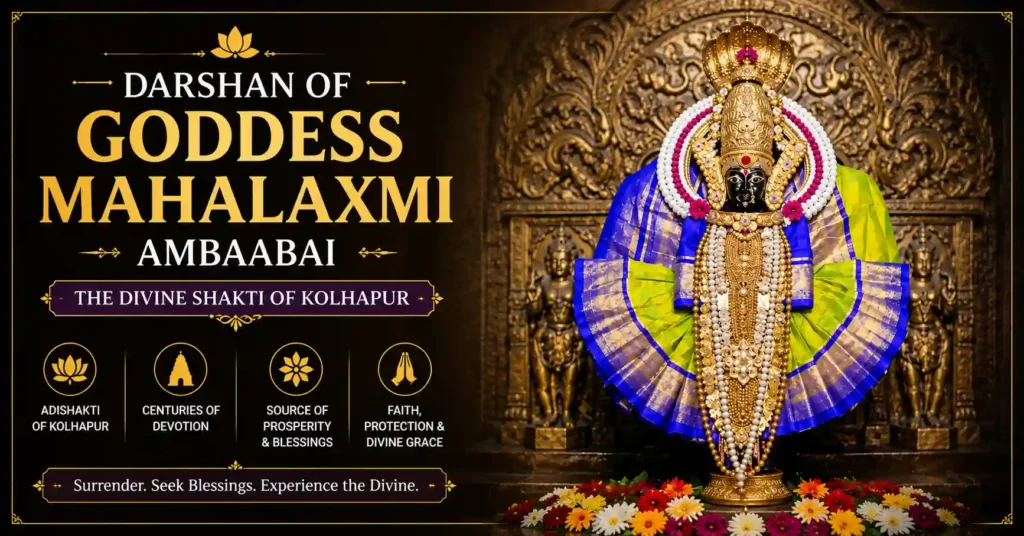
History and Architecture of Mahalaxmi Temple Kolhapur
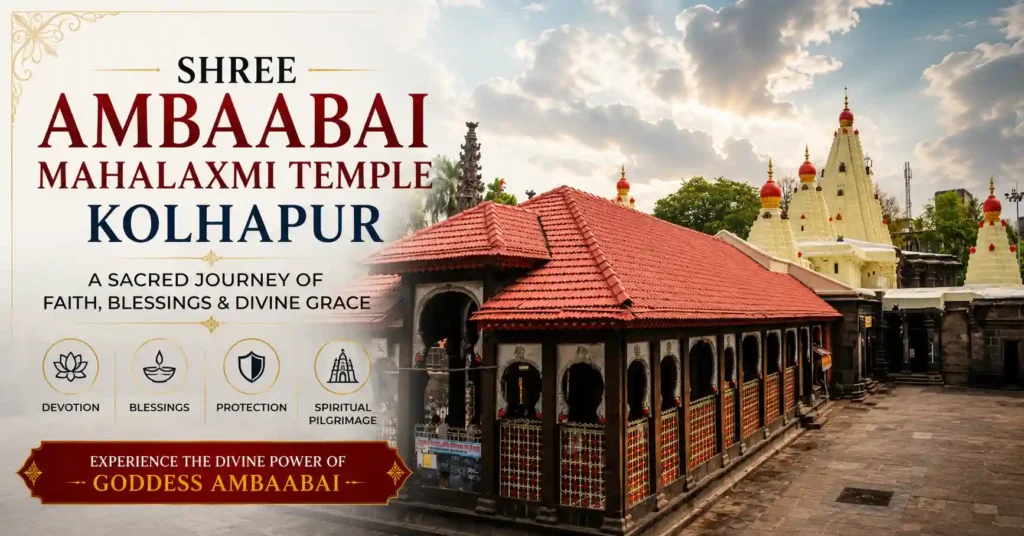
The Mahalaxmi Temple Kolhapur has a history that spans well over a thousand years.
While the present stone structure is generally attributed to the Western Chalukya dynasty (11th-12th century CE), inscriptions and literary references suggest that worship at this sacred site was already established by the 7th century, making it one of Maharashtra’s oldest living pilgrimage centres.
The temple primarily reflects the Western Chalukya architectural style, with later additions showing elements associated with Hemadpanthi craftsmanship.
Built from durable black basalt stone, its massive blocks were carefully interlocked with remarkable precision, allowing the structure to stand strong for centuries without relying extensively on mortar.
The temple walls are richly decorated with intricate carvings of deities, celestial figures, and sculptures believed to include Yoginis and Jain Tirthankaras, reflecting the artistic excellence and religious diversity of medieval India.
Over the centuries, rulers including Chhatrapati Shivaji Maharaj, Queen Tarabai, and other Maratha patrons supported and protected the temple, helping preserve its traditions and ensuring that worship continued uninterrupted.
Today, the architecture of the Kolhapur Mahalaxmi Temple stands as more than a masterpiece of medieval craftsmanship. It is a living symbol of centuries of devotion, royal patronage, and the enduring spiritual heritage of Sanatan Dharma.
The West-Facing Idol of Mahalaxmi Temple Kolhapur and Its Symbolism
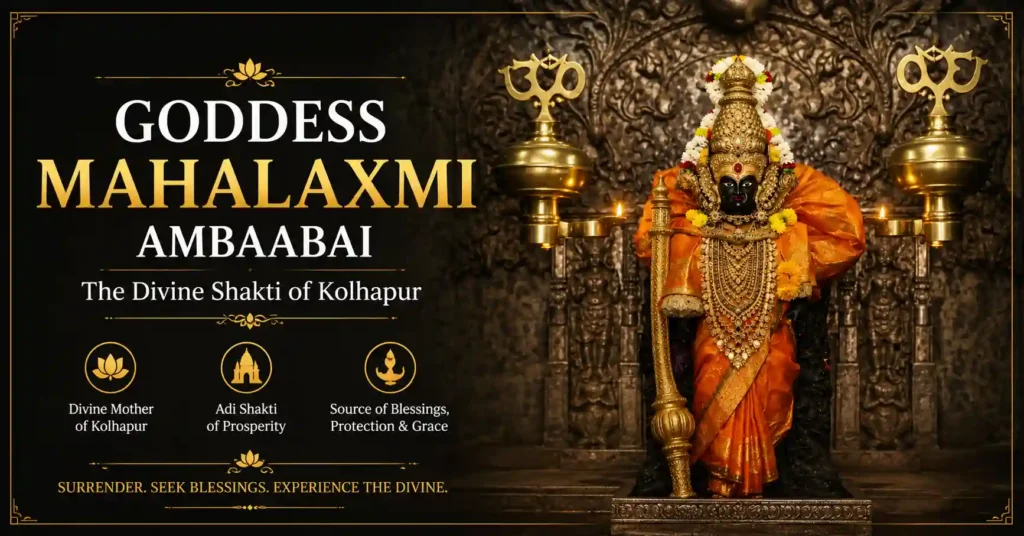
One of the most distinctive features of the Mahalaxmi Temple Kolhapur is its west-facing (Pashchim Abhimukh) idol, a rare orientation among Hindu temples.
According to temple tradition, this direction symbolises Goddess Mahalaxmi’s constant watch over the land and her devotees, reflecting her role as the eternal protector of Karveer (Kolhapur).
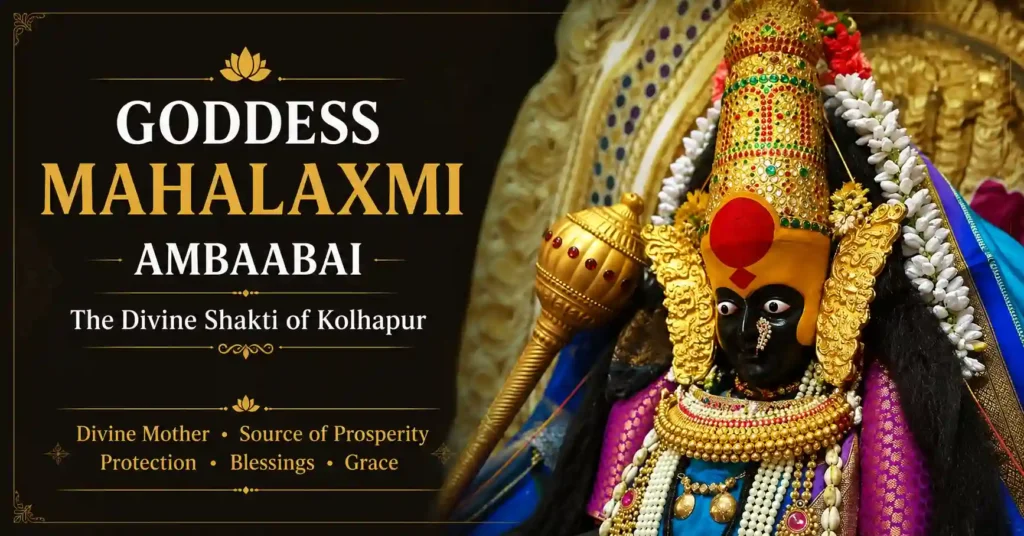
The approximately three-foot-tall black stone idol of Shree Ambabai is rich in symbolism. In her four hands, the Goddess holds:
- Kaumodaki (mace), representing divine strength and the power to protect righteousness.
- Matulinga (citron fruit), symbolising prosperity, abundance, and fertility.
- Khetaka (shield), signifying protection from obstacles and negative forces.
- Panpatra (bowl), representing compassion, nourishment, and the blessings she bestows upon her devotees.
Adding to the spiritual symbolism, her crown bears a five-headed Sheshnag and a Shiva Linga, beautifully expressing the inseparable unity of Shakti and Shiva as well as the harmony between the Vaishnava and Shaiva traditions.
Directly above the sanctum stands another shrine dedicated to Lord Shiva with Nandi, reinforcing this timeless spiritual connection.
For devotees visiting the Kolhapur Mahalaxmi Temple, every aspect of Ambabai’s divine form carries a deeper meaning.
Her west-facing presence, sacred attributes, and serene expression inspire faith, courage, protection, and inner strength, making darshan a deeply spiritual experience rather than simply a ritual visit.
Vajralepa: Preserving the Sacred Idol of Mahalaxmi Temple Kolhapur
The sacred idol of Shree Ambabai at the Mahalaxmi Temple Kolhapur is protected by Vajralepa, an ancient protective coating traditionally prepared from herbal ingredients, natural resins, and minerals.
This time-honoured layer helps preserve the black stone idol from gradual wear caused by centuries of daily Abhishek rituals performed with water, milk, and Panchamrit.
Over the years, the temple has also undertaken careful conservation to protect this priceless spiritual and cultural heritage. Conservation experts, including specialists associated with the Archaeological Survey of India (ASI), have assisted in preserving the idol using methods that respect both its historical significance and the temple’s uninterrupted ritual traditions.
The continued preservation of Ambabai’s sacred idol reflects a harmonious blend of ancient temple practices and modern conservation, ensuring that future generations of devotees can experience the same divine presence that has inspired pilgrims for centuries.
The Five Sacred Shikhars of Mahalaxmi Temple Kolhapur
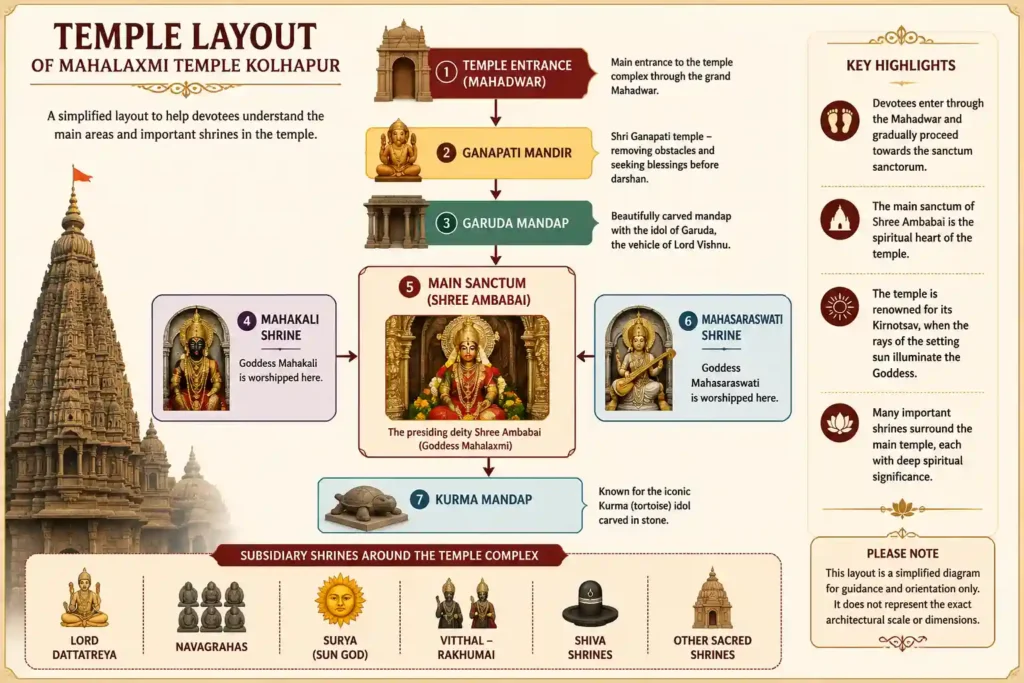
The Mahalaxmi Temple Kolhapur complex is crowned by five prominent shikhars (temple towers), each marking an important shrine within the sacred complex.
Together, they reflect the temple’s rich architectural heritage and the integrated worship of different forms of the Divine.
The five principal shikhars are dedicated to:
- The central shikhar above the sanctum of Goddess Mahalaxmi (Shree Ambabai).
- The northern shrine of Goddess Mahakali, representing divine power and protection.
- The southern shrine of Goddess Mahasaraswati, symbolising wisdom and knowledge.
- The eastern Ganapati Mandir, where devotees traditionally offer prayers before entering the main shrine.
- The Koorma Mandap shikhar, associated with the temple’s sacred assembly hall and the symbolic stability of Kurma, the tortoise incarnation of Lord Vishnu.
This thoughtfully planned temple layout reflects the harmonious worship of Shakti, wisdom, protection, and auspicious beginnings.
As pilgrims move through the temple complex, they experience a spiritual journey that extends beyond the main sanctum, making the Kolhapur Mahalaxmi Temple a complete centre of devotion rather than a shrine dedicated to a single deity.
Darshan Timings, Dress Code and Visitor Guidelines at Mahalaxmi Temple Kolhapur
Planning your visit to the Mahalaxmi Temple Kolhapur is easier when you know the temple timings and visitor guidelines in advance. The temple welcomes thousands of devotees every day for darshan of Shree Ambabai. While the schedule generally remains consistent throughout the year, timings and arrangements may change during major festivals and special religious occasions.
Visitor Information
| Information | Details |
|---|---|
| Darshan Timings | 5:00 AM to 10:00 PM (subject to change during festivals and special occasions) |
| Entry Fee | Free for general darshan |
| Special Darshan & Seva | Online booking is available for selected sevas and Abhishek through the official temple website |
| Dress Code | Modest and traditional attire is recommended, such as sarees, salwar-kameez, dhotis, or kurta-pyjamas |
| Footwear | Must be removed before entering the temple premises |
| Best Time for Darshan | Early morning on weekdays for a quieter and more peaceful experience |
| Accessibility | Basic facilities are available for senior citizens and differently abled visitors |
Visitors are expected to maintain the sanctity of the temple by following the queue system, respecting temple customs, and cooperating with temple authorities during their visit.
If you plan to participate in a special Abhishek or seva, it is advisable to make your booking in advance, especially during Navratri, Kirnotsav, and other major festivals when the temple receives a large number of pilgrims.
Note: Temple timings, seva schedules, and visitor guidelines may change on festival days or due to administrative requirements. Always check the official temple website before planning your pilgrimage.
Temple Etiquette and Important Guidelines for Devotees
Visiting the Mahalaxmi Temple Kolhapur is both a spiritual and cultural experience. Following the temple’s customs helps maintain its sanctity and ensures a smooth darshan for everyone.
| Guideline | Details |
|---|---|
| Dress Modestly | Wear clean and modest clothing suitable for a place of worship. Traditional Indian attire is preferred, though respectful attire is welcome for all visitors. |
| Remove Footwear | Shoes and slippers must be removed before entering the temple premises. |
| Maintain Silence | Speak softly and maintain a peaceful atmosphere, especially near the sanctum. |
| Follow the Queue | Join the designated darshan queue and follow instructions from temple staff and volunteers. |
| Photography | Photography and videography may be restricted inside certain areas of the temple. Follow the instructions displayed on the premises. |
| Offerings | Present flowers, kumkum, coconuts, or other offerings only at the designated counters or as directed by temple authorities. |
| Keep the Temple Clean | Dispose of waste responsibly and help preserve the cleanliness of the temple complex. |
Respecting these simple guidelines allows every devotee to experience a peaceful darshan while preserving the sacred traditions that have been followed at the temple for centuries.
Daily Aarti Schedule and Temple Rituals at Mahalaxmi Temple Kolhapur
Daily worship at the Mahalaxmi Temple Kolhapur follows a centuries-old tradition maintained by hereditary priests, ensuring that the rituals are performed according to established temple customs.
From the early morning awakening of the Goddess to the night ceremonies, each ritual reflects the temple’s living spiritual heritage and offers devotees different opportunities to participate in worship.
Daily Aarti and Puja Schedule
| Ritual | Approximate Time | Significance |
|---|---|---|
| Kakada Aarti | 5:30 AM | The first aarti of the day, performed to awaken Goddess Ambabai and begin the day’s worship. |
| Morning Mahapuja | 8:30 AM | A special worship ceremony with offerings and Vedic prayers seeking the Goddess’s blessings. |
| Alankar Pooja | 1:30 PM | The Goddess is adorned with beautiful ornaments and traditional decorations before devotees. |
| Friday Palakhi Ceremony | 9:30 PM | A ceremonial procession held on Friday evenings, a particularly auspicious day dedicated to Goddess Mahalaxmi. |
Suggested Darshan Sequence at Mahalaxmi Temple Kolhapur
A visit to the Mahalaxmi Temple Kolhapur is more than simply offering prayers at the main sanctum. Many devotees follow a traditional sequence of worship that allows them to experience the temple’s spiritual significance in its entirety.
While there is no compulsory order prescribed by the temple, the following sequence is commonly observed by pilgrims.
- Begin with Lord Ganapati by offering prayers for an obstacle-free pilgrimage before proceeding towards the main shrine.
- Seek the blessings of Goddess Mahalaxmi (Shree Ambabai) in the sanctum. Devotees traditionally offer flowers, kumkum, coconuts, or other sacred offerings while praying for prosperity, protection, and family well-being.
- Visit the shrines of Goddess Mahakali and Goddess Mahasaraswati, completing the worship of the three principal manifestations of Divine Shakti represented within the temple complex.
- Offer prayers at the subsidiary shrines, including those dedicated to Lord Dattatreya, the Navagrahas, Surya, Vitthal-Rakhumai, and other deities according to your personal devotion.
- Complete your visit with Pradakshina (circumambulation) of the temple, where permitted, and spend a few quiet moments in prayer or meditation before leaving. Many devotees consider this a time to express gratitude and reflect on the blessings received during their darshan.
Following this traditional sequence allows pilgrims to appreciate not only the sanctity of Shree Ambabai but also the temple’s rich spiritual heritage, where multiple forms of the Divine are worshipped together in harmony.
Puja, Abhishek and Seva Offerings at Mahalaxmi Temple Kolhapur
Devotees visiting the Mahalaxmi Temple Kolhapur can participate in a variety of pujas, abhisheks, and sevas to seek the blessings of Shree Ambabai. These sacred offerings allow devotees to express their devotion, pray for prosperity, family well-being, and spiritual growth.
Popular Sevas
| Seva | Purpose |
|---|---|
| Panchamrut Abhishek | Ritual bathing of the Goddess with Panchamrit as an act of devotion and purification. |
| Mahabhishek | A special ceremonial worship performed with Vedic mantras and sacred offerings. |
| Shrungar Puja | Worship of the beautifully adorned form of Goddess Ambabai. |
| Maha Shrungar Seva | A more elaborate form of Shrungar Puja with special decorations and offerings. |
| Kumkumarchana | Offering of kumkum while chanting the names of the Goddess, commonly performed for prosperity, peace, and family welfare. |
What to Offer at Mahalaxmi Temple Kolhapur
Offering simple items with devotion is an important part of worship at the Mahalaxmi Temple Kolhapur. While no offering is compulsory, devotees traditionally present items associated with Goddess Mahalaxmi as a symbol of gratitude and prayer.
The most common offerings include:
| Offering | Spiritual Significance |
|---|---|
| Kumkum | Symbolises auspiciousness, divine energy, and the blessings of Goddess Lakshmi. |
| Fresh Flowers | Offered as an expression of devotion, purity, and reverence. |
| Coconut | Represents surrender of the ego and a prayer for success and well-being. |
| Saree or Chunari | Many devotees offer traditional garments as a mark of respect to Goddess Ambabai. |
| Fruits and Sweets | Offered as Naivedya before being distributed as Prasad. |
Many devotees also pray for prosperity, harmony in family life, good health, and spiritual growth while making their offerings. The temple provides facilities for receiving offerings in an orderly manner, and devotees are encouraged to follow the guidance of the temple authorities during busy periods.
More than the value of the offering, Sanatan Dharma teaches that faith, humility, and sincere devotion are what truly please the Divine Mother.
Kirnotsav at Mahalaxmi Temple Kolhapur: Where Science Meets Spirituality
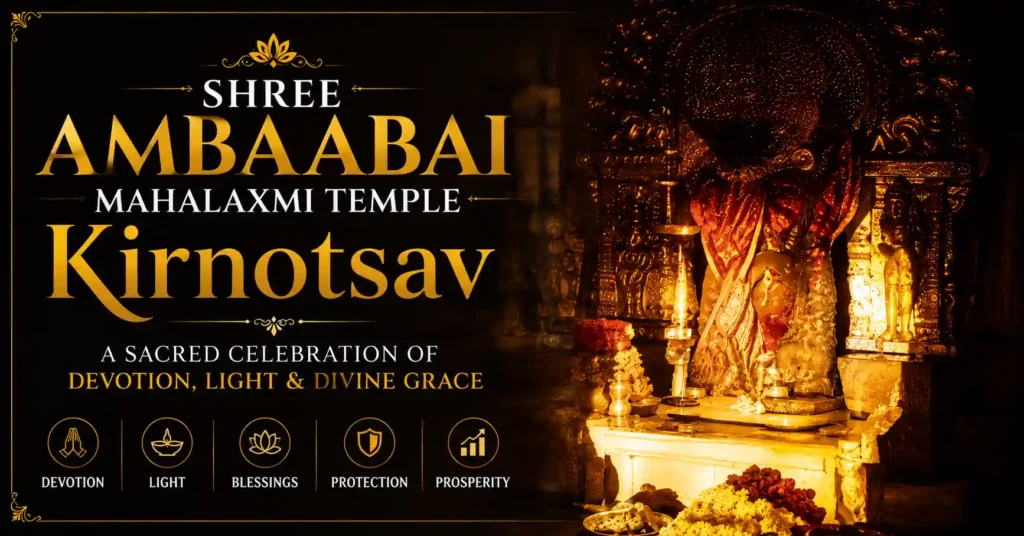
One of the most remarkable traditions of the Mahalaxmi Temple Kolhapur is Kirnotsav, a rare astronomical event celebrated twice each year. During this festival, the rays of the setting sun pass through the Mahadwar, Garuda Mandap, and the inner halls before illuminating the idol of Shree Ambabai in the sanctum.
This extraordinary alignment takes place over three consecutive days. On the first day, the sunlight falls on the Goddess’s feet, on the second day it reaches her waist, and on the third day it illuminates her face. The event showcases the exceptional architectural precision and astronomical knowledge of the temple’s medieval builders.
According to temple tradition, Kirnotsav symbolises the Sun God offering his respects to Goddess Mahalaxmi. For devotees, witnessing this sacred moment is considered highly auspicious, as it beautifully unites devotion with the rhythms of nature.
Kirnotsav 2027 Dates
| Kirnotsav | Dates | Sunlight Falls On |
|---|---|---|
| Uttarayana Kirnotsav | 31st January,1st February & 2 February 2027 | Feet, waist (midsection), and face of Goddess Ambabai over three consecutive days |
| Dakshinayana Kirnotsav | 9, 10 & 11 November 2027 | Feet, waist (midsection), and face of Goddess Ambabai over three consecutive days |
The 2027 Kirnotsav is expected to follow the temple’s traditional schedule, though devotees should confirm the final dates and timings with the temple authorities before planning their pilgrimage, as sunset timings and administrative arrangements may vary.
The unique alignment of sunlight and the temple’s sacred design makes Kirnotsav one of India’s finest examples of how spirituality, architecture, and astronomy come together in a living tradition.
Did You Know?
- The Mahalaxmi Temple Kolhapur is one of the few temples in India where devotees believe Goddess Ambabai resides permanently, rather than appearing only during specific occasions.
- During Kirnotsav, the rays of the setting sun illuminate the Goddess’s feet, waist, and face over three consecutive days through a remarkable architectural alignment.
- The temple’s west-facing idol is a rare feature among Hindu temples and is traditionally associated with the Goddess’s role as the protector of Karveer (Kolhapur).
- According to a long-standing tradition, Tirumala Tirupati Devasthanams (TTD) offers a silk saree to Goddess Ambabai during Dussehra, symbolising the sacred bond between Tirumala and Kolhapur.
Festivals and Special Worship at Mahalaxmi Temple Kolhapur
Throughout the year, the Mahalaxmi Temple Kolhapur comes alive with vibrant festivals and sacred rituals that attract thousands of devotees from across India.
These celebrations reflect the temple’s living traditions and offer pilgrims a unique opportunity to experience the devotion, music, processions, and rituals associated with Shree Ambabai.
Major Festivals and Observances
| Festival / Occasion | Significance |
|---|---|
| Navratri | The temple’s most important festival, celebrated with special alankar (adornment), devotional music, cultural programmes, and the nightly Palakhi (palanquin) procession of Goddess Ambabai. |
| Rathotsav (Chaitra Purnima) | A grand procession in which the Goddess is taken through the city in a beautifully decorated silver chariot, drawing thousands of devotees. |
| Fridays | Considered especially auspicious for the worship of Goddess Mahalaxmi. Many devotees, particularly women, observe Lakshmi Vrat, offer kumkum, and pray for prosperity, harmony, and family well-being. |
| Amavasya and Purnima | New Moon and Full Moon days witness increased footfall, with devotees performing special prayers and seeking the blessings of Ambabai. |
The Sacred Connection Between Tirupati and Mahalaxmi Temple Kolhapur
According to temple tradition, a pilgrimage to Tirumala Tirupati is considered spiritually complete only after seeking the blessings of Goddess Ambabai at the Mahalaxmi Temple Kolhapur.
This belief is rooted in the well-known legend of Sage Bhrigu, whose actions led Goddess Lakshmi to leave Vaikuntha and make Kolhapur her eternal abode, while Lord Vishnu manifested as Lord Venkateswara at Tirumala, awaiting her return.
This sacred connection continues to be honoured even today. As a mark of respect and devotion, the Tirumala Tirupati Devasthanams (TTD) traditionally presents a silk saree to Goddess Ambabai during Dussehra, symbolising the enduring bond between these two revered pilgrimage centres.
For many devotees, visiting both temples represents the divine union of Lord Vishnu and Goddess Lakshmi, making the pilgrimage spiritually complete and deeply meaningful.
Sacred Layout and Inner Shrines of Mahalaxmi Temple Kolhapur
According to temple tradition and the interpretation of some scholars, the Mahalaxmi Temple Kolhapur is designed around the principles of the Shri Yantra, a sacred geometric diagram that symbolises the Divine Mother and the harmonious union of the material and spiritual worlds. While this interpretation is rooted in tradition, it adds to the temple’s deep spiritual significance for many devotees.
Within the temple, the Garuda Mandap serves as a gathering place for devotees before entering the sanctum, while the Kurma Mandap, associated with Kurma, the tortoise incarnation of Lord Vishnu, symbolises steadiness, patience, and spiritual grounding on the path of devotion.
The temple complex also houses more than 80 subsidiary shrines, dedicated to deities such as Mahakali, Mahasaraswati, the Navagrahas, Surya, Vitthal-Rakhumai, and Lord Dattatreya. Many pilgrims visit these shrines as part of their darshan, recognising the temple as a sacred centre where multiple traditions of Sanatan Dharma are honoured within a single pilgrimage.
The Chaugula Tradition at Mahalaxmi Temple Kolhapur
One of the distinctive living traditions of the Mahalaxmi Temple Kolhapur is the role of the Chaugulas, hereditary families who have served the temple for generations. Historically, they were entrusted with protecting the temple, safeguarding its valuables, and assisting in the smooth conduct of important religious ceremonies.
Today, the Chaugulas continue to play an important ceremonial role during major festivals, especially the Friday Palakhi procession and other significant temple celebrations. Their continued service reflects the temple’s rich cultural heritage and preserves a tradition that has been passed down through generations.
For devotees, the Chaugula tradition is a reminder that the Kolhapur Mahalaxmi Temple is not only an ancient place of worship but also a living institution where centuries-old customs continue to thrive.
Royal Alankar and Sacred Jewellery of Mahalaxmi Temple Kolhapur
The Mahalaxmi Temple Kolhapur is renowned for the magnificent alankar (sacred adornment) of Goddess Ambabai. On special occasions and major festivals, the Goddess is beautifully decorated with traditional ornaments, reflecting centuries of devotion and royal patronage.
Among the most cherished ornaments are the Kolhapuri Saaj, a traditional Maharashtrian necklace symbolising prosperity and protection, the Putalya Haar, crafted with small gold pendants, and the elegant Thushi necklace, known for its closely woven gold beads. Many of these ornaments were gifted over the centuries by Maratha rulers, noble families, and devoted worshippers as offerings of gratitude and faith.
These sacred ornaments are more than precious jewellery. They represent the enduring devotion of generations of devotees and form an important part of the temple’s living traditions. Witnessing the royal alankar of Goddess Ambabai during festivals such as Navratri and Dussehra is considered a deeply memorable experience for pilgrims visiting the Kolhapur Mahalaxmi Temple.
How to Reach Mahalaxmi Temple Kolhapur
The Mahalaxmi Temple Kolhapur is located in the heart of Kolhapur city, Maharashtra, and is well connected by road, rail, and air. Whether you are travelling from Maharashtra, Karnataka, Goa, or other parts of India, reaching the temple is convenient.
Local transport such as auto-rickshaws, taxis, and city buses are easily available from the railway station, airport, and bus stand.
Distance from Major Cities
| City | Approximate Distance | Estimated Travel Time |
|---|---|---|
| Kolhapur Railway Station | 3 km | 10–15 minutes |
| Kolhapur Airport | 10 km | 20–25 minutes |
| Sangli | 50 km | 1–1.5 hours |
| Satara | 125 km | 2–2.5 hours |
| Belagavi (Belgaum) | 115 km | 2–2.5 hours |
| Pune | 230 km | 4.5–5 hours |
| Panaji (Goa) | 230 km | 4.5–5 hours |
| Mumbai | 375 km | 7–8 hours |
| Solapur | 300 km | 5.5–6 hours |
| Hyderabad | 540 km | 9–10 hours |
| Bengaluru | 610 km | 10–11 hours |
Travel Information
| Mode of Transport | Details |
|---|---|
| By Rail | Chhatrapati Shahu Maharaj Terminus (Kolhapur Railway Station) is approximately 3 km from the temple. The station is well connected to Mumbai, Pune, Bengaluru, Hyderabad, Tirupati, Nagpur, and other major cities. Auto-rickshaws and taxis are readily available outside the station. |
| By Air | Kolhapur Airport is about 10 km from the temple. Regular flights connect Kolhapur with cities such as Bengaluru, Hyderabad, and Mumbai (subject to airline schedules). Taxis are available at the airport. |
| By Road | Kolhapur enjoys excellent road connectivity through National Highway 48 (NH-48). Frequent Maharashtra State Transport (MSRTC) buses and private coaches operate from Pune, Mumbai, Belagavi, Goa, Sangli, Satara, and other nearby cities. |
Local Transportation
After reaching Kolhapur, devotees can easily travel to the temple using:
- Auto-rickshaws, available throughout the city.
- Taxi and app-based cab services for convenient travel.
- City buses, which connect the temple with major parts of Kolhapur.
- Many hotels and dharamshalas are located within walking distance or a short drive from the temple.
Nearby Places to Visit
If you are planning a longer pilgrimage or family trip, consider visiting these nearby attractions:
| Place | Distance from Temple | Significance |
|---|---|---|
| Jyotiba Temple | 18 km | Revered temple dedicated to Lord Jyotiba, an incarnation of Shiva. |
| Rankala Lake | 2 km | A scenic historic lake and popular evening destination for pilgrims. |
| Panhala Fort | 22 km | Historic Maratha fort closely associated with Chhatrapati Shivaji Maharaj. |
| New Palace Museum | 3 km | Former royal residence showcasing Maratha history and artefacts. |
| Shalini Palace | 4 km | Beautiful heritage palace overlooking Rankala Lake. |
Travel Tip: The best time to visit the Mahalaxmi Temple Kolhapur is early in the morning on weekdays, when crowds are relatively smaller. During Navratri, Kirnotsav, Fridays, and other major festivals, the temple receives a large number of devotees, so plan your journey and accommodation in advance.
Google Map of Mahalaxmi Temple Kolhapur
Planning your journey to the Mahalaxmi Temple Kolhapur is easier with the interactive Google Map below. Use it to get turn-by-turn directions, estimate travel time, and explore nearby parking areas, hotels, restaurants, and public transport options before your visit.
If you are travelling during Navratri, Kirnotsav, Fridays, or other major festivals, allow extra travel time as traffic restrictions and diversions may be in place around the temple.
Where to Stay, Local Food and Best Time to Visit Mahalaxmi Temple Kolhapur
Whether you are planning a one-day pilgrimage or an extended spiritual journey, Kolhapur offers a wide range of accommodation, dining, and visitor facilities to suit every budget. Staying close to the Mahalaxmi Temple Kolhapur allows devotees to attend the early morning darshan, daily aartis, and special temple rituals with ease.
Accommodation Options
Pilgrims can choose from temple guest houses, dharamshalas, budget hotels, and premium accommodations located within a short distance of the temple.
| Type | Details |
|---|---|
| Temple Accommodation | Temple Bhaktnivas and other temple-managed guest houses offer simple and affordable accommodation for devotees (subject to availability). |
| Dharamshalas & Yatri Niwas | Several dharamshalas and yatri niwas around the temple provide economical lodging with basic facilities for pilgrims and families. |
| Budget Hotels | Numerous budget hotels and lodges are available within walking distance of the temple, making them convenient for short stays. |
| Mid-range & Premium Hotels | Kolhapur also offers well-equipped hotels with modern amenities for families and tourists seeking a comfortable stay. |
Tip: If you are visiting during Navratri, Kirnotsav, Fridays, or other major festivals, book your accommodation well in advance, as rooms fill up quickly.
Local Food
Kolhapur is famous for its rich Maharashtrian cuisine. After darshan, devotees can enjoy traditional local dishes at restaurants and eateries located near the temple.
Popular local delicacies include:
- Kolhapuri Misal
- Tambada Rassa
- Pandhara Rassa
- Kolhapuri Thali
- Puran Poli
- Traditional Maharashtrian sweets and snacks
Many vegetarian restaurants and family dining options are available around the temple, making it convenient for pilgrims.
Best Time to Visit
The best time to visit the Mahalaxmi Temple Kolhapur is between October and February, when the weather is pleasant and ideal for sightseeing and pilgrimage.
| Season | What to Expect |
|---|---|
| October to February | Pleasant weather, comfortable for darshan, sightseeing, and pilgrimage. |
| March to May | Warm temperatures with moderate crowds. Early morning visits are recommended. |
| June to September | Monsoon brings lush greenery and a refreshing atmosphere, although occasional heavy rainfall may affect travel plans. |
| Navratri & Kirnotsav | The temple is beautifully decorated and spiritually vibrant, but expect large crowds and longer waiting times for darshan. |
Pilgrimage Tips
- Visit early in the morning for a peaceful darshan and shorter queues.
- Plan your visit on weekdays if you prefer a less crowded experience.
- During Navratri, Kirnotsav, Fridays, and other major festivals, arrive early and book accommodation well in advance.
- Carry light cotton clothing during summer and an umbrella or raincoat if travelling during the monsoon.
Planning your pilgrimage during the right season and making accommodation arrangements in advance will help you enjoy a comfortable and spiritually fulfilling visit to the Kolhapur Mahalaxmi Temple.
Scriptural and Historical References
The spiritual importance of the Mahalaxmi Temple Kolhapur is preserved through temple traditions, sacred texts, historical inscriptions, and scholarly studies. While some beliefs are rooted in local tradition, others are supported by scriptural and historical sources.
| Source | Relevance to the Temple |
|---|---|
| Karavira Mahatmya | The principal Sthala Purana of Kolhapur, describing the legend of Kolhasur, the glory of Goddess Ambabai, and the sacred significance of Karveer. |
| Devi Bhagavata Purana | Reveres the Divine Mother and forms an important scriptural basis for the worship of Shakti at sacred pilgrimage sites. |
| Skanda Purana | Contains references associated with sacred places and regional pilgrimage traditions, including the spiritual importance of Karveer in traditional literature. |
| Temple Inscriptions | Stone inscriptions dating from the early medieval period provide evidence of the temple’s long history and continued patronage by various dynasties. |
| Archaeological and Historical Studies | Research on the temple’s architecture and conservation highlights its significance as one of Maharashtra’s finest medieval temples. |
Together, these sources reflect the rich blend of scripture, temple tradition, history, and living devotion that continues to make the Mahalaxmi Temple Kolhapur one of India’s most revered pilgrimage destinations.
Key Takeaways
- Mahalaxmi Temple Kolhapur is one of the 18 revered Maha Shakti Peethas and is worshipped as the eternal abode of Shree Ambabai.
- The present temple structure dates mainly to the 11th-12th century CE, while worship at the site is believed to have continued since at least the 7th century.
- The temple is renowned for its west-facing idol, rare Kirnotsav solar alignment, and centuries-old traditions of daily worship.
- Pilgrims can participate in darshan, aartis, abhisheks, and sevas, making the temple a living centre of Sanatan Dharma.
- Festivals such as Navratri, Rathotsav, and Kirnotsav attract thousands of devotees from across India every year.
- The temple remains one of Maharashtra’s most revered pilgrimage destinations, where faith, history, architecture, and living traditions come together.
Conclusion
The Mahalaxmi Temple Kolhapur is far more than an ancient place of worship. It is a living centre of faith where history, architecture, devotion, and centuries-old traditions come together in the divine presence of Shree Ambabai.
From the sacred legend of Kolhasur and the rare Kirnotsav phenomenon to the temple’s daily rituals, royal alankar, and vibrant festivals, every aspect of this revered shrine reflects the enduring spirit of Sanatan Dharma.
Whether you are seeking the blessings of Goddess Mahalaxmi, planning a sacred pilgrimage, or exploring Maharashtra’s rich spiritual heritage, a visit to the Kolhapur Mahalaxmi Temple offers an experience that goes beyond rituals. It is a journey of faith, gratitude, and inner peace that continues to inspire millions of devotees across generations.
May Goddess Ambabai bless you and your family with prosperity, protection, wisdom, and spiritual well-being, and may your pilgrimage to this sacred Shakti Peetha become a cherished and transformative experience.
Suggested Reading
If your journey to the Mahalaxmi Temple Kolhapur has inspired you to explore more of India’s sacred temples and pilgrimage traditions, these carefully selected guides from The Sanatan Tales will help you discover other revered shrines, their history, spiritual significance, and practical travel information for a meaningful pilgrimage.
Mahakaleshwar Temple Ujjain: Complete Pilgrimage Guide
https://thesanatantales.com/mahakaleshwar-temple-ujjain/Vindhyavasini Devi Temple: Complete Pilgrimage Guide
https://thesanatantales.com/vindhyavasini-temple/Maa Saptashrungi Temple: Complete Pilgrimage Guide
https://thesanatantales.com/maa-saptashrungi-temple/Pavagadh Mahakali Temple: Complete Pilgrimage Guide
https://thesanatantales.com/pavagadh-mahakali-temple/Maa Sharda Maihar: The Divine Shakti Peeth of Wisdom and Faith
https://thesanatantales.com/maa-sharda-maihar/Salasar Balaji Temple: Story, Miracles, Darshan and Travel Guide
https://thesanatantales.com/salasar-balaji-temple/Ambaji Temple Banaskantha: A Sacred Experience Beyond Form
https://thesanatantales.com/ambaji-temple-banaskantha/Sanwariya Seth Temple: The Living Krishna of Mewar and Divine Business Partner
https://thesanatantales.com/sanwariya-seth-temple/Kedarnath Dham Yatra 2026: Complete Pilgrimage Guide
https://thesanatantales.com/kedarnath-dham-yatra-2026/Mahalakshmi Temple, Kolhapur (Wikipedia)
https://en.wikipedia.org/wiki/Mahalakshmi_Temple,_Kolhapur
FAQs
Why is Mahalaxmi Temple Kolhapur so famous?
Mahalaxmi Temple Kolhapur is one of the most revered Shakti Peethas in India and is believed to be the eternal abode of Goddess Ambabai (Mahalaxmi). Unlike many temples where the deity is believed to have appeared temporarily, devotees believe that Goddess Mahalaxmi permanently resides here.
The temple is also famous for its rare west-facing idol, the Kirnotsav solar phenomenon, centuries-old rituals, and rich medieval architecture, making it one of Maharashtra’s most important pilgrimage destinations.
Is Mahalaxmi Temple Kolhapur a Shakti Peetha?
Yes. Mahalaxmi Temple Kolhapur is traditionally revered as one of the 18 Maha Shakti Peethas. According to Shakta traditions, it is associated with Goddess Sati, and devotees worship Goddess Mahalaxmi here as the eternal form of Adi Shakti. Although different scriptures mention varying traditions regarding the exact body part of Sati that fell here, the temple’s importance as a sacred Shakti Peetha remains undisputed among devotees.
What are the darshan timings of Mahalaxmi Temple Kolhapur?
The temple generally remains open from 5:00 AM to 10:00 PM every day. Devotees can participate in Kakada Aarti, Mahapuja, Alankar Puja, and evening rituals throughout the day. Timings may change during Navratri, Kirnotsav, Fridays, or other major festivals, so it is advisable to check the official temple website before visiting.
How much time does darshan take at Mahalaxmi Temple Kolhapur?
On normal weekdays, darshan usually takes 30 to 60 minutes. During weekends, Fridays, Navratri, Kirnotsav, and other major festivals, waiting time may increase to 2 to 4 hours depending on the crowd. Arriving early in the morning is generally the best way to enjoy a peaceful darshan with shorter queues.
What is the dress code for Mahalaxmi Temple Kolhapur?
The temple recommends modest and respectful attire suitable for a place of worship. Traditional Indian clothing such as sarees, salwar-kameez, kurtas, and dhotis is preferred, although any clean and decent clothing is acceptable. Visitors should avoid revealing outfits and remove their footwear before entering the temple premises.
What is Kirnotsav at Mahalaxmi Temple Kolhapur?
Kirnotsav is a unique astronomical event celebrated twice every year. During this festival, the rays of the setting sun pass through the temple entrance and illuminate the idol of Goddess Ambabai over three consecutive days. The sunlight first reaches the feet, then the waist, and finally the face of the Goddess. This remarkable alignment showcases the advanced architectural and astronomical knowledge of the temple’s builders.
What offerings can devotees make to Goddess Ambabai?
Devotees commonly offer kumkum, fresh flowers, coconuts, fruits, sweets, sarees, and chunaris to Goddess Ambabai. Many also participate in Panchamrut Abhishek, Kumkumarchana, Shrungar Puja, and other sevas. In Sanatan Dharma, sincere devotion is considered more important than the material value of any offering.
Can devotees book pujas and sevas online?
Yes. The temple administration provides online booking for selected sevas and Abhishek rituals. Since availability and charges may change, especially during major festivals, devotees should book in advance through the official temple website.
Which is the best time to visit Mahalaxmi Temple Kolhapur?
The most pleasant time to visit is from October to February, when the weather is comfortable for pilgrimage and sightseeing. Early morning visits on weekdays are ideal for peaceful darshan. Those wishing to witness grand celebrations may visit during Navratri or Kirnotsav, although these periods are significantly more crowded.
Why is the idol of Goddess Mahalaxmi west-facing?
The west-facing idol of Goddess Ambabai is one of the temple’s rarest features. According to temple tradition, the Goddess faces west to watch over and protect the sacred land of Karveer (Kolhapur) and bless her devotees. This unique orientation also contributes to the spectacular Kirnotsav phenomenon when the setting sun’s rays illuminate the deity.
Is photography or mobile phone use allowed inside the temple?
Photography and videography are generally restricted inside the sanctum and certain parts of the temple. Mobile phone policies may vary depending on security arrangements and festival days. Visitors should follow the instructions displayed at the temple and cooperate with temple authorities for a smooth pilgrimage experience.
Which nearby places can be visited along with Mahalaxmi Temple Kolhapur?
Pilgrims often combine their visit with nearby attractions such as Jyotiba Temple, Rankala Lake, Panhala Fort, New Palace Museum, and Shalini Palace. These places offer a blend of spirituality, history, and scenic beauty, making Kolhapur an ideal destination for both pilgrims and tourists.
Glossary of Important Terms
| Term | Meaning |
|---|---|
| Abhishek | A sacred ritual of bathing the deity with water, milk, Panchamrit, or other holy substances as an act of devotion and purification. |
| Adi Shakti | The Supreme Divine Mother from whom all forms of divine feminine energy originate in Sanatan Dharma. |
| Alankar | The ceremonial decoration and adornment of a deity with clothes, ornaments, flowers, and sacred jewellery. |
| Ambabai | The beloved local name of Goddess Mahalaxmi worshipped at the Kolhapur temple. Devotees believe she resides here permanently. |
| Aarti | A devotional ritual in which lamps are waved before the deity while hymns and prayers are sung. |
| Chaugula | Hereditary temple families who have traditionally assisted in protecting the temple and participating in important ceremonies. |
| Darshan | The sacred act of seeing and receiving the blessings of a deity in a temple. |
| Garuda Mandap | The pillared hall before the main sanctum where devotees gather before entering for darshan. |
| Hemadpanthi Architecture | A medieval architectural style known for large stone blocks fitted together with minimal use of mortar. |
| Karavira Mahatmya | The sacred Sthala Purana describing the spiritual importance of Kolhapur, Goddess Ambabai, and the legend of Kolhasur. |
| Kirnotsav | A unique solar festival during which the setting sun’s rays illuminate the idol of Goddess Ambabai over three consecutive days through precise architectural alignment. |
| Kolhasur | The demon king who ruled ancient Karveer and was defeated by Goddess Mahalaxmi according to temple tradition. |
| Kurma Mandap | A sacred hall associated with Lord Vishnu’s Kurma (tortoise) incarnation, symbolising stability and spiritual support. |
| Maha Shakti Peetha | One of the most sacred pilgrimage sites dedicated to Goddess Shakti, traditionally associated with the body of Goddess Sati. |
| Mahapuja | An elaborate worship ceremony performed with Vedic mantras and sacred offerings to the deity. |
| Panchamrit | A sacred mixture of milk, curd, ghee, honey, and sugar used for ritual bathing (Abhishek) of the deity. |
| Palakhi | A ceremonial procession in which the deity is carried in a decorated palanquin during special occasions and festivals. |
| Pradakshina | The act of walking clockwise around a temple or deity as a mark of reverence and devotion. |
| Seva | A devotional service or religious offering performed for the deity, such as puja, Abhishek, or sponsoring temple rituals. |
| Shikhara | The tower or spire built above a temple sanctum, symbolising the spiritual ascent toward the Divine. |
| Shree Yantra | A sacred geometric diagram representing the Divine Mother and the union of cosmic energies, associated with Shakti worship. |
| Shringara (Shrungar) | The ritual decoration of the deity with garments, ornaments, flowers, and cosmetics before worship. |
| Sthala Purana | A sacred text that narrates the history, legends, and spiritual significance of a particular temple or pilgrimage site. |
| Vajralepa | An ancient protective coating made from natural herbal and mineral ingredients, traditionally applied to preserve sacred stone idols. |
| West-Facing Idol | A rare temple feature in which the deity faces west. At Kolhapur, it symbolises Goddess Ambabai’s eternal protection over Karveer and enables the Kirnotsav solar alignment. |
About the Author
Yateendra Chaturvedi is a spiritual writer, researcher, devotee, and the founder of The Sanatan Tales. With over 35 years of professional experience and a lifelong interest in Sanatan Dharma, he writes about Hindu deities, temples, scriptures, festivals, Mahavidyas, sacred stories, rituals, and living traditions that continue to guide and inspire devotees across India.
Drawing from traditional scriptures, regional beliefs, temple traditions, devotional literature, and historical sources, he aims to present authentic, well-researched, and easy-to-understand content for modern readers. His work focuses on preserving spiritual wisdom, explaining sacred traditions, and helping seekers develop a deeper understanding of India’s rich spiritual heritage.
Through The Sanatan Tales, Yateendra strives to make the timeless teachings of Sanatan Dharma simple, meaningful, and relevant for today’s generation while maintaining respect for traditional sources, regional practices, and diverse spiritual perspectives.
Learn More About Yateendra Chaturvedi →
https://thesanatantales.com/about-the-author/
References & Sources
This article is based on beliefs and traditions followed within the Shakta traditions of Sanatan Dharma, traditional knowledge associated with the Dashamahavidya tradition, Shakti worship, Devi sadhana, and insights drawn from various spiritual and religious study sources.
Some concepts discussed in this article are also inspired by teachings and interpretations preserved through the guru-disciple tradition.
Note: Beliefs, interpretations, and spiritual practices may vary across different traditions, sects, and paths within Sanatan Dharma. The purpose of this article is not to present any single viewpoint as the absolute truth, but to explain widely accepted religious and spiritual perspectives in a simple and accessible manner.
Explore More Fascinating Topics from Sanatan Dharma