The story of Ardhanarishvara is one of the most profound and symbolic teachings in Sanatan Dharma. Depicting Lord Shiva and Goddess Parvati united in a single form, Ardhanarishvara represents the inseparable relationship between Shiva and Shakti, consciousness and energy, and the masculine and feminine principles of creation.
The concept of Ardhanarishvara goes far beyond a divine image. It teaches that true harmony arises when complementary forces work together in balance. Through this sacred form, Sanatan Dharma reminds us that neither creation nor spiritual growth can exist without the union of both aspects of the Divine.
In this article, you will discover the Ardhanarishvara Story, its spiritual symbolism, the significance of the union of Shiva and Shakti, and the deeper lessons this sacred form offers to devotees. You will also learn why Ardhanarishvara continues to hold an important place in Hindu philosophy, worship, and spiritual practice.
For centuries, sages, devotees, and spiritual seekers have reflected upon the meaning of Ardhanarishvara as a symbol of unity, balance, and completeness. Its timeless message continues to inspire those seeking harmony within themselves and a deeper understanding of the Divine.
Table of Contents
ToggleArdhanarishvara Story Snapshot
| Aspect | Details |
|---|---|
| Main Characters | Lord Shiva, Goddess Parvati, Sage Bhringi, Brahma |
| Source | Shiva Purana, Linga Purana, Skanda Purana, and traditional Hindu teachings |
| Theme | Divine unity, balance, harmony, and the inseparable nature of Shiva and Shakti |
| Key Lesson | True completeness comes from recognizing the unity of complementary forces rather than seeing them as separate |
| Symbolism | The union of consciousness (Shiva) and energy (Shakti) within a single divine form |
| Spiritual Significance | Teaches balance, wholeness, mutual respect, and the interconnected nature of all creation |
Ardhanarishvara Story: The Sacred Union of Shiva and Shakti
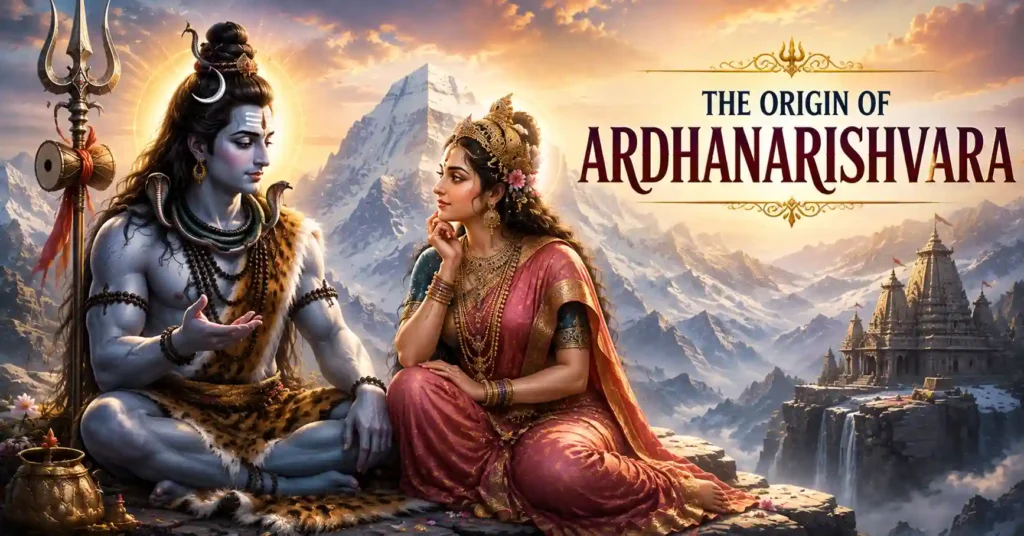
The story of Ardhanarishvara begins with a profound question about the nature of creation itself. In Sanatan Dharma, Lord Shiva represents pure consciousness, while Goddess Parvati embodies Shakti, the divine energy that sets creation into motion.
Although both are worshipped individually, Hindu scriptures teach that Shiva and Shakti are never truly separate. One is incomplete without the other, just as fire cannot exist without heat or the sun without its light.
According to traditional accounts, Lord Brahma was engaged in the work of creation. However, he realized that creation could not flourish through a single principle alone. Both consciousness and creative energy were necessary for the universe to function in harmony.
To reveal this eternal truth, Lord Shiva manifested in a remarkable form known as Ardhanarishvara.
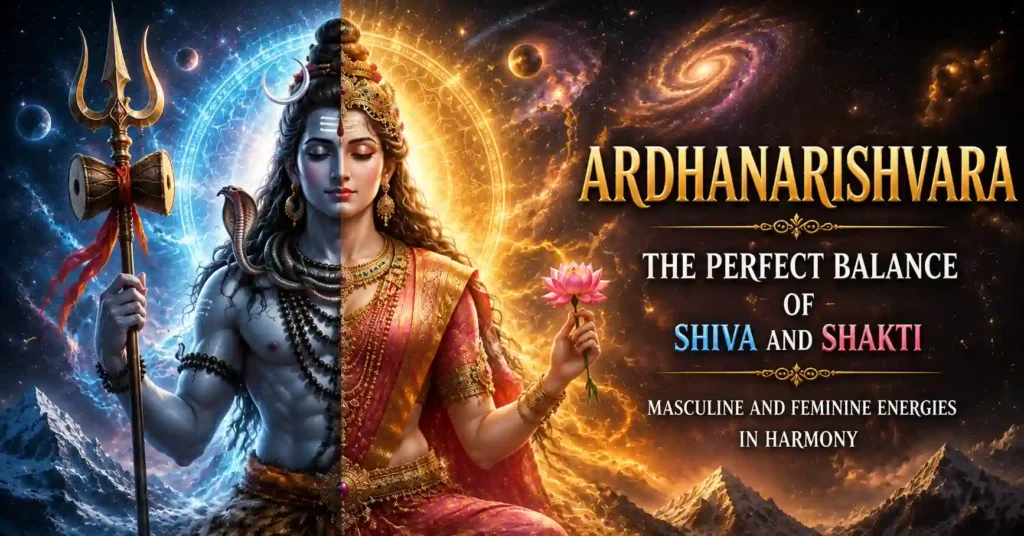
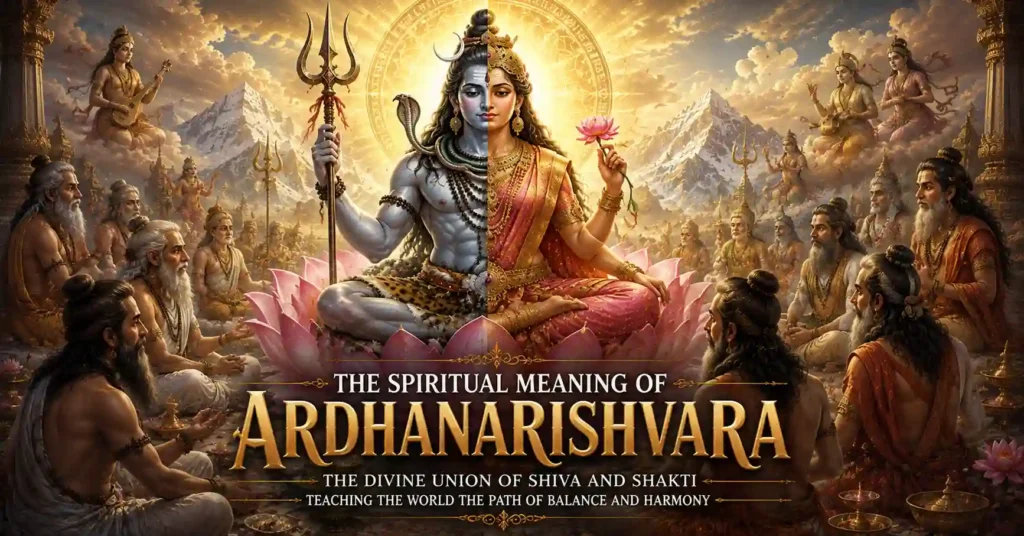
In this divine manifestation, one half of the body appeared as Shiva and the other half as Parvati. The right side reflected the ascetic Lord Shiva with matted hair, a trident, and the marks of renunciation.
The left side appeared as Goddess Parvati, adorned with graceful ornaments, compassion, beauty, and the nurturing power of Shakti.
This sacred form demonstrated that the universe is sustained through the perfect union of complementary forces. Neither dominates the other. Instead, both exist in balance, harmony, and mutual dependence.
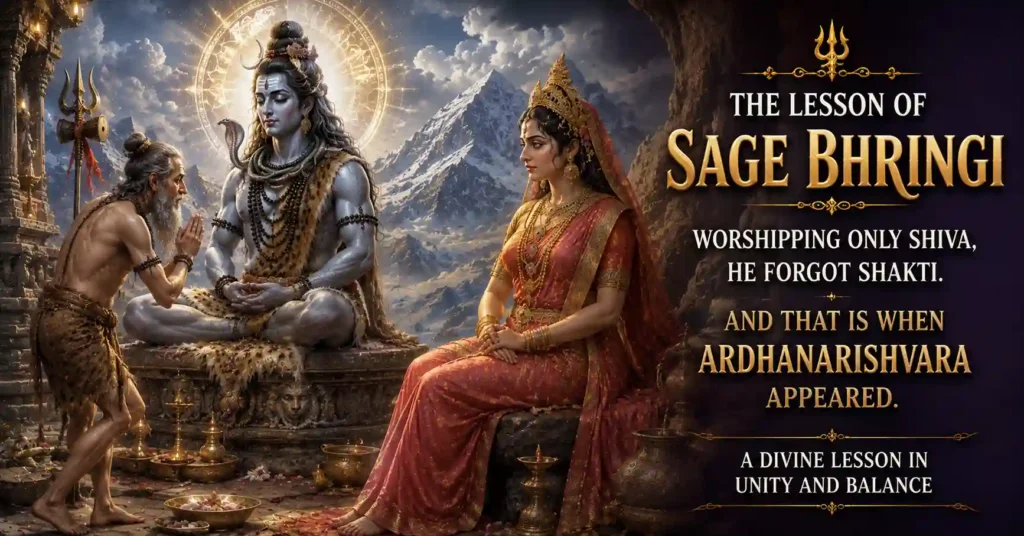
Another well-known episode associated with this sacred form involves Sage Bhringi, a devoted worshipper of Lord Shiva.
Bhringi deeply revered Shiva but refused to offer worship to Goddess Parvati. Whenever devotees circumambulated Shiva and Parvati together, he would walk only around Shiva, deliberately excluding Parvati from his worship.
Goddess Parvati observed this behavior and understood that the sage had failed to recognize the inseparable nature of Shiva and Shakti.
To teach an important spiritual lesson, Shiva and Parvati united into a single divine form.
Now there was no way to worship Shiva while ignoring Parvati because both existed within the same body.
Still determined to worship only Shiva, Sage Bhringi transformed himself into a tiny bee and attempted to pass between the two halves of the Divine.
This episode revealed the limitations of viewing the Divine as divided. It also demonstrated that true spiritual understanding requires recognizing both consciousness and energy as aspects of the same ultimate reality.
Through this sacred manifestation, Shiva and Parvati taught that separation exists only in human perception. At the highest spiritual level, all dualities dissolve into unity.
The form remains one of the most powerful symbols of the union of Shiva and Shakti. It reminds devotees that balance, harmony, and completeness arise when seemingly opposite forces come together as one.
The story continues to inspire spiritual seekers because it teaches that genuine growth comes not from division, but from understanding the interconnected nature of existence and the Divine.
What Does Ardhanarishvara Teach Us?
The story of Ardhanarishvara offers several profound spiritual lessons that remain relevant even today. While the divine form is visually striking, its deeper message extends far beyond symbolism and reveals timeless truths about balance, unity, and spiritual growth.
1. True Strength Comes from Balance
One of the central teachings of this sacred form is that balance creates harmony. Lord Shiva represents consciousness and stillness, while Goddess Parvati represents energy and action.
Together, they show that life functions best when wisdom is balanced with effort, and reflection is balanced with action.
2. Shiva and Shakti Are Inseparable
This sacred story teaches that Shiva and Shakti are not two separate realities. They are different expressions of the same Divine truth.
Just as a flame cannot be separated from its light, consciousness cannot be separated from energy.
Their eternal union reminds devotees that creation depends upon the harmony of both principles.
3. Respect All Aspects of the Divine
The episode involving Sage Bhringi reminds devotees that spiritual understanding grows when we recognize the completeness of the Divine.
By appearing in a single unified form, Shiva and Parvati demonstrated that favoring one aspect while ignoring the other leads to an incomplete understanding of reality.
This lesson encourages seekers to appreciate the Divine in all its manifestations.
4. Unity Exists Beyond Duality
Human beings often divide the world into opposites such as male and female, strength and compassion, action and stillness.
This sacred manifestation teaches that these apparent opposites can coexist in harmony and ultimately arise from the same source.
Understanding this principle helps cultivate a broader and more inclusive spiritual perspective.
5. Spiritual Growth Requires Inner Harmony
The spiritual meaning behind this divine form also applies to our inner lives. Every person possesses qualities associated with both wisdom and compassion, determination and gentleness.
When these qualities work together rather than against one another, greater peace, balance, and spiritual growth become possible.
The enduring lesson of Ardhanarishvara is that completeness is not found in division but in unity. By understanding the sacred union of Shiva and Shakti, devotees are reminded to cultivate balance, respect, and harmony within themselves and in the world around them.
Why Is Ardhanarishvara Important in Sanatan Dharma?
The importance of Ardhanarishvara in Sanatan Dharma goes far beyond its unique appearance. This sacred form represents one of the deepest spiritual truths found in Hindu philosophy: the eternal unity of Shiva and Shakti.
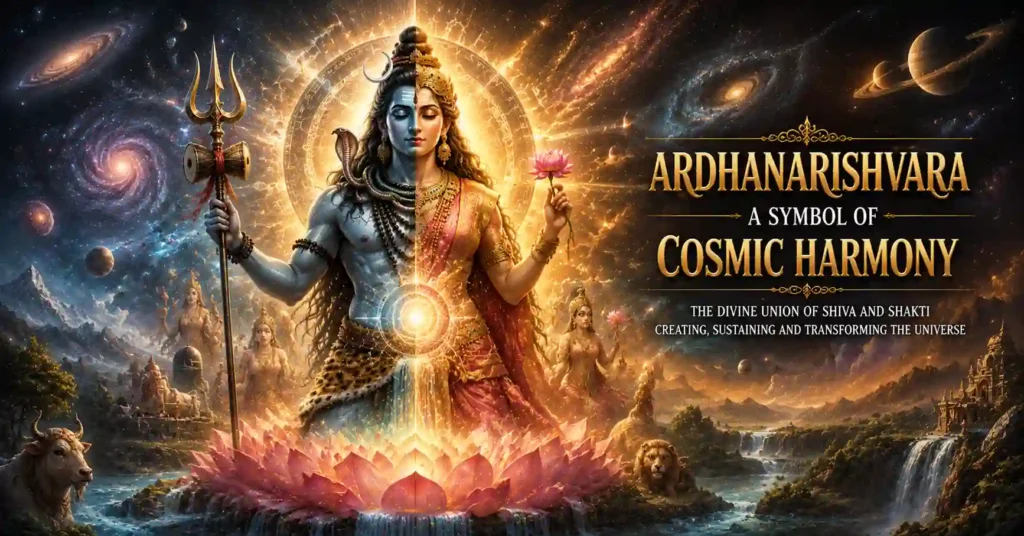
In many traditions, Lord Shiva is understood as pure consciousness, while Goddess Parvati represents divine energy. Their combined form shows that neither can function independently. Creation, preservation, and transformation occur only when both exist together.
For this reason, this divine manifestation is regarded as a powerful symbol of cosmic balance. It teaches that the universe is sustained through harmony rather than opposition.
Its significance is also closely connected to the concepts of Purusha and Prakriti. Purusha represents eternal consciousness, while Prakriti represents the creative force that manifests the world.
The union of these two principles is beautifully expressed through the sacred union of Shiva and Shakti, making this teaching important within both Shaiva and Shakta traditions.
The form also carries a meaningful social and spiritual message. By depicting Shiva and Parvati as equal halves of one divine reality, it emphasizes mutual respect, cooperation, and interdependence.
Rather than portraying one aspect as superior to the other, the image teaches that true strength comes from balance and unity.
Many temples across India contain sacred images and sculptures of this divine form, reflecting its enduring importance in worship and spiritual practice. Devotees meditate upon it to understand the inseparable relationship between the Divine masculine and Divine feminine.
The story associated with this manifestation also reminds seekers that spiritual growth requires integrating different aspects of their own nature. Wisdom must be balanced with compassion, strength with humility, and action with inner awareness.
Even today, its message remains highly relevant. In a world often divided by differences, this sacred representation teaches that harmony emerges when complementary forces work together rather than against one another.
For devotees of Sanatan Dharma, Ardhanarishvara is not merely a divine image. It is a timeless reminder that all creation arises from the sacred union of Shiva and Shakti and that true completeness is found in unity, balance, and spiritual harmony.
Did You Know?
The story of Ardhanarishvara contains several fascinating teachings that reveal the deep spiritual relationship between Lord Shiva and Goddess Parvati. Beyond its striking appearance, this sacred form has inspired devotees, philosophers, artists, and spiritual seekers for centuries.
Many of these teachings continue to be reflected in temple worship, sacred texts, and traditional interpretations across Sanatan Dharma.
1. Ardhanarishvara Represents the Unity of Shiva and Shakti
The form of Ardhanarishvara combines Lord Shiva and Goddess Parvati into a single divine body.
This sacred image teaches that consciousness and energy, Shiva and Shakti, are inseparable aspects of the same ultimate reality.
For this reason, it is regarded as one of the most profound symbols of divine unity in Hindu tradition.
2. The Name Ardhanarishvara Has a Deep Meaning
The word Ardhanarishvara comes from three Sanskrit terms: Ardha meaning half, Nari meaning woman, and Ishvara meaning Lord.
Together, the name means “the Lord who is half woman.”
The name itself reflects the central teaching of this sacred story, which emphasizes balance, harmony, and completeness.
3. Sage Bhringi Played an Important Role in the Story
One of the most famous episodes associated with this divine form involves Sage Bhringi.
The sage worshipped only Lord Shiva and refused to honor Goddess Parvati.
To demonstrate that Shiva and Shakti cannot be separated, the Divine appeared in a unified form, teaching a lesson that continues to be remembered today.
4. This Sacred Form Is Mentioned in Multiple Scriptures
The concept appears in several Hindu scriptures and traditional teachings.
References can be found in texts such as the Shiva Purana, Linga Purana, Skanda Purana, and other Shaiva traditions.
These sources describe it as a powerful expression of the union of Shiva and Shakti.
5. Ancient Sculptures Exist Across India
Images of this divine manifestation have been carved into temples and sacred monuments for centuries.
Ancient sculptures depicting the form can be found in various regions of India, reflecting its enduring importance in Hindu art and worship.
These representations helped preserve its spiritual message across generations.
6. It Symbolizes More Than Gender
Many people first notice the masculine and feminine aspects of the form.
However, its symbolism extends much deeper.
It represents the harmony of seemingly opposite forces such as stillness and action, wisdom and compassion, and consciousness and creative energy.
7. It Teaches the Importance of Balance
One of the key lessons of this story is the importance of balance in life.
The form reminds devotees that true harmony arises when different qualities work together rather than compete with one another.
This teaching remains relevant for both spiritual growth and everyday living.
8. It Is Revered in Both Shaiva and Shakta Traditions
Devotees of Lord Shiva and devotees of Goddess Shakti both honor this sacred manifestation.
The form beautifully expresses the belief that Shiva and Shakti are eternally united.
Because of this, it holds a special place in multiple spiritual traditions within Sanatan Dharma.
9. Its Message Remains Relevant Today
The teachings associated with Ardhanarishvara continue to inspire people around the world.
Its message encourages unity, mutual respect, inner harmony, and a deeper understanding of the interconnected nature of existence.
For many devotees, this sacred form remains a timeless reminder that true completeness is found through balance and spiritual unity.
Conclusion
The story of Ardhanarishvara is far more than a depiction of Lord Shiva and Goddess Parvati sharing a single form. It is a profound spiritual teaching that reveals the inseparable nature of Shiva and Shakti, consciousness and energy, and the balance that sustains all creation.
Through this sacred story, devotees learn that true harmony does not arise from division but from unity. The divine form reminds us that seemingly opposite qualities can work together to create completeness, strength, and spiritual growth.
Its significance continues to inspire spiritual seekers because the message remains timeless. Whether viewed as a symbol of cosmic balance, the union of Shiva and Shakti, or the harmony of complementary forces, this teaching encourages us to cultivate balance within ourselves and in our relationships with others.
In a world often focused on differences, the wisdom associated with Ardhanarishvara offers a powerful reminder that unity, mutual respect, and spiritual harmony are essential for both personal growth and collective well-being.
The enduring message of this sacred form is that completeness is found not through separation but through recognizing the interconnected nature of all existence. By understanding the divine union of Shiva and Shakti, devotees can move closer to inner peace, spiritual wisdom, and a deeper connection with the Divine.
Suggested Reading
If the story of Ardhanarishvara inspired you, you may enjoy exploring other sacred stories and teachings that reveal the deeper relationship between Shiva and Shakti, divine balance, spiritual wisdom, and the path toward inner harmony. Like this sacred teaching, these timeless narratives help devotees understand the interconnected nature of the Divine and the importance of balance in both spiritual and everyday life.
Many seekers are drawn to Ardhanarishvara because it beautifully expresses the unity of consciousness and energy, the Divine masculine and Divine feminine. Across Sanatan Dharma, numerous stories and teachings remind us that true spiritual growth comes from cultivating harmony, devotion, wisdom, and a deeper awareness of the sacred presence that exists throughout creation.
Shiv Parvati Vivah: The Sacred Marriage of Shiva and Parvati
https://thesanatantales.com/shiv-parvati-vivah/
Markandeya and Shiva Story: How Devotion Conquered Death
https://thesanatantales.com/markandeya-and-shiva-story/
The Story of Sati Anasuya: The Divine Test of Devotion and Purity
https://thesanatantales.com/story-of-sati-anasuya/
The Sacred Story of Vrinda and Tulsi Mata
https://thesanatantales.com/vishnu-and-tulsi-story/
Giddhraj Jatayu Story: How Jatayu Sacrifice His LIfe protecting Sita ji
https://thesanatantales.com/giddharaj-jatayu-story/
Gajendra Moksha Story: When Surrender Reached Bhagwan Vishnu Before Strength Failed
https://thesanatantales.com/gajendra-moksha-story/
Spiritual Stories of Sanatan Dharma
https://thesanatantales.com/spiritual-stories-of-sanatan-dharma/
Ardhanarishvara (Wikipedia)
https://en.wikipedia.org/wiki/Ardhanarishvara
FAQs
What is Ardhanarishvara in Sanatan Dharma?
Ardhanarishvara is a sacred form of the Divine that combines Lord Shiva and Goddess Parvati within a single body. The right half is traditionally depicted as Shiva, while the left half appears as Parvati.
This unique manifestation symbolizes the eternal union of Shiva and Shakti, consciousness and energy, which together sustain the universe.
The concept teaches that creation, balance, and spiritual growth depend upon the harmonious relationship between these complementary forces. For devotees, this sacred form serves as a reminder that true completeness arises from unity rather than separation.
What is the meaning of Ardhanarishvara?
The word Ardhanarishvara is derived from Sanskrit. Ardha means half, Nari means woman, and Ishvara means Lord.
Together, the name means “the Lord who is half woman.”
This sacred name carries a deeper meaning that goes beyond physical appearance. It represents the inseparable nature of Shiva and Shakti and the balance that exists at the heart of all creation.
The form also conveys the idea that seemingly opposite forces can coexist in perfect harmony and contribute equally to the functioning of the universe.
Why did Lord Shiva appear as Ardhanarishvara?
According to traditional accounts, Lord Shiva appeared as Ardhanarishvara to reveal the inseparable unity of Shiva and Shakti.
One well-known story involves Sage Bhringi, who worshipped only Shiva while ignoring Goddess Parvati. To demonstrate that Shiva and Shakti cannot be separated, the Divine manifested as a single combined form.
This appearance taught that consciousness and energy are not separate forces but two aspects of the same ultimate reality.
The lesson continues to inspire devotees by emphasizing the importance of unity, balance, and the harmonious relationship between Shiva and Shakti.
What does Ardhanarishvara symbolize?
Ardhanarishvara symbolizes balance, harmony, unity, and completeness. The form represents the sacred union of masculine and feminine principles within creation.
In Hindu philosophy, Shiva represents pure consciousness, while Shakti represents divine energy and creative power.
Their divine union teaches that neither principle is complete without the other.
The symbolism also extends to everyday life, encouraging balance between strength and compassion, action and reflection, and wisdom and devotion.
Why is Ardhanarishvara important in Sanatan Dharma?
The importance of Ardhanarishvara in Sanatan Dharma lies in its profound spiritual message. It teaches that all creation arises through the union of Shiva and Shakti.
This sacred form is also closely connected to the philosophical concepts of Purusha and Prakriti, which describe consciousness and creative energy.
Many devotees meditate upon this divine manifestation to better understand the interconnected nature of existence and the need for inner balance.
Its teachings continue to influence spiritual practices, temple traditions, and devotional worship throughout India.
Is Ardhanarishvara mentioned in Hindu scriptures?
Yes. Ardhanarishvara is mentioned in several Hindu scriptures and traditional teachings.
References to this sacred form appear in texts such as the Shiva Purana, Linga Purana, Skanda Purana, and various Shaiva traditions.
These scriptures describe the form as a manifestation of the eternal union of Shiva and Shakti.
Over time, this concept also became an important theme in Hindu art, temple architecture, devotional literature, and spiritual philosophy.
What spiritual lessons can devotees learn from Ardhanarishvara?
The Ardhanarishvara Story teaches several valuable spiritual lessons.
It reminds devotees that balance is essential for personal growth and inner peace. The story also encourages respect for different qualities and perspectives rather than viewing them as opposing forces.
Another important lesson is that spiritual completeness comes from recognizing unity beneath apparent differences.
By reflecting on this sacred form, devotees can cultivate harmony, compassion, self-awareness, and a deeper understanding of the Divine.
How is Ardhanarishvara worshipped today?
Ardhanarishvara is worshipped in temples, homes, and spiritual traditions across India. Devotees honor this form through prayers, meditation, chanting, and the study of sacred teachings.
Many worshippers contemplate the deeper symbolism of this divine manifestation as part of their spiritual practice.
The form is especially revered by those seeking balance, harmony, and a deeper connection with both Shiva and Shakti.
Even today, this sacred representation continues to inspire devotees by reminding them of the unity that exists within the Divine and throughout creation.
References & Sources
This article is based on traditional teachings and narratives associated with Ardhanarishvara, the sacred form that represents the union of Lord Shiva and Goddess Parvati. The story and symbolism are preserved within Hindu scriptures, philosophical traditions, temple iconography, and devotional literature that explore the relationship between Shiva and Shakti.
The article draws upon concepts and references found in the Shiva Purana, Linga Purana, Skanda Purana, and other Shaiva and Shakta traditions that describe the significance of this divine form, the unity of consciousness and energy, and the spiritual meaning of cosmic balance.
It also reflects traditional interpretations of Purusha and Prakriti, the union of Shiva and Shakti, and the symbolic teachings associated with this sacred manifestation within Sanatan Dharma.
These sources have been used to present the story, symbolism, and spiritual lessons in a simple, beginner-friendly manner while remaining aligned with the broader teachings and living traditions of Sanatan Dharma.
Explore More Topics from The Sanatan Tales