
The story of Ardhanarishvara and the balance of energies is not only about a divine form.
It is about the deepest truth of existence. In Sanatan Dharma, Ardhanarishvara reveals that life moves forward through harmony, not dominance, and wholeness arises only when opposing forces learn to rest together.
When we first see this form, it may feel unusual. Half Shiva, half Shakti. Yet the more we sit with it, the more it begins to feel familiar, as if it reflects something within us that we have always sensed but never fully understood.
When seekers reflect on Ardhanarishvara and the balance of energies, they begin to understand that consciousness and energy, often described as Purusha and Prakriti, are never separate.
They move as one rhythm, shaping both the universe and the inner world of the seeker.
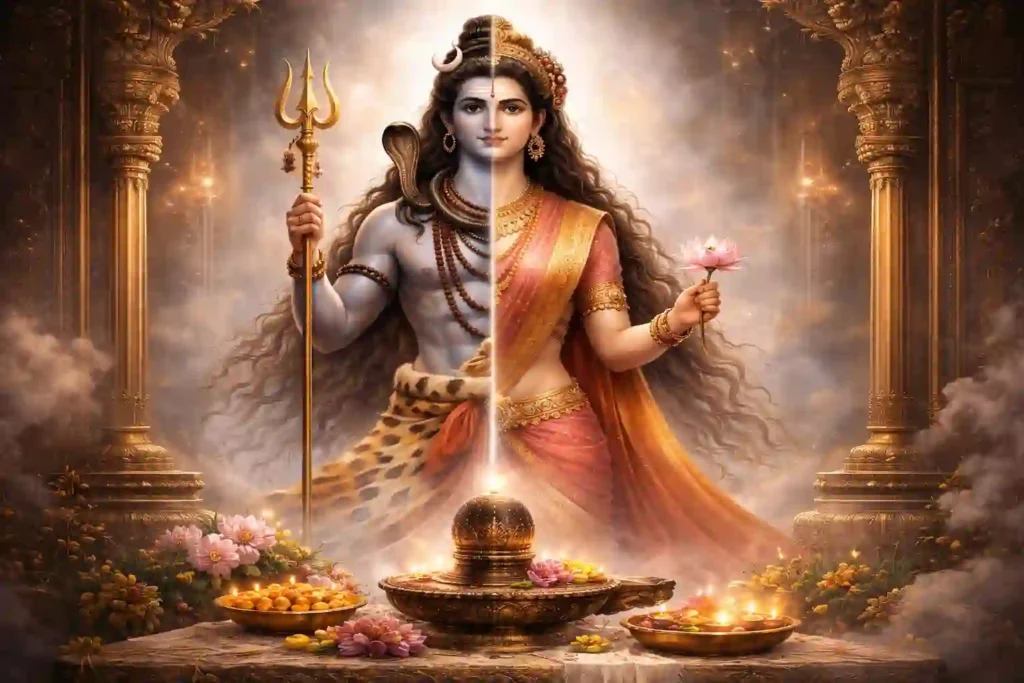
Table of Contents
ToggleThe story of Ardhanarishvara and the balance of energies
In the early moments of creation, something essential was missing.
According to the Shiva Purana, Brahma created beings, yet life could not continue. Forms existed, but movement did not flow through them. Consciousness was present, but energy did not awaken.
At that moment, Shiva appeared before Brahma in a form never witnessed before.
Half of his body was Shiva, representing Purusha, pure consciousness, still and aware.
Half of his body was Shakti, representing Prakriti, living energy, dynamic and creative.
This form was Ardhanarishvara.
In that moment, it was not just a form that appeared, but an understanding. What seemed separate was revealed as one, and creation found its missing balance.
The Ardhanarishvara meaning lies in this unity, where two seeming opposites are revealed as one complete reality.
Through this vision, Brahma understood that creation cannot happen through consciousness alone.
Purusha without Prakriti remains inactive. Prakriti without Purusha loses direction. Only their union allows life to arise.
Shakti then emerged from Shiva so that creation could continue, yet the truth was sealed forever.
Shiva and Shakti are inseparable.
This inseparability is often described as the Shiva Shakti union, where consciousness and energy move together.
This realization lies at the heart of Ardhanarishvara and the balance of energies.
Another story speaks of devotion without understanding.
Sage Bhringi was a devoted worshipper of Shiva, yet he ignored Parvati completely. To him, devotion was singular.
To awaken him, Shiva merged Parvati into his own body, becoming Ardhanarishvara.
Even then, Bhringi tried to worship only the Shiva half, turning himself into a beetle to circumambulate the right side alone.
His strength weakened.
What he had ignored began to reveal its importance. In trying to separate, he had weakened himself.
There is no Shiva without Shakti.
There is no consciousness without energy.
Devotion without balance becomes rigid.
Faith without wholeness remains incomplete.
A gentler legend speaks of love and surrender.
In the Skanda Purana, Parvati performs intense tapasya, not to gain power, but to remain eternally united with Shiva. She asks to reside within him, limb to limb, without separation.
Shiva grants her wish, and Ardhanarishvara manifests, not through command, but through understanding.
Here, union is not ownership.
It is harmony.
What Ardhanarishvara and the balance of energies teaches us
The story of Ardhanarishvara and the balance of energies teaches that life cannot move forward through one force alone.
When we choose only logic and suppress emotion, or follow only feeling without clarity, imbalance appears.
Masculine and feminine energies are not opposites in conflict. They are complementary forces working together.
What appears as duality is actually a deeper integration of forces moving as one.
This story reminds us that harmony is not created by control, but by acceptance. True balance arises when both sides are allowed to exist without resistance.
What Ardhanarishvara and the balance of energies reveals
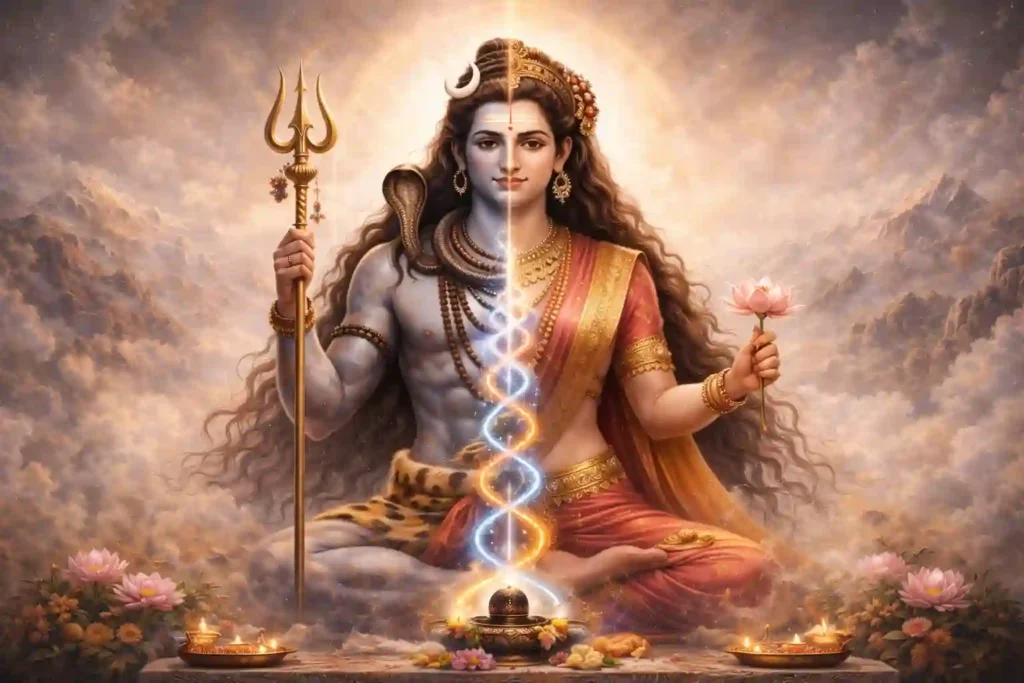
The form of Ardhanarishvara is divided vertically.
The right side is Shiva, ash-covered, holding the trident, wrapped in stillness and detachment. This side reflects logic, restraint, awareness, and the unchanging witness.
The left side is Parvati, adorned with garments and jewels, gentle yet powerful. This side reflects emotion, intuition, creativity, and nurturing movement.
This symbolism teaches that masculine and feminine are not opposing forces. They are complementary.
Creation, preservation, and harmony arise only when both exist together.
This unity is the core of Ardhanarishvara and the balance of energies.
This is why places like the Ardhanareeswarar Temple at Tiruchengode do not worship division. They worship unity.
Ardhanarishvara and the balance of energies within us
The story does not remain in the heavens.
Ardhanarishvara and the balance of energies speaks directly to human life.
Within every individual lives masculine energy, associated with logic, action, and stillness. Within the same being lives feminine energy, associated with emotion, intuition, and flow.
When one dominates and the other is denied, imbalance appears.
True alignment begins when inner balance is restored.
The form of Ardhanarishvara reminds us that inner masculine–feminine balance is essential for personal, emotional, and spiritual wholeness.
When logic listens to emotion, and action respects stillness, life becomes harmonious.
This is the lived meaning of Ardhanarishvara and the balance of energies.
It also reflects the deeper Shiva Shakti non-duality meaning, where separation is only apparent, not real.
Remembering Ardhanarishvara through practice
Some seekers softly chant,
“Om Ardhanarishvaraya Namah,”
inviting awareness of balance within their own being.
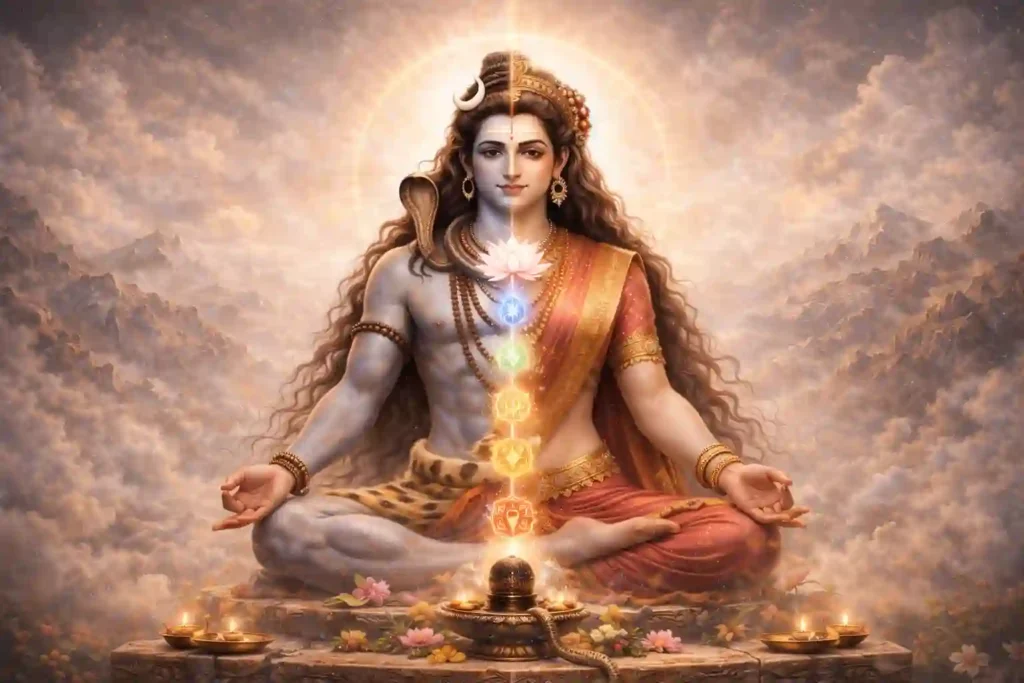
Others practice gentle breath awareness, aligning the Ida and Pingala channels, allowing harmony to rise naturally through the central path.
Some simply observe their own lives, noticing whether logic has silenced feeling, or emotion has clouded clarity, and gently restoring balance.
No force.
Only alignment.
Through this awareness, the journey slowly moves toward self-realization.
How time remembered Ardhanarishvara
Across centuries, art remembered what philosophy explained.
From early Kushan and Gupta images to flowing Chola bronzes, artists shaped balance into stone and metal. At Badami, Ardhanarishvara is shown playing the veena using hands from both sides, turning harmony itself into sound.
Folk traditions echoed the same truth. Madhubani filled every space with divine presence. Kerala murals allowed the form to flow like breath. Kalamkari grounded the divine in patience and earth.
Art understood that non-duality beyond gender is not an idea.
It is a lived reality.
Why Ardhanarishvara and the balance of energies is still relevant today
In today’s fast-moving world, imbalance is easy to feel.
Some live only through action and logic, while others feel overwhelmed by emotion.
The story of Ardhanarishvara and the balance of energies reminds us that peace does not come from choosing one side, but from allowing both to exist together.
This balance brings clarity, emotional stability, and inner harmony.
A truth that still walks with us
Some see Ardhanarishvara as half man, half woman.
The wise see Ardhanarishvara as complete.
Beyond gender.
Beyond division.
Balanced.
This is the essence of Ardhanarishvara and the balance of energies, where wholeness is seen beyond separation.
That is why this form still walks beside the seeker, quietly guiding life back to harmony.
Conclusion
The story of Ardhanarishvara and the balance of energies teaches that wholeness is not achieved by choosing one force over another.
Purusha without Prakriti remains still.
Prakriti without Purusha becomes restless.
Their union reveals the non-dual truth that balance, harmony, and life itself arise only when consciousness and energy move together.
This balance is not something to achieve once.
It is something to live, quietly, every day.
Suggested Reading
If the story of Ardhanarishvara and the balance of energies resonated with you, these stories will gently take you deeper into devotion, harmony, and inner transformation:
Meera and Krishna: A Story of Pure Devotion and Love
https://thesanatantales.com/meera-and-krishna-story/
Parvati’s Tapasya for Mahadev: Story of Devotion
https://thesanatantales.com/parvati-tapasya-for-shiva/
Sudama and Krishna Story: A Tale of True Friendship
https://thesanatantales.com/sudama-and-krishna-story/
Ram and Shabari Story: A Lesson in Pure Devotion
https://thesanatantales.com/ram-and-shabari-story/
Bholenath Ki Baarat: The Sacred Marriage of Shiva and Parvati
https://thesanatantales.com/bholenath-ki-baarat/
Samudra Manthan Story: How Shiva Became Neelkanth
https://thesanatantales.com/samudra-manthan-story/
The Sacred Story of Lord Ganesha Birth and His Elephant Head
https://thesanatantales.com/sacred-story-of-lord-ganesha-birth/
These stories, though different in form, all point toward the same quiet truth of balance, devotion, and divine connection.
FAQs
What is Ardhanarishvara in Sanatan Dharma?
Ardhanarishvara is the unified form of Lord Shiva and Goddess Parvati, representing the inseparable balance of consciousness and energy.
What does Ardhanarishvara symbolize spiritually?
It symbolizes harmony between masculine and feminine energies, teaching that wholeness arises from balance, not dominance.
Why is Ardhanarishvara described as beyond gender?
Because the form represents a reality where divine consciousness transcends physical gender and exists as unified truth.
Which scriptures mention Ardhanarishvara?
References appear in the Shiva Purana, Linga Purana, and Skanda Purana, each highlighting different aspects of divine unity.
What is the inner meaning of Ardhanarishvara for individuals?
It teaches balancing logic with emotion, stillness with action, and strength with compassion within oneself.
Where is Ardhanarishvara worshipped in temples?
The Ardhanareeswarar Temple in Tiruchengode, Tamil Nadu, is one of the most important centers of worship.
How is Ardhanarishvara connected to yoga and tantra?
It represents the inner union of Shiva consciousness and Shakti energy within the human body.
Why is Ardhanarishvara relevant in modern life?
Because it reminds us that peace, clarity, and emotional stability come from integrating all aspects of our nature.