
The story of Parvati Tapasya is one of the most inspiring examples of devotion, determination, and spiritual discipline in Sanatan Dharma. Long before the divine marriage of Shiva and Parvati, Goddess Parvati undertook an extraordinary spiritual journey to attain Lord Shiva as her husband.
The account of Parvati Tapasya shows how unwavering faith, patience, and sincere devotion can help a seeker overcome even the most difficult challenges. Through years of meditation, austerity, and self-discipline, Parvati remained firmly dedicated to her goal despite numerous tests and obstacles.
In this article, you will discover the complete story of Parvati Tapasya, learn why Goddess Parvati performed intense penance for Shiva, understand the spiritual lessons hidden within her journey, and explore the significance of this sacred story in Sanatan Dharma.
The story continues to inspire devotees because it demonstrates that genuine devotion is not measured by comfort or convenience. Instead, it is revealed through perseverance, faith, and the willingness to remain committed to a higher purpose.
Table of Contents
ToggleParvati Tapasya Story Snapshot
| Aspect | Details |
|---|---|
| Main Characters | Goddess Parvati, Lord Shiva, Narada Muni, Saptarishis, Himavan, Queen Mena |
| Source | Shiva Purana, Skanda Purana, Kumarasambhavam, and traditional Hindu teachings |
| Theme | Devotion, perseverance, faith, spiritual discipline, and divine love |
| Key Lesson | Sincere devotion, patience, and determination can help overcome even the greatest challenges on the spiritual path |
| Spiritual Significance | Demonstrates the power of tapasya, unwavering faith, and dedication to a divine purpose |
| Important Event | Goddess Parvati performs intense penance to attain Lord Shiva as her husband |
| Related Story | Shiv Parvati Vivah and the birth of Lord Kartikeya |
| Symbolism | The union of Shiva and Parvati represents the harmony of consciousness and divine energy |

Parvati Tapasya: How Goddess Parvati Won Lord Shiva Through Devotion
The story of Parvati Tapasya begins after the rebirth of Goddess Sati as Parvati, the daughter of Himavan, the king of the Himalayas, and Queen Mena.
From a young age, Parvati displayed extraordinary devotion toward Lord Shiva. Although she was born into comfort and royal privilege, her heart was drawn toward the great ascetic who spent his time in deep meditation on Mount Kailash.
As Parvati grew older, Narada Muni visited her family and revealed a divine truth. He foretold that Parvati was destined to become the consort of Lord Shiva.
The prophecy strengthened her resolve. From that moment, she dedicated herself to attaining Mahadev through devotion and spiritual discipline.
Parvati often visited the place where Shiva meditated. She served Him with humility and respect, bringing flowers and helping maintain the sacred surroundings.
However, Lord Shiva remained absorbed in meditation and appeared indifferent to worldly matters.
Despite this, Parvati’s devotion never weakened. She understood that winning the heart of the great yogi would require far more than ordinary effort.
Determined to fulfill her divine purpose, she began a period of intense penance that would later become famous as Parvati Tapasya for Shiva.
Leaving behind royal comforts, Parvati entered the forests and mountains to focus entirely on spiritual practice. She spent her days meditating on Lord Shiva and chanting His sacred names.
Over time, her austerities became increasingly difficult. She survived on fruits and roots, gradually reducing her dependence on food.
Eventually, she gave up even leaves and lived through the strength of her devotion alone.
Because of this extraordinary sacrifice, she became known as Aparna, meaning “one who does not even eat leaves.”
Her penance continued for years. Through scorching summers, freezing winters, and heavy rains, she remained firm in her spiritual discipline.
Traditional accounts describe how she performed severe austerities, including the famous Panchagni Tapasya, where she meditated surrounded by four fires beneath the blazing sun.
Her unwavering determination amazed sages, celestial beings, and the gods themselves.
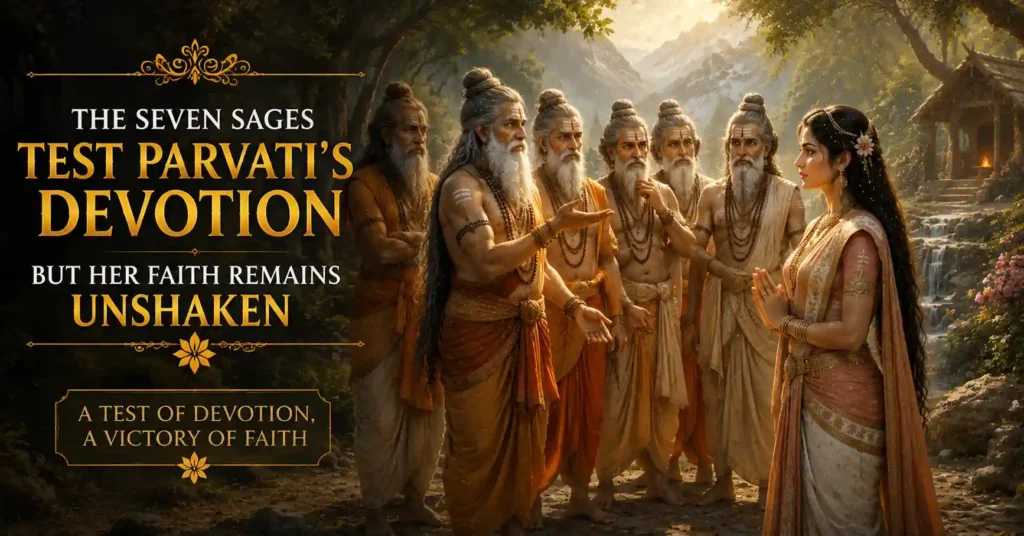
To test her resolve, the Saptarishis approached Parvati and questioned her decision to seek Shiva as her husband.
They spoke about Shiva’s ascetic lifestyle and unusual appearance, attempting to discourage her from her path.
Parvati listened respectfully but remained steadfast. She declared that her devotion to Mahadev could not be shaken by doubt or criticism.
Impressed by her faith, the sages recognized the depth of her spiritual commitment.
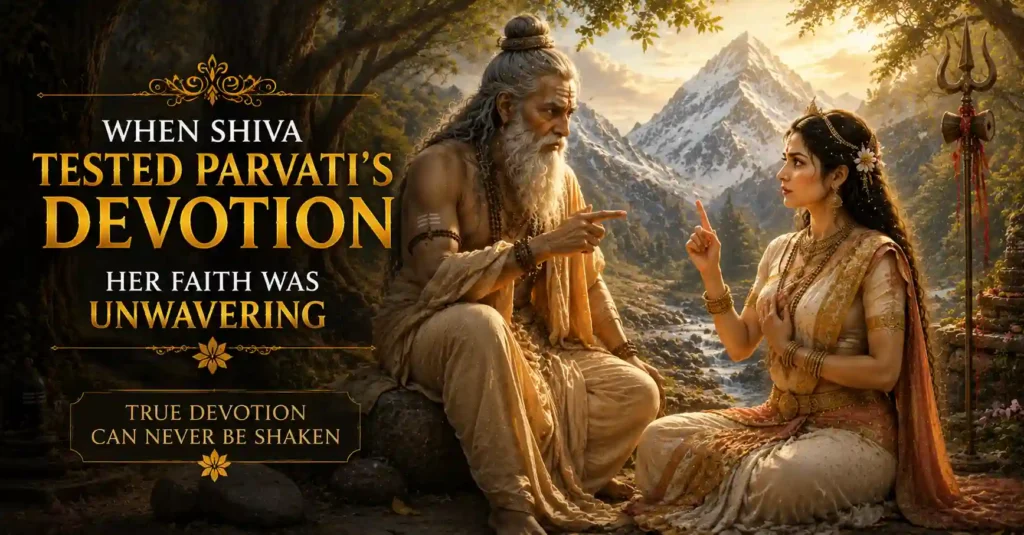
Lord Shiva then decided to test her personally.
Disguising Himself as an elderly sage, He approached Parvati and began speaking critically about Shiva.
The disguised sage questioned why a princess would wish to marry a wandering ascetic who lived among mountains, wore animal skins, and possessed no interest in worldly wealth.
Parvati immediately defended Mahadev with unwavering conviction.
She explained that Shiva was the Supreme Lord, beyond all external appearances and material possessions.
Her devotion remained unchanged even when faced with this final test.
Satisfied with her sincerity and faith, Lord Shiva revealed His true divine form.
The mountains seemed to glow with celestial light as Parvati beheld Mahadev standing before her.
Shiva accepted her devotion and acknowledged the extraordinary penance she had performed.
Years of meditation, sacrifice, and unwavering faith had finally borne fruit.
The success of Parvati Tapasya was not merely a personal achievement. It fulfilled a cosmic purpose that would benefit the entire universe.
The divine union of Shiva and Parvati later became one of the most celebrated events in Sanatan Dharma through the sacred Shiv Parvati Vivah.
Their marriage eventually led to the birth of Lord Kartikeya, who fulfilled the divine mission of defeating the demon Tarakasura and restoring balance to the world.
The story of Parvati Tapasya continues to inspire devotees because it demonstrates the transformative power of faith, perseverance, and wholehearted devotion to the Divine.

What Does Parvati Tapasya Teach Us?
The story of Parvati Tapasya is much more than a tale of divine love. It offers timeless lessons about faith, perseverance, self-discipline, and spiritual growth that continue to inspire devotees today.
1. True Devotion Requires Patience
One of the most important lessons from Parvati Tapasya is that meaningful goals often require patience and persistence.
Goddess Parvati did not achieve her goal immediately. She remained devoted to Lord Shiva for years, trusting the divine plan even when results were not visible.
Her journey reminds us that sincere effort and faith should not depend on immediate success.
2. Spiritual Discipline Strengthens the Mind
The Parvati Tapasya for Shiva demonstrates the power of self-discipline.
Despite harsh weather, physical hardship, and countless challenges, Parvati remained focused on her spiritual purpose.
Her example teaches that discipline helps develop inner strength, resilience, and determination.
3. Faith Should Remain Firm During Difficult Times
Throughout her penance, Parvati faced many tests.
The Saptarishis questioned her decision, and even Lord Shiva tested her devotion while disguised as an elderly sage.
Yet Parvati never allowed doubt to weaken her faith.
The story shows that genuine devotion remains steady even during periods of uncertainty.
4. External Appearances Do Not Define Greatness
When Shiva appeared as a wandering ascetic, many people focused only on His outward appearance.
Parvati, however, recognized His divine nature and spiritual greatness.
This lesson encourages us to look beyond external appearances and value inner qualities such as wisdom, character, and truth.
5. Perseverance Can Transform Obstacles into Success
The journey of Goddess Parvati Penance for Shiva was filled with challenges.
Instead of becoming discouraged, she treated every obstacle as an opportunity to strengthen her resolve.
Her story teaches that perseverance often becomes the bridge between aspiration and achievement.
6. Divine Love Is Rooted in Spiritual Understanding
The Shiva and Parvati Story is not merely a romantic narrative.
Their union represents the coming together of consciousness and energy, Shiva and Shakti, for the welfare of the universe.
Parvati’s devotion was based on spiritual understanding rather than personal desire alone.
7. Sincere Effort Never Goes Unnoticed
A powerful lesson from Parvati Devotion to Shiva is that sincere effort always has value.
Even when progress seems slow, every act of devotion, prayer, and spiritual practice contributes to inner growth.
Parvati’s success reminds devotees that dedication and faith eventually bear fruit in ways that may not always be immediately visible.
The enduring message of Parvati Tapasya is that devotion combined with patience, discipline, and unwavering faith has the power to transform both the individual and the world around them.
Why Is Parvati Tapasya Important in Sanatan Dharma?
The importance of Parvati Tapasya in Sanatan Dharma extends far beyond the story itself. It represents one of the finest examples of devotion, spiritual discipline, and unwavering faith found in Hindu tradition.
For centuries, devotees have looked to Goddess Parvati’s journey as a source of inspiration for overcoming challenges and remaining committed to a higher purpose.
1. It Demonstrates the Power of Tapasya
Tapasya, or spiritual austerity, is an important concept in Sanatan Dharma.
The story of Parvati Tapasya shows how sincere effort, self-discipline, and dedication can help a seeker progress on the spiritual path.
Parvati’s penance was not performed for personal comfort or material gain. It was rooted in devotion, purity of intention, and spiritual purpose.
Her example continues to inspire devotees who seek inner transformation through prayer, meditation, and disciplined living.
2. It Highlights the Ideal of Unwavering Devotion
One reason the Parvati Tapasya for Shiva remains significant is because it demonstrates steadfast devotion.
Even when faced with difficulties, criticism, and divine tests, Parvati never abandoned her faith in Mahadev.
Her determination teaches that true devotion remains firm regardless of external circumstances.
This lesson continues to resonate with spiritual seekers across generations.
3. It Forms an Important Part of the Shiva and Parvati Story
The story of Goddess Parvati Penance for Shiva serves as the foundation for the later Shiv Parvati Vivah.
Without Parvati’s years of devotion and tapasya, the sacred union of Shiva and Parvati would not have taken place.
As a result, this story occupies an important place within the larger narrative of Shiva and Shakti in Sanatan Dharma.
4. It Reveals the Value of Inner Qualities
Many people judge others based on appearance, status, or material possessions.
Parvati saw beyond Shiva’s outward form and recognized His divine nature.
This aspect of the Shiva and Parvati Story teaches that wisdom, character, and spiritual greatness are more important than external appearances.
The lesson remains relevant in both spiritual and everyday life.
5. It Teaches That Divine Tests Have a Purpose
Throughout her journey, Parvati faced several tests.
The Saptarishis questioned her decision, and Shiva Himself appeared in disguise to examine her devotion.
These episodes show that challenges are not always obstacles. Sometimes they help strengthen faith, reveal sincerity, and prepare a devotee for greater spiritual growth.
6. It Inspires Devotees to Pursue Their Spiritual Goals
The story of Parvati Devotion to Shiva encourages devotees to remain committed to their spiritual aspirations.
Parvati’s success was not the result of luck or circumstance. It came through perseverance, faith, and consistent effort over many years.
Her journey reminds seekers that meaningful spiritual progress often requires patience and dedication.
7. It Supports the Deeper Teachings of Shiva and Shakti
The ultimate purpose of Parvati Tapasya was not merely marriage.
The union of Shiva and Parvati represents the coming together of consciousness and divine energy, known as Shiva and Shakti.
This sacred principle lies at the heart of many spiritual teachings within Sanatan Dharma.
Through Parvati’s devotion, devotees gain a deeper appreciation for this divine relationship and its significance in creation.
The enduring importance of Parvati Tapasya lies in its timeless message. It teaches that sincere devotion, spiritual discipline, and unwavering faith can transform challenges into opportunities for growth and bring a seeker closer to the Divine.
Did You Know?
The story of Parvati Tapasya contains many fascinating details that continue to inspire devotees across generations. These traditions and beliefs are preserved through scriptures, temple worship, festivals, and spiritual teachings throughout India.
Goddess Parvati Was the Rebirth of Sati
Before becoming Parvati, Goddess Sati was the daughter of King Daksha and the first consort of Lord Shiva.
After Sati left her earthly body during Daksha’s yajna, she was reborn as Parvati to reunite with Mahadev.
This makes Parvati Tapasya not only a story of devotion but also a continuation of a divine relationship that transcended lifetimes.
Narada Muni Revealed Her Divine Destiny
According to traditional accounts, Narada Muni visited Parvati’s family when she was young.
He foretold that she was destined to marry Lord Shiva and play an important role in a cosmic mission.
This prophecy strengthened Parvati’s resolve and became one of the reasons she embraced a life of spiritual discipline.
Parvati Became Known as Aparna
During her intense penance, Parvati gradually gave up all forms of food.
Eventually, she stopped eating even leaves.
Because of this extraordinary austerity, she became known as Aparna, which means “one who does not eat leaves.”
This title is still remembered as a symbol of her unmatched determination and devotion.
Panchagni Tapasya Is One of Her Most Famous Austerities
Traditional narratives describe how Parvati performed the severe Panchagni Tapasya.
She meditated surrounded by four sacred fires while the blazing sun burned overhead as the fifth fire.
This practice is remembered as one of the most intense acts of spiritual discipline associated with Parvati Tapasya for Shiva.
The Saptarishis Tested Her Resolve
Before Lord Shiva accepted her devotion, the Seven Sages, known as the Saptarishis, approached Parvati.
They questioned her decision to seek Shiva as her husband and attempted to discourage her.
Parvati remained unwavering, demonstrating the depth of her faith and commitment.
Lord Shiva Personally Tested Parvati
One of the most famous moments in the story occurs when Shiva disguises Himself as an elderly sage.
He spoke critically about His own appearance and lifestyle to see whether Parvati’s devotion would weaken.
Instead of wavering, Parvati defended Mahadev with complete conviction.
Her response proved that her devotion was genuine and unwavering.
Her Tapasya Served a Cosmic Purpose
The Goddess Parvati Penance for Shiva was not undertaken solely for personal reasons.
The gods knew that the future union of Shiva and Parvati would help restore cosmic balance.
Their marriage would eventually lead to the birth of Lord Kartikeya, who was destined to defeat the demon Tarakasura.
The Story Led to Shiv Parvati Vivah
The success of Parvati Devotion to Shiva ultimately culminated in the sacred Shiv Parvati Vivah.
This divine wedding is celebrated as one of the most important and auspicious events in Hindu tradition.
Many devotees continue to remember and retell the story during festivals dedicated to Shiva and Parvati.
The Story Is Still Remembered During Spiritual Observances
Many devotees reflect on Parvati Tapasya during Mahashivratri and other sacred occasions.
Her journey is often cited as an ideal example of patience, faith, and spiritual commitment.
For countless seekers, the story serves as a reminder that sincere devotion can overcome even the greatest obstacles.
Parvati Tapasya Continues to Inspire Devotees Today
The lessons of Parvati Tapasya remain relevant in modern life.
Her determination teaches the value of perseverance, while her faith demonstrates the power of trusting in a higher purpose.
This timeless story continues to inspire devotees to pursue their spiritual goals with dedication, humility, and unwavering devotion.

Conclusion
The story of Parvati Tapasya is one of the most inspiring examples of devotion, perseverance, and spiritual discipline found in Sanatan Dharma. Despite facing years of hardship, tests, and challenges, Goddess Parvati remained unwavering in her dedication to Lord Shiva and never lost faith in her divine purpose.
Through Parvati Tapasya, devotees learn that true devotion is not measured by how quickly results are achieved. Instead, it is revealed through patience, determination, and the willingness to remain committed to a higher goal even during difficult times.
The significance of Parvati Tapasya continues to inspire spiritual seekers because its message remains timeless. It teaches that sincere faith, self-discipline, and unwavering devotion have the power to transform obstacles into opportunities for growth and bring a devotee closer to the Divine.
The story also highlights the deeper spiritual meaning behind the union of Shiva and Parvati. Their sacred relationship symbolizes the harmony of consciousness and divine energy, reminding us that spiritual growth flourishes when devotion is guided by wisdom and purpose.
The Shiva and Parvati Story remains beloved across generations because it offers practical lessons for everyday life while revealing profound spiritual truths. Whether viewed as a tale of divine love, a journey of perseverance, or an example of perfect devotion, the story continues to guide devotees on the path of faith and self-discovery.
The enduring message of Parvati Tapasya is that sincere devotion, supported by patience and determination, never goes unnoticed by the Divine. By following the example of Goddess Parvati, devotees can cultivate inner strength, deepen their spiritual connection, and move closer to realizing their highest purpose.
Suggested reading inspired by Parvati’s tapasya for Mahadev
If the story of Parvati Tapasya inspired you, you may enjoy exploring other sacred stories that highlight devotion, faith, perseverance, divine love, and spiritual transformation. Like Parvati Tapasya, these timeless narratives reveal how sincere dedication to Bhagwan can help devotees overcome challenges and progress on their spiritual journey.
Many devotees are drawn to Parvati Tapasya because it beautifully demonstrates the power of unwavering faith and spiritual discipline. Across Sanatan Dharma, numerous stories teach that devotion combined with patience and determination can lead to divine grace, inner growth, and a deeper connection with the Divine.
Shiv Parvati Vivah: The Sacred Marriage of Shiva and Parvati
https://thesanatantales.com/shiv-parvati-vivah/
Ardhanarishvara: The Sacred Union of Shiva and Shakti
https://thesanatantales.com/ardhanarishvara/
Markandeya and Shiva Story: How Devotion Conquered Death
https://thesanatantales.com/markandeya-and-shiva-story/
Ram and Shabari Story: A Lesson in Pure Devotion
https://thesanatantales.com/ram-and-shabari-story/
Meera and Krishna Story: A Tale of Pure Devotion and Divine Love
https://thesanatantales.com/meera-and-krishna-story/
The Sacred Story of Vrinda and Tulsi Mata
https://thesanatantales.com/vishnu-and-tulsi-story/
Spiritual Stories of Sanatan Dharma
https://thesanatantales.com/spiritual-stories-of-sanatan-dharma/
Parvati (Wikipedia)
https://en.wikipedia.org/wiki/Parvati
Each of these stories carries a unique spiritual lesson, yet all point toward the same truth reflected in Parvati Tapasya: sincere devotion, patience, faith, and perseverance are never overlooked by the Divine. These sacred teachings continue to inspire devotees to remain committed to their spiritual goals, trust the divine plan, and walk the path of dharma with courage and dedication.
FAQs
What is Parvati Tapasya?
Parvati Tapasya refers to the intense penance and spiritual discipline performed by Goddess Parvati to attain Lord Shiva as her husband.
After learning about her divine destiny, Parvati dedicated herself completely to meditation, austerities, and devotion. She willingly gave up royal comforts and embraced a life of simplicity in pursuit of her spiritual goal.
The story of Parvati Tapasya is remembered as one of the greatest examples of faith, perseverance, and devotion in Sanatan Dharma.
It continues to inspire devotees who seek to strengthen their relationship with the Divine through sincere effort and spiritual practice.
Why did Goddess Parvati perform tapasya for Shiva?
Goddess Parvati performed penance because she wished to marry Lord Shiva and fulfill a divine purpose.
According to traditional teachings, Parvati was the rebirth of Goddess Sati, Shiva’s first consort. Her devotion to Mahadev continued across lifetimes.
Parvati also understood that her union with Shiva would benefit the entire universe and help restore cosmic balance.
The Parvati Tapasya for Shiva therefore represented both personal devotion and a higher spiritual mission.
How long did Parvati perform penance?
Different scriptures and traditional accounts describe varying durations for Parvati’s austerities.
However, all versions agree that her penance lasted for many years and involved extraordinary self-discipline.
During this period, she gradually reduced her dependence on food, spent long hours in meditation, and endured severe weather conditions without abandoning her spiritual practices.
The length of her tapasya highlights the depth of her commitment and determination.
Why was Goddess Parvati called Aparna?
During the most intense phase of her penance, Parvati gradually gave up all forms of food.
Eventually, she stopped eating even leaves while remaining absorbed in meditation and devotion to Lord Shiva.
Because of this extraordinary austerity, she became known as Aparna, which means “one who does not eat leaves.”
This title remains one of the most well-known names associated with Goddess Parvati and symbolizes her unwavering dedication.
What tests did Parvati face during her tapasya?
Throughout her spiritual journey, Parvati faced several important tests.
The Saptarishis questioned her decision to seek Lord Shiva as her husband and attempted to discourage her. Their purpose was to assess the strength of her devotion.
Later, Lord Shiva Himself appeared in the disguise of an elderly sage and spoke critically about His own appearance and lifestyle.
Parvati remained steadfast during every challenge, proving that her faith was genuine and unshakable.
What can devotees learn from Parvati Tapasya?
The story of Parvati Tapasya offers many valuable spiritual lessons.
It teaches the importance of patience, determination, faith, self-discipline, and devotion. Parvati’s journey shows that meaningful goals often require perseverance and commitment.
The story also reminds devotees that challenges and delays do not necessarily indicate failure.
Instead, they can become opportunities for growth, spiritual maturity, and deeper trust in the Divine.
Is Parvati Tapasya mentioned in Hindu scriptures?
Yes. The story is preserved in several Hindu scriptures and traditional texts.
Accounts related to Parvati Tapasya can be found in the Shiva Purana, Skanda Purana, and the classical Sanskrit work Kumarasambhavam, among other sources.
These texts describe Parvati’s devotion, her severe austerities, the tests she faced, and her eventual union with Lord Shiva.
Over time, the story became one of the most cherished narratives within Shaiva traditions.
How did Parvati Tapasya lead to Shiv Parvati Vivah?
After years of devotion and penance, Lord Shiva recognized the sincerity of Parvati’s faith and accepted her as His consort.
Her unwavering commitment ultimately culminated in the sacred Shiv Parvati Vivah, one of the most celebrated events in Sanatan Dharma.
The divine marriage symbolized the union of Shiva and Shakti, consciousness and energy, for the welfare of creation.
This makes Parvati Tapasya an essential chapter in the larger Shiva and Parvati story.
Why is Parvati Tapasya still relevant today?
Although the story took place in a sacred age, its lessons remain relevant in modern life.
Many people face challenges that require patience, resilience, and trust in a higher purpose. Parvati’s example demonstrates the value of remaining committed even when success does not come immediately.
The story encourages devotees to cultivate faith, maintain discipline, and pursue their goals with sincerity.
For this reason, Parvati Tapasya continues to inspire spiritual seekers, devotees, and anyone striving to overcome obstacles with determination and grace.
What makes Parvati Tapasya unique among spiritual stories?
The uniqueness of Parvati Tapasya lies in the combination of devotion, sacrifice, spiritual discipline, and divine purpose.
Unlike many stories that focus on external battles, this narrative centers on an inner journey of transformation and unwavering faith.
Parvati’s victory was achieved not through force or power but through devotion, patience, and spiritual strength.
This timeless message has helped make Parvati Tapasya one of the most beloved and inspiring stories in Sanatan Dharma.
References & Sources
This article is based on traditional teachings and narratives associated with Parvati Tapasya, the sacred penance performed by Goddess Parvati to attain Lord Shiva. The story has been preserved through Hindu scriptures, devotional literature, classical Sanskrit works, and oral traditions that celebrate the devotion of Parvati and the divine union of Shiva and Shakti.
The article draws upon accounts and themes found in the Shiva Purana, Skanda Purana, and Kumarasambhavam, along with traditional Shaiva teachings that describe Parvati’s austerities, spiritual discipline, and unwavering devotion to Mahadev.
It also reflects interpretations of important concepts within Sanatan Dharma, including tapasya (penance), bhakti (devotion), faith, self-discipline, and the spiritual significance of the union between Shiva and Parvati.
These sources have been used to present the story of Parvati Tapasya and its teachings in a simple, beginner-friendly manner while remaining aligned with the broader traditions, philosophy, and devotional heritage of Sanatan Dharma.
Explore More Topics from The Sanatan Tales