The Shiv Parvati Vivah is one of the most sacred and celebrated stories in Sanatan Dharma. More than a divine wedding, the Shiv Parvati Vivah represents the union of devotion and divine consciousness, bringing together Lord Shiva and Goddess Parvati for the welfare of the universe.
This timeless story includes Parvati’s unwavering tapasya, Lord Shiva’s tests of devotion, the famous Bholenath Ki Baarat, and the divine marriage that united Shiva and Shakti. For centuries, devotees have remembered the Shiv Parvati Vivah as a powerful example of faith, patience, dedication, and divine love.
In this article, you will discover the complete story of Shiv Parvati Vivah, the spiritual lessons it teaches, its importance in Sanatan Dharma, fascinating facts associated with the divine wedding, and why the marriage of Shiva and Parvati continues to inspire devotees across generations.
Table of Contents
ToggleShiv Parvati Vivah Story Snapshot
| Aspect | Details |
|---|---|
| Main Characters | Lord Shiva, Goddess Parvati, Narada Muni, Himavan, Mena Devi, Kamadeva, Nandi, Shiva Ganas |
| Source | Shiva Purana, Skanda Purana, Kalika Purana, and traditional Hindu retellings |
| Setting | Himalayas, Mount Kailash, and the kingdom of Himavan |
| Theme | Devotion, Tapasya, Divine Love, Faith, Patience, and the Union of Shiva and Shakti |
| Key Lesson | Sincere devotion, patience, and determination can lead to divine blessings and spiritual fulfillment |
| Famous Event | Bholenath Ki Baarat and the divine marriage ceremony of Shiva and Parvati |
| Spiritual Significance | The Shiv Parvati Vivah symbolizes the sacred union of Shiva and Shakti, consciousness and divine energy |
| Associated Tradition | Mahashivratri celebrations, Shiv-Parvati worship, and Hindu marriage symbolism |
This snapshot provides a quick overview of the Shiv Parvati Vivah, one of the most beloved stories in Sanatan Dharma. The story is remembered not only for the famous Bholenath Ki Baarat but also for the devotion, tapasya, and divine purpose that led to the sacred marriage of Shiva and Parvati.
Shiv Parvati Vivah: The Sacred Marriage of Shiva and Parvati
The Shiv Parvati Vivah begins long before the wedding ceremony itself. To understand its significance, we must first remember the story of Goddess Sati, the previous incarnation of Parvati.
Sati, the daughter of King Daksha, was deeply devoted to Lord Shiva and chose Him as her husband. However, Daksha never respected Shiva and often insulted Him.
When Daksha organized a grand yajna and deliberately refused to invite Shiva, Sati attended the ceremony despite Shiva’s advice not to go.
Unable to tolerate the humiliation of her husband, Sati sacrificed her earthly body in the sacrificial fire. This event filled the universe with sorrow and anger.
After Sati’s departure, Lord Shiva withdrew from worldly affairs and entered deep meditation. For a long time, He remained detached from the world.
In time, Sati was reborn as Goddess Parvati, the daughter of King Himavan and Queen Mena. From childhood, Parvati felt a deep spiritual connection with Lord Shiva.
As Parvati grew older, Sage Narada visited her family and revealed an important prophecy. He explained that Parvati was destined to marry Lord Shiva and play a vital role in the divine plan of the universe.
Hearing this, Parvati wholeheartedly accepted her destiny. She resolved to win Lord Shiva’s blessings through devotion, patience, and spiritual discipline.
Meanwhile, the gods faced a serious challenge. The powerful demon Tarakasura had become nearly invincible and was troubling the celestial realms.
According to a divine boon, Tarakasura could only be defeated by a son born from Lord Shiva.
The gods understood that Shiva’s marriage was essential for restoring cosmic balance. Therefore, they prayed for the union of Shiva and Parvati.
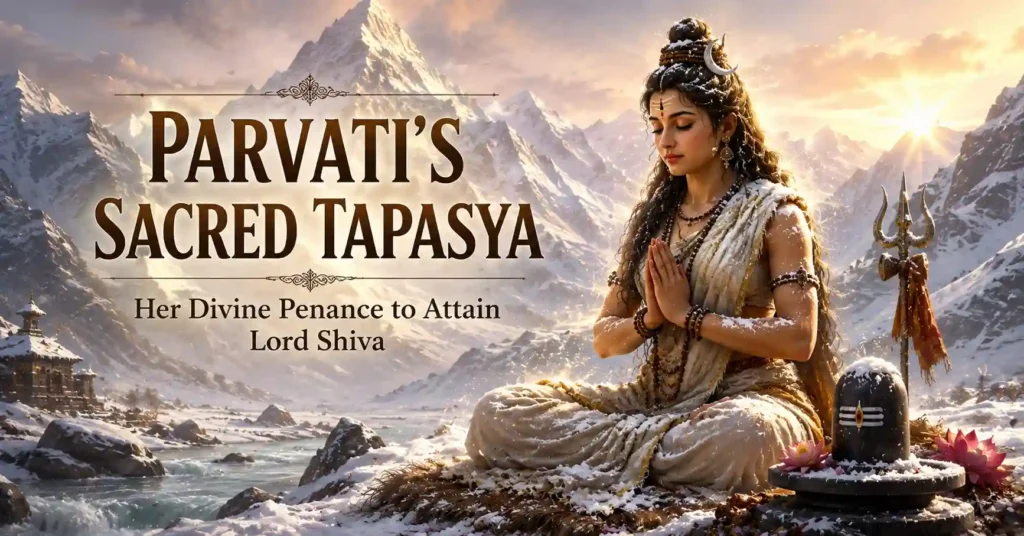
Determined to attain Shiva as her husband, Parvati began intense tapasya in the Himalayas. She gave up worldly comforts and spent years in meditation, prayer, and spiritual discipline.
Her devotion became so extraordinary that sages, gods, and celestial beings admired her unwavering determination.
At one point, the gods requested Kamadeva, the god of love, to awaken Shiva from meditation.
Kamadeva released his divine arrow toward Lord Shiva. However, Shiva opened His third eye and reduced Kamadeva to ashes.
Despite this setback, Parvati continued her tapasya with complete faith and patience.
Lord Shiva eventually decided to test her devotion. Disguised as a wandering ascetic, He approached Parvati and spoke critically about Himself.
The mysterious ascetic questioned why Parvati wished to marry a yogi who lived in cremation grounds, wore ashes, and possessed no interest in worldly comforts.
Parvati remained firm in her devotion. She respectfully defended Lord Shiva and declared that her faith would never change.
Pleased by her sincerity, Lord Shiva revealed His true form and accepted Parvati as His future bride.
Preparations for the divine wedding soon began across the heavens.
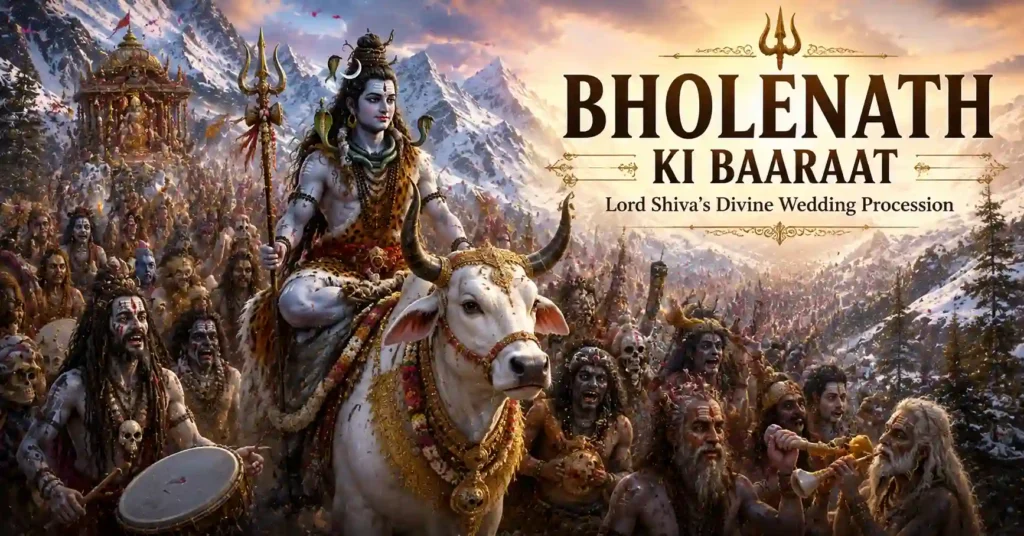
When the auspicious day arrived, Lord Shiva set out with His extraordinary wedding procession known as Bholenath Ki Baarat.
Unlike an ordinary royal procession, Shiva’s baraat included ganas, sages, yogis, celestial beings, spirits, and countless divine attendants.
Lord Shiva rode Nandi while the unique procession moved toward the kingdom of Himavan.
When Queen Mena first saw the unusual Mahadev Ki Baraat, she became worried. The appearance of many of Shiva’s companions seemed frightening and unlike anything she had imagined for her daughter’s wedding.
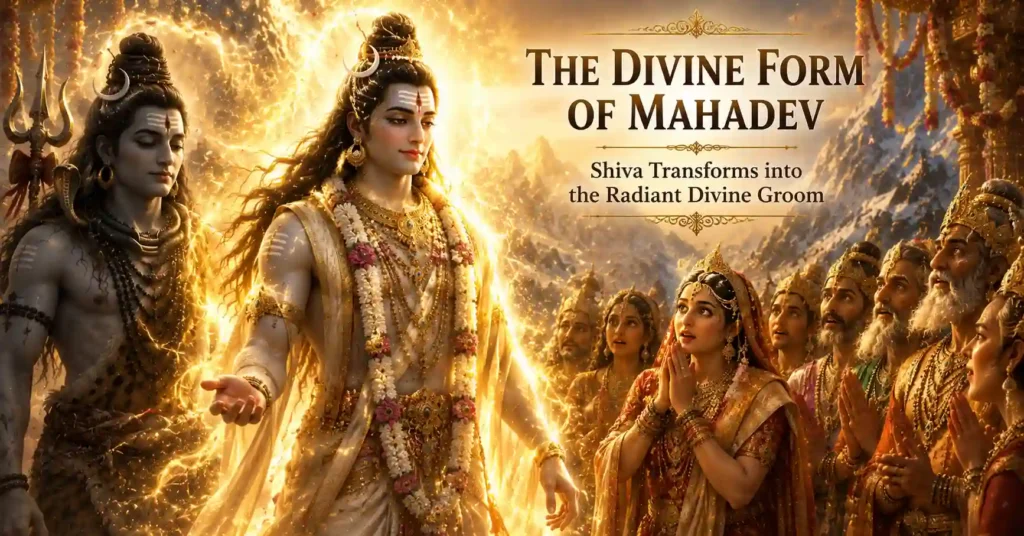
Seeing her concern, Lord Shiva compassionately revealed His magnificent divine form.
Radiant, beautiful, and adorned with celestial ornaments, He appeared as the perfect bridegroom.
Everyone present was filled with joy and devotion.
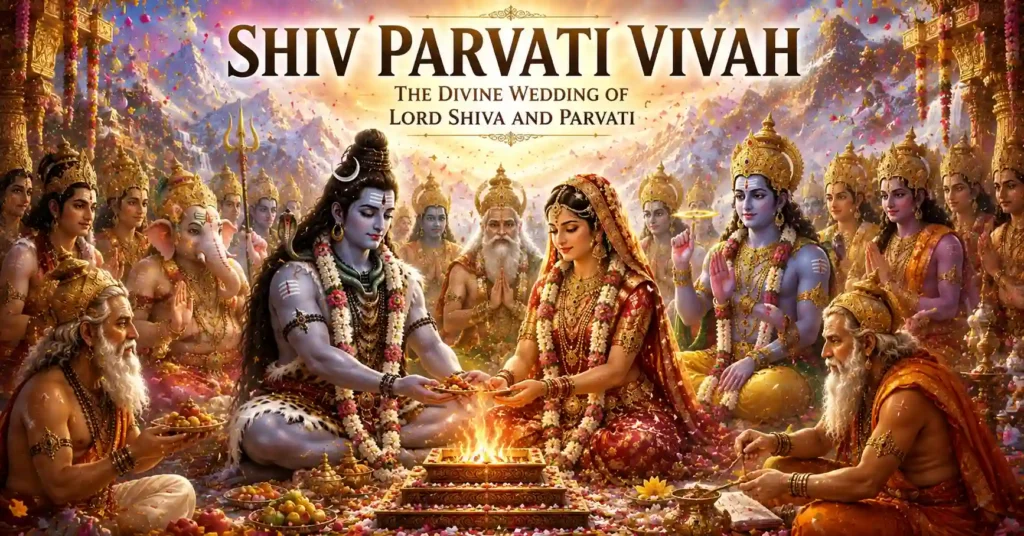
Soon, the sacred Shiv Parvati Vivah ceremony began.
Brahma, Vishnu, gods, sages, and celestial beings gathered to witness the divine marriage.
Vedic mantras filled the air as Shiva and Parvati were united through sacred rituals around the holy fire.
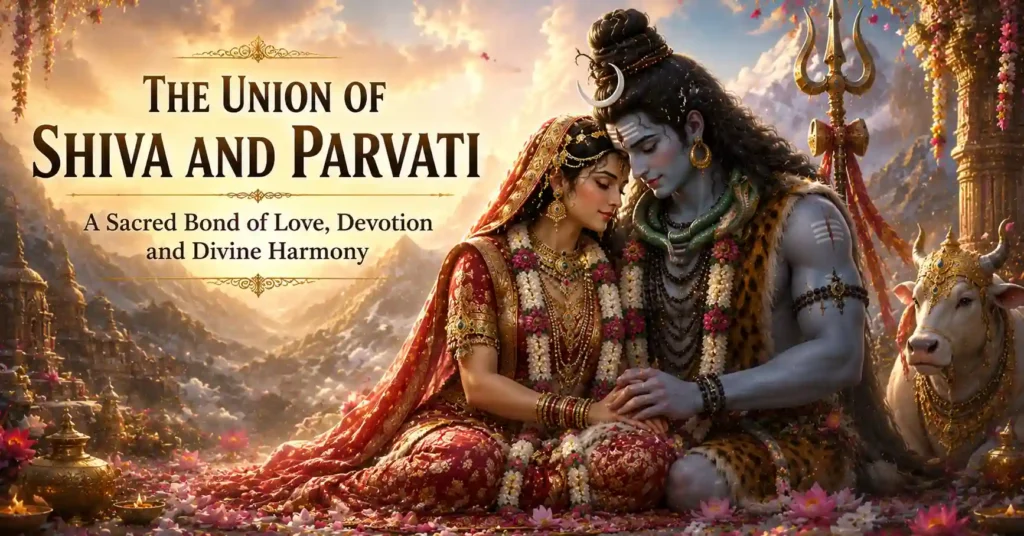
The marriage of Shiva and Parvati was not merely a wedding between two divine beings.
It symbolized the eternal union of Shiva and Shakti, consciousness and energy, stillness and creation.
The Shiv Parvati Vivah remains one of the most beloved stories in Sanatan Dharma because it beautifully combines devotion, tapasya, divine love, and cosmic purpose into a timeless spiritual narrative.
The divine union of Shiva and Parvati later led to the birth of Lord Kartikeya, who fulfilled the cosmic purpose behind the marriage by defeating the demon Tarakasura and restoring balance to the universe.
What Does Shiv Parvati Vivah Teach Us?
The Shiv Parvati Vivah is much more than the story of a divine wedding. It contains timeless lessons about devotion, patience, faith, inner strength, and the power of divine love.
1. True Devotion Requires Patience and Perseverance
Goddess Parvati did not attain Lord Shiva through shortcuts or worldly influence.
She spent years performing intense tapasya with unwavering determination and faith.
The Shiv Parvati Vivah teaches that sincere effort, patience, and dedication eventually bear fruit, even when the journey is long and difficult.
2. Faith Remains Strong During Difficult Times
Parvati faced many challenges during her spiritual journey.
Yet she never abandoned her goal or allowed doubt to weaken her devotion.
The story reminds us that faith becomes most powerful when it remains steady during periods of uncertainty and hardship.
3. Outer Appearances Do Not Define True Worth
Many people were surprised by Lord Shiva’s appearance as an ascetic who lived beyond worldly conventions.
However, Parvati recognized His divine nature and spiritual greatness.
The Shiv Parvati Vivah teaches us to look beyond external appearances and appreciate the deeper qualities of wisdom, character, and truth.
4. Genuine Love Is Rooted in Respect and Understanding
The relationship between Shiva and Parvati is not based on worldly attraction alone.
It is founded on mutual respect, trust, spiritual compatibility, and shared purpose.
This lesson continues to inspire devotees and is one reason why the Marriage of Shiva and Parvati is regarded as an ideal divine union.
5. Divine Tests Often Strengthen Our Conviction
Before accepting Parvati, Lord Shiva tested her devotion by appearing in disguise and questioning her choice.
Instead of becoming discouraged, Parvati remained firm in her faith.
The story teaches that challenges and tests can strengthen our commitment to what truly matters.
6. Spiritual Strength Is Greater Than Physical Strength
Parvati’s greatest power was not physical strength but spiritual determination.
Her tapasya transformed her life and fulfilled a divine purpose that benefited the entire universe.
The Shiv Parvati Vivah reminds us that inner strength, discipline, and devotion can achieve what worldly power cannot.
7. The Union of Shiva and Shakti Represents Cosmic Balance
The divine marriage symbolizes the union of consciousness and energy, stillness and creation.
Together, Shiva and Parvati represent harmony between complementary forces that sustain the universe.
This deeper spiritual meaning makes the Shiv Parvati Vivah one of the most significant stories in Sanatan Dharma.
For this reason, devotees continue to remember the Shiv Parvati Vivah as a timeless example of devotion, divine love, patience, and spiritual fulfillment.
Importance of Shiv Parvati Vivah in Sanatan Dharma
The Shiv Parvati Vivah holds a special place in Sanatan Dharma because it represents far more than a divine wedding. It symbolizes the union of Shiva and Shakti, the two fundamental forces that sustain creation and maintain cosmic balance.
For devotees, the story serves as a powerful reminder that devotion, patience, and faith can lead to spiritual fulfillment and divine grace.
1. It Symbolizes the Union of Shiva and Shakti
One of the deepest meanings of the Shiv Parvati Vivah is the union of Shiva and Shakti.
Lord Shiva represents pure consciousness, while Goddess Parvati represents divine energy and creative power.
Their sacred union symbolizes harmony between these two eternal principles that govern the universe.
2. It Demonstrates the Power of Tapasya and Devotion
The story highlights the extraordinary tapasya performed by Goddess Parvati.
Her unwavering dedication eventually led to the fulfillment of her spiritual goal.
Because of this, many devotees view the Shiv Parvati Vivah as a timeless example of how sincere devotion can attract divine blessings.
3. It Restored Cosmic Balance
The marriage of Shiva and Parvati was not only important for them personally but also for the welfare of the universe.
The gods believed that only a son born from Lord Shiva could defeat the demon Tarakasura.
As a result, the Shiva Parvati Marriage became an essential event in the divine plan to restore dharma and protect creation.
4. It Inspires Ideal Spiritual Partnership
The relationship between Shiva and Parvati is often regarded as an ideal model of mutual respect, trust, and spiritual companionship.
Unlike relationships based solely on worldly desires, their bond is rooted in understanding, devotion, and shared purpose.
For this reason, many devotees look to the Marriage of Shiva and Parvati as an example of harmony within family life and spiritual growth.
5. It Is Closely Connected to Hindu Traditions and Festivals
The story continues to influence many Hindu traditions and celebrations.
Events related to Mahadev Ki Baraat, Shiv-Parvati worship, and Mahashivratri often draw inspiration from this sacred narrative.
Many devotees also pray to Shiva and Parvati for blessings related to marriage, family harmony, and spiritual progress.
6. It Teaches That Divine Grace Follows Sincere Effort
Parvati’s journey shows that spiritual goals are achieved through dedication and perseverance.
Her years of tapasya were eventually rewarded by Lord Shiva’s acceptance and blessings.
The Shiv Parvati Vivah reminds devotees that sincere effort, combined with faith and patience, never goes unnoticed by the Divine.
7. It Remains a Living Part of Sanatan Dharma
Even today, the Shiv Parvati Vivah is remembered through temple celebrations, devotional songs, spiritual discourses, and religious observances across India.
Its message continues to inspire devotees to cultivate devotion, strengthen their faith, and walk the path of dharma with determination.
For these reasons, the Shiv Parvati Vivah remains one of the most beloved and spiritually significant stories in Sanatan Dharma, teaching timeless lessons about devotion, divine love, sacrifice, and cosmic harmony.
Did You Know?
The Shiv Parvati Vivah is filled with fascinating details that have inspired devotees, saints, and spiritual seekers for centuries. Many of these traditions and beliefs continue to be remembered through festivals, temple celebrations, and devotional teachings across India.
Goddess Parvati Was the Rebirth of Sati
Before becoming Parvati, she was born as Goddess Sati, the daughter of King Daksha.
After Sati sacrificed her earthly body during Daksha’s yajna, she was reborn as Parvati to reunite with Lord Shiva.
This makes the Shiv Parvati Vivah not only a divine marriage but also a sacred reunion.
Parvati Performed Years of Intense Tapasya
According to traditional accounts, Goddess Parvati performed severe penance for many years to attain Lord Shiva as her husband.
Her dedication became one of the most celebrated examples of devotion and determination in Hindu tradition.
Even today, devotees remember her tapasya as an inspiration for spiritual discipline and faith.
Kamadeva Played an Important Role in the Story
The gods once requested Kamadeva, the god of love, to awaken Lord Shiva from deep meditation.
When Kamadeva released his divine arrow, Shiva opened His third eye and reduced him to ashes.
This famous episode is often remembered as an important event that occurred before the Shiva Parvati Marriage.
Bholenath Ki Baarat Was Unlike Any Other Wedding Procession
One of the most memorable parts of the story is Bholenath Ki Baarat.
Instead of a royal procession filled only with kings and nobles, Shiva arrived with ganas, yogis, celestial beings, spirits, and divine attendants.
This unique procession remains one of the most beloved scenes associated with the Shiv Parvati Vivah.
Queen Mena Was Initially Worried
When Parvati’s mother, Queen Mena, first saw Shiva’s unusual wedding procession, she became concerned about her daughter’s marriage.
Traditional retellings describe how she was surprised by the appearance of many members of Mahadev Ki Baraat.
Lord Shiva later revealed His radiant divine form, bringing joy and reassurance to everyone present.
The Marriage Was Witnessed by the Gods
The Marriage of Shiva and Parvati is believed to have been attended by Brahma, Vishnu, sages, devas, and countless celestial beings.
The wedding became a cosmic celebration that united heaven, earth, and the spiritual realms.
Because of this, the event is considered one of the most auspicious moments in Hindu tradition.
Shiv Parvati Vivah Symbolizes Cosmic Balance
The divine wedding represents the union of Shiva and Shakti, consciousness and energy.
Many spiritual traditions view this union as the foundation of creation and universal harmony.
This deeper symbolism is one reason why the Shiv Parvati Vivah holds such great importance in Sanatan Dharma.
The Story Is Celebrated During Mahashivratri
Many devotees remember and recount the Shiv Parvati Vivah during Mahashivratri celebrations.
Temples often perform symbolic wedding ceremonies and special worship dedicated to Shiva and Parvati.
These traditions help keep the story alive for future generations.
Devotees Continue to Draw Inspiration from the Story
Even today, devotees read and listen to the Shiv Parvati Vivah for spiritual inspiration.
The story continues to teach lessons about devotion, patience, faith, divine love, and the rewards of sincere effort.
Its timeless message remains relevant for people seeking both spiritual growth and inner strength.
Conclusion
The Shiv Parvati Vivah is one of the most sacred and inspiring stories in Sanatan Dharma. It beautifully illustrates how unwavering devotion, patience, and faith can lead to divine blessings and spiritual fulfillment.
From Parvati’s intense tapasya to the unforgettable Bholenath Ki Baarat, every part of the story carries a deeper spiritual meaning. The journey shows that true devotion remains steady even when faced with challenges, tests, and uncertainty.
The Shiva Parvati Marriage also represents far more than a divine wedding. It symbolizes the eternal union of Shiva and Shakti, consciousness and energy, whose harmony sustains creation and cosmic balance.
The love and respect shared between Lord Shiva and Goddess Parvati continue to inspire devotees across generations. Their relationship is remembered as an ideal example of trust, commitment, spiritual companionship, and mutual understanding.
The Shiv Parvati Vivah remains relevant today because its teachings extend beyond mythology. It encourages us to cultivate patience, remain dedicated to our goals, and trust in the power of sincere effort and faith.
Ultimately, the Shiv Parvati Vivah reminds us that when devotion is pure and determination is unwavering, divine grace arrives at the right time and guides us toward our highest purpose.
Suggested Reading
If the Shiv Parvati Vivah inspired you, you may enjoy exploring other sacred stories that highlight devotion, faith, divine love, sacrifice, and spiritual transformation. Like the Shiv Parvati Vivah, these timeless narratives reveal how sincere devotion and unwavering determination can draw devotees closer to Bhagwan and deepen their understanding of Sanatan Dharma.
Many devotees are drawn to the Shiv Parvati Vivah because it beautifully illustrates the power of tapasya, divine grace, and the sacred union of Shiva and Shakti. Across Hindu tradition, many such stories teach that faith, patience, and devotion often become the foundation for spiritual growth and divine blessings.
Markandeya and Shiva Story: How Devotion Conquered Death
https://thesanatantales.com/markandeya-and-shiva-story/
The Sacred Story of Vrinda and Tulsi Mata
https://thesanatantales.com/sacred-story-of-vrinda-in-sanatan-dharma/
Story of Sati Anasuya: The Divine Test of Devotion and Purity
https://thesanatantales.com/story-of-sati-anasuya/
Meera and Krishna Story: A Tale of Pure Devotion and Divine Love
https://thesanatantales.com/meera-and-krishna-story/
Ram and Shabari Story: A Lesson in Pure Devotion
https://thesanatantales.com/ram-and-shabari-story/
Gajendra Moksha Story: When Surrender Reached Bhagwan Vishnu Before Strength Failed
https://thesanatantales.com/gajendra-moksha-story/
Spiritual Stories of Sanatan Dharma
https://thesanatantales.com/spiritual-stories-of-sanatan-dharma/
Shiva and Parvati (Wikipedia)
https://en.wikipedia.org/wiki/Shiva_and_Parvati
Each of these stories carries a unique spiritual lesson, yet all point toward the same truth found in the Shiv Parvati Vivah: sincere devotion, patience, faith, and purity of intention can transform life’s challenges into opportunities for spiritual growth. These timeless teachings continue to inspire devotees to strengthen their relationship with Bhagwan and walk the path of dharma with trust and dedication.
FAQs
Who are Lord Shiva and Goddess Parvati in the Shiv Parvati Vivah?
The Shiv Parvati Vivah is the sacred marriage of Lord Shiva and Goddess Parvati, two of the most revered deities in Sanatan Dharma.
Lord Shiva is worshipped as the Mahadev, the supreme yogi, and the destroyer of ignorance and negativity. Goddess Parvati is revered as the embodiment of Shakti, divine energy, compassion, and strength.
Their marriage symbolizes the eternal union of Shiva and Shakti, consciousness and energy, which together sustain creation and cosmic balance.
For devotees, the Shiv Parvati Vivah represents not only a divine wedding but also a profound spiritual truth about harmony, devotion, and divine purpose.
Why did Goddess Parvati perform tapasya to marry Lord Shiva?
According to the story of Shiv Parvati Vivah, Goddess Parvati was deeply devoted to Lord Shiva from a young age.
After learning that she was destined to marry Him, she undertook intense tapasya in the Himalayas. She willingly gave up worldly comforts and dedicated herself to prayer, meditation, and spiritual discipline.
Parvati’s devotion was not based on personal desire alone. She recognized Lord Shiva’s divine nature and wished to unite with Him through sincere faith and spiritual dedication.
Her tapasya remains one of the most celebrated examples of perseverance and devotion in Hindu tradition and is a central part of the Shiva Parvati Marriage story.
What is the significance of Bholenath Ki Baarat?
Bholenath Ki Baarat is one of the most famous and memorable events associated with the Shiv Parvati Vivah.
Unlike a traditional royal wedding procession, Lord Shiva arrived with an extraordinary group of companions that included ganas, yogis, sages, celestial beings, spirits, and divine attendants.
The unique procession symbolizes Lord Shiva’s acceptance of all beings regardless of appearance, status, or background.
For devotees, Mahadev Ki Baraat teaches that divine love and acceptance extend beyond social distinctions and external appearances.
It also highlights Shiva’s role as the compassionate Lord of all creation.
Why is the Shiv Parvati Vivah important in Sanatan Dharma?
The Shiv Parvati Vivah holds immense spiritual significance because it represents the sacred union of Shiva and Shakti.
This union symbolizes the harmony between consciousness and energy, stillness and action, which together sustain the universe.
The story also teaches important values such as devotion, patience, faith, self-discipline, and perseverance.
In addition, the Marriage of Shiva and Parvati played an important role in restoring cosmic balance, as it eventually led to the birth of Kartikeya, who defeated the demon Tarakasura.
For these reasons, the Shiv Parvati Vivah continues to be celebrated and remembered across generations.
What lessons can devotees learn from the Shiv Parvati Vivah?
The Shiv Parvati Vivah offers several timeless spiritual lessons.
It teaches that sincere devotion and patience can help overcome obstacles and lead to meaningful spiritual growth.
The story also reminds us that true faith remains steady even during difficult times and that divine grace often arrives after sustained effort and perseverance.
Another important lesson is that genuine relationships are built on mutual respect, understanding, trust, and shared values.
Through the story of Shiva and Parvati, devotees learn that inner qualities matter far more than external appearances or worldly status.
Why did Lord Shiva test Goddess Parvati before accepting her?
According to traditional retellings of the Shiv Parvati Vivah, Lord Shiva wished to examine the depth of Parvati’s devotion.
Disguised as a wandering ascetic, He questioned her decision to marry Him and spoke critically about His own appearance and lifestyle.
Instead of becoming confused or discouraged, Parvati remained firm in her faith and defended Lord Shiva with complete sincerity.
Her response demonstrated unwavering devotion and spiritual maturity.
This episode teaches that challenges and tests often strengthen our conviction and help reveal the sincerity of our intentions.
Is Shiv Parvati Vivah connected to Mahashivratri?
Yes, many traditions associate the Shiv Parvati Vivah with Mahashivratri celebrations.
Across India, devotees remember the divine wedding through special prayers, temple rituals, devotional singing, and symbolic marriage ceremonies of Shiva and Parvati.
Mahashivratri is considered one of the most important festivals dedicated to Lord Shiva.
For many devotees, it is also an opportunity to reflect upon the spiritual teachings of the Shiv Parvati Vivah, including devotion, self-discipline, faith, and divine love.
Why does the Shiv Parvati Vivah remain relevant today?
The Shiv Parvati Vivah continues to inspire people because its teachings remain timeless and universal.
The story encourages patience in difficult times, dedication toward meaningful goals, and faith in the power of sincere effort.
It also highlights the importance of mutual respect, commitment, and spiritual values in relationships.
Beyond its religious significance, the Shiv Parvati Vivah reminds us that devotion, perseverance, and inner strength can help us navigate life’s challenges while remaining connected to higher principles and dharma.
References & Sources
This article is based on traditional accounts of the Shiv Parvati Vivah preserved within Sanatan Dharma and drawn from Hindu scriptures, including the Shiva Purana, Skanda Purana, Kalika Purana, and other Puranic traditions that narrate the marriage of Lord Shiva and Goddess Parvati.
The article also incorporates teachings, interpretations, and devotional retellings associated with Shiva and Shakti, Parvati’s tapasya, Bholenath Ki Baarat, and the spiritual significance of the Shiva Parvati Marriage as understood in traditional Hindu philosophy and temple traditions.
These sources have been used to present the story and its spiritual lessons in a simple, beginner-friendly format while remaining aligned with the broader teachings of Sanatan Dharma.
Explore More Topics from The Sanatan Tales