Nishit Kaal is one of the most sacred and spiritually significant periods of the night in Sanatan Dharma. Often described as the deepest and most silent part of the night, it is traditionally associated with meditation, prayer, mantra chanting, self-reflection, and divine worship. Its timing varies from day to day because it is calculated according to traditional Hindu timekeeping rather than a fixed clock time. It is generally regarded as the midpoint of the night between sunset and sunrise.
Many devotees first hear about Nishit Kaal during Maha Shivratri, when midnight worship of Lord Shiva is considered especially significant. However, this sacred period is not limited to a single festival. Traditional Panchang calculations also use it while determining the observance of certain festivals, rituals, and night-based spiritual practices.
The Nishit Kaal meaning goes beyond simply identifying a time of night. It represents a period of profound stillness when external activity naturally decreases and the mind becomes more inward-focused. For this reason, many spiritual traditions regard it as a favorable time for contemplation, devotion, and spiritual awareness.
Today, many people wonder whether this ancient practice remains relevant in modern life. Others have questions about its timing, its connection with Maha Shivratri, whether it is considered auspicious, and how it differs from ordinary midnight.
In this guide, you will learn:
- What Nishit Kaal is and what the term means
- How its timing is traditionally calculated
- Why it holds spiritual importance in Sanatan Dharma
- Its connection with Maha Shivratri and other Hindu observances
- Common misconceptions surrounding this sacred period
- How its essence can be understood and applied in modern life
Understanding Nishit Kaal offers a deeper appreciation of how Sanatan Dharma views sacred time, silence, inner awareness, and spiritual practice. Rather than being merely a period on a clock, it is traditionally seen as an opportunity to turn inward and experience a greater sense of peace, devotion, and connection with the Divine.
Nishit Kaal at a Glance
| Aspect | Details |
|---|---|
| Meaning | Nishit Kaal is the deepest and most silent period of the night in traditional Hindu timekeeping. |
| Timing | Calculated based on sunset and sunrise, so it varies daily and by location. |
| Associated Deity | Commonly associated with Lord Shiva, especially during Maha Shivratri. |
| Spiritual Significance | Considered favorable for meditation, prayer, mantra chanting, and self-reflection. |
| Used In | Maha Shivratri, Krishna Janmashtami, Panchang calculations, and certain spiritual observances. |
| Best Activities | Meditation, mantra japa, silent prayer, reading sacred texts, and contemplation. |
| Fixed Time? | No. Nishit Kaal is not always exactly 12:00 AM. |
| Suitable For Beginners? | Yes. Even simple prayer or quiet reflection can be practiced during Nishit Kaal. |
| Considered Inauspicious? | No. It is generally regarded as spiritually significant rather than inauspicious. |
| Main Lesson | The value of silence, inner awareness, and spiritual focus amid daily life. |
Table of Contents
ToggleWhat Is Nishit Kaal in Sanatan Dharma?
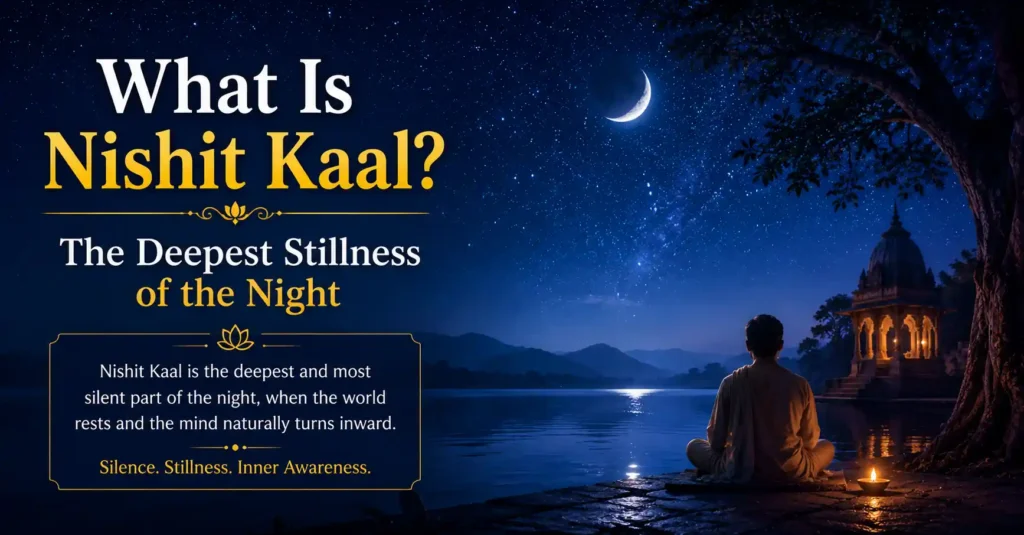
Nishit Kaal is the deepest and most silent period of the night as understood in traditional Hindu timekeeping. It is generally associated with the midpoint of the night and is regarded as a special time for prayer, meditation, mantra chanting, and inner reflection.
Unlike ordinary clock-based midnight, its timing is calculated according to the duration between sunset and sunrise. Because the length of the night changes throughout the year, this sacred period also varies from day to day and from place to place.
In Sanatan Dharma, this time is valued because external activity naturally decreases and silence becomes more prominent. Traditional spiritual teachings regard this calm atmosphere as supportive for concentration, devotion, and self-reflection.
Many devotees associate its spiritual importance with Lord Shiva, especially during Maha Shivratri. However, the concept is not limited to a single festival. It is also used in Panchang calculations and plays a role in determining certain religious observances and sacred timings.
The importance of Nishit Kaal does not come from fear, superstition, or mystery. Rather, it comes from the understanding that certain periods naturally support particular states of mind. This quiet phase of the night is traditionally seen as an opportunity to experience stillness, awareness, and spiritual practice more deeply.
What Is the Meaning of Nishit Kaal?
Nishit Kaal meaning comes from two Sanskrit words: Nishit and Kaal. The word Nishit refers to the deepest part of the night, a state of profound stillness and quietness. Kaal means time.
Together, the term refers to the most silent and inward-focused period of the night. It is traditionally regarded as a time when external activity reaches its lowest point and the atmosphere becomes naturally calm.
The deeper meaning of this concept is not merely about a clock-based moment. It symbolizes a period of stillness where the mind can move away from distractions and become more receptive to prayer, meditation, and self-reflection.
Ancient Hindu traditions often viewed different parts of the day and night as having unique qualities. Just as Brahma Muhurta is associated with spiritual practice before sunrise, this sacred period is linked with silence, contemplation, and inner awareness during the night.
For this reason, many devotees associate it with deeper spiritual practices, especially those connected with Lord Shiva, night worship, mantra chanting, and meditation. The emphasis is not on staying awake for the sake of it, but on using a naturally quiet time for spiritual focus.
Understanding the Nishit Kaal meaning helps us see that Sanatan Dharma does not view time as uniform. Certain periods are considered especially supportive for worship, reflection, self-discipline, and spiritual growth.
How Is Nishit Kaal Time Calculated?
Unlike ordinary midnight, Nishit Kaal time is not determined by a fixed clock. It is calculated using traditional Hindu timekeeping methods that consider the duration between sunset and the next sunrise. As a result, the exact timing changes throughout the year and varies from one location to another.
In traditional calculations, the entire night is divided into equal segments known as muhurtas. This sacred period is associated with the central portion of the night and is often identified as the eighth muhurta. Because nights are longer in some seasons and shorter in others, the timing does not remain constant.
This is why the timing shown in a Panchang may differ from city to city. Two places with different sunset and sunrise times will have different calculations even on the same date.
For most people, it usually falls around midnight. However, traditional observances rely on Panchang calculations rather than simply looking at a clock. This ensures that rituals and festivals are aligned with the actual midpoint of the night.
These calculations become especially important during festivals such as Maha Shivratri and Janmashtami. In such observances, the midpoint of the night helps determine the most sacred period for worship, prayer, and ritual practices.
Understanding how Nishit Kaal time is calculated helps us appreciate that Hindu traditions view time not merely as hours and minutes, but as a sacred rhythm connected with nature, astronomy, and spiritual observances.
Why Is Nishit Kaal Important in Sanatan Dharma?
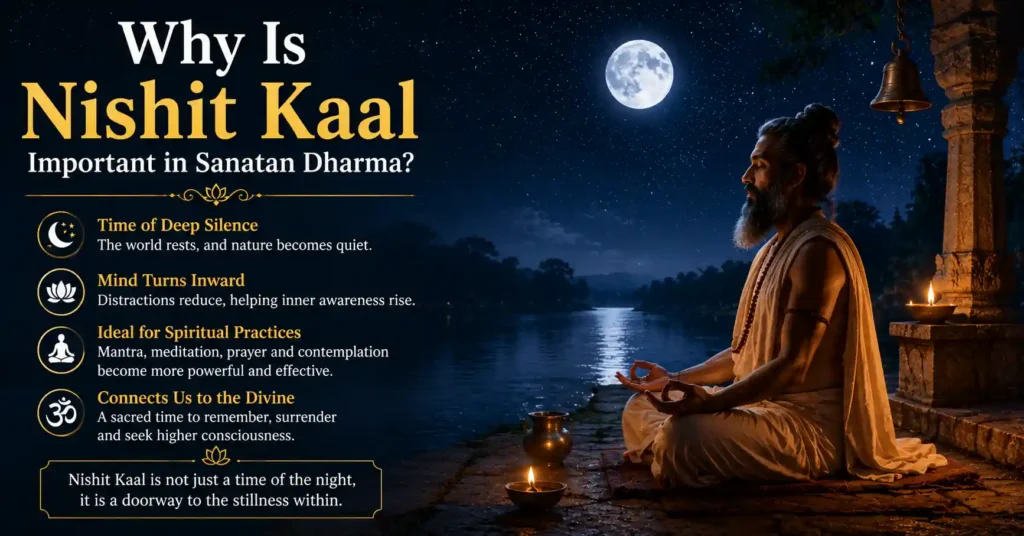
Nishit Kaal holds a special place in Sanatan Dharma because it represents the deepest and most silent period of the night. Traditional Hindu teachings recognize that different times of the day support different activities, and this sacred period is considered especially favorable for prayer, meditation, mantra chanting, and inner reflection.
During this time, most of the world is asleep and external distractions naturally reduce. The quiet atmosphere helps the mind become calmer and more focused. For this reason, many saints, yogis, and devotees have associated it with inward awareness rather than outward activity.
Its importance is also reflected in traditional Panchang calculations. Certain Hindu festivals and observances are determined based on whether a particular tithi is present during this period. This makes it an important reference point in the Hindu calendar system.
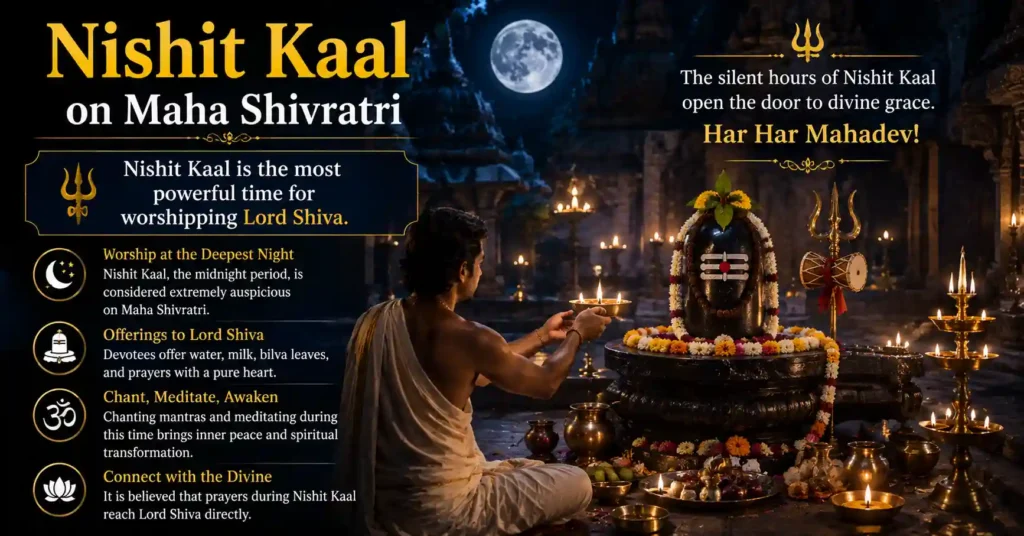
One of the most well-known examples is Maha Shivratri. Devotees regard this time on Maha Shivratri as the most sacred period for worshipping Lord Shiva. The stillness of the night is believed to reflect Shiva’s qualities of silence, meditation, detachment, and higher awareness.
This sacred time is also associated with observances such as Krishna Janmashtami, where the midnight period holds special importance because it commemorates the birth of Lord Krishna. This shows that its significance extends beyond a single festival or tradition.
Another reason for its spiritual value is that it encourages a temporary withdrawal from daily concerns. In a world filled with constant activity, it reminds practitioners of the importance of silence, contemplation, and self-awareness.
Ultimately, the importance of Nishit Kaal is not based on superstition or fear. It is valued because it provides a naturally peaceful environment that supports devotion, concentration, and spiritual growth. In this sense, it serves as a reminder that moments of stillness can be just as valuable as moments of action.
Is Nishit Kaal Mentioned in Hindu Traditions and Scriptures?
Yes, Nishit Kaal is recognized in traditional Hindu timekeeping, Panchang calculations, festival observances, and several devotional traditions. While many people associate it with Maha Shivratri, its importance extends beyond a single festival and reflects the broader understanding of sacred time in Sanatan Dharma.
Traditional Hindu calendars identify this period as the central portion of the night. Panchang makers and astrologers use it when determining the timing of certain festivals, vrats, and religious observances. In many traditions, the presence of a particular tithi during this period helps determine the correct day for celebration.
One of the most well-known examples is Maha Shivratri. Hindu traditions hold that worship of Lord Shiva during this time is especially significant. Many devotees perform Shiva Puja, Rudrabhishek, mantra chanting, and night-long vigil as part of their observance.
Its importance is also seen during Krishna Janmashtami. Since Lord Krishna is traditionally believed to have appeared at midnight, devotees carefully observe the sacred nighttime period and perform worship accordingly. This highlights its role as an important reference point in multiple Hindu festivals.
Various Shaiva, Shakta, and devotional traditions regard the silent hours of the night as especially favorable for meditation, prayer, mantra recitation, and contemplation. The emphasis is not merely on the clock time itself but on the unique atmosphere of stillness and reduced distraction that the period offers.
At the same time, it is important to understand that this observance is not viewed as a compulsory practice for everyone. Different traditions place different levels of importance on it, and many devotees express their spirituality through other forms of worship, devotion, and self-discipline.
The continued use of Nishit Kaal in Panchang calculations, festival observances, and devotional traditions shows that it has long been regarded as a meaningful and spiritually significant period within Hindu culture and practice.
Is Nishit Kaal Only Related to Maha Shivratri?
No, Nishit Kaal is not limited to Maha Shivratri. Although many people first learn about it through Shiva worship, this concept is much broader and is connected with traditional Hindu timekeeping, festival calculations, and night-based spiritual practices.
The strong association with Maha Shivratri exists because this period is regarded as the most sacred time for worshipping Lord Shiva on that night. Many devotees perform Shiva Puja, Rudrabhishek, mantra chanting, and meditation during this time, considering it especially favorable for devotion and spiritual focus.
However, its importance extends beyond Shaiva traditions. Panchang makers use this period while determining the observance of various festivals and religious events. The presence of a particular tithi during this time can influence how certain Hindu observances are calculated.
A well-known example is Krishna Janmashtami. Since Lord Krishna is traditionally believed to have appeared around midnight, devotees often pay special attention to this sacred nighttime period while performing Janmashtami worship and celebrations.
Many spiritual practitioners also regard these quiet hours of the night as suitable for meditation, mantra japa, contemplation, and silent prayer. The value of the period comes from its natural stillness rather than from any single festival or ritual.
It is therefore more accurate to think of Maha Shivratri as one of the most famous occasions on which Nishit Kaal is observed rather than the only one. The concept belongs to the wider understanding of sacred time within Sanatan Dharma and continues to influence multiple traditions, festivals, and devotional practices.
Is Nishit Kaal Considered Inauspicious?
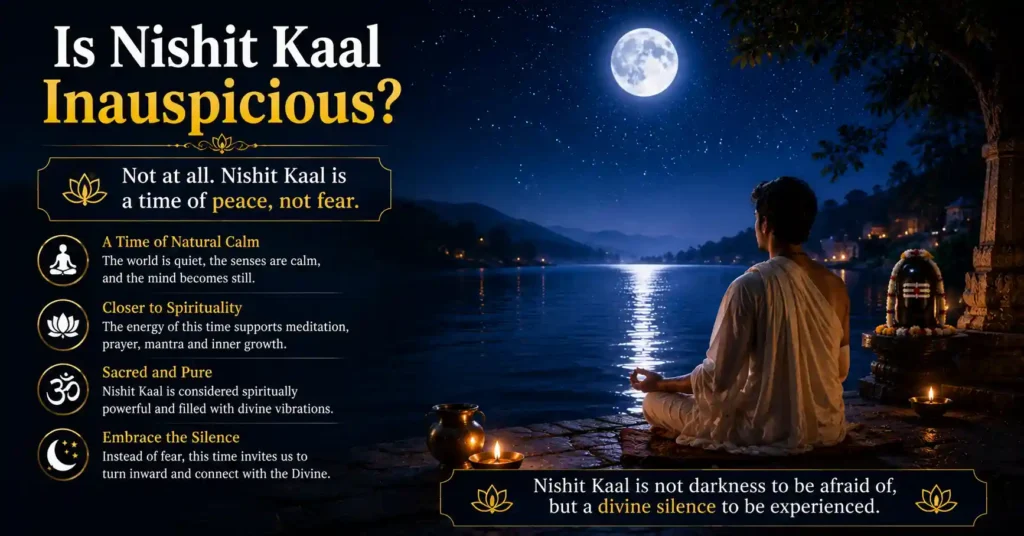
One of the most common questions about Nishit Kaal is whether it is considered inauspicious. The simple answer is no. In Sanatan Dharma, this sacred period is not viewed as inherently negative or harmful. Its significance depends on the purpose for which it is observed.
Many misconceptions arise because it occurs during the deepest part of the night. Since darkness is often associated with fear or uncertainty, some people assume that this period must be inauspicious. However, traditional Hindu teachings generally regard it as a time of stillness, silence, and inward awareness rather than negativity.
For spiritual activities, this time is considered highly beneficial. Traditions associated with Lord Shiva, meditation, mantra japa, and night worship often regard it as especially favorable because distractions are minimal and the mind can become more focused.
At the same time, some traditions do not recommend this period for activities that require outward energy and worldly engagement. New ventures, social ceremonies, or major beginnings are usually associated with other auspicious timings rather than the deep stillness of the night. This does not make the period bad; it simply means that different times are considered suitable for different purposes.
Understanding this concept requires moving beyond the idea of “good” and “bad” time. Traditional wisdom often focuses on harmony with the natural qualities of a particular period. It is valued for contemplation, devotion, meditation, and spiritual practice because these activities align with the quiet nature of the night.
Therefore, it is more accurate to say that Nishit Kaal is a spiritually significant period rather than an inauspicious one. Its importance comes from silence, depth, and inward focus, which is why it continues to be respected in many Hindu traditions.
Is Nishit Kaal Meant Only for Advanced Sadhaks?
No, Nishit Kaal is not reserved only for advanced yogis, monks, or experienced spiritual practitioners. While some traditions associate the deep hours of the night with intense meditation and advanced sadhana, its spiritual benefits are available to anyone who approaches this time with sincerity and devotion.
Many people assume that practices performed during this period require special knowledge, difficult rituals, or years of training. In reality, Sanatan Dharma places great importance on intention, faith, and inner attitude. Even simple acts of devotion can be meaningful.
A devotee may choose to:
- Sit quietly in prayer
- Chant a mantra or divine name
- Read a sacred text
- Practice meditation
- Reflect on spiritual teachings
These simple practices can help a person experience the calm and inward-focused nature of this sacred period. They do not require advanced spiritual qualifications.
At the same time, some traditions use this time for deeper forms of meditation, mantra sadhana, or specialized spiritual disciplines. Such practices are generally undertaken under the guidance of a qualified teacher and are not necessary for ordinary devotional worship.
It is also important to remember that spiritual growth is not measured by how late someone stays awake or how complex their practice appears. A few minutes of sincere remembrance of God can be more valuable than a lengthy ritual performed without focus or devotion.
For most people, the practical lesson is simple. The quiet hours of the night offer an opportunity to slow down, reduce distractions, and spend a few moments in prayer, gratitude, or self-reflection.
This spirit of inner awareness is accessible to everyone, regardless of age, background, or level of spiritual experience.
Do I Have to Stay Awake During Nishit Kaal?
No, there is no universal rule that every person must stay awake during Nishit Kaal. Sanatan Dharma generally emphasizes devotion, sincerity, and inner awareness more than physical endurance. While remaining awake during this period is encouraged in certain traditions and festivals, it is not considered a compulsory requirement for everyone.
The idea behind staying awake is to make use of the natural silence and stillness of the night. Many devotees choose to spend this time in prayer, meditation, mantra chanting, reading sacred texts, or quiet contemplation. These practices often benefit from the reduced distractions present during the deepest part of the night.
On occasions such as Maha Shivratri, night vigil (jagaran) is traditionally regarded as an important observance. Many devotees try to remain awake throughout the night or at least during the most sacred hours dedicated to Lord Shiva worship.
However, spiritual practice should not come at the cost of health. Elderly individuals, people with medical conditions, those with demanding work schedules, or anyone unable to remain awake can still participate through simple prayer, meditation, or worship according to their capacity.
Many traditions recognize that sincere devotion is more important than forcing the body beyond its limits. The purpose is spiritual focus, not physical hardship.
If staying awake throughout the night is difficult, you may choose to spend a few minutes in prayer or meditation before sleeping. Even a short period of focused remembrance can help deepen your spiritual connection without placing unnecessary strain on your body.
The deeper lesson of this sacred period is not simply staying awake. It is about cultivating silence, awareness, and devotion. Whether a person observes the entire period or spends only a few moments in reflection, the value lies in the sincerity of the practice rather than the number of hours spent awake.
How Can Beginners Observe Nishit Kaal?
Many people assume that Nishit Kaal is meant only for advanced spiritual practitioners. However, beginners can also benefit from this sacred period in simple and meaningful ways. The goal is not to perform complicated rituals but to use the quiet atmosphere of the night for spiritual reflection and devotion.
Offer a Simple Prayer
One of the easiest ways to observe this sacred period is through prayer. You can spend a few minutes expressing gratitude, seeking guidance, or remembering your chosen deity.
A sincere prayer offered with faith and concentration is often considered more valuable than a complex ritual performed without devotion.
Chant a Shiva Mantra
Because this time is closely associated with Lord Shiva, many devotees choose to chant simple mantras such as:
Om Namah Shivaya
Maha Mrityunjaya Mantra
Om Namah Bhagavate Rudraya
Even a few minutes of mantra chanting can help calm the mind and create a deeper sense of spiritual connection.
Practice Meditation
The natural silence of this period makes it especially suitable for meditation. Beginners can simply sit comfortably, focus on their breath, and observe their thoughts without judgment.
There is no need for advanced techniques. A short period of quiet awareness can be a meaningful spiritual practice.
Read a Sacred Text
Reading a few verses from the Bhagavad Gita, Shiva Purana, Ramayana, Upanishads, or another spiritual text can be a simple way to honor Nishit Kaal.
The peaceful atmosphere often makes spiritual teachings easier to reflect upon and absorb.
Spend Time in Silent Reflection
Not every spiritual practice requires words or rituals. Some people may choose to sit quietly and reflect on their actions, values, goals, and relationship with the Divine.
This form of self-reflection aligns naturally with the inward-focused nature of this sacred time.
Do Not Force Yourself to Stay Awake
While some devotees observe night vigils during festivals such as Maha Shivratri, staying awake all night is not a requirement for everyone.
If health, work, age, or personal responsibilities make it difficult to remain awake, it is perfectly acceptable to practice for a short time and then rest. Spiritual growth comes through sincerity and consistency, not through physical strain.
Focus on the Spirit, Not Perfection
The most important lesson of Nishit Kaal is not about following strict rules. It is about creating a moment of silence, devotion, and inner awareness.
Even a few minutes spent in prayer, meditation, or reflection can help beginners experience the deeper spiritual value of this quiet period.
How Is Nishit Kaal Different From Midnight?
Many people assume that Nishit Kaal and midnight are the same thing. While they often occur around a similar time, they are not identical. Understanding this difference is important for correctly understanding its role in Sanatan Dharma and traditional Hindu timekeeping.
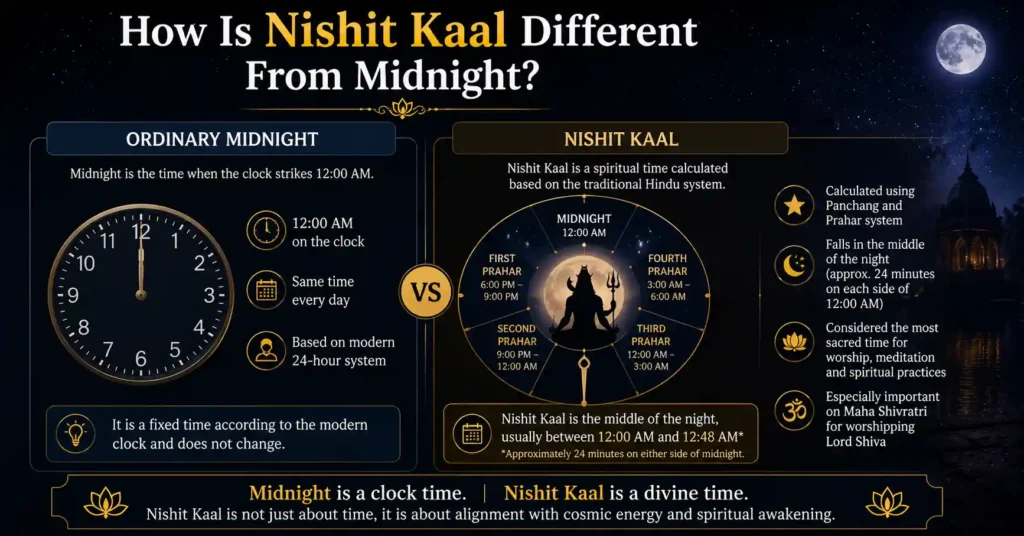
Midnight is a fixed clock-based concept. In modern timekeeping, midnight occurs at exactly 12:00 AM regardless of the season, location, or length of the night.
This sacred period, on the other hand, is traditionally calculated based on the actual duration of the night between sunset and the next sunrise. Because the length of the night changes throughout the year, its timing also changes.
For example, nights are longer during winter and shorter during summer. As a result, the exact period may occur slightly before or after 12:00 AM depending on the season and geographical location.
Traditional Hindu calendars determine this time by identifying the midpoint of the night. In many traditions, it is associated with the eighth muhurta and generally lasts for a limited duration around this central point.
This distinction becomes especially important during festivals such as Maha Shivratri and Janmashtami. The relevant worship is performed during the traditionally calculated sacred period, not necessarily at exactly 12:00 AM according to a clock. This is why Panchangs publish specific timings for different cities and dates.
Quick Comparision
| Aspect | Midnight | Nishit Kaal |
|---|---|---|
| Basis | Fixed clock time | Traditional Hindu calculation |
| Timing | Always 12:00 AM | Changes daily and seasonally |
| Depends on Sunset and Sunrise | No | Yes |
| Spiritual Significance | General time reference | Sacred period used in Hindu observances |
| Used in Panchang Calculations | No | Yes |
| Important for Festivals | Not specifically | Yes, especially Maha Shivratri and Janmashtami |
Understanding the difference helps us appreciate that Nishit Kaal is not simply another name for midnight. It is a traditionally calculated sacred period valued for its spiritual significance, silence, and connection with important Hindu observances.
Can Nishit Kaal Be Followed in Modern Life?
Yes, Nishit Kaal can still be understood and appreciated in modern life, even if most people are unable to follow traditional midnight practices regularly. The deeper purpose of this concept is not merely staying awake at night but creating space for silence, reflection, and spiritual awareness.
Modern lifestyles often involve work schedules, family responsibilities, and health considerations that make it difficult to remain awake during the deepest hours of the night. Sanatan Dharma generally encourages balance and does not require every person to observe spiritual practices in the same way.
Even if someone cannot stay awake during this period, they can still learn from its underlying message. It reminds us of the value of reducing distractions, slowing down the mind, and creating moments of inner stillness amid a busy life.
A simple way to apply its essence in daily life is to set aside a few minutes for:
- Silent prayer
- Meditation
- Mantra chanting
- Reading sacred texts
- Gratitude and self-reflection
These practices can be performed at any suitable time if late-night observance is not practical.
Many devotees choose to observe Nishit Kaal on special occasions such as Maha Shivratri, Janmashtami, or other important spiritual days while maintaining a simpler routine throughout the rest of the year. This approach allows them to honor tradition without disrupting their responsibilities.
Technology has also made it easier to follow traditional timings. Panchang apps and calendars can provide accurate information for specific dates and locations, helping devotees observe important festivals and rituals when desired.
Ultimately, the relevance of Nishit Kaal today lies in its timeless lesson. In a world filled with constant activity, noise, and digital distractions, the practice of pausing, becoming quiet, and turning inward may be more valuable than ever.
The true essence of this sacred period is not about the clock alone. It is about discovering moments of stillness that help deepen awareness, devotion, and connection with the Divine.
Common Misconceptions About Nishit Kaal
Many people misunderstand Nishit Kaal because it is often associated with midnight, mystery, or festival-specific practices. Understanding these misconceptions can help provide a clearer picture of its true spiritual purpose and place within Sanatan Dharma.
Nishit Kaal Is Not Evil or Dangerous
A common misconception is that Nishit Kaal is a negative or frightening time because it occurs during the deepest part of the night.
In reality, Sanatan Dharma generally views this period as a time of silence, stillness, and inward awareness. Its importance comes from the peaceful nature of the time, not from fear, superstition, or danger.
Nishit Kaal Is Not Only for Saints or Advanced Practitioners
Some people believe that this sacred period is meant only for yogis, monks, or highly advanced spiritual seekers.
However, even ordinary devotees can benefit from it through simple practices such as prayer, mantra chanting, meditation, or silent reflection. Spiritual sincerity is considered more important than spiritual status.
Nishit Kaal Is Not Exactly Midnight
Many people use the terms interchangeably, but Nishit Kaal and midnight are not the same.
Midnight is a fixed clock-based time of 12:00 AM. In contrast, this traditionally calculated period depends on the duration between sunset and sunrise, which means its timing changes throughout the year and varies by location.
Nishit Kaal Is Not Limited to Maha Shivratri
Because it is frequently discussed during Maha Shivratri, many assume it applies only to that festival.
While Maha Shivratri is one of the most important occasions for observing Nishit Kaal, the concept is also relevant in Panchang calculations, Krishna Janmashtami observances, and various devotional and meditative traditions.
Staying Awake All Night Is Not Mandatory
Another common misconception is that observing this period requires staying awake throughout the entire night.
Although some devotees choose to perform night vigils during special festivals, there is no universal requirement to remain awake. A short period of sincere prayer, meditation, or mantra chanting can also be meaningful.
Nishit Kaal Is Not About Ritual Alone
Some people think that this sacred time is valuable only when accompanied by elaborate rituals and ceremonies.
However, its deeper purpose is to encourage silence, self-reflection, devotion, and inner awareness. Even simple spiritual practices performed with sincerity can honor the essence of this period.
By understanding these misconceptions, readers can develop a clearer understanding of Nishit Kaal, its spiritual purpose, and its place within the broader traditions of Sanatan Dharma.
Conclusion
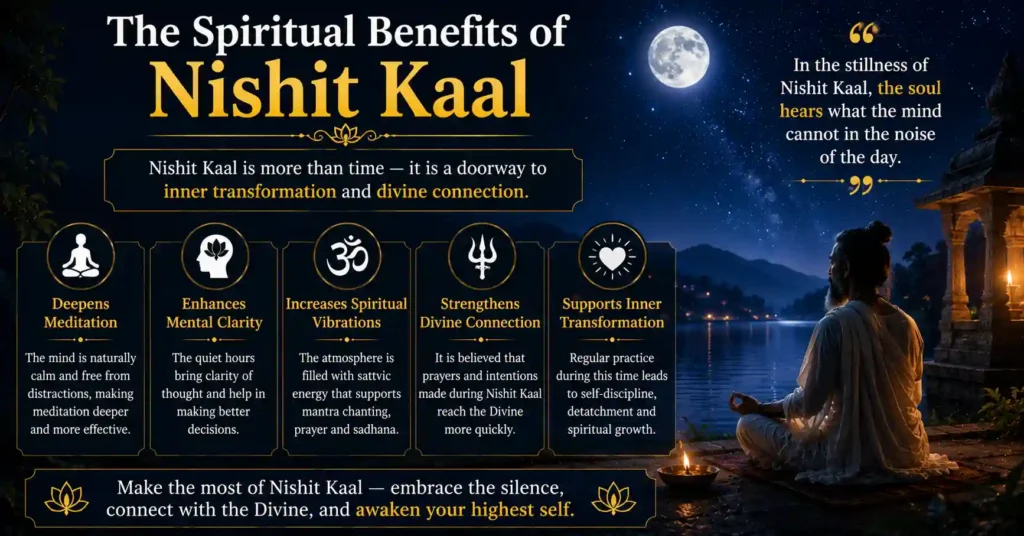
Nishit Kaal is much more than a period around midnight. In Sanatan Dharma, it is regarded as a sacred time of silence, stillness, and inward awareness. Calculated according to traditional Hindu timekeeping, this period varies each day and is closely connected with important festivals, spiritual observances, and Panchang calculations.
The meaning of this sacred time reminds us that certain moments naturally support reflection, prayer, meditation, and devotion. This is why it has been respected for centuries by devotees, saints, and spiritual traditions across India.
Its spiritual importance is especially visible during Maha Shivratri and Janmashtami, where worship performed during these quiet hours is considered highly meaningful. Yet its value is not limited to festivals alone. It also serves as a reminder of the importance of silence and inner stillness in everyday life.
In today’s fast-moving world, not everyone can observe Nishit Kaal in the traditional way. However, its deeper message remains relevant. By creating moments of quiet reflection and reducing distractions, we can bring some of the spirit of this sacred period into our daily lives.
Ultimately, Nishit Kaal teaches that spiritual growth is not always found in activity and noise. Sometimes, the most meaningful insights arise during moments of silence, when the mind becomes calm and the heart turns inward.
Key Takeaways
- Nishit Kaal is the deepest and most silent period of the night in traditional Hindu timekeeping. It is regarded as a favorable time for prayer, meditation, and spiritual reflection.
- The term reflects a state of profound stillness and inward awareness, making this period spiritually significant in Sanatan Dharma.
- Its timing is not fixed at 12:00 AM. Instead, it is calculated according to the duration between sunset and sunrise, which is why it varies by date and location.
- This sacred period plays an important role in Panchang calculations, festival observances, and various devotional traditions across Hinduism.
- During Maha Shivratri, it is considered one of the most sacred times for worshipping Lord Shiva, performing mantra chanting, and practicing meditation.
- Nishit Kaal is not considered inauspicious. It is respected for its silence, calmness, and ability to support spiritual focus and inner contemplation.
- It is not reserved only for advanced practitioners. Even simple acts of prayer, remembrance, meditation, or self-reflection can help a devotee connect with its spiritual essence.
- Staying awake during Nishit Kaal is optional. The deeper purpose is cultivating awareness, devotion, and inner stillness rather than merely remaining awake at night.
- Its timeless lesson is that silence, contemplation, and moments of inner quiet can play an important role in spiritual growth, even in modern life.
FAQs
What Is Nishit Kaal?
Nishit Kaal is the deepest and most silent period of the night in traditional Hindu timekeeping. It is generally considered the midpoint of the night between sunset and sunrise and is regarded as a spiritually significant time for prayer, meditation, mantra chanting, and inner reflection.
Unlike ordinary midnight, its timing is not fixed at 12:00 AM. It is calculated according to the actual duration of the night, which means it changes throughout the year and varies by location.
In Sanatan Dharma, this period is valued because external activity naturally decreases and the atmosphere becomes quieter. Many spiritual traditions believe that the reduced distractions of the night make it easier to focus the mind and deepen one’s spiritual practice.
The Nishit Kaal meaning goes beyond a simple measurement of time. It represents a state of stillness and inward awareness. For centuries, devotees, saints, and spiritual seekers have regarded this sacred period as favorable for connecting with the Divine through prayer, meditation, and self-reflection.
Its spiritual importance is especially visible during major Hindu festivals such as Maha Shivratri and Krishna Janmashtami. On these occasions, worship performed during this time is considered particularly sacred and meaningful.
However, the importance of Nishit Kaal is not limited to festivals alone. It reflects a broader understanding within Sanatan Dharma that certain periods naturally support particular spiritual activities and states of mind.
For many devotees, Nishit Kaal serves as a reminder that silence, contemplation, and inner awareness can play an important role in spiritual growth and self-discovery.
What Is the Exact Time of Nishit Kaal?
There is no single fixed Nishit Kaal time that applies every day. Unlike ordinary midnight, it is calculated based on the duration between sunset and the next sunrise. As a result, the timing changes throughout the year and varies from one location to another.
In traditional Hindu timekeeping, the night is divided into equal segments known as muhurtas. This sacred period is generally identified as the central portion of the night and is often associated with the eighth night muhurta.
Because the length of the night changes with the seasons, the exact timing also changes. During some months it may occur slightly before 12:00 AM, while in others it may occur slightly after midnight.
For this reason, devotees usually consult a Panchang or Hindu calendar to find the correct timing for a specific date and place. During important festivals such as Maha Shivratri and Krishna Janmashtami, these timings are carefully calculated and published in advance.
Understanding this calculation helps us appreciate that Nishit Kaal is not simply another name for midnight. It is a traditionally determined sacred period that reflects the Hindu understanding of time, astronomy, and spiritual observances.
Why Is Nishit Kaal Important on Maha Shivratri?
Nishit Kaal is considered the most sacred period of Maha Shivratri because it is traditionally associated with Lord Shiva. Many Hindu traditions believe that worship performed during this time holds special spiritual significance.
The silence and stillness of the night naturally support meditation, mantra chanting, and prayer. For this reason, devotees often perform Shiva Puja, Rudrabhishek, and chant “Om Namah Shivaya” during this sacred period.
Beyond rituals, the deeper significance lies in turning inward. Maha Shivratri encourages self-reflection, discipline, and spiritual awareness, and this period is regarded as one of the most important moments for these practices.
Can Women Observe or Pray During Nishit Kaal?
Yes, women can absolutely pray, meditate, chant mantras, and worship during Nishit Kaal. Sanatan Dharma does not place any general restriction on women participating in sincere devotional practices during this sacred time.
The core principle of Hindu spirituality is devotion (bhakti), sincerity, and inner purity. These qualities are not determined by gender. Whether a person is a man or a woman, the value of worship comes from faith, intention, and spiritual focus.
Many women observe Maha Shivratri, Janmashtami, and other religious festivals that involve worship during this period. They participate in prayer, fasting, meditation, and devotional practices according to their tradition and personal circumstances.
Is Nishit Kaal Auspicious or Inauspicious?
A common misconception is that Nishit Kaal is inauspicious because it occurs late at night. In reality, Hindu traditions generally regard this period as highly favorable for spiritual activities such as meditation, mantra chanting, Shiva worship, and contemplation.
However, traditional teachings often distinguish between spiritual and worldly activities. While this sacred time is considered beneficial for devotion and inner practices, it is usually not recommended for activities such as business launches, weddings, or other social functions.
Therefore, whether a period is considered suitable depends on the activity being performed. For spiritual growth, worship, and self-reflection, Nishit Kaal is widely regarded as a highly meaningful and beneficial time.
Is Nishit Kaal the Same as Midnight?
No. Although Nishit Kaal usually occurs around midnight, it is not exactly the same as 12:00 AM on a clock. Midnight is a fixed modern time reference, whereas this sacred period is determined through traditional Hindu calculations based on sunset and sunrise.
As the length of the night changes throughout the year, its timing also changes. On some days it may begin slightly before midnight, while on others it may occur after midnight.
This distinction is especially important during festivals because rituals are performed according to the calculated Nishit Kaal rather than simply at 12:00 AM.
Can I Practice Meditation During Nishit Kaal?
Yes. Meditation is one of the most common practices associated with Nishit Kaal in Sanatan Dharma. The quiet atmosphere of the night reduces distractions and can help practitioners focus more deeply on their spiritual practice.
Many devotees use this time for silent meditation, mantra japa, breath awareness, prayer, or reading sacred texts. The goal is not simply to stay awake but to make use of the natural stillness that the period offers.
Even a few minutes of sincere meditation during Nishit Kaal can become a meaningful spiritual experience.
Can Nishit Kaal Be Observed Without Staying Awake All Night?
No. Observing Nishit Kaal does not necessarily mean remaining awake throughout the entire night. Many devotees spend a short period in prayer, meditation, or mantra chanting during this sacred time and then rest normally.
Sanatan Dharma generally encourages balanced spiritual practice. If health, age, work, or family responsibilities make it difficult to stay awake, there is no fault in adapting the practice according to one’s capacity.
The essence of Nishit Kaal lies in cultivating devotion, silence, and awareness rather than forcing the body beyond its limits.
Suggested Reading
If learning about Nishit Kaal has deepened your interest in Sanatan Dharma, you may also enjoy exploring related spiritual concepts and practices. Understanding Nishit Kaal becomes even more meaningful when viewed alongside topics such as devotion, meditation, sacred time, surrender, and the soul’s spiritual journey.
These teachings help place the significance of Nishit Kaal within the broader framework of Hindu philosophy and spiritual growth.
What Is Rudraksha? Meaning, Types and Spiritual Benefits
https://thesanatantales.com/what-is-rudraksha/
What Is Sharanagati? Understanding Surrender in Hindu Philosophy
https://thesanatantales.com/what-is-sharanagati/
What Is Bhakti? Meaning, Types, Importance, and Understanding in Sanatan Dharma
https://thesanatantales.com/what-is-bhakti/
What Is Brahman? Meaning, Nature and Spiritual Significance in Hinduism
https://thesanatantales.com/what-is-brahman/
Brahma Muhurta: Meaning, Time, Benefits and Spiritual Significance
https://thesanatantales.com/brahma-muhurta/
What Is Samsara? Meaning, Karma, and the Cycle of Rebirth
https://thesanatantales.com/what-is-samsara/
References & Sources
This article is based on teachings, concepts, and traditional understandings associated with Nishit Kaal in Sanatan Dharma, including insights drawn from Hindu scriptures, Panchang traditions, festival observances, devotional practices, yogic teachings, and widely accepted spiritual interpretations preserved across generations.
The article also reflects traditional knowledge related to sacred timekeeping, meditation, prayer, mantra chanting, and the spiritual significance of silence and inward reflection within Hindu culture and practice.
Note: Interpretations, practices, and levels of observance related to Nishit Kaal may vary across different sampradayas, traditions, regions, spiritual lineages, and individual practitioners. The purpose of this article is not to promote any single interpretation as the absolute truth, but to present commonly understood perspectives in a simple, practical, and reader-friendly manner.
Sanatan Dharma embraces diverse paths of devotion, knowledge, meditation, self-discipline, and spiritual growth. As a result, the understanding and observance of Nishit Kaal may differ while still remaining rooted in the broader principles of Hindu philosophy and tradition.
Latest From The Sanatan Tales