Bhagwan Dattatreya is one of the most revered Gurus in Sanatan Dharma, worshipped as the combined manifestation of Brahma, Vishnu, and Mahesh. Yet devotees remember him not as a distant deity seated far away from human life, but as a compassionate guide who walks beside sincere seekers.
He is known as the Adi Guru, the eternal teacher whose wisdom transcends time, tradition, and social boundaries. His life demonstrates that true spirituality is simple, natural, and deeply connected with everyday living.
Instead of emphasizing rigid rules or fear-based discipline, Bhagwan Dattatreya teaches awareness, balance, self-realization, and inner freedom. Through his teachings, the twenty-four gurus, and the traditions that continue in his name, he inspires seekers to learn from life itself.
This is why his presence feels alive even today. Not merely as a figure from the past, but as a timeless Guru whose guidance continues to illuminate spiritual journeys across generations.
Table of Contents
ToggleWho Is Bhagwan Dattatreya in Sanatan Dharma
In Sanatan Dharma, Bhagwan Dattatreya holds a unique and deeply revered place as the embodiment of divine wisdom and the eternal Guru. He is worshipped as the combined manifestation of Brahma, Vishnu, and Mahesh, representing the cosmic forces of creation, preservation, and transformation united in a single form.
Yet, unlike many deities known for royal grandeur, celestial weapons, or divine battles, Bhagwan Dattatreya is remembered primarily as an Avadhuta. An Avadhuta is a realized being who has transcended ego, social identity, worldly attachments, and the limitations of ordinary perception.
His life reflects simplicity, detachment, and complete spiritual freedom. Rather than teaching through authority or ritual alone, he taught through personal example, observation, and direct experience.
Because of these qualities, Bhagwan Dattatreya is revered as the Adi Guru, the original teacher whose life itself became a timeless lesson for seekers pursuing wisdom, self-realization, and inner liberation.
The Birth Story and Its Quiet Message
The birth story of Bhagwan Dattatreya is deeply rooted in devotion, purity, and divine grace. According to traditional accounts, he was born to the great sage Rishi Atri and his virtuous wife Maa Anasuya, who is celebrated in Sanatan Dharma as an ideal of faith, humility, and unwavering devotion.
Moved by her spiritual strength and purity, the Divine Trinity of Brahma, Vishnu, and Mahesh decided to test her virtue. Maa Anasuya faced this challenge with wisdom, compassion, and complete surrender to Dharma.
Pleased by her devotion, the three deities blessed her by manifesting together as a single divine child. That child became Bhagwan Dattatreya, embodying the qualities of the Divine Trinity within one form.
Beyond its miraculous elements, this story carries a timeless spiritual message. It reminds seekers that divine grace naturally flows where there is purity of heart, selfless service, humility, and unwavering faith.
The Meaning Carried in the Name Dattatreya
The name Dattatreya itself reveals his spiritual essence. The word “Datta” means “given” or “bestowed,” while “Atreya” means “son of Atri.” Together, the name signifies the divine child who was gifted to the world through the blessings of the Divine Trinity and the devotion of Rishi Atri and Maa Anasuya.
This meaning points to a profound spiritual truth. Wisdom is not something to be possessed or controlled. It is meant to be shared for the benefit of all seekers. Bhagwan Dattatreya embodies this spirit of selfless giving through his teachings, guidance, and example.
For this reason, devotees often lovingly refer to him as Datta Guru or Dattaguru. The name reflects his role as the eternal spiritual teacher who freely offers wisdom, compassion, and divine grace to those who seek truth with sincerity and devotion.
His Form, Symbols, and Silent Teachings
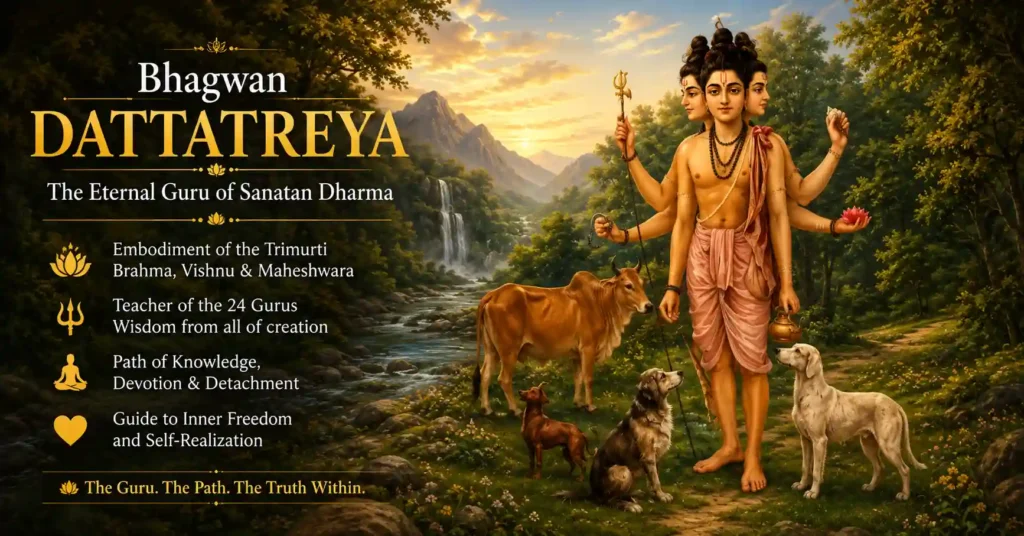
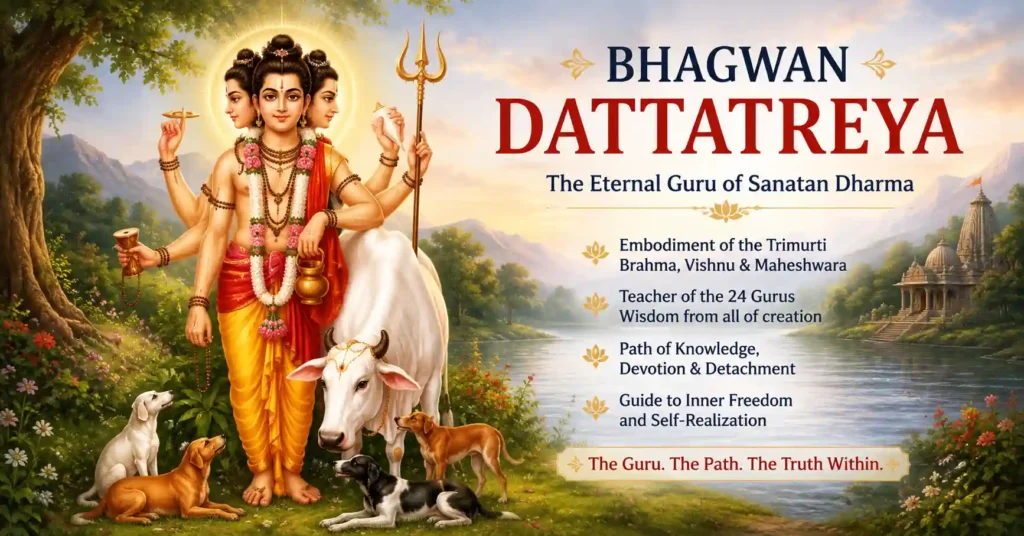
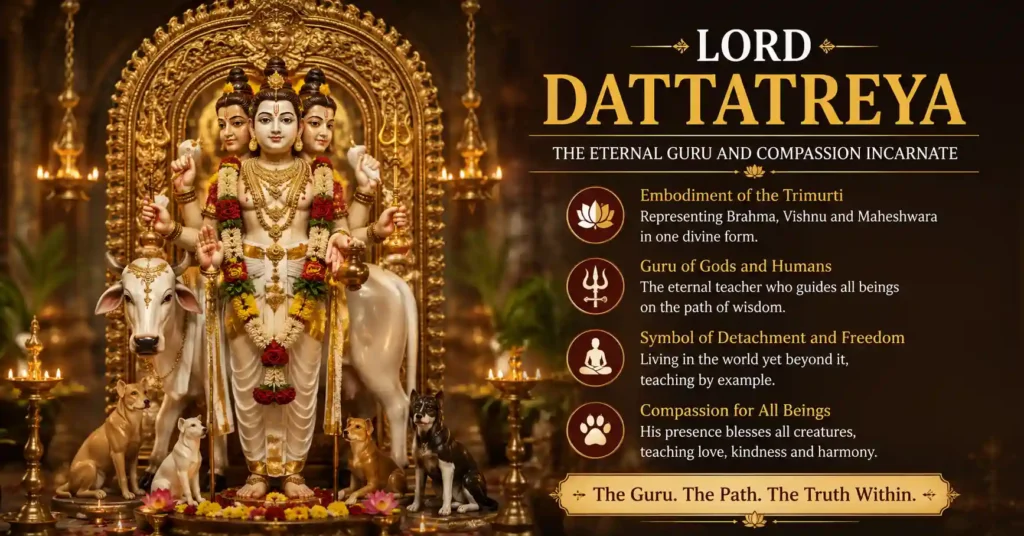
Bhagwan Dattatreya is often depicted with three faces, symbolizing the unified presence of Brahma, Vishnu, and Mahesh. His six hands carry sacred objects associated with spiritual wisdom, duty, and renunciation.
Beside him stands a sacred cow, representing compassion, nourishment, and the sustaining power of nature. Four dogs accompany him and are traditionally believed to symbolize the four Vedas, reflecting the presence of sacred knowledge.
More than a visual representation, his form conveys a deeper spiritual message. Despite embodying immense divine wisdom, Bhagwan Dattatreya appears simple and approachable. His image reminds seekers that true greatness lies not in power or display, but in humility, awareness, and inner realization.
The Deeper Symbolism of Bhagwan Dattatreya's Form
Every aspect of Bhagwan Dattatreya’s form carries spiritual meaning. His three faces symbolize the unity of creation, preservation, and transformation represented by Brahma, Vishnu, and Mahesh.
His six hands remind seekers that spiritual life requires both action and wisdom. They symbolize the balance between fulfilling worldly responsibilities and maintaining inner detachment.
The sacred cow standing beside him represents Mother Earth, compassion, nourishment, and the sustaining power of nature. The four dogs symbolize the four Vedas and also remind devotees that divine wisdom can be found even in places society may overlook.
Together, these symbols teach that true spirituality is not about withdrawing from life but understanding the divine reality present within all creation. Bhagwan Dattatreya’s form serves as a reminder that wisdom, compassion, knowledge, and spiritual freedom can exist in harmony.
Bhagwan Dattatreya as the Adi Guru
As the Adi Guru, Bhagwan Dattatreya teaches without command or compulsion. He does not demand belief or impose rigid discipline. Instead, his wandering life itself becomes the lesson.
He demonstrates that one can live fully in the world while remaining free from fear, greed, pride, and attachment. His teachings encourage seekers to cultivate awareness, balance, and inner freedom rather than depend solely on external rituals.
For many devotees, Bhagwan Dattatreya represents the inner Guru, the quiet presence that awakens understanding when the time is right. His guidance is believed to arise naturally through experience, reflection, and spiritual maturity.
In Sanatan Dharma, the Guru is not merely a teacher of information but a guide who removes ignorance and helps reveal higher truth. Bhagwan Dattatreya is therefore revered as the embodiment of Guru Tattva, the eternal principle of wisdom that leads seekers from confusion toward clarity, self-realization, and liberation.
Bhagwan Dattatreya and the Nath Sampradaya
In yogic traditions, particularly within the Nath Sampradaya, Bhagwan Dattatreya is revered as a great source of spiritual and yogic wisdom. Many Nath practitioners honor him as an Adi Guru whose life exemplified direct experience, self-discipline, and inner realization.
According to Nath tradition, yogic masters such as Matsyendranath and his disciple Gorakshanath carried forward teachings that emphasized spiritual discipline, mastery of the mind, and freedom from ego. Their approach focused on transforming the individual through practice, awareness, and self-realization.
Like Bhagwan Dattatreya, Nath yogis often lived beyond conventional social boundaries, valuing simplicity, detachment, and direct spiritual experience over external status or recognition.
Through this living tradition, the influence of Bhagwan Dattatreya became closely associated with the growth of yogic practices, including the broader stream of Hatha Yoga and spiritual awakening.
Bhagwan Dattatreya and the Datta Sampradaya
Beyond the Nath tradition, Bhagwan Dattatreya is also the central figure of the Datta Sampradaya, a devotional lineage that flourished across Maharashtra, Karnataka, Telangana, Andhra Pradesh, and Gujarat.
Followers of this tradition worship Dattatreya as the eternal Guru who continues to guide devotees through grace and spiritual wisdom. The emphasis is placed on devotion to the Guru, self-discipline, righteous living, and remembrance of the Divine Name.
Many saints associated with the Datta Sampradaya are believed to embody the Guru principle of Dattatreya, helping preserve his teachings across generations. Through this living tradition, his message remains active in the spiritual lives of countless devotees even today.
Shripada Shrivallabha and Narasimha Saraswati
Within the Datta tradition, Shripada Shrivallabha and Narasimha Saraswati are revered as important manifestations of Bhagwan Dattatreya’s Guru lineage.
Shripada Shrivallabha is regarded as one of the earliest widely recognized incarnations of Dattatreya. His life inspired devotion, faith, and spiritual discipline among seekers.
Narasimha Saraswati later strengthened the Datta tradition by emphasizing Vedic learning, righteous conduct, and Guru devotion. His teachings helped preserve spiritual values during a period of social change.
Even today, their lives are studied by devotees seeking a deeper understanding of the Datta path and the living presence of the Guru.
From Nath Yogis to Modern Yoga Seekers
For the Nath yogis, yoga was never a performance or display. It was a disciplined way of life rooted in awareness, self-mastery, and spiritual growth.
That same spirit continues to inspire seekers today. Many people turn to yoga for peace, healing, balance, or clarity, yet its deeper purpose remains inner transformation and self-understanding.
While modern yoga often takes different forms, its essential goal remains unchanged: cultivating awareness, overcoming limitations of the ego, and discovering a deeper connection with oneself. In this sense, the wisdom associated with Bhagwan Dattatreya and the Nath yogis continues to remain relevant in contemporary life.
Learning From Life: The Twenty-Four Gurus
One of the most inspiring teachings of Bhagwan Dattatreya is his acceptance of twenty-four gurus drawn from nature and everyday life. Instead of limiting wisdom to sages or scriptures alone, he learned from the world around him and discovered spiritual lessons in ordinary experiences.
| Guru | Lesson |
|---|---|
| Earth | Patience and forgiveness |
| Water | Purity and adaptability |
| Fire | Transformation and detachment |
| Sky | Vastness and freedom |
| Moon | The eternal nature of the Self |
| Ocean | Stability amidst change |
| Honeybee | Avoid excessive accumulation |
| Child | Innocence and simplicity |
The earth taught patience and forgiveness. Water taught purity and adaptability. Fire taught transformation and detachment.
The sky taught vastness and freedom from limitations. The moon revealed that the true Self remains unchanged even as life passes through different phases.
He also learned from animals and daily observations. The honeybee taught the dangers of excessive accumulation. The python taught contentment with whatever comes naturally.
The ocean taught stability amidst constant change, while a child demonstrated innocence, simplicity, and freedom from pride.
Through these observations, Bhagwan Dattatreya showed that spiritual learning is not confined to temples, forests, or formal teachings. Life itself becomes a Guru when approached with awareness.
This timeless lesson continues to inspire seekers to find wisdom in every experience and every aspect of creation.
Core Teachings of Bhagwan Dattatreya
The teachings of Bhagwan Dattatreya are simple in expression yet profound in meaning. He taught detachment without rejection, freedom without escape, and spirituality without unnecessary complexity. Balance, humility, self-awareness, and inner silence form the foundation of his path.
Key Teachings of Bhagwan Dattatreya
Learn from every experience.
Remain detached without rejecting life.
Balance worldly duties with spiritual growth.
Cultivate humility and self-awareness.
Stay steady during joy and sorrow.
Seek wisdom through direct experience.
He encouraged seekers to remain steady in both joy and sorrow, success and failure. Rather than running away from life, he taught the importance of observing it with clarity and understanding.
His teachings emphasize learning from experience, overcoming ego, and discovering wisdom in everyday situations.
Unlike paths based on fear or rigid control, the guidance of Bhagwan Dattatreya leads toward inner freedom and self-realization. His message continues to inspire those seeking a life rooted in awareness, simplicity, and spiritual growth.
Bhagwan Dattatreya in Scriptures and Living Tradition
Bhagwan Dattatreya occupies a unique place in Sanatan Dharma because he is remembered through both sacred texts and living spiritual traditions.
Various scriptures describe his wisdom, teachings, and realization, while generations of devotees have preserved his legacy through Guru lineages and devotional practices.
His influence extends beyond the pages of scripture into traditions that continue to inspire seekers across India. Through saints, teachers, pilgrimage centers, and spiritual communities, the teachings associated with Bhagwan Dattatreya remain alive and relevant even today.
This combination of scriptural authority and living tradition has helped preserve his role as the eternal Guru for countless generations.
Bhagwan Dattatreya in Sacred Scriptures
The presence of Bhagwan Dattatreya is found across several important spiritual texts of Sanatan Dharma. These scriptures present him not merely as a deity but as a realized Guru who embodies the highest state of spiritual freedom.
The Bhagavata Purana describes the dialogue between King Yadu and the Avadhuta Dattatreya, where the teaching of the twenty-four gurus is explained. This episode highlights his ability to discover wisdom in every aspect of creation.
The Markandeya Purana and Brahma Purana also contain references to Dattatreya and his divine nature. In yogic traditions, he is remembered as a master of self-realization whose teachings transcend sectarian boundaries.
Many seekers regard these scriptural references as evidence that Bhagwan Dattatreya represents the eternal Guru principle, guiding humanity toward knowledge, detachment, and liberation.
The Wisdom of the Avadhuta Gita
Among the texts associated with Bhagwan Dattatreya, the Avadhuta Gita holds a special place. It is considered one of the profound expressions of Advaita, the philosophy of non-duality.
The text teaches that the true Self is beyond birth and death, beyond success and failure, and beyond all worldly identities. It emphasizes direct realization rather than intellectual debate.
The Avadhuta Gita repeatedly points toward inner freedom. It reminds seekers that the Divine is not separate from the Self and that liberation comes through knowledge of one’s true nature.
For many spiritual aspirants, this text represents the heart of Dattatreya’s message: freedom from ignorance through direct experience of the eternal truth.
Dattatreya Upanishad and Spiritual Significance
The Dattatreya Upanishad is one of the lesser-known but important texts connected with Bhagwan Dattatreya. It presents him as a manifestation of supreme consciousness and emphasizes the transformative power of spiritual knowledge.
The Upanishadic tradition views Dattatreya not only as a Guru but also as a symbol of the unity underlying all existence. His teachings encourage seekers to move beyond external differences and discover the same divine reality within all beings.
This philosophical dimension explains why Dattatreya is respected across different traditions, including Vedanta, Yoga, Nath teachings, and the Datta Sampradaya. His message remains centered on self-realization, inner freedom, and awareness of the Divine presence in everyday life.
Worship, Mantra, and Simple Devotion
Devotion to Bhagwan Dattatreya is often simple, sincere, and centered on remembrance of the Guru. Many devotees begin their day by offering prayers, lighting a lamp, and chanting his name with faith.
One of the most widely recited mantras associated with Bhagwan Dattatreya is:
Om Dram Dattatreyaya Namah
Devotees chant this mantra seeking guidance, inner peace, wisdom, and spiritual strength. Regular remembrance of Bhagwan Dattatreya is believed to cultivate clarity, humility, devotion, and a deeper connection with the Guru principle.
Thursday is traditionally considered an auspicious day for Guru worship, and many devotees offer special prayers to Bhagwan Dattatreya on this day. Datta Jayanti, which celebrates his divine birth, is also observed with devotion, prayers, and spiritual gatherings.
More than elaborate rituals, the Datta tradition emphasizes purity of intention, selfless service, gratitude, and spiritual awareness. Through simple acts of devotion, seekers strive to bring the teachings of Bhagwan Dattatreya into their daily lives.
Datta Jayanti: Celebrating the Birth of Bhagwan Dattatreya
Datta Jayanti is the most important festival dedicated to Bhagwan Dattatreya. It is observed on the full moon day of the Margashirsha month and is celebrated by devotees across India, particularly in regions where the Datta tradition has a strong presence.
Common Datta Jayanti Observances
Visiting Datta temples
Chanting Datta mantras
Reading sacred texts
Guru worship
Bhajans and devotional gatherings
Acts of charity and service
On this sacred day, devotees visit temples, chant mantras, read spiritual texts, perform Guru worship, and participate in devotional gatherings. Many also spend time reflecting on the teachings of Bhagwan Dattatreya and the importance of the Guru in spiritual life.
More than a celebration of his divine birth, Datta Jayanti serves as a reminder of the timeless Guru principle that guides seekers toward wisdom, self-realization, and inner transformation.
For many devotees, the festival becomes an opportunity to renew their commitment to humility, self-discipline, devotion, gratitude, and spiritual growth.
Sacred Places Connected With His Presence
Several pilgrimage sites across India are deeply associated with Bhagwan Dattatreya and the Datta tradition. These sacred destinations attract devotees seeking spiritual guidance, inner peace, and Guru blessings.
| Sacred Place | State | Significance |
|---|---|---|
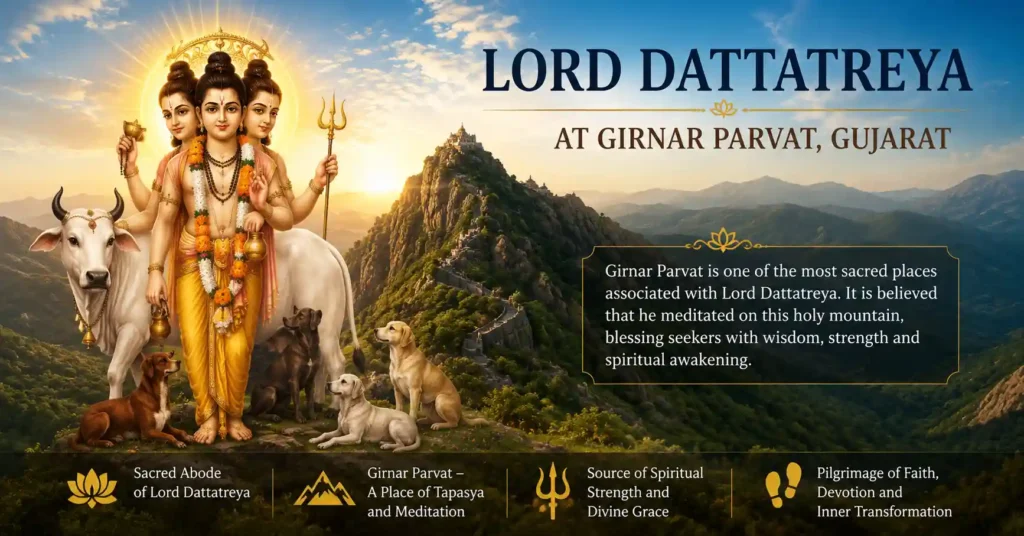
| Girnar | Gujarat | Revered as a major pilgrimage site associated with Bhagwan Dattatreya’s meditation and spiritual practices. |
| Ganagapur | Karnataka | One of the most important centers of the Datta Sampradaya and closely linked with Narasimha Saraswati. |
| Audumbar | Maharashtra | Known for its peaceful atmosphere and long-standing Datta devotional traditions. |
| Mahur | Maharashtra | Associated with Rishi Atri, Maa Anasuya, and traditions connected with Bhagwan Dattatreya’s birth and worship. |
For devotees, these places are more than geographical locations. They are living centers of faith, remembrance, spiritual practice, and Guru devotion that continue to attract seekers from across India.
Regional Traditions of Bhagwan Dattatreya Worship
The worship of Bhagwan Dattatreya varies across different regions of India while preserving the same Guru-centered spirit.
In Maharashtra, devotion to Dattatreya is closely connected with the Datta Sampradaya and the lives of revered saints. In Karnataka and Andhra Pradesh, many devotees undertake pilgrimages to sacred Datta centers and participate in collective chanting and devotional gatherings.
In Gujarat, Girnar remains one of the most important places associated with his presence. Various local traditions, stories, and devotional practices have developed around these sacred sites over generations.
These regional expressions show how Bhagwan Dattatreya’s teachings continue to inspire people from diverse backgrounds while remaining rooted in the same spiritual foundation.
Why He Feels Like a Living Guru Even Today
Even today, many devotees feel a deep connection with Bhagwan Dattatreya through prayer, meditation, and remembrance of the Guru. During moments of uncertainty, they often describe experiencing a sense of inner clarity, guidance, or reassurance that strengthens their faith.
Within the Datta tradition, it is believed that the Guru’s grace reaches the seeker when the time is right. Rather than being sought through demands or expectations, this guidance is said to arise naturally through devotion, sincerity, and spiritual readiness.
This living relationship between the Guru and the devotee continues to keep the worship of Bhagwan Dattatreya vibrant across generations, making him not only a revered figure of the past but also a source of inspiration for seekers today.
Relevance of Bhagwan Dattatreya in Modern Life
In today’s fast-moving and often distracted world, the teachings of Bhagwan Dattatreya remain deeply relevant. He encourages seekers to slow down, observe life with awareness, and discover wisdom in everyday experiences.
His example reminds us that true fulfillment does not depend on possessions, status, or external recognition, but on inner clarity and self-understanding.
The teaching of the twenty-four gurus is especially meaningful in modern times. It encourages people to learn not only from books and teachers but also from nature, relationships, challenges, and daily experiences.
Through observation and reflection, ordinary life itself becomes a source of spiritual growth.
Bhagwan Dattatreya’s message of simplicity, humility, balance, and inner freedom continues to inspire those seeking peace and spiritual grounding amidst the pressures of contemporary life.
His teachings remind us that inner freedom begins with awareness and grows through sincere self-observation.
What Today's Seekers Can Learn From Bhagwan Dattatreya
The life of Bhagwan Dattatreya offers timeless lessons for modern seekers. His teachings remind us that spiritual growth does not require withdrawing from the world.
Instead, it begins with observing life carefully, learning from every experience, and developing inner awareness. His example shows that wisdom can be found in nature, relationships, challenges, and everyday moments.
Learn from every experience, whether pleasant or difficult.
Remain humble even while gaining knowledge.
Value inner awareness more than outward appearance.
Stay balanced during success and failure.
Treat nature as a teacher and source of wisdom.
Remember that spiritual growth begins with observation and self-reflection.
In a world filled with constant distractions, Bhagwan Dattatreya’s teachings encourage simplicity, mindfulness, and self-understanding.
His path reminds us that true wisdom is not measured by how much we know, but by how deeply we understand ourselves and our connection with the Divine.
Conclusion
Whether approached as a deity, Guru, yogi, or spiritual ideal, Bhagwan Dattatreya continues to inspire seekers across traditions. His teachings remind us that truth can be discovered in every aspect of life by those who cultivate patience, humility, and awareness.
Bhagwan Dattatreya shows that the true Guru exists both outside and within. His life teaches that inner freedom is natural, spiritual growth is possible amidst everyday responsibilities, and divine grace flows where there is sincerity and surrender.
Walking his path is not about becoming someone new. It is about awakening to the wisdom, peace, and divine presence that already exist within.
Suggested Reading
If the teachings of Bhagwan Dattatreya inspire you, you may also enjoy exploring these related articles from The Sanatan Tales:
Kaal Bhairav: 7 Divine Ways He Clears Your Path
https://thesanatantales.com/kaal-bhairav/Khandoba: The Warrior God Worshipped Across Maharashtra
https://thesanatantales.com/khandoba-warrior-god-of-maharashtra/Khatu Shyam Baba: The God of Faith, Hope, and Surrender
https://thesanatantales.com/khatu-shyam-baba/Shiva and Bhairav: Meaning, Connection & Spiritual Path
https://thesanatantales.com/shiva-and-bhairav-guide/path/Das Mahavidya: The Ten Wisdom Goddesses of Sanatan Dharma
https://thesanatantales.com/das-mahavidya/Dattatreya (Wikipedia)
https://en.wikipedia.org/wiki/Dattatreya
These articles explore different aspects of Sanatan Dharma, including Guru wisdom, devotion, transformation, spiritual discipline, and the many ways divine guidance appears in a seeker’s journey.
FAQs
Who is Bhagwan Dattatreya in Sanatan Dharma?
Bhagwan Dattatreya is revered as the Adi Guru and the combined form of Brahma, Vishnu, and Mahesh. He represents creation, preservation, and dissolution united in one Guru form, guiding seekers toward inner freedom.
Why is Bhagwan Dattatreya called the Adi Guru?
He is called the Adi Guru because his life itself became the first teaching. He did not establish rigid systems or rules. Instead, he showed how awareness, detachment, and balance lead to self-realization.
What does Avadhuta mean in relation to Dattatreya?
An Avadhuta is one who has gone beyond ego, identity, and social conditioning. Bhagwan Dattatreya is remembered as an Avadhuta because he lived freely, untouched by fear, pride, or attachment.
What are the 24 gurus of Bhagwan Dattatreya?
The 24 gurus are teachers he recognized in nature and daily life, such as earth, water, fire, sky, and even a child. Through them, he taught that wisdom can be learned from everything when observed with awareness.
How is Bhagwan Dattatreya connected to the Nath Sampradaya?
The Nath Sampradaya regards Bhagwan Dattatreya as its Adi Guru. Nath yogis like Matsyendranath and Gorakshanath carried forward his yogic wisdom, emphasizing inner discipline and freedom rather than outer display.
Which scriptures mention Bhagwan Dattatreya?
He is mentioned in texts such as the Bhagavata Purana, where he teaches King Yadu, and the Avadhuta Gita, which reflects deep Advaita wisdom. Other Puranic texts also refer to his divine nature.
How is Bhagwan Dattatreya worshipped by devotees?
His worship is simple and heartfelt. Chanting his name, observing Datta Jayanti, remembering the Guru, and living with awareness are considered true forms of devotion. Sincerity matters more than ritual.
Why do devotees feel Bhagwan Dattatreya is a living Guru even today?
Many devotees believe he guides them through inner clarity, dreams, or silent reassurance during difficult times. He is seen as a Guru who appears when the seeker is ready, not when demanded.
Glossary of Important Terms
| Term | Meaning |
|---|---|
| Adi Guru | The original or first Guru who guides seekers toward spiritual knowledge and self-realization. |
| Avadhuta | A realized soul who has gone beyond ego, social identity, and worldly attachments. |
| Datta Sampradaya | A spiritual tradition centered on the worship and teachings of Bhagwan Dattatreya. |
| Guru Tattva | The eternal principle of divine wisdom that removes ignorance and leads a seeker toward truth. |
| Nath Sampradaya | A yogic tradition associated with great masters such as Matsyendranath and Gorakshanath, which reveres Bhagwan Dattatreya as an important spiritual source. |
| Datta Jayanti | The sacred festival celebrating the birth of Bhagwan Dattatreya. |
| Avadhuta Gita | A revered spiritual text associated with Bhagwan Dattatreya that teaches the philosophy of non-duality and self-realization. |
| Dattatreya Upanishad | A lesser-known Upanishadic text that presents Bhagwan Dattatreya as a manifestation of supreme consciousness and spiritual wisdom. |
About the Author
Yateendra Chaturvedi is a spiritual writer, devotee, researcher, and the founder of The Sanatan Tales. With a deep interest in Sanatan Dharma and Indian spiritual traditions, he writes about Hindu deities, temples, scriptures, festivals, Mahavidyas, sacred stories, rituals, and living traditions that continue to inspire millions of devotees.
Drawing from traditional texts, regional beliefs, temple practices, and devotional literature, he aims to present authentic and accessible content for modern readers. His work focuses on preserving spiritual wisdom, explaining sacred traditions, and helping seekers develop a deeper understanding of India’s rich spiritual heritage.
Through The Sanatan Tales, Yateendra strives to make the timeless teachings of Sanatan Dharma simple, meaningful, and relevant for today’s generation while maintaining respect for traditional sources and diverse spiritual perspectives.
Learn More About Yateendra Chaturvedi →
https://thesanatantales.com/about-the-author/
References and Sources
This article is based on beliefs and traditions followed within Sanatan Dharma, traditional Guru traditions, devotional practices, and insights drawn from various spiritual and religious study sources related to Bhagwan Dattatreya. Some concepts discussed in this article are also inspired by teachings and interpretations preserved through the guru-disciple tradition.
Note: Beliefs, interpretations, and spiritual practices may vary across different traditions, sampradayas, and lineages within Sanatan Dharma. The purpose of this article is not to present any single viewpoint as the absolute truth, but to explain widely accepted religious and spiritual perspectives in a simple and accessible manner.
Continue Your Spiritual Journey