In the villages of North India, faith does not always live inside temples or books. Sometimes it lives quietly near fields, under ancient trees, and along village paths where everyday life and devotion come together.
One such enduring tradition honors Gugga Pir, a revered folk deity associated with snakes and deeply respected across Punjab, Haryana, Rajasthan, Himachal Pradesh, and western Uttar Pradesh.
For many villagers, he is not simply a legendary figure from the past. During the monsoon, when snakes emerge from fields and forests, families remember him with devotion. Mothers pray for their children’s well-being, farmers seek his blessings before entering their fields, and shepherds invoke his protection while tending their livestock.
Beyond his association with snake protection, Gogaji represents courage, communal harmony, and unwavering faith. Revered by both Hindus and Muslims, he is also known as Gugga Veer and Jahar Veer in different regions, reflecting the rich diversity of North India’s folk traditions.
In this article, you’ll discover his story, historical background, worship traditions, Gugga Navami, and lasting cultural significance, along with the reasons his centuries-old legacy continues to inspire millions of devotees today.
Table of Contents
ToggleWho is Gugga Pir?
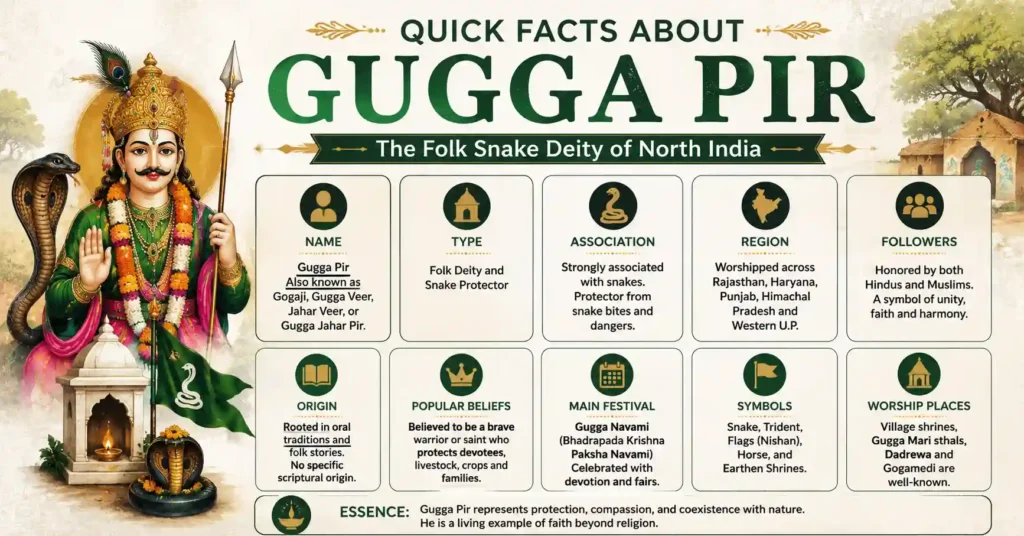
Gugga Pir, also known as Gogaji, Gugga Veer, and Jahar Veer, is a revered folk deity worshipped across Rajasthan, Haryana, Punjab, Himachal Pradesh, and parts of western Uttar Pradesh. He is widely remembered as a protector associated with snakes, courage, and the well-being of village communities.
According to regional folklore, Gogaji was a brave warrior whose compassion, sense of justice, and deep connection with nature earned him lasting devotion. Over time, he came to be worshipped as a guardian who protects people, livestock, and farmlands, especially during the monsoon season when snakes are more commonly encountered.
Unlike many deities described in the Vedas or Puranas, his legacy has been preserved through oral traditions, folk songs, village festivals, and local customs. Although different communities know him by different names, they share a common belief in his role as a protector and guardian.
Today, he remains one of North India’s most respected folk deities. His worship reflects the region’s rich cultural heritage and continues to symbolize courage, respect for nature, and harmony among communities.
Quick Facts
| Aspect | Details |
|---|---|
| Also Known As | Gogaji, Gugga Veer, Jahar Veer |
| Revered As | Folk deity and protector associated with snakes |
| Regions of Worship | Rajasthan, Haryana, Punjab, Himachal Pradesh, and western Uttar Pradesh |
| Major Festival | Gugga Navami |
| Primary Symbol | Snake |
| Associated Values | Courage, protection, respect for nature, communal harmony |
| Tradition | Regional folk traditions and oral heritage |
| Major Shrine | Gogamedi, Rajasthan |
Gugga Pir in Village Life
If you travel through the villages of North India, you will often come across simple shrines dedicated to Gugga Pir. These sacred places may stand beside fields, village roads, or beneath ancient neem and peepal trees.
Unlike many temples, these shrines are usually modest. There may be no idol, only an earthen mound, a painted snake symbol, a green or saffron flag, or a trident placed with devotion.
For local communities, these shrines are an important part of everyday life. Villagers stop to fold their hands, light an earthen lamp, offer incense, or silently pray before beginning their daily work.
There is rarely a formal priest or elaborate ritual. His worship is simple, heartfelt, and passed down through generations as a living folk tradition.
This simplicity reflects the true spirit of the revered folk deity. Rather than being seen as a distant divine figure, he is regarded as a guardian who watches over families, farmers, cattle, and the land they depend upon. His presence remains woven into the daily life and cultural heritage of rural North India.
How Gugga Pir's Tradition Has Been Preserved
Unlike many deities mentioned in the Vedas or Puranas, Gugga Pir is remembered through regional folklore rather than formal scriptures. His story has been preserved for centuries through oral traditions, folk songs, ballads, and village storytelling across North India.
There is no single written account that defines his life or identity. As a result, different regions remember him in different ways, making the tradition both flexible and inclusive.
Many devotees know him as Gogaji, while others lovingly call him Gugga Ji, Gugga Veer, or Jahar Veer. In many Muslim communities, he is revered as a Pir, a saint believed to possess divine blessings and miraculous powers.
According to popular folk traditions, he was a brave warrior who later came to be worshipped as a divine protector because of his courage, compassion, and special connection with snakes. Although the stories vary from one region to another, they all honor him as a guardian of people, animals, and village life.
This shared tradition is one of the most remarkable aspects of his worship. Hindus revere him as a Veer or folk hero, while Muslims honor him as a Pir. Rather than belonging to one religion, he is remembered by generations of devotees who seek his protection with faith and sincerity.
Note: The stories associated with Gogaji come primarily from regional folklore and oral traditions. Different communities preserve different versions of his life, and no single account is considered universally authoritative.
The Folk Story Passed Through Generations
The story of Gugga Pir has been passed down through generations through folk songs, village legends, and oral traditions. Like many regional folk heroes, different communities preserve different versions of his life.
According to popular tradition, Gogaji, also known as Jahar Veer and Gugga Ji, was born into a Chauhan Rajput family in present-day Rajasthan. Many folk accounts describe him as a brave warrior who displayed courage, compassion, and a deep sense of justice from an early age.
Several legends describe how he protected the weak and became known for his extraordinary bond with snakes. Rather than ruling over them through force, he was believed to live in harmony with them, symbolizing respect for nature and all living beings.
Gugga Pir in Different Folk Traditions
| Folk Tradition | Common Belief |
|---|---|
| Birth | Born into a Chauhan Rajput family according to popular tradition |
| Identity | Remembered as Gogaji, Gugga Ji, Jahar Veer, or Gugga Pir |
| Known For | Protecting people, cattle, and villages from snake bites |
| Legacy | Worshipped across North India as a guardian and revered folk deity |
The later part of his story also differs from one region to another. Some traditions say he sacrificed his life while protecting others, while others believe he entered the earth alive and continues to bless devotees spiritually.
Although the details vary, every tradition shares one message. He remained a protector even after his earthly life, and people continued to seek his blessings for safety, health, and protection from snake bites.
This faith spread across Rajasthan, Haryana, Punjab, Himachal Pradesh, and western Uttar Pradesh through folk songs, village melas, and family traditions that continue to this day.
Note: The life story of Gogaji comes primarily from regional folklore and oral traditions. As these traditions were passed down through generations, different communities preserve different versions of his life, and no single account is considered historically definitive.
Historical Background of Gugga Pir
While Gugga Pir is widely remembered through regional folklore, many historians believe that the tradition may have been inspired by a real warrior who lived in medieval Rajasthan. Over the centuries, stories of his courage, protection of local communities, and association with snakes gradually became part of North India’s oral tradition.
Unlike figures described in the Vedas, Puranas, or major historical chronicles, there is no single historical document that fully records his life. Most knowledge about Gogaji survives through folk ballads, village legends, devotional songs, and local customs passed down from one generation to another.
For this reason, scholars generally distinguish between historical tradition and folk belief. While many details cannot be confirmed with certainty, his cultural importance is unquestionable. The tradition continues to preserve regional history, community identity, and the living heritage of North India’s folk practices.
Note: Historical interpretations of Gogaji vary among scholars and regions. Much of his life is preserved through oral traditions rather than verified historical records.
Why is Gugga Pir Associated with Snakes?
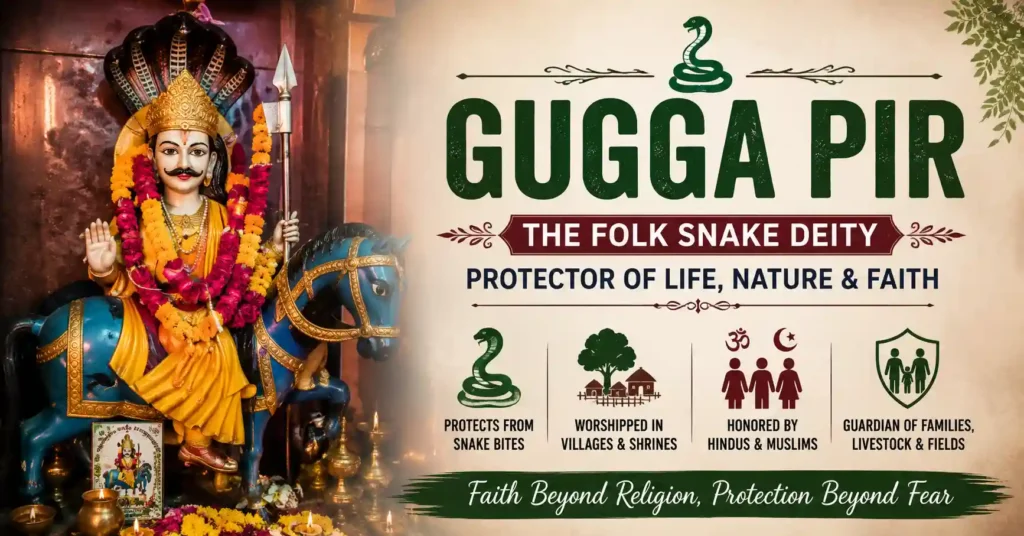
The strongest and most distinctive aspect of Gugga Pir’s worship is his deep association with snakes. Across many parts of North India, snakes are not seen merely as creatures to fear but as living beings that deserve respect and protection.
According to popular folk belief, he shared a special bond with snakes. Devotees believe he protected people from snake bites while also teaching them to live in harmony with nature rather than destroy it.
Because of this belief, many villagers avoid killing snakes unnecessarily. If a snake enters a home or farm, they traditionally guide it back to its natural habitat instead of harming it.
During the monsoon season, when snakes are more commonly seen, many families offer prayers and seek his blessings for the safety of their children, livestock, and fields.
This tradition reflects a deeper message than protection from snake bites alone. It encourages respect for wildlife, compassion toward all living beings, and a balanced relationship between humans and nature, values that remain meaningful even today.
Did You Know?
- Gugga Pir is one of the few folk deities in India who is revered by both Hindus and Muslims.
- He is popularly known by several names, including Gogaji, Gugga Veer, and Jahar Veer.
- Gugga Navami is celebrated across Rajasthan, Haryana, Punjab, Himachal Pradesh, and parts of western Uttar Pradesh with fairs, processions, and devotional songs.
- Devotees traditionally offer Nishan (sacred flags) at his shrines as a symbol of faith and gratitude.
- His worship reflects India’s rich folk heritage, where local traditions, oral history, and community beliefs have been preserved for centuries.
How is He Worshipped?
Unlike many formal religious traditions, Gugga Pir worship follows no rigid rituals or compulsory rules. Its simplicity is one of the main reasons this folk tradition has remained alive across generations.
Devotees usually offer milk, water, incense, flowers, earthen lamps, and seasonal sweets at village shrines. Many also tie sacred threads, offer green or saffron Nishan (sacred flags), and pray for the well-being of their families, livestock, and crops.
During Gugga Navami and local village melas, devotees gather to sing traditional folk songs, narrate his stories, and seek his blessings. These community gatherings help preserve the region’s rich oral traditions.
There is no fixed mantra or elaborate ritual that every devotee must follow. What matters most is sincere faith, gratitude, and respect for the values he represents.
Women, men, children, farmers, shepherds, and people from different communities worship together without distinction. This openness reflects the inclusive nature of this folk tradition, which belongs to the people rather than to any single institution or religious denomination.
Symbols Associated with Him
Several symbols are closely associated with Gugga Pir and are commonly seen at village shrines, during Gugga Navami processions, and in local folk traditions.
While their appearance may vary from one region to another, each symbolizes an important aspect of this living folk tradition.
| Symbol | Meaning |
|---|---|
| Snake | Represents his role as a protector from snake bites and his harmonious relationship with nature. |
| Nishan (Sacred Flag) | Carried by devotees during Gugga Navami as a symbol of faith, devotion, and gratitude. |
| Earthen Mound (Medi) | Many traditional shrines are simple earthen structures, reflecting the humble, community-centered nature of folk worship. |
| Trident (Trishul) | Seen at some shrines as a sacred symbol of protection, courage, and spiritual strength. |
| Earthen Lamp (Diya) | Represents devotion, hope, and prayers for the well-being of families, livestock, and prosperous harvests. |
These symbols are not merely decorative. Together, they reflect the values associated with this revered folk deity, including protection, simplicity, respect for nature, and the close relationship between faith and everyday village life.
Gugga Pir Mela: A Festival of Faith and Folk Traditions
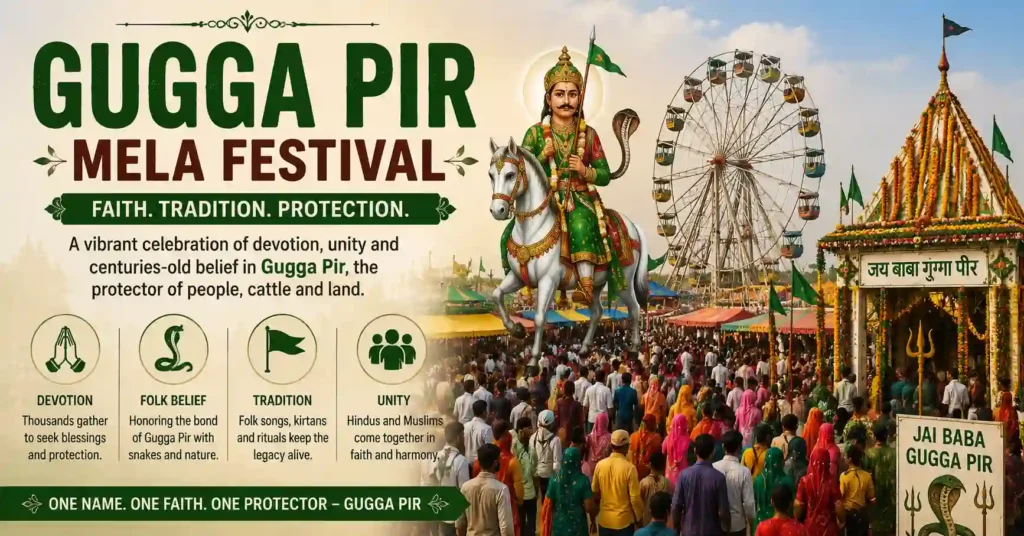
The Gugga Pir Mela is one of the most important celebrations associated with Gogaji. It is held across Rajasthan, Haryana, Punjab, Himachal Pradesh, and parts of western Uttar Pradesh, especially during Gugga Navami, which falls in the Hindu month of Bhadrapada.
More than a religious gathering, the mela is a celebration of local culture and community life. Devotees visit shrines, offer prayers, carry colorful Nishan (sacred flags), and seek his blessings for protection, health, and prosperity.
Traditional folk singers perform ballads that narrate his life, bravery, and miracles. Processions, devotional songs, local markets, and cultural performances create a vibrant atmosphere that attracts people of all ages.
Families gather to share meals, children enjoy the festive celebrations, and elders pass on centuries-old stories to younger generations. These customs help preserve the rich folk heritage of North India.
One of the most remarkable features of the mela is its spirit of harmony. Hindus and Muslims participate together with equal devotion, reflecting the inclusive values that have shaped this living folk tradition for generations.
Where is the Main Gugga Ji Temple Located?
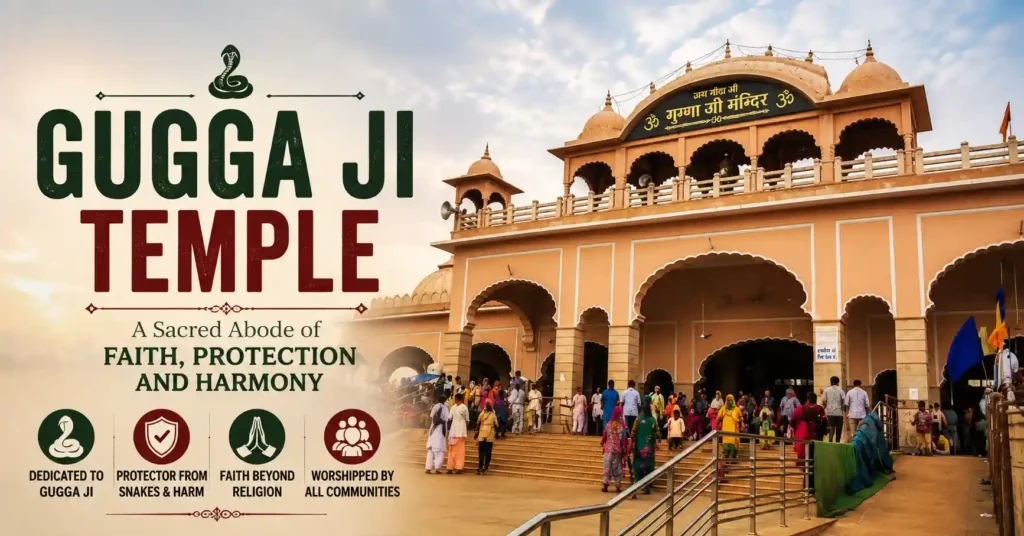
The most revered shrine dedicated to Gugga Pir, also known as Gogaji, is the Gogamedi Temple in Hanumangarh district of Rajasthan. Every year, thousands of devotees from Rajasthan, Haryana, Punjab, Himachal Pradesh, Delhi, and western Uttar Pradesh visit this sacred site, especially during Gugga Navami and the annual fair.
The temple is unique because it welcomes devotees from different religious communities, reflecting his enduring legacy of faith, courage, and communal harmony. Throughout the year, visitors offer prayers, Nishan (sacred flags), and seek blessings for protection, well-being, and relief from snake-related fears in keeping with local traditions.
Why is Gugga Pir Worshipped by Hindus and Muslims?
One of the most remarkable aspects of Gugga Pir is that he is revered by both Hindus and Muslims across many parts of North India. This shared devotion has developed through centuries of regional folk traditions rather than formal religious teachings.
Many Hindus worship Gogaji or Jahar Veer as a brave folk hero and guardian believed to protect people, cattle, and farmlands. Many Muslims honor him as a Pir, a saint remembered for his spiritual blessings and compassion.
For village communities, these different names do not create division. They simply reflect different ways of expressing faith in the same revered protector. The emphasis has always been on devotion, protection, and gratitude rather than religious identity.
This spirit of shared worship can often be seen at local shrines, where simple offerings, Nishan (sacred flags), snake symbols, and traditional folk practices exist side by side. These customs continue to reflect the rich cultural heritage and communal harmony of rural North India.
The Enduring Legacy of Gugga Pir
The legacy of Gugga Pir extends far beyond stories and seasonal festivals. For generations, he has been remembered as a guardian of children, farmers, cattle, and farmlands, reflecting the close relationship between village life and nature.
His association with snakes also carries a deeper message of coexistence. Instead of encouraging fear or harm, folk tradition teaches respect for all living beings and reminds communities that humans and nature are meant to live in balance.
Even today, he continues to inspire values of compassion, courage, and communal harmony. This living tradition brings people together across different backgrounds, preserving a heritage passed down through oral storytelling, village melas, and shared faith.
In this way, the revered folk deity represents more than a regional guardian. He symbolizes the enduring spirit of India’s folk culture, where spirituality is woven into everyday life and faith is expressed through kindness, protection, and community.
What Can We Learn from Gugga Pir Today?
Although Gugga Pir is remembered through centuries-old folk traditions, the values associated with him remain meaningful even today. His worship reminds people that courage is not only shown in battle but also through compassion, responsibility, and protecting those who depend on us.
His close association with snakes encourages respect for nature and peaceful coexistence with wildlife. Long before environmental conservation became a modern concern, village traditions connected with his worship emphasized living in harmony with the natural world rather than fearing or destroying it.
This living tradition also reflects the importance of community. Shrines, festivals, and folk songs have brought families and villages together for generations, helping preserve local history, customs, and a shared cultural identity.
Perhaps his greatest legacy is the spirit of harmony. Remembered by different communities as Gogaji, Gugga Veer, Jahar Veer, and Gugga Pir, he continues to represent a folk tradition where shared respect and devotion transcend religious, regional, and cultural boundaries.
Conclusion
Gugga Pir represents a unique tradition where faith, nature, and community come together. For generations, people across North India have remembered him as a guardian who inspires courage, compassion, and respect for all living beings.
His story reflects the richness of India’s folk heritage, where oral traditions, village festivals, and shared beliefs preserve values that continue to unite communities. Whether remembered as Gogaji, Jahar Veer, or Gugga Veer, his legacy remains an enduring symbol of protection, harmony, and cultural continuity.
Even today, his tradition reminds us that faith can be simple, inclusive, and deeply rooted in everyday life. It continues to inspire respect for nature, care for one another, and the timeless spirit of India’s living folk culture.
Suggested Reading
If you enjoyed learning about Gugga Pir, Gogaji, and the rich traditions of North India’s folk worship, you may also like these articles exploring regional deities, guardian gods, sacred temples, and the living spiritual heritage of Sanatan Dharma:
Gram Devta: Meaning, Role and Importance in Sanatan Dharma
https://thesanantales.com/gram-devta/Khandoba: Story, Jejuri Temple, Festivals and Worship
https://thesanantales.com/khandoba-god-jejuri-temple-story/Khodiyar Maa: Story, History, Temples, Miracles and the Beloved Kuldevi of Gujarat
https://thesanantales.com/khodiyar-maa/Goludevta: Story, Temples and the Folk God of Justice in Uttarakhand
https://thesanantales.com/goludevta-folk-god-of-justice/Dhari Devi Temple: Story, History, Char Dham Significance and Travel Guide
https://thesanantales.com/dhari-devi-temple/Nanda Devi: Story, Folk Beliefs, Raj Jat Yatra and Worship in Uttarakhand
https://thesanantales.com/nanda-devi-the-beloved-folk-goddess-of-uttarakhand/- Gogaji Temple (Wikipedia)
https://en.wikipedia.org/wiki/Gogaji_Temple
These articles explore the fascinating world of folk deities, guardian spirits, village traditions, sacred temples, and regional beliefs that continue to preserve India’s diverse spiritual and cultural heritage across generations.

FAQs
Who is Gugga Pir?
He is, also known as Gogaji, Gugga Veer, or Jahar Veer, is a revered folk deity worshipped across Rajasthan, Haryana, Punjab, Himachal Pradesh, and parts of western Uttar Pradesh. He is remembered as a protector associated with snakes, courage, and communal harmony.
According to regional folklore, devotees seek his blessings for protection from snake bites, the well-being of their families, livestock, and crops. His worship has been preserved through village traditions, oral storytelling, and annual fairs rather than formal religious institutions.
Today, he remains one of North India’s most respected folk deities, symbolizing harmony between people, nature, and community.
Why is Gugga Pir associated with snakes?
He is closely associated with snakes because regional folk traditions remember him as a protector against snake bites and a guardian of both people and wildlife. His stories emphasize respect for nature rather than fear of it.
For generations, many devotees have believed that harming snakes unnecessarily is wrong and that they should be allowed to return safely to their natural habitat whenever possible. This belief encouraged peaceful coexistence with wildlife long before modern conservation became widely discussed.
Even today, the snake remains one of the most recognizable symbols of Gugga Pir worship.
Is Gugga Pir the same as Gogaji?
Yes. In most parts of North India, Gugga Pir and Gogaji refer to the same revered folk deity. Depending on the region, he is also known as Gugga Ji, Gugga Veer, or Jahar Veer.
Different communities remember him in different ways. Many Hindus worship him as a brave folk hero and protector, while many Muslims honor him as a Pir or saint blessed with spiritual power.
Although the names differ, they generally refer to the same legendary figure preserved through regional folklore.
Why do both Hindus and Muslims worship Gugga Pir?
He is one of the few folk deities whose worship has been shared by both Hindus and Muslims for centuries. This tradition developed through regional culture and village life rather than formal religious teachings.
Many Hindus revere him as Gogaji or Jahar Veer, while many Muslims honor him as Gugga Pir, a saint known for his blessings and protection. These different names reflect local traditions rather than separate identities.
His worship continues to symbolize communal harmony, shared faith, and mutual respect across many parts of North India.
When is Gugga Navami celebrated?
Gugga Navami is celebrated on the Navami (ninth day) of Krishna Paksha in the Hindu month of Bhadrapada, usually falling in August or September.
On this day, devotees visit his shrines, offer prayers, carry colorful flags, sing traditional folk songs, and participate in village processions and melas. Families gather to seek blessings for protection, prosperity, and good health.
The festival is especially popular in Rajasthan, Haryana, Punjab, Himachal Pradesh, and neighboring regions where Gugga Pir is widely revered.
How is Gugga Pir worshipped?
He is worshipped through simple acts of devotion instead of elaborate rituals. Devotees commonly offer milk, water, flowers, incense, earthen lamps, and flags at local shrines.
During Gugga Navami and village fairs, people sing devotional folk songs, listen to traditional stories, and pray for the safety of their families, livestock, and crops. There is no compulsory mantra or complex ritual.
This simplicity has helped keep the tradition alive across generations and made it accessible to people from all backgrounds.
Where are the major temples and shrines of Gugga Pir located?
The most famous shrine dedicated to him is Gogamedi Temple in Rajasthan’s Hanumangarh district. Every year, thousands of devotees visit this sacred site during the annual fair.
Apart from Gogamedi, numerous temples and village shrines dedicated to him can be found across Rajasthan, Haryana, Punjab, Himachal Pradesh, and western Uttar Pradesh.
These places continue to preserve the living traditions, stories, and community worship associated with Gugga Pir.
What is the significance of Gugga Pir today?
He continues to hold great cultural and spiritual importance in North India. His worship represents courage, compassion, protection, respect for nature, and harmony among communities.
Although modern healthcare has replaced traditional methods for treating snake bites, devotees continue to remember him as a symbol of faith and cultural identity. His annual festivals, village shrines, and oral traditions keep his legacy alive.
More than a folk deity, he represents India’s enduring tradition of shared faith, local heritage, and community values.
Glossary of Important Terms
| Term | Meaning |
|---|---|
| Gugga Pir | A revered folk deity of North India, also known as Gogaji, Gugga Veer, and Jahar Veer, worshipped as a protector associated with snakes, courage, and village life. |
| Gogaji | One of the most popular names of Gugga Pir, especially in Rajasthan, where he is honored as a legendary warrior and guardian. |
| Jahar Veer | A traditional title of Gugga Pir in regional folklore, associated with his legendary power over snakes and his role as a protector. |
| Folk Deity | A locally worshipped deity whose traditions are preserved through oral history, village customs, and community practices rather than formal scriptures. |
| Gugga Navami | The annual festival dedicated to Gugga Pir, celebrated on the Navami (ninth day) of Krishna Paksha in the Hindu month of Bhadrapada. |
| Nishan | A sacred flag carried by devotees during Gugga Navami processions and offered at Gugga Pir shrines as a symbol of faith and devotion. |
| Mela | A traditional fair or religious gathering where devotees worship, celebrate local traditions, and participate in cultural activities. |
| Pir | A respected spiritual guide or saint in Islamic tradition. Many Muslim devotees revere Gugga Pir as a Pir known for his blessings and compassion. |
| Oral Tradition | The practice of preserving stories, beliefs, and customs through spoken narratives, folk songs, and ballads passed down across generations. |
| Village Shrine | A simple place of worship, often located near fields, roads, or sacred trees, where local communities offer prayers to Gugga Pir. |
| Chauhan Rajput | The Rajput clan to which Gugga Pir is traditionally believed to have belonged according to popular regional folklore. |
| Communal Harmony | Peaceful coexistence and mutual respect among different religious communities, reflected in the shared worship of Gugga Pir by Hindus and Muslims. |
| North Indian Folk Traditions | Regional customs, festivals, legends, and devotional practices from Rajasthan, Haryana, Punjab, Himachal Pradesh, and western Uttar Pradesh that preserve Gugga Pir’s legacy. |
About the Author
Yateendra Chaturvedi is a spiritual writer, researcher, devotee, and the founder of The Sanatan Tales. With over 35 years of professional experience and a lifelong interest in Sanatan Dharma, he writes about Hindu deities, temples, scriptures, festivals, Mahavidyas, sacred stories, rituals, and living traditions that continue to guide and inspire devotees across India.
Drawing from traditional scriptures, regional beliefs, temple traditions, devotional literature, and historical sources, he aims to present authentic, well-researched, and easy-to-understand content for modern readers. His work focuses on preserving spiritual wisdom, explaining sacred traditions, and helping seekers develop a deeper understanding of India’s rich spiritual heritage.
Through The Sanatan Tales, Yateendra strives to make the timeless teachings of Sanatan Dharma simple, meaningful, and relevant for today’s generation while maintaining respect for traditional sources, regional practices, and diverse spiritual perspectives.
Learn More About Yateendra Chaturvedi →
https://thesanatantales.com/about-the-author/
References & Sources
This article is based on beliefs and traditions followed within the regional folk traditions of Sanatan Dharma, traditional knowledge associated with North Indian folk deities, village worship practices, oral storytelling, and cultural heritage preserved across generations. Some historical details are drawn from regional folklore and publicly available reference materials.
Note: Folk traditions, legends, and regional customs associated with Gugga Pir may vary across different communities and regions. This article presents the most widely accepted beliefs and cultural traditions while acknowledging that local practices and narratives may differ.
Explore More Fascinating Topics from Sanatan Dharma