Prasad in Hinduism is much more than food offered to a deity. It is a sacred symbol of divine grace, devotion, and the spiritual bond between God and devotees. Whether at a temple or during daily worship at home, receiving Prasad is one of the most cherished traditions in Hinduism.
Many devotees wonder why food, fruits, or sweets are first offered to God and then returned as Prasad. This timeless practice reflects the deeper principles of surrender, gratitude, divine acceptance, and selfless sharing that form the foundation of Hindu worship.
Understanding the deeper meaning of Prasad in Hinduism helps devotees appreciate why this sacred tradition has remained an integral part of Hindu worship for centuries.
In this article, you will learn the meaning of Prasad, how it differs from Naivedya and Bhog, the significance of Mahaprasad, its scriptural importance, the spiritual benefits of accepting Prasad, the different types of Prasad, and the proper way to prepare, offer, and receive it with reverence.
Table of Contents
ToggleWhat Is Prasad in Hinduism?
Prasad in Hinduism is a sacred offering that has been presented to a deity with devotion during a puja, havan, or other religious ceremony and is then received by devotees as a symbol of God’s grace and blessings.
The concept of Prasad in Hinduism goes beyond the physical offering, emphasizing the spiritual relationship between God and the devotee.
The offering may include fruits, sweets, cooked food, Panchamrit, Mishri, coconut, dry fruits, or even simple water. Once it is offered with sincere faith, it is believed to be blessed by the deity and is no longer regarded as ordinary food.
The Sanskrit word “Prasad” (प्रसाद) means grace, favor, serenity, or divine blessing. It signifies God’s loving acceptance of a devotee’s offering and reminds us that every blessing in life ultimately comes from the Divine.
Unlike ordinary food, Prasad is received with reverence and gratitude. Devotees believe that accepting Prasad purifies the mind, strengthens faith, and deepens the spiritual connection between the devotee and God.
Whether distributed in a temple after darshan or shared during a home puja, Prasad carries the same message of devotion, humility, gratitude, and selfless sharing. It is one of the simplest yet most meaningful traditions of Sanatan Dharma.
This timeless understanding of Prasad in Hinduism continues to inspire millions of devotees across generations.
Quick Facts About Prasad
| Aspect | Description |
|---|---|
| Meaning | Divine grace or sacred blessing |
| Sanskrit | प्रसाद (Prasada) |
| Offered During | Puja, Havan, Temple Worship, Festivals, Vrats |
| Common Forms | Fruits, sweets, cooked food, Panchamrit, Charnamrit, Mishri, coconut |
| Symbolizes | Divine grace, gratitude, devotion, humility, and sharing |
| Received By | Devotees after the offering is made to the deity |
Why Is Prasad So Important in Hinduism?
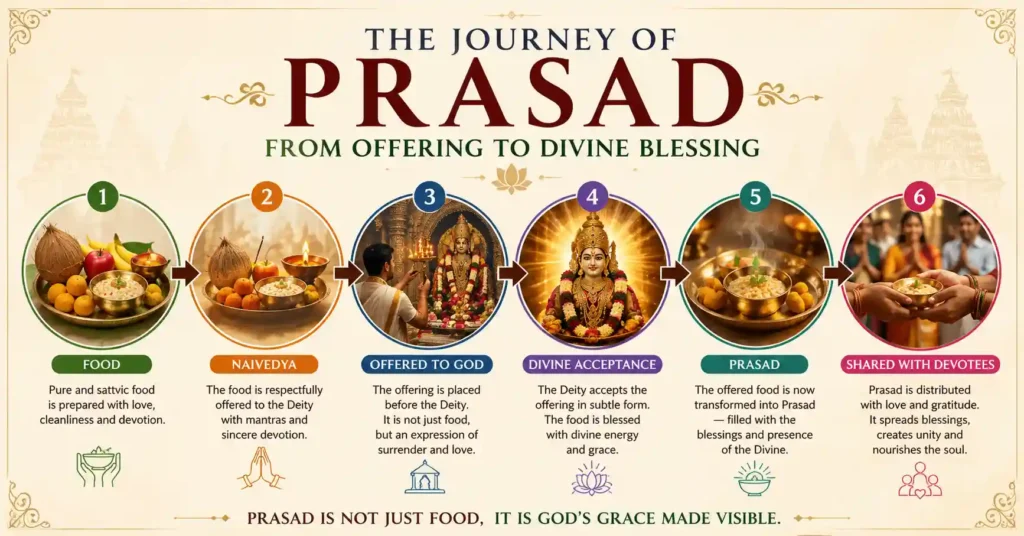
Every Hindu temple and almost every home begins worship by offering food, fruits, sweets, or water to the deity. After the prayers are complete, these offerings are returned to devotees as Prasad. This simple act is one of the oldest and most meaningful traditions in Hinduism.
Prasad is far more than food distributed after a puja. It is regarded as a symbol of God’s grace, reminding devotees that every blessing in life is a gift from the Divine. By accepting Prasad with gratitude, devotees acknowledge God’s presence in their daily lives.
The importance of Prasad in Hinduism lies not only in receiving blessed food but also in cultivating gratitude and devotion.
The tradition also teaches an important spiritual lesson. Before enjoying anything ourselves, we first offer it to God as an expression of love, devotion, and surrender. When the offering is returned, it is received not as ordinary food but as a sacred blessing filled with divine grace.
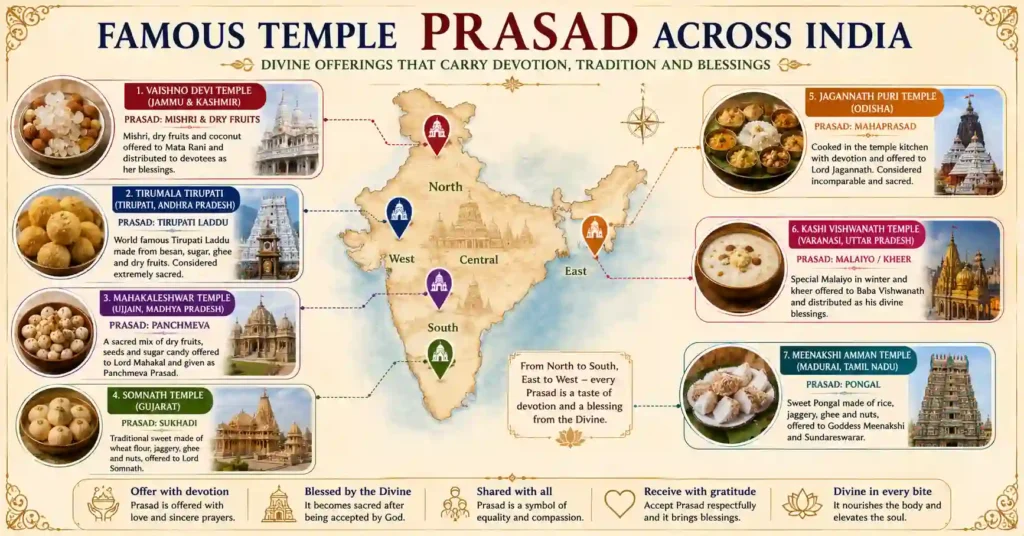
Whether it is a small piece of Mishri at a local temple, Mahaprasad from Jagannath Puri, or Panchamrit prepared during a home puja, every form of Prasad carries the same spiritual message—faith, humility, gratitude, and the joy of sharing God’s blessings with others.
Every tradition associated with Prasad in Hinduism reflects the values of faith, humility, and selfless sharing.
Why Does God Return the Offering as Prasad?
One of the most beautiful aspects of Prasad in Hinduism is that whatever is lovingly offered to God is returned to devotees as Prasad. This tradition is not based on the idea that God needs food or material offerings. Instead, it symbolizes the loving relationship between the Divine and the devotee.
According to Hindu philosophy, God is complete and self-sufficient. He does not require food, flowers, or sweets for His own nourishment. The true purpose of an offering is to express devotion, gratitude, humility, and surrender.
The Bhagavad Gita (9.26) beautifully explains this principle:
“Whoever offers Me with devotion a leaf, a flower, a fruit, or water, I accept that loving offering from the pure-hearted devotee.”
This verse teaches that God values the devotee’s bhav (pure intention and devotion) more than the material value of the offering. A simple fruit or a glass of water offered with sincere faith is considered more meaningful than an elaborate feast offered without devotion.
Once the offering is made with love and accepted by the deity, it is no longer regarded as ordinary food. It becomes Prasad, a sacred gift believed to carry God’s blessings and divine grace. Receiving Prasad reminds devotees that everything they possess ultimately comes from the Divine and should be accepted with gratitude.
The tradition also teaches an important life lesson. Before enjoying the gifts of nature or the fruits of our efforts, we first dedicate them to God. This transforms an ordinary act of eating into an expression of remembrance, humility, and spiritual connection.
For this reason, Prasad is never viewed merely as food returned after worship. It is a symbol of divine acceptance, a reminder of God’s compassion, and an invitation to cultivate devotion, gratitude, and selfless living in everyday life.
Why Is Prasad Considered Sacred?
Prasad in Hinduism is considered sacred because it is no longer viewed as ordinary food after it has been offered to God with devotion. In Hindu tradition, the offering is believed to be blessed by the deity, transforming it into a symbol of divine grace and compassion.
The Sanskrit word “Prasad” (प्रसाद) means grace, favor, serenity, or divine blessing. When devotees receive Prasad, they do not see it merely as food but as God’s blessings returned to them with love.
The sanctity of Prasad lies not in its ingredients but in the devotion with which it is offered. Whether it is a fruit, a piece of Mishri, Panchamrit, or a simple meal, every offering becomes sacred when it is presented with a pure heart and sincere faith.
Receiving Prasad also reminds devotees that everything they have ultimately comes from God. By accepting it with gratitude, they cultivate humility, contentment, and a deeper awareness of the Divine in everyday life.
This sacred tradition strengthens the bond between God and the devotee. It symbolizes that the offering has been accepted and that divine grace is always available to those who approach God with faith, love, and surrender.
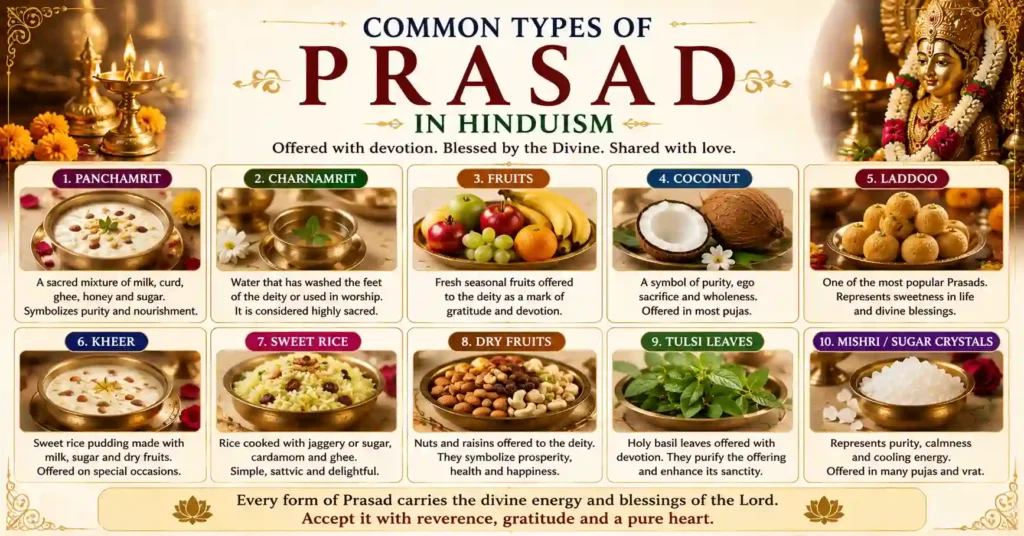
What Are the Different Types of Prasad in Hinduism?
The various forms of Prasad in Hinduism reflect the diversity of Hindu traditions while conveying the same spiritual message.
Prasad in Hinduism is not limited to sweets or fruits. Different temples, regions, festivals, and traditions prepare and distribute various forms of Prasad, each carrying its own cultural and spiritual significance.
While the ingredients may vary, every type of Prasad represents the same divine blessing received after offering it to God with devotion. The value of Prasad lies in the faith and sincerity behind the offering rather than its quantity or richness.
Some of the most common types of Prasad include:
| Type of Prasad | Common Examples | Usually Offered During |
|---|---|---|
| Fruit Prasad | Banana, apple, grapes, coconut | Daily puja and temple worship |
| Sweet Prasad | Ladoo, Halwa, Kheer, Peda, Modak | Festivals and special pujas |
| Panchamrit | Milk, curd, ghee, honey, and sugar | Abhishek and temple rituals |
| Charnamrit | Sanctified water with Tulsi or milk | Vishnu and Krishna temples |
| Dry Prasad | Mishri, dry fruits, roasted gram | Daily worship and distribution |
| Cooked Prasad (Bhog) | Rice, Khichdi, Pongal, Puri, Sabzi | Temple offerings and festivals |
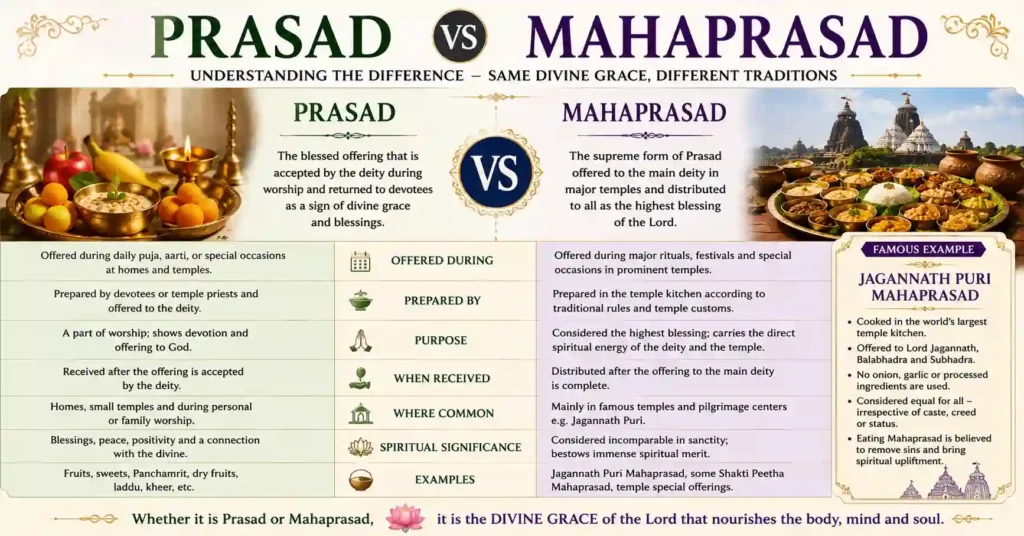
| Mahaprasad | Blessed food from sacred temples such as Jagannath Puri | Special temple traditions |
Each temple may also have its own unique Prasad that has become closely associated with the deity worshipped there. For example, Modak is closely linked with Lord Ganesha, Makhan-Mishri with Lord Krishna, and Panchamrit is widely used in Shiva and Vishnu worship.
Regardless of its form, every Prasad in Hinduism carries the same spiritual message of devotion, gratitude, humility, and God’s blessings. Devotees therefore receive even the smallest portion with reverence and joy.
Prasad vs Naivedya vs Bhog vs Mahaprasad
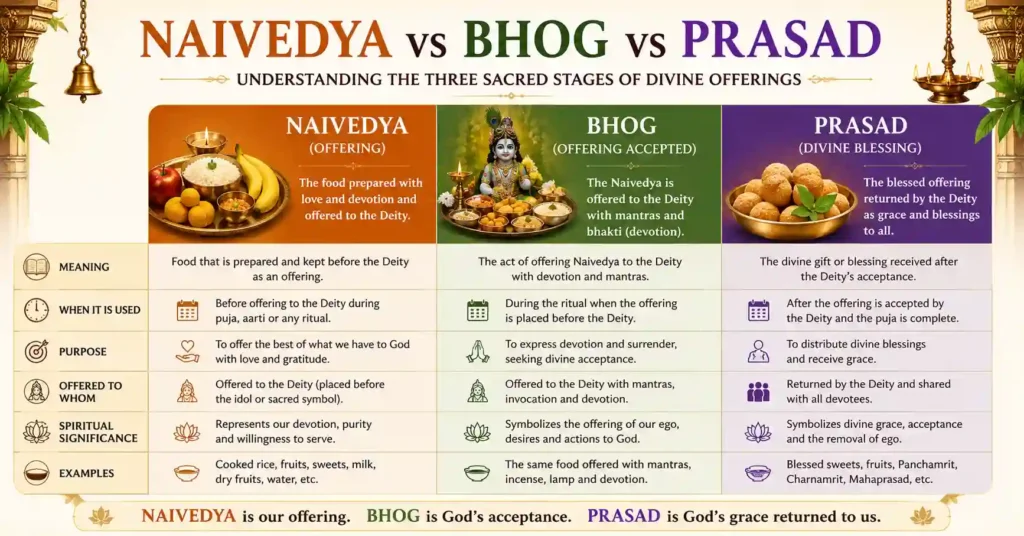
In Prasad in Hinduism, these four terms are closely related but have different meanings and purposes. Understanding the distinction helps devotees appreciate the journey of an offering from preparation to receiving God’s blessings.
| Term | Meaning | When It Is Used |
|---|---|---|
| Naivedya | Food or drink offered to the deity before worship is completed. | Before the offering is accepted by God. |
| Bhog | A meal or food specially prepared and presented to the deity. In many traditions, it serves as the Naivedya. | During daily worship, festivals, and temple rituals. |
| Prasad | The blessed offering returned to devotees after being offered to God. | Distributed after the puja or religious ceremony. |
| Mahaprasad | A highly revered form of Prasad associated with certain temples and sacred traditions. | Received at temples with established Mahaprasad traditions, such as Jagannath Temple. |
Although these terms have different meanings, they are all part of the same sacred tradition of offering food to God with devotion. Together, they remind devotees that sincere faith transforms an ordinary offering into a symbol of divine grace and spiritual nourishment.
Did You Know?
- The Sanskrit word “Prasad” literally means grace, favor, serenity, or divine blessing.
- Even a leaf, flower, fruit, or water offered with sincere devotion is accepted by God, as taught in the Bhagavad Gita (9.26).
- The spiritual value of Prasad depends on the devotee’s faith, not on the richness or quantity of the offering.
- Many famous temples in India are known for their unique Prasad, such as Mahaprasad at Jagannath Temple, Modak offered to Lord Ganesha, and Panchamrit used in Shiva worship.
- Sharing Prasad is considered an act of seva because it spreads God’s blessings equally among all devotees.
How to Offer Prasad to God at Home
Offering Prasad in Hinduism at home is a simple yet meaningful spiritual practice. Hindu scriptures emphasize that God accepts an offering made with a pure heart, sincere faith, and gratitude rather than expensive or elaborate preparations.
Before preparing Prasad, devotees generally bathe or wash their hands and ensure that the kitchen and utensils are clean. The food is prepared with a calm and devotional mindset, avoiding anger, negativity, or unnecessary distractions.
Once the food is ready, it is placed before the deity on a clean plate. Many devotees light a diya, offer flowers, chant a mantra, or observe a few moments of silent prayer before mentally dedicating the offering to God.
After the offering is complete, the food is respectfully received as Prasad and shared with family members, guests, or anyone present. This beautiful tradition reminds us that every meal is a blessing received through God’s grace.
Following these simple steps helps preserve the sacred tradition of Prasad in Hinduism in daily life.
Simple Steps to Offer Prasad
| Step | What to Do |
|---|---|
| Prepare the Offering | Cook or arrange the food with a clean body, mind, and utensils. |
| Place before the deity | Offer the food on a clean plate before the idol or image of God. |
| Pray with devotion | Chant a prayer or silently dedicate the offering with gratitude. |
| Wait briefly | Allow a few moments for the offering before removing the plate. |
| Receive as Prasad | Accept the blessed offering respectfully and share it with others. |
Beginner’s Tip: Even if you cannot perform a complete puja every day, you can mentally offer your meal to God before eating. In Hindu tradition, sincere devotion is considered more important than elaborate rituals.
Can We Offer Any Food as Prasad?
In Prasad in Hinduism, devotion (Bhav) is always considered more important than the richness of the offering. A simple fruit, a handful of Mishri, or even a glass of water offered with a sincere heart is considered a worthy offering to God.
Many devotees prepare fresh, clean, and sattvic food for Prasad. Fruits, milk, sweets, dry fruits, coconut, Panchamrit, and home-cooked vegetarian dishes are among the most commonly offered items during daily worship and festivals.
Certain traditions avoid offering food prepared with onion, garlic, eggs, meat, or alcohol during religious worship. However, these practices may vary according to the deity, temple customs, family traditions, and different sampradayas within Sanatan Dharma.
Ultimately, Hindu scriptures teach that God accepts the devotion and sincerity behind the offering. A simple offering made with humility is considered more meaningful than an elaborate feast prepared without faith.
This principle has guided the tradition of Prasad in Hinduism for centuries.
Common Offerings as Prasad
| Commonly Offered | Examples |
|---|---|
| Fruits | Banana, apple, grapes, pomegranate, coconut |
| Sweets | Ladoo, Peda, Halwa, Kheer, Modak |
| Sacred Preparations | Panchamrit, Charnamrit, Mishri |
| Home-cooked Food | Rice, Khichdi, Puri, Sabzi, Pongal (varies by tradition) |
| Dry Fruits | Almonds, raisins, cashews, dates |
Note: The choice of Prasad may differ according to the deity, festival, temple tradition, family customs, or regional practices. The spirit of devotion remains the same in every offering.
Why Do Devotees Receive Prasad with Reverence?
In Prasad in Hinduism, devotees usually accept Prasad with both hands or folded palms as a mark of respect. Many consume it immediately and mindfully, not because of its taste but because it represents a sacred blessing received after worship.
This simple act encourages gratitude, devotion, and the understanding that even the smallest gift from God deserves to be cherished. In this way, Prasad nourishes both the body and the soul.
What Life Lessons Does Prasad Teach Us?
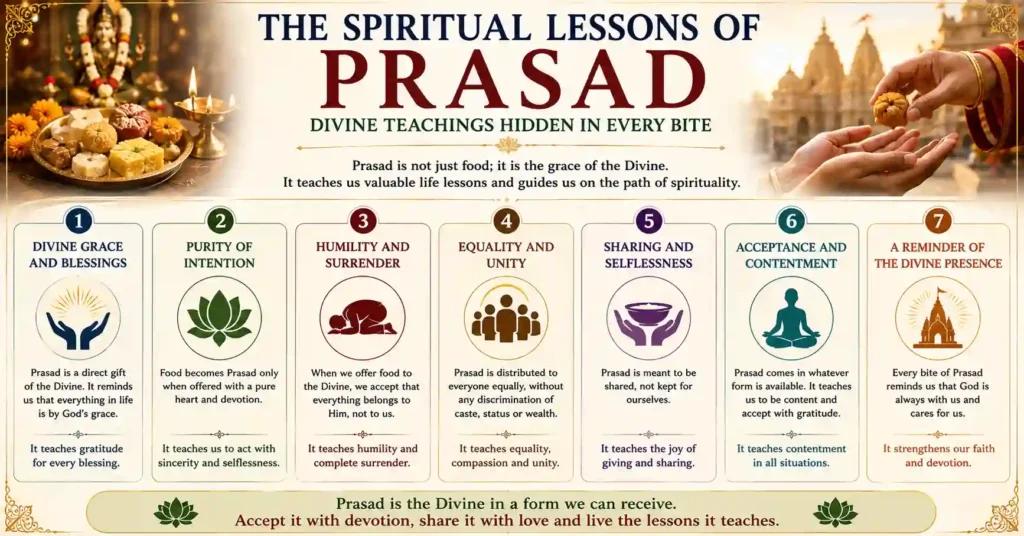
The tradition of offering and receiving Prasad in Hinduism is more than a religious ritual. It teaches timeless values that can guide us in our everyday lives.
When devotees offer food to God before consuming it, they acknowledge that everything they have—whether food, wealth, knowledge, or success—is ultimately a gift from the Divine. This simple act nurtures gratitude and reduces the feeling of ego and ownership.
Receiving the same offering as Prasad reminds us to accept life’s blessings with humility. It encourages us to view every achievement and every opportunity as God’s grace rather than our accomplishment alone.
Prasad also inspires the spirit of sharing. In temples and homes, it is distributed equally among everyone without discrimination based on age, status, wealth, or background. This reflects the Hindu ideals of equality, compassion, and community.
Another important lesson is contentment. Even a small portion of Prasad is accepted with joy because its spiritual value is greater than its quantity. This teaches devotees to appreciate what they receive instead of constantly desiring more.
Above all, Prasad reminds us that devotion is not limited to rituals. When we offer our actions, thoughts, and daily efforts to God with sincerity, even ordinary moments can become sacred.
Key Life Lessons from Prasad
| Lesson | Spiritual Meaning |
|---|---|
| Gratitude | Recognize every blessing as God’s grace. |
| Humility | Let go of ego and the sense of ownership. |
| Devotion | Offer your actions with a pure heart. |
| Sharing | Distribute blessings with love and equality. |
| Contentment | Value quality and sacredness over quantity. |
| Surrender | Trust in God’s wisdom and accept His will. |
Why Is Prasad Shared with Everyone?
One of the most beautiful traditions associated with Prasad in Hinduism is that it is meant to be shared. Whether in a temple, during a festival, or after a home puja, Prasad is distributed among family members, guests, neighbours, and even strangers. This practice reflects the belief that God’s blessings are for everyone.
Sharing Prasad symbolizes equality and unity. Regardless of caste, age, social status, or financial background, every devotee receives the same sacred offering. Before God, all are equal, and Prasad becomes a reminder of this timeless Hindu principle.
The tradition also encourages generosity and compassion. Instead of keeping blessings to ourselves, Hinduism teaches us to share them with others. Distributing Prasad spreads joy, strengthens community bonds, and inspires acts of kindness and selfless service.
In many temples, devotees also offer Prasad to the poor, pilgrims, and visitors as an expression of seva (selfless service). This transforms a simple act of giving into a spiritual practice that combines devotion with compassion.
By sharing Prasad, devotees express gratitude for God’s grace while remembering that true blessings multiply when they are shared with love and humility.
Why Sharing Prasad Matters
| Tradition | Spiritual Meaning |
|---|---|
| Sharing with everyone | God’s grace is available to all. |
| Equal distribution | Promotes equality and removes social barriers. |
| Offering to the needy | Encourages compassion and selfless service (seva). |
| Receiving together | Strengthens faith, unity, and community spirit. |
Is There a Difference Between Home Prasad and Temple Prasad?
Whether prepared during a home puja or received at a temple, Prasad in Hinduism represents the same divine grace and blessings. The spiritual value of Prasad does not depend on where it is offered but on the sincerity and devotion with which it is presented to God.
At home, Prasad reflects a personal and intimate connection with the Divine. Family members prepare and offer food with love, prayers, and gratitude, making it a cherished part of daily worship and household traditions.
Temple Prasad, on the other hand, represents collective devotion. It is offered on behalf of thousands of devotees and shared among everyone who visits the temple, creating a sense of unity, equality, and shared faith within the community.
Receiving Prasad at the end of a puja also symbolizes the completion of the worship. It reminds devotees to accept God’s blessings with gratitude and carry the spirit of devotion beyond the prayer room into their daily lives.
For this reason, Hindus treat Prasad with great respect and avoid wasting it. Even a small portion is received reverently because it is regarded as a sacred blessing rather than ordinary food.
Home Prasad vs Temple Prasad
| Home Prasad | Temple Prasad |
|---|---|
| Offered during personal or family worship | Offered during temple rituals and ceremonies |
| Reflects individual or family devotion | Represents the collective faith of the community |
| Shared among family and guests | Distributed to all devotees without distinction |
| Strengthens daily spiritual practice | Promotes unity, equality, and shared devotion |
Key Takeaways
If you’re short on time, here are the most important things to remember about Prasad in Hinduism. These key points summarize the meaning of Prasad in Hinduism, its spiritual significance, and its role in Hindu worship.
- Prasad is a sacred offering that is returned to devotees after being offered to God with sincere devotion.
- The Sanskrit word “Prasad” means divine grace, favor, or blessing, symbolizing God’s acceptance of a devotee’s offering.
- Prasad is different from Naivedya and Bhog. Naivedya is the offering made to God, while Prasad is the blessed offering received afterward.
- The spiritual value of Prasad depends on devotion (bhav), not on the cost or quantity of the food.
- Prasad may include fruits, sweets, Panchamrit, cooked food, coconut, Mishri, and many other offerings, depending on the tradition and occasion.
- Sharing Prasad promotes gratitude, equality, compassion, and selfless service, reminding devotees that God’s blessings are meant to be shared.
- Receiving Prasad with reverence strengthens faith and inspires humility, contentment, and a deeper connection with the Divine.
Conclusion
Prasad in Hinduism is much more than a ritual. It is a timeless expression of God’s grace and the devotee’s faith.
Prasad is much more than food offered during worship. It is a sacred symbol of God’s grace, divine acceptance, and the loving relationship between the Divine and the devotee. Every offering made with faith and a pure heart becomes a reminder that true devotion lies in sincerity rather than material value.
From understanding the meaning of Prasad and its scriptural significance to learning the differences between Naivedya, Bhog, and Mahaprasad, this beautiful tradition reveals the deeper philosophy of Hindu worship. It teaches gratitude, humility, surrender, equality, and the joy of sharing God’s blessings with others.
Whether received at a temple or during a simple home puja, Prasad encourages us to remember that everything we have is a gift from God. Accepting it with reverence inspires us to live with faith, contentment, and compassion in our daily lives.
The next time you receive Prasad, pause for a moment before accepting it. See it not merely as a sacred offering, but as a reminder of God’s love, blessings, and the timeless wisdom that continues to guide millions of devotees across generations.
By understanding the true meaning of Prasad in Hinduism, devotees can experience this sacred tradition with greater awareness, gratitude, and devotion.
Suggested Reading
If you found this guide on Prasad in Hinduism helpful, you may also enjoy these related articles that will deepen your understanding of Prasad in Hinduism, Hindu worship, daily puja, sacred rituals, mantras, and Sanatan Dharma traditions:
Puja in Sanatan Dharma: Meaning, Vidhi, Bhav and Spiritual Significance
https://thesanatantales.com/puja-in-sanatan-dharma/Daily Puja at Home: Simple Step-by-Step Guide for Everyday Worship
https://thesanatantales.com/daily-puja-at-home/Panchopchar Pujan: The Five Sacred Offerings in Hindu Worship
https://thesanatantales.com/panchopchar-pujan/Mantra Japa: Meaning, Benefits and How to Practice Daily
https://thesanatantales.com/mantra-japa/Kalash (Purna Kalasha): Meaning, Symbolism and Importance in Hindu Worship
https://thesanatantales.com/kalash-in-hinduism/Tilak in Hinduism: Meaning, Types and Spiritual Significance
https://thesanatantales.com/tilak-in-hinduism/Havan: Meaning, Benefits and Step-by-Step Procedure
https://thesanatantales.com/havan-meaning-procedure-benefits/Kanya Pujan: Meaning, Significance, Rituals and Spiritual Benefits
https://thesanatantales.com/kanya-pujan/Prasada (Wikipedia)
https://en.wikipedia.org/wiki/Prasada
These articles will help you deepen your understanding of Prasad, Hindu worship, Naivedya, daily puja, mantra chanting, Havan, and other sacred rituals of Sanatan Dharma, helping you build a stronger spiritual connection through devotion and daily practice.
FAQs
What Is Prasad in Hinduism?
Prasad in Hinduism is a sacred offering that has been presented to God with devotion during a puja or religious ceremony and is then received by devotees as a symbol of divine grace and blessings.
In Hinduism, Prasad can include fruits, sweets, cooked food, Panchamrit, Mishri, coconut, or other offerings. Once these items are offered with sincere faith, they are believed to be blessed by the deity and are no longer regarded as ordinary food.
The Sanskrit word “Prasad” means grace, favor, serenity, or divine blessing. It represents God’s acceptance of a devotee’s offering and reminds us to receive every blessing in life with gratitude, humility, and devotion.
Whether received at a temple or during a home puja, Prasad is considered a sacred gift that strengthens the spiritual bond between God and the devotee. It also teaches the timeless values of sharing, selflessness, and contentment that lie at the heart of Sanatan Dharma.
What Is the Difference Between Prasad and Naivedya?
Naivedya is the food, fruits, sweets, or drinks offered to a deity before worship is completed. It is presented with prayers as an expression of devotion and gratitude.
Once the offering is accepted by the deity according to Hindu tradition, it is known as Prasad. It is no longer regarded as ordinary food but as a sacred blessing carrying God’s grace.
In simple words, Naivedya is the offering made to God, while Prasad is the blessed offering returned to devotees.
Why Is Prasad Considered Sacred in Hinduism?
Prasad in Hinduism is considered sacred because it is first offered to God with devotion and is then received as a symbol of divine grace and blessings. It symbolizes divine grace rather than the material value of the food itself.
The sanctity of Prasad comes from the devotee’s bhav (pure intention), faith, and the spiritual act of offering. Even a simple fruit or a small piece of Mishri becomes sacred when dedicated to God.
Receiving Prasad reminds devotees to live with gratitude, humility, and devotion while recognizing every blessing as a gift from the Divine.
Can We Eat Prasad Without Offering It to God?
Traditionally, food becomes Prasad only after it has been offered to God with devotion. Until then, it remains ordinary food.
However, if someone unknowingly eats the food before offering it, it is not considered a sin. Hinduism emphasizes sincere intention and devotion over rigid ritual rules.
Many devotees make it a daily practice to mentally offer their meals to God before eating, even when performing a formal puja is not possible.
Can Prasad Be Prepared at Home?
Yes. Prasad in Hinduism can be prepared at home using fresh, clean, and sattvic ingredients offered with sincere devotion. It can be as simple as offering fruits, milk, Mishri, Panchamrit, or a home-cooked meal during daily puja.
The most important requirement is cleanliness, purity of mind, and sincere devotion. The simplicity of the offering does not reduce its spiritual significance.
Many families prepare Prasad during festivals, birthdays, vrats, and other religious ceremonies before sharing it with everyone present.
Can Anyone Receive Prasad?
Yes. Prasad is meant for everyone and is distributed without discrimination based on caste, religion, gender, age, or social status.
This tradition reflects the Hindu belief that God’s grace is universal and should be shared equally among all people.
Receiving Prasad respectfully is considered an act of humility and gratitude, regardless of one’s background or place in society.
Why Is Prasad Shared with Others?
Prasad in Hinduism is shared with others because it symbolizes God’s blessings, equality, compassion, and the spirit of selfless sharing. It encourages generosity, compassion, and unity among devotees.
In temples and homes, Prasad is distributed equally, reminding everyone that all people are equal before God.
The practice also promotes seva (selfless service) and strengthens the spirit of community within Hindu society.
What Should Never Be Done with Prasad?
Prasad should always be treated with respect because it is regarded as a sacred blessing. It should not be thrown away, wasted, or handled carelessly.
If any Prasad remains, it should be consumed respectfully or shared with others whenever possible.
Devotees generally receive Prasad with clean hands and a grateful heart, considering it a symbol of God’s grace rather than ordinary food.
What Is Mahaprasad?
Mahaprasad refers to Prasad that holds exceptional religious significance in certain temples and traditions. One of the best-known examples is the Mahaprasad of the Jagannath Temple in Puri.
Although every Prasad is sacred, Mahaprasad is especially revered because of the unique traditions and rituals associated with its preparation and offering.
Devotees believe that receiving Mahaprasad brings spiritual merit, blessings, and a deeper connection with the Divine.
Is Prasad Mentioned in Hindu Scriptures?
Yes. The concept of offering food with devotion is found in several Hindu scriptures, including the Bhagavad Gita, the Puranas, and various Agamas.
In Bhagavad Gita 9.26, Lord Krishna says that He accepts even a leaf, a flower, a fruit, or water when it is offered with sincere devotion.
This teaching emphasizes that God values the devotee’s faith and love more than the material richness of the offering.
Why Should We Accept Prasad with Respect?
Accepting Prasad with reverence is a way of expressing gratitude for God’s blessings. It reminds devotees that everything in life ultimately comes from the Divine.
Many devotees receive Prasad with both hands or folded palms as a mark of humility and respect. They consume it mindfully rather than treating it as ordinary food.
This simple practice strengthens devotion and helps cultivate gratitude, contentment, and spiritual awareness in daily life.
Glossary of Important Terms
| Term | Meaning |
|---|---|
| Prasad | A sacred offering returned to devotees after being offered to God with devotion. It symbolizes divine grace and blessings. |
| Naivedya | Food, fruits, sweets, or drinks offered to a deity before they become Prasad. |
| Bhog | Food prepared and offered to a deity during worship. In many traditions, Bhog refers to the meal offered before it is distributed as Prasad. |
| Mahaprasad | A highly revered form of Prasad associated with specific temples, especially the Jagannath Temple in Puri, and considered especially sacred. |
| Bhav | The inner feeling of devotion, sincerity, and love with which an offering or worship is performed. |
| Puja | A Hindu ritual of worship involving prayers, offerings, mantras, and devotion to a deity. |
| Panchamrit | A sacred mixture of milk, curd, ghee, honey, and sugar used in Hindu rituals and often distributed as Prasad. |
| Charnamrit | Sanctified water, often mixed with milk, Tulsi leaves, or other sacred ingredients, offered after bathing the deity and distributed as Prasad. |
| Seva | Selfless service performed without expecting anything in return, considered an important spiritual practice in Hinduism. |
| Mantra | A sacred word, phrase, or hymn chanted during worship to invoke divine blessings and focus the mind. |
| Darshan | The auspicious act of seeing and receiving the blessings of a deity in a temple or sacred place. |
| Bhagavad Gita | One of Hinduism’s most revered scriptures, containing Lord Krishna’s teachings on devotion, duty, and spiritual wisdom. |
| Tulsi | The holy basil plant, revered in Hinduism and commonly used in worship and offerings to Lord Vishnu and Lord Krishna. |
| Devotee | A person who worships God with faith, devotion, and sincerity. |
| Sanatan Dharma | The eternal spiritual tradition commonly known as Hinduism, based on timeless principles of dharma, devotion, and self-realization. |
About the Author
Yateendra Chaturvedi is a spiritual writer, researcher, devotee, and the founder of The Sanatan Tales. With over 35 years of professional experience and a lifelong interest in Sanatan Dharma, he writes about Hindu deities, temples, scriptures, festivals, Mahavidyas, sacred stories, rituals, and living traditions that continue to guide and inspire devotees across India.
Drawing from traditional scriptures, regional beliefs, temple traditions, devotional literature, and historical sources, he aims to present authentic, well-researched, and easy-to-understand content for modern readers. His work focuses on preserving spiritual wisdom, explaining sacred traditions, and helping seekers develop a deeper understanding of India’s rich spiritual heritage.
Through The Sanatan Tales, Yateendra strives to make the timeless teachings of Sanatan Dharma simple, meaningful, and relevant for today’s generation while maintaining respect for traditional sources, regional practices, and diverse spiritual perspectives.
Learn More About Yateendra Chaturvedi →
https://thesanatantales.com/about-the-author/
References & Sources
This article on Prasad in Hinduism is based on widely accepted beliefs, traditions, scriptures, and practices followed across various schools of Sanatan Dharma. The content has been prepared using traditional knowledge, respected Hindu religious texts, and insights from authentic spiritual literature and scholarly resources.
Note: Beliefs, rituals, and interpretations may vary among different regions, sampradayas (traditions), and lineages within Sanatan Dharma. The purpose of this article is not to promote any single viewpoint as the absolute truth, but to present commonly accepted spiritual and religious perspectives in a simple, informative, and respectful manner.
Read More Interesting Articles on Sanatan Dharma