
Brahma Muhurta is one of the most sacred and widely discussed concepts in Sanatan Dharma. It refers to the peaceful period before sunrise that has traditionally been recommended for meditation, prayer, mantra japa, self-reflection, and spiritual study. Ancient sages regarded this time as especially supportive for inner growth because the mind is naturally calmer and the atmosphere is quieter.
But what exactly is Brahma Muhurta? How is Brahma Muhurta time calculated? Is it really necessary to wake up during this sacred hour, and what are the actual benefits of Brahma Muhurta in daily life?
In this article, you will learn the meaning of Brahma Muhurta, its scriptural significance, traditional calculation, spiritual and practical benefits, common misconceptions, and simple ways to incorporate this practice into modern life. Whether you are a spiritual seeker, a student, a working professional, or simply curious about this ancient tradition, this guide will help you understand why Brahma Muhurta continues to hold a special place in Sanatan Dharma.
Brahma Muhurta at a Glance
| Aspect | Details |
|---|---|
| Meaning | Sacred pre-sunrise period for spiritual practices |
| Timing | About 1 hour 36 minutes before sunrise |
| Duration | Approximately 48 minutes |
| Mentioned In | Ayurvedic and traditional Sanatan texts |
| Best Activities | Meditation, mantra japa, prayer, study |
| Associated Guna | Sattva (clarity and balance) |
| Suitable For | Householders, students, professionals, seekers |
| Fixed Time? | No, varies according to sunrise |
| Is Sleeping During It a Sin? | No |
| Main Benefit | Mental clarity and spiritual focus |
Table of Contents
ToggleWhat Is Brahma Muhurta?
Brahma Muhurta is the sacred period before sunrise that is traditionally considered the most favorable time for spiritual practices in Sanatan Dharma. According to Vedic timekeeping, it occurs approximately 1 hour and 36 minutes before sunrise and lasts for one muhurta, or about 48 minutes.
This pre-sunrise period is believed to be dominated by sattva guna, the quality of clarity, balance, and harmony. Because the mind is naturally calmer and distractions are minimal, many sages, yogis, and spiritual seekers have used this time for meditation, mantra japa, scriptural study, and self-reflection.
The importance of Brahma Muhurta in Sanatan Dharma is not limited to monks or ascetics. Householders, students, and working professionals can also benefit from using this quiet time to cultivate focus, discipline, and inner peace.
In simple terms, Brahma Muhurta is regarded as nature’s invitation to begin the day with awareness before the demands and activity of daily life take over.
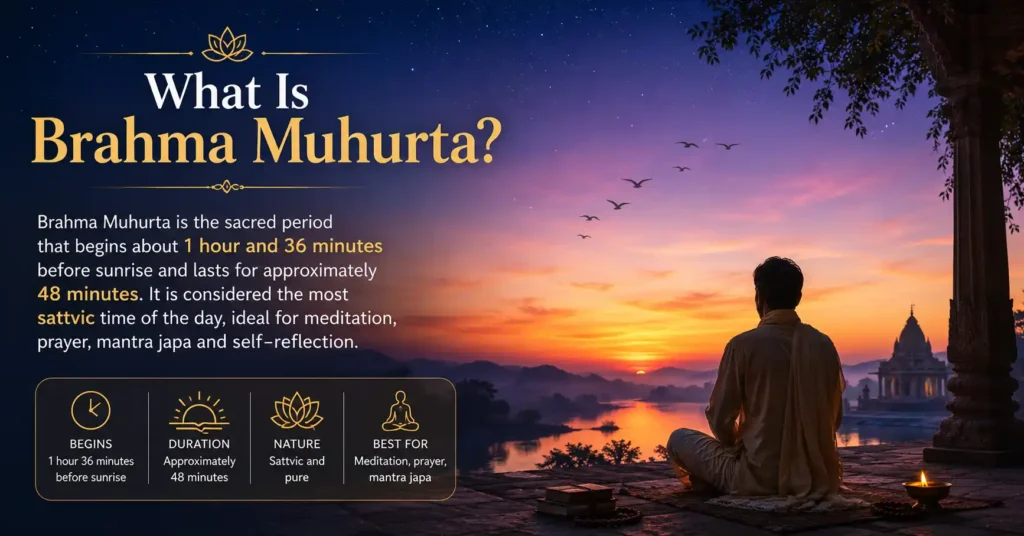
How Is Brahma Muhurta Calculated Traditionally?
In traditional Vedic timekeeping, a full day and night are divided into 30 muhurtas. The daylight period contains 15 muhurtas, and the night period contains another 15.
Brahma Muhurta is traditionally considered the second-last muhurta of the night. Because each muhurta lasts approximately 48 minutes, Brahma Muhurta begins about 1 hour and 36 minutes before sunrise and continues for one muhurta.
Since sunrise changes throughout the year and varies by location, Brahma Muhurta time is not fixed. It shifts according to the local sunrise in your area.
| Traditional Calculation | Time |
|---|---|
| 1 Muhurta | Approximately 48 minutes |
| Brahma Muhurta Begins | Around 1 hour 36 minutes before sunrise |
| Duration | Approximately 48 minutes |
| Depends On | Local sunrise time |
This traditional method shows that Brahma Muhurta is not an arbitrary hour chosen for convenience. It is carefully positioned within the natural rhythm of night and dawn according to Vedic timekeeping.
Understanding this calculation helps us appreciate that Brahma Muhurta in Sanatan Dharma is based on the movement of the sun rather than a fixed clock time.
What Does Brahma Muhurta Mean?
The term Brahma Muhurta comes from two Sanskrit words: Brahma and Muhurta.
In this context, Brahma does not refer only to Lord Brahma, the creator deity. It is often understood as a reference to Brahman, the ultimate reality, pure consciousness, or the highest truth described in Sanatan philosophy.
Muhurta is a traditional unit of time used in Vedic timekeeping.
Together, Brahma Muhurta can be understood as “the time conducive to the realization of higher truth” or “the period that supports spiritual awakening.”
Ancient sages observed that the mind is naturally calmer during this sacred hour before sunrise. With fewer distractions and a peaceful environment, meditation, mantra japa, prayer, and self-reflection become easier and more effective.
For this reason, Brahma Muhurta has long been regarded as an ideal time for spiritual practice, study, and inner contemplation. It is not merely about waking up early but about using a naturally supportive period for cultivating awareness and mental clarity.
In a deeper sense, Brahma Muhurta in Sanatan Dharma symbolizes the transition from darkness to light, both in nature and within the human mind. Just as dawn gradually illuminates the world, spiritual understanding gradually dispels ignorance and confusion.
Is Brahma Muhurta Mentioned in Scriptures?
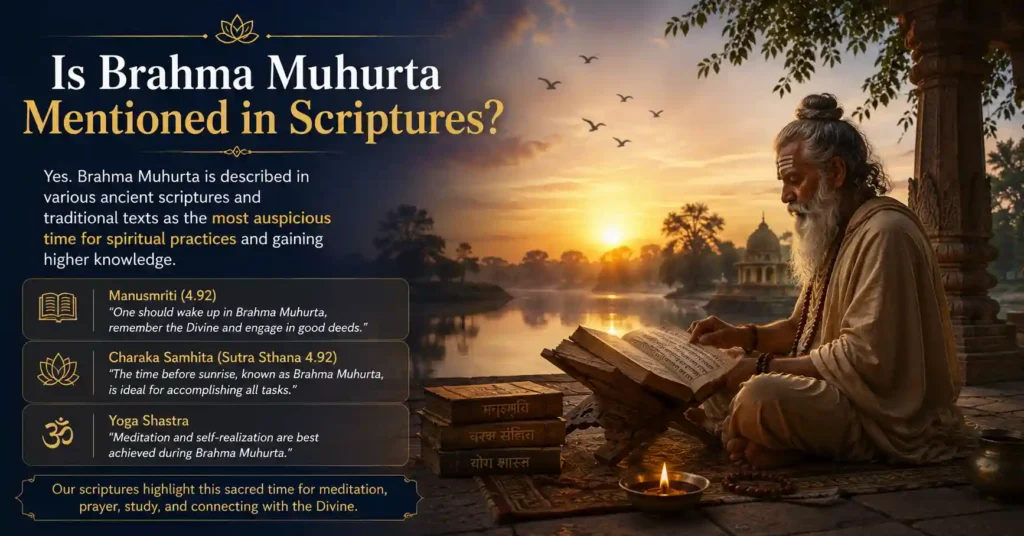
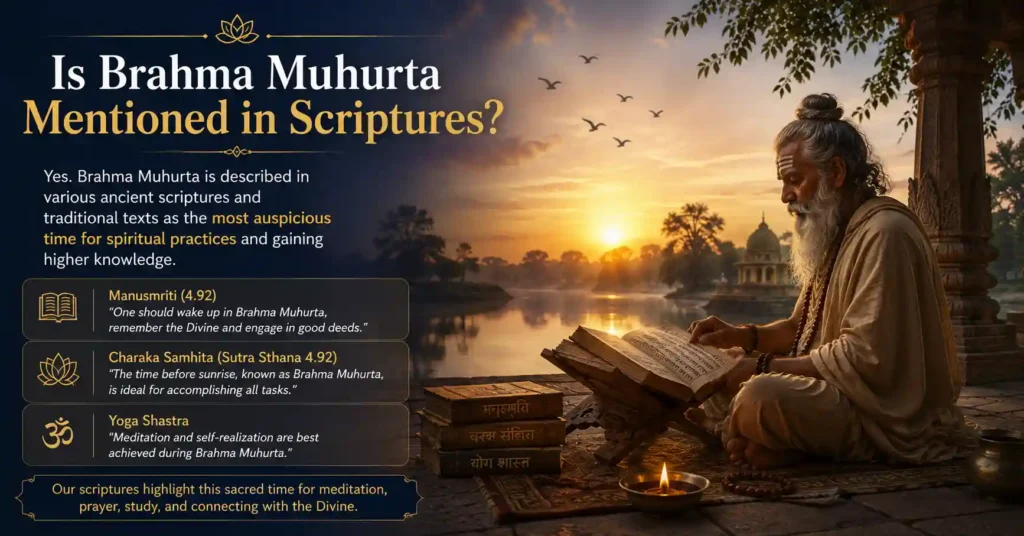
Yes, Brahma Muhurta is mentioned in traditional Ayurvedic and spiritual literature. One of the most frequently cited references appears in the Ashtanga Hridayam, a classical Ayurvedic text composed by Acharya Vagbhata. It advises healthy individuals to wake during Brahma Muhurta as part of a balanced daily routine.
The well-known verse states:
“ब्राह्मे मुहूर्ते उत्तिष्ठेत्स्वस्थो रक्षार्थमायुषः”
Its meaning is generally understood as:
“A healthy person should wake up during Brahma Muhurta to maintain good health and support a long, balanced life.”
Traditional commentators explain that Brahma Muhurta is the second-last muhurta of the night, beginning about 96 minutes before sunrise. This period has long been regarded as favorable for study, meditation, self-discipline, and spiritual reflection.
The significance of Brahma Muhurta in Sanatan Dharma is also connected to the concept of the three gunas. Before sunrise, the atmosphere is believed to be more influenced by sattva guna, which represents clarity, harmony, and balance.
As the day progresses, rajas guna becomes more active, encouraging movement, activity, and worldly engagement. Late night is generally associated with tamas guna, which is linked with heaviness and inertia.
Because of this transition, Brahma Muhurta is often viewed as a bridge between darkness and light, making it especially suitable for meditation, mantra japa, scriptural study, and inner contemplation.
It is also closely connected with morning Sandhya, the sacred dawn period traditionally associated with Gayatri Japa, Surya Upasana, and other daily spiritual practices.
At the same time, it is important to distinguish between scriptural references and later interpretations. Classical texts recommend Brahma Muhurta as a beneficial time for healthy individuals, but they do not present it as a rigid rule or a requirement for spiritual progress. In Sanatan Dharma, it is considered a valuable opportunity rather than an obligation.
Why Is Brahma Muhurta Considered Sacred?
In Sanatan Dharma, Brahma Muhurta is considered sacred because it occurs during the quiet transition between night and day. At this time, the world is still, distractions are minimal, and the mind is naturally more peaceful.
Traditional teachings associate this pre-sunrise period with the predominance of sattva guna, the quality of clarity, harmony, and balance. A sattvic mind is believed to be more receptive to meditation, prayer, mantra japa, and spiritual study.
Ancient sages observed that the atmosphere before sunrise feels different from the rest of the day. Daily activities have not yet begun, making it easier to turn attention inward and cultivate self-awareness.
This sacred hour is also closely connected with Sandhya, the transitional period of dawn. Many traditional practices, including Gayatri Japa, Surya Upasana, and morning prayers, are performed around this time because it is considered spiritually uplifting.
The significance of Brahma Muhurta in Sanatan Dharma is not based on superstition or fear. Rather, it reflects the understanding that different times of the day influence the body, mind, and emotions in different ways.
For spiritual seekers, Brahma Muhurta is valued because it provides a natural environment for inner silence, concentration, and contemplation before the activity of the day begins.
Spiritual and Practical Benefits of Brahma Muhurta
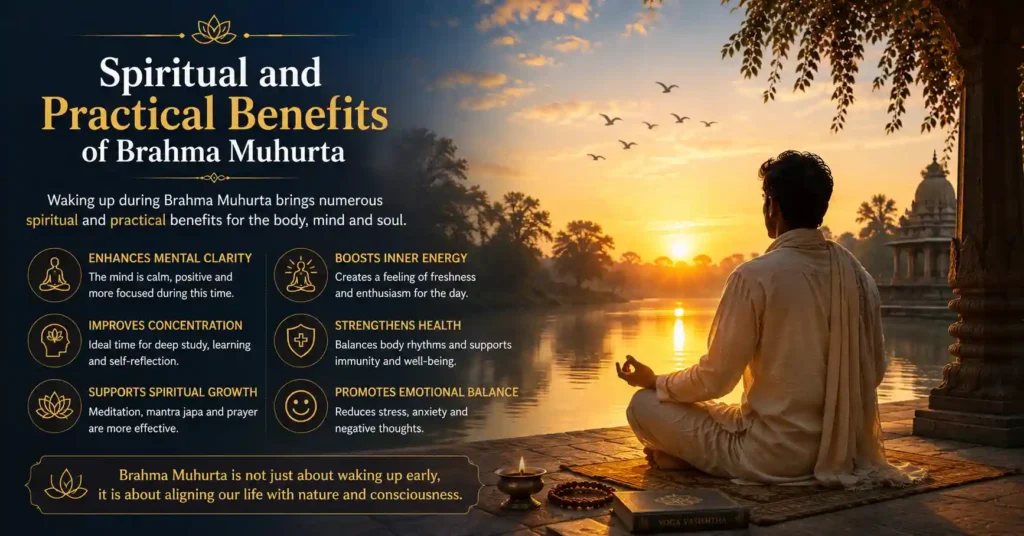
Many people first learn about Brahma Muhurta through its benefits. While the experience may vary from person to person, traditional teachings and Ayurvedic texts have long regarded this sacred pre-sunrise period as highly supportive for both spiritual practice and personal wellbeing.
Spiritual Benefits
The quiet atmosphere of Brahma Muhurta makes it easier to focus the mind. With fewer distractions and less external activity, meditation, mantra japa, prayer, and self-reflection often feel more natural.
Traditional teachings associate this time with sattva guna, the quality of clarity, harmony, and inner balance. Because of this, many spiritual seekers consider Brahma Muhurta the best time for developing concentration and cultivating a deeper connection with the Divine.
It is also regarded as an ideal period for studying sacred texts, reflecting on spiritual teachings, and beginning the day with a calm and positive mindset.
Practical Benefits
Apart from its spiritual value, waking during Brahma Muhurta time can help establish a disciplined daily routine. Starting the day before distractions arise often provides uninterrupted time for planning, learning, exercise, or personal growth.
Many people find that the early morning environment supports better focus and mental clarity. The mind is generally less burdened by the responsibilities and stimulation that accumulate throughout the day.
Ayurvedic texts place great importance on aligning daily habits with natural rhythms. For this reason, Brahma Muhurta has traditionally been viewed as a beneficial time to begin the day in a balanced and mindful manner.
At a Glance: Benefits of Brahma Muhurta
Spiritual Benefits
Supports meditation and japa
Improves concentration
Promotes inner calm
Helps spiritual study
Encourages self-reflection
Practical Benefits
Encourages discipline
Provides distraction-free time
Enhances focus and productivity
Creates a positive start to the day
Supports a balanced routine
The true value of Brahma Muhurta in Sanatan Dharma lies not in simply waking up early, but in using this peaceful period wisely. Even a few minutes of prayer, meditation, or quiet reflection can make this sacred hour meaningful.
What Should You Do During Brahma Muhurta?
The peaceful atmosphere of Brahma Muhurta is considered ideal for activities that require concentration and inner awareness. Traditional texts and spiritual teachers have long recommended using this time for practices that nourish the mind and spirit.
You do not need an elaborate routine. Even a few minutes of focused practice can make this sacred hour meaningful.
Recommended Practices During Brahma Muhurta
Meditation
Meditation is one of the most common practices performed during Brahma Muhurta. The quiet surroundings and reduced distractions make it easier to calm the mind and develop concentration.
Mantra Japa
Chanting a mantra such as the Gayatri Mantra, Om Namah Shivaya, or a personal mantra can help create a sense of focus and devotion.
Prayer and Gratitude
Many people begin the day with simple prayers, offering gratitude and setting a positive intention for the hours ahead.
Scriptural Study
Reading a few verses from the Bhagavad Gita, Upanishads, Ramayana, or other sacred texts can provide inspiration and spiritual guidance.
Breath Awareness
Simple breathing practices or mindful observation of the breath can help cultivate calmness and mental clarity.
Quiet Reflection
Some people prefer to spend this time in silence, reflecting on their thoughts, goals, and spiritual journey.
A Simple Brahma Muhurta Routine
Wake up and freshen up: 5–10 minutes
Prayer or gratitude: 5 minutes
Meditation or mantra japa: 10–20 minutes
Scriptural reading: 10 minutes
Quiet reflection: 5 minutes
There is no single correct way to practice Brahma Muhurta. The most important thing is to use this time consciously rather than immediately turning to phones, social media, or other distractions.
Even a short period of prayer, meditation, or self-reflection can help you experience the deeper purpose of Brahma Muhurta in Sanatan Dharma.
Is It Bad to Sleep During Brahma Muhurta?
No, sleeping during Brahma Muhurta is not considered sinful, inauspicious, or spiritually harmful.
In Sanatan Dharma, Brahma Muhurta is viewed as a valuable opportunity rather than a strict obligation. Traditional texts recommend waking during this time because it is believed to be beneficial for health, mental clarity, and spiritual practices, not because sleeping is forbidden.
Many people are unable to wake before sunrise due to work schedules, family responsibilities, health conditions, or the need for adequate rest. In such situations, getting sufficient sleep is more important than forcing yourself to follow a routine that leaves you exhausted.
The purpose of Brahma Muhurta in Sanatan Dharma is to make use of a naturally peaceful period for meditation, prayer, study, or self-reflection. If you occasionally miss it, there is no need for guilt or fear.
What matters most is the quality of your spiritual practice and daily conduct, not whether you wake up at an exact time every day.
A person who wakes later but maintains sincerity, discipline, and devotion can still progress spiritually. Brahma Muhurta is a helpful aid, not the only path to inner growth.
The real teaching behind this sacred hour is awareness. If waking during Brahma Muhurta helps you cultivate that awareness, it can be a valuable practice. If your circumstances do not allow it, Sanatan Dharma does not regard that as a failure.
Who Should Not Force Themselves to Wake During Brahma Muhurta?
While Brahma Muhurta is traditionally recommended as an ideal time for spiritual practice, it is not meant to be followed at the cost of health and wellbeing.
Interestingly, the famous Ayurvedic verse itself begins with the word “svastha”, which means a healthy person. This suggests that the recommendation is primarily intended for individuals who are physically and mentally well.
If waking up during Brahma Muhurta leaves you exhausted, sleep deprived, or unable to function properly during the day, it may not be the right practice for you at that stage of life.
The following people should avoid forcing themselves into an early waking routine without considering their health and circumstances:
People Recovering from Illness
The body needs adequate rest for healing and recovery. Reducing sleep in the name of discipline can sometimes slow down the recovery process rather than support it.
People with Sleep Disorders
Those dealing with insomnia, poor sleep quality, or chronic sleep deprivation should focus on establishing healthy sleep patterns before attempting to wake during Brahma Muhurta.
Pregnant Women
Pregnancy places additional demands on the body. Adequate rest is essential, and sleep should not be sacrificed simply to follow a spiritual routine.
Elderly Individuals with Health Concerns
Older adults may have different sleep needs and medical conditions that make very early waking difficult or unnecessary. Personal wellbeing should always take priority.
Shift Workers
People who work night shifts or rotating schedules often cannot align their sleep with sunrise. In such cases, maintaining sufficient rest is more important than following a fixed clock time.
Those Experiencing Severe Fatigue
If you are consistently tired, physically exhausted, or mentally drained, your body may be asking for recovery rather than additional discipline.
Sanatan Dharma emphasizes balance, not self-punishment. The purpose of Brahma Muhurta in Sanatan Dharma is to support health, clarity, and spiritual growth. If a practice begins to weaken the body or disturb proper rest, its purpose is being lost.
A well-rested mind is often more beneficial for spiritual practice than a tired mind that is struggling to stay awake. The goal is not to wake up at any cost, but to create a lifestyle that supports both inner growth and overall wellbeing.
Is Brahma Muhurta Only for Yogis and Monks?
No. One of the biggest misconceptions about Brahma Muhurta is that it is meant only for yogis, monks, or people living in ashrams.
While many sages and spiritual practitioners have traditionally used this sacred time for meditation and contemplation, the benefits of Brahma Muhurta are not limited to them. The peaceful atmosphere before sunrise can be valuable for anyone seeking a calmer and more focused start to the day.
Students may use this time for study and concentration. Working professionals may find it useful for planning, reflection, or prayer before daily responsibilities begin. Householders can dedicate a few quiet minutes to meditation, mantra japa, or reading a sacred text.
In fact, classical Ayurvedic texts do not reserve Brahma Muhurta for a special group of people. The recommendation is addressed to a healthy person (svastha), not only to ascetics or renunciates.
Many people believe they must spend hours meditating to benefit from Brahma Muhurta. In reality, even 10 to 15 minutes of sincere practice can be meaningful. A short prayer, a few minutes of silence, or reading a passage from the Bhagavad Gita can help create a positive mindset for the day ahead.
The true spirit of Brahma Muhurta in Sanatan Dharma is not about withdrawing from life. It is about beginning the day with awareness before becoming engaged in worldly duties.
Whether you are a student, a parent, a professional, or a retiree, this sacred pre-sunrise period can be adapted to your circumstances. What matters most is consistency and sincerity, not the length or complexity of the practice.
Brahma Muhurta vs Amrit Vela vs Nishita Kaal
Many people confuse Brahma Muhurta, Amrit Vela, and Nishita Kaal because all three are associated with spiritual practices and quiet periods of the day. However, they refer to different time periods and have distinct spiritual contexts.
Brahma Muhurta
Timing: About 1 hour and 36 minutes before sunrise
Tradition: Sanatan Dharma and Vedic timekeeping
Purpose: Meditation, mantra japa, prayer, and scriptural study
Atmosphere: Calm, sattvic, and conducive to inner reflection
Best For: Spiritual discipline, yoga, and self-awareness
Amrit Vela
Timing: Early morning before dawn
Tradition: Sikh spiritual tradition
Purpose: Naam Simran, meditation, and remembrance of God
Atmosphere: Quiet, devotional, and contemplative
Best For: Spiritual reflection and devotion
Nishita Kaal
Timing: Around midnight
Tradition: Hindu ritual and tantric traditions
Purpose: Specific night-time worship and spiritual observances
Atmosphere: Deep stillness and silence
Best For: Certain rituals, sadhana, and midnight worship
Brahma Muhurta is calculated according to the traditional Vedic division of time into muhurtas and occurs during the final part of the night before sunrise. It is widely regarded as the most favorable time for meditation, prayer, yoga, and scriptural study because the mind is naturally calm and less distracted.
Amrit Vela, which means “the ambrosial hours,” is especially important in Sikh tradition. It refers to the pre-dawn period dedicated to meditation, prayer, and remembrance of the Divine. While it often overlaps with the early morning hours, its significance comes from a different spiritual tradition.
Nishita Kaal refers to the deepest part of the night around midnight. In Hindu traditions, it is associated with specific forms of worship and spiritual observances. It is also linked with certain festivals and rituals, including the midnight worship observed during Maha Shivaratri.
Understanding these differences helps avoid confusion. While all three periods are considered spiritually significant, Brahma Muhurta in Sanatan Dharma is uniquely associated with the transition from darkness to dawn and is traditionally regarded as the ideal time for cultivating clarity, awareness, and inner discipline.
Can Brahma Muhurta Be Practiced in Modern Life?
Yes, but it should be approached gradually and realistically.
One of the biggest mistakes people make is trying to wake up two hours earlier overnight. While the idea sounds inspiring, it often leads to fatigue and frustration. Sustainable change usually happens through small, consistent adjustments rather than dramatic shifts.
The purpose of Brahma Muhurta is not to reduce sleep. In fact, traditional teachings assume that a person is getting adequate rest before waking early. A peaceful morning begins with a healthy night routine.
Modern lifestyles often involve late-night screen use, irregular sleep schedules, and constant digital stimulation. These habits can make waking before sunrise difficult. Reducing screen time before bed, eating dinner earlier, and maintaining a regular sleep schedule can make the transition much easier.
If you are new to the practice, start small. Try waking up 15 to 20 minutes earlier than usual and use that time for prayer, meditation, or quiet reflection. As your routine becomes more comfortable, you can gradually move closer to the traditional Brahma Muhurta window.
Simple Tips for Beginners
| Practice | Why It Helps |
|---|---|
| Sleep earlier | Supports adequate rest |
| Reduce screen time before bed | Helps improve sleep quality |
| Wake up gradually | Easier to maintain long term |
| Avoid checking your phone immediately | Preserves mental calm |
| Start with 10–15 minutes of practice | Builds consistency without pressure |
Many spiritual teachers emphasize that consistency matters more than perfection. Waking up during Brahma Muhurta time once in a while is less valuable than developing a routine that you can maintain comfortably over the long term.
Even if you cannot wake during the exact Brahma Muhurta period every day, setting aside a few quiet minutes before the rush of daily life can still help cultivate focus, balance, and self-awareness. The goal is not to compete with an ideal schedule but to create a rhythm that supports your physical, mental, and spiritual wellbeing.
Common Misconceptions About Brahma Muhurta
Misconception 1: Brahma Muhurta Is Always at 4 AM
This is one of the most common myths.
Brahma Muhurta time is not fixed. It is calculated based on the local sunrise and therefore changes with the season and geographical location. In summer it may begin earlier, while in winter it may begin later.
Misconception 2: Missing Brahma Muhurta Is Sinful
No traditional text states that sleeping during Brahma Muhurta is a sin.
Sanatan Dharma presents Brahma Muhurta as an ideal time for spiritual practice, not as a strict rule that must be followed under all circumstances. Missing it occasionally does not cancel spiritual progress or devotion.
Misconception 3: Less Sleep Makes You More Spiritual
This is a misunderstanding of the practice.
The classical recommendation itself is directed toward a healthy person. If waking during Brahma Muhurta causes sleep deprivation, fatigue, or health problems, the purpose of the practice is defeated. Adequate rest remains essential for physical, mental, and spiritual wellbeing.
Misconception 4: Brahma Muhurta Is Only for Saints and Yogis
Many people assume that only monks, yogis, or spiritual masters can benefit from this sacred hour.
In reality, students, householders, professionals, and retirees can all use this peaceful time for prayer, meditation, study, planning, or quiet reflection. The benefits are not limited to a particular group of people.
Misconception 5: Waking Up Early Alone Is Enough
Simply waking up before sunrise is not the goal.
The real value of Brahma Muhurta in Sanatan Dharma comes from how the time is used. Meditation, mantra japa, prayer, scriptural study, and self-reflection are what give this period its spiritual significance. Waking up early only to spend the time scrolling through a phone defeats its purpose.
Misconception 6: Brahma Muhurta Is Just a Productivity Hack
In recent years, Brahma Muhurta has often been promoted as a tool for productivity and success.
While an early morning routine may improve focus and discipline, the traditional purpose of Brahma Muhurta goes much deeper. It is primarily valued as a time for inner clarity, self-awareness, spiritual practice, and alignment with natural rhythms.
Understanding these misconceptions helps us appreciate Brahma Muhurta for what it truly is: a sacred opportunity for inner growth rather than a rigid rule or modern self-improvement trend.
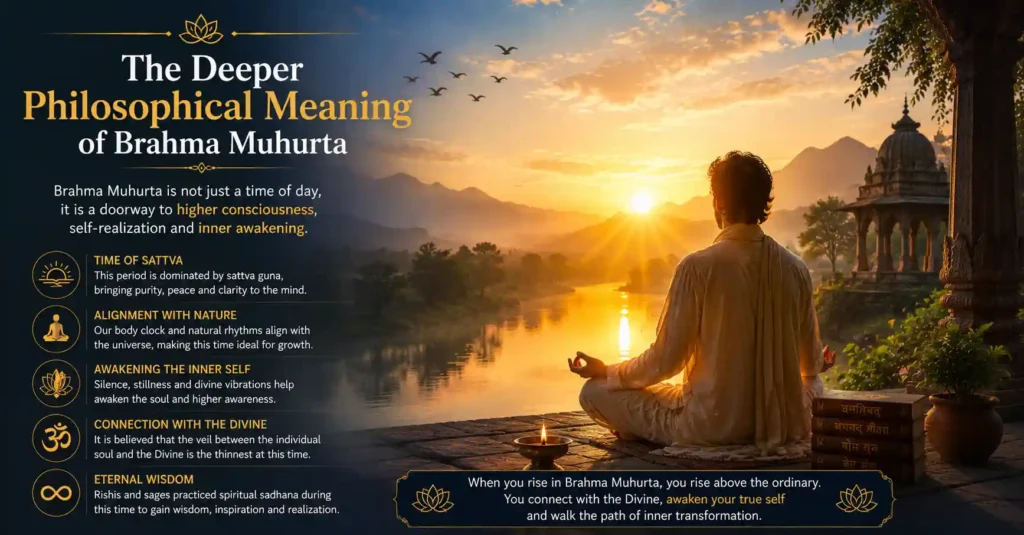
The Deeper Philosophical Meaning of Brahma Muhurta
At its deepest level, Brahma Muhurta is not merely about waking up before sunrise. It is a reminder of an important truth found throughout Sanatan Dharma: outer nature and inner consciousness are closely connected.
Every day, the world moves from darkness to light. Night gradually gives way to dawn, and dawn gives way to daylight. Ancient sages saw this daily transition as a reflection of the spiritual journey of human life.
Just as the rising sun slowly removes darkness from the world, spiritual knowledge gradually removes ignorance from the mind. In this sense, Brahma Muhurta symbolizes an inner dawn, a time when awareness begins to awaken.
The word Brahma is often linked with Brahman, the ultimate reality described in the Upanishads. For this reason, Brahma Muhurta is traditionally understood as a period that supports contemplation of higher truths and deeper self-awareness.
Ancient traditions also describe this pre-sunrise period as predominantly sattvic, meaning that the mind is naturally calmer, clearer, and less disturbed by external distractions. When the mind is quiet, meditation, prayer, and introspection become easier and more meaningful.
This is why the true significance of Brahma Muhurta in Sanatan Dharma is not found in the clock. It is found in the quality of awareness that this time encourages.
A person may wake during Brahma Muhurta every day and still remain restless, distracted, or impatient. Another person may use even a few minutes of this sacred hour for sincere reflection and experience a deeper sense of peace.
The essence of Brahma Muhurta is therefore not perfection but awakening. It invites us to begin the day consciously, before the noise of the world fills the mind.
Like sunrise itself, inner growth rarely happens all at once. It unfolds gradually, bringing greater clarity, wisdom, and self-understanding over time.
Key Takeaways
- Brahma Muhurta is the sacred period that begins about 1 hour and 36 minutes before sunrise and lasts for approximately 48 minutes.
- In traditional Vedic timekeeping, it is considered the second-last muhurta of the night and is regarded as an auspicious time for meditation, prayer, mantra japa, and spiritual study.
- The term Brahma Muhurta is associated with higher awareness, inner clarity, and the pursuit of spiritual knowledge rather than simply waking up early.
- Traditional teachings connect this pre-sunrise period with sattva guna, making it especially suitable for concentration, self-reflection, and spiritual practices.
- The benefits of Brahma Muhurta can be experienced by householders, students, professionals, and spiritual seekers, not just by yogis or monks.
- Waking during Brahma Muhurta is considered beneficial, but it is not a compulsory religious rule and should never come at the expense of proper sleep and health.
- Even a few minutes of meditation, prayer, gratitude, or quiet reflection during this sacred hour can help create a more peaceful and mindful start to the day.
Conclusion
Brahma Muhurta is much more than an early morning routine. In Sanatan Dharma, it represents a sacred opportunity to begin the day with clarity, awareness, and inner stillness.
The hours before sunrise have long been valued by sages, yogis, and spiritual seekers because they provide a natural environment for meditation, prayer, mantra japa, and self-reflection. Traditional texts describe this period as especially supportive for cultivating focus, discipline, and spiritual growth.
At the same time, Brahma Muhurta is not a rigid rule or a measure of spiritual worth. Health, adequate sleep, and personal circumstances should always be respected. The goal is not simply to wake up early but to use a peaceful period of the day with awareness and purpose.
Even a few minutes spent in silence, gratitude, meditation, or prayer during Brahma Muhurta can help create a calmer and more balanced beginning to the day.
Ultimately, the deeper message of Brahma Muhurta is the same as the message of dawn itself: every day offers a new opportunity to move from distraction toward clarity, from restlessness toward peace, and from darkness toward inner light.
FAQs
What Is Brahma Muhurta?
Brahma Muhurta is the sacred period before sunrise that is traditionally considered the most favorable time for meditation, prayer, mantra chanting, scriptural study, and spiritual practices in Sanatan Dharma. The term comes from two Sanskrit words: Brahma, which refers to the highest reality or divine knowledge, and Muhurta, a unit of time.
According to traditional Vedic timekeeping, a day and night are divided into 30 muhurtas. Brahma Muhurta is the second-last muhurta of the night and begins approximately 1 hour and 36 minutes before sunrise, lasting for about 48 minutes. Since sunrise changes with season and location, Brahma Muhurta time also varies accordingly.
This sacred pre-dawn period is believed to be dominated by sattva guna, the quality of clarity, harmony, and balance. For this reason, sages and spiritual seekers have traditionally regarded it as the ideal time for inner reflection, meditation, and connecting with higher awareness.
Brahma Muhurta is not simply about waking up early. Its deeper purpose is to use the peaceful hours before sunrise for personal growth, spiritual practice, and cultivating a calm and focused mind
What is the exact time of Brahma Muhurta?
Brahma Muhurta does not occur at a fixed clock time every day. According to traditional Vedic calculation, it begins approximately 1 hour and 36 minutes before sunrise and lasts for about 48 minutes.
Because sunrise changes throughout the year and differs from one location to another, Brahma Muhurta also changes accordingly.
For example, if sunrise is at 6:00 AM, Brahma Muhurta may begin around 4:24 AM and end around 5:12 AM. The most accurate way to determine it is by checking your local sunrise time and calculating it accordingly.
Why is Brahma Muhurta considered the best time for meditation?
Brahma Muhurta is traditionally regarded as the most peaceful period of the day. Before sunrise, there is usually less noise, fewer distractions, and a calmer environment.
Sanatan traditions associate this time with the predominance of sattva guna, which represents clarity, balance, and harmony. Because the mind is often more rested and receptive, meditation, mantra japa, prayer, and self-reflection may feel easier and more natural.
This is one reason why many sages, yogis, and spiritual seekers have preferred the pre-dawn hours for spiritual practice throughout history.
What should I do during Brahma Muhurta?
The most commonly recommended activities include meditation, mantra chanting, prayer, scriptural reading, pranayama, and quiet self-reflection.
You do not need a complicated routine. Even spending 10 to 15 minutes in silence, offering gratitude, or reading a few verses from the Bhagavad Gita can make this time meaningful.
Many people also use this period for planning the day ahead because the mind is generally calmer and less distracted than during regular daytime hours.
Is it bad or sinful to sleep during Brahma Muhurta?
No. Sleeping during Brahma Muhurta is not considered a sin.
Traditional texts recommend waking during this time because it is viewed as beneficial for health, discipline, and spiritual practice. However, the recommendation should not be interpreted as a rigid religious rule.
If you are tired, unwell, recovering from illness, or unable to get enough sleep, proper rest is more important than forcing yourself to wake early.
Sanatan Dharma generally emphasizes balance and wellbeing rather than guilt or fear. Brahma Muhurta is an opportunity to use a favorable time of day, not a compulsory obligation.
Who should avoid waking up during Brahma Muhurta?
Classical Ayurvedic guidance specifically addresses healthy individuals when recommending Brahma Muhurta. Some traditional sources advise caution for people who are ill, recovering from illness, pregnant, elderly, or struggling with sleep-related problems.
People working night shifts or following medically necessary sleep schedules may also find it impractical to wake before sunrise.
The goal of Brahma Muhurta is to support wellbeing and spiritual growth. If waking early leads to exhaustion, poor health, or chronic sleep deprivation, the purpose of the practice is defeated.
Is Brahma Muhurta only for yogis, monks, and spiritual seekers?
No. While yogis and monks have traditionally valued Brahma Muhurta, the practice is not limited to them.
Students may use this time for study and concentration. Professionals may use it for planning, meditation, or quiet reflection before work begins. Householders can dedicate a few minutes to prayer, mantra japa, or reading sacred texts.
The benefits of Brahma Muhurta are available to anyone who wishes to begin the day with greater awareness and discipline. Even a short daily practice can be meaningful when done consistently.
Can I practice Brahma Muhurta if I cannot wake up very early?
Yes. While the traditional timing remains important, it is better to practice consistently than to abandon the idea altogether because of a busy schedule.
If waking during the exact Brahma Muhurta period is difficult, start by waking 15 to 30 minutes earlier than usual. Use that time for meditation, prayer, gratitude, or quiet reflection.
Many spiritual teachers emphasize that sincerity and consistency matter more than perfection. Over time, you may naturally adjust your routine and move closer to the traditional Brahma Muhurta schedule.
Suggested Reading
Brahma Muhurta is one of the most revered concepts in Sanatan Dharma, yet many people are unsure about its exact meaning, timing, and significance. Often described as the sacred period before sunrise, Brahma Muhurta has traditionally been regarded as the ideal time for meditation, prayer, mantra chanting, and self-reflection. Ancient sages believed that this quiet pre-dawn period offers a unique opportunity to cultivate mental clarity, inner peace, and spiritual awareness.
In this article, you will learn what Brahma Muhurta is, how it is calculated, its scriptural basis, spiritual and practical benefits, common misconceptions, and how it can be practiced in modern life. Whether you are a spiritual seeker, a student, or simply curious about this ancient tradition, this guide will help you understand why Brahma Muhurta continues to hold a special place in Sanatan Dharma.
Kundalini Shakti: Meaning, Chakras, Awakening Signs and Spiritual Significance
https://thesanatantales.com/kundalini-shakti-signs-awakening/
Kaal in Sanatan Dharma: Meaning, Yugas, Cosmic Time and Kala Chakra
https://thesanatantales.com/kaal-in-sanatan-dharma/
What Is Moksha? Meaning, Path and Spiritual Truth
https://thesanatantales.com/what-is-moksha/
Karma: Meaning, Types, Philosophy and How it Works in Sanatan Dharma
https://thesanatantales.com/karma/
Living in the Present Moment: A Sanatan Perspective
https://thesanatantales.com/living-in-the-present-moment/
What Are the Three Gunas in Sanatan Dharma?
https://thesanatantales.com/sattva-rajas-tamas-meaning/
Brahmamuhurta (Wikipedia)
https://en.wikipedia.org/wiki/Brahmamuhurta
References & Sources
This article is based on traditional Sanatan Dharma teachings, classical Ayurvedic literature, and respected spiritual traditions related to Brahma Muhurta.
The concepts discussed in this article are drawn from:
- Ashtanga Hridayam by Acharya Vagbhata
- Traditional Ayurvedic Dinacharya (daily routine) teachings
- Vedic concepts of Muhurta and timekeeping
- Sanatan Dharma teachings on the three gunas (Sattva, Rajas, and Tamas)
- Traditional practices of meditation, mantra japa, and morning spiritual discipline
The article is intended for educational and spiritual awareness purposes and aims to present traditional knowledge in a simple and practical manner for modern readers.
About the Author
Yateendra Chaturvedi is a spiritual writer, researcher, devotee, and the founder of The Sanatan Tales. With over 35 years of professional experience and a lifelong interest in Sanatan Dharma, he writes about Hindu deities, temples, scriptures, festivals, Mahavidyas, sacred stories, rituals, and living traditions that continue to guide and inspire devotees across India.
Drawing from traditional scriptures, regional beliefs, temple traditions, devotional literature, and historical sources, he aims to present authentic, well-researched, and easy-to-understand content for modern readers. His work focuses on preserving spiritual wisdom, explaining sacred traditions, and helping seekers develop a deeper understanding of India’s rich spiritual heritage.
Through The Sanatan Tales, Yateendra strives to make the timeless teachings of Sanatan Dharma simple, meaningful, and relevant for today’s generation while maintaining respect for traditional sources, regional practices, and diverse spiritual perspectives.
Learn More About Yateendra Chaturvedi →
https://thesanatantales.com/about-the-author/
Explore More Fascinating Topics from Sanatan Dharma


A very well curated page i must say, the world needs this. The topics chosen are addressing exactly the queries spiritual seekers usually hold. Loving every article l. Keep up the good work.
Thanks Divya