
Have you ever wondered whether there is a hidden spiritual energy within you waiting to awaken?
In the yogic and tantric traditions of Sanatan Dharma, this sacred energy is known as Kundalini Shakti. It is described as a dormant divine force resting at the base of the spine, capable of transforming consciousness and leading a seeker toward higher spiritual awareness.
For centuries, sages and yogis have spoken about Kundalini Shakti as a powerful force connected to meditation, chakras, inner purification, and self-realization.
While many people are curious about Kundalini Shakti, there is also confusion surrounding its awakening, signs, and spiritual significance. Understanding this subject correctly requires a balanced approach rooted in traditional wisdom rather than myths or sensational claims.
In this article, you will learn the meaning of this sacred energy, its connection with the chakras, common awakening signs, and its role in spiritual growth.
You will also discover what ancient scriptures say about this inner spiritual force, how it relates to the journey of self-realization, and why guidance, discipline, and devotion are considered important on this path.
Whether you are a beginner or a spiritual seeker, this guide will help you understand the deeper significance of this transformative journey in Sanatan Dharma.
Kundalini Shakti at a Glance
| Aspect | Details |
|---|---|
| Meaning | Dormant spiritual power present within every human being according to yogic and tantric traditions. |
| Sanskrit Origin | Derived from Kundala, meaning coiled or circular. |
| Symbol | A coiled serpent representing hidden spiritual potential and higher consciousness. |
| Location | Traditionally said to rest in the Muladhara Chakra (Root Chakra). |
| Nature | Subtle spiritual energy, not a physical object or organ. |
| Associated With | Spiritual awakening, self-realization, inner transformation, and higher consciousness. |
| Primary Energy Channel | Sushumna Nadi, the central channel through which spiritual energy is believed to rise. |
| Related Energy Channels | Ida Nadi and Pingala Nadi. |
| Connection with Chakras | Awakening is traditionally associated with the activation of the seven main chakras. |
| Highest Destination | Sahasrara Chakra (Crown Chakra), symbolizing divine consciousness and spiritual realization. |
| Main Practices | Meditation, mantra japa, pranayama, devotion (Bhakti), self-discipline, and spiritual study. |
| Role of Guru | Provides guidance, balance, and support on the spiritual path. |
| Connection with Devi | Considered the inner manifestation of the Divine Mother or Shakti. |
| Connection with Tantra | Tantra views awakening as a path toward liberation and expanded consciousness. |
| Common Signs | Increased awareness, emotional healing, deeper meditation, compassion, inner peace, and spiritual growth. |
| Common Misconception | It is not a physical snake inside the body; the serpent is symbolic. |
| Ultimate Goal | Self-realization, spiritual awakening, and ultimately Moksha (liberation). |
| Key Message | The journey is not about gaining powers but about inner purification, wisdom, and union with the Divine. |
Table of Contents
ToggleWhat Is Kundalini Shakti in Sanatan Dharma?
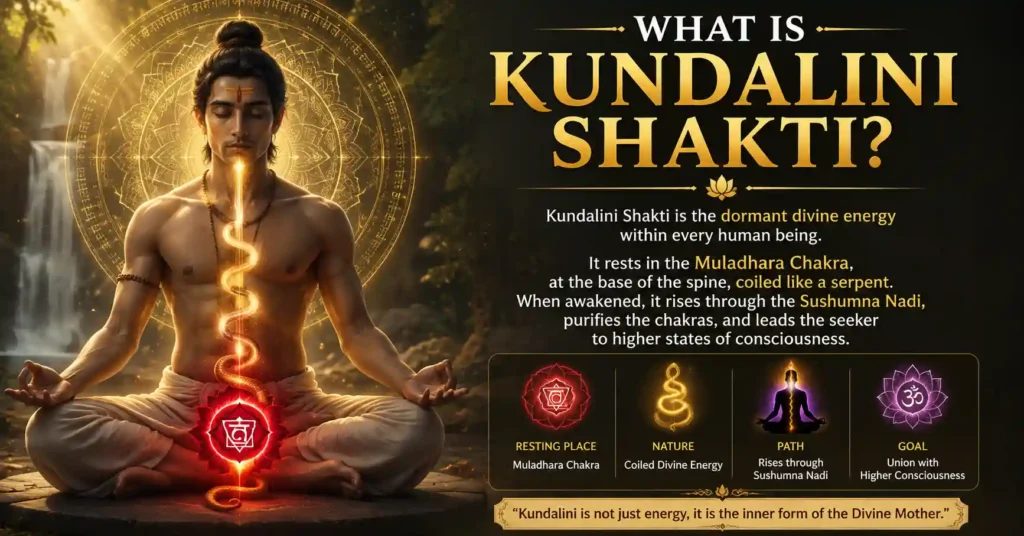
The word “Kundalini” comes from the Sanskrit word kundala, meaning coiled or circular. In yogic traditions, it is symbolically described as a coiled serpent resting at the base of the spine.
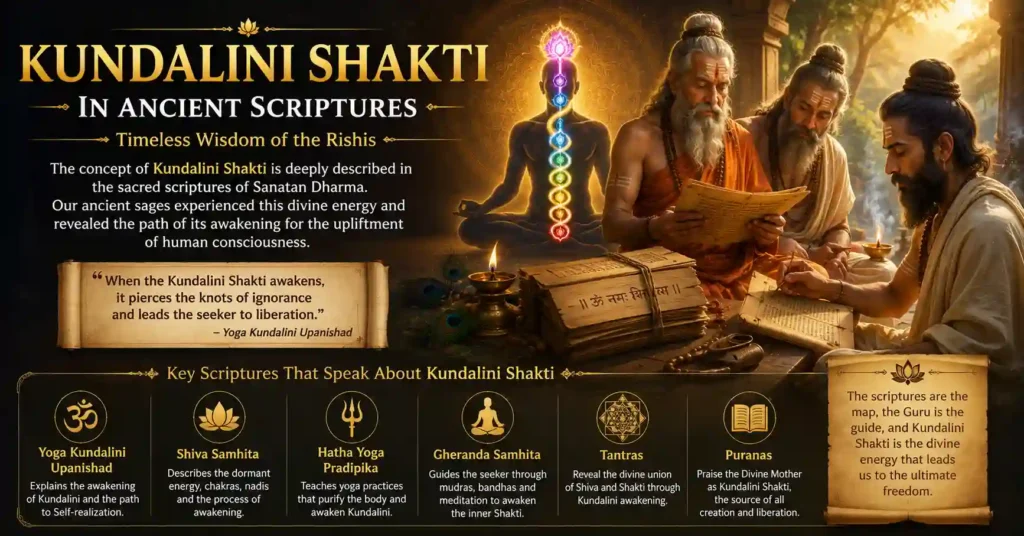
This symbolism appears in traditional texts such as the Hatha Yoga Pradipika, Shiva Samhita, and Yoga Kundalini Upanishad. These scriptures use symbolic language to explain subtle spiritual realities rather than physical structures.
According to these teachings, Kundalini Shakti is the dormant spiritual power present within every human being. It is considered a manifestation of the Divine Mother residing within the subtle body.
This sacred energy is said to rest in the Muladhara Chakra, the root energy center associated with stability, grounding, and survival.
In simple terms, the divine force within an individual is viewed as the same cosmic Shakti worshipped as Maa Durga, Maa Kali, Maa Lalita Tripura Sundari, and other forms of Devi.
When this inner spiritual energy awakens, it begins its journey through the central channel known as Sushumna Nadi. As it ascends through the chakras, the seeker’s awareness gradually expands and undergoes inner transformation.
The journey culminates at the Sahasrara Chakra, the crown center associated with higher consciousness and spiritual realization.
In yogic philosophy, the union of Shakti and Shiva symbolizes the merging of individual consciousness with universal consciousness. This state is regarded as a profound stage of spiritual awakening and self-realization.
Kundalini Shakti in Ancient Scriptures
The concept of Kundalini Shakti is deeply rooted in the spiritual traditions of Sanatan Dharma. It is not a modern idea but a subject discussed in several yogic and tantric texts for centuries.
The Yoga Kundalini Upanishad describes this dormant spiritual power as an inner force present within every human being. The text explains that its awakening is supported by disciplined spiritual practice, self-control, and inner purification.
The Hatha Yoga Pradipika emphasizes the importance of practices such as pranayama, meditation, and the cleansing of subtle energy channels. These disciplines help prepare the mind and body for higher states of awareness.
Similarly, the Shiva Samhita explores the relationship between chakras, nadis, prana, and spiritual consciousness. It explains how these elements work together in the seeker’s journey toward inner transformation.
An important point found across these scriptures is that spiritual progress is not measured by unusual experiences or supernatural abilities. The real goal is the purification of the mind, expansion of awareness, and growth in wisdom.
Although different traditions explain the process in their own way, they share a common message. True spiritual advancement comes through discipline, devotion, self-realization, and a deeper connection with the Divine.
Where Is Kundalini Shakti Located in the Body?
According to yogic traditions, Kundalini Shakti is said to rest in the Muladhara Chakra, the root energy center located at the base of the spine. However, this should not be understood as a physical organ or anatomical structure.
The chakra system belongs to the subtle body described in Yoga, Tantra, and other spiritual traditions of Sanatan Dharma. It represents an inner framework of consciousness and energy rather than the physical body.
This subtle energy system includes:
- Seven main chakras extending from the root to the crown
- Three primary energy channels: Ida, Pingala, and Sushumna Nadi
- Prana, the life force that sustains all physical and mental activities
During the process of Kundalini Awakening, this dormant spiritual energy is believed to rise through Sushumna Nadi, gradually influencing each chakra along its path.
This journey is not a physical movement inside the body. Instead, it symbolizes the expansion of awareness, purification of the mind, and the unfolding of higher consciousness.
Many people interpret the serpent imagery literally. In traditional teachings, however, the coiled serpent is a symbol of hidden potential, spiritual power, and the awakening of consciousness.
The image reminds seekers that immense spiritual possibilities lie dormant within every individual, waiting to be awakened through sincere practice, devotion, and inner growth.
What Are the Signs of Kundalini Awakening?
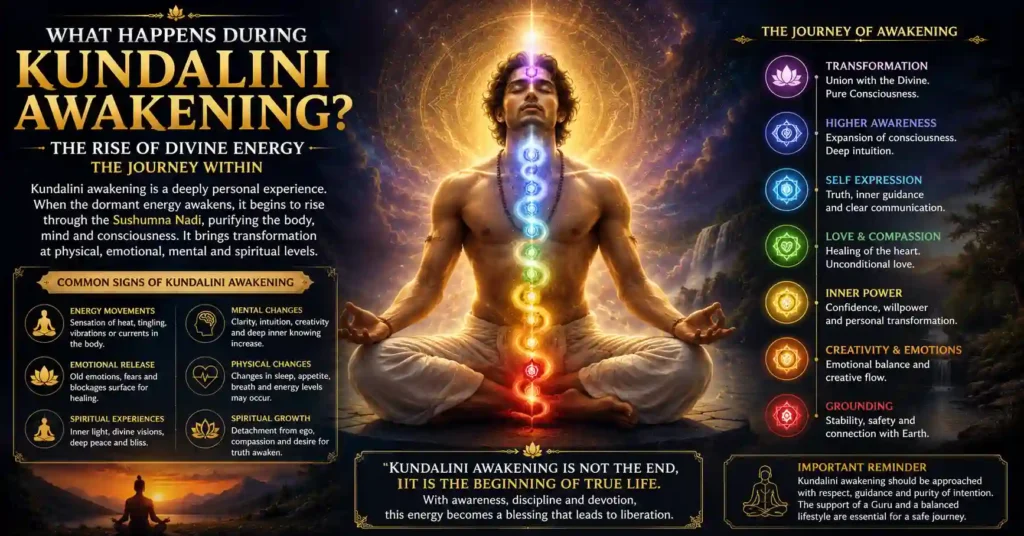
Kundalini Awakening does not look the same for everyone. Some people experience gradual changes over months or years, while others may notice sudden shifts in awareness, emotions, or spiritual practice.
In many cases, the process unfolds quietly. A person may not immediately recognize what is happening and may simply feel drawn toward meditation, self-reflection, or a deeper spiritual life.
These experiences are often grouped into three broad categories.
Physical Signs
- Sensations of warmth or energy along the spine
- Tingling or vibration in different parts of the body
- Spontaneous movements during meditation or yoga
- Changes in sleep patterns or dreams
- Pressure or sensations around the forehead or crown area
These experiences do not automatically indicate a full awakening. In some cases, they may simply reflect increased prana flow, deeper meditation, or changes in mental and emotional states.
Emotional Signs
- Sudden emotional release
- Unexplained crying or feelings of relief
- Old memories resurfacing for healing
- Greater compassion toward others
- Increased emotional sensitivity
Many spiritual traditions teach that inner purification involves releasing emotional blockages and unresolved impressions stored in the mind.
Spiritual Signs
- Deeper meditation experiences
- Reduced attachment to unnecessary desires
- Increased devotion and faith
- Moments of inner peace, bliss, or silence
- Expanded awareness and self-reflection
Some seekers also report a stronger interest in spiritual study, mantra japa, yoga, or contemplation as their inner journey deepens.
It is important to remember that Kundalini Awakening Signs vary from person to person. Not every unusual sensation has a spiritual cause, and not every spiritual experience indicates a full awakening.
The true measure of progress is not dramatic experiences but positive inner transformation. Greater clarity, compassion, self-discipline, and spiritual maturity are often considered more meaningful than temporary sensations.
Stages of Kundalini Awakening
Traditional yogic teachings describe Kundalini Awakening as a gradual process rather than a single dramatic event. While every seeker’s journey is unique, many spiritual traditions recognize certain stages of inner transformation that may unfold over time.
These stages should not be viewed as rigid rules. Some people may experience them differently, while others may move through them gradually and almost unnoticed.
1. Preparation and Purification
The journey often begins long before any noticeable awakening occurs.
During this stage, a seeker develops discipline through meditation, prayer, mantra japa, self-study, ethical living, and devotion.
The mind gradually becomes calmer, emotional burdens begin to lessen, and spiritual interest naturally increases.
2. Increased Energy and Awareness
As inner purification deepens, some seekers may notice changes in awareness and sensitivity.
These experiences can include deeper meditation, heightened intuition, stronger devotion, emotional healing, or a greater sense of inner peace.
At this stage, spiritual growth is often more important than unusual sensations.
3. Activation of the Subtle Energy System
Traditional texts describe a stage where dormant spiritual energy begins to move through the subtle energy channels.
Some people report sensations such as warmth, tingling, spontaneous meditation experiences, or a feeling of energy moving within the body.
However, such experiences vary greatly and should not be used as the sole measure of spiritual progress.
4. Chakra Transformation and Inner Growth
As awareness expands, deeper changes may occur within the seeker’s personality and outlook on life.
Fear may gradually reduce. Compassion may increase. Old emotional patterns may begin to dissolve.
Many traditions view these positive inner changes as more significant than extraordinary experiences.
5. Spiritual Maturity and Self-Realization
In advanced stages, the focus shifts away from experiences and toward wisdom, surrender, and spiritual understanding.
The seeker becomes less attached to ego, desires, and external validation.
Greater inner peace, clarity, and devotion become natural aspects of daily life.
6. Union with Higher Consciousness
Yogic traditions symbolically describe the highest stage as the union of Shakti and Shiva at the Sahasrara Chakra.
This represents the realization of one’s true spiritual nature and the recognition of the Divine presence within all existence.
Rather than being an end point, it is the culmination of a journey of self-discovery, inner transformation, and spiritual awakening.
Important: Not every seeker experiences these stages in the same way. Some journeys are gradual and subtle, while others may involve more noticeable spiritual experiences. Traditional teachings emphasize that lasting qualities such as peace, humility, compassion, and wisdom are the most reliable signs of genuine spiritual progress.
Is Kundalini Awakening Dangerous?
This is one of the most common questions asked by spiritual seekers.
The honest answer is that Kundalini Awakening is generally considered safe when it unfolds naturally through disciplined practice, devotion, meditation, and a balanced lifestyle.
Problems are more likely to arise when people attempt to force the process through extreme techniques, aggressive breathing exercises, intoxicants, or self-experimentation without proper guidance.
Traditional yogic and tantric teachings place great importance on preparation before seeking higher spiritual experiences. A stable mind, ethical living, self-discipline, and emotional balance are viewed as essential foundations.
For this reason, many teachers recommend progressing gradually rather than chasing dramatic experiences or quick results.
It is also important to remember that not every unusual sensation is related to spiritual awakening. Physical, emotional, or psychological experiences may have different causes and should be understood carefully.
If someone experiences severe anxiety, emotional distress, or health concerns, seeking appropriate medical or professional support is always advisable alongside spiritual practice.
The inner spiritual force described in yogic traditions is powerful, but it is not something to fear. When approached with humility, patience, devotion, and respect, the journey is generally smoother and more balanced.
Fear is rarely helpful on the spiritual path. Awareness, preparation, and respect are far more important.
Why Is a Guru Important in Kundalini Awakening?
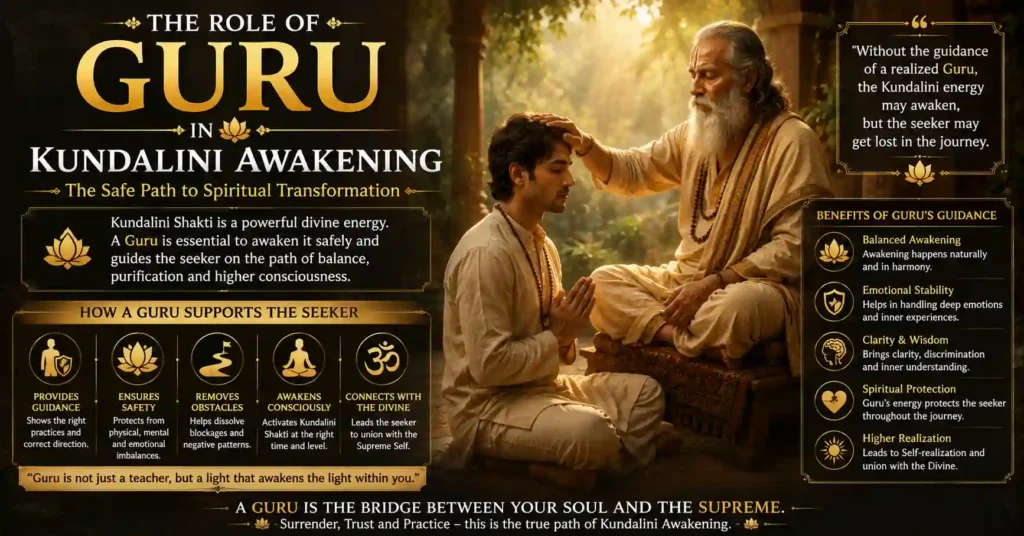
In many spiritual traditions, the guidance of a Guru is considered invaluable during the process of Kundalini Awakening.
A realized teacher can help a seeker understand:
- The different stages of spiritual growth
- The signs of balance and imbalance
- Appropriate spiritual practices for their level
- When to move forward and when to proceed more slowly
A Guru’s role is not merely to provide knowledge. Traditionally, a Guru helps the seeker develop discipline, clarity, humility, and right understanding on the spiritual path.
Many traditions also speak of Shaktipat, a sacred transmission of spiritual energy or grace from Guru to disciple. While its interpretation varies among traditions, it is generally viewed as a catalyst for deeper spiritual awakening.
At the same time, not every sincere seeker has access to a realized Guru. Spiritual progress is still possible through regular meditation, devotion, self-discipline, scriptural study, and ethical living.
Sanatan Dharma teaches that sincerity and purity of intention are often more important than chasing extraordinary experiences.
Whether guided by a Guru or progressing through sincere practice, the goal remains the same: inner transformation, spiritual maturity, and a deeper connection with the Divine.
Can Householders Experience Kundalini Awakening?
Yes. Kundalini Awakening is not limited to monks, ascetics, or advanced yogis. Many spiritual traditions within Sanatan Dharma teach that sincere householders can also experience profound spiritual growth while fulfilling their family and worldly responsibilities.
In fact, some of the greatest saints and devotees in Indian spiritual history lived as householders before attaining higher spiritual realization.
A common misconception is that one must renounce the world to progress spiritually. Traditional teachings do not support this idea. What matters most is the purity of one’s actions, thoughts, intentions, and devotion.
Householders can nurture spiritual growth through simple and consistent practices such as:
- Daily prayer and devotion
- Mantra japa
- Meditation
- Study of spiritual texts
- Selfless service
- Ethical and disciplined living
Many seekers find that family life itself becomes a powerful spiritual teacher. Patience, responsibility, compassion, forgiveness, and self-control are qualities that naturally develop through daily interactions and challenges.
The Bhagavad Gita repeatedly emphasizes that spiritual progress is possible while actively participating in worldly life. What matters is performing one’s duties with sincerity and without excessive attachment.
For this reason, paths such as Bhakti Yoga, Karma Yoga, and meditation are often considered especially suitable for householders seeking spiritual growth.
The awakening process may appear different for a householder than for a renunciant. Rather than dramatic experiences, it may unfold gradually through increased inner peace, emotional balance, wisdom, devotion, and self-awareness.
Traditional teachings remind us that the Divine is present everywhere, not only in forests, caves, or monasteries. A sincere seeker can walk the spiritual path from home, transforming everyday life into a form of sadhana.
Ultimately, spiritual awakening depends less on one’s outer lifestyle and more on one’s inner sincerity, discipline, and connection with the Divine.
Did You Know? Many revered saints in Indian spiritual traditions, including several Bhakti saints, lived as householders. Their lives demonstrate that devotion, selfless action, and spiritual realization are not restricted to monastic life.
Difference Between Prana, Chakras and Kundalini Shakti
Many people use the terms Prana, Chakras, and Kundalini Shakti interchangeably. However, in yogic philosophy, they refer to different aspects of the subtle energy system.
Understanding the distinction helps seekers better understand spiritual practices and avoid confusion.
- Prana is the vital life force that sustains the body and mind. It flows through the subtle energy channels known as nadis.
- Chakras are energy centers within the subtle body that influence different aspects of physical, emotional, and spiritual well-being.
- Kundalini Shakti is the dormant spiritual power believed to rest in the Muladhara Chakra, waiting to awaken through spiritual growth and inner purification.
Practices such as pranayama help regulate and strengthen prana. Meditation, mantra japa, and other yogic disciplines can help balance and harmonize the chakras.
Kundalini Awakening, however, refers to a deeper process in which dormant spiritual energy begins to rise through Sushumna Nadi, leading to expanded awareness and inner transformation.
A simple way to understand the difference is this:
- Prana is the energy that sustains life.
- Chakras are the centers through which energy is experienced and expressed.
- Kundalini is the deeper spiritual force associated with higher consciousness and self-realization.
Recognizing these differences makes it easier to understand many teachings found in Yoga, Tantra, and the broader spiritual traditions of Sanatan Dharma.
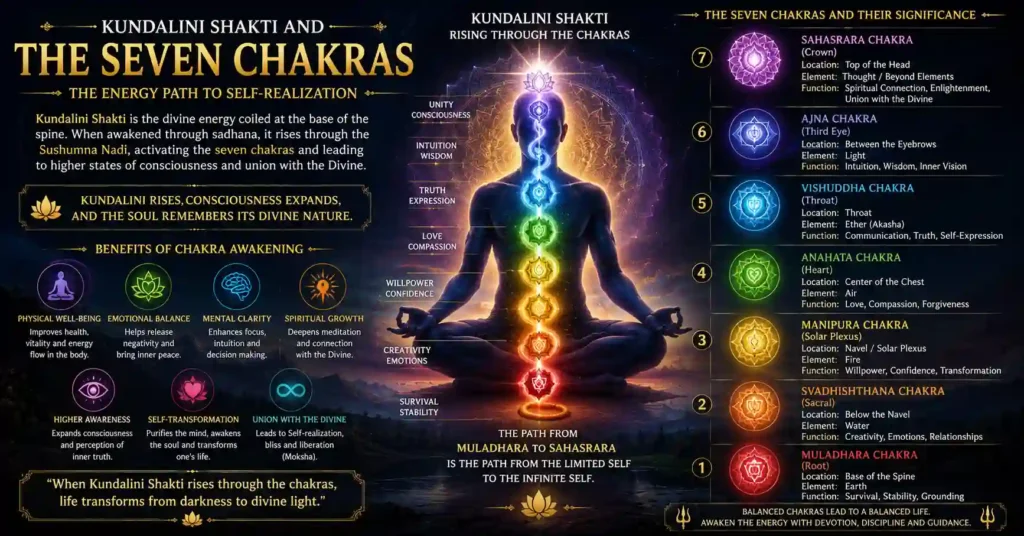
The Seven Chakras and Their Spiritual Significance
According to yogic traditions, Kundalini Awakening is described as a gradual journey through the seven main chakras of the subtle body. Each chakra represents a different stage of personal growth, awareness, and spiritual development.
These energy centers are not physical organs. They belong to the subtle energy system explained in Yoga and Tantra and are used to understand different levels of consciousness.
| Chakra | Spiritual Meaning |
|---|---|
| Muladhara | Stability, grounding, security, survival |
| Swadhisthana | Emotions, creativity, relationships |
| Manipura | Confidence, willpower, personal strength |
| Anahata | Love, compassion, forgiveness |
| Vishuddha | Truth, communication, self-expression |
| Ajna | Wisdom, intuition, inner vision |
| Sahasrara | Divine consciousness, spiritual realization |
As spiritual awareness deepens, seekers may experience positive changes associated with these centers. For example, the heart chakra is linked with compassion, while the Ajna chakra is associated with intuition and inner wisdom.
Traditional teachings emphasize that chakra awakening is not about gaining supernatural powers. The real purpose is the purification of the mind, expansion of consciousness, and movement toward self-realization.
As this inner journey progresses, many seekers experience greater balance, clarity, compassion, and spiritual maturity. These qualities are considered far more important than unusual experiences or mystical phenomena.
Ultimately, the journey through the chakras symbolizes the evolution of human consciousness from basic survival concerns toward higher wisdom, inner peace, and union with the Divine.
Did You Know?
According to yogic traditions, the goal of Kundalini Awakening is not to gain supernatural powers or mystical experiences.
Ancient texts emphasize that the true purpose of this inner journey is self-realization, inner transformation, and ultimately Moksha.
A seeker who becomes more peaceful, compassionate, and spiritually aware is considered to be making genuine progress, even without dramatic experiences.
Understanding the Tantric Perspective on Kundalini
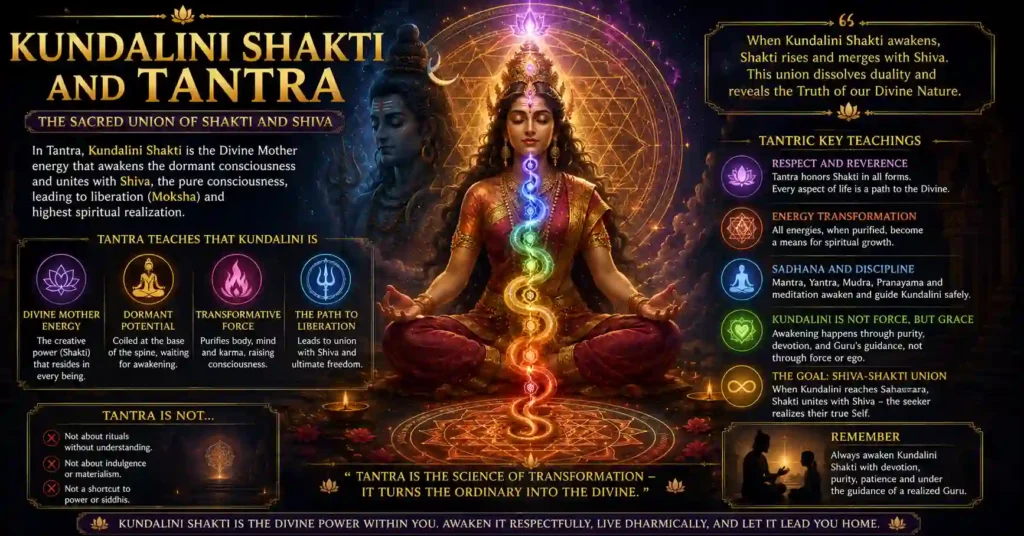
The word Tantra is often misunderstood. Many people associate it with black magic or occult practices, but traditional Tantra is a profound spiritual path focused on expanding consciousness and realizing the Divine.
In tantric philosophy, the awakening of the inner Shakti plays a central role. It is viewed as a sacred journey that gradually transforms the seeker’s awareness and leads toward spiritual liberation.
Tantra teaches that the human body is not merely physical. It is also a vessel of subtle energy, consciousness, and divine potential. Through disciplined practices, a seeker learns to purify the mind and awaken higher states of awareness.
Many traditions connected to the Dasa Mahavidyas also explore different dimensions of this transformative spiritual power. The various forms of Devi symbolize wisdom, compassion, courage, transcendence, and inner transformation.
For example, Maa Kali is often associated with the destruction of ignorance and ego, while Maa Tripura Sundari represents divine beauty, harmony, and higher consciousness.
From a tantric perspective, worship is not limited to external rituals. The Divine Mother is believed to exist both in the universe and within the seeker’s own consciousness.
This is why devotion to Kali, Tripura Sundari, Bhuvaneshwari, and other forms of Devi is often viewed as both an outer act of worship and an inner journey toward spiritual awakening.
The ultimate goal of Tantra is not the pursuit of powers or extraordinary experiences. Its deeper purpose is self-realization, liberation, and union with the Divine.
Kundalini Shakti in Vedanta and Tantra
Both Vedanta and Tantra discuss spiritual awakening and self-realization, but they approach the subject from different perspectives. Understanding these differences helps seekers appreciate the richness of Sanatan Dharma’s spiritual traditions.
In Tantra, the emphasis is often on Shakti, the dynamic divine energy that manifests as creation, consciousness, and spiritual transformation. Tantric teachings view the awakening of Kundalini Shakti as an important part of the journey toward higher awareness and liberation.
Tantra describes the subtle body in detail, including chakras, nadis, prana, and the ascent of spiritual energy through the Sushumna Nadi. Through practices such as mantra, meditation, devotion, and inner discipline, the seeker gradually awakens to their divine nature.
Vedanta, particularly Advaita Vedanta, focuses more directly on the realization of the true Self (Atman) and its unity with Brahman, the ultimate reality.
Rather than emphasizing the movement of spiritual energy, Vedanta places greater importance on self-inquiry, discrimination between the real and the unreal, contemplation, and spiritual knowledge.
From a Vedantic perspective, liberation comes through realizing that one’s true nature has always been divine and complete. The emphasis is on removing ignorance rather than awakening a specific spiritual force.
Despite these differences, the ultimate goal of both paths is remarkably similar.
Both seek:
- Freedom from ignorance
- Expansion of consciousness
- Self-realization
- Union with the Divine
- Liberation from suffering and limitation
Many spiritual teachers explain that Tantra and Vedanta are not contradictory. Tantra often emphasizes the path of transformation through Shakti, while Vedanta emphasizes the realization of the eternal Self.
One begins with the experience of divine energy, while the other focuses on the direct recognition of divine consciousness. Yet both point toward the same spiritual truth.
For many seekers, these traditions complement rather than oppose each other. Devotion, meditation, self-inquiry, and inner transformation can all work together on the path to spiritual realization.
Common Misconceptions About Kundalini Awakening
As interest in spirituality grows, Kundalini Awakening has become a popular topic on social media, podcasts, and online forums. Unfortunately, this has also led to several misconceptions.
One common myth is that Kundalini is a physical snake living inside the body. In traditional yogic teachings, the serpent is a symbolic representation of dormant spiritual potential and higher consciousness.
Another misunderstanding is that every unusual sensation during meditation is a sign of awakening. Warmth, tingling, emotional release, vivid dreams, or temporary shifts in awareness can occur for many reasons and do not necessarily indicate a genuine spiritual awakening.
Some people believe that awakening always produces dramatic visions, psychic abilities, or supernatural powers. Traditional scriptures place far greater importance on inner purification, self-discipline, compassion, devotion, and wisdom.
There is also a misconception that spiritual growth happens quickly. In reality, most authentic traditions describe it as a gradual process that unfolds through consistent practice, patience, and self-transformation.
Another common mistake is to focus only on experiences while neglecting character development. A person may have unusual spiritual experiences, yet still need to cultivate humility, emotional balance, and ethical conduct.
The true purpose of this inner journey is not to become extraordinary or gain special powers. Its deeper purpose is self-realization, expansion of consciousness, and a closer connection with spiritual truth.
Traditional teachings remind seekers that lasting transformation is measured by peace, clarity, compassion, and wisdom rather than by dramatic experiences alone.
Can Kundalini Awakening Happen Through Bhakti and Daily Life?
Yes, it can.
Many people assume that Kundalini Awakening occurs only through advanced yoga practices. However, traditional spiritual teachings describe several paths through which inner awakening may unfold.
Deep Bhakti, sincere prayer, mantra japa, meditation, selfless service, and devotion to the Divine can all contribute to spiritual transformation.
Some traditions also teach that divine grace, intense spiritual longing, or profound life experiences may become catalysts for inner growth and higher awareness.
In many cases, the process is gentle rather than dramatic. A person may gradually become calmer, more compassionate, emotionally balanced, and less reactive to life’s challenges.
Others may notice a stronger attraction toward meditation, spiritual study, satsang, or devotional practices. These subtle changes can be just as meaningful as more noticeable experiences.
Not every spiritual awakening is accompanied by visions, intense sensations, or extraordinary events. For many seekers, the journey unfolds quietly through steady growth in wisdom, devotion, and self-awareness.
Sanatan Dharma recognizes multiple paths to spiritual progress. Whether through Bhakti Yoga, Dhyana Yoga, Karma Yoga, or divine grace, the ultimate purpose remains the same: purification of the mind, expansion of consciousness, and movement toward self-realization.
The deepest signs of awakening are often seen in a person’s character, conduct, and relationship with the Divine rather than in outward experiences.
A Balanced Perspective on Spiritual Experiences
Spiritual experiences can sometimes be difficult to interpret correctly. Not every unusual sensation or emotional shift has a spiritual cause.
Deep meditation, emotional healing, prolonged stress, lack of sleep, or major life changes can create experiences that feel profound or transformative. Some may be connected with spiritual growth, while others may have physical or psychological explanations.
For this reason, traditional teachers advise seekers not to become overly attached to sensations, visions, sounds, or unusual experiences.
The focus should remain on inner growth rather than on collecting spiritual experiences. Lasting transformation is reflected in greater peace, self-awareness, compassion, and emotional balance.
A balanced spiritual path combines meditation, devotion, ethical living, and practical wisdom. These qualities help seekers remain grounded while continuing their spiritual journey.
If someone experiences severe emotional distress, persistent anxiety, or health-related concerns, seeking appropriate medical guidance is always advisable alongside spiritual practice.
Sanatan Dharma encourages both spiritual inquiry and responsible self-care. The two are not opposed to each other.
Ultimately, genuine spiritual progress brings greater clarity, stability, and inner peace. It should help a person become more balanced, not more fearful or confused.
How to Prepare for Kundalini Awakening Safely
When it comes to spiritual growth, preparation is far more important than excitement. Traditional teachings emphasize building a strong foundation before seeking higher experiences.
Some safe and time-tested practices include:
- Regular meditation without expectations or pressure
- Simple pranayama practiced under proper guidance
- Ethical living and self-discipline
- A balanced diet and adequate sleep
- Devotional practices such as prayer, mantra japa, and bhakti
- Avoiding intoxicants and extreme spiritual techniques
These practices help purify the mind, improve emotional balance, and create a stable foundation for spiritual progress.
Rather than forcing experiences, yogic traditions encourage patience and steady effort. Genuine transformation usually unfolds gradually through consistent practice and inner refinement.
As awareness deepens, seekers often develop greater clarity, compassion, self-control, and peace of mind. These qualities are considered important signs of spiritual maturity.
Traditional teachings suggest that when the mind becomes calmer, the heart becomes purer, and life becomes more balanced, the process of inner awakening unfolds more naturally.
The goal is not to chase extraordinary experiences but to cultivate a life that supports lasting spiritual growth and self-realization.
The Spiritual Significance of Kundalini Awakening
At its deepest level, Kundalini Awakening is not about gaining power, extraordinary abilities, or unusual experiences. Its true purpose is inner purification and spiritual transformation.
As awareness expands, many seekers gradually experience positive changes in their thoughts, emotions, and outlook on life.
This transformation may include:
- A reduction in ego and self-centered thinking
- Greater awareness and mindfulness
- Increased compassion and empathy
- Less fear and emotional reactivity
- Deeper inner peace and silence
In yogic philosophy, the highest stage of this journey is symbolized by the awakening of the Sahasrara Chakra, the crown center associated with divine consciousness and spiritual realization.
Traditional teachings describe this as the union of Shakti and Shiva. Symbolically, it represents the realization that individual consciousness is not separate from the Divine.
This union is not viewed as a physical event. Rather, it is a profound shift in awareness in which the seeker recognizes their deeper spiritual nature.
From the perspective of Sanatan Dharma, the ultimate goal is not merely awakening but self-realization and, ultimately, Moksha or liberation.
The journey is inward. It is a movement from ignorance to wisdom, from restlessness to peace, and from limited identity to a deeper understanding of one’s true nature.
Kundalini Shakti and Moksha
One of the most important questions in spiritual philosophy is whether Kundalini Awakening automatically leads to Moksha, or liberation.
Traditional teachings generally explain that the two are related, but they are not exactly the same.
Kundalini Awakening refers to the activation of dormant spiritual potential and the expansion of awareness. It is often described as an important milestone on the spiritual path.
Moksha, however, is the ultimate realization of one’s true nature and freedom from ignorance, attachment, and the cycle of birth and death.
For this reason, many spiritual traditions view awakening as a means rather than the final destination.
A person may experience profound spiritual states, heightened awareness, or deep meditation experiences and still have further inner growth ahead. Lasting liberation requires wisdom, self-realization, and complete transformation of consciousness.
Yogic and tantric traditions often describe awakening as a process that helps purify the mind, dissolve limitations, and prepare the seeker for higher spiritual realization.
Similarly, Vedantic teachings emphasize that liberation arises through direct knowledge of the Self and the removal of ignorance.
Although different traditions explain the journey in different ways, they agree on an important principle: spiritual experiences alone are not the goal.
The true measure of progress is reflected in qualities such as:
- Inner peace
- Freedom from excessive ego
- Compassion and humility
- Detachment from selfish desires
- Steady awareness of the Divine
When these qualities deepen, the seeker moves closer to genuine spiritual freedom.
In this sense, awakening can be viewed as an important step on the path, while Moksha represents the fulfillment of that journey.
Ultimately, the goal of Sanatan Dharma is not merely to awaken spiritual energy but to realize the eternal truth of one’s divine nature and live in harmony with that realization.
Key Insight: Kundalini Awakening may open the door to higher consciousness, but Moksha is the complete realization of the Self. Awakening is part of the journey; liberation is the ultimate destination.
Kundalini Shakti and the Divine Mother
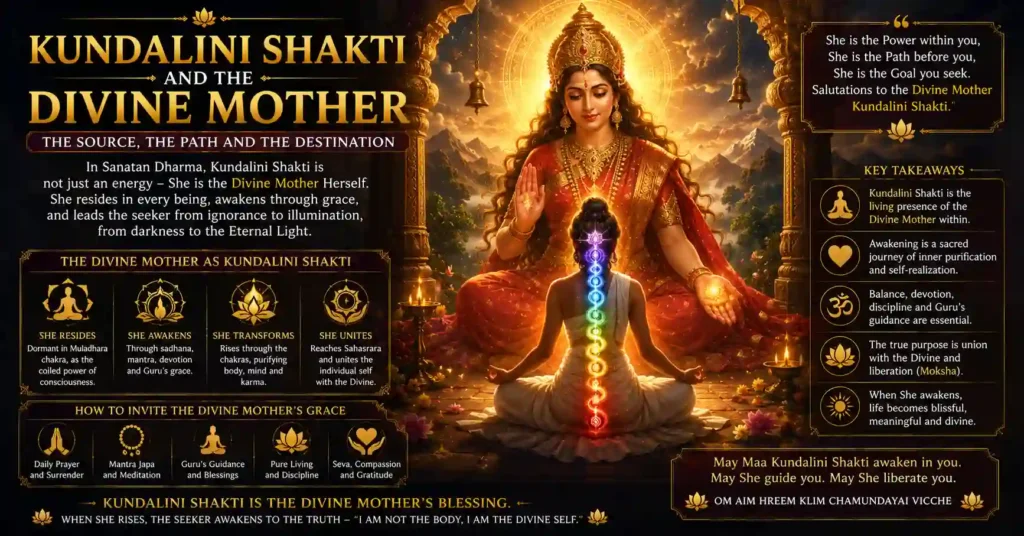
One of the most beautiful teachings in Sanatan Dharma is that the Divine Mother exists both in the universe and within every living being.
The same Shakti worshipped as Maa Durga during Navratri, the same Divine Mother revered through the Mahavidyas, is believed to reside within as Kundalini Shakti.
For this reason, many spiritual traditions see no separation between outer worship and inner awakening. Both are part of the same spiritual journey.
Devotional practices such as prayer, mantra japa, puja, and meditation help purify the mind and open the heart to divine grace.
As devotion deepens, seekers often develop greater humility, faith, compassion, and inner awareness. These qualities prepare the ground for spiritual growth.
In this sense, external worship is not merely a ritual. It becomes a way of strengthening one’s connection with the Divine Mother and cultivating the qualities needed for inner transformation.
Traditional teachings describe this sacred energy as Devi in her subtle form, present within every individual as a source of spiritual potential and higher consciousness.
When a devotee bows before the Divine Mother, they are not only honoring the cosmic power that sustains the universe. They are also acknowledging the divine presence that exists within their own heart.
This understanding beautifully unites Bhakti, self-discovery, and spiritual awakening into a single path leading toward self-realization and the Divine.
Conclusion
Kundalini Shakti is one of the most profound concepts in Sanatan Dharma. It represents the dormant spiritual potential within every human being and the possibility of awakening to a higher state of consciousness.
While the journey is often associated with chakras, meditation, and spiritual experiences, its true purpose is far deeper. It is a path of inner purification, self-discovery, and transformation that gradually leads a seeker toward greater wisdom, compassion, and self-realization.
Whether this awakening unfolds through yoga, meditation, bhakti, mantra japa, or divine grace, the focus should never be on extraordinary experiences alone. The real measure of spiritual progress is a calmer mind, a purer heart, and a deeper connection with the Divine.
Ultimately, the journey of Kundalini Shakti reminds us that the Divine Mother we worship outside also resides within. By walking the path with patience, humility, and devotion, a seeker moves closer to spiritual truth, inner peace, and the timeless goal of Moksha.
Key Takeaways
- Kundalini Shakti is the dormant spiritual power described in yogic and tantric traditions of Sanatan Dharma.
- It is symbolically said to rest in the Muladhara Chakra and represents the Divine Mother’s presence within every individual.
- The awakening process is associated with inner transformation, expanded awareness, and spiritual growth rather than supernatural powers.
- Traditional teachings describe the journey through the seven chakras as a gradual evolution of consciousness.
- Common signs may include deeper meditation, emotional healing, increased compassion, inner peace, and greater self-awareness.
- Kundalini Awakening does not look the same for everyone and may unfold gradually over time.
- Practices such as meditation, mantra japa, pranayama, devotion, ethical living, and self-discipline help prepare a seeker for spiritual progress.
- A Guru can provide valuable guidance, but sincere spiritual growth is also supported by devotion, wisdom, and consistent practice.
- The true purpose of awakening is not dramatic experiences but purification of the mind, self-realization, and a deeper connection with the Divine.
- In many Shakta traditions, the same Divine Mother worshipped as Durga, Kali, and other forms of Devi is believed to reside within as Kundalini Shakti.
- The highest spiritual goal is not merely awakening but Moksha, the realization of one’s true nature and union with the Divine.
Suggested Reading
If you found this exploration of Kundalini Shakti meaningful, you may also enjoy learning about other dimensions of Shakti in Sanatan Dharma.
From the Divine Mother’s powerful forms and sacred wisdom traditions to the deeper symbolism of spiritual awakening, these articles will help you understand how inner transformation, devotion, and divine consciousness are connected.
Dasa Mahavidya: The Ten Wisdom Goddesses of Sanatan Dharma
https://thesanatantales.com/das-mahavidya/
Navadurga: The Nine Forms of Maa Durga and Their Divine Powers
https://thesanatantales.com/navadurga-nine-forms-of-maa-durga/
Maa Kali: Meaning, Symbolism and Spiritual Significance
https://thesanatantales.com/maa-kali-origin-story-meaning-power/
Maa Tripura Sundari: The Goddess of Divine Beauty and Consciousness
https://thesanatantales.com/maa-lalita-tripura-sundari/
Maa Bhuvaneshwari: The Goddess of Cosmic Space and Compassion
https://thesanatantales.com/maa-bhuvaneshwari/
Maa Durga: Meaning, Story, Navadurga, Temple and Worship Guide
https://thesanatantales.com/maa-durga-meaning-story-navadurga-worship/
Bhagwan Jagannath Story, Nabakalebara, Mahaprasad and Temple Mysteries
https://thesanatantales.com/bhagwan-jagannath-story-nabakalebara/
Devi Mantras, Aartis and Stotras: Sacred Sounds of the Divine Mother
https://thesanatantales.com/durga-mantras-stotras-chalisa-aarti/
Kundalini (Wikipedia)
https://en.wikipedia.org/wiki/Kundalini
FAQs
1. What is Kundalini Shakti in Sanatan Dharma?
Kundalini Shakti is described in yogic and tantric traditions as a dormant spiritual power present within every human being. It is symbolically said to rest in the Muladhara Chakra at the base of the spine.
This sacred energy is considered a manifestation of the Divine Mother within the subtle body. When awakened through spiritual practice, it is believed to support inner transformation, expanded awareness, and spiritual growth.
The ultimate purpose of this journey is not power or extraordinary experiences but self-realization and a deeper connection with the Divine.
2. What are the signs of Kundalini Awakening?
The signs of Kundalini Awakening can vary from person to person. Some seekers experience gradual changes, while others notice more intense shifts in awareness.
Common signs may include:
- Deep meditation experiences
- Increased compassion and sensitivity
- Greater inner peace
- Emotional release and healing
- Reduced attachment to unnecessary desires
- Stronger devotion and spiritual interest
Traditional teachings emphasize that lasting transformation in character, awareness, and wisdom is more important than temporary sensations or unusual experiences.
3. Is Kundalini Awakening dangerous?
In traditional teachings, a natural and gradual awakening supported by discipline, meditation, and devotion is generally considered safe.
Difficulties are more likely when people attempt to force the process through extreme techniques, intoxicants, or practices performed without proper understanding.
For this reason, Yoga and Tantra emphasize preparation, self-discipline, emotional balance, and patience. A grounded spiritual approach is usually considered more beneficial than chasing dramatic experiences.
4. Can Kundalini Awakening happen without yoga?
Yes. While yoga is one of the traditional paths, awakening is not limited to physical or advanced yogic practices.
Many traditions teach that deep Bhakti, mantra japa, meditation, selfless service, sincere devotion, and divine grace can also support spiritual awakening.
For some seekers, the process unfolds quietly through gradual inner growth rather than intense spiritual experiences.
5. What is the connection between Kundalini and the seven chakras?
According to yogic traditions, the dormant spiritual energy is believed to rise through the seven main chakras of the subtle body.
Each chakra represents a different stage of awareness and personal development, from basic survival and emotional balance to wisdom and spiritual realization.
The journey through the chakras symbolizes the evolution of consciousness and the gradual unfolding of higher spiritual awareness.
6. What is the role of a Guru in Kundalini Awakening?
A Guru can provide guidance, clarity, and support during the spiritual journey. Traditional teachings consider the guidance of an experienced teacher valuable because they can help a seeker understand spiritual experiences and maintain balance.
A Guru may also help identify misunderstandings, encourage proper practices, and prevent unnecessary fear or confusion.
However, sincere spiritual progress is still possible through devotion, meditation, scriptural study, and ethical living when a Guru is not available.
7. Is Kundalini Shakti the same as Prana?
No. Although both are related to the subtle energy system, they are not the same.
Prana is the life force that sustains the body and mind. It flows through the energy channels known as nadis.
Kundalini Shakti is described as a deeper dormant spiritual power associated with higher consciousness and spiritual awakening.
Understanding this distinction helps avoid confusion when studying Yoga, Tantra, and chakra-related teachings.
8. Does Kundalini Awakening lead to Moksha?
Traditional teachings generally view awakening as an important stage in spiritual development, but not necessarily the final goal.
The ultimate aim of Sanatan Dharma is Moksha, or liberation from ignorance and the cycle of birth and death.
Awakening may support this journey by expanding awareness and deepening self-understanding. However, liberation is associated with complete self-realization and realization of one’s true nature.
9. Can householders experience Kundalini Awakening?
Yes. Spiritual awakening is not limited to monks, ascetics, or advanced yogis.
Many traditions teach that householders can progress spiritually through devotion, meditation, ethical living, selfless service, and sincere spiritual practice.
A balanced family life combined with regular sadhana can also become a path of inner growth and transformation.
10. Why is Kundalini Shakti associated with the Divine Mother?
In many Shakta traditions, the spiritual energy within is viewed as a manifestation of the same Divine Mother worshipped as Durga, Kali, Lalita Tripura Sundari, and other forms of Devi.
This understanding teaches that the Divine is not only present in temples and sacred images but also within every individual.
For this reason, devotion to the Divine Mother and the journey of inner awakening are often seen as complementary aspects of the same spiritual path.
Glossary of Important Terms
| Term | Meaning |
|---|---|
| Ajna Chakra | The sixth chakra, also called the Third Eye Chakra. It is associated with intuition, wisdom, insight, and inner vision. |
| Anahata Chakra | The fourth chakra or Heart Chakra. It represents love, compassion, forgiveness, and emotional balance. |
| Bhakti | The path of devotion and love for the Divine. It is one of the major spiritual paths in Sanatan Dharma. |
| Chakra | A subtle energy center described in yogic traditions. The seven main chakras represent different levels of consciousness and spiritual growth. |
| Divine Mother | The supreme feminine aspect of the Divine worshipped as Durga, Kali, Lalita Tripura Sundari, and other forms of Devi. |
| Ida Nadi | One of the three primary energy channels in the subtle body. It is associated with intuition, calmness, and lunar energy. |
| Karma Yoga | The path of selfless action performed without attachment to results. It is a key teaching of the Bhagavad Gita. |
| Kundalini Awakening | The process through which dormant spiritual energy becomes active, leading to inner transformation, expanded awareness, and spiritual growth. |
| Kundalini Shakti | The dormant spiritual power described in Yoga and Tantra. It is symbolically said to rest in the Muladhara Chakra and represents the Divine Mother’s presence within. |
| Mahavidyas | The ten wisdom forms of the Divine Mother in Shakta tradition. Each represents a unique aspect of spiritual knowledge and transformation. |
| Mantra Japa | The repeated chanting or silent repetition of a sacred mantra to focus the mind and deepen spiritual practice. |
| Manipura Chakra | The third chakra associated with confidence, willpower, determination, and personal strength. |
| Moksha | Liberation from ignorance and the cycle of birth and death. It is considered the ultimate goal of spiritual life in Sanatan Dharma. |
| Muladhara Chakra | The first chakra, also called the Root Chakra. It is associated with stability, grounding, security, and survival. |
| Nadi | A subtle energy channel through which prana is believed to flow. The three most important nadis are Ida, Pingala, and Sushumna. |
| Prana | The vital life force that sustains the body and mind. Yogic practices aim to regulate and balance prana. |
| Pranayama | Yogic breathing techniques used to regulate prana, calm the mind, and prepare for meditation. |
| Sahasrara Chakra | The seventh chakra, known as the Crown Chakra. It symbolizes divine consciousness, spiritual realization, and union with the Divine. |
| Satsang | Association with spiritually minded people, saints, or teachings that encourage spiritual growth and wisdom. |
| Self-Realization | The direct realization of one’s true spiritual nature beyond the ego, body, and mind. |
| Shakti | The divine feminine power responsible for creation, preservation, and transformation. |
| Shaktipat | A spiritual transmission of grace or energy from a Guru to a disciple, believed in some traditions to support spiritual awakening. |
| Shiva | The supreme consciousness in yogic and tantric philosophy. The union of Shiva and Shakti symbolizes spiritual realization. |
| Spiritual Awakening | A gradual expansion of awareness that leads to greater wisdom, inner peace, and connection with the Divine. |
| Sushumna Nadi | The central energy channel through which spiritual energy is believed to rise during the awakening process. |
| Swadhisthana Chakra | The second chakra associated with emotions, creativity, relationships, and pleasure. |
| Tantra | A spiritual tradition focused on expanding consciousness and realizing the Divine through disciplined practices and inner transformation. |
| Vishuddha Chakra | The fifth chakra, also called the Throat Chakra. It is associated with truth, communication, and self-expression. |
| Yoga | A spiritual discipline that seeks union of the individual self with the Divine through meditation, self-discipline, devotion, and self-realization. |
About the Author
Yateendra Chaturvedi is a spiritual writer, researcher, devotee, and the founder of The Sanatan Tales. With over 35 years of professional experience and a lifelong interest in Sanatan Dharma, he writes about Hindu deities, temples, scriptures, festivals, Mahavidyas, sacred stories, rituals, and living traditions that continue to guide and inspire devotees across India.
Drawing from traditional scriptures, regional beliefs, temple traditions, devotional literature, and historical sources, he aims to present authentic, well-researched, and easy-to-understand content for modern readers. His work focuses on preserving spiritual wisdom, explaining sacred traditions, and helping seekers develop a deeper understanding of India’s rich spiritual heritage.
Through The Sanatan Tales, Yateendra strives to make the timeless teachings of Sanatan Dharma simple, meaningful, and relevant for today’s generation while maintaining respect for traditional sources, regional practices, and diverse spiritual perspectives.
Learn More About Yateendra Chaturvedi →
https://thesanatantales.com/about-the-author/
References & Sources
This article is based on traditional concepts, teachings, and spiritual perspectives found within Sanatan Dharma. It draws upon widely known ideas from Hindu philosophy, yogic traditions, devotional practices, scriptural teachings, and cultural wisdom that have been passed down through generations.
The content is intended to provide a simple and reader-friendly understanding of the topic while remaining respectful to traditional beliefs and practices.
Note: Spiritual beliefs, interpretations, and practices may vary across different traditions, sampradayas, teachers, regions, and individual paths within Sanatan Dharma. The purpose of this article is not to present any one interpretation as the only truth, but to share commonly accepted perspectives in an accessible and practical manner. Sanatan Dharma embraces diverse paths of devotion, knowledge, meditation, self-discipline, and spiritual growth.
Explore More Fascinating Topics from Sanatan Dharma