
There are moments when life slows down and a quiet question rises inside us. Who am I really? Am I only this body, this name, this role I play every day? Or is there something deeper that stays unchanged even when everything else keeps moving? Also who is Atma and Parmatma?
Sanatan Dharma answers this question gently, without fear or force. It speaks of Atma and Parmatma, not as distant ideas, but as living truths meant to be felt and understood in daily life.
This wisdom is not meant only for monks or scholars. It is meant for ordinary people living ordinary lives, facing joy and loss, success and failure, love and confusion. The teachings of Atma and Parmatma are meant to bring clarity, not complexity.
When understood slowly, they help a person live with less fear and more trust in life.
Table of Contents
ToggleWhat is atma in sanatan dharma
Atma means the true self.
Not the body that grows and weakens with time.
Not the mind that keeps changing thoughts, moods, and desires.
Not even the personality shaped by past experiences.
Atma is the silent presence within. It is the awareness that knows the body, observes the mind, and experiences the world. In Sanatan Dharma, Atma is described as eternal. It does not begin with birth and does not end with death.
This is why ancient texts say the soul cannot be cut, burned, or destroyed. Only the outer layers change. The Atma remains untouched, calm, and complete.
Understanding this brings a quiet strength. Life may shake us, but something within remains steady.
What is parmatma, the supreme reality
Parmatma is the Supreme consciousness, the source from which everything arises.
If Atma is individual awareness, Parmatma is universal awareness.
If Atma experiences life through one body, Parmatma experiences life through all bodies.
Sanatan Dharma does not restrict Parmatma to one image or belief. Some worship Parmatma as God with form and qualities. Others experience it as formless truth, light, or pure being.
Both paths are respected because the Supreme cannot be limited by human understanding. Parmatma is present everywhere, yet beyond everything. Nothing exists outside it.
Atma and parmatma relationship explained simply
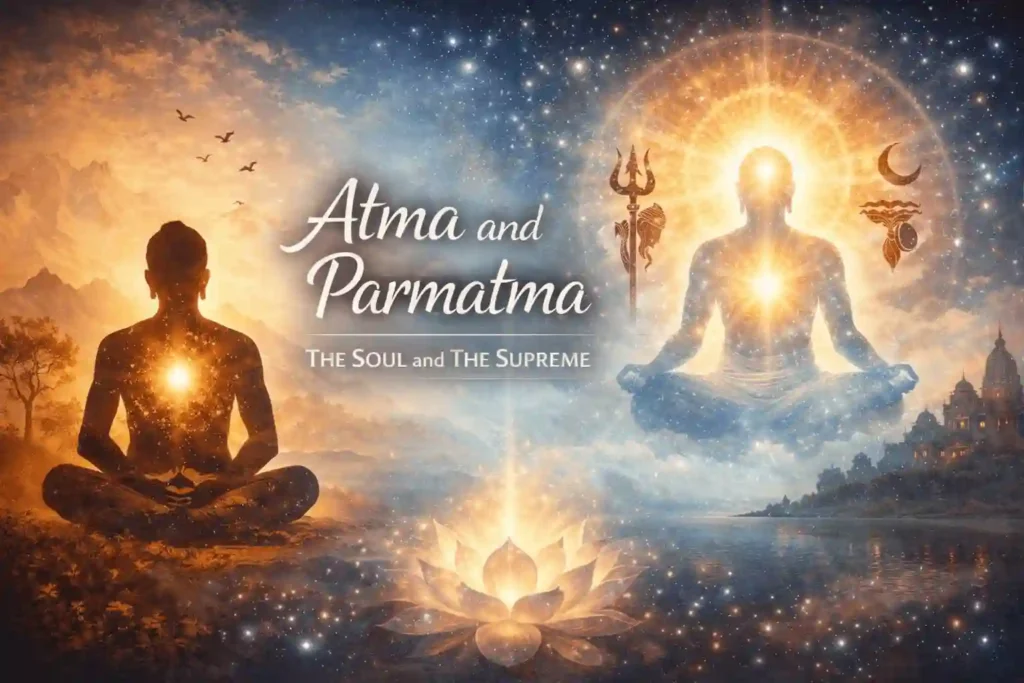
“In simple words, Atma is the individual soul, and Parmatma is the universal soul.”
The relationship between Atma and Parmatma is not one of distance, but of depth.
A simple way to understand this is through experience rather than logic. When the mind becomes quiet, even for a moment, there is a sense of peace that does not depend on circumstances. That peace is not created. It is revealed. That is Atma touching its source, Parmatma.
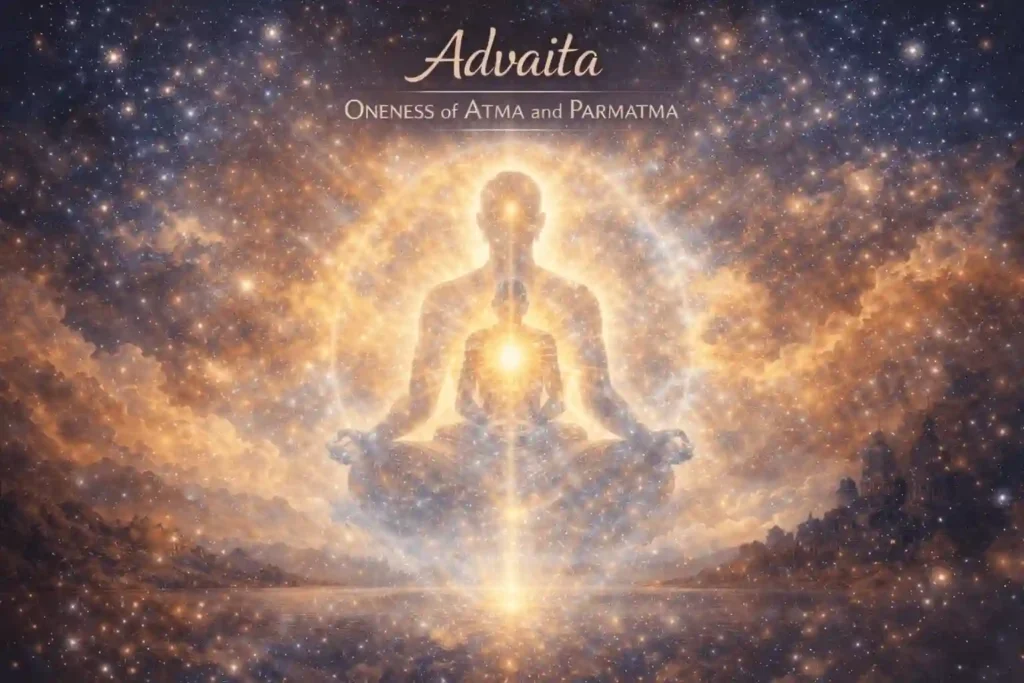
Sanatan wisdom explains that Atma and Parmatma are one in essence, but different in expression. Just as sparks arise from fire, the Atma arises from the Supreme, carrying the same nature.
Realization is not about becoming divine. It is about remembering that the divine was never absent.
Why humans feel separate from parmatma
If this unity is real, why does life often feel heavy, lonely, and fearful?
The reason lies in identification. From childhood, we are taught to identify ourselves as the body, the name, the family, the role. Slowly, the deeper identity is forgotten.
This forgetting creates ego, not as arrogance, but as limitation. The self begins to feel small and vulnerable. From this, fear is born. Fear of loss. Fear of death. Fear of not being enough.
Sanatan Dharma does not condemn this state. It sees it as part of the human journey. Awareness is the beginning of freedom.
Sanatan dharma teaches union, not fear
Many belief systems rely on fear or reward. Sanatan Dharma relies on understanding.
It does not ask you to fear the Supreme. It invites you to know it.
It does not demand blind belief. It encourages inquiry and experience.
The purpose of life is not escape from the world, but right living within it, with awareness of one’s true nature. When the sense of separation reduces, actions become more natural and less forced.
Devotion becomes love, not obligation.
Duty becomes service, not burden.
How one slowly realizes atma
Realization does not arrive suddenly for most people. It unfolds gently.
It happens when silence is allowed, even for a few moments each day.
It happens when actions are done sincerely, without constant demand for reward.
It happens when devotion softens the heart.
Sanatan Dharma offers many paths because human nature is diverse. Some connect through knowledge, some through love, some through action. No path is considered higher or lower.
What matters is sincerity, not speed.
The role of karma in understanding atma
Karma plays an important role in this journey. Actions performed with attachment strengthen identification with the ego. Actions performed with awareness slowly loosen it.
When actions are done as duty, without excessive expectation, the mind becomes lighter. This lightness allows the Atma to shine through.
Karma is not punishment. It is learning.
And learning gradually leads the soul toward awareness.
Atma and parmatma in daily life
This wisdom is not meant to remain in books or discussions.
When a person knows they are Atma, insults lose their sharpness. Praise no longer inflates the ego. Fear of death slowly reduces, because identity is no longer tied only to the body.
Seeing Parmatma in others brings compassion. Even disagreement carries respect. Life becomes less reactive and more thoughtful.
Problems still arise, but they no longer define the person.
The place of devotion in this understanding
Devotion is often misunderstood as blind faith. In Sanatan Dharma, devotion is closeness.
When love is directed toward the Divine, the heart becomes pure and open. This openness allows deeper understanding to arise naturally.
Devotion does not oppose knowledge. It prepares the heart for it.
A devoted heart and a clear mind walk together.
Common misunderstandings about atma and parmatma
Some believe Atma is the same as the thinking mind. It is not. The mind is seen by the Atma.
Others believe Parmatma is distant, watching and judging. Sanatan Dharma teaches that the Supreme is nearer than breath.
There is also fear that union means loss of individuality. In truth, realization brings freedom from limitation, not disappearance.
Closing thought
The journey of Atma and Parmatma is not about reaching somewhere far away. It is about removing what covers the truth.
When fear reduces, peace increases.
When ego softens, clarity grows.
When awareness deepens, life feels lighter.
The Supreme is not waiting elsewhere.
It is quietly present within.
Further reading
To deepen this understanding, you may also explore related wisdom on thesanatantales.com such as Karma Kya Hai Aur Kaise Kaam Karta Hai, Dharma meaning in daily life, and Moksha as inner freedom. Together, these teachings form a complete picture of Sanatan wisdom, helping the seeker live with balance, clarity, and quiet confidence.
FAQs
What is the concept of atma and paramatma?
Atma is the individual soul, the true self that experiences life through one body.
Parmatma is the Supreme consciousness, present in all beings and beyond all forms.
Sanatan Dharma teaches that they are one in essence, not separate in reality.
Can atma become paramatma?
Atma does not become Parmatma, because it was never truly separate.
Realization is the removal of ignorance, not a change in nature.
When awareness deepens, the Atma recognizes its unity with Parmatma.
Are prana and atma the same?
No. Prana is the life energy that supports the body and breath.
Atma is the conscious witness that observes prana, body, and mind.
Prana moves, Atma remains still and aware
What are the 4 stages of atman?
Sanatan wisdom speaks of four states of awareness experienced by the Atma.
These are waking, dreaming, deep sleep, and the fourth state of pure awareness.
The Atma remains present in all four, unchanged and observing.
Can we see atma?
Atma cannot be seen with the eyes like an object.
It is known through awareness, silence, and inner experience.
You do not see Atma, you realize it.
Does atma have a gender?
No. Atma has no gender, form, or physical quality.
Gender belongs to the body, not the soul.
Atma exists beyond male and female distinctions.