Somewhere in life, many people come across a divine form that feels strangely familiar. Not because they understand it, not because someone explained it to them, but because their heart recognizes it instantly.
For countless devotees, that quiet moment of recognition happens the first time they stand before Bhagwan Jagannath.
When devotees stand before him, something gentle and unspoken happens inside. His large, round eyes do not judge or question. They do not ask who you are or where you come from. They only see, fully and lovingly.
Many people say it feels as if the Lord is looking straight into their life, holding every joy, fear, mistake, and hope without asking for explanations.
This is why Puri does not feel like a destination you visit and leave. It feels like a place that quietly accepts you, the way you are. It feels like home.
The name Jagannath means the Lord of the universe. Yet his presence is deeply personal. Rich or poor, learned or simple, young or old, everyone stands equal before him. In that moment, there is no distance between God and devotee.
There is no feeling of being small or unworthy. There is only a quiet connection that stays long after the darshan ends and often returns in moments when life feels heavy.
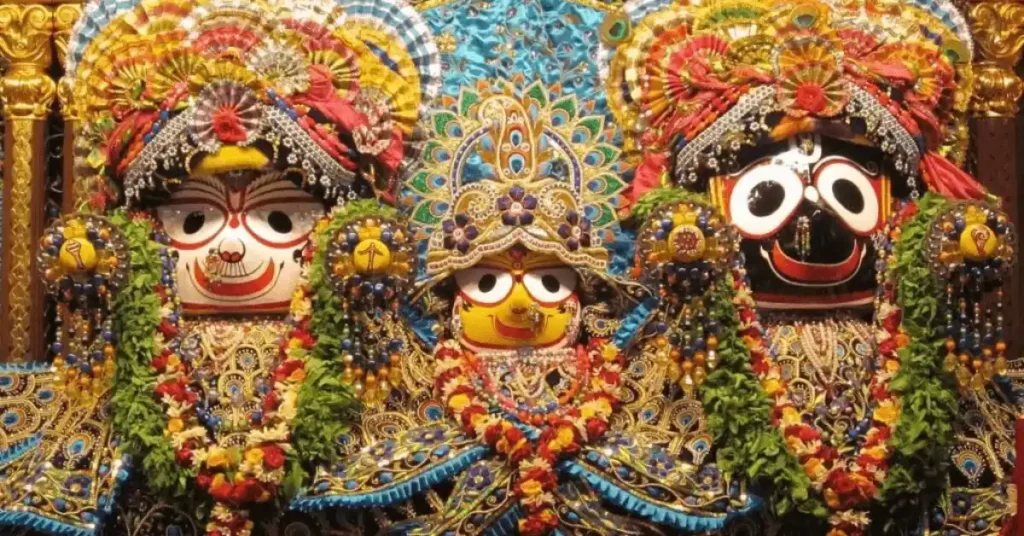
Table of Contents
ToggleWhere the Divine Form Came From
Long ago, King Indradyumna ruled with devotion rooted deep in his heart. He had heard of a mysterious form of Vishnu worshipped by forest dwellers, a form unseen by the world. The king longed to see that Lord with his own eyes. His desire was not driven by pride or power, but by longing.
His search was not easy. He faced delays, doubts, and repeated disappointments. Many times, the path seemed unclear. Yet his faith did not weaken. He kept walking, trusting that true devotion is always answered, even if the answer comes slowly.
Guided by divine signs, the king finally reached the sacred land of Nilachal. There, the Lord agreed to appear in a form never seen before. A mysterious carpenter arrived and promised to carve the idols, but with one strict condition. No one was to disturb him until the work was complete.
Days passed. Silence filled the space where the carving was happening. Slowly, doubt entered the king’s heart. When the door was opened too early, the carpenter vanished. The idols stood unfinished.
There were no clear hands or feet, only large eyes and a powerful presence. The king was filled with sorrow and regret. Then a divine voice reassured him.
This unfinished form was not a mistake. It was the chosen form. Incompleteness itself would carry the message. Thus, Bhagwan Jagannath appeared not as perfection of form, but as perfection of acceptance.
Bhagwan Jagannath and Lord Krishna
Many devotees see Bhagwan Jagannath as a special form of Lord Krishna. In Vaishnava traditions, Jagannath is often worshipped as Krishna in a state of divine love and compassion that embraces all beings without distinction.
Several traditions connect Jagannath to Krishna’s final earthly pastimes. Others trace his worship to the ancient form of Nilamadhava, which later became associated with Vishnu and Krishna. Over time, these traditions merged into the Jagannath worship known today.
This is one reason devotees from different backgrounds feel drawn to Bhagwan Jagannath. Whether worshipped as Krishna, Vishnu, or the Lord of the Universe, his message remains the same: divine love belongs to everyone.
Why Jagannath Looks Different
Many people wonder why Bhagwan Jagannath does not look like other deities. His eyes are large and round. His body is simple. His arms appear short. His feet are unseen. Yet this form speaks quietly, in ways words often cannot.
The Lord sees everything, so his eyes are wide open. He never turns away from anyone, so his feet remain hidden. He embraces all beings, so his arms reach every heart without boundaries.
There is no pride in this form and no distance to maintain. It gently reminds us that the Divine does not demand us to be complete or perfect. We are loved exactly as we are, broken parts included.
This is why people from every background feel drawn to him. Before Jagannath, no one feels small or excluded. His form itself becomes a lesson in equality and compassion.
Nabakalebara: When the Lord Changes his Body
One of the most sacred and emotional rituals connected to Bhagwan Jagannath is Nabakalebara, which means taking a new body. Unlike stone idols, Jagannath, Balabhadra, and Subhadra are made of sacred neem wood. Over time, this wood ages, just like a human body does.
During Nabakalebara, priests search for very special neem trees marked with divine signs. This search is done with prayer, silence, and deep care. Once found, the carving of the new idols begins in complete secrecy. The artisans work in silence, with focused minds and surrendered hearts, as if they are part of a living prayer.
The most mysterious moment is the transfer of the Brahma Padartha, believed to be the life essence of the Lord. Priests perform this ritual blindfolded, in the darkness of night. What exactly is transferred is never spoken of. When the new form is finally revealed, devotees feel both joy and sadness.
The Lord has returned in a new body, yet something old has gently been let go. Nabakalebara reminds devotees of a deep truth. The body changes, but the soul remains eternal.
The Power and Mysteries of The Jagannath Puri Temple
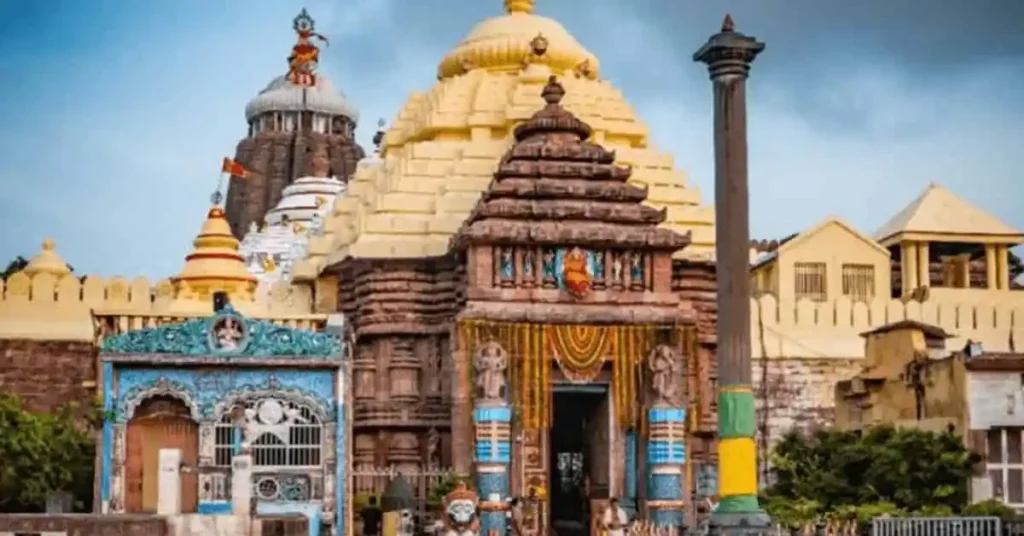
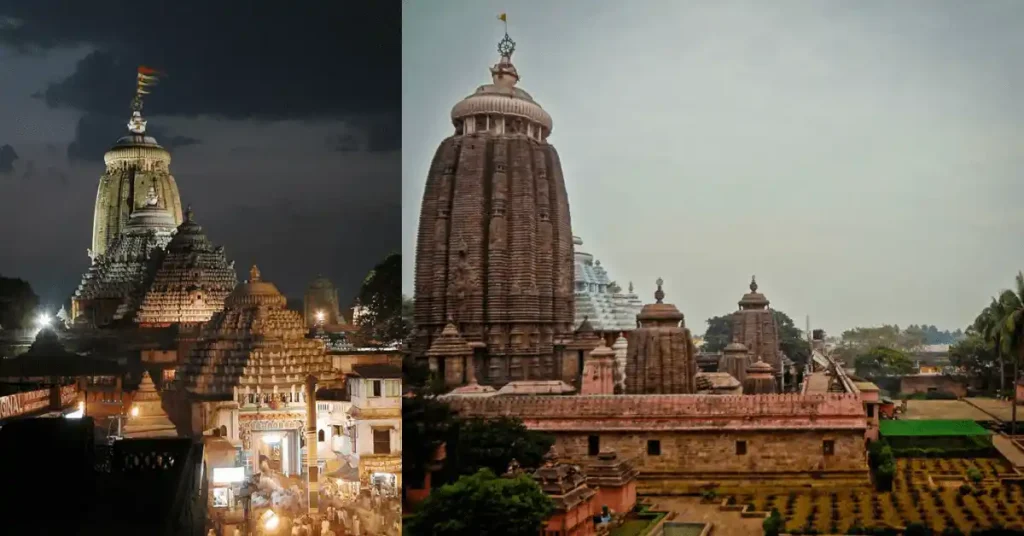
The Jagannath Puri Temple stands not just as a structure of stone and wood, but as a living presence. Over centuries, devotees have noticed many mysteries that continue to inspire wonder.
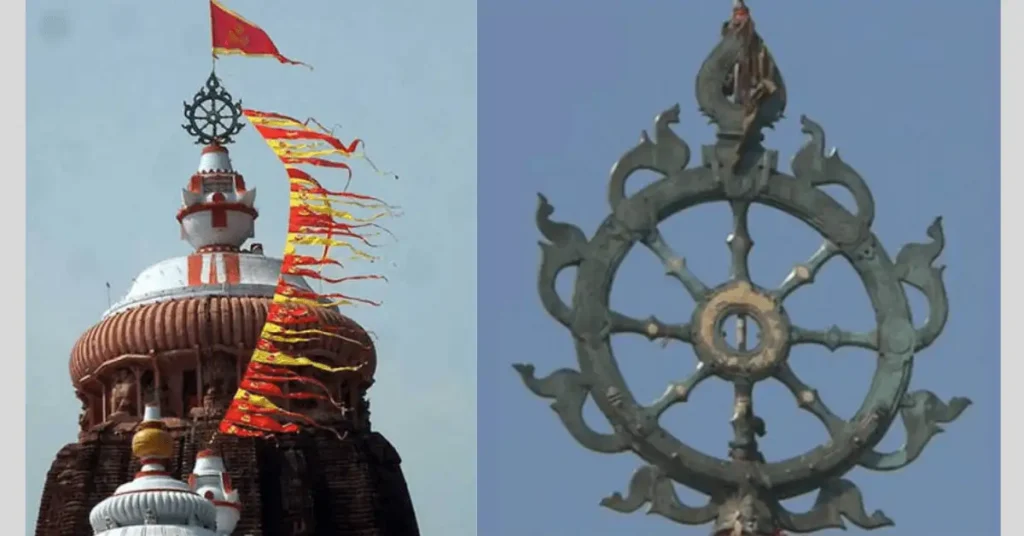
The temple flag always flies against the direction of the wind. The Sudarshan Chakra on top appears straight no matter where you stand in the city. Birds do not fly above the temple. The main dome casts no visible shadow at any time of day.
Some traditions say that if the flag ever stops or falls, or if an eagle circles the temple in a certain way, it signals the end of Kaliyuga. Elders often explain these beliefs gently. They are not meant to create fear or panic. They are reminders that time moves under divine order, and nothing in creation is permanent.
The temple is also one of the sacred Char Dhams, making it a spiritual pillar of Sanatan Dharma and a place where faith feels ancient and alive at the same time.
Faith, Tradition, and Temple Mysteries
Many traditions and stories are associated with the Jagannath Temple. Devotees often speak about the temple flag, the Sudarshan Chakra, and other mysteries that have been passed down through generations.
Some of these are matters of faith and local tradition, while others continue to inspire curiosity and discussion. For devotees, the importance of these stories lies less in proving them and more in the sense of wonder they create.
Whether understood through faith, symbolism, or tradition, these mysteries remind visitors that not everything sacred can be measured or explained through ordinary logic alone.
The Divine Siblings of Puri
Bhagwan Jagannath is never alone. Balabhadra stands beside him as strength and protection, while Subhadra represents compassion, harmony, and grace. Together, they form the sacred trio worshipped in the Jagannath tradition.
In many traditions, Bhagwan Jagannath is associated with Lord Krishna, Balabhadra with his elder brother Balarama, and Subhadra with their beloved sister. Their presence together reflects the importance of family, unity, and divine companionship.
Devotees often say the temple does not feel like a grand palace. It feels like a household. The siblings sit close to one another, sharing space and presence. This closeness teaches unity and reminds us that life becomes richer when strength, love, and compassion walk together.
Mahaprasad: The Grace of Jagannath
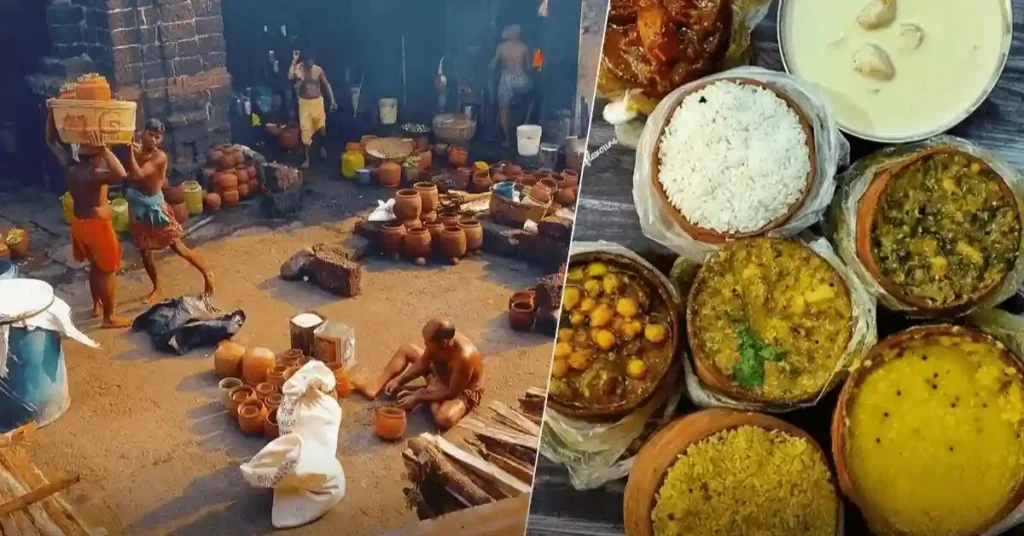
The Mahaprasad of Puri is known across the world. The temple kitchen is one of the largest ever built for worship. Food is cooked in earthen pots stacked one above the other, yet the top pot cooks first, something that continues to amaze people.
This food is first offered to Bhagwan Jagannath and then to Maa Vimala. The sharing of Mahaprasad is also a powerful symbol of equality. At Anand Bazaar within the temple complex, devotees from different regions, communities, and backgrounds sit together to receive the Lord’s grace. In that moment, social differences fade and only devotion remains.
Many pilgrims consider receiving Mahaprasad to be as important as having darshan because it represents a direct blessing from Bhagwan Jagannath.Only after this does it become Mahaprasad. There is no distinction of caste or status when it is shared. Devotees sit on the floor, eating together, feeling equal and blessed.
Many say the taste is simple, yet unforgettable. It does not impress the tongue as much as it touches the heart. It is not just food. It is grace made tangible.
Rath Yatra: When God Comes to Meet Us
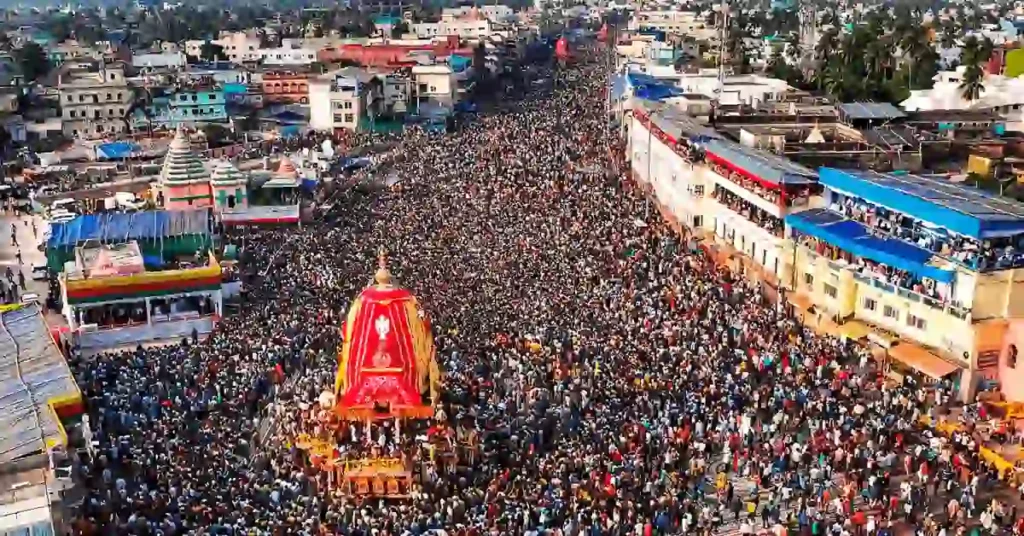
Once every year, Bhagwan Jagannath steps out of the temple to meet his devotees. During Rath Yatra, new chariots are built with care and devotion. Lakhs of people gather to pull the ropes.
Each deity travels in a separate Chariot. Bhagwan Jagannath rides Nandighosha, Balabhadra rides Taladhwaja, and Subhadra rides Darpadalana. These beautifully decorated chariots become the center of devotion, celebration, and prayer.
The journey to Gundicha Temple is often seen as a reminder that the Lord does not wait for devotees alone. He also comes out to meet them with love and compassion.
In that moment, the Lord is not distant or hidden behind walls. He walks among his children. People cry, laugh, sing, and chant together. Some say it feels like walking hand in hand with God, without fear and without formality.
Rath Yatra is celebrated every year on Ashadha Shukla Dwitiya, the second day of the bright fortnight of the Ashadha month. This sacred day usually falls in June or July.
On this day, Bhagwan Jagannath, along with Balabhadra and Subhadra, steps out of the temple to meet devotees from all walks of life.
The journey to Gundicha Temple is filled with emotion. It gently reminds devotees that the Divine also longs to come closer to those who love him.
Stories of Devotees Loved by Jagannath
The love of Bhagwan Jagannath is best understood through his devotees.
Salabega, born into a Muslim family, loved Jagannath with complete devotion. Once, when he fell ill and could not reach Puri in time for Rath Yatra, the chariot is said to have stopped until he arrived. Love itself paused the Lord.
Dasia Bauri, a humble devotee, once offered a coconut with pure faith. Though he was not allowed to enter the temple, Jagannath accepted his offering, showing that love matters more than rules.
Manik Gauduni, a simple milkmaid, was once caught in a fierce storm. She prayed to Jagannath with tears in her eyes, and it is believed the Lord protected her until she reached safety.
These stories remind us that devotion needs no label or qualification.
Miracles and Living Experiences
Devotees often speak of quiet changes in their lives after turning to Bhagwan Jagannath in prayer. Sometimes it is the strength to face difficulties, the courage to continue during uncertain times, or a sense of peace that arrives when it is needed most.
These experiences are rarely dramatic. They are often felt in small moments, like finding hope during hardship, receiving guidance when the path seems unclear, or feeling comfort in the midst of worry and loss.
Many devotees see these moments as the grace of Bhagwan Jagannath working gently in their lives. Whether understood as miracles, blessings, or simple acts of faith, they continue to strengthen the bond between the Lord and those who remember him with devotion.
What Surrender to Jagannath Truly Means
To surrender to Bhagwan Jagannath does not mean giving up life or responsibilities. It means placing trust in the Divine while continuing to walk your path with faith and sincerity.
It means moving forward even when the future feels uncertain, believing that the Lord of the Universe sees what we cannot and guides in ways we may not immediately understand.
Many devotees say they feel held by Bhagwan Jagannath. In moments of difficulty, prayer becomes lighter, fear feels smaller, and the heart remembers that it does not walk alone.
How to reach Puri and plan your visit
Puri is one of the most visited pilgrimage destinations in India and is well connected by air, rail, and road. The nearest airport is Biju Patnaik International Airport in Bhubaneswar, located about 60 kilometers away. From there, taxis, buses, and private vehicles are easily available for the journey to Puri.
Puri Railway Station connects the city with major destinations across India, making train travel one of the most convenient options for pilgrims. Those travelling by road can also reach Puri comfortably from Bhubaneswar and nearby cities through well-maintained highways.
Accommodation options range from simple dharamshalas and ashrams to budget hotels and premium stays. Many devotees prefer staying near the Jagannath Temple or close to the beach for easier access to both darshan and local attractions.
The city is also known for its traditional Odia cuisine and the sacred Mahaprasad of Bhagwan Jagannath. Many pilgrims consider receiving Mahaprasad to be one of the most meaningful parts of their visit.
While temple schedules may vary during festivals and special occasions, devotees generally prefer visiting early in the morning or during less crowded hours for a more peaceful darshan experience.
Witnessing the daily rituals, hearing the temple bells, and spending time in the spiritual atmosphere of Puri often become some of the most memorable parts of the pilgrimage.
Many devotees say the journey to Puri feels like more than travel. It feels like a gradual preparation of the heart, as if Bhagwan Jagannath is gently drawing them closer with every step.
Why Puri is One of The Char Dham Pilgrimage Site
Puri is one of the four sacred Char Dham pilgrimage sites of Hindu tradition, alongside Badrinath in the north, Dwarka in the west, and Rameswaram in the south.
Representing the eastern direction, Puri has been a center of devotion, pilgrimage, and spiritual learning for centuries. For many devotees, completing the Char Dham Yatra is considered a deeply meaningful spiritual journey.
The presence of Bhagwan Jagannath makes Puri unique among these sacred sites. Here, the Lord is worshipped not only as a divine ruler but also as a compassionate presence who welcomes people from all walks of life with equal grace and acceptance.
For generations, saints, devotees, and pilgrims have travelled to Puri seeking blessings, spiritual renewal, and a deeper connection with the divine. Even today, the city continues to inspire faith through its living traditions, sacred festivals, and the enduring presence of Bhagwan Jagannath.
Planning a pilgrimage to Bhagwan Jagannath Temple
A visit to Puri is much more than a journey to a temple. For many devotees, it is a deeply personal pilgrimage filled with prayer, darshan, and the experience of living traditions that have continued for centuries.
The city is well connected by air, rail, and road. The nearest airport is Biju Patnaik International Airport in Bhubaneswar, located about 60 kilometers from Puri. Taxis, buses, and private vehicles are easily available from the airport.
Puri Railway Station connects the city to major destinations across India, including Delhi, Kolkata, Mumbai, Chennai, Hyderabad, Ahmedabad, and Bengaluru. Many pilgrims prefer travelling by train as it allows them to experience the gradual approach to this sacred coastal town.
For those travelling by road, Puri is connected through a well-maintained highway network. Regular buses and private taxis operate from Bhubaneswar and nearby cities.
Accommodation options range from simple dharamshalas and ashrams to budget hotels and comfortable family-friendly stays. Many devotees choose accommodation near the Jagannath Temple or along the sea beach road for easier access to both the temple and local attractions.
The local cuisine is simple, flavorful, and deeply connected to temple traditions. Pilgrims often enjoy Mahaprasad, traditional Odia meals, khichdi preparations, sweets, and local vegetarian dishes that reflect the spiritual culture of the region.
Darshan, Aarti, and Daily Worship at Jagannath Temple
The Jagannath Temple follows a detailed daily schedule of rituals and seva that begins before sunrise and continues until late at night. Throughout the day, Bhagwan Jagannath, Balabhadra, and Subhadra are offered different forms of worship, food offerings, and ceremonial rituals.
Among the most important daily observances are Mangala Aarti, Mailam, Abakash, Gopal Ballav Bhog, Madhyahna Dhupa, Sandhya Dhupa, and Badasinghara Besha. Each ritual reflects a different aspect of the Lord’s daily life and is performed according to traditions preserved for generations.
Darshan timings may vary slightly during festivals, special observances, and temple events. During major occasions such as Rath Yatra, Snana Purnima, and Nabakalebara, the number of devotees increases significantly, and waiting times can become much longer.
Many pilgrims prefer visiting early in the morning or during less crowded periods of the day for a more peaceful darshan experience. Before planning a visit, it is always advisable to check the latest temple timings and visitor guidelines, as schedules may change during special festivals and religious occasions.
For devotees, the true experience of Puri is not limited to seeing the deity for a few moments. It includes hearing the temple bells, witnessing the daily rituals, receiving Mahaprasad, and feeling the living presence of Bhagwan Jagannath throughout the sacred city.
Other Must Visit Temples in Puri
While in Puri, devotees often visit several other sacred temples that are closely connected to the spiritual heritage of the city.
Gundicha Temple is especially important because it becomes the destination of the famous Rath Yatra. Lokanath Temple is dedicated to Lord Shiva and is deeply revered by devotees.
Maa Vimala Temple, located within the Jagannath Temple complex, holds special significance because offerings made to Bhagwan Jagannath become Mahaprasad only after being offered to the Goddess.
Markandeshwar Temple is another ancient shrine associated with devotion, prayer, and spiritual reflection.
Together, these temples add new dimensions to the pilgrimage experience and help visitors appreciate the rich spiritual traditions that have flourished in Puri for centuries.
A Presence That Stays
Bhagwan Jagannath is difficult to describe through words alone. His stories, rituals, festivals, and sacred traditions offer glimpses into his greatness, but for many devotees, his true presence is felt in the heart rather than understood by the mind.
Perhaps this is why people return to him again and again. Some come seeking answers, some come carrying burdens, and some arrive with nothing more than simple faith. Yet many leave with the same feeling: they have been seen, accepted, and blessed without conditions.
The large eyes of Bhagwan Jagannath remind devotees that the Divine never turns away. His unfinished form teaches that perfection is not required for grace. His Rath Yatra shows that God does not wait for devotees alone but also comes out to meet them.
His Mahaprasad teaches equality, and his Nabakalebara reminds us that while bodies change, the soul remains eternal.
Long after the journey to Puri ends, the memory of Bhagwan Jagannath often remains. In moments of joy, uncertainty, or prayer, devotees continue to feel the quiet presence of the Lord of the Universe, watching with compassion and guiding with love.
Suggested reading
If you enjoyed learning about Bhagwan Jagannath, you may also like exploring these related articles on Sanatan Dharma, sacred temples, devotion, and spiritual wisdom.
Bhagwan Shiv: Meaning, Symbolism and Spiritual Significance
https://thesanatantales.com/bhagwan-shiv-the-supreme-consciousness/Navadurga: Nine Divine Forms of Maa Durga and Their Spiritual Powers
https://thesanatantales.com/navadurga-nine-forms-of-maa-durga/Devi Mantras, Aartis and Stotras: Sacred Sounds of the Divine Mother
https://thesanatantales.com/devi-mantras-aartis-and-stotras/Das Mahavidya: From Kali to Kamala, The Journey Within
https://thesanatantales.com/das-mahavidya/Sanwariya Seth Temple: The Living Krishna of Mewar and Divine Business Partner
https://thesanatantales.com/sanwariya-seth-temple-mandfiya/Vrindavan Pilgrimage: A Complete Guide to the Land Where Devotion Feels Alive
https://thesanatantales.com/vrindavan-pilgrimage-complete-guide/Jagannath (Wikipedia)
https://en.wikipedia.org/wiki/Jagannath
Every sacred place, deity, and tradition reveals a different aspect of Sanatan Dharma. Exploring them together helps deepen our understanding of devotion, spiritual wisdom, and the many paths that lead toward the Divine.
FAQs
What is Jagannath the god of?
Bhagwan Jagannath is worshipped as the Lord of the Universe. Devotees regard him as a compassionate form of the Divine who welcomes all people equally, regardless of background, status, or social identity.
Why is Bhagwan Jagannath associated with Lord Krishna?
Many Hindu traditions identify Bhagwan Jagannath as a form of Lord Krishna. His worship combines ancient traditions connected to Vishnu, Krishna, and the sacred form of Nilamadhava, creating a unique spiritual tradition centered in Puri.
Why does Bhagwan Jagannath have large round eyes?
The large eyes symbolize the Lord’s all-seeing and ever-watchful presence. Devotees often believe that Bhagwan Jagannath looks upon everyone with equal love, compassion, and acceptance.
What is Nabakalebara?
Nabakalebara is the sacred ritual during which Bhagwan Jagannath, Balabhadra, and Subhadra receive new wooden forms. The ceremony symbolizes the eternal nature of the soul and the temporary nature of the physical body.
Why is Mahaprasad famous?
Mahaprasad is considered sacred because it is first offered to Bhagwan Jagannath and Maa Vimala before being distributed to devotees. It is known not only for its spiritual significance but also for its tradition of equality, where everyone receives the same blessing.
Why is Rath Yatra celebrated?
Rath Yatra celebrates Bhagwan Jagannath’s annual journey from the main temple to Gundicha Temple. The festival symbolizes the Lord coming out to meet devotees and bless people from all walks of life.
What are the names of the three Rathas?
The three chariots used during Rath Yatra are Nandighosha for Bhagwan Jagannath, Taladhwaja for Balabhadra, and Darpadalana for Subhadra.
Why is Puri one of the Char Dham pilgrimage sites?
Puri is one of the four sacred Char Dham pilgrimage destinations of Hindu tradition. The presence of Bhagwan Jagannath has made it one of India’s most important spiritual centers for centuries.
What is the significance of Maa Vimala Temple in Puri?
Maa Vimala is regarded as the guardian goddess of the Jagannath Temple complex. According to tradition, food offered to Bhagwan Jagannath becomes Mahaprasad only after it is offered to Maa Vimala.
Can non-Hindus enter the Jagannath Temple?
Entry into the main Jagannath Temple is traditionally restricted to Hindus. However, visitors of all backgrounds can view the temple from nearby locations and participate in the spiritual atmosphere of Puri.
Glossary of Important Terms
| Term | Meaning |
|---|---|
| Bhagwan Jagannath | The “Lord of the Universe,” worshipped as a compassionate form of Vishnu and Krishna. |
| Jagannath | Derived from Sanskrit, meaning “Lord of the World” or “Lord of the Universe.” |
| Puri | Sacred pilgrimage city in Odisha and home of the famous Jagannath Temple. |
| Jagannath Temple | One of the most revered Hindu temples dedicated to Bhagwan Jagannath. |
| Char Dham | Four sacred pilgrimage sites of Hinduism: Puri, Badrinath, Dwarka, and Rameswaram. |
| Nilachal | The sacred hill and traditional name associated with the Jagannath Temple region. |
| Nilamadhava | An ancient form of Vishnu believed to be connected with the origins of Jagannath worship. |
| King Indradyumna | The legendary king credited with establishing the worship of Bhagwan Jagannath. |
| Vishnu | The Hindu deity associated with preservation and protection of the universe. |
| Lord Krishna | An incarnation of Vishnu often identified with Bhagwan Jagannath. |
| Balabhadra | Elder brother of Krishna, worshipped alongside Jagannath and Subhadra. |
| Subhadra | Sister of Krishna and Balabhadra, forming the sacred sibling trio of Puri. |
| Darshan | The sacred act of seeing and receiving blessings from a deity. |
| Nabakalebara | A rare ritual in which Jagannath, Balabhadra, and Subhadra receive new wooden bodies. |
| Brahma Padartha | The mysterious sacred essence transferred during the Nabakalebara ritual. |
| Neem Wood | Sacred wood used for carving the idols of Jagannath, Balabhadra, and Subhadra. |
| Rath Yatra | The annual chariot festival in which the deities travel from Jagannath Temple to Gundicha Temple. |
| Nandighosha | The chariot of Bhagwan Jagannath during Rath Yatra. |
| Taladhwaja | The chariot of Balabhadra during Rath Yatra. |
| Darpadalana | The chariot of Subhadra during Rath Yatra. |
| Gundicha Temple | The destination temple visited by the deities during Rath Yatra. |
| Mahaprasad | Sacred food offered first to Jagannath and Maa Vimala before distribution to devotees. |
| Anand Bazaar | The area within the temple complex where Mahaprasad is distributed and shared. |
| Maa Vimala | A form of the Divine Mother whose offering completes the sanctification of Mahaprasad. |
| Prasad | Food or offerings blessed by a deity and distributed among devotees. |
| Sudarshan Chakra | The sacred discus of Vishnu, represented atop the Jagannath Temple. |
| Kaliyuga | The current age in Hindu cosmology, characterized by spiritual decline. |
| Mangala Aarti | The early morning worship ritual performed before sunrise. |
| Mailam | A daily temple ritual involving changing the deities’ clothes and decorations. |
| Abakash | A morning purification ritual performed for the deities. |
| Gopal Ballav Bhog | An early food offering made to Bhagwan Jagannath. |
| Madhyahna Dhupa | The main midday offering and worship ceremony. |
| Sandhya Dhupa | The evening worship and food offering ritual. |
| Badasinghara Besha | The final nightly adornment and decoration of the deities. |
| Snana Purnima | The ceremonial bathing festival of Jagannath, Balabhadra, and Subhadra. |
| Ashadha Shukla Dwitiya | The lunar date on which Rath Yatra is celebrated. |
| Dharma | Righteous living and spiritual duty in Hindu philosophy. |
| Pilgrimage (Yatra) | A sacred journey undertaken for spiritual growth and devotion. |
| Seva | Selfless service offered to the deity or temple. |
| Bhog | Food offerings presented to a deity before becoming prasad. |
| Devotee (Bhakta) | A person who worships and expresses devotion to God. |
| Salabega | A famous devotee of Jagannath known for his deep devotion despite social barriers. |
| Dasia Bauri | A humble devotee remembered for his pure devotion to Jagannath. |
| Manik Gauduni | A devotee associated with traditional stories of Jagannath’s grace and protection. |
| Biju Patnaik International Airport | The nearest airport to Puri, located in Bhubaneswar. |
| Lokanath Temple | A prominent Shiva temple in Puri visited by many pilgrims. |
| Markandeshwar Temple | An ancient temple in Puri associated with prayer and spiritual reflection. |
| Compassion | A central spiritual quality embodied by Bhagwan Jagannath. |
| Surrender | Trusting and placing one’s faith in the Divine while continuing life’s duties. |
| Equality | A core teaching of Jagannath tradition, where all devotees are viewed equally before God. |
| Divine Grace | The blessings, protection, and guidance received from Bhagwan Jagannath. |
About the Author
Yateendra Chaturvedi is a spiritual writer, researcher, devotee, and the founder of The Sanatan Tales. With over 35 years of professional experience and a lifelong interest in Sanatan Dharma, he writes about Hindu deities, temples, scriptures, festivals, Mahavidyas, sacred stories, rituals, and living traditions that continue to guide and inspire devotees across India.
Drawing from traditional scriptures, regional beliefs, temple traditions, devotional literature, and historical sources, he aims to present authentic, well-researched, and easy-to-understand content for modern readers. His work focuses on preserving spiritual wisdom, explaining sacred traditions, and helping seekers develop a deeper understanding of India’s rich spiritual heritage.
Through The Sanatan Tales, Yateendra strives to make the timeless teachings of Sanatan Dharma simple, meaningful, and relevant for today’s generation while maintaining respect for traditional sources, regional practices, and diverse spiritual perspectives.
Learn More About Yateendra Chaturvedi →
https://thesanatantales.com/about-the-author/
References & Sources
This article is based on Vaishnava traditions followed within Sanatan Dharma, traditional beliefs associated with Lord Vishnu and His various forms and avatars, religious narratives, temple traditions, devotional practices, and insights gathered from various spiritual and religious study sources. Some concepts discussed in this article are also inspired by interpretations found in guru-disciple lineages, Vaishnava sampradayas, temple traditions, Puranic literature, and devotional texts.
Note: Beliefs, stories, philosophical interpretations, and methods of worship related to Lord Vishnu, His avatars, and Vaishnava traditions may differ across regions, sects, and spiritual lineages. The purpose of this article is not to present any single viewpoint as the absolute truth, but to explain commonly accepted religious and spiritual perspectives in a simple and accessible manner.
Explore More Fascinating Topics from Sanatan Dharma