Human life is marked by many important transitions, from birth and education to marriage, retirement, and the final farewell. In Sanatan Dharma, these milestones are traditionally guided by the 16 Samskaras, a sacred system of rites and ceremonies designed to support an individual’s physical, mental, moral, and spiritual development.
The 16 Samskaras are not merely rituals. They are meaningful life-stage observances that help shape character, cultivate values, and encourage a life rooted in dharma. Collectively known as Shodasha Samskara, they serve as a framework for transforming life’s key moments into opportunities for reflection, responsibility, and inner growth.
The tradition of the 16 Samskaras in Sanatan Dharma begins even before birth and continues through every major stage of life until Antyeshti, the final rite. Each samskara carries a deeper purpose, reminding individuals and families that life is a sacred journey rather than a series of ordinary events.
In this guide, you will learn the meaning of samskara, the names and purpose of all 16 Samskaras, their scriptural significance, why they are important in Hindu life, and how their timeless wisdom continues to remain relevant in the modern world.
At a Glance: The 16 Samskaras in Sanatan Dharma
| Aspect | Details |
|---|---|
| Meaning of Samskara | A sacred rite of passage that helps refine character, values, and spiritual awareness. |
| Traditional Name | Shodasha Samskara (Sixteen Samskaras) |
| Total Number | 16 |
| Purpose | To guide individuals through important stages of life with dharma, discipline, and responsibility. |
| Main Focus | Physical, mental, moral, social, and spiritual development. |
| Covers Life Stages | Before birth, childhood, education, adulthood, family life, retirement, and final rites. |
| Scriptural Basis | Discussed in various Grihya Sutras, Dharmashastras, and traditional Hindu texts. |
| Nature of the Rituals | Hindu life-cycle rites that sanctify major transitions in life. |
| Goal | To transform ordinary life events into meaningful spiritual milestones. |
| Relevance Today | While not all are widely practiced, their values remain relevant in modern life. |
| Connection to Dharma | They encourage ethical living, self-discipline, gratitude, and spiritual growth. |
| Core Message | Human life is sacred and should be lived with awareness, purpose, and responsibility. |
Table of Contents
ToggleWhat Is the Meaning of Samskara in Sanatan Dharma?
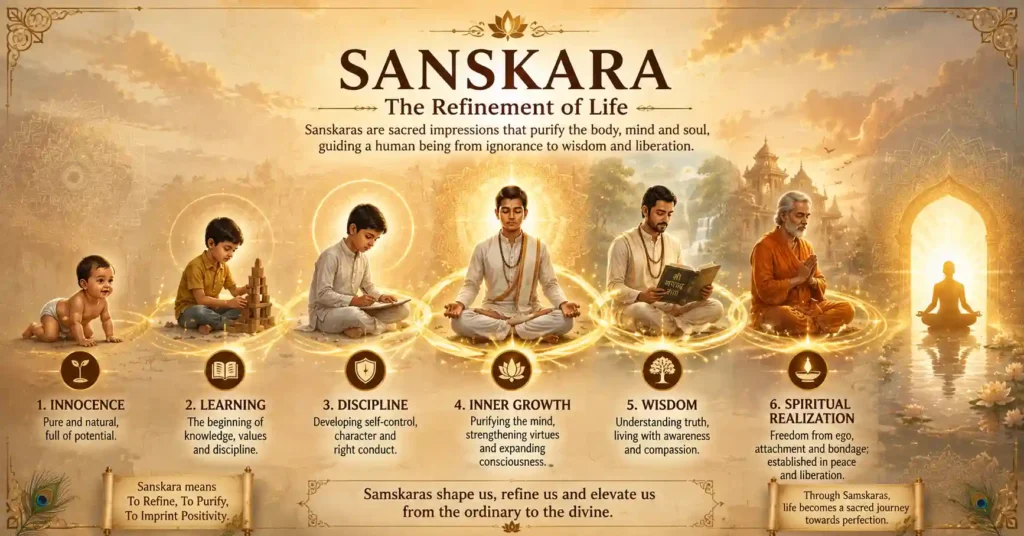
The word Samskara comes from the Sanskrit roots sam (well or completely) and kara (to make or do). Together, the term refers to a process of refinement, cultivation, or positive transformation. In Sanatan Dharma, a samskara is a sacred rite performed to purify, elevate, and guide an individual through important stages of life.
The concept goes beyond external rituals. Traditionally, a samskara is intended to leave a positive impression on the mind, character, and conduct of a person. It serves as a reminder that life should be lived with awareness, responsibility, and a commitment to dharma.
The 16 Samskaras are therefore not merely ceremonies. They are milestones designed to support physical, emotional, intellectual, social, and spiritual development from conception until the final rites of life.
In Hindu thought, every major transition carries both opportunities and responsibilities. The 16 Samskaras in Sanatan Dharma help individuals approach these transitions consciously rather than treating them as ordinary events. They encourage gratitude, self-discipline, respect for family and society, and a deeper understanding of life’s purpose.
Because of this, the 16 Samskaras are often described as sacred rites of passage that transform important life events into meaningful spiritual experiences. Their ultimate aim is not only personal growth but also the cultivation of values that contribute to individual well-being and social harmony.
What Are the 16 Samskaras?
The 16 Samskaras are a traditional system of sacred rites that guide an individual through the major stages of life in Sanatan Dharma. Collectively known as Shodasha Samskara, these ceremonies are intended to sanctify important transitions and encourage a life rooted in dharma, responsibility, and spiritual awareness.
The journey of the 16 Samskaras begins even before birth and continues through childhood, education, family life, and the final rites after death. Each samskara marks a significant milestone and serves as an opportunity for reflection, growth, and the cultivation of positive values.
These Hindu life cycle rituals were developed to support not only physical and social development but also moral and spiritual progress. Rather than viewing life as a series of ordinary events, the samskara tradition encourages individuals to recognize the sacredness of every stage of human existence.
The 16 Samskaras in Sanatan Dharma also strengthen the connection between the individual, family, community, and spiritual traditions. Many of these rites involve blessings from parents, teachers, elders, and spiritual guides, highlighting the importance of relationships and shared values.
Although the way these ceremonies are performed may vary across regions and traditions, their underlying purpose remains the same: to help individuals live meaningful lives guided by wisdom, discipline, gratitude, and self-improvement.
Before exploring each samskara individually, it is helpful to understand where this tradition originated and how it became an important part of Hindu culture and spiritual life.
What Is the Origin of the 16 Samskaras?
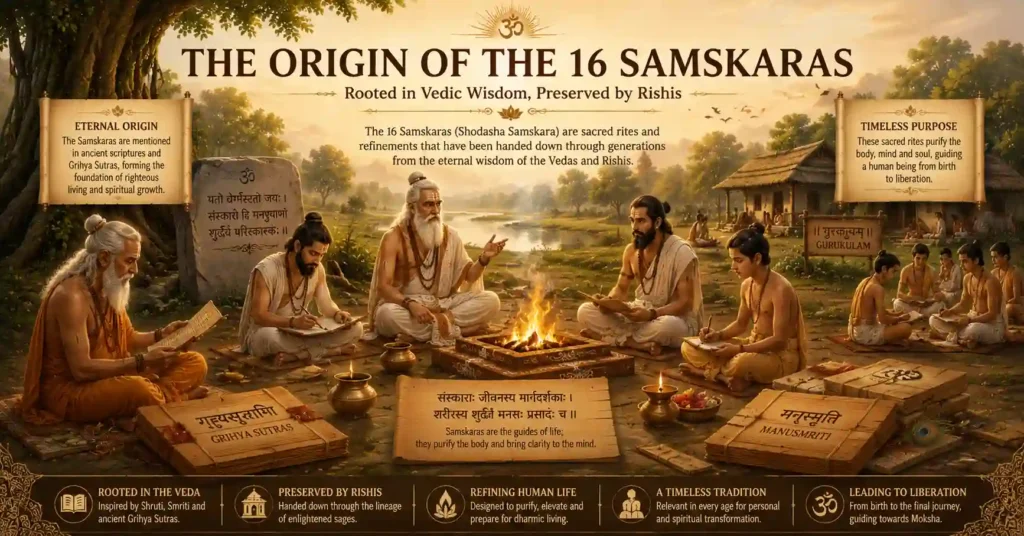
The tradition of the 16 Samskaras has its roots in the ancient Vedic way of life. Early Hindu sages recognized that human life passes through many important stages, each bringing new responsibilities and opportunities for growth. To help individuals navigate these transitions with awareness and discipline, they developed a system of sacred rites known as Samskaras.
Over time, these rites became an important part of Hindu culture and social life. They were designed not only to mark significant events but also to cultivate virtues such as self-control, respect, gratitude, learning, and spiritual responsibility.
The detailed procedures and significance of various samskaras were discussed in ancient texts such as the Grihya Sutras, which describe domestic rituals and ceremonies, and later Dharmashastra literature that deals with ethical and social conduct. While the number and form of samskaras varied among different traditions, the idea of refining human life through sacred observances remained consistent.
The system that eventually became known as the 16 Samskaras in Sanatan Dharma gained widespread acceptance because it provided a structured framework covering the entire journey of life, from conception to the final rites. Together, these ceremonies helped connect personal development with family values, social responsibilities, and spiritual growth.
At their core, the 16 Samskaras reflect an important Hindu belief: life is not merely a biological process but a sacred journey that should be approached with mindfulness, purpose, and dharma.
Are the 16 Samskaras Mentioned in Hindu Scriptures?
Yes, the tradition of the samskaras is rooted in Hindu scriptures and has been preserved through various ritual and legal texts over centuries. While no single scripture presents a universally identical list, the concept of sanctifying important stages of life is well established in the Hindu tradition.
Many of these rites are described in the Grihya Sutras, a group of ancient texts that outline domestic rituals, family ceremonies, and social observances. Different Vedic schools developed their own ritual manuals, which sometimes led to variations in the details and sequence of certain rites.
References to samskaras are also found in Dharmashastra literature, including texts such as the Manusmriti and Yajnavalkya Smriti. These works discuss the purpose of life-stage ceremonies and their role in personal conduct, family life, and social order.
Over time, Hindu scholars and spiritual traditions organized these rites into the system commonly known as Shodasha Samskara, or the sixteen major samskaras. Although regional customs and practices may differ, the underlying goal remains the same: to guide individuals through life with discipline, responsibility, and spiritual awareness.
The scriptural foundation of these observances highlights an important principle of Sanatan Dharma. Human life is viewed as sacred, and significant transitions are approached with mindfulness, prayer, and a sense of higher purpose.
What Are the Names of the 16 Samskaras?
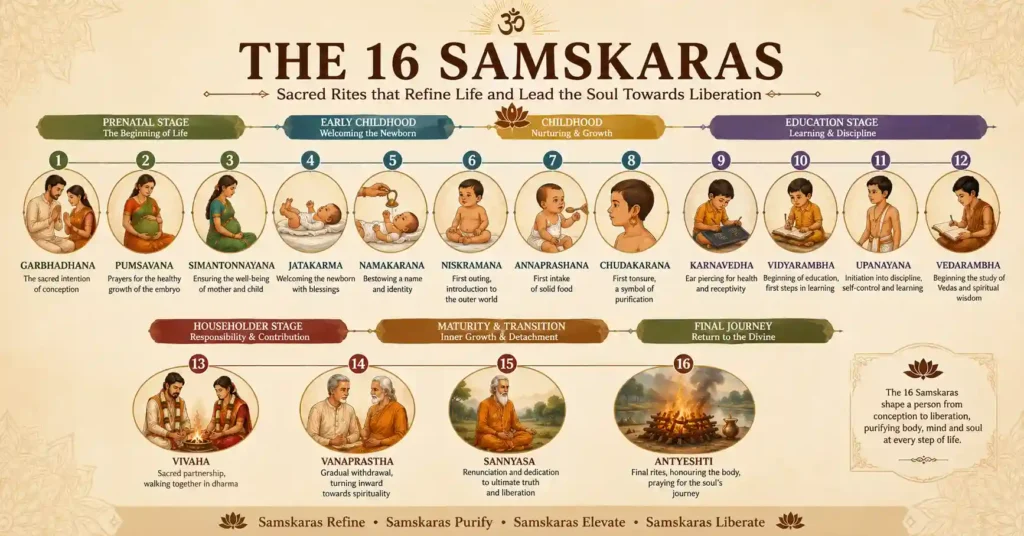
The 16 Samskaras are sacred rites of passage that guide an individual through the key stages of life, from conception to the final rites. Collectively known as Shodasha Samskara, they aim to nurture physical well-being, moral values, social responsibility, and spiritual growth.
Each samskara marks an important milestone and serves as a reminder that life should be lived with awareness, gratitude, and dharma. Together, these observances form a structured framework for personal development and help transform life’s major transitions into meaningful and sacred moments.
The names of the sixteen samskaras are:
| No. | Samskara | Purpose |
|---|---|---|
| 1 | Garbhadhana | Preparation for conception |
| 2 | Pumsavana | Blessings for the unborn child |
| 3 | Simantonnayana | Well-being of the mother and child during pregnancy |
| 4 | Jatakarma | Welcoming the newborn |
| 5 | Namakarana | Naming ceremony |
| 6 | Nishkramana | Child’s first outing |
| 7 | Annaprashana | First intake of solid food |
| 8 | Chudakarana | First haircut ceremony |
| 9 | Karnavedha | Ear-piercing ceremony |
| 10 | Vidyarambha | Beginning of education |
| 11 | Upanayana | Initiation into disciplined learning |
| 12 | Vedarambha | Commencement of scriptural study |
| 13 | Samavartana | Completion of education |
| 14 | Vivaha | Marriage |
| 15 | Vanaprastha | Gradual withdrawal from worldly responsibilities |
| 16 | Antyeshti | Final rites after death |
While the names and sequence of these rites are widely recognized, the way they are performed may vary across regions, communities, and family traditions. Some are still commonly observed today, while others are remembered primarily through their teachings and symbolic meaning.
The following sections explore each samskara in greater detail and explain its role in the lifelong journey envisioned by Sanatan Dharma.
1. Garbhadhana (Conception Rite)
Garbhadhana is performed before conception and emphasizes the importance of bringing new life into the world with purity, responsibility, and conscious intention. It marks the beginning of the samskara journey and reflects the belief that parenthood should be approached with physical, mental, and spiritual preparedness.
2. Pumsavana (Prenatal Blessing Rite)
Traditionally performed during pregnancy, this rite seeks blessings for the healthy growth and well-being of the unborn child. It highlights the importance of nurturing life from its earliest stages and creating a positive environment for both mother and child.
3. Simantonnayana (Protection of Mother and Child)
This samskara focuses on the emotional and physical well-being of the expectant mother. Traditionally observed during pregnancy, it symbolizes care, support, and prayers for a safe delivery and healthy child.
4. Jatakarma (Birth Ceremony)
Jatakarma is performed soon after birth to welcome the newborn into the world. The ceremony includes blessings and prayers for good health, wisdom, strength, and a virtuous life.
5. Namakarana (Naming Ceremony)
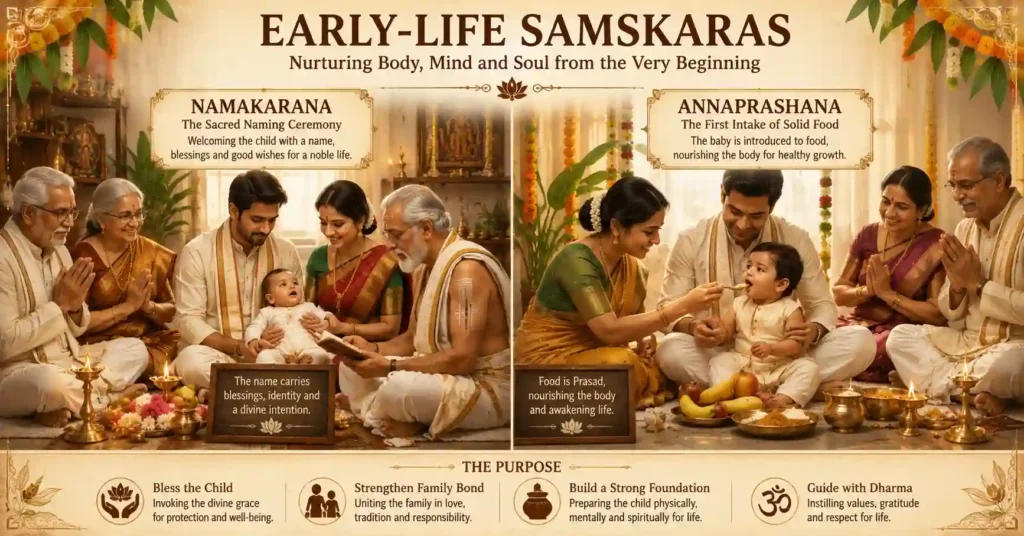
Namakarana is the formal naming ceremony of a child. In Hindu tradition, a name is often chosen with spiritual, cultural, or symbolic significance and is considered an important part of a person’s identity.
6. Nishkramana (First Outing Ceremony)
Nishkramana marks the child’s first visit outside the home. It symbolizes the child’s introduction to the natural world and the beginning of interaction with the wider environment.
7. Annaprashana (First Feeding Ceremony)
Annaprashana celebrates the child’s first intake of solid food. This rite expresses gratitude for nourishment and marks an important milestone in physical growth and development.
8. Chudakarana (First Haircut Ceremony)
Also known as Mundan, Chudakarana involves the child’s first haircut. Traditionally, it symbolizes purification, the removal of past influences, and the beginning of a new stage in life.
9. Karnavedha (Ear-Piercing Ceremony)
Karnavedha is the traditional ear-piercing ceremony. Besides its cultural significance, it is associated with receptiveness to learning and preparedness for future growth and education.
10. Vidyarambha (Beginning of Education)
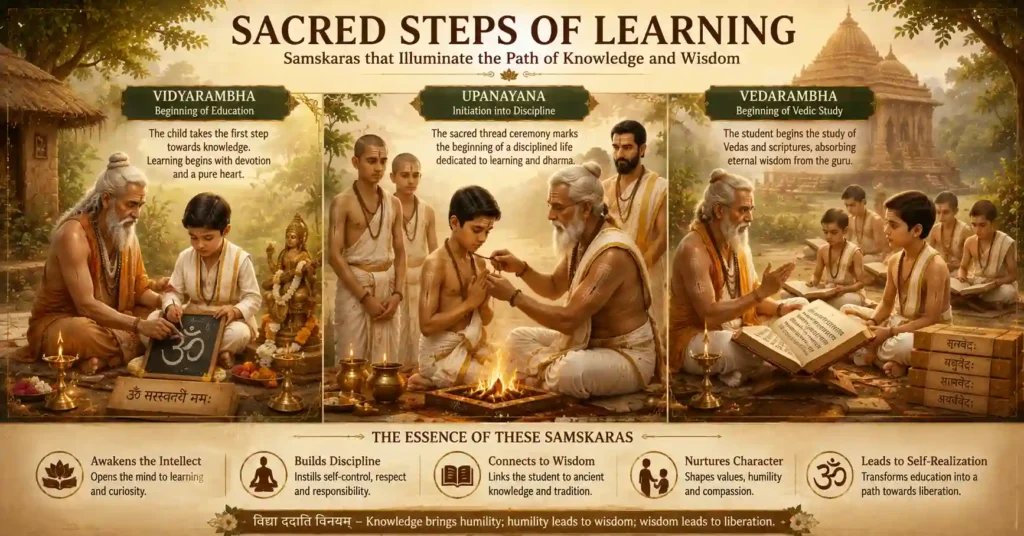
Vidyarambha marks a child’s formal introduction to education. During this ceremony, the child begins learning letters and basic knowledge, symbolizing the pursuit of wisdom and learning.
11. Upanayana (Initiation into Student Life)
Upanayana is one of the most significant samskaras and traditionally marks the beginning of disciplined study under a teacher. It emphasizes self-control, responsibility, and dedication to learning and personal development.
12. Vedarambha (Beginning of Scriptural Study)
Vedarambha signifies the commencement of studying sacred knowledge and scriptures. It encourages a deeper understanding of spiritual teachings and the pursuit of higher wisdom.
13. Samavartana (Completion of Education)
Samavartana marks the completion of formal education and the transition from student life to greater social and family responsibilities. It symbolizes readiness to apply knowledge in the world.
14. Vivaha (Marriage Ceremony)
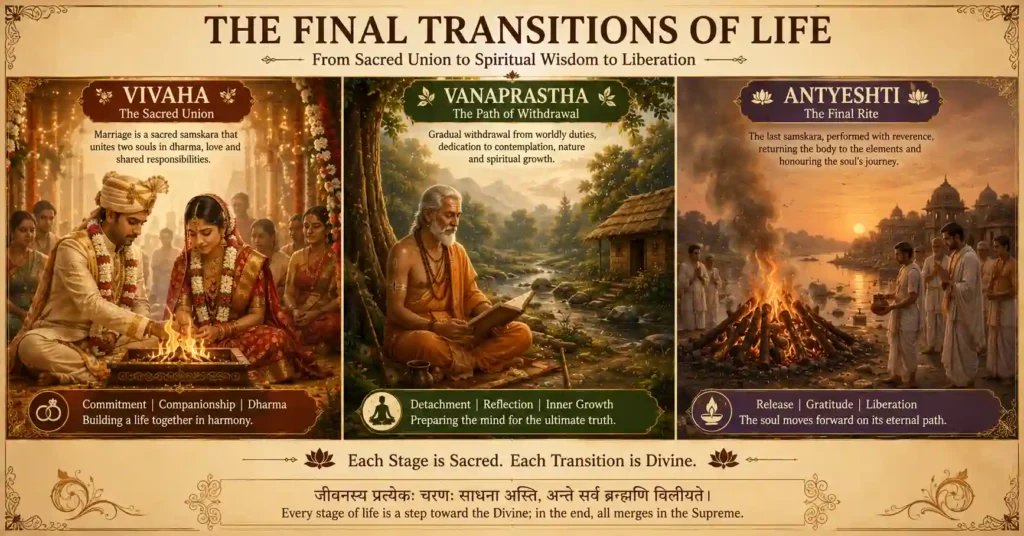
Vivaha marks the beginning of married life and is regarded as a sacred partnership. It emphasizes mutual support, shared responsibilities, family life, and the pursuit of dharma together.
15. Vanaprastha (Retirement and Detachment)
Vanaprastha represents a gradual withdrawal from active worldly responsibilities. It encourages reflection, simplicity, and a greater focus on spiritual growth and inner development.
16. Antyeshti (Final Rites)
Antyeshti is the final samskara performed after death. It honors the departed and reflects the Hindu understanding that while the body is temporary, the soul continues its journey beyond physical existence.
Why Are There 16 Samskaras?
The number sixteen holds special significance in Hindu tradition and is often associated with completeness and fullness. Ancient scholars viewed human life as a sacred journey that unfolds through several important stages, each requiring guidance, preparation, and responsibility.
The system of sixteen samskaras was developed to ensure that no major transition in life remained without reflection or spiritual direction. These rites collectively cover the journey from conception and birth to education, marriage, later life, and the final rites after death.
Rather than being random ceremonies, these observances form a structured framework that supports the physical, emotional, intellectual, social, and spiritual development of an individual. Each rite prepares a person for the next stage of life while reinforcing values that contribute to personal growth and social harmony.
Different ancient texts sometimes mention varying numbers of samskaras. However, the set of sixteen gradually became the most widely accepted because it was considered comprehensive and capable of encompassing the essential milestones of human life.
The idea behind this tradition is simple yet profound: life is not merely a sequence of events but a sacred journey of learning, duty, growth, and self-realization. The sixteen samskaras serve as reminders to approach each stage with awareness, gratitude, and a sense of higher purpose.
What Is the Purpose of the 16 Samskaras?
The primary purpose of the samskaras is to guide individuals through life’s important transitions with awareness, discipline, and a sense of responsibility. These sacred rites help transform ordinary milestones into meaningful occasions for reflection, learning, and spiritual growth.
Each samskara serves as a reminder that human development involves more than physical progress. It also includes the cultivation of character, values, knowledge, and ethical conduct. Through these observances, individuals are encouraged to live in harmony with dharma and contribute positively to family and society.
The samskara tradition also strengthens important relationships. Many of these ceremonies involve the participation of parents, teachers, elders, and community members, reinforcing the role of guidance, support, and shared values in personal development.
Another purpose of these rites is to prepare individuals for new responsibilities. Whether entering education, marriage, or later stages of life, each observance marks a transition and encourages thoughtful preparation for the duties that lie ahead.
From a spiritual perspective, the samskaras are intended to purify the mind, nurture positive qualities, and inspire a deeper understanding of life’s purpose. They remind individuals that every stage of life offers opportunities for learning, self-improvement, and inner growth.
Rather than being viewed as isolated ceremonies, these rites work together as a lifelong framework that supports balanced development of the body, mind, and spirit.
What Is the Importance of the 16 Samskaras in Sanatan Dharma?
The importance of the samskaras lies in their ability to bring meaning, purpose, and awareness to the different stages of human life. Rather than allowing major life events to pass as ordinary experiences, these sacred rites encourage individuals to approach them with reflection, gratitude, and responsibility.
At the personal level, these observances help cultivate positive qualities such as discipline, respect, self-control, compassion, and commitment to learning. They remind individuals that growth involves not only physical development but also moral and spiritual maturity.
For families, the samskara tradition strengthens bonds across generations. Many ceremonies bring together parents, grandparents, teachers, and community members, creating opportunities to pass on values, cultural heritage, and spiritual teachings.
These rites also contribute to social harmony by encouraging individuals to fulfill their duties responsibly. They emphasize respect for relationships, ethical conduct, and the importance of contributing positively to society.
From a spiritual perspective, the samskaras help individuals view life as a sacred journey rather than a collection of isolated events. Each rite serves as a reminder of higher ideals and encourages a deeper connection with dharma, self-improvement, and spiritual awareness.
Even in modern times, the values embedded within these traditions continue to offer guidance. Their lasting importance lies not only in the rituals themselves but also in the timeless principles they seek to nurture throughout life.
How Do the 16 Samskaras Relate to the Four Ashramas?
The samskara system and the Four Ashramas are two important frameworks in Sanatan Dharma that work together to guide human life. While the ashramas describe the major stages of life, the samskaras mark important transitions within those stages.
The Four Ashramas are Brahmacharya (student life), Grihastha (householder life), Vanaprastha (retired life), and Sannyasa (renounced life). Each stage has its own duties, responsibilities, and spiritual goals.
Several samskaras prepare an individual for the Brahmacharya Ashrama. Ceremonies such as Vidyarambha, Upanayana, and Vedarambha emphasize learning, discipline, and respect for knowledge. These rites help lay the foundation for education and character development.
The transition into Grihastha Ashrama is marked most prominently by Vivaha, or marriage. This stage focuses on family life, social responsibilities, and the fulfillment of duties toward society and future generations.
As a person grows older, the ideals associated with Vanaprastha Ashrama encourage a gradual shift from worldly involvement toward reflection and spiritual growth. The corresponding samskara highlights the importance of inner development and detachment.
Although Sannyasa is traditionally recognized as the final stage of life, it is not always included among the sixteen samskaras. Nevertheless, the entire samskara tradition supports the broader goal of spiritual evolution that ultimately culminates in self-realization and liberation.
Together, the ashramas and samskaras provide a balanced framework for living. One outlines the stages of life, while the other sanctifies the important milestones within those stages, helping individuals progress with purpose, responsibility, and spiritual awareness.
Are All 16 Samskaras Practiced Today?
Not all sixteen samskaras are widely practiced in the modern world. Changes in lifestyle, family structures, education systems, and social customs have influenced how these traditional rites are observed across different Hindu communities.
Today, some samskaras remain very common and continue to be performed by many families. These include Namakarana (naming ceremony), Annaprashana (first feeding of solid food), Mundan or Chudakarana (first haircut), Upanayana in certain traditions, Vivaha (marriage), and Antyeshti (final rites).
Other rites, particularly those associated with prenatal observances or traditional Vedic education, may be practiced less frequently or in modified forms. In some regions, several samskaras are combined into a single ceremony, while in others they are observed according to local customs and family traditions.
The level of observance also varies among different Hindu communities. Factors such as regional practices, sectarian traditions, and family preferences often influence which rites are performed and how they are conducted.
Although every samskara may not be followed in its traditional form today, the values they promote continue to remain relevant. Respect for parents, commitment to learning, responsibility in family life, gratitude, ethical conduct, and spiritual awareness are principles that transcend time and social change.
For many people, the enduring significance of these rites lies not only in the ceremonies themselves but also in the wisdom they convey about living a balanced and meaningful life.
Do All Hindu Traditions Follow the Same 16 Samskaras?
The core idea of the samskara tradition is widely respected across Hindu communities, but the exact way these rites are observed can vary. Differences in region, language, family customs, and religious traditions have led to diverse practices throughout India and beyond.
Ancient ritual texts belonging to different Vedic schools sometimes describe variations in the number, sequence, or method of performing certain samskaras. As a result, not every tradition follows an identical format.
Some communities place greater emphasis on specific rites, while others may combine multiple ceremonies or adapt them to local customs. For example, the details of Upanayana, marriage rituals, and childhood ceremonies often differ between regions while preserving their underlying purpose.
In many parts of India, customs have also evolved over time to reflect changing social conditions. Families may simplify rituals, perform them collectively, or focus on the observances that hold the greatest cultural and spiritual significance for them.
Despite these variations, the fundamental objective remains the same. Across traditions, these sacred rites seek to guide individuals through life’s important transitions with values such as responsibility, gratitude, learning, self-discipline, and spiritual awareness.
This diversity reflects one of the strengths of Sanatan Dharma. While practices may differ, the underlying principles continue to unite Hindu communities through a shared respect for life’s sacred journey.
What Can We Learn from the 16 Samskaras Today?
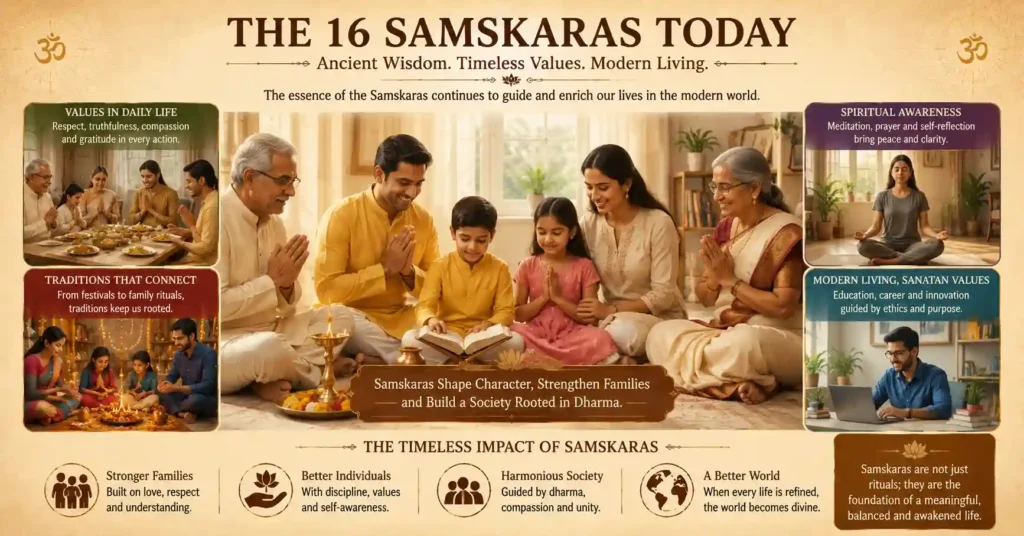
Although these rites originated in ancient times, the values they embody remain relevant in the modern world. The samskara tradition reminds us that personal growth is a lifelong process that requires awareness, discipline, and a commitment to ethical living.
One of the most important lessons is that every stage of life carries both opportunities and responsibilities. Whether pursuing education, building a family, or entering later years, each phase deserves thoughtful preparation and reflection.
These observances also highlight the importance of strong relationships. Parents, teachers, elders, and communities all play a role in shaping an individual’s character and helping them navigate life’s challenges.
Another enduring lesson is the value of gratitude. Many of these rites encourage people to appreciate the blessings of life, knowledge, family, food, nature, and the support they receive from others.
The samskara tradition further teaches that external success alone is not enough. True development includes cultivating wisdom, self-control, compassion, and spiritual awareness alongside material achievements.
Even for those who may not perform every traditional ceremony, the principles behind these rites can still offer meaningful guidance. Their message encourages individuals to live consciously, fulfill their responsibilities, and strive for continuous self-improvement.
In this way, the wisdom of the samskaras continues to inspire a balanced approach to life, one that values both worldly duties and inner growth.
Key Takeaways
- The 16 Samskaras are sacred rites of passage in Sanatan Dharma that guide an individual through the major stages of life.
- Collectively known as Shodasha Samskara, they begin before birth and continue until the final rites after death.
- These observances are designed to support physical, mental, moral, social, and spiritual development.
- The samskara tradition teaches that life’s important transitions should be approached with awareness, responsibility, and dharma.
- Ancient texts such as the Grihya Sutras and Dharmashastras preserve the foundations of these life-cycle rites.
- The sixteen samskaras cover conception, childhood, education, marriage, later life, and the final farewell.
- Different Hindu communities may observe these rites in varying ways, but their core purpose remains the same.
- Not all samskaras are widely practiced today, yet the values they promote continue to remain relevant.
- The tradition emphasizes gratitude, self-discipline, learning, family responsibility, and spiritual growth.
- Understanding the 16 Samskaras offers valuable insight into how Sanatan Dharma views human life as a sacred journey of continuous development and self-realization.
Conclusion
The 16 Samskaras represent one of the most comprehensive systems of life-stage guidance found in Sanatan Dharma. From conception to the final rites, these sacred observances were designed to bring awareness, purpose, and spiritual meaning to life’s most important transitions.
More than a collection of rituals, the samskara tradition seeks to nurture character, responsibility, learning, family values, and inner growth. Each rite serves as a reminder that human life is a sacred journey that should be approached with mindfulness and dharma.
While not all of these ceremonies are widely practiced today, the principles they embody remain timeless. Their emphasis on self-improvement, respect for relationships, gratitude, ethical conduct, and spiritual awareness continues to offer valuable guidance in the modern world.
Understanding the 16 Samskaras in Sanatan Dharma provides deeper insight into how Hindu traditions view human life, not merely as a sequence of events, but as a meaningful path of growth, duty, and self-realization.
Suggested Reading
The 16 Samskaras are closely connected with many other core teachings of Sanatan Dharma. Understanding the 16 Samskaras becomes even more meaningful when viewed alongside concepts such as karma, dharma, atma, maya, artha, and bhakti.
These teachings together provide a deeper understanding of human life, spiritual growth, and the path toward self-realization.
Karma: Meaning, Types, Philosophy and How It Works in Sanatan Dharma
https://thesanatantales.com/karma/
What Is Atma? Meaning, Nature and Spiritual Significance in Hinduism
https://thesanatantales.com/what-is-atma/
What Is Dharma? Meaning, Types, Importance, and Scriptural Understanding
https://thesanatantales.com/dharma-meaning-types-importance/
What Is Maya? Meaning, Illusion and Spiritual Significance in Hindu Philosophy
https://thesanatantales.com/what-is-maya-in-hindu-philosophy/
What Is Artha in Sanatan Dharma? Meaning, Importance, and Role in Life
https://thesanatantales.com/artha-in-sanatan-dharma/
What Is Bhakti? Meaning, Types, Importance, and Understanding in Sanatan Dharma
https://thesanatantales.com/what-is-bhakti/
Samskara (Wikipedia)
https://en.wikipedia.org/wiki/Samskara/
FAQs
What are the 16 Samskaras in Sanatan Dharma?
The 16 Samskaras, also known as Shodasha Samskara, are a series of sacred rites of passage that guide an individual through the major stages of life in Sanatan Dharma. These ceremonies begin before birth with Garbhadhana and continue through childhood, education, marriage, later life, and the final rites after death.
The purpose of these samskaras is not merely ceremonial. They are intended to refine character, instill values, encourage responsible living, and support spiritual growth. Together, they provide a framework for living a meaningful life rooted in dharma and self-awareness.
What is the meaning of Samskara?
The word Samskara comes from Sanskrit and generally means refinement, cultivation, or positive transformation. In Hindu tradition, it refers to sacred rites that help shape an individual’s character, conduct, and spiritual outlook.
A samskara is believed to leave a positive impression on the mind and personality. Through these observances, important life events become opportunities for learning, reflection, and personal growth rather than merely social occasions.
Why are the 16 Samskaras important?
The importance of the samskaras lies in their role in guiding individuals through life’s major transitions with awareness and responsibility. They help connect personal development with ethical values, family duties, and spiritual aspirations.
These rites encourage qualities such as discipline, gratitude, respect, learning, compassion, and self-control. They also strengthen family bonds and preserve cultural and spiritual traditions across generations.
What is the purpose of the 16 Samskaras?
The primary purpose of the sixteen samskaras is to support the holistic development of an individual. They address not only physical growth but also emotional, intellectual, social, and spiritual well-being.
Each rite prepares a person for the next stage of life and reminds them of the responsibilities that come with it. Together, they help transform life’s milestones into meaningful experiences guided by dharma.
Are the 16 Samskaras mentioned in Hindu scriptures?
Yes. The tradition of the samskaras is rooted in ancient Hindu literature. References to various samskaras are found in the Grihya Sutras, Dharmashastras, and other traditional texts that discuss domestic rituals, social duties, and religious observances.
While different texts sometimes describe variations in the number or sequence of rites, the broader concept of sanctifying important stages of life is firmly established in the Hindu scriptural tradition.
Do all Hindu traditions follow the same 16 Samskaras?
Not necessarily. Different regions, communities, and traditions may follow slightly different practices or place emphasis on particular rites. Some traditions combine certain ceremonies, while others preserve detailed ritual procedures.
Despite these differences, the underlying purpose remains consistent: to guide individuals through life’s important transitions with spiritual awareness, responsibility, and respect for dharma.
Are all 16 Samskaras practiced today?
In contemporary society, not all sixteen samskaras are commonly observed in their traditional form. Ceremonies such as naming, first feeding, marriage, and final rites remain widely practiced, while others may be performed less frequently or in modified ways.
However, even when the rituals themselves are not observed, many families continue to uphold the values and teachings associated with these sacred rites.
What is the difference between Samskara and a ritual?
A ritual is generally a religious or cultural act performed according to a prescribed method. A Samskara, on the other hand, is a specific type of rite of passage intended to mark and sanctify important stages of life.
While every samskara includes ritual elements, its deeper purpose is personal refinement, character development, and spiritual growth. It is therefore both a ceremony and a transformative life milestone.
Do women also participate in the 16 Samskaras?
Yes. Women play an important role in the samskara tradition and participate in many of these rites throughout life. Several samskaras are directly connected with pregnancy, childbirth, education, marriage, family life, and other important milestones.
The benefits and values associated with these observances are intended for all individuals, regardless of gender.
Can someone follow the values of the 16 Samskaras without performing every ceremony?
Yes. While the traditional ceremonies have great cultural and spiritual significance, the principles behind them can be practiced by anyone. Values such as self-discipline, respect for learning, gratitude, ethical conduct, family responsibility, and spiritual awareness remain relevant regardless of whether every ritual is formally observed.
Many people find inspiration in the teachings of the samskaras even when they do not perform all sixteen ceremonies in the traditional manner.
Which of the 16 Samskaras are most commonly practiced today?
Among the sixteen, Namakarana (naming ceremony), Annaprashana (first feeding of solid food), Chudakarana (first haircut), Vivaha (marriage), and Antyeshti (final rites) are among the most widely practiced today.
Their continued observance reflects the enduring importance of family, community, and spiritual traditions in Hindu life.
What is Shodasha Samskara?
Shodasha Samskara is the Sanskrit term for the 16 Samskaras, the traditional rites of passage described in Sanatan Dharma. The word Shodasha means “sixteen,” while Samskara refers to refinement, purification, or a sacred life-cycle rite.
These sixteen observances guide an individual through the major stages of life, beginning with conception and continuing through birth, education, marriage, later life, and the final rites. Together, they are intended to nurture physical, moral, social, and spiritual development while helping individuals live in harmony with dharma.
The concept of Shodasha Samskara reflects the belief that every important transition in life should be approached with awareness, responsibility, and spiritual purpose, transforming ordinary milestones into meaningful opportunities for growth and self-improvement.
References & Sources
This article is based on traditional teachings related to the 16 Samskaras (Shodasha Samskara) in Sanatan Dharma. It draws upon concepts found in Hindu scriptures, including the Vedas, Grihya Sutras, Dharmashastras, Smriti literature, and traditional commentaries that discuss rites of passage, human development, family life, and spiritual growth.
The article also reflects the broader understanding of samskaras preserved through Hindu cultural traditions, family practices, spiritual communities, and the guru-disciple lineage that has helped transmit these teachings across generations.
Note: The names, sequence, interpretation, and method of performing the samskaras may vary among different traditions, sampradayas, regions, and communities within Sanatan Dharma. The purpose of this article is not to present any one tradition as the sole authority, but to provide a clear, balanced, and beginner-friendly overview of the commonly accepted understanding of the sixteen samskaras and their significance in Hindu life. Sanatan Dharma embraces diversity in practice while maintaining shared spiritual values and principles.
Explore More Topics from The Sanatan Tales