Atma is one of the most important concepts in Sanatan Dharma because it helps us understand our true identity beyond the body, mind, emotions, and worldly roles. While most people identify themselves through their physical appearance, thoughts, or experiences, Hindu philosophy teaches that the real self is eternal and remains unchanged through all stages of life.
This concept forms the foundation of many spiritual teachings, including Karma, rebirth, self-realization, and Moksha. Understanding the nature of the true self helps explain who experiences the results of actions, what continues after death, and why spiritual growth is considered important.
Hindu scriptures such as the Upanishads, Bhagavad Gita, and Vedanta philosophy describe the soul as eternal, conscious, and present within every living being. It is not created at birth, nor does it cease to exist when the body dies. Instead, it is the inner witness that observes thoughts, emotions, and experiences while remaining beyond them.
In this article, you will learn what Atma is, its meaning, origin, characteristics, scriptural significance, relationship with the body and mind, connection with Karma, rebirth, and Moksha, common misconceptions, and why understanding the true self remains central to spiritual life in Sanatan Dharma.
Atma At a Glance
| Aspect | Summary |
|---|---|
| Meaning | The true self or eternal soul present within every living being. |
| Sanskrit Term | Atma (Atman) |
| Nature | Eternal, conscious, unchanging, and beyond the physical body. |
| Scriptural Sources | Upanishads, Bhagavad Gita, Vedas, and Vedanta philosophy. |
| Role in Hinduism | Forms the foundation of Karma, rebirth, and spiritual growth. |
| Relation to the Body | Exists beyond the body, mind, and emotions. |
| Relation to Karma | Experiences the results of actions across lifetimes. |
| Relation to Moksha | Self-realization leads toward liberation from the cycle of rebirth. |
| Ultimate Purpose | To realize one’s true nature and attain spiritual freedom. |
Table of Contents
ToggleWhat Is Atma?
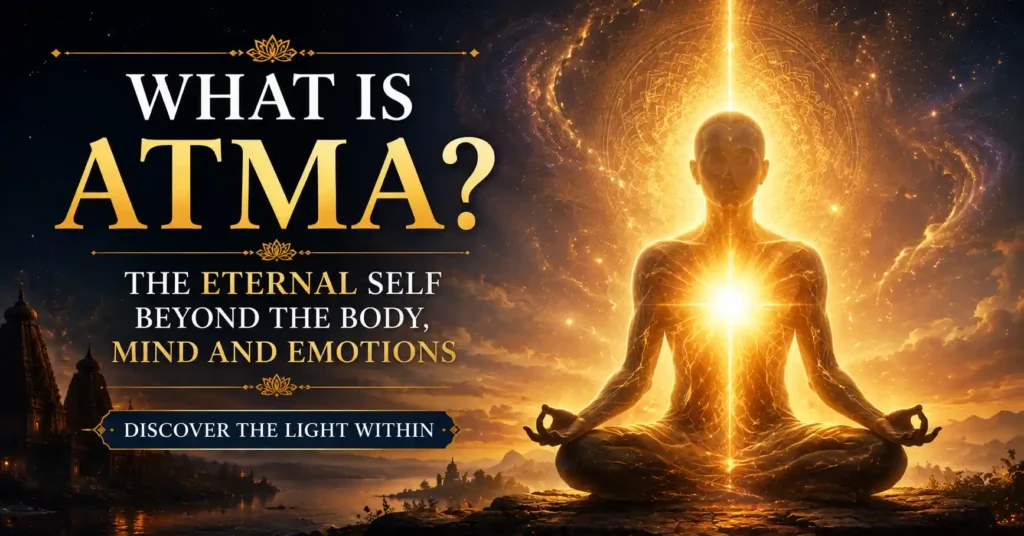
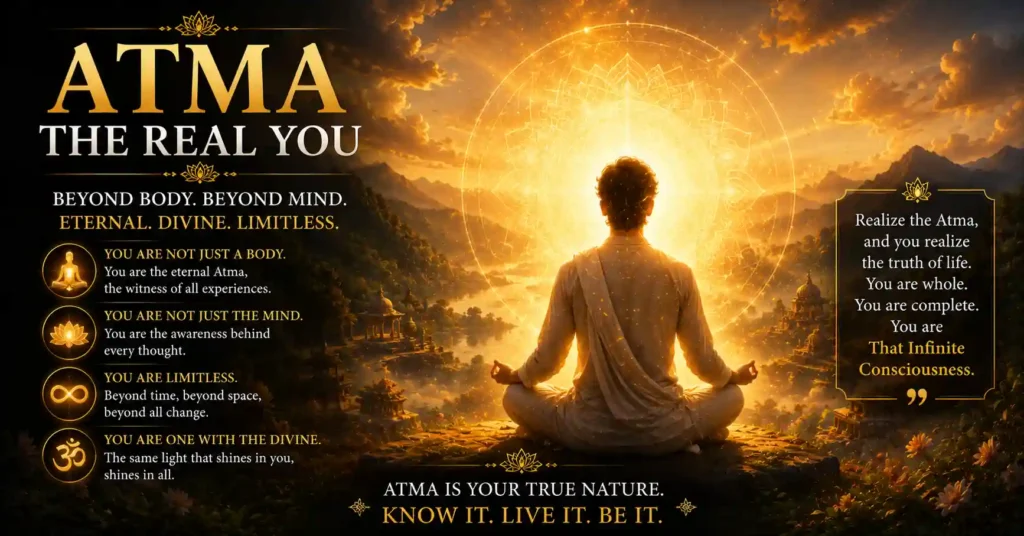
Atma is the true self that exists beyond the physical body, mind, thoughts, and emotions. In Hindu philosophy, it is the eternal consciousness present within every living being and is considered the essence of individual existence.
Unlike the body, which changes with age, or the mind, which constantly experiences different thoughts and emotions, the true self remains unchanged. It is the inner witness that observes every experience without being affected by them.
Hindu teachings explain that a person’s real identity is not their name, appearance, profession, or social role. These are temporary aspects of life, while the spiritual self remains constant throughout all experiences.
Sacred texts describe the soul as eternal, indestructible, and beyond birth and death. The Bhagavad Gita explains that weapons cannot cut it, fire cannot burn it, water cannot wet it, and wind cannot dry it. These descriptions emphasize its existence beyond physical limitations.
The term is also written as Atman in many Sanskrit texts. It is often described as pure consciousness, awareness, or the divine presence that gives life to the body. Without this spiritual essence, the body becomes lifeless.
Understanding this concept forms the foundation of many teachings in Sanatan Dharma. Ideas such as Karma, rebirth, self-realization, and Moksha all depend upon understanding the nature of the eternal soul.
In simple terms, Atma can be understood as the real “I” that exists beyond the body and mind. It is the unchanging spiritual essence that remains present throughout life’s journey and continues beyond physical death.
What Is the Meaning of Atma?
The word Atma (Atman in Sanskrit) refers to the true self or inner consciousness that exists within every living being. It is one of the most important concepts in Hindu philosophy and is often used to describe the eternal soul that exists beyond the body and mind.
In simple terms, it represents a person’s deepest identity. While people usually identify themselves through their name, appearance, occupation, or personality, Hindu teachings explain that these are temporary aspects of life. The true self remains present through all experiences and changes.
This concept is closely associated with consciousness, awareness, and the spiritual essence that gives life to the body. It is not considered a physical object, nor can it be perceived through the senses. Instead, it is understood through self-inquiry, spiritual practice, and inner realization.
The Upanishads describe the soul as eternal, unchanging, and beyond all limitations. It remains the same despite the constant changes that occur in the body, thoughts, emotions, and external circumstances.
Many Hindu philosophical traditions teach that ignorance of one’s real nature is the primary cause of suffering. When a person identifies only with the body and mind, they remain bound by attachment, fear, and confusion. Recognizing the eternal self helps shift attention toward the deeper reality of existence.
For this reason, the search for self-knowledge occupies a central place in Sanatan Dharma. Understanding this teaching is not merely an intellectual exercise but the beginning of a deeper journey toward spiritual awareness, self-realization, and liberation.
What Is the Origin of the Word Atma?
The word Atma comes from the Sanskrit term Atman (आत्मन्), a concept discussed in Hindu scriptures for thousands of years. It is one of the most important philosophical ideas in Sanatan Dharma and appears extensively in the Upanishads, Bhagavad Gita, and Vedanta literature.
The exact linguistic origin of the term has been interpreted in different ways by scholars. Traditionally, it is associated with the inner self, consciousness, and the essential nature of a living being. Over time, the concept came to represent the eternal soul that exists beyond the physical body and the changing mind.
Ancient Hindu texts do not describe the true self as a physical object that can be seen or touched. Instead, it is presented as the innermost reality of a person, the conscious presence that experiences life and gives meaning to existence.
The Upanishads frequently explore questions such as “Who am I?”, “What remains unchanged amid constant change?”, and “What is the ultimate nature of reality?” These teachings helped establish this concept as a central theme in Hindu philosophy and spiritual inquiry.
Different schools of Hindu thought may explain its nature in slightly different ways, but all recognize it as something deeper than the body, senses, and mind. It is regarded as the spiritual essence that underlies individual existence.
Understanding the origin of the term provides valuable insight into its deeper meaning. Rather than referring merely to personality or identity, it points toward the eternal conscious self that remains present throughout all experiences and stages of life.
Is Atma Mentioned in Hindu Scriptures?
Yes, Atma is one of the most important concepts discussed throughout Hindu scriptures. The nature of the soul, the true self, and the purpose of human life are central themes in many sacred texts of Sanatan Dharma.
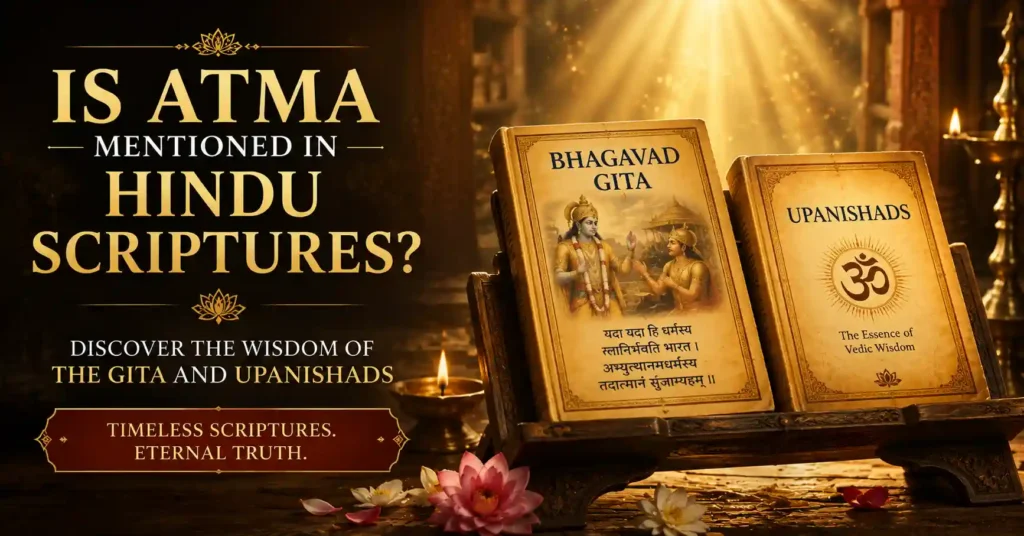
The Upanishads contain some of the deepest teachings on this subject. These texts repeatedly encourage seekers to look beyond the body and mind and discover their true nature. Many famous Upanishadic statements focus on self-realization and the understanding of the eternal self.
The Bhagavad Gita also provides extensive teachings about the soul. Lord Krishna explains that it is eternal, indestructible, and unaffected by physical death. He teaches that while the body changes and eventually perishes, the true self continues to exist.
The Vedas, especially their philosophical portions, explore questions about consciousness, existence, and the inner reality that supports all life. These teachings later developed into the more detailed discussions found in the Upanishads and Vedanta philosophy.
This concept is also discussed in various Puranas, Yoga texts, and classical commentaries written by great Hindu philosophers. Different traditions may explain certain aspects differently, but all acknowledge the existence of an eternal spiritual essence within every living being.
One of the most well-known teachings in Hindu scriptures is that self-knowledge leads to freedom from ignorance. Rather than focusing only on external rituals, many texts emphasize understanding one’s true nature as an essential step toward spiritual growth.
The repeated discussion of Atma in Hindu scriptures highlights its importance in Sanatan Dharma. It is not presented as a minor philosophical idea but as a fundamental truth connected with Karma, rebirth, self-realization, and Moksha.
What Are the Characteristics of Atma?
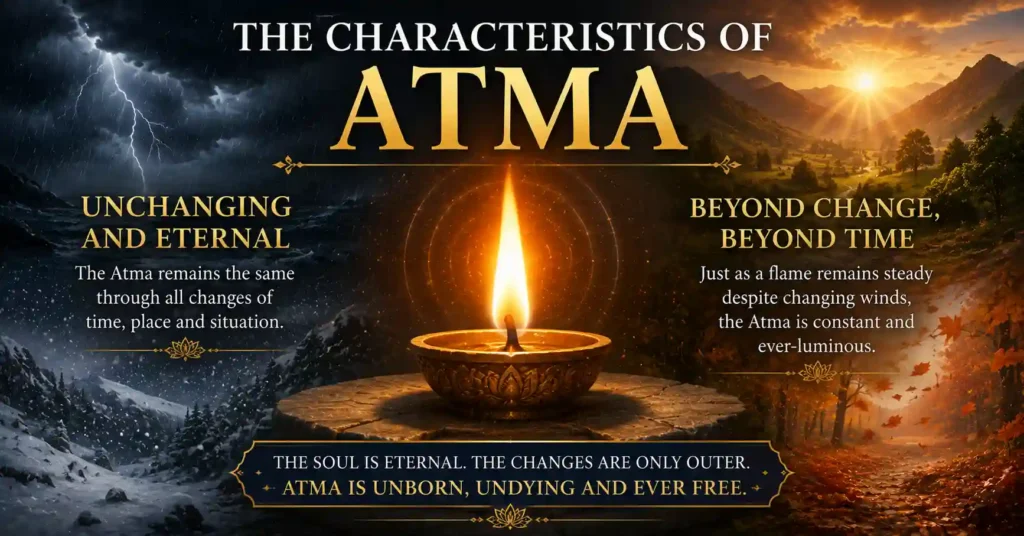
Hindu scriptures describe the true self as eternal, conscious, and unchanging. Unlike the body, which ages over time, or the mind, which constantly experiences different thoughts and emotions, the inner self remains the same throughout life.
One of its most important characteristics is its eternal nature. It is not created at birth and does not cease to exist at death. The Bhagavad Gita teaches that the soul is beyond destruction and continues its journey even when the physical body perishes.
It is also described as pure consciousness. This inner awareness makes all experiences possible. Thoughts, feelings, and perceptions arise within consciousness, but the witness behind them remains unchanged.
Another important characteristic is that it is distinct from the body and mind. The body undergoes physical changes, and the mind experiences countless fluctuations, yet the observer of these changes remains constant. This witnessing presence is regarded as one’s true identity.
Hindu philosophy further teaches that the soul is beyond physical limitations. It cannot be cut, burned, drowned, or destroyed by any material force. Because it is spiritual rather than physical, it is not subject to the laws that govern the material world.
It is also considered unchanging and timeless. While external circumstances, relationships, and identities may change throughout life, the essential nature of the spiritual self remains the same.
These qualities help explain why this concept occupies such a central place in Hindu philosophy. Understanding the eternal and conscious nature of one’s true identity forms the foundation for teachings related to Karma, rebirth, self-realization, and Moksha.
Key Characteristics at a Glance
| Characteristic | Description |
|---|---|
| Eternal | Exists beyond birth and death. |
| Conscious | The source of awareness and experience. |
| Unchanging | Remains the same despite changes in body and mind. |
| Beyond the Body | Distinct from physical form and mental activity. |
| Indestructible | Cannot be harmed by material forces. |
| Timeless | Not limited by age, time, or physical existence. |
| Spiritual in Nature | Exists as the true self rather than a material entity. |
Is Atma Different From the Body and Mind?
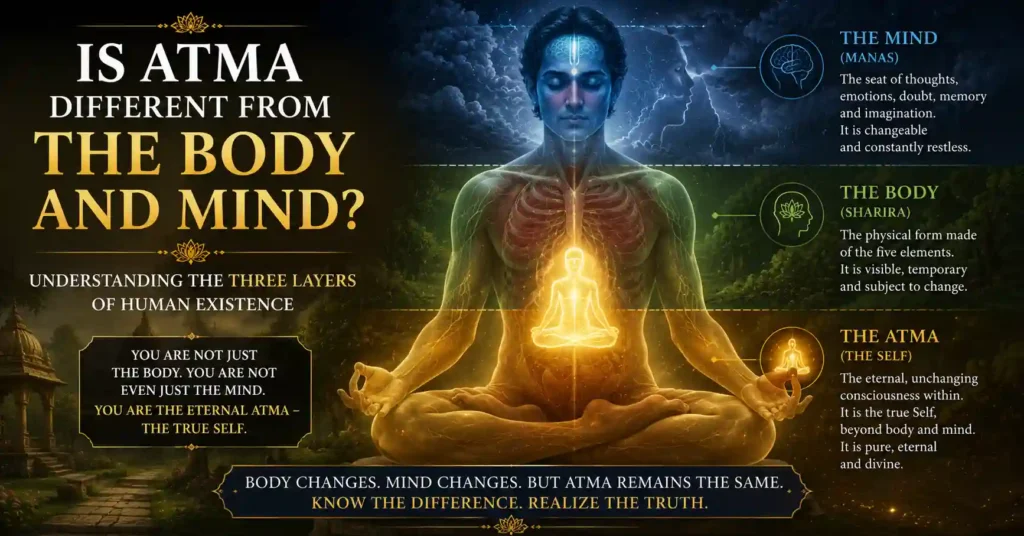
Yes, Hindu philosophy teaches that the soul is different from both the body and the mind. While the body and mind are important instruments through which life is experienced, they are not considered a person’s true identity.
The body is physical and constantly changes over time. It grows, ages, experiences illness, and eventually dies. Because it is subject to change, Hindu teachings do not regard the physical body as permanent.
The mind also changes continuously. Thoughts, emotions, memories, desires, and opinions arise and disappear throughout life. A person’s mental state today may be very different from what it was years ago.
The true self, however, remains constant through all these changes. It is the witness consciousness that observes the body, thoughts, feelings, and experiences without being affected by them.
A common example used in Hindu philosophy is that of a driver and a vehicle. Just as a driver uses a vehicle without being the vehicle itself, the soul experiences life through the body and mind without being identical to them.
The Bhagavad Gita explains that the body is temporary, while the eternal self continues beyond physical death. This distinction helps seekers understand that their real nature is not limited to appearance, age, social identity, or mental activity.
Recognizing the difference between the soul, the body, and the mind is considered an important step toward self-realization. It helps reduce excessive attachment to temporary conditions and encourages a deeper understanding of one’s spiritual nature.
Soul, Body, and Mind: A Simple Comparison
| Aspect | Soul | Body | Mind |
|---|---|---|---|
| Nature | Spiritual | Physical | Mental |
| Changes Over Time | No | Yes | Yes |
| Birth and Death | Beyond both | Subject to both | Functions through life |
| Role | Witness and experiencer | Instrument of action | Instrument of thought |
| Permanence | Eternal | Temporary | Temporary |
| True Identity | Yes | No | No |
This teaching forms the basis of many spiritual practices in Sanatan Dharma, where the goal is to move beyond identification with the body and mind and recognize one’s eternal nature.
Is Atma Eternal?
Yes, Hindu philosophy teaches that the soul is eternal. Unlike the physical body, which is born, grows, ages, and eventually dies, the true self is considered timeless and beyond the cycle of birth and death.
The Bhagavad Gita repeatedly emphasizes this eternal nature. Lord Krishna explains that the self is never born and never dies. While the body undergoes constant change, inner consciousness remains unchanged throughout all stages of existence.
This teaching helps explain why death is viewed differently in Sanatan Dharma. Physical death is understood as the end of the body, not the end of one’s spiritual existence. The soul continues its journey according to the law of Karma and the cycle of rebirth.
Hindu scriptures often compare the body to a garment. Just as a person removes old clothes and puts on new ones, the soul leaves one body and takes another. This analogy highlights the temporary nature of physical existence and the enduring nature of the spiritual self.
This teaching is also closely connected to Moksha. Since the soul exists beyond birth and death, spiritual practice focuses on realizing this truth rather than identifying solely with the temporary material world.
Understanding the eternal nature of the self can reduce fear of death and bring a broader perspective on life. It encourages individuals to focus not only on temporary achievements but also on spiritual growth, wisdom, and self-realization.
Key Points About the Eternal Nature of the Soul
| Aspect | Explanation |
|---|---|
| Birth | Not created at birth. |
| Death | Does not perish when the body dies. |
| Nature | Timeless and unchanging. |
| Scriptural Teaching | Extensively discussed in the Bhagavad Gita and Upanishads. |
| Connection to Rebirth | Continues its journey through different lifetimes. |
| Spiritual Significance | Understanding this truth helps lead toward self-realization and Moksha. |
What Is the Relationship Between Atma and Karma?
The relationship between the soul and Karma is one of the most important teachings in Hindu philosophy. While Karma refers to actions and their consequences, the eternal self is the experiencer of those consequences across different lifetimes.
According to Sanatan Dharma, every thought, word, and action creates Karma. These actions leave impressions that influence future experiences. Although the body changes and eventually dies, the soul continues its journey and carries the effects of past actions.
This teaching explains why individuals are born into different circumstances and encounter different life experiences. Hindu philosophy teaches that present conditions are influenced not only by current actions but also by Karma accumulated in previous lives.
The Bhagavad Gita emphasizes the importance of performing actions responsibly and without attachment to results. By acting with honesty, compassion, and selflessness, individuals create positive Karma and support their spiritual growth.
At the same time, the true self is considered pure and beyond all actions. Karma influences the soul’s journey through the cycle of birth and rebirth, but it does not alter its essential nature. The eternal self remains unchanged, while the consequences of actions shape life experiences.
Understanding this connection encourages individuals to take responsibility for their choices. It highlights that every action has consequences and that conscious living plays an important role in personal and spiritual development.
Soul and Karma at a Glance
| Aspect | Soul | Karma |
|---|---|---|
| Meaning | The eternal self or spiritual essence | Actions and their consequences |
| Nature | Unchanging and spiritual | Dynamic and action-based |
| Role | Experiences the results of actions | Creates future experiences |
| Affected by Time | Eternal | Operates across lifetimes |
| Connection | Continues through rebirth | Influences the circumstances of rebirth |
| Spiritual Goal | Self-realization | Purification through right action |
Understanding the relationship between the soul and Karma helps explain how actions influence life’s journey and why ethical living is considered essential in Sanatan Dharma.
What Is the Relationship Between Atma and Rebirth?
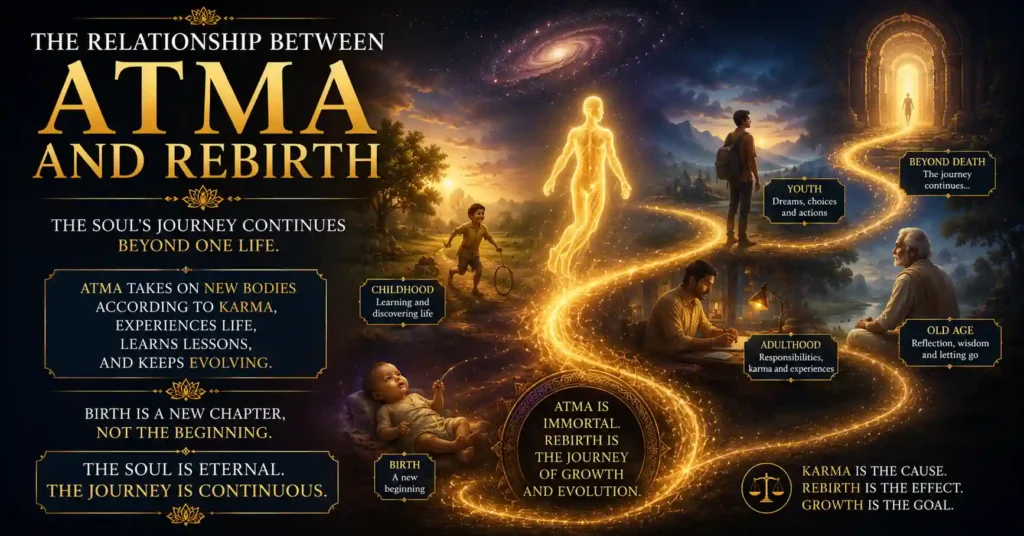
The relationship between the soul and rebirth is a central teaching in Hindu philosophy. Sanatan Dharma teaches that while the physical body is temporary, the eternal self continues its journey beyond death and takes birth again according to the law of Karma.
When the body dies, the soul does not cease to exist. Instead, it leaves the old body and continues its journey. The circumstances of a future birth are influenced by the actions, intentions, and Karma accumulated in previous lives.
This understanding helps explain why life experiences vary from person to person. Hindu teachings state that the soul carries karmic impressions from one lifetime to another, creating opportunities for learning, growth, and spiritual evolution.
The Bhagavad Gita uses the analogy of changing clothes to explain rebirth. Just as a person discards worn-out garments and puts on new ones, the soul leaves one body and enters another. This comparison highlights the temporary nature of the body and the continuity of the eternal self.
The cycle of repeated birth, death, and rebirth is known as Samsara. As long as ignorance, attachment, and accumulated Karma remain, the individual continues to move through this cycle.
The ultimate goal of spiritual life is not merely to obtain a better rebirth but to attain self-realization and freedom from Samsara. Through spiritual knowledge, righteous living, devotion, and self-discipline, seekers gradually move closer to liberation.
Understanding the connection between the soul and rebirth encourages a broader view of life. It reminds us that existence extends beyond a single lifetime and that our actions have consequences that reach far beyond the present moment.
Soul and Rebirth at a Glance
| Aspect | Explanation |
|---|---|
| What Continues After Death? | The eternal soul continues its journey. |
| What Ends at Death? | The physical body perishes. |
| What Influences Rebirth? | Karma accumulated through actions and intentions. |
| Cycle of Birth and Death | Known as Samsara. |
| Purpose of Rebirth | Spiritual growth, learning, and karmic evolution. |
| Ultimate Goal | Freedom from the cycle through Moksha. |
Understanding the relationship between Karma, rebirth, and the soul provides deeper insight into how Hindu philosophy views life, death, and the ongoing journey of spiritual growth.
What Is the Relationship Between Atma and Moksha?
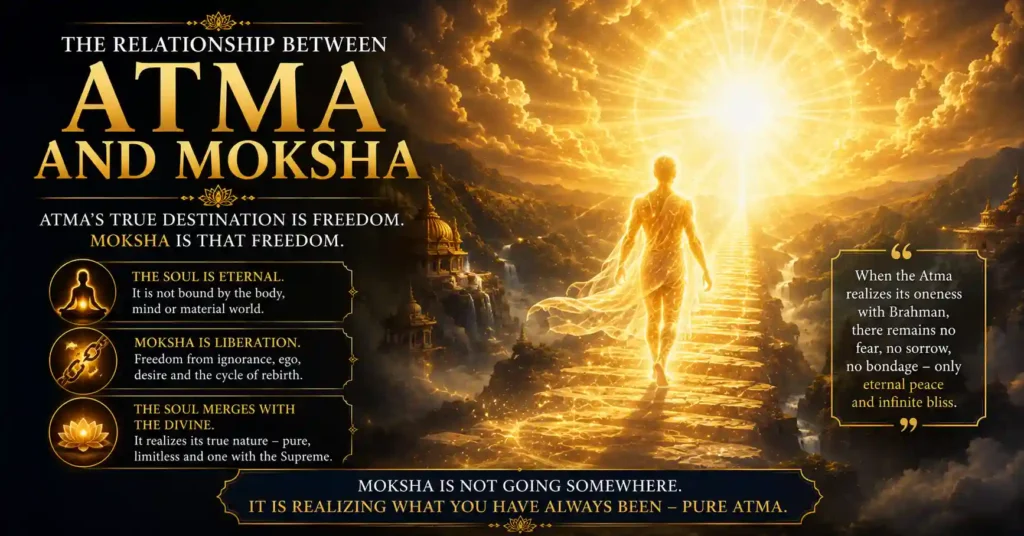
The relationship between the soul and Moksha lies at the heart of Hindu spiritual teachings. Moksha, or liberation, is attained when a person realizes their true nature and becomes free from ignorance, attachment, and the cycle of rebirth.
According to Sanatan Dharma, most people identify themselves with the body, mind, emotions, and worldly roles. This mistaken identity creates attachment, desire, fear, and suffering. Spiritual knowledge helps remove this ignorance and reveals the eternal nature of the self.
The Upanishads and Bhagavad Gita teach that liberation is not achieved by creating something new. Rather, it comes from recognizing what has always been true: the soul is eternal, pure, and beyond the limitations of the physical world.
As long as a person remains attached to temporary identities and desires, they continue to experience the cycle of birth and death known as Samsara. Self-realization helps break this cycle by removing the ignorance that causes bondage and suffering.
Different paths within Hinduism, including Bhakti Yoga, Karma Yoga, Jnana Yoga, and Raja Yoga, aim to purify the mind and guide seekers toward this realization. While the methods may differ, the ultimate goal remains the same: spiritual freedom and liberation.
Understanding this relationship also changes how a person views life. Instead of seeking lasting happiness only through external achievements, one begins to seek inner wisdom, peace, and spiritual awareness.
For this reason, self-realization is considered one of the highest goals of human life. It leads to freedom from suffering and a direct understanding of one’s eternal nature.
Soul and Moksha at a Glance
| Aspect | Explanation |
|---|---|
| Soul | The eternal spiritual self. |
| Moksha | Liberation from the cycle of birth and death. |
| Cause of Bondage | Ignorance of one’s true nature. |
| Path to Freedom | Self-realization and spiritual knowledge. |
| Role of Spiritual Practice | Helps remove ignorance and purify the mind. |
| Ultimate Result | Inner freedom, peace, and liberation. |
Understanding the connection between the soul and Moksha helps explain why self-realization is regarded as one of the highest aims of spiritual life in Sanatan Dharma.
How Can One Realize Atma?
Understanding Atma intellectually is an important first step, but Hindu philosophy teaches that true knowledge comes through direct realization. Self-realization is not about acquiring something new. It is about recognizing the true self that has always existed beneath temporary identities and mental distractions.
According to the Upanishads and Vedanta philosophy, ignorance of one’s real nature is the primary obstacle to self-realization. People often identify themselves with the body, mind, emotions, possessions, and social roles, forgetting their deeper spiritual nature. Spiritual practice helps remove this ignorance and reveal the eternal self.
Different paths within Sanatan Dharma offer ways to attain this realization. While the methods vary, they all aim to purify the mind, cultivate self-awareness, and guide the seeker toward direct spiritual understanding.
Self-Inquiry (Atma Vichara)
Self-inquiry involves reflecting on questions such as “Who am I?” and examining the difference between the observer and the observed.
By looking beyond thoughts, emotions, and external identities, a seeker gradually discovers the witnessing consciousness that remains unchanged through all experiences.
Meditation
Meditation helps calm mental activity and allows attention to move inward.
As distractions decrease, individuals may become more aware of the silent presence that exists beyond thoughts and emotions. Many Hindu traditions regard meditation as a powerful tool for self-realization.
Study of Scriptures
The Upanishads, Bhagavad Gita, and Vedanta texts provide guidance for understanding the nature of the soul and the deeper reality of existence.
Regular study, combined with reflection and practical application, helps deepen spiritual understanding and remove misconceptions about identity and reality.
Karma Yoga and Selfless Service
Performing actions without selfish attachment helps purify the mind and reduce ego-centered thinking.
Through selfless service and responsible action, individuals develop qualities such as humility, compassion, and inner balance that support spiritual growth.
Bhakti and Devotion
Many spiritual traditions teach that devotion to the Divine can also lead to self-realization.
Through prayer, surrender, and loving devotion, seekers gradually overcome ego and develop a deeper awareness of their spiritual nature.
Signs of Spiritual Progress
As understanding deepens, a person may experience greater inner peace, reduced attachment, increased compassion, and a clearer sense of purpose.
These changes are generally viewed as natural outcomes of spiritual growth rather than goals in themselves.
Ultimately, self-realization is considered one of the highest goals of spiritual life. It is the direct recognition of one’s true nature beyond the body, mind, and ego, leading toward lasting peace, wisdom, and liberation.
Why Is Understanding Atma Important?
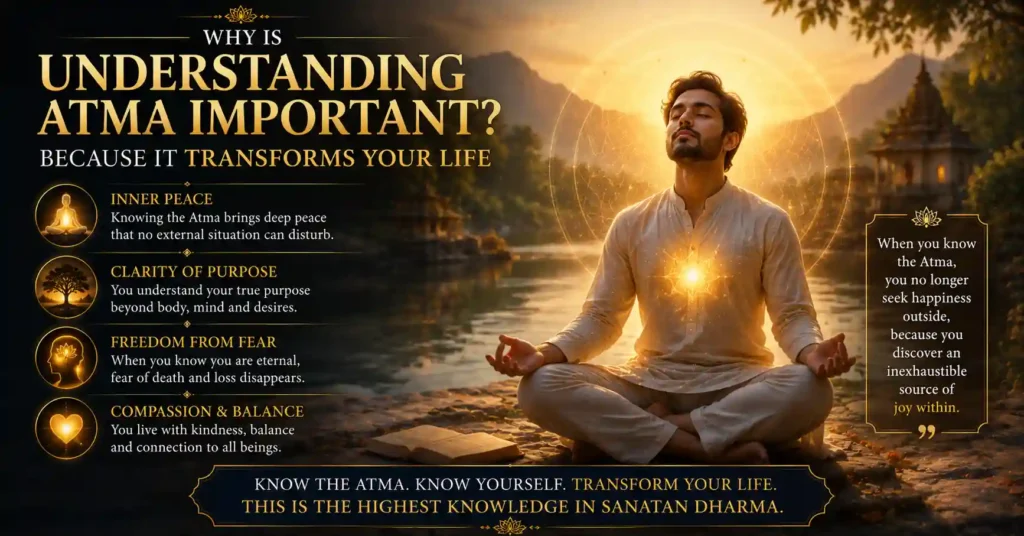
Understanding Atma is important because it helps answer some of life’s deepest questions: Who am I? Why do I experience happiness and suffering? What happens after death? What is the purpose of human life?
Most people identify themselves primarily with the body, mind, emotions, or social roles. Hindu philosophy teaches that these aspects are temporary, while the true self remains eternal and unchanged. Recognizing this distinction can transform how a person views life and its challenges.
Knowledge of one’s deeper nature helps reduce fear, especially the fear of loss, change, and death. When individuals understand that their real identity is not limited to the physical body, they often develop greater inner strength and resilience.
This understanding also provides a foundation for other important teachings such as Karma, rebirth, Dharma, and Moksha. Without understanding the nature of the soul, many of these concepts can seem incomplete or difficult to grasp.
Such knowledge encourages self-awareness and introspection. Instead of seeking fulfillment only through external achievements, people begin to explore their inner nature and develop a deeper sense of purpose.
These teachings also promote qualities such as compassion, patience, humility, and respect for all living beings. When the same spiritual essence is recognized in everyone, relationships can become more harmonious and meaningful.
Ultimately, learning about the true self is not merely a philosophical exercise. It is a practical step toward self-realization, inner peace, and spiritual growth. For this reason, the search for deeper self-knowledge remains one of the central goals of Sanatan Dharma.
Benefits of Understanding the True Self
| Benefit | Explanation |
|---|---|
| Greater Self-Awareness | Helps individuals understand their true identity beyond external labels. |
| Reduced Fear | Encourages a broader perspective on life, death, and change. |
| Inner Peace | Reduces attachment to temporary circumstances. |
| Spiritual Growth | Supports the journey toward self-realization and Moksha. |
| Better Understanding of Karma | Explains how actions influence life’s experiences. |
| Compassion for Others | Encourages respect for the spiritual essence in all beings. |
| Sense of Purpose | Provides deeper meaning and direction in life. |
Common Misconceptions About Atma
REVISED VERSION
Because the concept of the soul is profound and subtle, it is often misunderstood. Clarifying these misconceptions can help develop a more accurate understanding of the true self and its role in Hindu philosophy.
The Soul Is Not the Physical Body
One of the most common misconceptions is that a person is only the body. Hindu teachings explain that the body is temporary and constantly changing, while the true self remains eternal and unchanging.
The body serves as an instrument through which life is experienced, but it is not the ultimate identity of an individual.
The Soul Is Not the Mind
Many people identify themselves with their thoughts, emotions, memories, or personality. However, the mind is constantly changing, whereas the witness of those changes remains the same.
The true self observes thoughts and feelings but is not limited by them.
The Soul Is Not the Ego
The ego is the sense of “I” that becomes attached to names, achievements, possessions, and social identity. Hindu philosophy teaches that the ego is a temporary construct, while the deeper spiritual self exists beyond such labels.
Understanding this distinction helps reduce attachment and promotes inner freedom.
The Soul Is Not Created at Birth
Another common misunderstanding is that the soul begins to exist when a person is born. Hindu scriptures describe the self as eternal, meaning it has neither a beginning nor an end.
Birth marks the beginning of a physical life, not the beginning of one’s spiritual existence.
The Same Spiritual Essence Exists in All Beings
Although individuals appear separate on the physical level, Hindu philosophy teaches that the same spiritual essence exists within all living beings.
This understanding forms the basis for compassion, respect, and the recognition of unity within diversity.
Self-Realization Is More Than Intellectual Knowledge
Some people assume that simply reading spiritual teachings is the same as realizing them. Hindu traditions explain that true understanding comes through reflection, spiritual practice, self-inquiry, and direct experience.
Knowledge may begin with study, but realization requires inner transformation.
Key Misconceptions at a Glance
| Misconception | Clarification |
|---|---|
| The soul is the body | The body is temporary; the true self is eternal. |
| The soul is the mind | Thoughts and emotions change, but the witness remains unchanged. |
| The soul is the ego | The ego is temporary, while the spiritual self endures. |
| The soul begins at birth | It exists beyond birth and death. |
| Each soul is completely separate | The same spiritual essence exists in all beings. |
| Reading alone leads to realization | Self-realization requires inner experience and spiritual growth. |
Understanding these misconceptions helps reveal the true self described in Hindu scriptures rather than reducing it to a purely philosophical idea. This deeper understanding supports self-awareness, spiritual growth, and the journey toward self-realization.
Conclusion
Atma is one of the most fundamental concepts in Hindu philosophy and serves as the foundation for understanding the true nature of existence. Far more than a philosophical idea, it explains the eternal self that exists beyond the body, mind, and temporary identities that people often mistake for their true nature.
From its meaning and scriptural origins to its relationship with Karma, rebirth, and Moksha, the concept of Atma provides a deeper perspective on life, death, and spiritual growth. It helps individuals look beyond external appearances and recognize the enduring consciousness that remains present throughout all experiences.
The teachings on Atma in Hinduism continue to guide spiritual seekers toward greater self-awareness, inner peace, and wisdom. By understanding the nature of the true self, individuals can develop a clearer sense of purpose and approach life with greater balance and clarity.
Ultimately, the journey to understand what Atma is is also a journey of self-discovery. According to Sanatan Dharma, realizing one’s true nature is an important step toward freedom from ignorance, lasting inner fulfillment, and the highest goal of spiritual life, Moksha.
Key Takeaways
- Atma is the true self or eternal soul that exists within every living being.
- The term refers to the unchanging spiritual essence that remains beyond the body, mind, and emotions.
- Hindu scriptures such as the Upanishads, Bhagavad Gita, and Vedanta texts discuss Atma extensively.
- The soul is considered eternal, conscious, timeless, and indestructible.
- Atma is different from the physical body, mental activity, and ego-based identity.
- Understanding the nature of the soul helps explain important concepts such as Karma, rebirth, and Moksha.
- The cycle of birth and death continues until self-realization removes ignorance and attachment.
- Spiritual practices such as self-inquiry, meditation, devotion, and righteous living help seekers understand their true nature.
- Realizing the true self is regarded as one of the highest goals of spiritual life in Sanatan Dharma.
- Knowledge of Atma encourages inner peace, self-awareness, compassion, and spiritual growth.
FAQs
What is Atma in simple words?
In simple terms, Atma is the true self or eternal soul that exists within every living being. It is the inner consciousness that experiences life through the body and mind but is not limited by them.
Most people identify themselves through their name, appearance, profession, or personality. Hindu philosophy teaches that these are temporary identities, while the true self remains unchanged throughout life.
The body ages, thoughts change, and emotions come and go, but Atma remains constant. For this reason, it is often described as the eternal witness of all experiences.
Is Atma the same as the soul?
Yes, Atma is commonly translated as the soul, but its meaning in Hindu philosophy is deeper than the way the word “soul” is often used in English.
Atma refers to the eternal conscious self that exists beyond the physical body, mind, and ego. It is not merely a part of a person but their deepest and most fundamental reality.
Many Hindu scriptures describe Atma as pure consciousness, eternal awareness, and the spiritual essence that gives life to the body.
Is Atma different from the body and mind?
Yes. Hindu teachings clearly distinguish the true self from both the body and the mind.
The body is physical and undergoes constant change through birth, growth, aging, and death. The mind also changes continuously through thoughts, emotions, desires, and memories.
Atma, however, remains unchanged. It is the witnessing consciousness that observes these changes without being affected by them.
Understanding this distinction is considered an important step toward self-realization.
Is Atma eternal?
Yes. According to Hindu scriptures, Atma is eternal and indestructible.
The Bhagavad Gita teaches that the soul is never born and never dies. While the body may perish, the true self continues to exist.
This teaching forms the foundation of Hindu beliefs regarding rebirth, Karma, and spiritual liberation.
Because Atma is eternal, spiritual growth focuses on realizing its true nature rather than identifying solely with temporary physical existence.
What happens to Atma after death?
Hindu philosophy teaches that death affects the body but not the soul.
When the body dies, Atma continues its journey according to the law of Karma. The accumulated effects of past actions influence future experiences and future births.
This ongoing process is connected to the cycle of birth, death, and rebirth known as Samsara.
The ultimate goal is to attain Moksha, which brings freedom from this cycle.
What is the relationship between Atma and Karma?
Karma refers to actions and their consequences, while Atma is the eternal self that experiences those consequences.
Every thought, word, and action creates Karma. These actions influence future experiences and shape the circumstances encountered in this life and future lives.
Although Karma affects the soul’s journey through Samsara, it does not change the essential nature of Atma itself.
The true self remains pure and eternal, while Karma influences the experiences through which spiritual growth occurs.
What is the relationship between Atma and Moksha?
Moksha is the liberation that comes from realizing the true nature of the self.
According to Hindu philosophy, ignorance causes people to identify themselves with the body, mind, and temporary worldly identities. This creates attachment, fear, and suffering.
When a person realizes the eternal nature of Atma, this ignorance is removed. Such realization leads to freedom from the cycle of rebirth and the attainment of Moksha.
For this reason, self-realization is regarded as one of the highest goals of spiritual life.
Is Atma the same as Paramatma?
Atma and Paramatma are closely related but are not described in exactly the same way.
Atma refers to the individual self present within every living being. Paramatma refers to the Supreme Self or universal consciousness that exists everywhere.
Different schools of Hindu philosophy explain this relationship differently. Some emphasize unity, while others emphasize both unity and distinction.
However, all traditions agree that understanding this relationship is important for spiritual growth and self-realization.
Can Atma be seen or experienced?
Atma cannot be seen through the physical eyes because it is not a material object.
Hindu scriptures explain that the true self is realized through spiritual practices such as meditation, self-inquiry, devotion, contemplation, and disciplined living.
While it cannot be perceived through ordinary senses, it can be directly experienced through deeper spiritual awareness.
This direct realization is often described as self-knowledge or self-realization.
Why is understanding Atma important in Hinduism?
Understanding Atma in Hinduism helps answer fundamental questions about life, death, purpose, and spiritual growth.
It provides the foundation for understanding Karma, rebirth, Dharma, and Moksha. Without understanding the nature of the self, many other Hindu teachings remain incomplete.
Knowledge of the true self also encourages inner peace, self-awareness, compassion, and freedom from excessive attachment to temporary circumstances.
For this reason, the study of Atma remains one of the most important subjects in Sanatan Dharma.
Suggested Reading
If learning about Atma has deepened your interest in Sanatan Dharma, you may also enjoy exploring related spiritual concepts and teachings. Understanding Atma becomes even more meaningful when viewed alongside topics such as devotion, surrender, ultimate reality, sacred time, spiritual practice, and liberation.
These teachings help place Atma in Hinduism within the broader framework of self-realization, Karma, spiritual growth, and the pursuit of ultimate truth.
What Is Rudraksha? Meaning, Types and Spiritual Benefits
https://thesanatantales.com/what-is-rudraksha/
What Is Sharanagati? Understanding Surrender in Hindu Philosophy
https://thesanatantales.com/what-is-sharanagati/
What Is Bhakti? Meaning, Types, Importance, and Understanding in Sanatan Dharma
https://thesanatantales.com/what-is-bhakti/
What Is Brahman? Meaning, Nature and Spiritual Significance in Hinduism
https://thesanatantales.com/what-is-brahman/
Brahma Muhurta: Meaning, Time, Benefits and Spiritual Significance
https://thesanatantales.com/brahma-muhurta-meaning/
What Is Samsara? Meaning, Karma, and the Cycle of Rebirth
https://thesanatantales.com/what-is-samsara/
What Is Nishit Kaal? Meaning, Time, Importance and Spiritual Significance
https://thesanatantales.com/what-is-nishit-kaal/
What Is Maya? Meaning, Illusion and Spiritual Significance in Hindu Philosophy
https://thesanatantales.com/what-is-maya-in-hindu-philosophy/
What Is Dharma? Meaning, Types, Importance and Spiritual Understanding
https://thesanatantales.com/dharma-meaning-types-importance/
Ātman (Hinduism)
https://en.wikipedia.org/wiki/%C4%80tman_(Hinduism)
This Wikipedia article provides a comprehensive overview of Ātman (Atma) in Hinduism, including its meaning, development in the Vedas and Upanishads, relationship with Brahman, interpretations across different schools of Hindu philosophy, and its connection to self-realization and Moksha. (Wikipedia)
References & Sources
This article is based on teachings, concepts, and philosophical principles found within Sanatan Dharma, including insights drawn from Hindu scriptures, traditional spiritual knowledge, Vedantic teachings, devotional traditions, and widely accepted interpretations of the nature of the self, consciousness, and spiritual growth.
It also reflects wisdom preserved through spiritual communities, classical commentaries, family traditions, and the guru-disciple lineage that has transmitted Sanatan teachings across generations. The concepts discussed here are commonly explored within Hindu philosophy in the context of self-realization, Karma, rebirth, liberation, and the deeper purpose of human life.
Note: Beliefs, interpretations, and spiritual perspectives may vary across different traditions, sampradayas, philosophical schools, regions, and individual paths within Sanatan Dharma. The purpose of this article is not to promote any single viewpoint as the absolute truth, but to present commonly accepted spiritual perspectives in a simple, practical, and reader-friendly manner. Sanatan Dharma embraces multiple paths of knowledge, devotion, meditation, self-inquiry, ethical living, and spiritual transformation.
Explore Topics from The Sanatan Tales