In Rajasthan, gods are not always believed to descend from heaven. Many are remembered as ordinary men who lived among farmers, cattle herders, and village communities, earning reverence through their courage, compassion, and unwavering sense of duty.
These heroes lived as humans, kept their promises, stood against injustice, and sacrificed their lives to protect others. Over time, people stopped remembering them only as brave warriors and began worshipping them as Lok Devtas of Rajasthan, the beloved folk deities who continue to inspire generations.
Unlike the deities described in ancient scriptures, these Rajasthan folk deities are deeply rooted in local history, oral traditions, and community memory. Their stories continue to shape village values, social responsibility, and faith across the state.
Among the most revered are Tejaji and Pabuji, whose lives symbolize truth, sacrifice, courage, and protection of the vulnerable. Along with other Rajasthan Lok Devtas, they remain an important part of the state’s living folk traditions and cultural identity.
Today, the Lok Devtas of Rajasthan are worshipped not merely as legendary heroes, but as living guardians of truth, honor, and compassion. Their temples, fairs, folk songs, and community traditions keep their legacy alive in villages across Rajasthan.
Lok Devtas of Rajasthan at a Glance
| Feature | Details |
|---|---|
| Region | Rajasthan, India |
| Tradition | Regional Folk Traditions of Sanatan Dharma |
| Known As | Rajasthan Folk Deities, Hero Deities of Rajasthan |
| Most Revered Lok Devtas | Tejaji, Pabuji, Gogaji, Ramdevji, Devnarayanji |
| Worshipped For | Courage, truth, promise-keeping, cattle protection, justice, and community welfare |
| Major Forms of Worship | Village temples, fairs, Phad performances, folk songs, devotional rituals, sacred threads (Tanti) |
| Important Festivals | Tejaji Fair, Kolumand Fair, Ramdevra Fair, Gogamedi Fair |
| Sacred Traditions | Oral storytelling, Phad paintings, Pavade ballads, Bhopa performances |
| Common Symbols | Horse, sword, cattle, Tanti, Neem tree, Khejri tree, Devali (hero stones) |
| Primary Devotees | Farming communities, pastoral communities, Rajputs, Gurjars, Rabaris, Raikas, Bhils, and rural devotees across Rajasthan |
| Living Heritage | Worship continues through temples, annual fairs, folk music, and village traditions across Rajasthan |
Table of Contents
ToggleWho Are the Lok Devtas of Rajasthan?
Lok Devtas of Rajasthan are revered folk heroes who earned divine status through their courage, sacrifice, and service to society rather than by birth or royal lineage. According to local traditions, they were ordinary men who became extraordinary through their actions and unwavering commitment to truth.
Most Rajasthan Lok Devtas came from farming, pastoral, warrior, or local ruling communities. Their stories were preserved through oral traditions, folk songs, ballads, and generations of storytelling long before they were written down.
In the harsh desert landscape of Rajasthan, cattle, water, and honor were essential for survival. Those who gave their lives protecting these values were remembered with deep respect and, over time, came to be worshipped as protectors of villages and communities.
Unlike many deities described in ancient Hindu scriptures, these Rajasthan folk deities are closely connected with local history and regional beliefs. Their lives continue to inspire ideals such as keeping one’s word, defending the vulnerable, serving society, and protecting nature.
Many of these traditions have been preserved by Charan poets, Bhopa storytellers, pastoral communities, and village elders, who continue to pass their stories from one generation to the next through songs, festivals, and sacred rituals.
Although different regions preserve different versions of these legends, the central message remains the same: Lok Devtas of Rajasthan are remembered not because they performed miracles alone, but because they chose duty, truth, compassion, and sacrifice above personal gain.
Why Rajasthan Has So Many Lok Devtas
The emergence of the Lok Devtas of Rajasthan is closely connected with the state’s geography, history, and way of life. For centuries, people lived in harsh desert conditions where water, cattle, grazing land, and trade routes were essential for survival. Protecting these resources often meant protecting the entire community.
In such circumstances, individuals who displayed exceptional courage, kept their promises, defended the weak, or sacrificed their lives for others became deeply respected. Their stories were remembered through oral traditions and gradually evolved into acts of community worship.
Many of Rajasthan’s folk heroes belonged to farming, pastoral, Rajput, Charan, Gurjar, Bhil, and other local communities. Although their backgrounds differed, they were united by values such as truthfulness, duty, compassion, and service to society.
Over generations, these revered heroes came to be worshipped as the Lok Devtas of Rajasthan. Their shrines, fairs, folk songs, and sacred traditions continue to reflect the enduring relationship between faith, local history, and community life.
Tejaji: The Lok Devta of Truth, Cattle Protection, and Sacred Promises
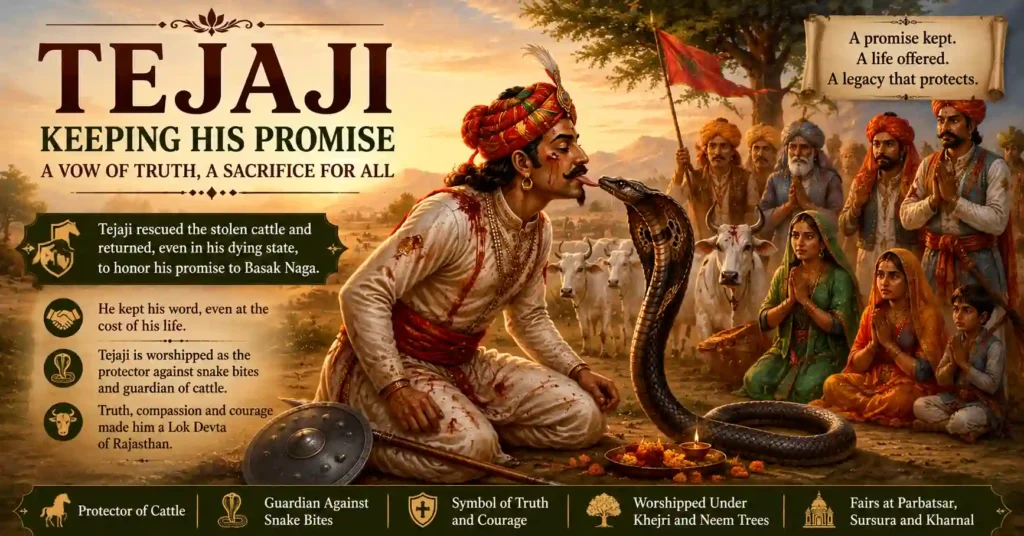
According to Rajasthan’s oral traditions, Tejaji, also known as Veer Teja, was born around 1073 CE in Kharnal, near Nagaur. Born into a farming family, he lived a simple rural life and became renowned for his unwavering commitment to truth, compassion, and keeping his word.
One of the most celebrated legends tells that while travelling to bring his wife Pemal from her maternal home, Tejaji met Lachha Gujari, whose cattle had been stolen by robbers. Without hesitation, he set aside his personal journey and vowed to rescue her cows.
On the way, Tejaji encountered a snake trapped in a forest fire. According to local belief, the serpent, known as Basak Naga, wished to bite him because of a karmic bond from a previous birth. Tejaji requested time to fulfil his duty first and promised that he would return after rescuing the cattle.
True to his word, Tejaji fought the robbers, recovered the stolen cows, and returned despite suffering severe injuries. Since every part of his body was wounded, he offered his tongue, the only uninjured part, to the serpent so that he could keep his promise.
The serpent bit him, and Tejaji is believed to have left his mortal body on Bhadrapada Shukla Dashami, around 1103 CE. His extraordinary devotion to truth and duty transformed him into one of the most revered Lok Devtas of Rajasthan, remembered for placing honor and compassion above his own life.
Note: Different regions preserve slight variations of Tejaji’s life story, but all traditions celebrate his unwavering commitment to truth, promise-keeping, and the protection of cattle.
Why Is Tejaji Worshipped as a Lok Devta?i
Tejaji’s sacrifice was never remembered as a defeat. In Rajasthan’s folk traditions, it symbolizes the triumph of truth, courage, and keeping one’s promise even at the cost of one’s own life. This unwavering commitment is the reason he is revered as one of the most respected Rajasthan folk deities.
According to local belief, Tejaji blesses and protects devotees from snake bites. In many villages across Rajasthan, people still visit his shrines to offer prayers and seek his blessings after snakebite incidents, alongside receiving appropriate medical treatment.
A sacred thread known as Tanti is tied in Tejaji’s name as an expression of faith and devotion. This centuries-old tradition continues in many parts of Rajasthan, as well as neighboring states such as Madhya Pradesh, Gujarat, and Haryana.
Most shrines dedicated to Tejaji are simple village sanctuaries, often located beneath Khejri or Neem trees, reflecting his close association with rural life and nature rather than grand temple architecture.
Every year, large fairs and religious gatherings are held at Kharnal, Parbatsar, and Sursura, where thousands of devotees gather to offer prayers, sing folk ballads, and celebrate his legacy. Farmers especially worship Tejaji for the well-being of their families, healthy cattle, timely rainfall, and a prosperous harvest.
His continuing worship shows how the Lok Devtas of Rajasthan remain a living part of village life, where faith, community traditions, and everyday values are closely connected.
Pabuji: The Lok Devta of Honor, Courage, and Promise-Keeping
According to Rajasthan’s folk traditions, Pabuji Rathore was a 13th-century Rajput warrior born near Kolu, close to present-day Barmer. Many devotees regard him as an incarnation of Lakshman, although his enduring reverence comes primarily from his courage, compassion, and unwavering commitment to protecting others.
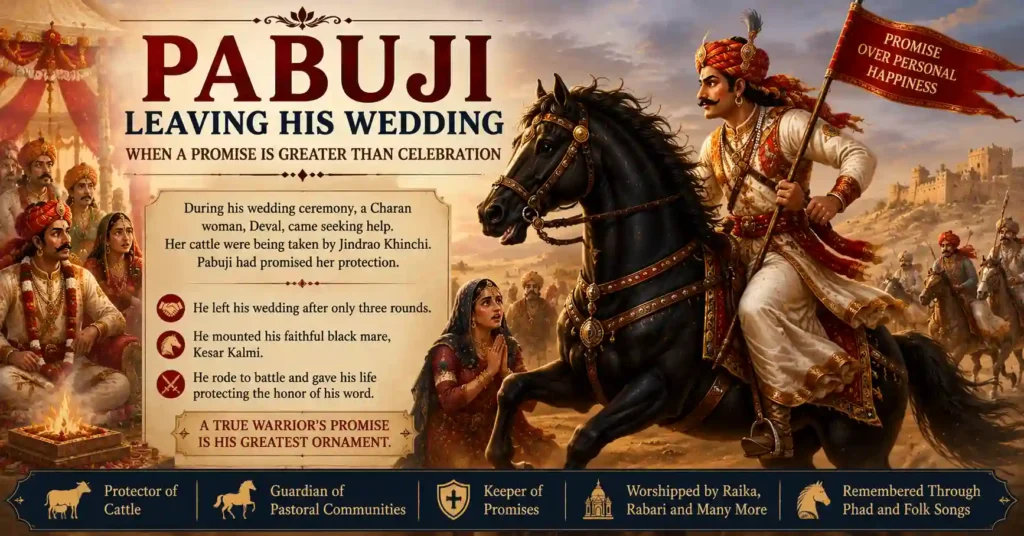
The most celebrated legend of Pabuji tells that during his wedding ceremony, a Charan woman named Deval sought his help after her cattle were seized by Jindrao Khinchi. Pabuji had earlier promised to protect her livestock, and he considered that promise a sacred duty.
Without hesitation, he left his wedding after completing only three marriage rounds (pheras). Mounting his loyal black mare, Kesar Kalmi, he rode into battle to rescue Deval’s cattle, placing honor and duty above personal happiness.
According to local tradition, Pabuji was martyred around 1276 CE while defending the cattle. His willingness to sacrifice his life to uphold a promise transformed him into one of the most revered Lok Devtas of Rajasthan.
For Rajasthan’s desert communities, this story represents more than personal bravery. It reflects the belief that honor is greater than celebration, duty is greater than comfort, and a promise must be kept regardless of the cost. These values continue to define Pabuji’s place in Rajasthan’s living folk traditions.
Why Is Pabuji Worshipped as a Lok Devta?
Pabuji is revered by Raika, Rabari, Bhil, and other pastoral communities across Rajasthan. According to local tradition, he is the protector of camels, cattle, travelers, and those seeking refuge. His enduring legacy has made him one of the most respected Rajasthan folk deities.
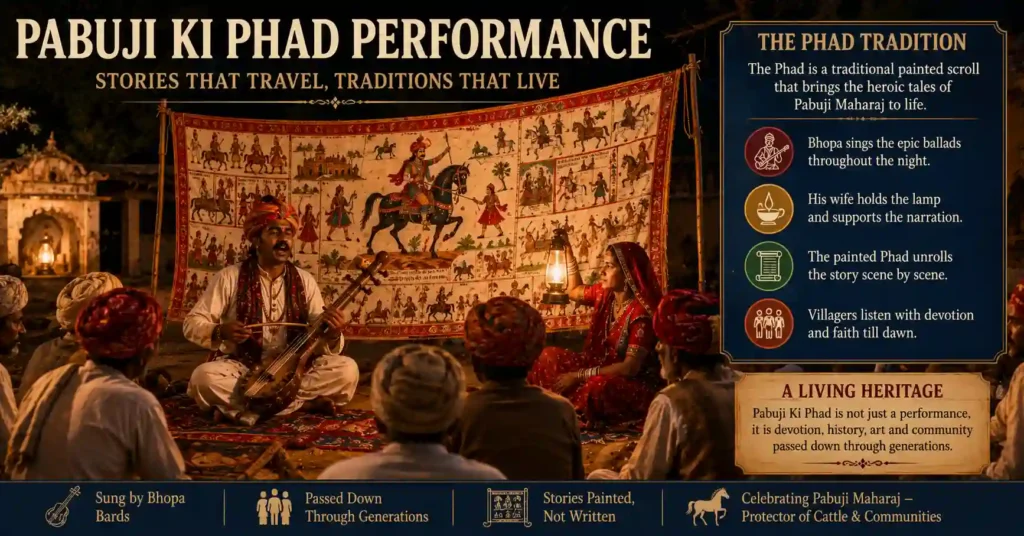
One of the most distinctive traditions associated with Pabuji is Pabuji Ki Phad, a sacred painted scroll that narrates his life and heroic deeds. More than a work of art, the Phad is regarded as a living symbol of Rajasthan’s rich oral and folk storytelling heritage.
Traditionally, Bhopas (priest-singers) perform these stories at night by unfolding the Phad and singing Pabuji’s life using the Ravanhatta, a traditional string instrument. Many devotees believe these performances invoke the spiritual presence of Pabuji, turning the recital into an act of devotion rather than entertainment.
Every year, a large fair is held at Kolumand on Chaitra Amavasya, attracting thousands of devotees, camel herders, and rural communities. The gathering celebrates Pabuji’s legacy through prayers, folk music, cultural performances, and community worship.
These living traditions demonstrate how the Lok Devtas of Rajasthan continue to shape the cultural identity of the state. Through sacred art, music, festivals, and oral storytelling, Pabuji’s ideals of honor, service, and protection remain alive across generations.
What Makes Tejaji and Pabuji True Lok Devtas of Rajasthan?
Although their stories are different, Tejaji and Pabuji embody the same ideals that define the Lok Devtas of Rajasthan. Both are remembered not for their power or status, but for their unwavering commitment to truth, duty, and selfless service.
| Shared Value | Tejaji | Pabuji |
|---|---|---|
| Protection | Rescued stolen cattle and defended the vulnerable | Sacrificed his life to protect Deval’s cattle |
| Promise-Keeping | Returned to fulfill his promise to Basak Naga despite fatal injuries | Left his own wedding to honor his promise to Deval |
| Courage | Faced death without breaking his word | Chose duty over personal happiness and comfort |
| Justice | Stood against wrongdoing and protected the innocent | Fought injustice and defended those seeking his help |
| Legacy | Worshipped as a protector from snake bites and guardian of farmers | Revered as the protector of camels, pastoral communities, and travelers |
Both heroes remind us that true greatness comes from keeping one’s word, protecting others, and placing duty above self-interest. These timeless values continue to inspire people across Rajasthan and keep their traditions alive through temples, fairs, folk songs, and oral storytelling.
That is why Lok Devtas of Rajasthan remain deeply relevant even today. Tejaji and Pabuji are remembered as Rajasthan folk heroes whose lives continue to inspire courage, compassion, and integrity across generations.
Other Revered Lok Devtas of Rajasthan
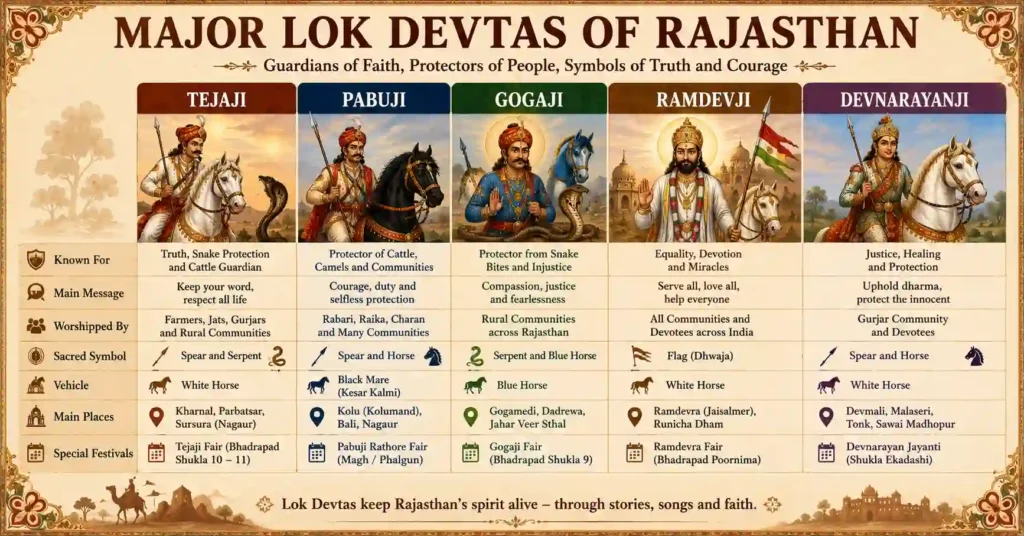
While Tejaji and Pabuji are among the most celebrated Lok Devtas of Rajasthan, they are part of a much larger tradition of revered folk deities. Each is remembered for unique acts of courage, compassion, and service, and their inspiring stories will be explored in dedicated articles.
| Lok Devta | Known For | Significance |
|---|---|---|
| Ramdevji (Ramshah Pir) | Social equality, compassion, and miracles | Revered by both Hindus and Muslims, Ramdevji symbolizes communal harmony and is worshipped at the famous pilgrimage site of Ramdevra. |
| Gogaji (Jahar Veer) | Protection from snake bites and safeguarding cattle | Deeply connected with Rajasthan’s agrarian culture, Gogaji’s shrines are commonly found beneath Khejri trees, where devotees seek protection and blessings. |
| Devnarayanji | Justice, healing, and social welfare | Worshipped primarily by the Gurjar community as an incarnation of Lord Vishnu, Devnarayanji is remembered for promoting righteousness and serving society. |
Although their legends differ, these Rajasthan folk deities share a common purpose: protecting people, upholding justice, and preserving the values that continue to shape Rajasthan’s living folk traditions.
Where Are the Major Temples of the Lok Devtas of Rajasthan?
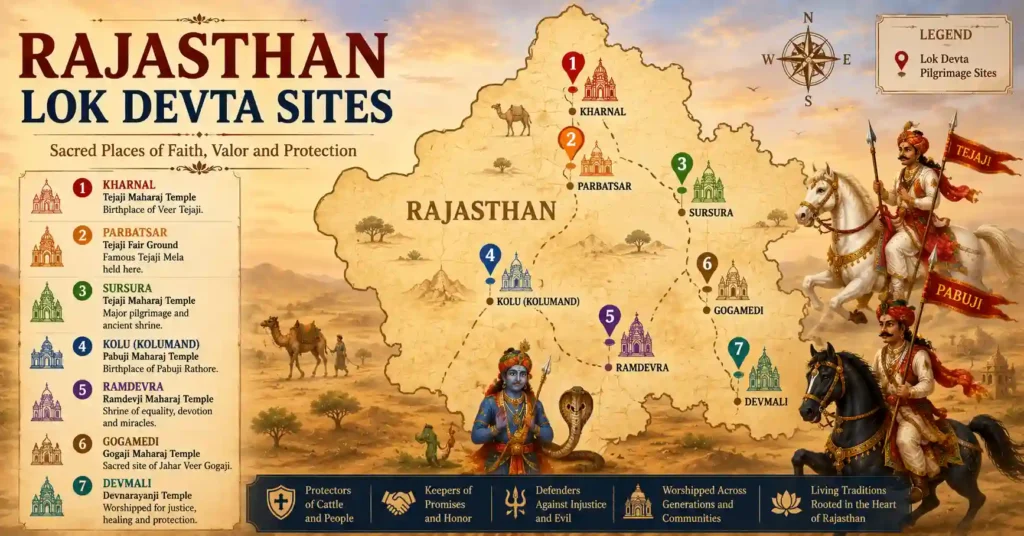
Every region of Rajasthan has its own sacred places dedicated to the Lok Devtas of Rajasthan. While many shrines are simple village temples, a few pilgrimage sites attract thousands of devotees throughout the year and have become important centers of Rajasthan’s folk traditions.
| Lok Devta | Major Temple / Shrine | Location | Known For |
|---|---|---|---|
| Tejaji | Tejaji Temple | Kharnal, Nagaur | Birthplace and the largest annual Tejaji fair |
| Tejaji | Tejaji Temple | Sursura, Ajmer | One of the most revered pilgrimage sites dedicated to Tejaji |
| Pabuji | Pabuji Temple | Kolu (Kolumand), Phalodi district | Associated with Pabuji’s life and the famous Chaitra fair |
| Ramdevji | Ramdevra Temple | Ramdevra, Jaisalmer district | One of Rajasthan’s largest folk pilgrimage centers |
| Gogaji | Gogamedi Temple | Hanumangarh district | Major pilgrimage site dedicated to Gogaji |
| Devnarayanji | Devnarayan Temple | Asind, Bhilwara district | Important pilgrimage center for devotees of Devnarayanji |
These temples are more than places of worship. They serve as cultural centers where fairs, folk music, oral storytelling, and community traditions continue to preserve Rajasthan’s living spiritual heritage.
Festivals and Fairs Dedicated to the Lok Devtas of Rajasthan
The worship of the Lok Devtas of Rajasthan reaches its peak during annual fairs, where devotion, folk music, community gatherings, and traditional rituals come together. These events are not only religious celebrations but also important occasions for preserving Rajasthan’s living cultural heritage.
| Lok Devta | Festival / Fair | When | Highlights |
|---|---|---|---|
| Tejaji | Tejaji Fair | Bhadrapada Shukla Dashami | Processions, devotional songs, cattle worship, and village rituals |
| Pabuji | Kolumand Fair | Chaitra Amavasya | Phad performances, Ravanhatta music, camel gatherings, and community worship |
| Ramdevji | Ramdevra Fair | Bhadrapada Shukla Dwitiya to Ekadashi | One of Rajasthan’s largest pilgrimages attended by devotees from across India |
| Gogaji | Gogamedi Fair | Bhadrapada Krishna Navami (Goga Navami) | Prayers, folk processions, and traditional worship of Gogaji |
| Devnarayanji | Devnarayan Jayanti Fair | Magha Shukla Saptami (varies by tradition) | Religious gatherings, devotional singing, and community celebrations |
These fairs are much more than annual religious events. They help preserve oral traditions, strengthen community bonds, support local artisans and folk performers, and ensure that the stories of Rajasthan’s revered folk deities continue to be passed from one generation to the next.
How Folk Traditions Keep the Lok Devtas of Rajasthan Alive
The stories of the Lok Devtas of Rajasthan have been preserved not only through temples but also through the state’s rich oral traditions. Long before books became common, these legends were passed from one generation to the next through storytelling, music, and sacred performances.
Among the most remarkable traditions are Phad paintings and Pavade (heroic ballads). These served as mobile shrines, allowing communities without permanent temples to remember and worship their beloved folk deities wherever they gathered.
At the heart of this tradition are the Bhopas, hereditary priest-singers who narrate the lives of Lok Devtas through all-night performances. Accompanied by the haunting melodies of the Ravanhatta, they bring centuries-old legends to life before devoted audiences.
During these performances, the Bhopa’s wife, known as the Bhopi, holds a lamp to illuminate different scenes of the sacred Phad painting. The ritual transforms the painted scroll into a living shrine, and the performance becomes an act of worship rather than mere entertainment.
These living traditions have helped preserve the stories of Rajasthan’s folk deities for centuries. Even today, they continue to strengthen community identity, pass on moral values, and keep the legacy of the Lok Devtas of Rajasthan alive across villages and generations.
Did You Know?
Rajasthan preserves one of India’s richest traditions of hero worship, where brave men remembered for protecting people, cattle, and village communities gradually came to be revered as Lok Devtas.
Unlike many religious traditions preserved primarily through written scriptures, their stories have survived for centuries through oral storytelling, Phad paintings, devotional ballads, village fairs, and community rituals that continue to keep their legacy alive today.
Devalis: The Hero Stones of Rajasthan's Lok Devtas
Across Rajasthan, stone memorials known as Devalis commemorate the bravery and sacrifice of warriors who gave their lives while protecting their people, cattle, or community. These memorial stones preserve the memory of heroes who later came to be revered as Lok Devtas of Rajasthan.
A typical Devali depicts a warrior riding a horse, often accompanied by sun and moon symbols. In local tradition, these celestial symbols represent eternal honor, signifying that the hero’s courage and reputation will live on forever.
Another important tradition is that of Govardhan stones, which are commonly found near grazing lands and village pastures. These memorials honor those who sacrificed their lives while protecting cattle, reflecting the deep connection between livestock, livelihood, and rural life in Rajasthan.
Even today, these hero stones are more than historical markers. They serve as symbols of courage, sacrifice, and unwavering duty, reminding communities that truth, honor, and service to others are values worth preserving, even at the cost of one’s own life.
Sacred Symbols and Folk Healing Traditions
The Lok Devtas of Rajasthan are closely associated with nature and traditional village customs. Sacred trees such as Neem and Khejri, along with rituals involving the Tanti (sacred thread), continue to play an important role in local expressions of faith.
When devotees tie a Tanti in the name of Tejaji or Gogaji, it symbolizes surrender, trust, and a heartfelt prayer for divine protection. According to local tradition, this act reflects faith in the deity’s blessings rather than fear of misfortune.
In Rajasthan’s folk culture, nature, spirituality, and community life are deeply connected. Sacred trees often serve as places of worship, village shrines become centers of community gatherings, and traditional rituals strengthen the bond between people, their environment, and their shared beliefs.
Together, these living traditions show how the Rajasthan folk deities continue to inspire devotion through simple yet meaningful practices that have been preserved across generations.
Are the Lok Devtas of Rajasthan Still Worshipped Today?
The Lok Devtas of Rajasthan are not figures remembered only through history or folklore. Their worship remains an active part of daily life in villages and towns across the state, where devotees continue to visit temples, participate in annual fairs, and observe traditional rituals passed down through generations.
Many farming and pastoral communities seek the blessings of Tejaji, Pabuji, Gogaji, Ramdevji, and other Rajasthan folk deities before important events such as the sowing season, livestock care, family ceremonies, and long journeys. Their shrines continue to serve as places where faith, community, and local traditions come together.
Beyond religious worship, these folk deities remain an important part of Rajasthan’s cultural identity. Their stories are taught through oral traditions, sung in devotional ballads, performed through Phad recitals, and celebrated during village festivals, ensuring that their values continue to inspire future generations.
The Timeless Legacy of the Lok Devtas of Rajasthan
In a world where compromise often seems easier than conviction, the Lok Devtas of Rajasthan remind us that truth, duty, and selfless service never lose their value. Their lives demonstrate that real greatness is earned through courage, compassion, and an unwavering commitment to protecting others.
The inspiring stories of Tejaji, Pabuji, and other Rajasthan folk deities continue to resonate because they are rooted in values that remain relevant today. They teach us that keeping one’s word, standing against injustice, and placing the welfare of others above personal gain are timeless ideals.
Their legacy lives on through village temples, annual fairs, Phad performances, folk songs, oral traditions, and the unwavering faith of millions of devotees. These living traditions ensure that the wisdom of Rajasthan’s folk heroes is passed from one generation to the next.
By remembering the Lok Devtas of Rajasthan, we preserve more than inspiring legends. We celebrate a living heritage where honor was greater than comfort, promises were stronger than fear, and service to others became the path to divinity.
Conclusion
The Lok Devtas of Rajasthan remind us that true greatness is not measured by power or status, but by courage, integrity, and selfless service. Through their lives, Tejaji, Pabuji, and other Rajasthan folk deities showed that protecting others and keeping one’s word are among the highest forms of devotion.
Their legacy continues to live through village temples, annual fairs, Phad performances, folk songs, and oral traditions that have preserved these inspiring stories for centuries. Even today, millions of devotees look to them as symbols of faith, justice, and community values.
Remembering the Lok Devtas of Rajasthan is about more than honoring the past. It is about preserving a timeless way of life where truth was stronger than fear, promises were sacred, and duty was valued above personal gain. These enduring ideals continue to inspire generations and remain at the heart of Rajasthan’s rich folk heritage.
Suggested Reading
If you enjoyed learning about the Lok Devtas of Rajasthan, you may also like these articles exploring India’s rich traditions of folk deities, guardian gods, and regional spiritual heritage.
Folk Deities of India by Region: Stories, Traditions and Living Faith
https://thesanatantales.com/folk-deities-of-india-by-region/
Himalayan Folk Deities: Living Devta Traditions of Uttarakhand and Himachal
https://thesanantales.com/himalayan-folk-deities/
Gram Devta, Kshetrapal and Bhairav: India’s Living Tradition of Guardian Deities
https://thesanatantales.com/gram-devta-india/
Folk Deities in North India: Living Gods of Hills, Forests, and Villages
https://thesanantales.com/folk-deities-in-north-india/
Gugga Pir (Gogaji): The Snake God and Folk Hero of North India
https://thesanantales.com/gugga-pir/
Khandoba: Story, Jejuri Temple, and Champa Shashthi
https://thesanantales.com/khandoba-god-jejuri-temple-story/
Golu Devta: The God of Justice in Uttarakhand
https://thesanantales.com/goludevta-folk-god-of-justice/
Nanda Devi: Story, Raj Jat Yatra, and Worship in Uttarakhand
https://thesanatantales.com/nanda-devi-story-raj-jat-yatra-worship/
Dhari Devi Temple: Story, History, and Char Dham Significance
https://thesanantales.com/dhari-devi-temple/
Folk Deities of Rajasthan (Wikipedia)
https://en.wikipedia.org/wiki/Folk_deities_of_Rajasthan
These articles explore how regional traditions, oral heritage, and community worship have preserved the living legacy of Sanatan Dharma across different parts of India.
FAQs
Who are the Lok Devtas of Rajasthan?
The Lok Devtas of Rajasthan are revered folk deities who were once historical or legendary heroes remembered for their courage, sacrifice, and service to society. Unlike many deities described in ancient scriptures, they are closely connected with local traditions, village life, and oral history.
People worship them because they protected cattle, upheld justice, kept their promises, and stood by the weak. Over time, these extraordinary individuals became symbols of faith and community identity across Rajasthan.
Even today, their temples, fairs, folk songs, and traditional rituals continue to preserve their legacy, making them an important part of Rajasthan’s living spiritual heritage.
Why are Tejaji and Pabuji worshipped in Rajasthan?
Tejaji and Pabuji are worshipped because their lives symbolize truth, courage, and selfless service. According to local traditions, Tejaji sacrificed his life to keep a promise after rescuing stolen cattle, while Pabuji left his own wedding to protect a Charan woman’s livestock.
Their unwavering commitment to duty earned them the status of Lok Devtas of Rajasthan. Their stories continue to inspire people to value honesty, compassion, and responsibility above personal gain.
Today, devotees honor them through temples, annual fairs, folk performances, and traditional rituals that celebrate their enduring ideals.
What is the difference between Lok Devtas and Hindu gods?
The main difference lies in their origin and tradition of worship. Hindu gods such as Shiva, Vishnu, and Durga are described in sacred texts like the Vedas, Puranas, and Itihasas.
Lok Devtas, on the other hand, are regional folk deities whose stories have been preserved through oral traditions, community memory, and local customs. Many devotees worship them alongside mainstream Hindu deities rather than as separate traditions.
They are regarded as guardians of villages, cattle, and local communities, reflecting the spiritual values and cultural identity of the regions where they are revered.
Which are the most famous Lok Devtas of Rajasthan?
Rajasthan is home to many revered folk deities, each remembered for unique acts of courage and service. Among the most well-known are Tejaji, Pabuji, Gogaji (Jahar Veer), Ramdevji (Ramshah Pir), and Devnarayanji.
Tejaji is associated with truth and cattle protection, while Pabuji is remembered for honor and sacrifice. Gogaji is worshipped as a protector against snake bites, Ramdevji is revered for promoting equality and communal harmony, and Devnarayanji is honored as an incarnation of Lord Vishnu by many Gurjar communities.
Together, these Lok Devtas of Rajasthan represent the rich diversity of the state’s folk traditions and continue to inspire millions of devotees.
What is Pabuji Ki Phad?
Pabuji Ki Phad is a traditional painted scroll that narrates the life and heroic deeds of Pabuji. It is one of Rajasthan’s most celebrated forms of sacred folk art and storytelling.
During night-long performances, Bhopas (priest-singers) sing Pabuji’s story while pointing to different scenes on the painted scroll. They are accompanied by the Ravanhatta, a traditional string instrument that adds to the devotional atmosphere.
For many devotees, these performances are more than cultural events. They are acts of worship that preserve Rajasthan’s oral traditions and keep Pabuji’s legacy alive across generations.
Why is Tejaji associated with snake bites?
According to Rajasthan’s folk traditions, Tejaji fulfilled a promise to Basak Naga even after suffering fatal injuries while rescuing stolen cattle. Since every part of his body was wounded, he offered his tongue to the serpent so that he could keep his word.
Because of this extraordinary act of truthfulness and sacrifice, devotees came to regard Tejaji as a protector against snake bites. Many people continue to visit his shrines and tie the sacred Tanti thread as an expression of faith and devotion.
These practices are part of local religious traditions and are observed alongside the importance of seeking timely medical treatment in case of a snake bite.
How are the Lok Devtas of Rajasthan worshipped today?
The Lok Devtas of Rajasthan continue to be worshipped through village temples, annual fairs, folk songs, Phad performances, and community rituals. Their stories remain deeply connected with everyday life in rural Rajasthan.
Devotees offer prayers, tie sacred threads, participate in religious processions, and attend festivals dedicated to these revered folk heroes. Many families also pass down their legends through oral storytelling from one generation to the next.
These living traditions have helped preserve the cultural and spiritual heritage of Rajasthan for centuries and continue to strengthen community bonds.
What values do the Lok Devtas of Rajasthan represent?
The stories of the Lok Devtas of Rajasthan emphasize timeless values such as truth, courage, compassion, promise-keeping, justice, and selfless service. Their lives demonstrate that greatness is achieved through righteous actions rather than power or social status.
Their examples continue to inspire people to protect the vulnerable, honor their commitments, and place the welfare of society above personal interests. These ideals remain deeply woven into Rajasthan’s festivals, folk traditions, and village life.
For many devotees, the Lok Devtas are not only revered figures from the past but also enduring symbols of ethical living and community responsibility.
Glossary of Important Terms
| Term | Meaning |
|---|---|
| Lok Devta | A regional folk deity revered for courage, sacrifice, protection, and service to the community rather than scriptural origin. |
| Rajasthan Folk Deities | The revered local gods and hero-saints worshipped across Rajasthan through oral traditions, fairs, and village rituals. |
| Tejaji | A revered Lok Devta known for truthfulness, promise-keeping, cattle protection, and devotion to duty. |
| Pabuji | A Rajput folk hero worshipped as a Lok Devta for sacrificing his life to protect cattle and uphold his promise. |
| Gogaji (Jahar Veer) | A folk deity associated with protection from snake bites and the welfare of cattle. |
| Ramdevji (Ramshah Pir) | A revered folk saint known for promoting equality, compassion, and communal harmony. |
| Devnarayanji | A Lok Devta worshipped mainly by the Gurjar community as an incarnation of Lord Vishnu and a symbol of justice and healing. |
| Phad | A sacred painted scroll used by Bhopas to narrate the life stories of Rajasthan’s folk deities through devotional performances. |
| Pabuji Ki Phad | The traditional painted scroll depicting the life and heroic deeds of Pabuji, performed as a sacred storytelling tradition. |
| Bhopa | A traditional priest-singer who narrates the stories of Lok Devtas through music and Phad performances. |
| Bhopi | The wife and performance partner of a Bhopa, who traditionally illuminates the Phad with a lamp during performances. |
| Ravanhatta | An ancient bowed string instrument traditionally played by Bhopas during devotional storytelling performances. |
| Pavade | Heroic folk ballads that celebrate the bravery and sacrifices of Rajasthan’s legendary heroes and Lok Devtas. |
| Tanti | A sacred thread tied in the name of deities such as Tejaji or Gogaji as an expression of faith and devotion. |
| Devali (Hero Stone) | A memorial stone erected in honor of a warrior who sacrificed his life while protecting people, cattle, or the community. |
| Govardhan Stone | A memorial stone traditionally installed near grazing lands to honor those who died protecting cattle. |
| Khejri Tree | The sacred state tree of Rajasthan, often associated with village shrines and the worship of Lok Devtas. |
| Neem Tree | A sacred tree commonly found near village shrines and revered in Indian traditions for its spiritual and medicinal significance. |
| Charan | A traditional community of poets, bards, and guardians of oral history who played a vital role in preserving the legends of Rajasthan’s folk heroes. |
| Raika (Rabari) | A pastoral community of Rajasthan traditionally known for camel and livestock herding, with deep devotion to Pabuji. |
| Bhadrapada Shukla Dashami | The Hindu lunar day traditionally associated with the sacrifice and remembrance of Tejaji. |
| Chaitra Amavasya | The new moon day in the Hindu month of Chaitra, when the famous Pabuji fair is held at Kolumand. |
About the Author
Yateendra Chaturvedi is a spiritual writer, researcher, devotee, and the founder of The Sanatan Tales. With over 35 years of professional experience and a lifelong interest in Sanatan Dharma, he writes about Hindu deities, temples, scriptures, festivals, Mahavidyas, sacred stories, rituals, and living traditions that continue to guide and inspire devotees across India.
Drawing from traditional scriptures, regional beliefs, temple traditions, devotional literature, and historical sources, he aims to present authentic, well-researched, and easy-to-understand content for modern readers. His work focuses on preserving spiritual wisdom, explaining sacred traditions, and helping seekers develop a deeper understanding of India’s rich spiritual heritage.
Through The Sanatan Tales, Yateendra strives to make the timeless teachings of Sanatan Dharma simple, meaningful, and relevant for today’s generation while maintaining respect for traditional sources, regional practices, and diverse spiritual perspectives.
Learn More About Yateendra Chaturvedi →
https://thesanatantales.com/about-the-author/
References & Sources
This article is based on regional folk traditions, oral histories, local beliefs, traditional knowledge, community practices, and cultural studies related to the Lok Devtas of Rajasthan. It also draws upon historical references, folklore, devotional traditions, and publicly available research on Rajasthan’s folk deities and living heritage.
Note: The stories, beliefs, and traditions associated with the Lok Devtas of Rajasthan have been preserved through oral traditions and may vary across regions, communities, and local lineages. The purpose of this article is not to establish any single version as the absolute historical truth, but to present widely respected folk traditions and cultural perspectives in a simple, balanced, and accessible manner.
Explore More Fascinating Topics from Sanatan Dharma