
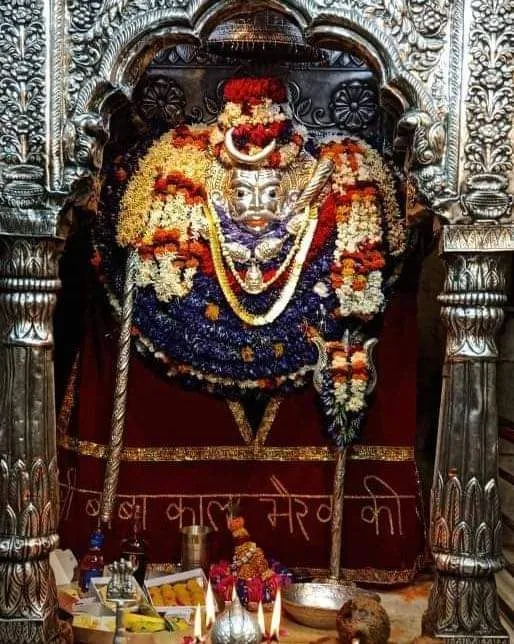
Kaal Bhairav is worshipped as one of the most powerful and protective forms of Lord Shiva. Devotees see him as the guardian of time, truth, and dharma, a divine force that removes fear, ego, and hidden negativity from life.
His form may appear fierce, but his purpose is deeply compassionate. Kaal Bhairav protects those who walk with honesty and courage. He stands at the edge of time itself, cutting through illusion so clarity and wisdom can rise.
For devotees, he is not a god of fear. He is a strong protector who walks beside them when life feels uncertain, blocked, or heavy.
Table of Contents
ToggleWho Is Bhairav?
Kaal Bhairav is the fierce manifestation of Lord Shiva who governs time and protects cosmic order. The word kaal represents time, death, and transformation. Bhairav means one who removes fear.
Together, the fierce form of Shiva represents time that reveals truth. He reminds devotees that nothing escapes time, and every action carries consequence. In many traditions, he is believed to stand at the threshold between life and death, guiding souls and protecting them from unseen forces.
Remembering Bhairav Baba is remembering that time is sacred and truth cannot be delayed.

Why Shiva Becomes Bhairav
According to the Shiva Purana, Brahma and Vishnu once argued over supremacy. To dissolve this ego, Shiva appeared as an endless pillar of light, the jyotirlinga.
Vishnu accepted his limitation. Brahma falsely claimed victory. From the blazing pillar emerged Kaal Bhairav. With a single act, he removed Brahma’s fifth head, not in hatred, but to destroy false pride and restore cosmic balance.
As penance, Bhairav wandered carrying the skull until he reached Kashi. The moment he entered the sacred city, the skull fell away. From that day, Kaal Bhairav became the eternal guardian of Kashi, the one who grants permission even to death itself.
The Story of Kaal Bhairav Appearance
According to the Shiva Purana, Brahma and Vishnu once argued over supremacy. To dissolve this ego, Shiva appeared as an endless pillar of light, the jyotirlinga.
Vishnu accepted his limitation. Brahma falsely claimed victory. From the blazing pillar emerged Kaal Bhairav. With a single act, he removed Brahma’s fifth head, not in hatred, but to destroy false pride and restore cosmic balance.
As penance, Bhairav wandered carrying the skull until he reached Kashi. The moment he entered the sacred city, the skull fell away. From that day, Kaal Bhairav became the eternal guardian of Kashi, the one who grants permission even to death itself.

Kaal Bhairav in the Puranas
Shiva Purana
In the Shiva Purana, Kaal Bhairav appears as the force of immediate karmic justice. He acts where truth is violated and ego refuses correction. His action is swift, precise, and without emotional attachment. This Purana shows Bhairav as dharma in motion, where consequence follows intent without delay.
Skanda Purana
The Skanda Purana presents Kaal Bhairav as Kshetrapala, the guardian of sacred spaces, especially Kashi. He stands at the spiritual threshold, granting permission for rituals, liberation, and even death itself. Devotion without discipline finds no entry in his domain. This is why no act in Kashi is considered complete without honoring Kaal Bhairav.
Linga Purana
In the Linga Purana, Bhairav is linked deeply with time that dissolves form and illusion. He represents the phase where creation withdraws back into truth. His fierce symbols remind devotees that attachment fades, but awareness remains. Bhairav here teaches detachment not as loss, but as liberation.
Agni and Brahmanda Puranas
The Agni and Brahmanda Puranas describe Bhairav in the context of protection, boundary rites, and spiritual safeguarding. His worship is prescribed to protect sacred land, spiritual practice, and inner resolve. These texts stress purity of intent, warning that Bhairav responds to sincerity, not desire or fear.
Across All Puranas
Across all Puranic references, one truth remains constant. Bhairav is never approached casually. His worship demands honesty, discipline, and inner alignment. He is precise, uncompromising, and deeply protective, a guardian who responds to truth, not performance.
Shaiva and Kashmir Shaivism Views
Classical Shaiva Siddhanta View
In classical Shaiva Siddhanta, Bhairav is understood as Shiva’s active will in the world. Shiva remains pure stillness, silent awareness, and limitless compassion. Bhairav is the force that protects this order by setting boundaries and enforcing dharma.
Without Bhairav, compassion can turn into indulgence and disorder. Without Shiva, Bhairav’s power would lose balance and become destructive. Together, they preserve cosmic harmony.
Kashmir Shaivism View
In Kashmir Shaivism, Bhairav is not approached as a fearsome deity. He is recognized as Paramashiva himself, the highest state of consciousness.
Texts like the Vijnana Bhairava Tantra describe Bhairav as the living awareness present in every breath, every pause, and every moment of perception. Here, Bhairav is beyond weapons, form, and time.
Liberation Through Awareness
From this view, Kaal Bhairav is not time that destroys existence, but awareness that dissolves ignorance. He is the sudden clarity that arises when illusion falls away.
Fear ends not because something is fought, but because truth is recognized. In this understanding, Bhairav liberates by awakening, not by force.
South Indian and Village Traditions
In South India, Bhairava is primarily worshipped as a temple guardian. His shrines are found near gopurams and temple boundaries. Worship is simple, oil lamps, silence, and restraint, especially on Ashtami nights.
In village traditions across North and Central India, Bhairav appears as Bhairavnath, the living protector of land, cattle, women, and borders. He is strict but deeply trusted. Here, Bhairav is law, not philosophy.
Symbols of Kaal Bhairav
The dog represents loyalty, instinct, and vigilance.
The skull bowl teaches impermanence and ego dissolution.
The trident represents balance of body, mind, and awareness.
Snakes symbolize mastery over fear and hidden inner poisons.
Every symbol reminds devotees that true power comes from awareness, not control.
Kaal Bhairav also manifests as the Ashta Bhairavas, eight forms guarding all directions of existence, showing that his protection is complete.
How Bhairav Transforms the Inner World
Kaal Bhairav’s greatest work happens within.
Devotees often experience reduced fear, clearer thinking, stronger discipline, and courage to face difficult truths. He removes inner fog created by ego and doubt, replacing it with quiet strength.
He does not demand perfection. He asks only for sincerity.
How Bhairav is worshipped at home
Kaal Bhairav worship is simple and disciplined.
A clean space, sincere heart, and silence are enough. Offer water, flowers, black sesame seeds, or mustard oil. Lighting a mustard oil lamp is traditionally considered beneficial.
The most common mantra is:
ॐ कालभैरवाय नमः
Om Kaalabhairavaya Namah
Chanting softly, followed by silence, creates protection and clarity.
Beej mantras exist but are traditionally practiced only under guidance, out of respect, not fear.
Festivals, Dates, and Sacred Days
Kalashtami is observed every Krishna Paksha Ashtami and is highly sacred for Bhairav worship.
Kaal Bhairav Ashtami, observed in the Margashirsha month, is especially dedicated to him.
Feeding black dogs on these days is considered a meaningful act of devotion.
Many temples also observe Bhairav worship on Saturday nights and during Pradosha.

What Bhairav Baba Encourages and Rejects
Kaal Bhairav blesses truthfulness, discipline, courage, responsibility, and respect for boundaries.
He does not support ego, manipulation, shortcuts, or falsehood. Devotion without honesty finds no ground in Bhairav’s presence.
Is This the Era of Bhairav
While no scripture declares specific years as Bhairav’s era, many astrologers and spiritual practitioners observe that current planetary cycles highlight themes of time, karma, discipline, and truth.
These are qualities deeply aligned with Kaal Bhairav’s energy, making his worship feel especially relevant in recent years.
Conclusion
Kaal Bhairav is not a deity of fear, but of fearless truth. He stands where time, discipline, and awareness meet. For those who walk with honesty and humility, his presence becomes deeply protective.
He clears confusion, strengthens inner resolve, and guards devotees not only from outer harm, but from inner collapse. To remember Kaal Bhairav is to remember that time is sacred and truth is non-negotiable.
Suggested Reading
To understand Bhairav beyond form, you may explore our detailed pillar on Bhairav Tattva, which explains Bhairav as a living principle of awareness and boundaries.
Devotees may also read about the Ashta Bhairavas, the eight directional guardians, and Batuk Bhairav, the child form that balances innocence with fierce discipline.
For more such article on Hindu Deities, Festivals & Vats, Folk Myths, Spiritual Stories and Pilgrimage, please visit out site The Sanatan Tales.
FAQs
What is Kaal Bhairav also known as?
Kaal Bhairav is also known as Bhairavnath and Kshetrapala, the guardian of sacred spaces and protector of dharma.
Why is Kaal Bhairav so powerful?
Kaal Bhairav is powerful because he governs time and truth. Nothing false can survive in his presence.
Who prays to Kaal Bhairav?
Devotees seeking protection, courage, discipline, and clarity during difficult phases of life pray to Kaal Bhairav.
Who is the wife of Kaal Bhairav?
Kaal Bhairav is traditionally associated with Shakti, often revered as Bhairavi or Kali, depending on the tradition.
Is Bhairav the son of Kali?
No, Bhairav is not the son of Kali. He is a form of Shiva, while Kali is his Shakti or divine counterpart.
What is the favourite colour of Kaal Bhairav?
Black and deep blue are traditionally associated with Kaal Bhairav, symbolising time, depth, and protection.
Why am I drawn to Kaal Bhairav?
Many devotees feel drawn to Kaal Bhairav during times of inner change, when truth, discipline, and protection are needed.
Why does Kaal Bhairav have a dog?
The dog represents loyalty, vigilance, and instinct, reminding devotees to stay alert and faithful to truth.
How do you know if Kaal Bhairav is with you?
When fear reduces, clarity increases, and life gently pushes you toward truth and discipline, devotees believe Bhairav’s presence is active.
Comments are closed.