
Time is not just hours on a clock. It is not something that simply passes while we are busy living.
In Sanatan Dharma, time is alive. It breathes. It moves creation forward, and when the moment comes, it quietly dissolves worlds.
It shapes destiny without noise. It ripens karma patiently. It trains the soul through joy, loss, birth, and death.
Kaal in Sanatan Dharma is not merely a measurement of days and years. It is a cosmic principle. It is the unseen rhythm through which the universe expands and contracts.
Stars are born within it. Civilizations rise and fall within it. Even gods operate within its vast cycles, and yet, something within us is beyond it.
When we begin to understand Kaal properly, fear slowly reduces. Anxiety about the future softens. Regret about the past loosens its grip.
Perspective expands. Life feels less chaotic and more like part of a much larger divine design. This is not just philosophy. It is a shift in how we see existence itself.
Table of Contents
ToggleMeaning of Kaal and Samay
The Sanskrit word Kaal carries depth. It means time. It also means death. Why both? Because time eventually dissolves everything that is born.
Samay means the right moment. It is timing within the larger flow of Kaal. So Samay is a point. Kaal is the river.
In the Bhagavad Gita, Lord Krishna says, “I am Time, the destroyer of worlds.” This is not poetry. It is philosophy.
It tells us that Kaal in Sanatan Dharma is not separate from the Divine. Time itself is an expression of Ishvara.
Kaal as Divine Power: Mahakal and Kali
Shiva is called Mahakal, the Lord beyond time. Time does not control him. He governs time.
Maa Kali also emerges from the same root. She represents the unstoppable force that destroys illusion, ego, and attachment.
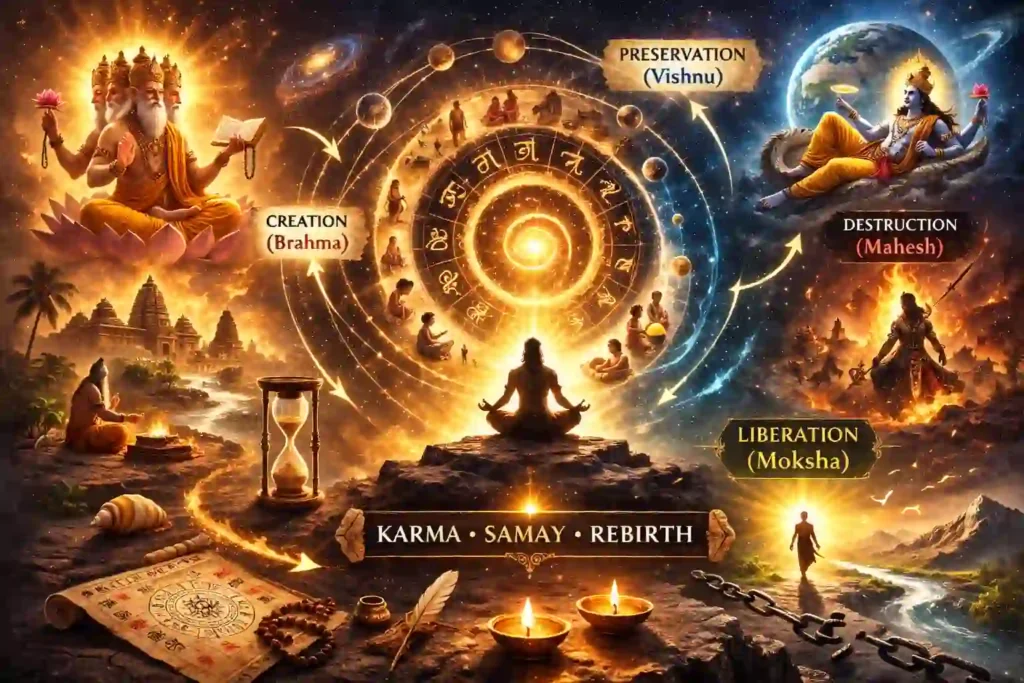
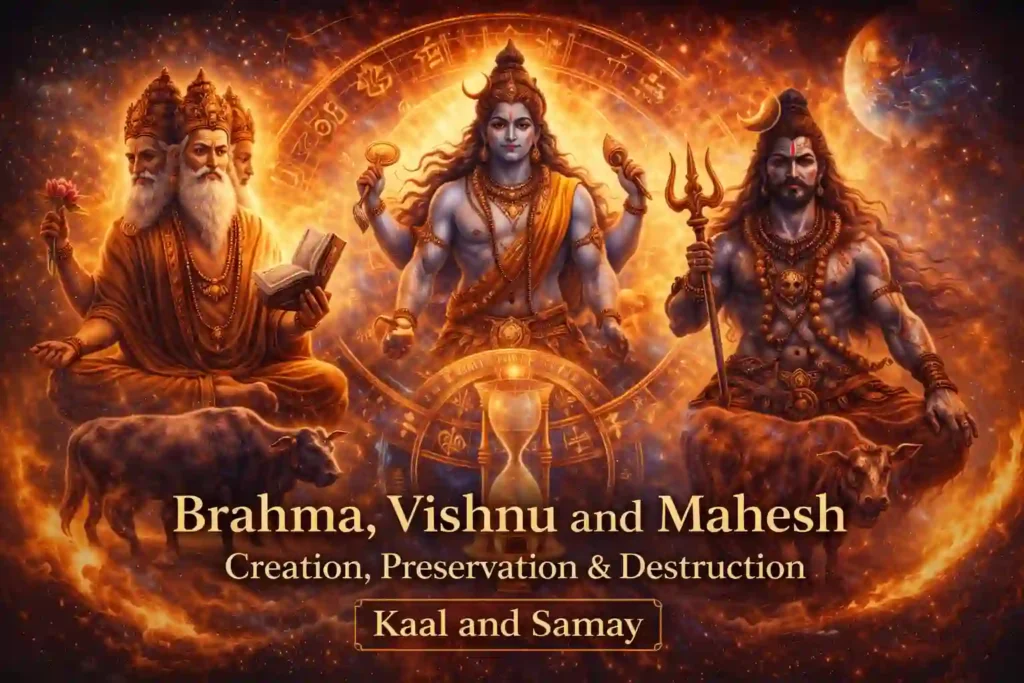
Brahma creates within time. Vishnu sustains within time. Shiva dissolves at the end of time.
This shows that Kaal in Sanatan Dharma is not blind force. It operates through divine intelligence.
Kala Bhairava: The Guardian of Time
Kala Bhairava is a powerful manifestation of Shiva representing the sharp edge of time.
In Varanasi, he is worshipped as the guardian of the city. Symbolically, this means that no one escapes time. Not kings. Not sages. Not ordinary people.
But devotees do not fear him. Why?
Because Kala Bhairava teaches discipline. He reminds us that:
Time must be respected.
Life is temporary.
Fear dissolves in surrender.
Worship of Kala Bhairava is not about terror. It is about awareness.
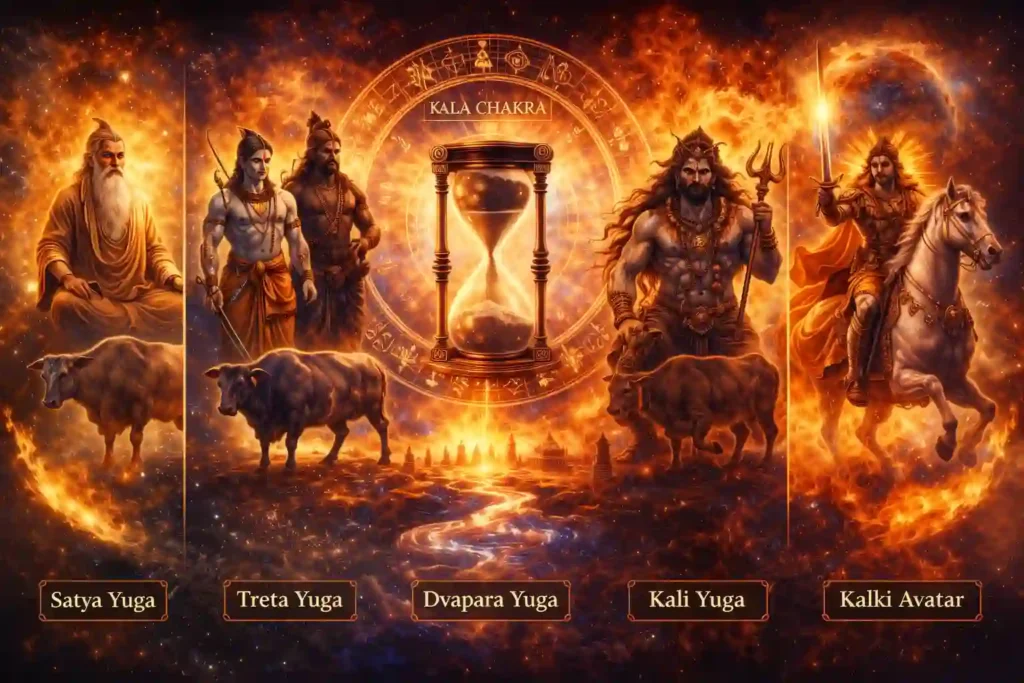
Kala Chakra: The Cyclical Nature of Time
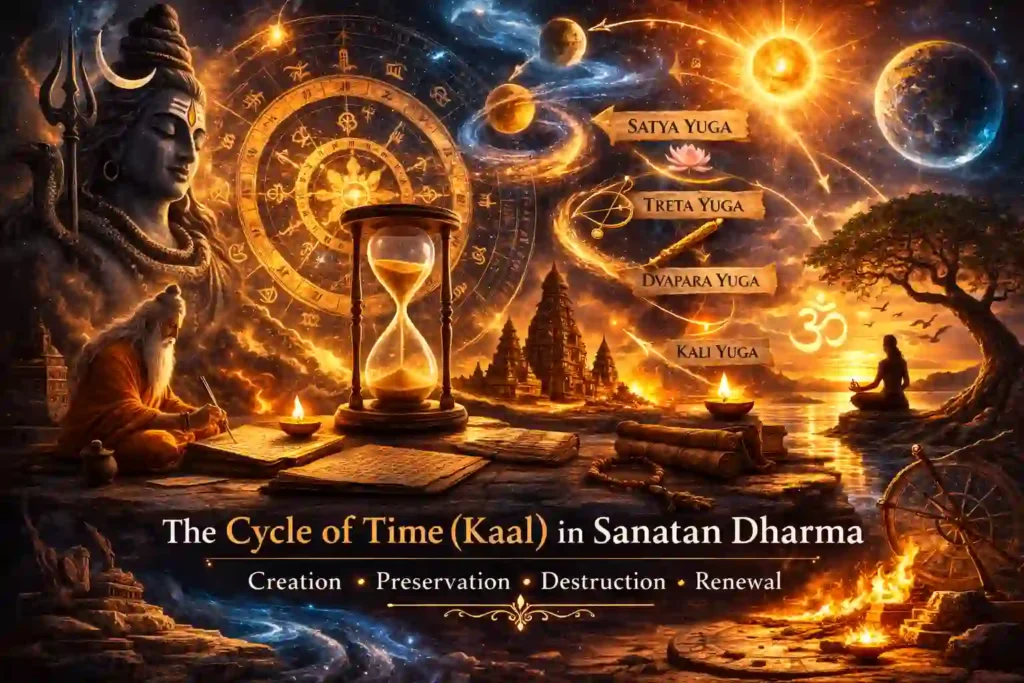
Modern thinking often sees time as a straight line. Sanatan Dharma sees it as a wheel.
This is Kala Chakra.
Creation, preservation, and dissolution repeat endlessly. There is no absolute beginning and no final ending.
After every collapse, a new beginning emerges.
This cyclical understanding is central to Kaal in Sanatan Dharma.
Yugas and the Gradual Decline of Dharma
Time does not just pass. It changes the quality of human consciousness.
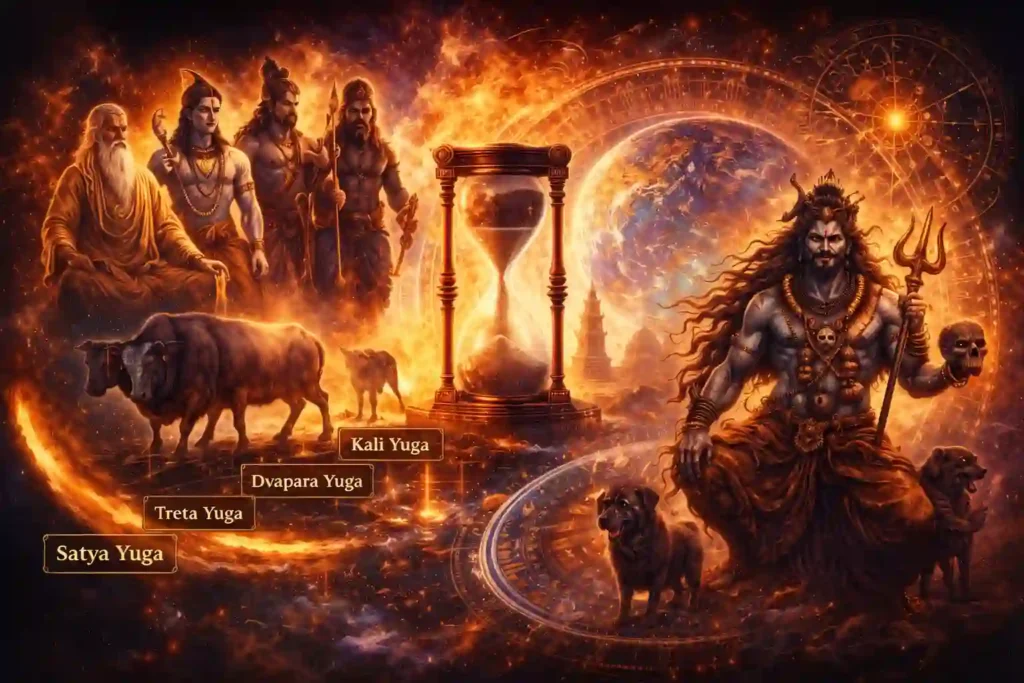
Dharma is symbolized as a bull standing on four legs: truth, purity, austerity, and charity.
In Satya Yuga, all four legs stand firm.
In Treta Yuga, one leg weakens.
In Dvapara Yuga, two legs remain.
In Kali Yuga, only one leg remains, usually identified as charity.
Scriptures describe extremely long lifespans and greater physical strength in earlier Yugas. Whether interpreted literally or symbolically, the meaning is clear: spiritual clarity gradually declines.
We are currently in Kali Yuga, which began in 3102 BCE. It will last 432,000 years. Only around 5,000 years have passed.
This perspective humbles us. It reminds us that we are in the early stage of a very long cycle.
Vedic Time Calculation: From Subtle Units to Cosmic Spans
Ancient sages described time with extraordinary detail.
Tiny units like Truti and Nimesha measured subtle fractions of a second.
A Muhurta equals 48 minutes.
Four Yugas together form a Mahayuga lasting 4.32 million years.
One thousand Mahayugas form a Kalpa, which equals one day of Brahma. That is 4.32 billion human years.
Brahma lives for 100 such years.
After that comes Maha Pralaya, total cosmic dissolution.
This vast system shows the sophistication of Kaal in Sanatan Dharma. It is not random mythology. It is structured cosmology.
Manvantara and Our Present Cosmic Location
Each Kalpa contains 14 Manvantaras.
We are currently in the 7th Manvantara, called Vaivasvata Manvantara.
Within this Manvantara, we are in the 28th cycle of the four Yugas.
Within that cycle, we are in Kali Yuga.
Traditional cosmology also states that Brahma is currently in his 51st year in the Shveta Varaha Kalpa.
This cosmic positioning provides scale. It reminds us that human history is only a small chapter in a much larger story.
Relativity of Time Across Realms
Sanatan texts describe time moving differently in different lokas.
One day of the Devas equals one human year.
Stories such as King Kakudmi visiting Brahma illustrate this idea of time relativity.
This does not mean ancient sages knew Einstein’s equations. But it does show that time was never viewed as fixed and uniform.
Four Types of Pralaya
Time dissolves at different levels.
Nitya Pralaya happens every moment as things decay.
Naimittika Pralaya occurs at the end of Brahma’s day.
Prakritika Pralaya occurs when Brahma’s lifespan ends.
Atyantika Pralaya is personal liberation, Moksha.
The last is spiritually most important. When the soul realizes its true nature, it transcends time completely.
Kaal and Karma
Kaal works with karma.
Actions create potential. Time matures the result.
Just as a fruit ripens only in the right season, karma bears fruit when the correct Samay arrives.
Understanding Kaal in Sanatan Dharma teaches patience and responsibility.
Sacred Time Periods in Daily Life
Time is also sacred in everyday living.
Brahma Muhurta, before sunrise, is ideal for meditation.
Rahu Kaal is considered unsuitable for beginning new ventures.
Nishit Kaal, around midnight, is powerful for certain spiritual practices.
These divisions show that time is not empty. It carries energetic quality.
Understanding Kaal in Sanatan Dharma teaches patience and responsibility.
Spiritual Goal: Becoming Beyond Time
The ultimate aim is not to control time. It is to transcend it.
When a person realizes the Self, he becomes Kalateet, beyond time. The body remains within time, but consciousness is free.
That is Moksha.
Conclusion
Kaal in Sanatan Dharma is divine rhythm. It creates, sustains, dissolves, and renews. It governs karma and shapes destiny. It humbles ego and deepens wisdom.
Time destroys everything material. But the Self is untouched.
To understand Kaal is to live wisely. To transcend Kaal is to be free.
Suggested Reading
If you enjoyed understanding Kaal in Sanatan Dharma, you may also like exploring the deeper spiritual meaning behind related concepts. Our article on What Is Nishit Kaal? explains why midnight holds powerful spiritual significance.
You can also read Brahma Muhurta: The Sacred Hour Before Sunrise to understand how time influences daily sadhana. For those curious about divine forms connected to time.
Other upcoming articles like Difference Between Shiva and Mahakal offers clarity.
If you wish to explore the current age further, our detailed guide on Kali Yuga: Duration, Signs and Spiritual Remedies expands on where humanity stands today in the cosmic cycle.
For more such interesting article in Hindu Deties, Rituals & Traditions, Wisdom & Philosophy and Sanatan FAQs visit our website: www.thesanatantales.com.
FAQs
What is Kaal in Sanatan Dharma?
Kaal in Sanatan Dharma is the cosmic principle of time that governs creation, preservation, destruction, and the cycle of birth and death.
. What is the difference between Kaal and Samay?
Kaal refers to the eternal flow of time, while Samay means the right moment or proper timing within that larger flow.
Why did Krishna say “I am Time” in the Gita?
In the Bhagavad Gita, Krishna reveals that time itself is divine power. It shows that Kaal is not separate from God but an expression of divine will.
Which Yuga are we in now?
We are currently in Kali Yuga, which began in 3102 BCE after the departure of Lord Krishna.
How long will Kali Yuga last?
Kali Yuga lasts 432,000 years. Only about 5,000 years have passed so far.
What is Brahma Muhurta and why is it important?
Brahma Muhurta is the sacred time before sunrise, ideal for meditation, study, and spiritual practice because the mind is calm and pure.
What is Nishit Kaal?
Nitya (constant change), Naimittika (end of Brahma’s day), Prakritika (end of Brahma’s life), and Atyantika (personal liberation or Moksha).
Why is Shiva called Mahakal?
Shiva is called Mahakal because he is beyond time and governs its movement and dissolution.
Can a person go beyond Kaal?
Yes. Through self-realization and Moksha, the soul becomes free from the cycle of time and rebirth.
. Who is Kala Bhairava?
Kala Bhairava is a fierce form of Shiva who represents the protective and disciplining aspect of time.