
What is Samsara is a question that arises when people begin to reflect on birth, death, and the repeated experiences of life.
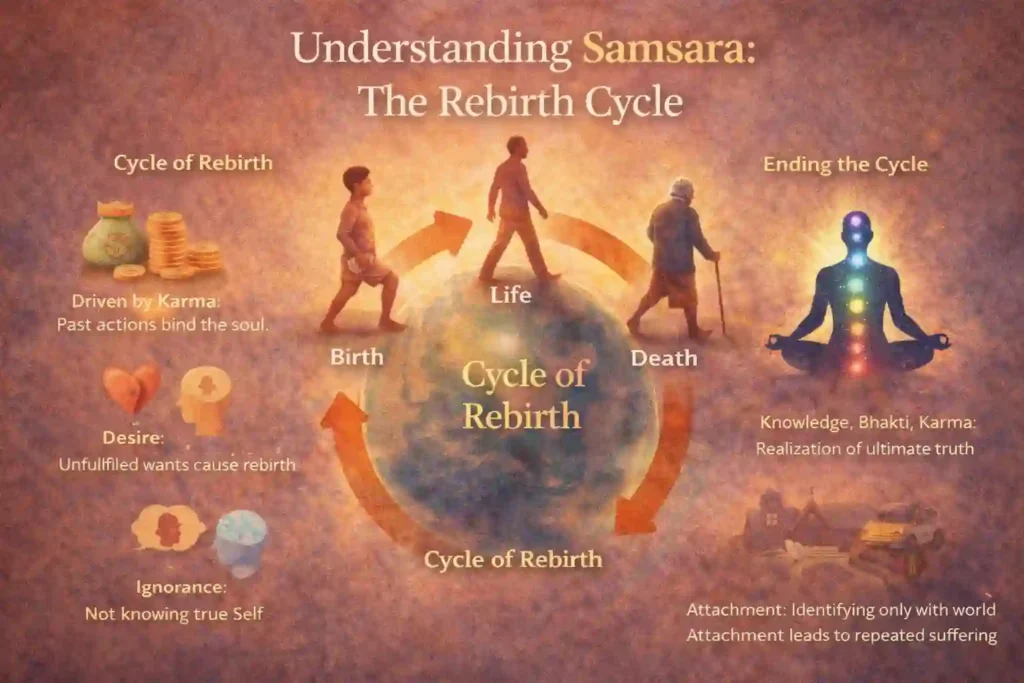
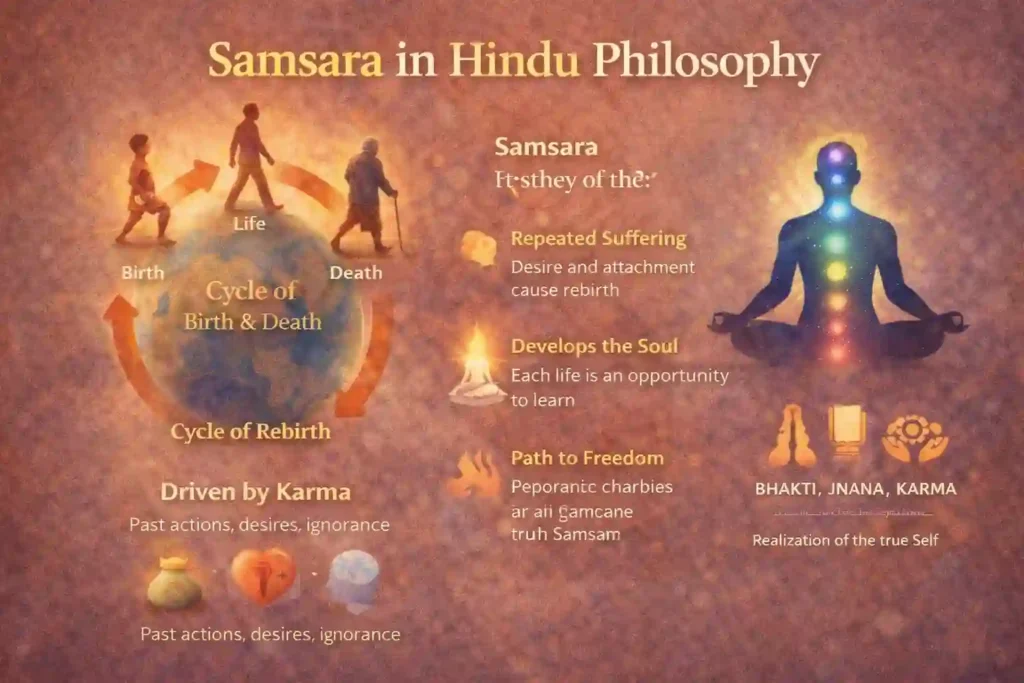
In Hindu philosophy, Samsara refers to the continuous cycle of birth, life, death, and rebirth that the soul passes through.
This cycle of rebirth is driven by karma, desires, and ignorance of one’s true nature. The soul keeps taking new bodies to experience the results of past actions.
Samsara is not only about physical rebirth after death, but also about repeated emotional patterns, attachments, and suffering within life itself.
In Sanatan thought, life is not seen as a single event but as a long journey of the soul. Each birth offers new experiences, lessons, and opportunities for growth.
Until the soul fully understands its true nature, it continues to move through Samsara.
Understanding what is Samsara helps a person see life as a meaningful journey of learning rather than a random or unfair process.
This understanding slowly reduces fear, confusion, and resistance toward life’s ups and downs.
Table of Contents
ToggleWhat does Samsara mean in Hindu philosophy?
The meaning of Samsara comes from the idea of “continuous flow.”
It refers to the ongoing movement of the soul through many births.
Life, death, and rebirth repeat until true wisdom arises.
How does the cycle of rebirth work?
The cycle of rebirth works through karma.
Actions performed in one life create impressions.
These impressions shape future births and experiences.
Even good karma binds the soul to Samsara.
Only freedom from attachment ends the cycle.
Is Samsara considered suffering?
Samsara itself is not suffering.
Suffering arises due to attachment, desire, and ignorance.
When expectations are broken, pain is experienced.
Without awareness, the cycle feels heavy and exhausting.
With understanding, it becomes a path of learning.
What role does karma play in Samsara?
Karma is the driving force behind Samsara.
Every action leaves a subtle mark on the soul.
These marks determine future conditions of birth.
Karma does not punish.
It simply reflects past choices and intentions.
Does the soul remember past lives?
Generally, the soul does not remember past lives.
Forgetting allows fresh experiences without confusion.
However, tendencies and inner nature carry forward.
Habits, fears, and talents often reflect past impressions.
How is Samsara different from Moksha?
Samsara is bondage through repeated birth and death.
Moksha is freedom from the cycle of rebirth.
Moksha ends Samsara completely.
It is not escape, but realization of truth.
How can one attain freedom from Samsara?
Freedom from Samsara comes through inner awareness.
Knowledge removes ignorance.
Devotion purifies the heart.
Selfless action reduces attachment.
When the true Self is realized, rebirth ends naturally.
Why is understanding Samsara important in life?
Understanding what is Samsara reduces fear of death.
It brings acceptance of change and loss.
Life is seen as purposeful, not cruel.
Samsara in Hindu philosophy gives meaning to struggle and growth.
Final understanding
What is Samsara is not only about rebirth after death.
It also explains repeated emotional cycles within life.
Understanding Samsara is the first step toward liberation.
Suggested Reading
To deepen this understanding, you may also read What Is Maya in Hindu Philosophy?, What Is Karma and How Does It Work?, and What Is Moksha in Hindu Philosophy?, already published on thesanatantales.com.