Siddha Kunjika Stotram is one of the most revered hymns in the Shakta tradition of Sanatan Dharma. Though short in length, it is traditionally regarded as the sacred key that unlocks the deeper spiritual power of the Durga Saptashati. Revealed by Lord Shiva to Goddess Parvati, this stotram holds a special place among devotees of Maa Durga and Chandi.
Unlike many devotional hymns that focus primarily on praise, Siddha Kunjika Stotram is deeply connected with mantra shakti, inner transformation, and Devi worship. Its verses contain powerful beej mantras and invocations that are believed to awaken devotion, strengthen spiritual practice, and invoke the grace of the Divine Mother.
Many devotees recite Siddha Kunjika Stotram during Navratri, Chandi Path, and daily worship. It is especially valued by those who wish to connect with Maa Durga’s protective and transformative energy but may not be able to recite the entire Durga Saptashati regularly.
In this article, you will learn the meaning and significance of Siddha Kunjika Stotram, its scriptural origin, connection with Durga Saptashati, complete Sanskrit text, transliteration, line-by-line explanation, spiritual benefits, chanting guidance, and the deeper symbolism behind this sacred hymn.
Siddha Kunjika Stotram At a Glance
| Aspect | Details |
|---|---|
| Sanskrit Name | सिद्ध कुंजिका स्तोत्रम् |
| Common Name | Siddha Kunjika Stotram |
| Dedicated To | Maa Durga / Maa Chamunda |
| Scriptural Source | Rudrayamala Tantra (Gauri Tantra) |
| Revealed By | Lord Shiva |
| Revealed To | Goddess Parvati |
| Tradition | Shakta Tradition |
| Associated Scripture | Durga Saptashati (Chandi Path) |
| Main Purpose | Awakening the spiritual power associated with Durga Saptashati |
| Key Mantras | Aim, Hreem, Kleem, Chamundayai Vichche |
| Primary Benefits | Devotion, protection, inner strength, spiritual focus, mantra awakening |
| Popular Recitation Time | Daily worship, Navratri, Chandi Path, Durga Sadhana |
| Suitable For | Beginners and experienced devotees alike |
| Core Theme | Divine Mother worship, mantra shakti, and spiritual awakening |
| Spiritual Symbolism | The sacred “key” that opens the path to Devi’s grace and inner transformation |
Table of Contents
ToggleWhat is Siddha Kunjika Stotram?
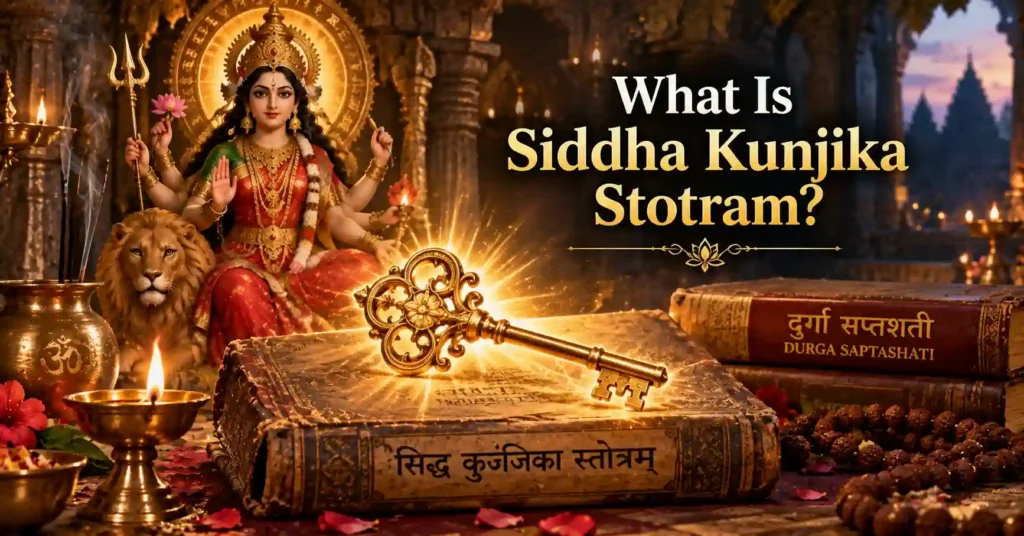
The word Siddha means “perfected” or “accomplished,” while Kunjika means “a small key.” Together, Siddha Kunjika Stotram can be understood as the “Perfected Key” that unlocks the spiritual essence of Devi worship.
In the Shakta tradition, Siddha Kunjika Stotram is regarded as a highly sacred hymn revealed by Lord Shiva to Goddess Parvati. It is traditionally described as the key to understanding and accessing the deeper power of the Durga Saptashati, one of the most important scriptures dedicated to Maa Durga.
Unlike longer stotras that focus primarily on glorifying the Divine Mother, Siddha Kunjika Stotram combines praise, mantra shakti, and spiritual invocation within a compact form. This unique combination is one reason why devotees hold it in such high regard.
The stotram contains powerful beej mantras such as Aim, Hreem, Kleem, and Chamundayai Vichche. These sacred sounds are considered central to Devi worship and are traditionally associated with knowledge, divine energy, protection, and inner transformation.
Because of its concise nature, many devotees recite Siddha Kunjika Stotram during daily worship, Navratri, and Chandi Path. It is often chosen by seekers who wish to connect with Maa Durga’s grace but may not have the time or ability to perform the complete recitation of the Durga Saptashati.
More than a prayer for worldly benefits, Siddha Kunjika Stotram is traditionally viewed as a spiritual tool that helps devotees deepen their devotion, strengthen their focus, and cultivate a closer relationship with the Divine Mother.
Scriptural Origin and Sacred Context
The Siddha Kunjika Stotram is traditionally found in the Rudrayamala Tantra, a respected text within the Shakta and Tantric traditions of Sanatan Dharma. According to the scripture, Lord Shiva revealed this sacred stotram to Goddess Parvati as a secret teaching connected with the worship of Maa Durga.
The dialogue begins with Shiva explaining that this stotram contains the essence of the practices associated with the Durga Saptashati. He describes it as a powerful spiritual aid for devotees who seek the blessings of the Divine Mother through sincere devotion and mantra recitation.
In the traditional narrative, Lord Shiva emphasizes that merely performing rituals without understanding or devotion may not yield the desired spiritual benefit. Therefore, Siddha Kunjika Stotram is presented as a sacred key that helps devotees approach Devi worship with greater focus and inner connection.
The stotram holds a special place in the Shakta tradition, where Maa Durga is worshipped as the supreme Divine Mother and the source of all cosmic energy. Its verses combine praise of the Goddess with powerful beej mantras that are considered central to many forms of Devi Upasana.
For centuries, saints, practitioners, and devotees have recited Siddha Kunjika Stotram during Durga worship, Chandi Path, and Navratri observances. Its enduring popularity reflects the deep faith devotees place in Maa Durga’s grace and protection.
Rather than being viewed as a substitute for devotion or spiritual practice, Siddha Kunjika Stotram is traditionally understood as a means of strengthening one’s connection with the Divine Mother and cultivating greater spiritual awareness.
Why It Is Called the Key of Durga Saptashati
One of the most distinctive aspects of Siddha Kunjika Stotram is that it is traditionally described as the “key” to the Durga Saptashati. This description comes from Lord Shiva’s own words to Goddess Parvati in the sacred dialogue where the stotram is revealed.
The Durga Saptashati, also known as the Chandi Path, consists of 700 verses that glorify the power, compassion, and victory of Maa Durga over negative forces. It is one of the most important scriptures in Devi worship and is recited by devotees across India, especially during Navratri.
According to tradition, Siddha Kunjika Stotram contains the essential mantra shakti associated with the worship of the Divine Mother. Because of this, it is viewed as a spiritual key that helps devotees connect with the deeper essence of the Durga Saptashati.
The stotram is not merely a summary of the Durga Saptashati. Rather, it serves as a concise devotional hymn that invokes the grace of Maa Durga through powerful beej mantras and sacred invocations. This is why many devotees recite it before or alongside the Chandi Path.
Traditional practitioners believe that the stotram helps prepare the mind for Devi worship by encouraging devotion, concentration, and reverence toward the Divine Mother. Its importance lies not in replacing the Durga Saptashati but in helping devotees approach it with the right spiritual attitude.
For devotees who may not be able to recite all 700 verses regularly, Siddha Kunjika Stotram offers a practical way to remember and honor Maa Durga through daily prayer and remembrance. However, the full Durga Saptashati continues to hold its own unique place in the Shakta tradition.
The symbolism of a “key” also carries a deeper spiritual meaning. Just as a key opens a locked door, Siddha Kunjika Stotram is believed to help open the heart to devotion, faith, self-discipline, and the transformative grace of the Divine Mother.
Siddha Kunjika Stotram and Durga Saptashati: Understanding the Connection
To fully appreciate Siddha Kunjika Stotram, it is important to understand its relationship with the Durga Saptashati, one of the most revered scriptures dedicated to Maa Durga.
The Durga Saptashati, also known as the Devi Mahatmyam or Chandi Path, consists of 700 verses divided into thirteen chapters. It narrates the divine victories of Maa Durga over powerful demonic forces and reveals her role as the protector of righteousness and cosmic order.
According to tradition, Lord Shiva revealed Siddha Kunjika Stotram to Goddess Parvati as a concise yet powerful hymn connected to the worship of the Divine Mother. The stotram is traditionally regarded as containing the essence of the mantra shakti associated with the Durga Saptashati.
For this reason, many devotees recite Siddha Kunjika Stotram before beginning the Chandi Path or as part of their regular Devi worship. It is believed to help cultivate devotion, focus the mind, and prepare the seeker for a deeper spiritual connection with Maa Durga.
Although the two are closely related, Siddha Kunjika Stotram and the Durga Saptashati serve different purposes. The Durga Saptashati is a complete scripture containing sacred narratives, hymns, and philosophical teachings, while Siddha Kunjika Stotram is a shorter devotional composition centered around powerful invocations and beej mantras.
Many devotees who are unable to recite all 700 verses daily choose to recite Siddha Kunjika Stotram as part of their spiritual practice. However, this does not diminish the unique importance of the Durga Saptashati, which remains one of the foundational texts of the Shakta tradition.
The connection between these two sacred texts highlights an important principle of Sanatan Dharma: sincere devotion is often valued as much as elaborate ritual. Whether one recites the full Durga Saptashati or the shorter Siddha Kunjika Stotram, the ultimate goal is to seek the blessings, protection, and grace of the Divine Mother.
The Power of Beej Mantras Within the Stotram
One of the most unique features of Siddha Kunjika Stotram is its use of sacred beej mantras. These are short, powerful syllables that hold deep spiritual significance in the Shakta tradition and are commonly used in the worship of Maa Durga and other forms of Divine Shakti.
A beej mantra is often described as a “seed sound.” Just as a tiny seed contains the potential of a large tree, a beej mantra is believed to contain the subtle spiritual energy of a deity within a single sacred sound.
The Siddha Kunjika Stotram includes well-known beej mantras such as Aim, Hreem, Kleem, Chamundayai, and Vichche. These mantras are traditionally associated with divine wisdom, spiritual power, protection, devotion, and transformation.
Among them, Aim is commonly linked with divine knowledge and wisdom, while Hreem is associated with the creative and transformative power of the Divine Mother. Kleem is traditionally connected with attraction, devotion, and loving connection with the Divine.
The mantra Chamundayai Vichche is especially revered in Devi worship. It invokes Maa Chamunda, a fierce and protective form of the Goddess who destroys negativity, fear, and harmful influences. For many devotees, this mantra represents courage, inner strength, and surrender to Divine protection.
Unlike ordinary words, beej mantras are not always translated literally. Their importance lies in their spiritual vibration, traditional usage, and devotional significance. This is why many practitioners focus on correct pronunciation, concentration, and sincere devotion while chanting them.
The presence of these sacred sounds is one reason why Siddha Kunjika Stotram is held in such high regard. The stotram combines prayer, praise, and mantra shakti in a concise form, making it a cherished part of Devi worship for countless devotees.
Many spiritual teachers emphasize that the true power of these mantras is best experienced through regular practice, humility, and faith. Rather than seeking quick results, devotees are encouraged to chant with reverence and allow their spiritual journey to unfold naturally.
Complete Siddha Kunjika Stotram (Sanskrit Text)
Before exploring the meaning of each verse, it is helpful to read the complete Siddha Kunjika Stotram in its traditional Sanskrit form. Devotees often recite this sacred hymn during daily worship, Navratri, and Chandi Path as an expression of devotion to Maa Durga.
The stotram combines praise of the Divine Mother with powerful beej mantras that hold special significance in the Shakta tradition. While understanding the meaning deepens appreciation, many devotees also recite the stotram with faith and reverence as part of their spiritual practice.
Below is the complete Siddha Kunjika Stotram in Sanskrit, followed by transliteration, line-by-line meaning, and spiritual explanations to help readers understand its deeper significance.
अथ मंत्रः ।
ॐ ऐं ह्रीं क्लीं चामुंडायै विच्चे ।
ॐ ग्लौं हुं क्लीं जूं सः ज्वालय ज्वालय ज्वल ज्वल प्रज्वल प्रज्वल
ऐं ह्रीं क्लीं चामुंडायै विच्चे ज्वल हं सं लं क्षं फट् स्वाहा ॥
इति मंत्रः ।
नमस्ते रुद्ररूपिण्यै नमस्ते मधुमर्दिनि ।
नमः कैटभहारिण्यै नमस्ते महिषार्दिनि ॥
नमस्ते शुंभहंत्र्यै च निशुंभासुरघातिनि ।
जाग्रतं हि महादेवि जपं सिद्धं कुरुष्व मे ॥
ऐंकारी सृष्टिरूपायै ह्रींकारी प्रतिपालिका ।
क्लींकारी कामरूपिण्यै बीजरूपे नमोऽस्तु ते ॥
चामुंडा चंडघाती च यैकारी वरदायिनी ।
विच्चे चाभयदा नित्यं नमस्ते मंत्ररूपिणि ॥
धां धीं धूं धूर्जटेः पत्नी वां वीं वूं वागधीश्वरी ।
क्रां क्रीं क्रूं कालिका देवि शां शीं शूं मे शुभं कुरु ॥
हुं हुं हुंकाररूपिण्यै जं जं जं जंभनादिनी ।
भ्रां भ्रीं भ्रूं भैरवी भद्रे भवान्यै ते नमो नमः ॥
अं कं चं टं तं पं यं शं वीं दुं ऐं वीं हं क्षम् ।
धिजाग्रं धिजाग्रं त्रोटय त्रोटय दीप्तं कुरु कुरु स्वाहा ॥
पां पीं पूं पार्वती पूर्णा खां खीं खूं खेचरी तथा ।
सां सीं सूं सप्तशती देव्या मंत्रसिद्धिं कुरुष्व मे ॥
कुंजिकायै नमो नमः ।
इदं तु कुंजिकास्तोत्रं मंत्रजागर्तिहेतवे ।
अभक्ते नैव दातव्यं गोपितं रक्ष पार्वति ॥
यस्तु कुंजिकया देवि हीनां सप्तशतीं पठेत् ।
न तस्य जायते सिद्धिररण्ये रोदनं यथा ॥
इति श्रीरुद्रयामले गौरीतंत्रे शिवपार्वतीसंवादे कुंजिकास्तोत्रं संपूर्णम् ।
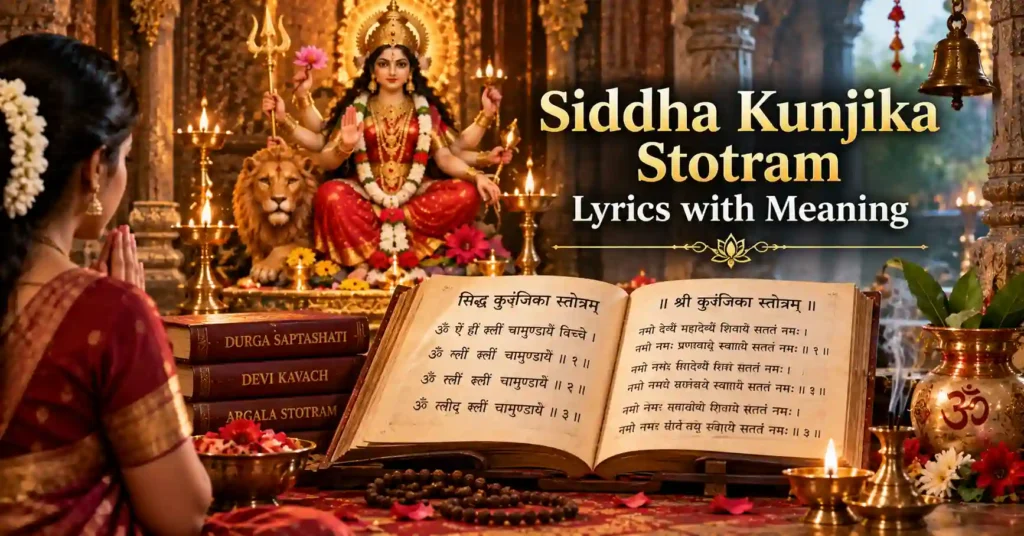
Siddha Kunjika Stotram Lyrics and Verse-by-Verse Explanation
अथ मंत्रः ।
ॐ ऐं ह्रीं क्लीं चामुंडायै विच्चे ।
ॐ ग्लौं हुं क्लीं जूं सः ज्वालय ज्वालय ज्वल ज्वल प्रज्वल प्रज्वल
ऐं ह्रीं क्लीं चामुंडायै विच्चे ज्वल हं सं लं क्षं फट् स्वाहा ॥
Transliteration
Ath Mantrah
Om Aim Hreem Kleem Chamundayai Vichche
Om Glaum Hum Kleem Jum Sah Jwalaya Jwalaya Jwala Jwala Prajwala Prajwala
Aim Hreem Kleem Chamundayai Vichche Jwala Ham Sam Lam Ksham Phat Swaha
Line-by-Line Hindi Meaning
अथ मंत्रः
अब इस पवित्र और रहस्यमय मंत्र का प्रारम्भ किया जा रहा है।
ॐ ऐं ह्रीं क्लीं चामुंडायै विच्चे
मैं माँ चामुण्डा को नमन करता हूँ, जो ज्ञान, शक्ति और दिव्य कृपा का स्वरूप हैं।
ॐ ग्लौं हुं क्लीं जूं सः ज्वालय ज्वालय ज्वल ज्वल प्रज्वल प्रज्वल
हे देवी, मेरे भीतर की अज्ञानता, भय और नकारात्मकता को जलाकर दिव्य चेतना को जागृत कीजिए।
ऐं ह्रीं क्लीं चामुंडायै विच्चे ज्वल हं सं लं क्षं फट् स्वाहा
हे माँ चामुण्डा, मेरी रक्षा करें, मेरे मार्ग की बाधाओं को दूर करें और मेरे जीवन में आध्यात्मिक प्रकाश प्रकट करें।
Line-by-Line English Meaning
Ath Mantrah
Now begins this sacred and mystical mantra.
Om Aim Hreem Kleem Chamundayai Vichche
I bow to Goddess Chamunda, the embodiment of wisdom, divine power, and grace.
Om Glaum Hum Kleem Jum Sah Jwalaya Jwalaya Jwala Jwala Prajwala Prajwala
O Divine Mother, burn away ignorance, fear, and negativity, and awaken the inner light of consciousness.
Aim Hreem Kleem Chamundayai Vichche Jwala Ham Sam Lam Ksham Phat Swaha
O Goddess Chamunda, protect me, remove obstacles, and illuminate my spiritual path.
Full Verse Meaning
This opening invocation calls upon Maa Chamunda through powerful beej mantras. The prayer seeks purification, protection, spiritual awakening, and the removal of inner and outer obstacles that hinder progress on the spiritual path.
Spiritual Essence
The opening mantra reminds devotees that true transformation begins within. By invoking Maa Chamunda with faith and devotion, one seeks to awaken divine strength, clarity, and spiritual awareness.
Verse 1
Sanskrit Verse
नमस्ते रुद्ररूपिण्यै नमस्ते मधुमर्दिनि ।
नमः कैटभहारिण्यै नमस्ते महिषार्दिनि ॥
Transliteration
Namaste Rudrarupinyai Namaste Madhumardini
Namah Kaitabhaharinyai Namaste Mahishardini
Line-by-Line Hindi Meaning
नमस्ते रुद्ररूपिण्यै नमस्ते मधुमर्दिनि
हे देवी, आपको प्रणाम है जो रुद्र स्वरूप धारण करती हैं और मधु नामक असुर का विनाश करने वाली हैं।
नमः कैटभहारिण्यै नमस्ते महिषार्दिनि
हे माता, आपको नमन है जो कैटभ असुर का नाश करती हैं और महिषासुर का संहार करने वाली हैं।
Line-by-Line English Meaning
Namaste Rudrarupinyai Namaste Madhumardini
Salutations to the Goddess who embodies the fierce power of Rudra and who destroyed the demon Madhu.
Namah Kaitabhaharinyai Namaste Mahishardini
I bow to the Divine Mother who destroyed Kaitabha and who defeated the powerful demon Mahishasura.
Full Verse Meaning
This verse glorifies Maa Durga as the destroyer of powerful demonic forces that symbolize ignorance, ego, and negativity. It reminds devotees that the Divine Mother protects righteousness and removes obstacles from the spiritual path.
Spiritual Essence
The verse teaches that divine power always triumphs over darkness. By remembering Maa Durga with devotion, devotees seek the strength to overcome inner weaknesses and move toward spiritual growth.
Verse 2
Sanskrit Verse
नमस्ते शुंभहंत्र्यै च निशुंभासुरघातिनि ।
जाग्रतं हि महादेवि जपं सिद्धं कुरुष्व मे ॥
Transliteration
Namaste Shumbhahantyai Cha Nishumbhasuraghatini
Jagratam Hi Mahadevi Japam Siddham Kurushva Me
Line-by-Line Hindi Meaning
नमस्ते शुंभहंत्र्यै च निशुंभासुरघातिनि
हे देवी, आपको प्रणाम है जो शुंभ और निशुंभ जैसे असुरों का विनाश करने वाली हैं।
जाग्रतं हि महादेवि जपं सिद्धं कुरुष्व मे
हे महादेवी, मेरे मंत्र-जप को जागृत कीजिए और उसे सिद्धि प्रदान कीजिए।
Line-by-Line English Meaning
Namaste Shumbhahantyai Cha Nishumbhasuraghatini
Salutations to the Goddess who destroyed the demons Shumbha and Nishumbha.
Jagratam Hi Mahadevi Japam Siddham Kurushva Me
O Great Goddess, awaken my mantra practice and bless it with spiritual success.
Full Verse Meaning
The devotee bows to Maa Durga as the destroyer of evil and humbly prays for divine assistance in spiritual practice. The verse expresses the desire for sincere worship and successful mantra recitation.
Spiritual Essence
Spiritual progress depends not only on effort but also on divine grace. This verse encourages devotees to approach their practice with humility and seek the blessings of the Divine Mother.
Verse 3
Sanskrit Verse
ऐंकारी सृष्टिरूपायै ह्रींकारी प्रतिपालिका ।
क्लींकारी कामरूपिण्यै बीजरूपे नमोऽस्तु ते ॥
Transliteration
Aimkari Srishtirupayai Hreemkari Pratipalika
Kleemkari Kamarupinyai Bijarupe Namostute
Line-by-Line Hindi Meaning
ऐंकारी सृष्टिरूपायै ह्रींकारी प्रतिपालिका
हे देवी, आप ऐं बीज के रूप में सृष्टि की उत्पत्ति करने वाली और ह्रीं बीज के रूप में उसका पालन करने वाली हैं।
क्लींकारी कामरूपिण्यै बीजरूपे नमोऽस्तु ते
आप क्लीं बीज के रूप में आकर्षण और प्रेम की शक्ति हैं। बीज स्वरूप देवी, आपको प्रणाम है।
Line-by-Line English Meaning
Aimkari Srishtirupayai Hreemkari Pratipalika
O Goddess, as the mantra Aim you are the source of creation, and as Hreem you sustain the universe.
Kleemkari Kamarupinyai Bijarupe Namostute
As the mantra Kleem, you embody divine attraction, love, and fulfillment. I bow to you, the very form of sacred seed mantras.
Full Verse Meaning
This verse praises the Divine Mother as the source of creation, preservation, and divine attraction. It recognizes that all sacred mantra energies ultimately arise from her supreme power.
Spiritual Essence
The verse reveals that the universe is sustained by Divine Shakti. Every aspect of creation and spiritual growth is rooted in the presence of the Goddess.
Verse 4
Sanskrit Verse
चामुंडा चंडघाती च यैकारी वरदायिनी ।
विच्चे चाभयदा नित्यं नमस्ते मंत्ररूपिणि ॥
Transliteration
Chamunda Chandaghati Cha Yaikari Varadayini
Vichche Chabhayada Nityam Namaste Mantrarupini
Line-by-Line Hindi Meaning
चामुंडा चंडघाती च यैकारी वरदायिनी
हे माँ चामुण्डा, आप दुष्ट शक्तियों का विनाश करने वाली और भक्तों को वरदान देने वाली हैं।
विच्चे चाभयदा नित्यं नमस्ते मंत्ररूपिणि
आप सदा भय को दूर करने वाली हैं। हे मंत्रस्वरूपिणी देवी, आपको प्रणाम है।
Line-by-Line English Meaning
Chamunda Chandaghati Cha Yaikari Varadayini
O Goddess Chamunda, you destroy negative forces and bless devotees with divine boons.
Vichche Chabhayada Nityam Namaste Mantrarupini
You always grant fearlessness and protection. O Goddess who embodies sacred mantras, I bow to you.
Full Verse Meaning
The verse praises Maa Chamunda as the remover of fear, negativity, and suffering. It acknowledges her as the living embodiment of divine mantra power and grace.
Spiritual Essence
Fear often prevents spiritual progress. This verse reminds devotees that surrendering to the Divine Mother brings courage, protection, and inner confidence.
Verse 5
Sanskrit Verse
धां धीं धूं धूर्जटेः पत्नी वां वीं वूं वागधीश्वरी ।
क्रां क्रीं क्रूं कालिका देवि शां शीं शूं मे शुभं कुरु ॥
Transliteration
Dhaam Dheem Dhoom Dhurjateh Patni
Vaam Veem Voom Vagadhishwari
Kraam Kreem Kroom Kalika Devi
Shaam Sheem Shoom Me Shubham Kuru
Line-by-Line Hindi Meaning
धां धीं धूं धूर्जटेः पत्नी वां वीं वूं वागधीश्वरी
हे देवी, आप भगवान शिव की अर्धांगिनी और वाणी की अधिष्ठात्री शक्ति हैं।
क्रां क्रीं क्रूं कालिका देवि शां शीं शूं मे शुभं कुरु
हे कालिका देवी, मेरे जीवन में मंगल, शांति और कल्याण स्थापित कीजिए।
Line-by-Line English Meaning
Dhaam Dheem Dhoom Dhurjateh Patni Vaam Veem Voom Vagadhishwari
O Goddess, you are the consort of Lord Shiva and the supreme ruler of speech, wisdom, and expression.
Kraam Kreem Kroom Kalika Devi Shaam Sheem Shoom Me Shubham Kuru
O Goddess Kalika, bless my life with auspiciousness, peace, protection, and well-being.
Full Verse Meaning
This verse invokes the Divine Mother as both the power behind Lord Shiva and the source of wisdom and speech. The devotee seeks blessings, peace, and spiritual welfare through her grace.
Spiritual Essence
The verse highlights that true auspiciousness comes from divine wisdom and inner harmony. By seeking the blessings of Maa Kalika, devotees aspire to cultivate clarity, strength, and spiritual balance.
Verse 6
Sanskrit Verse
हुं हुं हुंकाररूपिण्यै जं जं जं जंभनादिनी ।
भ्रां भ्रीं भ्रूं भैरवी भद्रे भवान्यै ते नमो नमः ॥
Transliteration
Hum Hum Humkararupinyai Jam Jam Jam Jambhanadini
Bhraam Bhreem Bhroom Bhairavi Bhadre Bhavanyai Te Namo Namah
Line-by-Line Hindi Meaning
हुं हुं हुंकाररूपिण्यै जं जं जं जंभनादिनी
हे देवी, आप हुंकार स्वरूप हैं और विरोधी तथा नकारात्मक शक्तियों को स्तंभित करने वाली हैं।
भ्रां भ्रीं भ्रूं भैरवी भद्रे भवान्यै ते नमो नमः
हे भैरवी, भद्ररूपा और भवानी माता, आपको बार-बार प्रणाम है।
Line-by-Line English Meaning
Hum Hum Humkararupinyai Jam Jam Jam Jambhanadini
O Goddess, you are the embodiment of divine power and the one who immobilizes harmful and negative forces.
Bhraam Bhreem Bhroom Bhairavi Bhadre Bhavanyai Te Namo Namah
Salutations again and again to Goddess Bhairavi, the auspicious Mother Bhavani.
Full Verse Meaning
This verse praises the Divine Mother as the protector who neutralizes negativity and safeguards her devotees. It also honors her compassionate and auspicious nature.
Spiritual Essence
The verse teaches that divine protection comes not only from external strength but also from inner faith. Remembering the Goddess helps devotees remain steady during life’s challenges.
Verse 7
Sanskrit Verse
अं कं चं टं तं पं यं शं वीं दुं ऐं वीं हं क्षम् ।
धिजाग्रं धिजाग्रं त्रोटय त्रोटय दीप्तं कुरु कुरु स्वाहा ॥
Transliteration
Am Kam Cham Tam Tam Pam Yam Sham Veem Dum Aim Veem Ham Ksham
Dhijagram Dhijagram Trotaya Trotaya Deeptam Kuru Kuru Swaha
Line-by-Line Hindi Meaning
अं कं चं टं तं पं यं शं वीं दुं ऐं वीं हं क्षम्
ये दिव्य बीज ध्वनियाँ देवी की विभिन्न शक्तियों का आह्वान करती हैं।
धिजाग्रं धिजाग्रं त्रोटय त्रोटय दीप्तं कुरु कुरु स्वाहा
हे माँ, मेरी सुप्त चेतना को जागृत कीजिए, अज्ञान के बंधनों को तोड़ दीजिए और भीतर दिव्य प्रकाश उत्पन्न कीजिए।
Line-by-Line English Meaning
Am Kam Cham Tam Tam Pam Yam Sham Veem Dum Aim Veem Ham Ksham
These sacred seed syllables invoke different aspects of the Goddess’s divine energy.
Dhijagram Dhijagram Trotaya Trotaya Deeptam Kuru Kuru Swaha
O Divine Mother, awaken my dormant consciousness, break the bonds of ignorance, and fill me with spiritual light.
Full Verse Meaning
This verse invokes the transformative energy of the Divine Mother through sacred beej mantras. The devotee seeks awakening, illumination, and freedom from limitations.
Spiritual Essence
True spiritual growth begins when ignorance is replaced by awareness. The verse is a prayer for inner awakening and divine guidance.
Verse 8
Sanskrit Verse
पां पीं पूं पार्वती पूर्णा खां खीं खूं खेचरी तथा ।
सां सीं सूं सप्तशती देव्या मंत्रसिद्धिं कुरुष्व मे ॥
Transliteration
Paam Peem Poom Parvati Poorna Khaam Kheem Khoom Khechari Tatha
Saam Seem Soom Saptashati Devya Mantrasiddhim Kurushva Me
Line-by-Line Hindi Meaning
पां पीं पूं पार्वती पूर्णा खां खीं खूं खेचरी तथा
हे पूर्ण स्वरूपा पार्वती, हे दिव्य शक्ति से युक्त खेचरी देवी, आपको प्रणाम है।
सां सीं सूं सप्तशती देव्या मंत्रसिद्धिं कुरुष्व मे
हे देवी, मुझे सप्तशती के मंत्रों की सिद्धि और आपकी कृपा प्रदान कीजिए।
Line-by-Line English Meaning
Paam Peem Poom Parvati Poorna Khaam Kheem Khoom Khechari Tatha
O complete and perfect Goddess Parvati, O Divine Khechari, I bow to you.
Saam Seem Soom Saptashati Devya Mantrasiddhim Kurushva Me
O Goddess, grant me the blessings and spiritual success associated with the sacred mantras of the Durga Saptashati.
Full Verse Meaning
The devotee invokes Goddess Parvati in her complete and transcendent form and prays for spiritual progress, devotion, and the grace associated with Devi worship.
Spiritual Essence
The verse reminds devotees that spiritual accomplishment is ultimately a gift of divine grace rather than personal effort alone.
Verse 9
Sanskrit Verse
इदं तु कुंजिकास्तोत्रं मंत्रजागर्तिहेतवे ।
अभक्ते नैव दातव्यं गोपितं रक्ष पार्वति ॥
Transliteration
Idam Tu Kunjikastotram Mantrajagartihetave
Abhakte Naiva Datavyam Gopitam Raksha Parvati
Line-by-Line Hindi Meaning
इदं तु कुंजिकास्तोत्रं मंत्रजागर्तिहेतवे
यह कुंजिका स्तोत्र मंत्र शक्ति को जागृत करने के उद्देश्य से बताया गया है।
अभक्ते नैव दातव्यं गोपितं रक्ष पार्वति
हे पार्वती, इसे श्रद्धा और भक्ति रहित व्यक्ति को नहीं देना चाहिए। इसकी पवित्रता की रक्षा करनी चाहिए।
Line-by-Line English Meaning
Idam Tu Kunjikastotram Mantrajagartihetave
This Kunjika Stotram is revealed for the awakening of mantra power.
Abhakte Naiva Datavyam Gopitam Raksha Parvati
O Parvati, it should not be shared carelessly with those who lack faith and reverence. Its sanctity should be preserved.
Full Verse Meaning
Lord Shiva explains that the stotram is a sacred teaching meant to be approached with devotion, sincerity, and respect. It is not intended to be treated casually.
Spiritual Essence
Sacred knowledge becomes meaningful when received with humility and faith. The verse encourages devotees to honor spiritual teachings with reverence.
Verse 10
Sanskrit Verse
यस्तु कुंजिकया देवि हीनां सप्तशतीं पठेत् ।
न तस्य जायते सिद्धिररण्ये रोदनं यथा ॥
Transliteration
Yastu Kunjikaya Devi Hinam Saptashatim Pathet
Na Tasya Jayate Siddhir Aranye Rodanam Yatha
Line-by-Line Hindi Meaning
यस्तु कुंजिकया देवि हीनां सप्तशतीं पठेत्
हे देवी, जो व्यक्ति कुंजिका स्तोत्र के महत्व को समझे बिना केवल सप्तशती का पाठ करता है,
न तस्य जायते सिद्धिररण्ये रोदनं यथा
उसे अपेक्षित आध्यात्मिक फल प्राप्त नहीं होता, जैसे जंगल में रोने की आवाज़ व्यर्थ चली जाती है।
Line-by-Line English Meaning
Yastu Kunjikaya Devi Hinam Saptashatim Pathet
O Goddess, one who recites the Durga Saptashati while neglecting the significance of the Kunjika teaching,
Na Tasya Jayate Siddhir Aranye Rodanam Yatha
May not attain the intended spiritual fruit, just as a cry in the wilderness goes unheard.
Full Verse Meaning
This verse emphasizes the traditional importance of Siddha Kunjika Stotram within the context of Devi worship. It highlights the value of devotion, understanding, and proper spiritual preparation rather than mechanical recitation alone.
Spiritual Essence
The verse teaches that spiritual practices become meaningful when accompanied by sincerity, awareness, and devotion. True transformation comes from heartfelt connection with the Divine Mother.
Spiritual Significance of Siddha Kunjika Stotram
Beyond its words and mantras, Siddha Kunjika Stotram represents a path of surrender to Maa Durga. It reminds devotees that divine grace, inner purity, and sincere devotion are more important than ritual complexity.
The stotram repeatedly invokes the Divine Mother as the source of wisdom, protection, courage, and transformation. Through its verses, devotees seek not only blessings but also spiritual awakening and a deeper connection with Shakti.
At its heart, Siddha Kunjika Stotram teaches that when faith, devotion, and divine remembrance come together, the path toward inner growth becomes clearer and more meaningful.
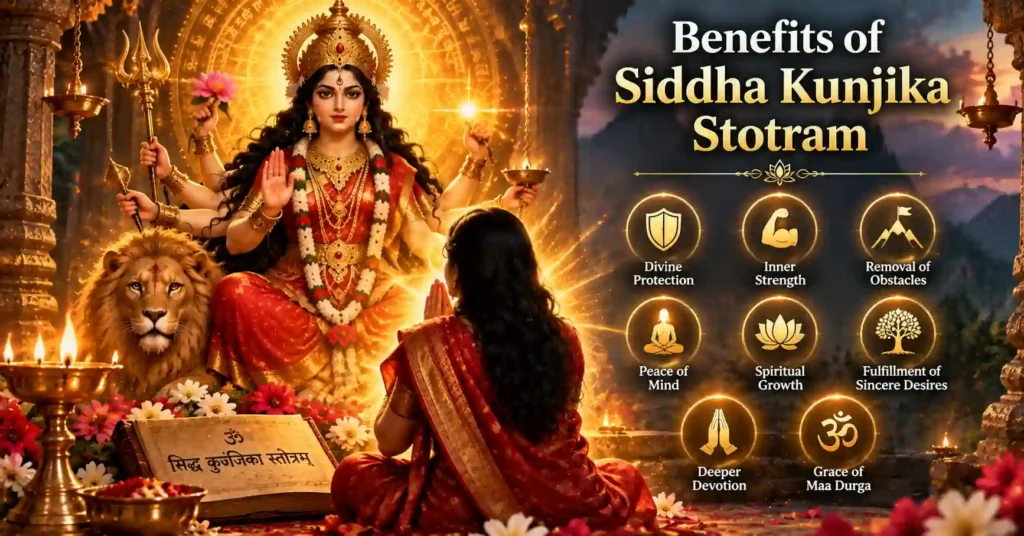
Spiritual and Practical Benefits of Siddha Kunjika Stotram
For centuries, devotees have recited Siddha Kunjika Stotram with faith and reverence as part of their worship of Maa Durga. While spiritual experiences vary from person to person, the stotram is traditionally associated with several devotional and spiritual benefits.
Key Benefits of Siddha Kunjika Stotram
- Deepens devotion to Maa Durga
Regular recitation helps strengthen a devotee’s connection with the Divine Mother and encourages surrender, faith, and spiritual growth. - Improves focus during prayer
The sacred beej mantras help calm the mind and support concentration during worship and meditation. - Invokes a sense of protection
Many devotees chant Siddha Kunjika Stotram while praying for protection from fear, negativity, and life’s challenges. - Builds courage and inner strength
The stotram glorifies Maa Durga as the destroyer of evil, inspiring devotees to face difficulties with confidence and determination. - Enhances Navratri and Devi worship
Chanting the stotram during Navratri or other Devi observances can help deepen spiritual focus and devotional practice. - Encourages spiritual discipline
Daily recitation fosters consistency, mindfulness, and the habit of setting aside time for prayer and self-reflection. - Supports inner transformation
As the sacred “key” of Devi worship, the stotram reminds devotees to cultivate wisdom, devotion, and self-awareness.
Ultimately, the greatest benefit of Siddha Kunjika Stotram is not merely the fulfillment of worldly desires but the opportunity to grow closer to Maa Durga and progress on the spiritual path with faith and humility.
When Is Siddha Kunjika Stotram Traditionally Recited?
Siddha Kunjika Stotram can be recited throughout the year with devotion. However, certain occasions are traditionally considered especially auspicious for chanting this sacred hymn.
| Occasion | Traditional Significance |
|---|---|
| Daily Worship | Helps maintain a regular connection with Maa Durga and supports spiritual discipline. |
| Navratri | One of the most popular times to recite Siddha Kunjika Stotram as devotees intensify Devi worship. |
| Before Durga Saptashati Recitation | Traditionally chanted by many devotees before or alongside the Chandi Path. |
| Ashtami and Navami | Sacred days associated with the worship of Maa Durga during Navratri and other observances. |
| Fridays | Considered auspicious for Devi worship in many Hindu traditions. |
| During Personal Challenges | Devotees often chant the stotram seeking courage, protection, and inner strength. |
| During Spiritual Practice (Sadhana) | Helps cultivate concentration, devotion, and connection with the Divine Mother. |
While these occasions are considered auspicious, there is no strict requirement regarding the time or day of recitation. The most important aspect of Siddha Kunjika Stotram is chanting it with sincerity, faith, and reverence for Maa Durga.
Many practitioners prefer reciting the stotram during Brahma Muhurta or in a quiet environment where the mind can remain focused on prayer and devotion.
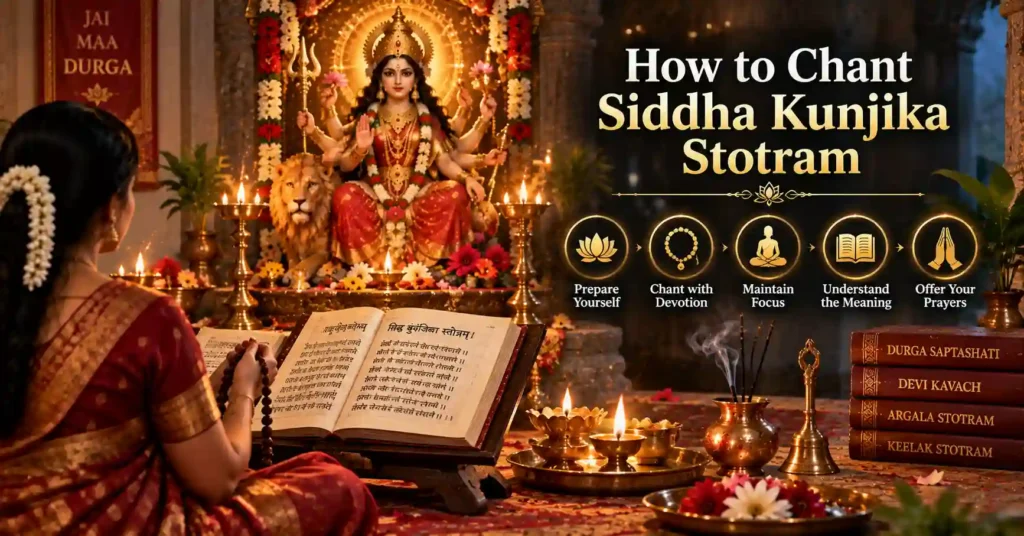
How to Chant Siddha Kunjika Stotram
While Siddha Kunjika Stotram can be recited by any sincere devotee of Maa Durga, approaching it with devotion, respect, and concentration helps make the practice more meaningful.
There is no single mandatory method of recitation. However, the following traditional guidelines are commonly followed by devotees and practitioners of Devi worship.
Traditional Guidelines for Chanting
Begin with a clean body and mind
Taking a bath and wearing clean clothes before worship helps create a sense of purity and focus.Choose a peaceful place
A quiet environment can help reduce distractions and improve concentration during recitation.Remember Maa Durga with devotion
Before beginning the stotram, offer a simple prayer and mentally bow to the Divine Mother.Recite with attention and sincerity
Chant the verses slowly and mindfully rather than rushing through them.Pronounce the beej mantras carefully
Since Siddha Kunjika Stotram contains powerful beej mantras, devotees traditionally try to recite them with care and reverence.Maintain regularity if possible
Consistent recitation is often considered more beneficial than occasional chanting.Use it as a part of Devi worship
Many devotees recite Siddha Kunjika Stotram along with Durga prayers, Navratri worship, or Chandi Path.
Important Reminder
The heart of Siddha Kunjika Stotram is devotion rather than perfection. While correct pronunciation and traditional practices are valuable, sincere faith, humility, and reverence for Maa Durga remain the most important aspects of the recitation.
For beginners, it is perfectly acceptable to start slowly, learn the pronunciation over time, and focus on understanding the meaning of the stotram while cultivating devotion to the Divine Mother.
Symbolic Meaning of the Sacred Key
The word “Kunjika” literally means a small key. In the context of Siddha Kunjika Stotram, this key symbolizes the spiritual wisdom and divine grace that help unlock a deeper connection with Maa Durga.
On the surface, the stotram is a hymn filled with powerful mantras and praises of the Divine Mother. On a deeper level, however, it points toward the inner transformation that occurs when a devotee approaches spiritual practice with sincerity and devotion.
The “locked door” in this symbolism can represent ignorance, fear, doubt, ego, or the distractions that prevent a person from recognizing their true spiritual nature. The sacred key represents the awakening of devotion, wisdom, and self-awareness.
The repeated invocation of Maa Chamunda and other forms of the Goddess reminds devotees that divine power is not only present in the universe but also within their own hearts. Through prayer and remembrance, seekers gradually uncover this inner strength.
The beej mantras found throughout Siddha Kunjika Stotram further reinforce this symbolism. They are traditionally understood as seeds of spiritual awakening that help direct the mind toward higher awareness and devotion.
The stotram also teaches that spiritual progress is not achieved through rituals alone. True transformation happens when faith, understanding, discipline, and divine grace come together in a devotee’s life.
For many devotees, the sacred key ultimately symbolizes access to the blessings of Maa Durga. Rather than opening a physical door, it opens the heart to courage, devotion, wisdom, and the presence of the Divine Mother.
In this way, Siddha Kunjika Stotram serves as both a devotional prayer and a reminder that the path to spiritual growth begins within. The key is not something external to be found but something that is awakened through sincere devotion and remembrance of the Goddess.
Secrecy, Discipline and Right Intent in Siddha Kunjika Stotram
Towards the end of Siddha Kunjika Stotram, Lord Shiva emphasizes the importance of approaching this sacred hymn with devotion, sincerity, and respect. These teachings offer valuable guidance for anyone who wishes to incorporate the stotram into their spiritual practice.
Key Teachings from Siddha Kunjika Stotram
- Approach the stotram with reverence
The hymn is presented as a sacred spiritual teaching and should be recited with devotion rather than treated as ordinary text. - Faith is more important than mechanical recitation
Simply chanting the words without concentration or devotion may not provide the deeper spiritual benefits that the stotram seeks to inspire. - Practice with sincerity and humility
A humble attitude helps devotees develop a genuine connection with Maa Durga and her teachings. - Maintain discipline in worship
Regular recitation, even if brief, is often considered more meaningful than occasional worship performed without focus. - Seek spiritual growth, not just material gain
The stotram encourages devotees to cultivate wisdom, devotion, courage, and inner transformation alongside worldly well-being. - Respect sacred knowledge
Traditional teachings advise devotees to value spiritual practices and share them responsibly with those who approach them with faith and respect. - Develop a deeper relationship with Maa Durga
The ultimate purpose of Siddha Kunjika Stotram is to strengthen devotion and help devotees move closer to the Divine Mother.
Why This Teaching Matters Today
In today’s fast-paced world, it is easy to approach spiritual practices as routines to be completed quickly. Siddha Kunjika Stotram reminds devotees that the true power of any prayer lies in devotion, awareness, and the sincerity of one’s heart.
When recited with the right intention, Siddha Kunjika Stotram becomes more than a hymn. It becomes a path toward self-discipline, inner growth, and a deeper connection with Maa Durga.
Why Siddha Kunjika Stotram Matters in Kali Yuga
In Sanatan Dharma, Kali Yuga is described as an age marked by distraction, stress, spiritual forgetfulness, and a decline in dharmic values. In such times, simple yet powerful devotional practices are often considered especially valuable.
Many devotees revere Siddha Kunjika Stotram because it offers a concise way to connect with Maa Durga without requiring lengthy rituals or extensive scriptural study. Its compact form makes it accessible to people leading busy modern lives.
Why Devotees Value Siddha Kunjika Stotram in Kali Yuga
Easy to incorporate into daily worship
The stotram is relatively short, making it suitable for regular recitation even when time is limited.Strengthens devotion to Maa Durga
Regular chanting helps devotees remember the Divine Mother and maintain a spiritual connection amidst worldly responsibilities.Encourages inner strength and courage
The verses glorify Maa Durga as the destroyer of negativity, inspiring devotees to face challenges with faith and confidence.Promotes focus and mindfulness
The sacred mantras encourage concentration and help calm a restless mind.Provides spiritual support during difficult times
Many devotees turn to Siddha Kunjika Stotram when facing uncertainty, fear, or emotional struggles.Preserves a connection with sacred traditions
Reciting the stotram allows devotees to remain connected with the timeless teachings of Devi worship and the Shakta tradition.Reminds seekers of their spiritual purpose
Beyond worldly concerns, the stotram encourages self-reflection, devotion, and the pursuit of inner growth.
A Timeless Message for Modern Life
While the challenges of Kali Yuga may appear different from those of earlier ages, the need for faith, discipline, and spiritual grounding remains the same. Siddha Kunjika Stotram continues to inspire devotees by reminding them that the grace of Maa Durga is available to all who approach her with sincerity and devotion.
Its enduring popularity reflects a simple yet profound truth: even in times of confusion and uncertainty, remembrance of the Divine Mother can bring strength, clarity, and hope.
Did You Know?
- The word “Kunjika” literally means “a small key” or “secret key.”
- Siddha Kunjika Stotram is traditionally associated with the Rudrayamala Tantra, where Lord Shiva reveals it to Goddess Parvati.
- The stotram is often called the “Key to Durga Saptashati” because it is believed to contain the essence of Devi worship.
- Many devotees recite Siddha Kunjika Stotram before beginning the Chandi Path.
- Despite its short length, the stotram contains several powerful beej mantras central to the Shakta tradition.
- Siddha Kunjika Stotram is especially popular during Navratri, when devotion to Maa Durga is at its peak.
- The hymn repeatedly invokes Maa Chamunda, a fierce and protective form of the Divine Mother.
- Traditional teachings emphasize that devotion, faith, and sincerity are more important than ritual complexity when reciting the stotram.
Conclusion
Siddha Kunjika Stotram is far more than a collection of sacred verses. Revered as the spiritual key to the Durga Saptashati, it occupies a special place in the worship of Maa Durga and the Shakta tradition.
Through its powerful beej mantras, prayers, and invocations, Siddha Kunjika Stotram encourages devotees to cultivate devotion, courage, self-discipline, and inner transformation. Its teachings remind us that the true purpose of spiritual practice is not merely to seek blessings but to develop a deeper connection with the Divine Mother.
Whether recited during Navratri, before a Chandi Path, or as part of daily worship, Siddha Kunjika Stotram continues to inspire countless devotees with its message of faith, protection, and spiritual awakening.
As the sacred “key” of Devi worship, the stotram symbolically opens the door to greater wisdom, devotion, and self-awareness. By approaching it with sincerity, humility, and reverence, devotees can experience its deeper spiritual significance and strengthen their relationship with Maa Durga.
May the blessings of Maa Chamunda and the Divine Mother guide your spiritual journey and fill your life with strength, clarity, devotion, and inner peace.
Suggested Reading
Siddha Kunjika Stotram is traditionally regarded as the sacred key to the Durga Saptashati and holds a special place in Devi worship. The stotram is closely connected with the worship of Maa Durga, powerful beej mantras, Chandi Path, and the spiritual teachings of the Shakta tradition.
Exploring related hymns, mantras, and scriptures can help devotees develop a deeper understanding of Siddha Kunjika Stotram, the Divine Mother, Navratri practices, and the transformative power of Devi worship.
Argala Stotram Lyrics with Meaning and Spiritual Significance
https://thesanatantales.com/argala-stotram-lyrics-meaning/
Devi Kavach Lyrics with Meaning and Spiritual Significance
https://thesanatantales.com/devi-kavach-meaning/
What Is Durga Saptashati? Meaning, Story and Why It Is Read in Navratri
https://thesanatantales.com/durga-saptashati-meaning-navratri/
Navarna Mantra Meaning, Benefits, Chanting Rules and How to Chant
https://thesanatantales.com/navarna-mantra/
Durga Beej Mantra: Simple Meaning, Benefits and How to Chant
https://thesanatantales.com/durga-beej-mantra-meaning/
Durga Chalisa Lyrics with English Pronunciation and Meaning
https://thesanatantales.com/durga-chalisa-lyrics-meaning/
Aarti of Maa Ambe: Lyrics, Meaning, Benefits and How to Perform
https://thesanatantales.com/aarti-of-maa-ambe/
Durga Saptashati
https://en.wikipedia.org/wiki/Devi_Mahatmya
Navratri
https://en.wikipedia.org/wiki/Navaratri
You can also refer to our guides on Maa Durga Mantra, Strotra ans Aarti, which explain how Maa Durga is traditionally invoked through scripture and devotion.
For a deeper Shakta perspective, our articles on Das Mahavidhya offer helpful context and continuity on thesanatantales.com.
FAQs
What is Siddha Kunjika Stotram?
Siddha Kunjika Stotram is a sacred hymn dedicated to Maa Durga and traditionally found in the Rudrayamala Tantra as a dialogue between Lord Shiva and Goddess Parvati.
It is revered as the spiritual “key” that unlocks the deeper power of the Durga Saptashati (Chandi Path). The stotram contains powerful beej mantras along with praises of the Divine Mother in her various forms, including Chamunda, Kalika, and Bhairavi.
Despite its relatively short length, Siddha Kunjika Stotram occupies an important place in Devi worship. Many devotees recite it to cultivate devotion, seek divine protection, and deepen their connection with Maa Durga.
Why is Siddha Kunjika Stotram called the Sacred Key?
The word “Kunjika” means a key, and this symbolism lies at the heart of Siddha Kunjika Stotram.
In the Shiva-Parvati dialogue, the hymn is described as the key that unlocks the spiritual essence of the Durga Saptashati. Just as a key opens a locked door, the stotram is believed to help devotees access deeper devotion and spiritual understanding.
The hymn teaches that true spiritual progress is not achieved through rituals alone. It comes through faith, concentration, humility, and surrender to the Divine Mother.
What is the connection between Siddha Kunjika Stotram and Durga Saptashati?
Siddha Kunjika Stotram is closely connected with the Durga Saptashati, one of the most revered scriptures dedicated to Maa Durga.
Traditional teachings describe the stotram as containing the essence of the mantra power associated with the Saptashati. Because of this connection, many devotees recite it before beginning the Chandi Path.
Over time, Siddha Kunjika Stotram has become an important part of Devi worship, especially during Navratri and other celebrations dedicated to the Divine Mother.
Can Siddha Kunjika Stotram be chanted daily?
Yes, many devotees chant Siddha Kunjika Stotram as part of their daily spiritual practice.
Its concise structure makes it easier to include in regular worship than longer scriptural recitations. Daily chanting can help cultivate devotion, mindfulness, and spiritual discipline.
There is no strict rule regarding how often it must be recited. What matters most is sincerity, concentration, and faith in Maa Durga.
When is the best time to recite Siddha Kunjika Stotram?
Siddha Kunjika Stotram can be recited at any time of the day with devotion and a focused mind.
Many devotees prefer chanting it during Brahma Muhurta, the sacred period before sunrise traditionally associated with meditation and spiritual practices. It is also widely recited during Navratri, Ashtami, Navami, and Fridays.
While auspicious timings are valued, traditional teachings emphasize that devotion and sincerity are more important than the specific time of recitation.
What are the benefits of chanting Siddha Kunjika Stotram?
Devotees traditionally associate Siddha Kunjika Stotram with several spiritual benefits, including stronger devotion, greater focus during prayer, and a deeper connection with Maa Durga.
The sacred beej mantras within the stotram are believed to help calm the mind and direct one’s attention toward spiritual practice. Many devotees also recite it while seeking courage, protection, and inner strength during difficult periods of life.
While experiences vary from person to person, Siddha Kunjika Stotram consistently encourages qualities such as faith, self-discipline, surrender, and spiritual growth. Its greatest benefit lies in helping devotees strengthen their relationship with the Divine Mother.
Can beginners chant Siddha Kunjika Stotram?
Yes, beginners can chant Siddha Kunjika Stotram with faith, respect, and a sincere desire to learn. There is no requirement to be an advanced practitioner before starting its recitation.
Although the stotram contains Sanskrit verses and beej mantras that may initially seem challenging, many devotees gradually improve their pronunciation through regular practice. Understanding the meaning of the verses can also make the recitation more meaningful.
Traditional teachings emphasize devotion over perfection. For beginners, sincerity, consistency, and reverence toward Maa Durga are considered more important than flawless pronunciation or extensive ritual knowledge.
What do the beej mantras in Siddha Kunjika Stotram represent?
The beej mantras in Siddha Kunjika Stotram are sacred seed syllables that hold special significance in the Shakta tradition. Mantras such as Aim, Hreem, and Kleem are traditionally associated with wisdom, divine energy, and spiritual attraction.
These mantras are not ordinary words. They are regarded as concentrated expressions of the Divine Mother’s power and are used to invoke different aspects of her presence and blessings.
For many devotees, the beej mantras help deepen concentration during prayer and meditation. They also symbolize the subtle spiritual energies that support devotion, transformation, and inner awakening.
Is Siddha Kunjika Stotram dedicated to Maa Durga or Maa Chamunda?
Siddha Kunjika Stotram honors the Divine Mother in several forms, including Maa Chamunda, Kalika, Bhairavi, Parvati, and Durga. Among these, Maa Chamunda is prominently invoked throughout the stotram.
However, Maa Chamunda is herself considered a powerful manifestation of Maa Durga. Therefore, the hymn is generally understood as a prayer dedicated to the Divine Mother in her many forms rather than to a single aspect alone.
This reflects an important principle of Sanatan Dharma: while the Goddess appears in different manifestations, all forms ultimately represent the same supreme Divine Shakti that protects, nurtures, and guides devotees.
Do I need to recite the full Durga Saptashati to benefit from Siddha Kunjika Stotram?
No. Siddha Kunjika Stotram can be recited independently and is widely practiced by devotees who may not regularly perform the complete Durga Saptashati or Chandi Path.
Traditional teachings describe the stotram as containing the essence of Devi worship associated with the Saptashati. Because of this, many devotees regard it as a meaningful spiritual practice in its own right.
Some practitioners recite Siddha Kunjika Stotram before the Durga Saptashati, while others chant it as part of their daily worship. In either case, sincere devotion and remembrance of Maa Durga remain the most important aspects of the practice.
Share Your Devotion
Have you recited Siddha Kunjika Stotram or included it in your Navratri and Devi worship practices?
Share your experience, favorite verse, or reflections in the comments below. Your insights may inspire fellow devotees on their spiritual journey with Maa Durga.
If this article helped you understand the meaning and significance of Siddha Kunjika Stotram, consider sharing it with family and friends who are interested in Devi worship, Durga Saptashati, and Sanatan Dharma.
May Maa Durga bless you with devotion, courage, wisdom, and inner peace.
References & Sources
Scriptures and Traditional Sources
- Rudrayamala Tantra (traditional source associated with Siddha Kunjika Stotram)
- Durga Saptashati (Devi Mahatmya), Markandeya Purana
External References
- Wikipedia – Durga Saptashati
https://en.wikipedia.org/wiki/Devi_Mahatmya - Wikipedia – Navratri
https://en.wikipedia.org/wiki/Navaratri - Sanskrit Documents – Siddha Kunjika Stotram
https://sanskritdocuments.org/doc_devii/siddhakunjikaa.html
Internal References
- Argala Stotram
- Keelak Stotram
- Devi Kavach
- Durga Saptashati
- Navarna Mantra
- Durga Beej Mantra
Explore More Topics from The Sanatan Tales