Regional forms of Maa Durga reflect how one eternal Shakti is felt, loved, and worshipped across India in many deeply local ways.
Maa Durga is one, yet her presence changes with land, people, and lived experience. These regional forms of Maa Durga were not created to divide belief.
They emerged naturally as people tried to understand the divine through their own lives. Land, climate, danger, and emotion shaped how the goddess was felt and remembered.
For devotees, Durga is not a distant cosmic force. She is a living mother who understands hunger, fear, childbirth, loss, injustice, and protection.
That is why different forms of Maa Durga in India feel real rather than symbolic. People do not worship her because philosophy demands it. They worship her because experience confirms her presence.
This is what makes regional worship a living expression of Sanatan Dharma. It adapts without breaking and evolves without losing its truth.
Table of Contents
ToggleWhy Does Maa Durga Appear in Different Regional Forms?
Sanatan Dharma never insisted on a single divine appearance for all people. It allowed truth to meet people where they stood.
When communities faced forests, wild animals, invasions, droughts, or disease, their fears were different. Maa Durga responded by taking forms that addressed those fears directly.
In farming regions, she protected land and harvest. In mountains, she guarded paths and judged right from wrong. In villages, she became the watcher of children and women.
These local forms of Maa Durga were shaped by lived necessity, not abstract theology.
When the divine becomes familiar, devotion becomes fearless. This is why regional forms of Durga are not lesser expressions. They are intimate expressions.
How Have History and Geography Shaped Regional Durga Worship?
Over centuries, migration, invasions, and settlement patterns changed how people lived. Forest dwellers needed a guardian against disease and animals.
Hill communities needed protection against danger and moral disorder. Coastal societies needed stability and balance. Sanatan Dharma did not erase older beliefs. It absorbed them.
Local goddesses were gradually understood as manifestations of Durga. Instead of replacing village faith, Puranic thought embraced it.
This is why regional Durga worship in India feels continuous rather than imposed. The goddess did not arrive suddenly.
She was already there, only given deeper meaning over time.
This ability to include rather than dominate is one reason Durga remains relevant everywhere.
How Do Scriptures Explain the Regional Forms of Maa Durga?
The idea of regional forms of Maa Durga is deeply rooted in Sanatan Dharma. While different communities worship the Divine Mother in unique ways, the underlying belief remains the same: all forms are manifestations of one eternal Shakti.
The Devi Mahatmya from the Markandeya Purana describes the Goddess as the supreme cosmic power who appears in different forms whenever balance must be restored.
Whether she is worshipped as Durga, Chandika, Ambika, Bhavani, or another local deity, devotees recognize the same divine energy working through different names and traditions.
Shakta traditions across India further explain that the Mother Goddess reveals herself according to the needs of time, place, and people. This understanding allowed local goddess traditions to flourish while remaining connected to the broader framework of Sanatan Dharma.
For this reason, regional forms of Maa Durga are not separate deities. They are diverse expressions of one universal Shakti worshipped throughout India.
Readers interested in exploring the broader tradition of Divine Mother worship may also learn about the Das Mahavidya and the many manifestations of Shakti in Sanatan Dharma.
How Did Regional Traditions of Maa Durga Develop Across India?
The worship of the Divine Mother in India developed over many centuries. Ancient communities often revered local goddesses connected with rivers, forests, mountains, fertility, and protection.
As Puranic traditions spread, many of these local deities became associated with Durga, Parvati, Ambika, and other forms of Shakti. Rather than replacing existing beliefs, Sanatan Dharma brought them into a broader spiritual framework.
This process helped preserve regional identities while also creating a shared understanding of the Divine Mother across India. As a result, regional forms of Maa Durga continue to reflect both local heritage and the wider Shakta tradition.
Although the spiritual foundation remains the same, the way devotees experience Maa Durga varies from region to region. Local culture, geography, and historical experience have all contributed to the unique forms of worship seen across India today.
How Is Maa Durga Worshipped in Eastern India?
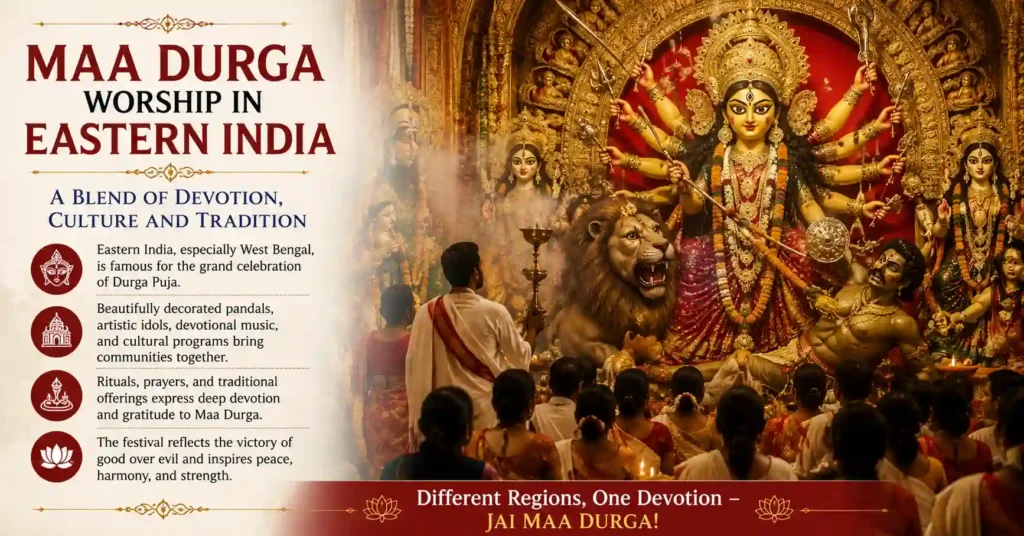
In eastern India, especially Bengal, Odisha, and Assam, social life developed around family bonds, shared memory, and emotional expression.
Here, Durga naturally appeared as both mother and daughter.
During Durga Puja, she is welcomed as a married daughter returning home. People speak to her, laugh with her, and cry when she leaves.
This closeness reflects how deeply she is woven into everyday life. Yet she is also Mahishasura Mardini, the slayer of injustice.
The emotional culture of the east shaped this form. Strength here does not cancel tenderness. Protection flows through affection.
This is one of the most emotionally expressive regional forms of Maa Durga.
How Have Local Legends Shaped Regional Forms of Maa Durga?
Many regional forms of Maa Durga are connected with local legends that have been passed down through generations.
In Assam, devotees believe Kamakhya Devi represents the creative power of Shakti and has been worshipped for centuries as one of the most sacred forms of the Divine Mother.
In Uttar Pradesh, Vindhyavasini Devi is associated with the Vindhya mountains and is believed to have appeared to protect devotees from destructive forces.
In Maharashtra, Tulja Bhavani is remembered as a source of courage and protection. Historical traditions connect her worship with Chhatrapati Shivaji Maharaj, who regarded the goddess as a guiding force.
These stories may vary from region to region, but they share a common message: the Divine Mother responds whenever protection, guidance, or strength is needed.
How Is Maa Durga Worshipped in Northern India?
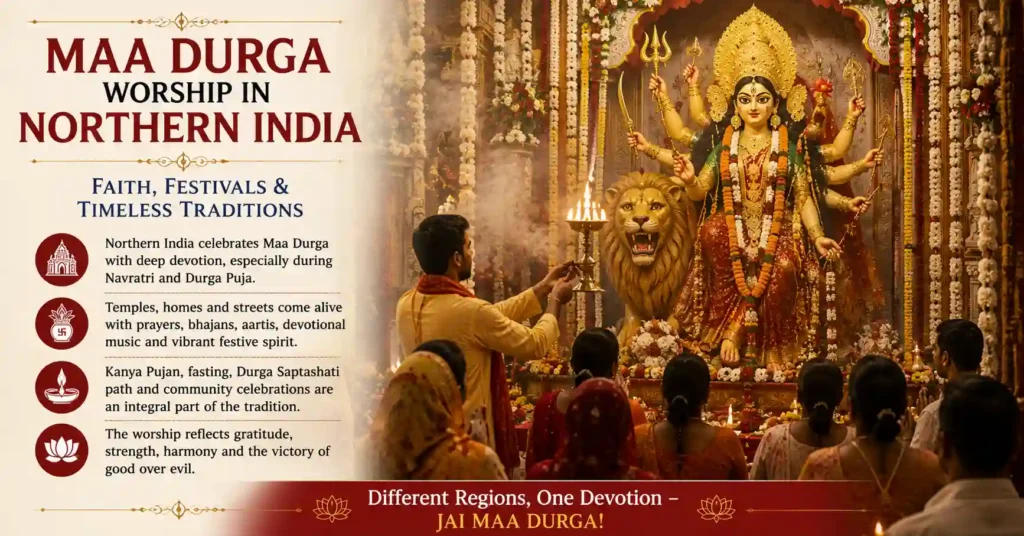
Northern India, especially the Himalayan belt, demanded alertness and moral clarity. Life in mountains was harsh and unpredictable.
Travel was dangerous. Winters were severe. Communities relied on discipline and inner strength.
Here, Durga appeared fierce and judicial. Forms worshipped at places like Vaishno Devi, Chamunda Devi, and Jwala Devi reflect this energy.
Devotees believe the goddess calls those who are ready. She protects, but she also corrects. This Durga guards dharma as lived truth, not just belief.
How Is Maa Durga Worshipped in Southern India?
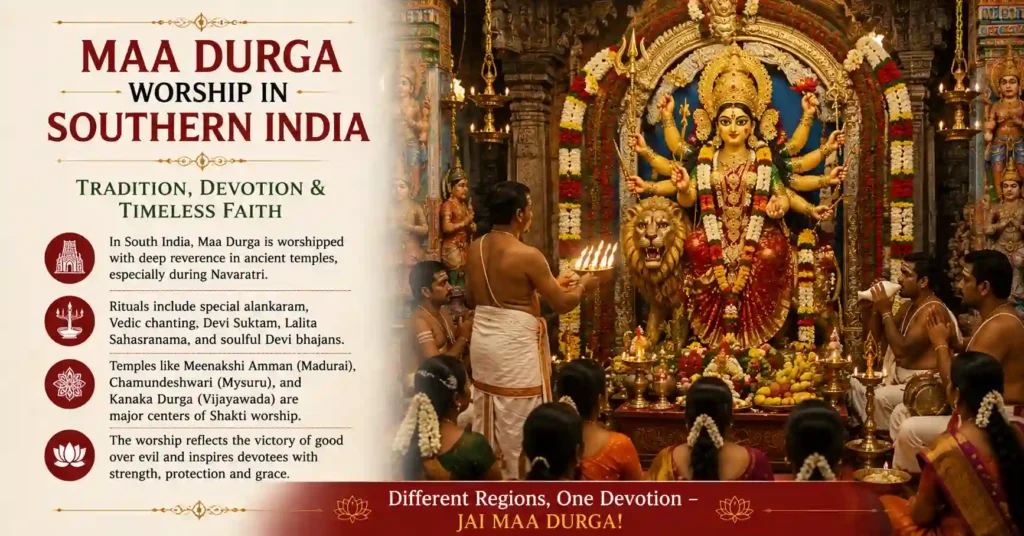
Southern India developed stable kingdoms, continuous temple traditions, and inward spiritual practices. Life here leaned toward continuity rather than crisis.
As a result, Durga appeared calm, composed, and settled.
At Kanya Kumari, she stands at the meeting of land and sea, silent and complete. Worship is steady and daily rather than seasonal and dramatic.
These regional forms of Durga show Shakti as balance. Power here sustains rather than disrupts. Silence itself becomes strength.
How Is Maa Durga Worshipped in Central and Tribal India?
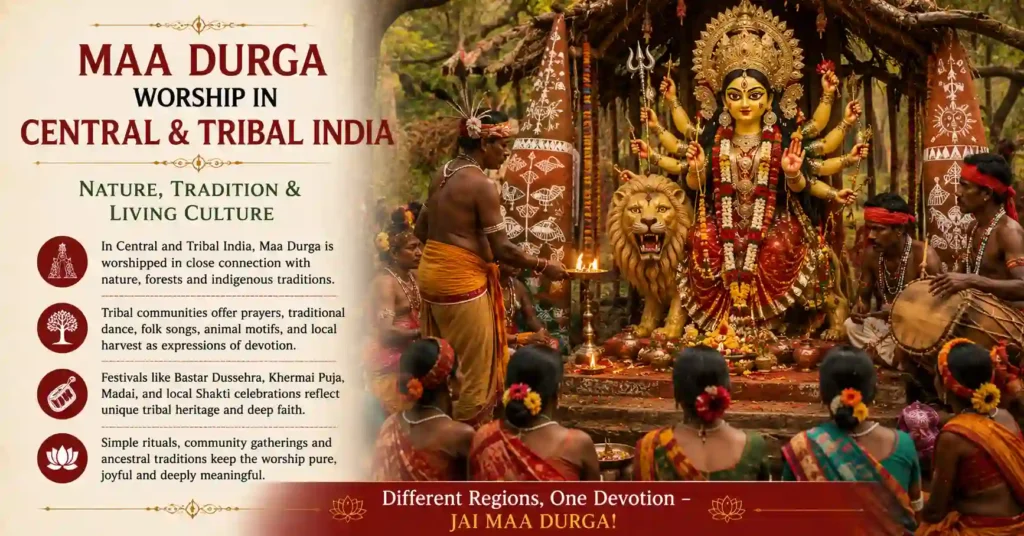
Central and tribal India preserves some of the oldest living Durga traditions. Life here involved forests, disease, wildlife, and uncertainty. Protection was not symbolic. It was urgent.
Here, folk forms of Maa Durga emerged as Gram Devi. She may be a stone under a tree or a mound of earth covered in red cloth.
There are no elaborate rituals, only trust built through experience.
People believe she controls rain, guards children, prevents epidemics, and maintains harmony with nature.
These local forms of Maa Durga are practical and direct. Fear and faith exist together, making devotion honest and grounded.
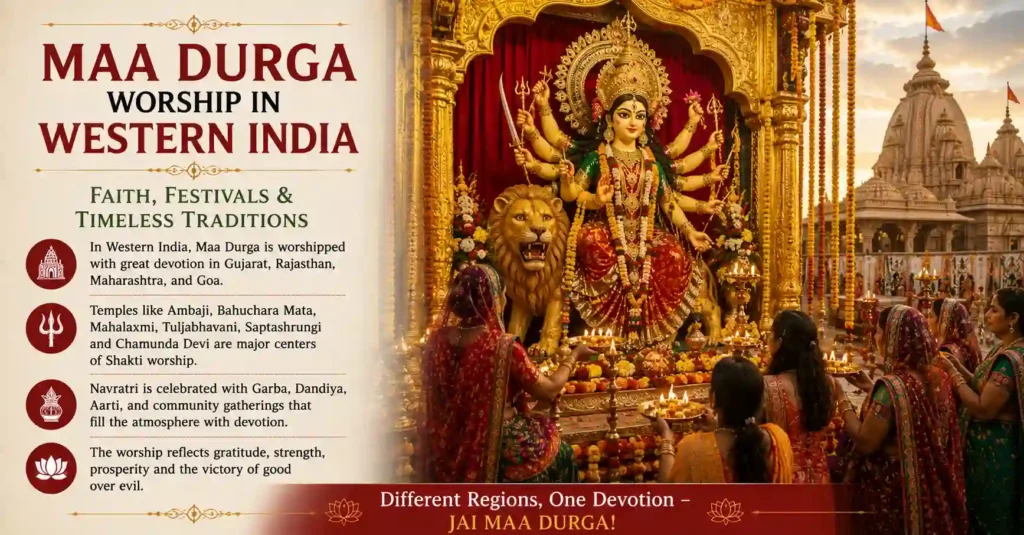
How Is Maa Durga Worshipped in Western India?
Western India experienced centuries of warfare, kingdom-building, and strong clan identity. Here, Durga appeared as warrior and protector of land and lineage.
Forms like Amba Mata and Bhavani became guardians of rulers and communities. She was worshipped for courage, unity, and survival.
Garba is circular worship of Shakti, symbolizing life revolving around divine energy. This Durga strengthens collective faith.
Which Regional Forms of Maa Durga Are Worshipped Across India?
Across India, Maa Durga is worshipped through many regional names and traditions. While customs differ, devotees recognize each form as an expression of the Divine Mother.
| State/Region | Regional Form | Key Association |
|---|---|---|
| West Bengal | Durga, Mahishasura Mardini | Durga Puja |
| Assam | Kamakhya Devi | Shakti Peetha tradition |
| Uttar Pradesh | Vindhyavasini Devi | Vindhyachal pilgrimage |
| Jammu & Kashmir | Vaishno Devi | Cave shrine and pilgrimage |
| Himachal Pradesh | Naina Devi, Jwala Devi, Chamunda Devi | Shakti Peethas |
| Gujarat | Amba Mata | Navratri and Garba |
| Maharashtra | Tulja Bhavani, Saptashrungi Devi | Warrior traditions |
| Karnataka | Banashankari | Regional Devi worship |
| Andhra Pradesh | Kanaka Durga | Vijayawada temple tradition |
| Tamil Nadu | Kanyakumari Amman | Southern Shakti tradition |
| Odisha | Cuttack Chandi | Regional Durga worship |
This diversity reflects the remarkable ability of Sanatan Dharma to preserve local traditions while recognizing one universal source of divine power.
Which Temples Preserve the Regional Traditions of Maa Durga?
Many regional forms of Maa Durga are closely connected with ancient temples that continue to attract millions of devotees every year.
Some of the most respected temples include:
- Kamakhya Temple in Assam
- Vaishno Devi Temple in Jammu
- Vindhyavasini Temple in Uttar Pradesh
- Jwala Devi Temple in Himachal Pradesh
- Naina Devi Temple in Himachal Pradesh
- Ambaji Temple in Gujarat
- Tulja Bhavani Temple in Maharashtra
- Kanaka Durga Temple in Andhra Pradesh
- Kanyakumari Amman Temple in Tamil Nadu
These temples preserve local traditions, rituals, legends, and festivals that have been passed down through generations. They also demonstrate how regional forms of Maa Durga remain vibrant living traditions rather than historical memories.
Are Folk and Puranic Forms of Maa Durga Really Different?
Many people assume that village goddesses and Puranic forms of Durga belong to separate traditions. Historically, however, the relationship is much more interconnected.
Long before large temples became common, local communities worshipped protective mother goddesses connected with fertility, health, forests, rivers, and village life. These traditions developed through lived experience and community memory.
As Puranic literature and Shakta traditions spread across India, many local goddesses came to be understood as manifestations of the same Divine Mother described in sacred texts. Rather than replacing village traditions, Sanatan Dharma absorbed and respected them.
This process created a bridge between local faith and scriptural theology. A village Gram Devi, a temple Bhavani, and the Durga described in the Devi Mahatmya may appear different externally, yet devotees often recognize them as expressions of one Shakti.
This inclusive approach allowed regional traditions to survive while remaining connected to a wider spiritual framework.
What Remains the Same in Every Form of Maa Durga?
Across all regional forms of Maa Durga, certain truths remain unchanged. She protects the vulnerable.
She restores balance. She stands with justice. Fierceness is always guided by compassion.
Forms change according to land and people, but the mother remains the same.
How Do Different Regional Forms of Maa Durga Remain Connected?
Although regional traditions vary, certain spiritual principles remain common across India.
| Aspect | Regional Variation | Shared Belief |
|---|---|---|
| Name | Bhavani, Amba, Kamakhya, Durga, Kanyakumari | One Divine Mother |
| Rituals | Vary by region | Devotion to Shakti |
| Festivals | Durga Puja, Navratri, local fairs | Celebration of divine power |
| Temple Architecture | Different styles | Sacred worship spaces |
| Local Legends | Region-specific stories | Protection of devotees |
| Cultural Expression | Songs, dances, folk customs | Reverence for the Goddess |
Why Does Regional Worship Continue to Inspire Modern Devotees?
Even today, people turn to regional forms of Durga because they feel emotionally close.
Women especially play a key role in passing this faith through songs, stories, and daily prayers.
In times of stress, illness, or uncertainty, devotees often return to local forms of Maa Durga. She feels accessible and personal.
This is why regional Durga worship in India survives modern life and urban change.
How Is Maa Durga Celebrated in Different Regions of India?
Regional forms of Maa Durga are expressed not only through temples and traditions but also through festivals.
In West Bengal, Durga Puja transforms entire cities into spaces of devotion, art, and community celebration. In Gujarat, Navratri is marked by Garba and Dandiya, where devotees celebrate Shakti through dance.
In Himachal Pradesh, local goddess fairs and temple processions remain important parts of community life. In Maharashtra, devotees gather at Bhavani and Saptashrungi temples during Navratri. In South India, Golu displays present the Divine Mother through symbolic arrangements of sacred figures and stories.
These regional celebrations may differ in form, but they share the same purpose: honoring the power, compassion, and protection of Maa Durga.
Why Do So Many Forms of Maa Durga Lead to the Same Divine Mother?
The regional forms of Maa Durga show how Sanatan Dharma embraces both unity and diversity. Across mountains, forests, villages, temples, and cities, devotees have experienced the same Divine Mother in ways that reflect their local culture and daily lives.
Whether worshipped as Kamakhya, Vaishno Devi, Bhavani, Amba, Kanyakumari, or Durga, the essence remains unchanged. She protects, guides, and nurtures her devotees while reminding them that the one Shakti can appear in countless forms without losing her eternal nature.
The many regional forms of Maa Durga remind us that while paths may differ, the Divine Mother remains one, guiding her devotees through every place, language, and tradition.
Suggested Reading
If you would like to explore the Divine Mother and her many traditions more deeply, you may also enjoy these related articles:
The Nine Forms of Maa Durga (Navadurga)
https://thesanatantales.com/nine-forms-of-maa-durga/Das Mahavidya: The Ten Wisdom Goddesses
https://thesanatantales.com/das-mahavidya/Kamakhya Temple and the Ambubachi Mela
https://thesanatantales.com/kamakhya-temple-and-ambubachi-mela-myth/Why Are There Many Deities in Sanatan Dharma?
https://thesanatantales.com/why-there-are-many-deities-in-sanatan-dharma/Maa Sharda Maihar: The Divine Shakti Peeth of Wisdom and Faith
https://thesanatantales.com/maa-sharda-maihar/Pavagadh Temple Gujarat: Shakti Peeth, History, Darshan, Steps and Ropeway Guide
https://thesanatantales.com/pavagadh-temple-gujarat/Maa Saptashrungi: Story, Importance, Darshan, and Complete Travel Guide
https://thesanatantales.com/maa-saptashrungi/Ambaji Temple Banaskantha: A Sacred Experience Beyond Form
https://thesanatantales.com/ambaji-temple-banaskantha/Vindhyavasini Devi: Story, Temple & Vindhyachal Darshan Guide
https://thesanatantales.com/vindhyavasini-devi/Mahalaxmi Temple, Kolhapur: Complete Pilgrim Guide to Ambabai Shakti Peetha
https://thesanatantales.com/mahalaxmi-temple-kolhapur/
Maa Durga (Wikipedia)
https://en.wikipedia.org/wiki/Durga
FAQs
Are regional forms of Maa Durga different goddesses?
o. In Sanatan Dharma, regional forms of Maa Durga are generally understood as different manifestations of the same Divine Mother. While names, stories, rituals, and local traditions may vary, devotees believe that the same universal Shakti is worshipped in different forms across India.
Why is Maa Durga worshipped differently in different parts of India?
Regional customs, geography, local history, and cultural traditions have influenced how communities experience and worship the Divine Mother. Over time, these influences gave rise to unique forms such as Kamakhya Devi, Vaishno Devi, Vindhyavasini Devi, Amba Mata, and Tulja Bhavani while preserving the core belief in one divine source.
Is village Durga worship part of Sanatan Dharma?
Yes. Many village goddesses, often known as Gram Devis, are regarded as local manifestations of Shakti. As Sanatan Dharma evolved, these traditions became connected with broader Puranic and Shakta beliefs, creating a continuous relationship between local worship and scriptural traditions.
Can one worship multiple forms of Maa Durga?
Yes. Many devotees worship different forms of Maa Durga depending on family traditions, regional customs, festivals, or personal devotion. Since these forms are viewed as manifestations of the same Divine Mother, worshipping multiple forms is widely accepted in Hindu tradition.
Why are some forms of Maa Durga fierce while others appear gentle?
Different forms of Maa Durga represent different aspects of divine power. Fierce forms often symbolize protection, courage, and the destruction of negative forces, while gentle forms emphasize compassion, nurturing, wisdom, and blessings. Together they reflect the many dimensions of the Divine Mother.
Which regional form of Maa Durga is most widely worshipped?
There is no single answer because popularity varies by region. Durga in West Bengal, Vaishno Devi in Jammu, Kamakhya Devi in Assam, Vindhyavasini Devi in Uttar Pradesh, Amba Mata in Gujarat, and Tulja Bhavani in Maharashtra are among the most widely revered regional forms.
Is Kamakhya Devi considered a form of Maa Durga?
Kamakhya Devi is one of the most important manifestations of Shakti in the Hindu tradition. Although she has her own unique identity and temple traditions, she is closely connected with the broader worship of the Divine Mother and is often regarded as part of the larger Durga-Shakti tradition.
What is the connection between folk goddesses and Puranic forms of Durga?
Many folk goddesses were worshipped by local communities long before formal temple traditions became widespread. Over time, these local deities were associated with the Divine Mother described in Puranic texts, allowing regional traditions and scriptural traditions to coexist within the broader framework of Sanatan Dharma.
Which states are most famous for regional forms of Maa Durga?
West Bengal, Assam, Uttar Pradesh, Himachal Pradesh, Jammu and Kashmir, Gujarat, Maharashtra, Andhra Pradesh, Karnataka, Odisha, and Tamil Nadu are especially known for their distinctive forms of Maa Durga, temples, festivals, and devotional traditions.
What do all regional forms of Maa Durga have in common?
Despite differences in names, rituals, and local legends, all regional forms of Maa Durga are connected through the belief in one Divine Mother who protects, guides, and nurtures her devotees. This shared spiritual foundation unites diverse traditions across India.
Glossary of Important Terms
| Term | Meaning |
|---|---|
| Ambika | A revered name of the Divine Mother in Hindu tradition. Ambika is often associated with Durga and represents her nurturing, protective, and compassionate nature. |
| Bhavani | A popular form of Maa Durga worshipped especially in Maharashtra. Bhavani is regarded as a protector, giver of strength, and guardian of righteousness. |
| Devi Mahatmya | A sacred text within the Markandeya Purana that describes the Divine Mother’s victories over evil forces. It is one of the most important scriptures in the Shakta tradition. |
| Durga Puja | A major Hindu festival, especially celebrated in West Bengal and eastern India, honoring Maa Durga’s victory over Mahishasura. |
| Gram Devi | A village goddess worshipped as the protector of a specific community, village, or region. Many Gram Devis are considered local manifestations of the Divine Mother. |
| Kamakhya Devi | A highly revered form of Shakti worshipped at the Kamakhya Temple in Assam and closely associated with divine creative energy. |
| Mahishasura Mardini | A title of Maa Durga meaning “Destroyer of Mahishasura,” symbolizing her victory over evil and protection of dharma. |
| Navadurga | The nine sacred forms of Maa Durga worshipped during Navratri, each representing a unique aspect of divine power and spiritual growth. |
| Puranas | Ancient Hindu scriptures containing stories, teachings, genealogies, and traditions related to gods, goddesses, sages, and sacred places. |
| Puranic Tradition | The religious and devotional traditions that developed through the teachings and narratives found in the Puranas. |
| Shakta Tradition | A major branch of Hinduism that worships the Divine Mother (Shakti) as the supreme reality and source of all creation. |
| Shakti | The divine feminine energy believed to be the source of creation, preservation, and transformation in the universe. |
| Shakti Peetha | A sacred shrine dedicated to the Divine Mother and considered an important pilgrimage destination in Hindu tradition. |
| Tulja Bhavani | A regional form of Maa Durga worshipped primarily in Maharashtra and associated with courage, protection, and devotion. |
| Vaishno Devi | One of India’s most revered forms of the Divine Mother, worshipped at the famous shrine in Jammu and Kashmir. |
| Vindhyavasini Devi | A widely worshipped form of Maa Durga associated with the Vindhya region of Uttar Pradesh and revered as a powerful protector goddess. |
| Worship Tradition | The collection of rituals, customs, festivals, prayers, and beliefs through which a community honors a deity. |
| Regional Forms of Maa Durga | Local manifestations of the Divine Mother that developed through regional customs, history, geography, and devotional traditions across India. |
About the Author
Yateendra Chaturvedi is a spiritual writer, researcher, devotee, and the founder of The Sanatan Tales. With over 35 years of professional experience and a lifelong interest in Sanatan Dharma, he writes about Hindu deities, temples, scriptures, festivals, Mahavidyas, sacred stories, rituals, and living traditions that continue to guide and inspire devotees across India.
Drawing from traditional scriptures, regional beliefs, temple traditions, devotional literature, and historical sources, he aims to present authentic, well-researched, and easy-to-understand content for modern readers. His work focuses on preserving spiritual wisdom, explaining sacred traditions, and helping seekers develop a deeper understanding of India’s rich spiritual heritage.
Through The Sanatan Tales, Yateendra strives to make the timeless teachings of Sanatan Dharma simple, meaningful, and relevant for today’s generation while maintaining respect for traditional sources, regional practices, and diverse spiritual perspectives.
Learn More About Yateendra Chaturvedi →
https://thesanatantales.com/about-the-author/
References & Sources
This article is based on beliefs and traditions followed within the Shakta traditions of Sanatan Dharma, traditional knowledge associated with the Dashamahavidya tradition, Shakti worship, Devi sadhana, and insights drawn from various spiritual and religious study sources.
Some concepts discussed in this article are also inspired by teachings and interpretations preserved through the guru-disciple tradition.
Note: Beliefs, interpretations, and spiritual practices may vary across different traditions, sects, and paths within Sanatan Dharma. The purpose of this article is not to present any single viewpoint as the absolute truth, but to explain widely accepted religious and spiritual perspectives in a simple and accessible manner.
Continue Your Spiritual Journey