
What is Brahman? This is one of the deepest and most important questions in Hinduism and Vedanta. The concept of Brahman refers to the ultimate reality that exists beyond all names, forms, and limitations. It is described as eternal, infinite, and the source of everything in the universe.
Understanding what is Brahman helps us explore the spiritual foundation of Sanatan Dharma. The Upanishads teach that Brahman is the supreme reality behind creation, while many Hindu philosophies explain its relationship with the individual self, known as Atman.
In this article, you will learn what is Brahman, its meaning, origin, scriptural significance, relationship with Atman, and why it plays a central role in spiritual life. We will also explore common misconceptions, the difference between Brahman and Brahma, and how reflecting on this timeless truth can bring greater clarity and inner peace.
This beginner-friendly guide aims to explain what is Brahman in simple language while remaining rooted in the wisdom of Hindu scriptures and tradition.
At a Glance
| Aspect | Quick Answer |
|---|---|
| Meaning | Brahman is the ultimate, infinite reality in Hinduism. |
| Origin | The concept of Brahman is explained extensively in the Upanishads and Vedanta. |
| Nature | Eternal, infinite, unchanging, and beyond time and space. |
| Forms | Understood as Nirguna Brahman (without attributes) and Saguna Brahman (with attributes). |
| Relationship with Atman | Many Hindu traditions teach a close connection between Atman and Brahman, though interpretations vary. |
| Goal of Spiritual Life | Realizing the true nature of Brahman is considered the path to Moksha or liberation. |
| Mentioned In | Upanishads, Bhagavad Gita, Brahma Sutras, and other Hindu scriptures. |
| Why It Matters | Understanding what is Brahman helps seekers explore the deepest truth about existence, consciousness, and the self. |
Table of Contents
ToggleWhat Is Brahman?
To understand what is Brahman, we must look beyond the idea of a person, object, or deity. In Hinduism, Brahman is the ultimate reality that exists behind everything in the universe. It is the eternal truth from which all creation arises and into which everything ultimately returns.
Brahman is not limited by form, name, gender, time, or space. It is infinite, unchanging, and present everywhere. The Upanishads describe Brahman as the highest reality that cannot be fully understood through the senses or ordinary thinking.
According to Hindu philosophy, everything we see in the world is connected to Brahman. The universe, nature, living beings, and even consciousness itself exist because of this supreme reality.
Many spiritual traditions within Hinduism teach that Brahman is both transcendent and immanent. This means Brahman exists beyond creation while also being present within every aspect of creation.
The sages of ancient India did not view Brahman as a distant force. They saw it as the deepest essence of existence and the source of all knowledge, life, and awareness.
Understanding what is Brahman is the foundation of Vedanta. It helps seekers explore profound questions such as: Who am I? What is the nature of reality? What is the relationship between Atman and Brahman? These questions have guided spiritual inquiry in Sanatan Dharma for thousands of years.
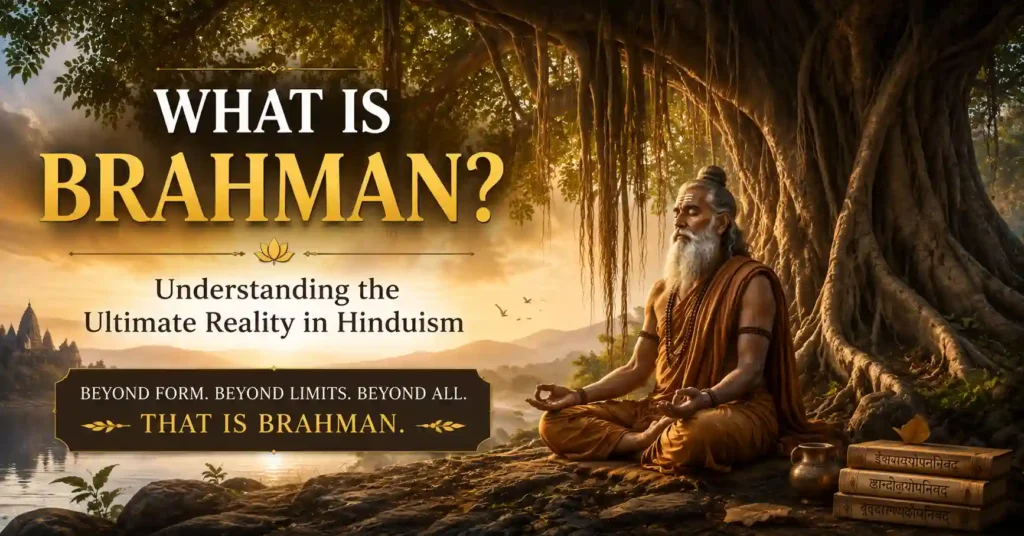
What Is the Meaning of Brahman?
The Brahman meaning comes from the Sanskrit root brh, which means “to grow,” “to expand,” or “to become great.” Because of this, Brahman is understood as the limitless and all-pervading reality that has no boundaries.
In Hinduism, Brahman is not simply a powerful being among many others. It is the infinite existence that supports and sustains everything. The universe changes constantly, but Brahman remains eternal and unchanging.
The Upanishads describe Brahman as Sat-Chit-Ananda, which means Existence, Consciousness, and Bliss. These three qualities help explain the nature of the supreme reality, though Brahman ultimately transcends all descriptions and definitions.
Ancient sages taught that words and concepts can only point toward Brahman. Since it is beyond the limitations of the mind and senses, it cannot be fully captured by language. This is why the Upanishads often describe Brahman through phrases such as “Neti Neti” or “Not this, not this.”
The Brahman meaning also differs from the idea of a creator deity. Brahman is the absolute reality behind all existence, while the various forms of God worshipped in Hinduism are understood as manifestations or expressions of that supreme truth.
Understanding the Brahman meaning helps seekers appreciate why Vedanta regards Brahman as the highest reality and the ultimate goal of spiritual knowledge.
What Is the Origin of the Concept of Brahman?
The concept of Brahman has its roots in the ancient spiritual traditions of India and developed over centuries through Vedic and Upanishadic teachings. While the early Vedas often focus on rituals, hymns, and divine powers, later texts began exploring deeper questions about the nature of reality and existence.
The Upanishads, which form the philosophical foundation of Vedanta, gave the most profound explanations of Brahman. The sages who composed these texts sought to understand the ultimate truth behind the universe, life, and consciousness.
As their inquiry deepened, they realized that all existence is connected to a single, eternal reality. This supreme reality came to be known as Brahman.
Several major Upanishads discuss Brahman in detail, including the Chandogya Upanishad, Brihadaranyaka Upanishad, Taittiriya Upanishad, and Mundaka Upanishad. These texts describe Brahman as the source of creation, the sustainer of existence, and the ultimate goal of spiritual realization.
Over time, different schools of Hindu philosophy such as Advaita Vedanta, Vishishtadvaita Vedanta, and Dvaita Vedanta developed their own interpretations of Brahman. While their explanations differ, all regard Brahman as central to understanding the nature of reality.
The concept of Brahman continues to influence Hindu thought, spirituality, meditation, and self-inquiry even today. Understanding its origin helps us appreciate why Brahman remains one of the most important ideas in Hinduism and Vedantic philosophy.
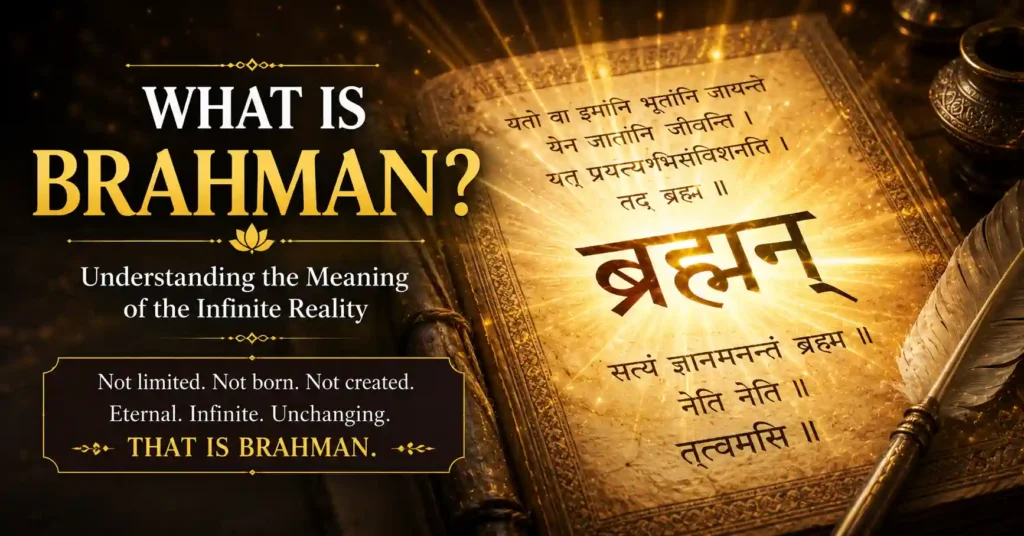
Is Brahman Mentioned in Hindu Scriptures?
Yes, Brahman is mentioned throughout many of the most important Hindu scriptures. The concept is especially prominent in the Upanishads, which explore the nature of reality, consciousness, and the ultimate truth behind existence.
The Upanishads describe Brahman as the eternal and infinite reality that exists beyond all names and forms. They teach that Brahman is the source of the universe and the foundation of all life.
One of the most famous teachings appears in the Chandogya Upanishad, where the sage Uddalaka tells his son, “Tat Tvam Asi” meaning “You Are That.” This Mahavakya suggests a profound connection between Atman and Brahman.
The Brihadaranyaka Upanishad describes Brahman through the phrase “Neti Neti” or “Not this, not this.” This teaching emphasizes that the ultimate reality cannot be fully defined by words or limited concepts.
The Taittiriya Upanishad presents Brahman as Sat-Chit-Ananda, meaning Existence, Consciousness, and Bliss. This description remains one of the most widely quoted explanations of the nature of Brahman.
Brahman is also discussed in the Bhagavad Gita, where Lord Krishna explains the eternal and imperishable reality that exists beyond the physical world. The Gita teaches that those who understand this higher truth move closer to self-realization and spiritual freedom.
The Brahma Sutras, one of the foundational texts of Vedanta, further examine the nature of Brahman and its relationship with the individual soul and the universe.
Together, these scriptures form the foundation of Hindu teachings about Brahman and continue to guide spiritual seekers today.
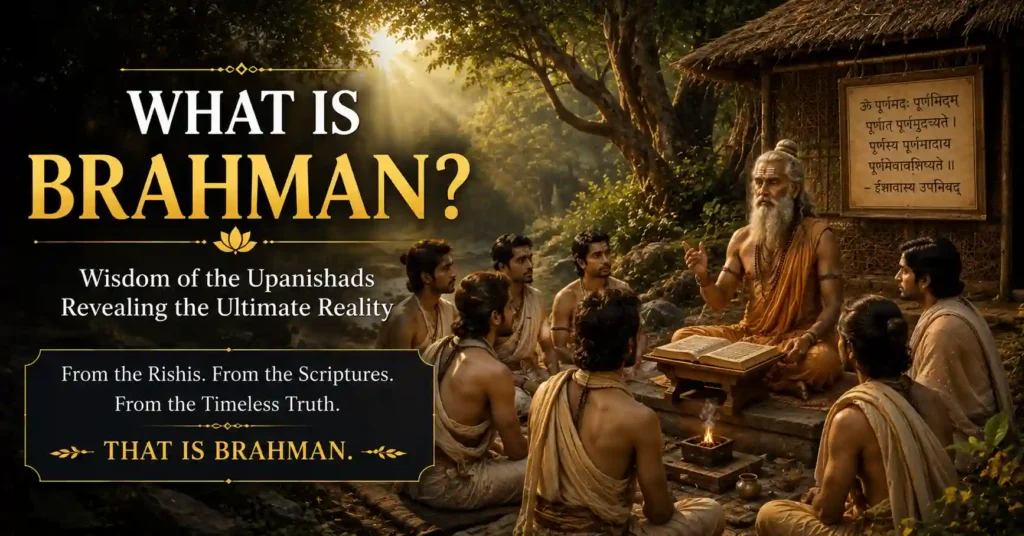
Why Is Brahman Important in Hindu Philosophy?
Understanding what is Brahman is important because it helps answer some of the deepest questions about life, existence, and the nature of reality. Hindu philosophy teaches that behind the changing world lies an eternal truth that never changes. That truth is Brahman.
The search for Brahman is at the heart of Vedanta, one of the most influential schools of Hindu thought. Rather than focusing only on external rituals, Vedanta encourages seekers to understand the ultimate reality that exists within and beyond the universe.
Brahman is considered the source of all existence. Everything in creation arises from Brahman, exists through Brahman, and ultimately returns to Brahman. Because of this, understanding Brahman helps people see the unity behind the apparent diversity of life.
The concept of Brahman in Hinduism also provides a deeper understanding of the self. Many spiritual traditions teach that our true nature is not limited to the body, mind, or temporary identities. Instead, the deepest self is connected to a higher spiritual reality.
The relationship between Atman and Brahman is one of the central teachings of Hindu philosophy. Reflecting on this relationship encourages self-inquiry and helps seekers move beyond fear, attachment, and ignorance.
The realization of Brahman is closely linked to Moksha, or liberation. Hindu scriptures teach that true freedom comes not from external achievements but from recognizing the eternal reality that underlies all existence.
For this reason, Brahman is not merely a philosophical idea. It is a spiritual truth that guides meditation, self-discovery, and the quest for lasting peace and wisdom.
What Are the Spiritual Benefits of Understanding Brahman?
Understanding what is Brahman can transform the way a person sees themselves and the world around them. Hindu scriptures teach that spiritual growth begins when we move beyond temporary identities and seek the deeper truth of existence.
One of the greatest spiritual benefits is the development of self-awareness. As seekers reflect on the nature of Brahman, they begin to recognize that lasting peace does not come from external possessions or achievements but from inner understanding.
The study of Brahman in Hinduism also encourages a sense of unity. Instead of seeing life as separate and divided, spiritual seekers learn to appreciate the interconnectedness of all beings and creation.
Another important benefit is freedom from fear and insecurity. Hindu philosophy teaches that Brahman is eternal and unchanging. Reflecting on this eternal reality can help people face life’s uncertainties with greater courage and balance.
Understanding the relationship between Atman and Brahman inspires deeper self-inquiry. Many spiritual traditions teach that realizing one’s true nature leads to wisdom, compassion, and inner freedom.
The contemplation of Brahman also supports practices such as meditation, prayer, self-reflection, and mindfulness. These practices help quiet the mind and create space for spiritual insight.
Ultimately, the highest spiritual benefit associated with Brahman is Moksha, or liberation. Hindu scriptures describe liberation as freedom from ignorance and the realization of the highest truth.
For this reason, understanding Brahman is not merely an intellectual exercise. It is a path toward self-realization, inner peace, and spiritual awakening.
What Are the Practical Benefits of Understanding Brahman?
While Brahman may seem like a highly philosophical concept, its teachings can also have practical value in everyday life. Understanding what is Brahman encourages a broader perspective on life and helps people focus on what is truly important.
One practical benefit is greater mental balance. When we recognize that life is constantly changing, we become less attached to temporary successes and failures. This can reduce stress, anxiety, and unnecessary worry.
The idea of Brahman in Hinduism also encourages self-reflection. Instead of seeking happiness only from external circumstances, people are inspired to develop inner stability, wisdom, and contentment.
Understanding Brahman can improve relationships as well. When we see the same divine reality present in all beings, it becomes easier to practice compassion, patience, and respect toward others.
Many seekers find that reflecting on Brahman helps them make decisions with greater clarity. It encourages them to act according to values such as truthfulness, self-discipline, and responsibility rather than being driven solely by fear or desire.
The teachings related to Atman and Brahman also remind us that our worth is not defined by social status, wealth, or achievements. This understanding can build confidence and reduce the need for constant external validation.
Even a simple habit of daily reflection, meditation, or scriptural study can help bring the wisdom of Brahman into everyday life. Over time, this can lead to greater peace, resilience, and a deeper sense of purpose.
For many people, understanding Brahman is not about escaping the world. It is about living in the world with greater awareness, balance, and inner freedom.
Is Brahman Different From Brahma?
Yes, Brahman and Brahma are different concepts, even though their names sound similar. This is one of the most common misunderstandings among beginners studying Hinduism.
Brahman is the ultimate reality, supreme truth, or infinite existence described in the Upanishads and Vedanta. It is eternal, formless, and beyond all limitations of time, space, and matter.
Brahma, on the other hand, is the creator deity of the Hindu Trimurti, which also includes Vishnu the preserver and Shiva the transformer. Brahma is a divine being associated with the creation of the universe.
A simple way to understand the difference is that Brahman is the ultimate reality, while Brahma is a deity within creation. Brahma is worshipped as a divine figure, whereas Brahman refers to the supreme reality that transcends all forms and names.
In many Hindu traditions, deities such as Brahma, Vishnu, Shiva, and Devi are viewed as manifestations or expressions of the same ultimate reality known as Brahman. However, Brahman itself is not limited to any single form.
Understanding Brahman vs Brahma helps avoid confusion and makes it easier to understand many teachings found in Hindu scriptures. While Brahma plays an important role in Hindu mythology, Brahman remains a central concept in Hindu philosophy and spiritual inquiry.
Brahman vs Brahma at a Glance
| Aspect | Brahman | Brahma |
|---|---|---|
| Meaning | Ultimate reality or supreme truth | Creator deity |
| Nature | Infinite, eternal, formless | Divine being with a specific role |
| Mentioned In | Upanishads, Vedanta, Bhagavad Gita | Puranas and Hindu mythology |
| Worship | Usually understood through meditation, knowledge, and spiritual inquiry | Worshipped as a deity, though relatively few temples are dedicated to Brahma |
| Role | Source and foundation of all existence | Creator within the cosmic cycle |
What Is the Relationship Between Atman and Brahman?
The relationship between Atman and Brahman is one of the most important teachings in Hindu philosophy. It seeks to answer a fundamental question that spiritual seekers have asked for centuries: Who am I in my deepest essence?
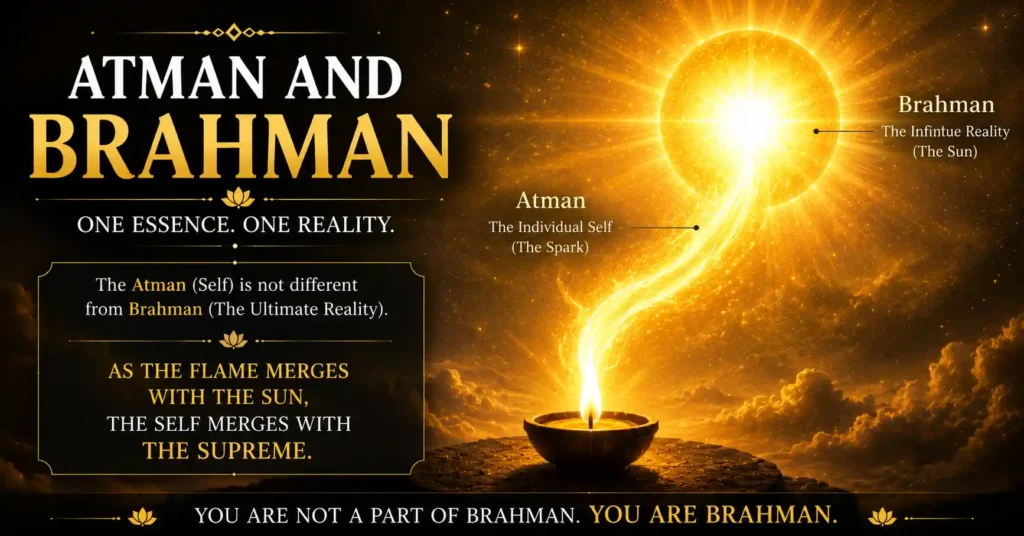
Atman refers to the true self or inner consciousness that exists beyond the body, mind, emotions, and ego. It is the eternal spiritual essence within every living being.
Brahman, on the other hand, is the ultimate reality that exists throughout the universe. It is infinite, eternal, and beyond all limitations.
Many teachings of Vedanta explain that the individual self and the supreme reality are deeply connected. The famous Upanishadic statement “Tat Tvam Asi” meaning “You Are That” points toward this profound relationship between Atman and Brahman.
According to Advaita Vedanta, Atman and Brahman are ultimately one. The realization that one’s true self is not separate from the supreme reality is considered the highest spiritual knowledge.
Other schools of Hindu philosophy offer different interpretations. For example, Vishishtadvaita Vedanta teaches that individual souls are part of Brahman but retain their unique identity, while Dvaita Vedanta maintains that the individual soul and Brahman remain distinct.
Despite these differences, all major traditions agree that understanding the relationship between Atman and Brahman is essential for spiritual growth and self-discovery.
This teaching encourages seekers to look beyond temporary identities and recognize a deeper spiritual reality within themselves. It is one of the reasons why the study of Brahman remains central to Hindu philosophy and Vedantic thought.
Atman and Brahman: A Simple Comparison
| Aspect | Atman | Brahman |
|---|---|---|
| Meaning | Individual self or soul | Ultimate reality |
| Nature | Eternal spiritual essence within a being | Infinite and universal reality |
| Scope | Individual | Universal |
| Discussed In | Upanishads, Bhagavad Gita, Vedanta | Upanishads, Bhagavad Gita, Vedanta |
| Spiritual Goal | To realize its true nature | To be understood as the highest reality |
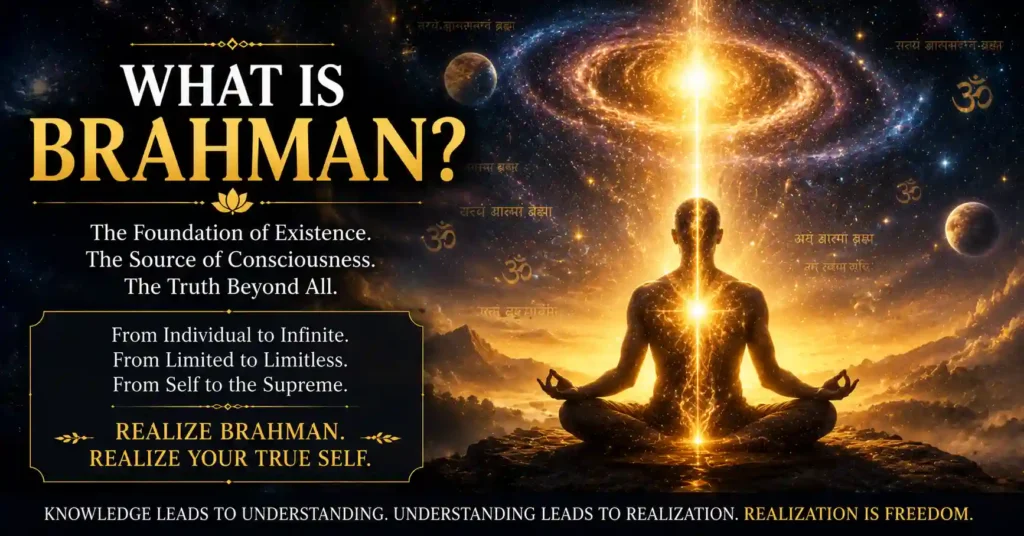
Can Anyone Realize Brahman?
Yes, Hindu scriptures teach that the realization of Brahman is possible for anyone who sincerely seeks truth and spiritual understanding. It is not limited to saints, monks, scholars, or people living in ashrams.
The path to understanding what is Brahman begins with self-inquiry, reflection, and a sincere desire to know the deeper nature of reality. Different spiritual traditions within Hinduism offer different approaches, but all encourage inner growth and self-awareness.
Some seekers pursue the path of Jnana Yoga, which emphasizes knowledge and contemplation. Others follow Bhakti Yoga, expressing devotion to God as a way of connecting with the supreme reality. Some focus on meditation, while others practice selfless service through Karma Yoga.
Hindu teachings emphasize that realizing Brahman is not merely an intellectual exercise. Reading scriptures can provide guidance, but true understanding develops through spiritual practice, reflection, and personal experience.
The Bhagavad Gita teaches that people can progress spiritually regardless of their background, occupation, or stage of life. What matters most is sincerity, discipline, and a genuine desire to seek higher truth.
The journey toward realizing Brahman may take different forms for different individuals. Some experience gradual inner transformation, while others gain deeper insight through meditation, devotion, or study of the Upanishads and Vedanta.
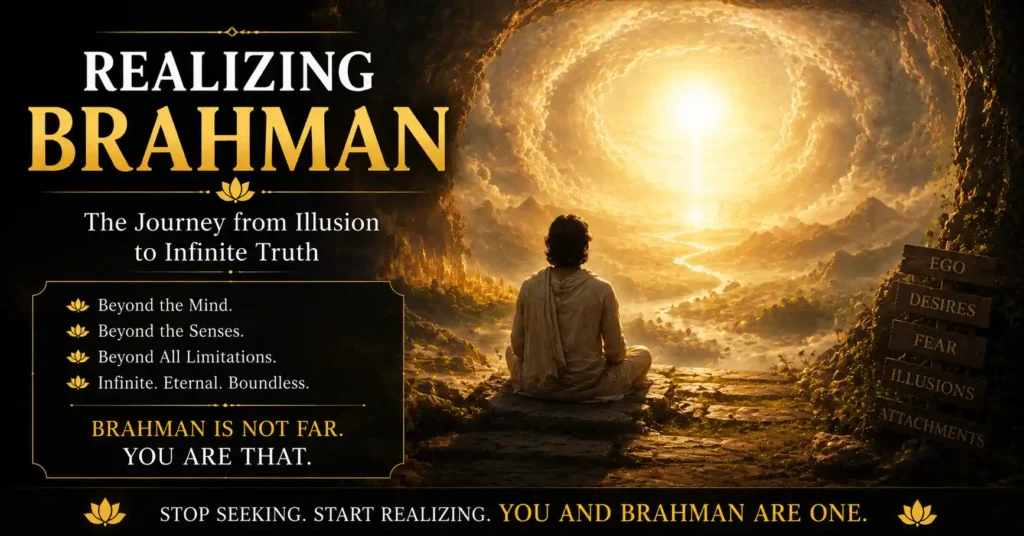
Ultimately, the realization of Brahman is described as recognizing the eternal reality that has always been present. Hindu sages teach that the truth is not something new to be created, but something to be discovered within.
Common Paths Associated with Brahman Realization
| Path | Focus |
|---|---|
| Jnana Yoga | Knowledge, self-inquiry, and wisdom |
| Bhakti Yoga | Devotion and surrender to the Divine |
| Karma Yoga | Selfless action without attachment to results |
| Raja Yoga | Meditation, concentration, and inner discipline |
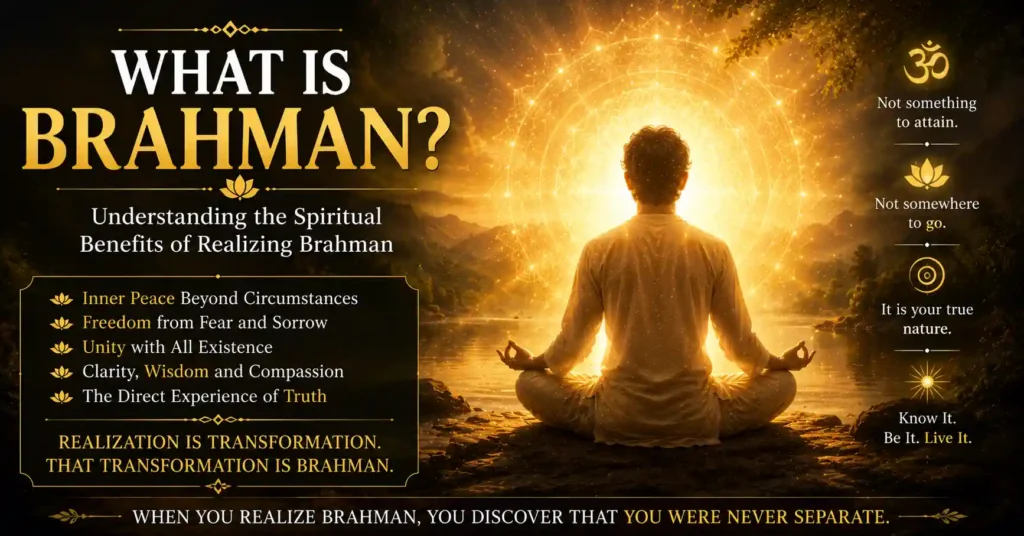
How Can You Reflect on Brahman in Daily Life?
Understanding what is Brahman becomes more meaningful when it is applied to daily life. While the concept may seem profound, Hindu teachings encourage seekers to reflect on Brahman through simple practices that cultivate awareness, wisdom, and inner peace.
One way to begin is through self-reflection. Taking a few moments each day to observe your thoughts, emotions, and actions can help you look beyond temporary experiences and connect with a deeper sense of self.
Meditation is another important practice. Sitting quietly and focusing on the present moment can help calm the mind and create space for deeper awareness. Many spiritual traditions view meditation as a way to move closer to understanding the ultimate reality.
Reading and reflecting on the Upanishads, Bhagavad Gita, and Vedanta teachings can also deepen one’s understanding of Brahman in Hinduism. These scriptures encourage seekers to explore the nature of the self and the universe.
Practicing compassion, honesty, and selfless service is another way to bring spiritual wisdom into everyday life. Hindu philosophy teaches that recognizing the same divine reality in all beings encourages kindness and respect toward others.
Many people also find value in spending time in nature. Observing the beauty and interconnectedness of life can inspire reflection on the unity that Brahman represents.
It is important to remember that reflecting on Brahman does not require withdrawing from the world. Whether you are a student, professional, homemaker, or retiree, spiritual awareness can develop through everyday experiences and mindful living.
Over time, these simple practices can help cultivate greater clarity, inner balance, and a deeper appreciation for the eternal reality described by Hindu scriptures.
Simple Daily Practices for Reflecting on Brahman
| Practice | How It Helps |
|---|---|
| Meditation | Calms the mind and develops inner awareness |
| Self-Reflection | Encourages deeper understanding of the self |
| Scriptural Study | Strengthens knowledge of Brahman and Vedanta |
| Prayer and Devotion | Cultivates humility and spiritual connection |
| Selfless Service | Encourages compassion and reduces ego |
| Time in Nature | Inspires reflection on the unity of existence |
Common Myths About Brahman
Because Brahman is a profound spiritual concept, it is often misunderstood. Learning the truth behind these common myths can help readers better understand what is Brahman and its place in Hindu philosophy.
Myth 1: Brahman and Brahma Are the Same
This is one of the most common misconceptions. Brahman is the ultimate reality or supreme truth, while Brahma is the creator deity in the Hindu Trimurti. Although their names sound similar, they refer to different concepts.
Myth 2: Brahman Is Just Another Hindu God
Brahman is not a deity with a specific form, personality, or mythology. In Hinduism, Brahman is the infinite reality that exists beyond all names and forms. Various deities may be understood as manifestations of that supreme reality.
Myth 3: Only Saints and Monks Can Understand Brahman
Hindu scriptures teach that spiritual wisdom is available to all sincere seekers. While deep realization may require dedication and practice, anyone can begin exploring the teachings about Brahman through study, reflection, and spiritual discipline.
Myth 4: Brahman Is Only a Philosophical Idea
Although Brahman is discussed in philosophical texts such as the Upanishads and Vedanta, it is not merely an abstract concept. Many spiritual traditions view Brahman as a living truth that can influence how people think, act, and understand life.
Myth 5: Brahman Can Be Fully Described in Words
The Upanishads repeatedly teach that Brahman transcends ordinary language and thought. Words can point toward the truth, but they cannot fully capture the nature of the ultimate reality.
Myth 6: Understanding Brahman Has No Practical Value
Some people believe that Brahman is relevant only to scholars or philosophers. In reality, reflecting on Brahman can encourage self-awareness, inner peace, compassion, and a deeper understanding of life’s purpose.
Quick Myth vs Reality
Myth: Brahman and Brahma are the same
Reality: Brahman is ultimate reality; Brahma is the creator deity.Myth: Brahman is just another god
Reality: Brahman is the supreme reality beyond all forms.Myth: Only monks can understand Brahman
Reality: Anyone can study and reflect on Brahman.Myth: Brahman is only philosophy
Reality: Brahman has both spiritual and practical significance.Myth: Brahman can be fully explained
Reality: The ultimate reality transcends complete description.Myth: Brahman has no relevance today
Reality: Its teachings can guide daily life and self-understanding.
Conclusion
So, what is Brahman? In Hinduism, Brahman is the ultimate, infinite reality that exists beyond all names, forms, and limitations. It is described in the Upanishads as the eternal truth that underlies the universe and the source of all existence.
Understanding what is Brahman helps us explore some of life’s deepest questions about reality, consciousness, and the nature of the self. The teachings on Brahman in Hinduism encourage seekers to look beyond temporary identities and discover a deeper spiritual perspective.
Whether approached through study, meditation, devotion, or self-reflection, the concept of Brahman continues to inspire spiritual inquiry and personal growth. While the ultimate reality may be difficult to describe fully, reflecting on it can bring greater wisdom, inner peace, and a deeper appreciation of life’s interconnectedness.
Key Takeaways
- What is Brahman? Brahman is the ultimate and infinite reality described in Hinduism and Vedanta.
- The Brahman meaning comes from a Sanskrit root that means “to expand” or “to grow,” symbolizing limitless existence.
- The Upanishads describe Brahman as Sat-Chit-Ananda (Existence, Consciousness, and Bliss).
- Brahman is different from Brahma, the creator deity of the Hindu Trimurti.
- The relationship between Atman and Brahman is a central teaching of Hindu philosophy.
- Understanding Brahman can support self-awareness, spiritual growth, and inner peace.
- Hindu scriptures teach that sincere seekers can gradually move toward realizing the nature of Brahman.
- Reflecting on Brahman through meditation, study, and mindful living can enrich daily life.
FAQs
1. What is Brahman in simple words?
In simple terms, Brahman is the ultimate reality described in Hinduism. It is the eternal truth that exists behind the universe, nature, life, and consciousness.
Unlike ordinary objects, Brahman is not limited by form, time, or space. Hindu scriptures describe it as infinite, unchanging, and present everywhere.
Understanding what is Brahman helps seekers explore the deeper meaning of existence and the spiritual foundation of life.
2. Is Brahman the same as God?
The answer depends on how the word “God” is understood.
In many Hindu traditions, Brahman is regarded as the highest reality from which all divine forms emerge. When that reality is understood without attributes, it is called Nirguna Brahman. When understood through divine qualities and forms, it is often referred to as Saguna Brahman.
This is why many Hindus worship Vishnu, Shiva, Devi, or other deities while recognizing one supreme reality behind all forms.
3. What is the difference between Brahman and Brahma?
This is one of the most common questions among beginners.
Brahman refers to the ultimate reality or supreme truth discussed in the Upanishads and Vedanta. Brahma is the creator deity of the Hindu Trimurti.
A simple way to remember the difference is:
- Brahman = Ultimate Reality
- Brahma = Creator Deity
4. What is the relationship between Atman and Brahman?
The relationship between Atman and Brahman is one of the central teachings of Hindu philosophy.
Atman refers to the true self or soul, while Brahman refers to the ultimate reality. Many Upanishadic teachings suggest a profound connection between the two. Statements such as “Tat Tvam Asi” and “Ayam Atma Brahma” emphasize this relationship.
Different schools of Vedanta interpret this relationship differently, but all regard it as essential for spiritual understanding.
5. Can Brahman be seen or experienced?
According to Hindu scriptures, Brahman cannot be perceived through ordinary senses in the same way that we see physical objects.
However, spiritual traditions teach that Brahman can be realized through meditation, self-inquiry, devotion, and inner awareness. This realization is described as a direct spiritual experience rather than intellectual knowledge alone.
For this reason, many sages emphasize practice and self-transformation alongside scriptural study.
6. Is Brahman mentioned in the Upanishads?
Yes. The Upanishads are among the most important sources for understanding Brahman in Hinduism.
These texts describe Brahman as the source of creation, the foundation of existence, and the highest truth. The Upanishads approach Brahman through dialogue, reflection, and spiritual inquiry rather than simple definitions.
Many of the most famous teachings about Brahman originate from the Chandogya, Brihadaranyaka, Taittiriya, and Mandukya Upanishads.
7. Why is Brahman important in Hindu philosophy?
Brahman is important because it helps explain the nature of reality, consciousness, and existence itself.
The search for Brahman inspired many of the major schools of Vedanta and shaped centuries of spiritual thought in India. Understanding Brahman encourages seekers to look beyond temporary identities and explore deeper truths about life and the self.
This is why Brahman remains one of the most influential concepts in Hindu philosophy.
8. What is the difference between Nirguna Brahman and Saguna Brahman?
Nirguna Brahman refers to Brahman without attributes, form, or qualities. It is the absolute and transcendent reality beyond human description.
Saguna Brahman refers to the same supreme reality understood through divine qualities, names, and forms. This understanding allows devotees to develop a personal relationship with the Divine through worship and devotion.
Both concepts help explain different ways of understanding the ultimate reality.
9. Can ordinary people understand Brahman?
Yes. Hindu teachings do not restrict spiritual inquiry to monks, scholars, or ascetics.
Anyone with sincerity, curiosity, and a willingness to learn can begin exploring what is Brahman through study, reflection, prayer, meditation, and ethical living.
While complete realization may require lifelong spiritual practice, understanding the basic teachings about Brahman is accessible to all seekers.
10. What is the ultimate goal of understanding Brahman?
The ultimate goal is Moksha, or liberation.
Hindu scriptures teach that ignorance about our true nature is the root of suffering. By realizing the deeper truth of existence and understanding the relationship between Atman and Brahman, seekers move closer to spiritual freedom and lasting peace.
For this reason, the study of Brahman is not merely philosophical. It is considered a path toward wisdom, self-realization, and liberation.
Is Brahman male or female?
Neither. In Hindu philosophy, Brahman is understood as the ultimate reality that transcends all human categories, including gender. Brahman is infinite, eternal, and beyond physical form, so it cannot be described as exclusively male or female.
However, when the same supreme reality is worshipped through divine forms, it may be represented as male deities such as Vishnu or Shiva, female deities such as Devi or Lakshmi, or in forms that symbolize the unity of both masculine and feminine energies.
The Upanishads teach that Brahman exists beyond all names, forms, and distinctions. For this reason, Hindu scriptures describe Brahman as the source from which all beings and all aspects of creation arise.
Understanding what is Brahman helps us see that the ultimate reality is not limited by gender. Instead, it is the universal consciousness and eternal truth that pervades all existence.
Suggested Reading
If you found this guide on what is Brahman helpful, you may also enjoy exploring these related topics. These articles can help you deepen your understanding of Hindu philosophy, spiritual wisdom, and the core teachings of Sanatan Dharma.
Learning what is Brahman often leads to deeper questions about the self, reality, liberation, and the purpose of life. The following articles are excellent next reads on your spiritual journey.
What Is Maya in Hindu Philosophy?
https://thesanatantales.com/what-is-maya-in-hindu-philosophy/
What Is Moksha and How Is It Attained?
https://thesanatantales.com/what-is-moksha-and-how-is-it-attained/
What Is Dharma and Why Is It Important?
https://thesanatantales.com/what-is-dharma-and-why-is-it-important/
What Is Karma According to Sanatan Dharma?
https://thesanatantales.com/what-is-karma-according-to-sanatan-dharma/
What Is Sharanagati? Meaning, Importance, and Understanding in Hindu Philosophy
https://thesanatantales.com/what-is-sharanagati/
What Is Rudraksha? Meaning, Types and Spiritual Benefits
https://thesanatantales.com/what-is-rudrakshas/
What Is Bhakti? Meaning, Types and Importance and Understanding in Sanatan Dharma
https://thesanatantales.com/what-is-bhakti/
What Is Sanatan Dharma: Meaning, Origin, Core Principal and Way of Life
https://thesanatantales.com/sanatan-dharma/
Brahman (Wikipedia)
https://en.wikipedia.org/wiki/Brahman
Vedanta (Wikipedia)
https://en.wikipedia.org/wiki/Vedanta
This collection will help you build a stronger understanding of what is Brahman, its relationship with Atman and Brahman, the nature of ultimate reality, and the spiritual teachings that form the foundation of Hindu philosophy.
References & Sources
This article is based on traditional Hindu scriptures, Vedantic teachings, and the spiritual wisdom of Sanatan Dharma.
Readers who wish to explore the topic further may study:
- The Upanishads
- Bhagavad Gita
- Brahma Sutras
- Vedanta philosophy
- Traditional commentaries by Hindu acharyas and spiritual teachers
Note: Different schools of Hindu philosophy may explain Brahman and its relationship with the individual soul in different ways. This article presents a beginner-friendly overview intended to introduce the concept in a simple and accessible manner.
Latest from The Sanatan Tales