
Detachment in Hindu philosophy is often misunderstood. Many imagine it means becoming cold, distant, or emotionless. But that is not what the sages taught.
In fact, detachment in Hindu philosophy is the key that transforms ordinary life into a path of liberation.
Detachment does not ask you to withdraw from life. It asks you to live fully without being trapped by fear, craving, or constant anxiety about results.
You do not stop loving. You stop clinging.
You do not stop acting. You stop binding your identity to outcomes.
So what is detachment in Hindu philosophy? It is inner freedom from emotional dependency while continuing to perform one’s dharma sincerely.
In Sanskrit, this freedom is called Vairagya. Without Vairagya, knowledge remains intellectual.
Meditation becomes unstable. Even devotion becomes conditional. With Vairagya, ordinary life becomes sacred practice.
Table of Contents
ToggleThe Sanskrit meaning of Vairagya
The word Vairagya comes from:
Vi – without
Raga – attachment, passion, emotional coloring
But Hindu thought also speaks of Dvesha, meaning aversion. Both attraction and aversion disturb inner balance.
True detachment is freedom from both raga and dvesha.
It means not chasing desire blindly.
Not reacting emotionally in hatred.
Not being controlled by what you like or dislike.
It is equilibrium.
The Upanishadic vision
The foundation of detachment lies in the Upanishads. The Isha Upanishad begins by declaring that everything in this universe belongs to the Divine.
When ownership shifts from ego to the Divine, anxiety reduces.
The Katha Upanishad speaks of two paths: the pleasant and the higher good. Detachment means choosing the higher good.
The Mundaka Upanishad explains that when one realizes the imperishable reality, desires fall away naturally.
Detachment is therefore not suppression. It is insight.
Detachment in the Bhagavad Gita
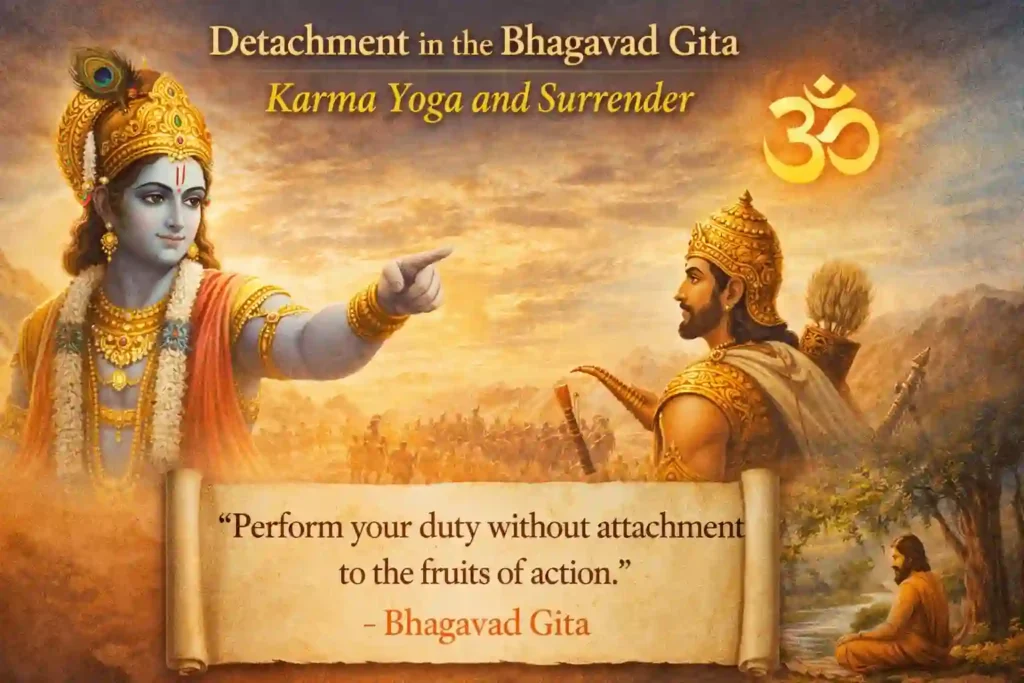
The practical teaching of detachment appears clearly in the Bhagavad Gita.
Arjuna is emotionally overwhelmed. He wants to withdraw. But Krishna teaches him Karma Yoga.
Perform your duty without attachment to the fruits of action.
This is Nishkama Karma.
Detachment in Hindu philosophy does not cancel action. It purifies action. You act because it is right. You surrender the outcome. You remain steady in success and failure.
This transforms work into worship.
Detachment in Hindu philosophy and karma theory
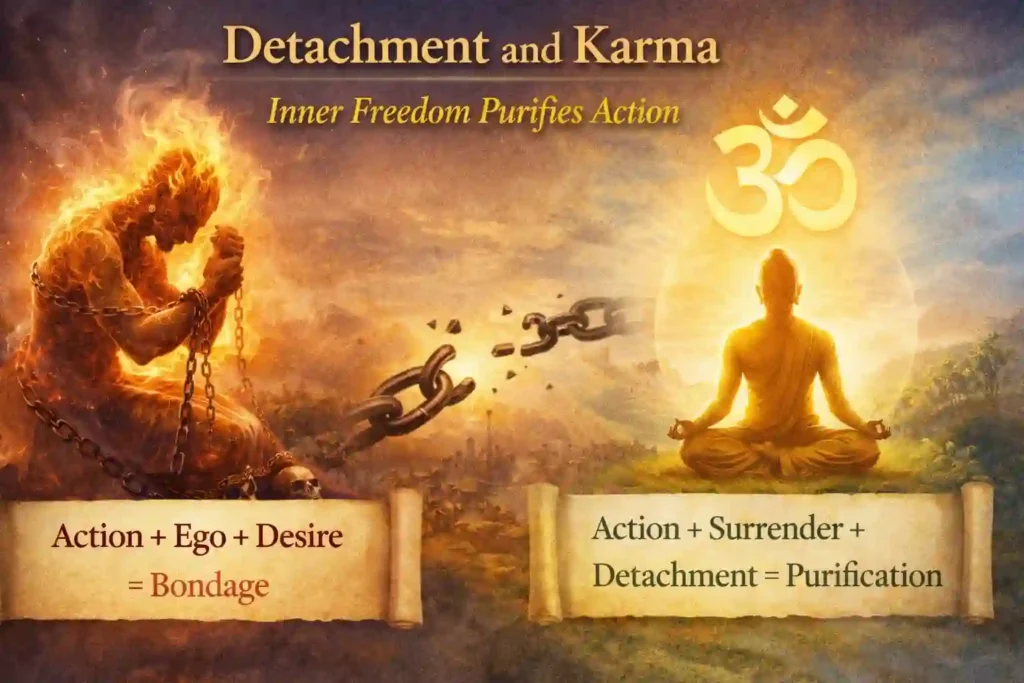
Karma binds when ego and desire dominate action.
Action + Ego + Desire = Bondage
Action + Surrender + Detachment = Purification
When actions are performed with clinging, they leave residue. That residue binds the subtle self, the Atman, to cycles of rebirth.
Detachment changes the inner intention. The action may look the same outwardly, but inwardly it no longer creates the same bondage.
This is why detachment and Moksha are deeply connected. This is why detachment in Hindu philosophy is not just psychological balance but a spiritual necessity for Moksha.
The three gunas and inner clarity
Hindu philosophy describes three gunas: Sattva, Rajas, and Tamas.
Rajas creates restlessness and desire.
Tamas creates confusion and inertia.
Sattva brings clarity.
As Sattva increases, awareness becomes sharper. You observe thoughts and emotions without being swept away by them.
Vairagya grows naturally with Sattva. It cannot be forced.
Philosophical schools and Vairagya
In Advaita Vedanta, taught by Adi Shankaracharya, detachment arises from discrimination between eternal and temporary reality.
In Vishishtadvaita, associated with Ramanuja, detachment grows through loving surrender to Narayana.
In Dvaita Vedanta, founded by Madhvacharya, detachment is humility before God’s supremacy.
Different philosophies. Same conclusion. Without Vairagya, liberation remains distant.
Detachment in daily life
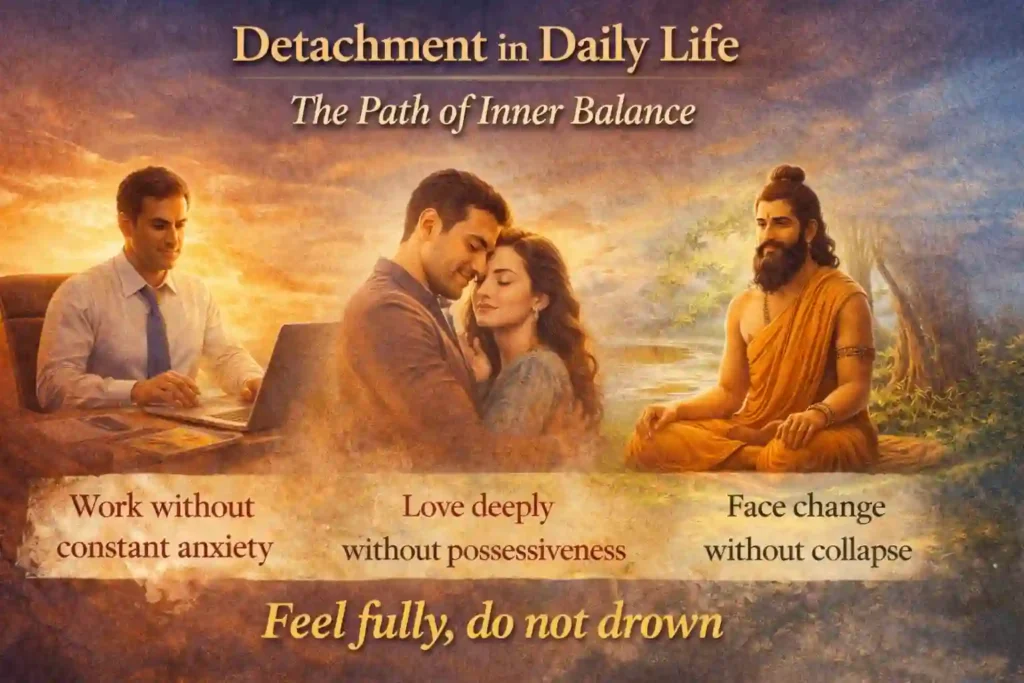
Detachment in Hindu philosophy is not only for monks. It is for householders, professionals, students, seekers.
It means:
Working sincerely without constant anxiety.
Loving deeply without possessiveness.
Accepting change without collapse.
Facing criticism without losing inner balance.
You feel fully, but you do not drown. That is emotional maturity.
False detachment
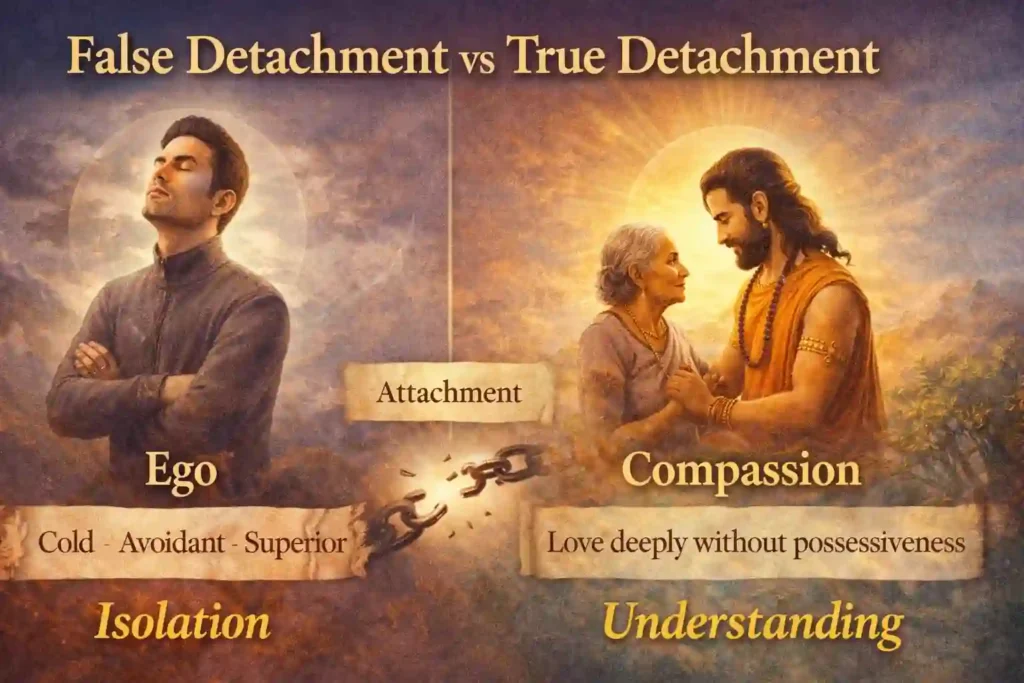
There is something that looks like detachment but is not.
Emotional avoidance is not detachment.
Cold superiority is not detachment.
Suppression is not detachment.
True detachment increases compassion. When ego softens, empathy grows.
The highest goal: Jivanmukti
The ultimate fruit of detachment is Jivanmukti, liberation while living.
The body acts.
The mind thinks.
Life continues.
But inwardly there is no bondage.
The Self remains untouched by praise or criticism, gain or loss. This is luminous freedom.
Detachment prepares the mind for this realization.
Conclusion
Detachment in Hindu philosophy is sacred maturity.
It is not escape from the world.
It is clarity within the world.
It is not emotional dryness.
It is emotional refinement.
Through Vairagya, action becomes pure.
Through Vairagya, karma loses its binding force.
Through Vairagya, the soul moves steadily toward Moksha.
And when that freedom stabilizes, life itself becomes liberation.
Suggested Reading
If this reflection resonated with you, you may also explore:
What Is Sanatan Dharma? Meaning & Core Principles
https://thesanatantales.com/what-is-sanatan-dharma-meaning-core-principles/
Saptapuri: The Seven Holi Cities in Sanatan Dharma
https://thesanatantales.com/saptapuri-seven-holy-cities/
What Is Brahma Muhurta and Why It Matters
https://thesanatantales.com/brahma-muhurta-meaning-benefits/
These teachings gently connect knowledge, devotion, and inner transformation. For more such articles please visit our website: www.thesanatantales.com.
FAQs
What is detachment in Hindu philosophy?
Detachment in Hindu philosophy means freedom from unhealthy attachment to results, possessions, and ego while continuing to fulfill responsibilities.
What is the meaning of Vairagya?
Vairagya means freedom from both attraction and aversion, allowing inner balance.
Is detachment the same as renunciation?
No. Renunciation is an outer lifestyle choice. Detachment is an inner state.
Why is detachment important for Moksha?
Because attachment binds the soul to karma and rebirth. Detachment weakens that bondage.
Can householders practice detachment?
Yes. Hindu philosophy teaches that inner detachment can be practiced while living family life.
Does detachment mean not loving others?
No. It allows deeper love without possessiveness.
What is Nishkama Karma?
It is action performed without selfish desire for personal reward.
How can I begin practicing detachment?
Start by acting sincerely, accepting outcomes calmly, and reflecting on the temporary nature of all experiences.