
Sometimes a person begins to feel that life may be deeper than what appears on the surface.
The same routines, ambitions, and distractions that once felt exciting may slowly begin to feel incomplete. Questions begin to arise naturally. Why am I here? What is the purpose of life? Is there something deeper within me that I have not yet understood?
This inner transformation is often described as spiritual awakening. It does not mean leaving the world, rejecting responsibilities, or suddenly becoming a saint. Instead, it is the gradual awakening of inner awareness and a deeper understanding of one’s true nature.
In Sanatan Dharma, spiritual awakening is not seen as discovering something new. Rather, it is the gradual remembrance of the Atman, the eternal Self that has always existed within us. The Bhagavad Gita and the Upanishads describe this journey as moving from ignorance to Self-realization through knowledge, devotion, and inner experience.
In this article, you will learn the spiritual awakening meaning, the common spiritual awakening signs, the stages of spiritual awakening, and how spiritual awakening in Hinduism is understood through the timeless wisdom of Sanatan Dharma. You will also discover simple practices that can help support this beautiful inner journey.
Spiritual Awakening at a Glance
| Aspect | Summary |
|---|---|
| Meaning | Recognizing the Atman, the eternal Self beyond the body and mind. |
| Goal | Self-realization and ultimately Moksha. |
| How It Begins | Through self-inquiry, meditation, prayer, life experiences, or a sincere search for truth. |
| Common Signs | Greater awareness, compassion, inner peace, and reduced attachment to temporary pleasures. |
| Daily Practices | Meditation, japa, prayer, scriptural study, gratitude, and mindful living. |
| Scriptural Basis | Bhagavad Gita, Upanishads, and other teachings of Sanatan Dharma. |
Table of Contents
ToggleWhat Is Spiritual Awakening in Sanatan Dharma?
Spiritual awakening is the gradual realization that we are not merely the body, the mind, or the identities we carry in society. It is the beginning of recognizing our true nature beyond thoughts, emotions, and worldly roles.
According to Sanatan Dharma, this deeper awareness is the Atman, the eternal Self that remains unchanged while the body and mind continuously change. The Upanishads describe the Atman as pure consciousness, while the Bhagavad Gita teaches that it is unborn, eternal, and indestructible.
Long before the modern term Spiritual Awakening became popular, the ancient rishis of Sanatan Dharma explored the nature of consciousness, the Atman, and the purpose of human life. Through deep meditation, self-inquiry, and direct spiritual experience, they taught that lasting peace comes from realizing the eternal Self within rather than seeking happiness only in the external world.
As Spiritual Awakening begins, a person’s perspective on life gradually changes. Success, possessions, and external recognition no longer become the sole source of happiness. Instead, inner peace, wisdom, compassion, and self-understanding begin to hold greater value.
This transformation usually happens slowly rather than all at once. Like a flower unfolding one petal at a time, Spiritual Awakening deepens through self-inquiry, spiritual practice, and life’s experiences. Each step brings a clearer understanding of our relationship with the Atman, Dharma, and the Supreme Reality.
Although every person’s journey is unique, the ultimate purpose of Spiritual Awakening in Sanatan Dharma is to move from ignorance (Avidya) toward Self-realization, where one experiences the divine presence within and recognizes the same consciousness in all living beings.
This timeless wisdom, preserved in the Bhagavad Gita and the Upanishads, continues to guide spiritual seekers even today.
What Do Hindu Scriptures Teach About Spiritual Awakening?
Bhagavad Gita (2.20) teaches that the Atman is never born and never dies. It is eternal, indestructible, and beyond the physical body. Spiritual Awakening begins when a person starts identifying with this eternal Self rather than temporary worldly identities.
The Upanishads repeatedly explain that the purpose of human life is to realize the unity of the individual Self (Atman) with the Supreme Reality (Brahman). This realization is the foundation of true spiritual wisdom in Sanatan Dharma.
These teachings remind us that Spiritual Awakening is not about gaining something new. It is about removing ignorance (Avidya) and recognizing the divine consciousness that has always existed within us.
How Does Spiritual Awakening Begin?
For many people, Spiritual Awakening begins during moments of deep reflection or significant life changes. An unexpected challenge, personal loss, success that feels empty, or a profound spiritual experience can inspire a person to look beyond the surface of everyday life.
For others, the journey begins more quietly through meditation, prayer, mantra chanting, reading sacred scriptures, or simply developing a sincere desire to understand the true purpose of life. There is no single path, and every individual’s experience is unique.
These experiences gradually shift a person’s attention from the outer world of constant activity to the inner world of awareness. Instead of seeking lasting happiness only through external achievements, the mind naturally begins searching for something deeper and more permanent.
In Sanatan Dharma, this inward journey is known as self-inquiry (Atma Vichara), the sincere search to understand one’s true nature. As this awareness grows, a person slowly realizes that lasting peace is found not in worldly possessions but in recognizing the Atman, the eternal Self that exists within every living being.
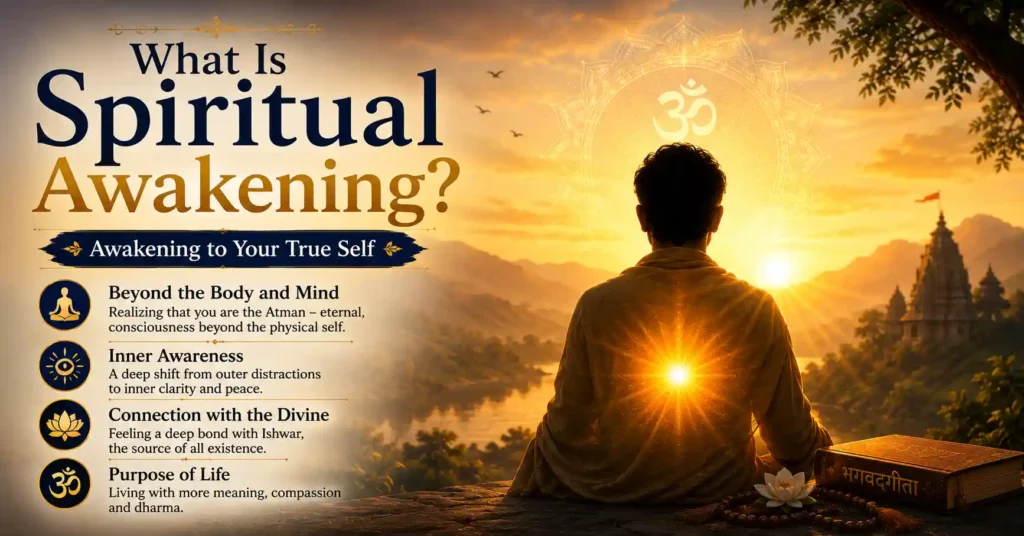
Did You Know?
According to Sanatan philosophy, the goal of Spiritual Awakening is not to gain extraordinary powers or escape the world.
Its true purpose is to recognize the Atman, the eternal Self, and live with greater wisdom, compassion, and inner peace while fulfilling one’s Dharma.
Who Can Benefit from Spiritual Awakening?
Spiritual Awakening is not limited to monks, saints, or people living in ashrams. Anyone with a sincere desire to understand themselves and live with greater awareness can begin this inner journey.
Whether you are a student, a working professional, a homemaker, or a retired person, the principles of Sanatan Dharma encourage spiritual growth while fulfilling your daily responsibilities. Every step taken with sincerity, patience, and self-reflection helps deepen inner awareness.
Common Signs of Spiritual Awakening
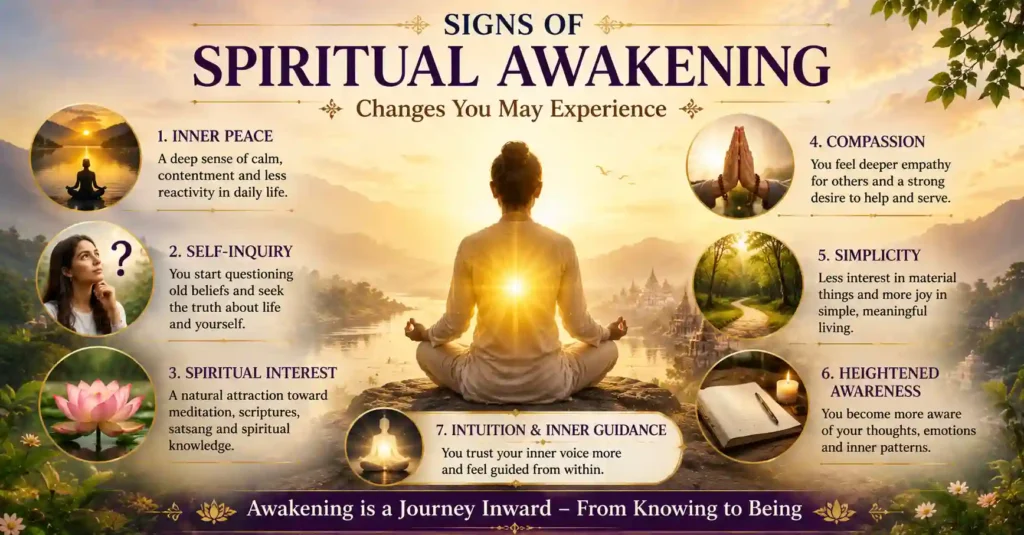
Spiritual Awakening does not look the same for everyone. Every person’s journey is unique, and no single experience proves that someone has awakened spiritually. However, many seekers notice certain gentle changes in their thoughts, emotions, habits, and priorities as their inner awareness begins to deepen.
1. Waking During Brahma Muhurta
Some people naturally begin waking up during the early morning hours, often between Brahma Muhurta and sunrise, without setting an alarm. In Sanatan Dharma, Brahma Muhurta is considered an ideal time for meditation, prayer, and self-reflection because the mind is naturally calmer. While not everyone experiences this, many seekers feel drawn to silence and spiritual practice during these peaceful hours.
2. Preferring Simpler Food
As awareness grows, some people naturally develop a preference for lighter and simpler meals. This change is usually gradual rather than forced. Many seekers feel more comfortable eating fresh, balanced food that supports physical and mental clarity.
3. Responding with Greater Calm
Situations that once caused anger, worry, or frustration may no longer create the same emotional reaction. This does not mean emotions disappear. Rather, a person gradually becomes more aware of them and learns to respond with greater patience, understanding, and balance.
4. Losing Interest in Constant Stimulation
Many people begin enjoying quiet moments more than constant entertainment or unnecessary distractions. Time spent in nature, meditation, meaningful conversations, or reading spiritual literature often becomes more fulfilling than endless external stimulation.
5. Changes in Habits and Priorities
Favourite activities, social circles, or daily routines may gradually change as personal values evolve. These changes are usually natural and reflect an increasing desire to live with greater simplicity, purpose, and inner peace.
6. Growing Compassion and Kindness
As awareness deepens, compassion often develops naturally. Helping others, forgiving mistakes, and understanding different perspectives become easier because a person begins seeing the shared humanity in everyone.
7. A Natural Interest in Spiritual Wisdom
Many seekers become curious about meditation, mantra chanting, the Bhagavad Gita, the Upanishads, and the teachings of saints and sages. This interest usually arises from a genuine desire to understand life rather than from mere curiosity.
8. Questioning the Purpose of Life
One of the most common spiritual awakening signs is the quiet question that keeps returning:
What is the true purpose of life?
Instead of seeking temporary satisfaction, a person begins searching for lasting truth, inner peace, and Self-realization. In Sanatan Dharma, this sincere inquiry marks the beginning of a deeper spiritual journey.
9. Becoming Less Attached to Material Success
Achievements, possessions, and social recognition may gradually lose their hold on the mind. This does not mean abandoning worldly responsibilities. Rather, a person learns to perform their Dharma while becoming less dependent on external success for lasting happiness.
Stages of Spiritual Awakening in Sanatan Dharma
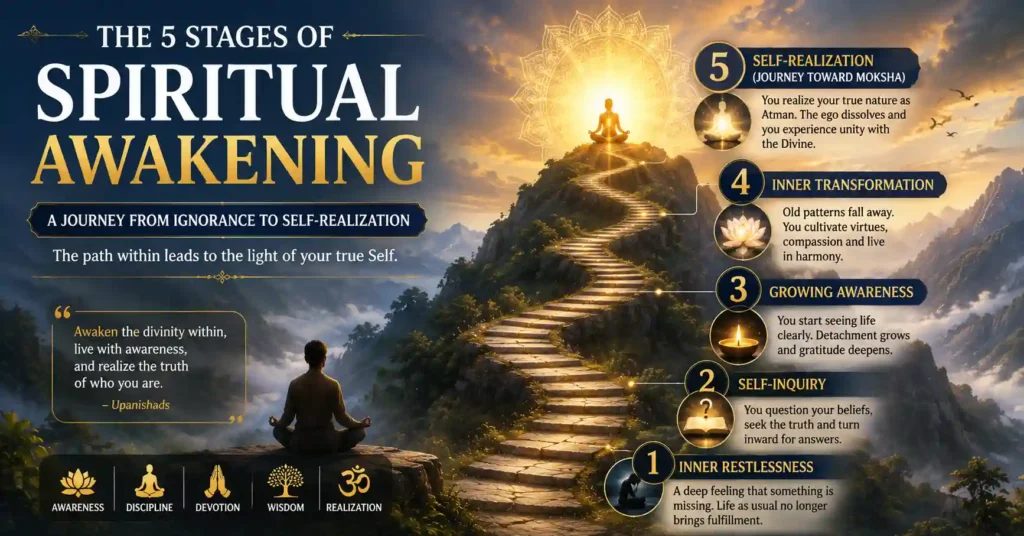
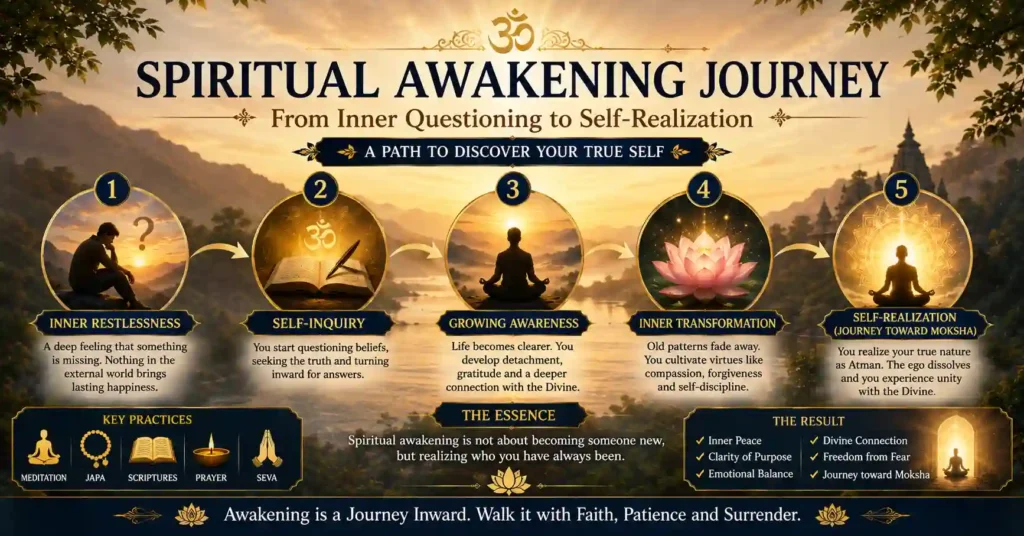
Although every person’s journey is unique, many seekers experience Spiritual Awakening as a gradual process rather than a single life-changing event. The pace and experiences may differ, but the journey often follows a natural progression.
| Stage | Description |
|---|---|
| Inner Restlessness | A person begins questioning the purpose of life and feels that worldly success alone cannot provide lasting happiness. |
| Self-Inquiry | Curiosity about the true Self grows through reflection, meditation, prayer, or the study of spiritual wisdom. |
| Growing Awareness | The seeker develops greater compassion, inner peace, and reduced attachment to temporary pleasures and external validation. |
| Inner Transformation | Thoughts, habits, and priorities gradually change as spiritual understanding becomes part of daily life. |
| Self-realization | The ultimate goal in Sanatan Dharma is realizing the Atman, leading the seeker toward lasting peace and ultimately Moksha. |
These stages should not be viewed as fixed rules or a checklist. Some people move through them gradually, while others may experience different stages at different times. In Sanatan Dharma, Spiritual Awakening is a lifelong journey of continuous learning, inner growth, and Self-realization.
Spiritual Awakening, Self-realization and Moksha
| Concept | Meaning |
|---|---|
| Spiritual Awakening | The beginning of becoming aware of your true nature beyond the body and mind. |
| Self-realization | The direct realization and experience of the Atman, the eternal Self. |
| Moksha | Liberation from the cycle of birth and death through complete spiritual realization and union with the Supreme Reality. |
Common Misconceptions About Spiritual Awakening
Spiritual Awakening does not mean rejecting the world, withdrawing from society, or giving up family and responsibilities. In Sanatan Dharma, true spiritual growth happens while living a balanced and responsible life.
It also does not mean becoming perfect, emotionless, or free from every challenge. Even spiritually awakened people continue to experience life’s ups and downs, but they gradually respond with greater wisdom, patience, and inner stability.
Another common misconception is that Spiritual Awakening gives a person special powers or makes them superior to others. In reality, genuine spiritual growth develops humility, compassion, and a deeper respect for all living beings.
Many spiritually aware people continue working, caring for their families, and fulfilling their Dharma while steadily developing greater inner awareness. Their outward life may appear ordinary, but their way of thinking and responding to life gradually changes.
Sanatan Dharma teaches that spiritual wisdom is not separate from everyday life. Instead, it helps us perform our duties with greater awareness, compassion, and detachment while moving steadily toward Self-realization.
Common Mistakes to Avoid During Spiritual Awakening
During Spiritual Awakening, it is easy to misunderstand certain experiences or develop unrealistic expectations. Keeping a balanced perspective helps make the journey healthier and more meaningful.
- Do not compare your journey with others. Every seeker’s path unfolds at its own pace.
- Do not expect instant transformation. Spiritual growth is gradual and requires patience.
- Do not neglect your family or responsibilities. Sanatan Dharma encourages fulfilling your Dharma while growing spiritually.
- Do not chase extraordinary experiences or supernatural powers. Inner peace, wisdom, and compassion are more meaningful signs of genuine progress.
- Do not become discouraged by difficult phases. Moments of confusion and self-doubt are often part of the journey toward greater understanding.
How Spiritual Awakening Changes Daily Life
As Spiritual Awakening deepens, the changes are often seen in everyday life rather than in extraordinary experiences. A person may continue living the same outward life, but their thoughts, choices, and responses gradually become more balanced.
Small situations that once caused stress, anger, or frustration are often handled with greater patience and understanding. Relationships become more compassionate, and decisions are guided by wisdom instead of impulse.
Many seekers also discover a stronger sense of gratitude, contentment, and purpose. Rather than constantly chasing external success, they begin finding lasting peace through self-awareness, meaningful actions, and living according to Dharma.
These changes develop naturally over time and reflect the quiet transformation that lies at the heart of Spiritual Awakening in Sanatan Dharma.
Simple Practices to Support Spiritual Awakening
Spiritual Awakening cannot be forced or rushed. It unfolds naturally as the mind becomes calmer, the heart becomes purer, and awareness gradually deepens. However, certain daily practices can help create the right inner environment for this transformation.
Quiet prayer, meditation, mantra chanting, reading the Bhagavad Gita, the Upanishads, or other spiritual wisdom, and spending time in silence can gently calm the mind and strengthen inner awareness.
Simple practices such as japa, self-reflection, mindful breathing, and expressing gratitude each day can also support the journey. Consistency is more important than intensity, and even a few minutes of sincere practice every day can bring meaningful inner change.
In Sanatan Dharma, these practices are not performed to chase extraordinary experiences. Their true purpose is to purify the mind, deepen Self-awareness, and gradually lead the seeker toward Self-realization.
Simple Daily Habits to Nurture Spiritual Growth
You do not need to make dramatic changes to begin your spiritual journey. Small, consistent steps often create the greatest inner transformation.
✔ Spend a few minutes in silent meditation or prayer.
✔ Read a verse from the Bhagavad Gita or another sacred scripture.
✔ Chant a simple mantra or practice japa with full attention.
✔ Reflect on your thoughts and actions before going to sleep.
✔ Perform at least one act of kindness without expecting anything in return.
✔ Spend a few quiet moments in nature or away from digital distractions.
✔ Be grateful for the blessings and lessons each day brings.
Remember, Spiritual Awakening is not about doing everything perfectly. It is about taking sincere steps every day with patience, humility, and devotion.
Spiritual Awakening, Meditation and Self-realization: What's the Difference?
| Concept | Meaning | Purpose |
|---|---|---|
| Spiritual Awakening | The beginning of recognizing one’s true nature beyond the body and mind. | Starts the journey of inner transformation. |
| Meditation | A spiritual practice that calms the mind and develops inner awareness. | Supports concentration, peace, and spiritual growth. |
| Self-realization | The direct experience of the Atman, the eternal Self. | Leads to lasting wisdom and spiritual liberation. |
Although these concepts are closely connected, they are not the same. Meditation is one of the practices that supports Spiritual Awakening, while Self-realization is a much deeper spiritual experience that develops through continuous inner growth and sincere practice.
A Gentle Truth About Spiritual Awakening
Spiritual Awakening is not a final destination but the beginning of a deeper inner journey. It unfolds gradually, revealing new insights and a clearer understanding of ourselves with each step.
Along the way, there may be moments of peace, moments of confusion, and moments of profound clarity. These experiences are a natural part of spiritual growth and help us develop greater patience, wisdom, and inner strength.
In Sanatan Dharma, Spiritual Awakening is understood as the gradual remembrance of our true nature, the Atman. As awareness deepens, a person begins to live with greater compassion, detachment, and harmony while steadily moving toward Self-realization and, ultimately, Moksha.
Rather than searching for extraordinary experiences, the true purpose of Spiritual Awakening is to discover the peace, wisdom, and divine presence that have always existed within.
Can Spiritual Awakening Be Lost?
Many seekers wonder whether Spiritual Awakening can disappear after it has begun. In most cases, the deeper understanding gained through genuine inner experience is not lost, but its intensity may seem to rise and fall as life presents new challenges.
There may be periods when daily responsibilities, stress, or distractions make a person feel less connected to their spiritual practice. This does not necessarily mean the awakening has ended. Rather, it is often an invitation to return to regular prayer, meditation, self-reflection, and mindful living.
According to Sanatan Dharma, spiritual growth is a continuous journey rather than a single event. Every sincere effort strengthens inner awareness and graduallyl eading the seeker toward Self-realization and, ultimately, Moksha.
Why Spiritual Awakening Matters in Today's World
Modern life is filled with constant distractions, competition, and information. While technology has made life more convenient, many people still struggle with stress, anxiety, loneliness, and a lack of inner fulfillment.
Spiritual Awakening does not ask us to reject modern life. Instead, it teaches us to live with greater awareness, balance, and purpose while fulfilling our daily responsibilities.
The wisdom of Sanatan Dharma reminds us that lasting happiness comes not from external achievements alone but from understanding our true nature. As inner awareness grows, we become better equipped to face life’s challenges with patience, compassion, and clarity.
For this reason, Spiritual Awakening remains just as relevant today as it was thousands of years ago. Its timeless principles continue to guide people toward a more peaceful, meaningful, and spiritually fulfilling life.
Conclusion
Spiritual Awakening often begins quietly through small shifts in awareness, habits, and priorities. Waking up earlier, seeking inner peace, questioning the deeper purpose of life, and developing compassion for others can all be gentle signs that this inner journey has begun.
In Sanatan Dharma, Spiritual Awakening is the gradual remembrance of the Atman, the eternal Self that exists within every being. It is not about escaping the world but about living with greater awareness, wisdom, and compassion while fulfilling one’s Dharma.
Whether your journey begins through meditation, prayer, self-inquiry, or life’s experiences, every sincere step brings you closer to understanding your true nature. As awareness deepens, life gradually becomes clearer, calmer, and more meaningful, leading the seeker toward Self-realization and, ultimately, Moksha.
This version provides a more complete ending by naturally reinforcing the focus keyword, incorporating key Sanatan concepts such as Atman, Dharma, Self-realization, and Moksha, and leaving readers with a meaningful final takeaway.
Key Takeaways
- Spiritual Awakening is the gradual realization of your true nature beyond the body and mind.
- In Sanatan Dharma, it is the journey toward recognizing the Atman, the eternal Self.
- The journey often begins with self-inquiry, life experiences, meditation, prayer, or a sincere search for life’s deeper purpose.
- Common signs include greater inner peace, compassion, reduced attachment, and a growing interest in spiritual wisdom.
- Spiritual Awakening is not about escaping worldly life but about fulfilling your Dharma with greater awareness and balance.
- Daily practices such as meditation, japa, prayer, and studying the Bhagavad Gita can support steady spiritual growth.
- The ultimate goal of this journey is Self-realization and, ultimately, Moksha.
Suggested Reading
If you enjoyed learning about Spiritual Awakening from the perspective of Sanatan Dharma, you may also like exploring these articles. Together, they explain the deeper principles of Sanatan philosophy, consciousness, Dharma, Karma, Self-realization, and the timeless wisdom that guides spiritual growth.
Sanatan Dharma: Meaning, Origin, Core Principles and Way of Life
https://thesanatantales.com/sanatan-dharma-meaning/
Sri Vidya: Meaning, Philosophy, Sri Chakra and the Sacred Path of Lalita Tripura Sundari
https://thesanatantales.com/sri-vidya-meaning/
Chausath Yogini (64 Yogini): Story, Names, Temples and Spiritual Significance
https://thesanatantales.com/chausath-yogini/
Does the Soul Choose Its Next Journey? The Mystery of Rebirth and Consciousness
https://thesanatantales.com/does-the-soul-choose-its-next-journey/
What Are the Four Purusharthas? A Simple Guide to Dharma, Artha, Kama and Moksha
https://thesanatantales.com/four-purusharthas/
Sattva Rajas Tamas: Meaning, Examples and Role in Daily Life
https://thesanatantales.com/sattva-rajas-tamas/
Vairagya is Trending, but Sthitpragya is the Original Mindset
https://thesanatantales.com/vairagya-vs-sthitpragya/
Karma Yoga Meaning: Action without Attachment
https://thesanatantales.com/karma-yoga-meaning/
FAQs
What is Spiritual Awakening in Sanatan Dharma?
Spiritual Awakening in Sanatan Dharma is the gradual realization that we are more than the body and mind. It is the process of recognizing the Atman, the eternal Self that exists within every living being.
The Bhagavad Gita and the Upanishads describe this journey as moving from ignorance to Self-realization through wisdom, devotion, and spiritual practice. It is not a sudden event but a lifelong path of inner transformation.
What are the most common Spiritual Awakening signs?
Some common Spiritual Awakening signs include greater self-awareness, a desire for inner peace, growing compassion, reduced attachment to material success, and a deeper interest in meditation or spiritual wisdom.
Not everyone experiences the same signs. Every person’s journey is unique, and these changes usually appear gradually rather than all at once.
What are the stages of Spiritual Awakening?
The stages of Spiritual Awakening often begin with inner questioning and a search for life’s deeper meaning. As awareness grows, a person develops greater self-understanding, compassion, and detachment from temporary pleasures.
According to Sanatan Dharma, this journey gradually leads toward Self-realization and, ultimately, Moksha. The pace of this transformation is different for every individual.
Is Spiritual Awakening mentioned in Hindu scriptures?
Yes. Spiritual Awakening in Hinduism is deeply rooted in the Bhagavad Gita, the Upanishads, and other sacred texts of Sanatan Dharma.
These scriptures teach that the purpose of human life is to realize the Atman, understand one’s true nature, and experience unity with the Supreme Reality through righteous living and spiritual practice.
Can Spiritual Awakening happen without meditation?
Yes. Meditation is a powerful practice, but it is not the only path. Spiritual Awakening may begin through prayer, selfless service, devotion, self-inquiry, reading sacred scriptures, or profound life experiences.
In Sanatan Dharma, sincerity, regular practice, and inner purity are considered more important than following a single method.
Does Spiritual Awakening mean leaving family and worldly life?
No. One of the biggest misconceptions is that Spiritual Awakening requires renouncing family or worldly responsibilities.
Sanatan Dharma teaches that a person can continue fulfilling their Dharma while developing greater wisdom, compassion, and inner awareness. True spirituality transforms how we live, not where we live.
What is the difference between Spiritual Awakening and Self-realization?
Spiritual Awakening is the beginning of becoming aware of one’s true nature. Self-realization is the deeper experience of directly knowing the Atman beyond the body, mind, and ego.
In Sanatan philosophy, awakening opens the path, while Self-realization represents a much deeper stage of spiritual understanding.
How can I support my Spiritual Awakening naturally?
Simple daily practices such as meditation, mantra chanting, japa, prayer, self-reflection, reading the Bhagavad Gita, and spending time in silence can support Spiritual Awakening.
The goal is not to force spiritual experiences but to cultivate a calm, pure, and attentive mind that allows inner awareness to grow naturally.
Glossary of Important Terms
| Term | Meaning |
|---|---|
| Spiritual Awakening | The gradual realization of one’s true nature beyond the body and mind. It marks the beginning of a deeper journey toward Self-realization and inner transformation. |
| Atman | The eternal Self or soul that exists within every living being. It is beyond the body, mind, and emotions and is the true essence of who we are. |
| Self-realization | The direct experience of the Atman, where a person realizes their true spiritual identity beyond the ego and worldly attachments. |
| Sanatan Dharma | The eternal way of life and spiritual wisdom that teaches Dharma, Karma, compassion, and the pursuit of Self-realization. |
| Bhagavad Gita | One of the most revered scriptures of Sanatan Dharma, teaching righteous action, devotion, Self-knowledge, and the path to liberation. |
| Upanishads | Ancient philosophical scriptures that explain the nature of the Atman, Brahman, consciousness, and the ultimate purpose of human life. |
| Brahma Muhurta | The sacred period before sunrise, traditionally regarded as the best time for meditation, prayer, and spiritual practices. |
| Japa | The repeated chanting of a sacred mantra, silently or aloud, to calm the mind and deepen spiritual awareness. |
| Mantra | A sacred word, sound, or phrase repeated during meditation or prayer to focus the mind and cultivate devotion. |
| Meditation | The practice of calming the mind and turning awareness inward to develop concentration, peace, and Self-awareness. |
| Dharma | Righteous living and fulfilling one’s duties in harmony with moral, spiritual, and universal principles. |
| Karma | The universal law of cause and effect, where every thought, word, and action creates consequences that influence future experiences. |
| Avidya | Spiritual ignorance or misunderstanding of one’s true nature. Overcoming Avidya is considered the first step toward Spiritual Awakening. |
| Brahman | The infinite, eternal, and formless Supreme Reality from which all existence arises and into which everything ultimately returns. |
| Moksha | Liberation from the cycle of birth and death through the realization of one’s true Self and union with the Supreme Reality. |
About the Author
Yateendra Chaturvedi is a spiritual writer, researcher, devotee, and the founder of The Sanatan Tales. With over 35 years of professional experience and a lifelong interest in Sanatan Dharma, he writes about Hindu deities, temples, scriptures, festivals, Mahavidyas, sacred stories, rituals, and living traditions that continue to guide and inspire devotees across India.
Drawing from traditional scriptures, regional beliefs, temple traditions, devotional literature, and historical sources, he aims to present authentic, well-researched, and easy-to-understand content for modern readers. His work focuses on preserving spiritual wisdom, explaining sacred traditions, and helping seekers develop a deeper understanding of India’s rich spiritual heritage.
Through The Sanatan Tales, Yateendra strives to make the timeless teachings of Sanatan Dharma simple, meaningful, and relevant for today’s generation while maintaining respect for traditional sources, regional practices, and diverse spiritual perspectives.
Learn More About Yateendra Chaturvedi →
https://thesanatantales.com/about-the-author/
References & Sources
This article is based on the spiritual philosophy and teachings of Sanatan Dharma, with insights drawn from revered Hindu scriptures such as the Bhagavad Gita and the Upanishads, along with traditional spiritual knowledge and widely accepted religious study sources on consciousness, the Atman, Self-realization, and spiritual growth.
Note: Spiritual Awakening is understood and interpreted in different ways across various traditions, sampradayas, and philosophical schools within Sanatan Dharma. The purpose of this article is not to present any single interpretation as the absolute truth, but to explain widely accepted spiritual and philosophical perspectives in a simple, respectful, and easy-to-understand manner.
Read More Interesting Articles on Sanatan Dharma