The Samudra Manthan Story is one of the most important and fascinating narratives in Sanatan Dharma. It tells the story of how the devas and asuras joined forces to perform the Churning of the Ocean of Milk in search of Amrit, the nectar of immortality.
During this extraordinary event, many divine treasures emerged, including Goddess Lakshmi, but it also brought forth the deadly Halahala poison that threatened all of creation.
A defining moment in the Samudra Manthan Story is when Lord Shiva drank Halahala and became Neelkanth to protect the universe. His selfless act of sacrifice remains one of the most revered episodes in Hindu tradition and continues to inspire devotees around the world.
In this article, you will discover the complete Samudra Manthan Story, learn why the ocean was churned, understand how Lord Shiva became Neelkanth, explore the treasures that emerged from the cosmic ocean, and uncover the spiritual lessons and significance of this timeless event in Sanatan Dharma.
Table of Contents
ToggleSamudra Manthan Story Snapshot
| Aspect | Details |
|---|---|
| Main Characters | Lord Shiva, Maa Parvati, Lord Vishnu, Lord Indra, Sage Durvasa, Devas, Asuras, Vasuki, Dhanvantari |
| Source | Bhagavata Purana, Vishnu Purana, Mahabharata, Kurma Purana, traditional retellings of Sanatan Dharma |
| Theme | Sacrifice, cooperation, divine intervention, protection of creation, and the triumph of Dharma |
| Key Lesson | True greatness lies in selfless sacrifice. Lord Shiva’s act of drinking Halahala teaches compassion, responsibility, and the willingness to protect others even at personal cost. |
Samudra Manthan Story: Why Lord Shiva Drank Halahala and Became Neelkanth
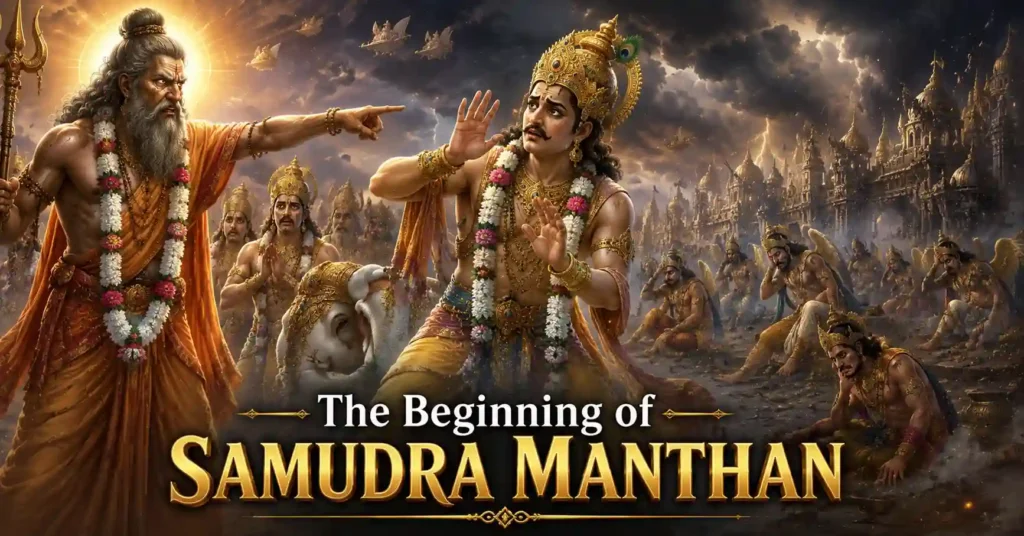
The Samudra Manthan Story begins with an event that changed the balance of the universe. One day, Sage Durvasa gifted Lord Indra a divine garland blessed with spiritual power and prosperity.
Instead of honoring the sacred gift, Indra placed it on his elephant Airavata. The elephant threw the garland to the ground and trampled it. Seeing this disrespect, Sage Durvasa became angry and cursed Indra and the devas.
As a result of the curse, the devas gradually lost their strength, prosperity, and divine radiance. Their power weakened, while the asuras grew stronger and began dominating the three worlds.
Unable to defend themselves, the devas approached Lord Vishnu and sought his guidance. They prayed for a solution that would restore their strength and protect the universe from falling into chaos.
Lord Vishnu advised the devas to make peace with the asuras temporarily and work together to perform the Churning of the Ocean of Milk. He explained that the cosmic ocean contained Amrit, the nectar of immortality, which could restore their lost power.
Following Vishnu’s advice, the devas approached the asuras with a proposal. Tempted by the promise of immortality, the asuras agreed to participate in the great undertaking.
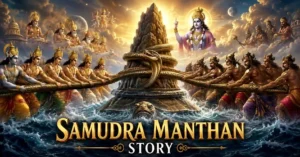
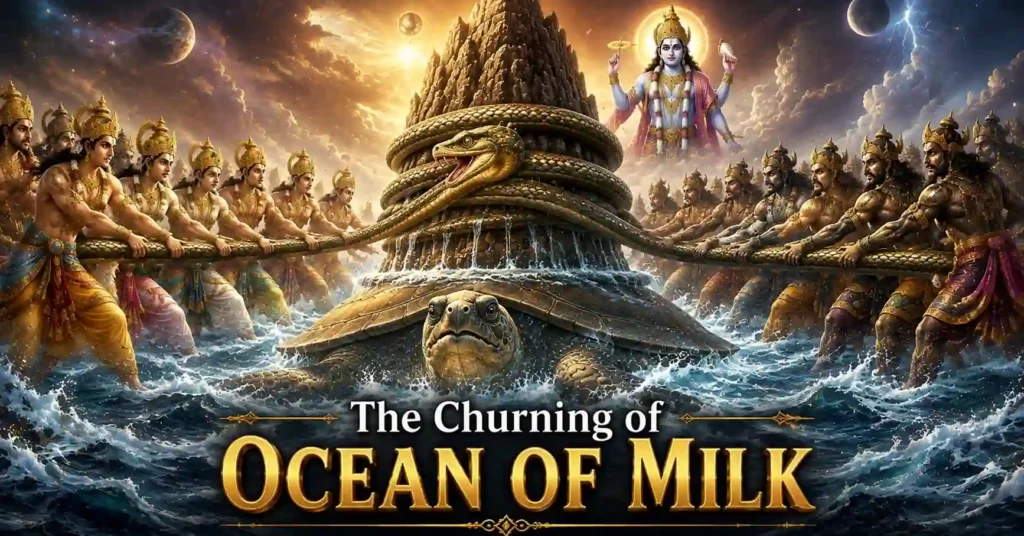
To begin the churning, Mount Mandara was chosen as the churning rod. The mighty serpent Vasuki agreed to serve as the rope that would be pulled by both sides.
However, as the mountain was carried toward the ocean, it slipped and fell because of its immense weight. Seeing their struggle, Lord Vishnu used his divine power to place the mountain in position.
When the churning began, another problem arose. Mount Mandara started sinking into the depths of the ocean because it lacked a stable foundation.
To support the mountain, Lord Vishnu assumed the form of Kurma Avatar, the divine tortoise. Resting beneath the ocean, he carried the enormous mountain on his back and ensured that the churning could continue.
With the mountain stabilized, the devas and asuras pulled Vasuki from opposite sides. The great Samudra Manthan continued with tremendous force, causing the Ocean of Milk to churn and shake the cosmos.
As the churning progressed, something unexpected emerged before any treasure or nectar could appear.
A terrifying poison known as Halahala rose from the depths of the ocean. The poison was so deadly that its fumes began spreading throughout the universe.
The devas, asuras, sages, and celestial beings were filled with fear. The poison threatened to destroy all forms of life and bring creation itself to an end.
Realizing that no one else could stop the catastrophe, the devas turned to Lord Shiva and prayed for help. They knew that only Mahadev possessed the strength and compassion needed to save the universe.
Hearing their prayers, Lord Shiva decided to intervene for the welfare of all beings.
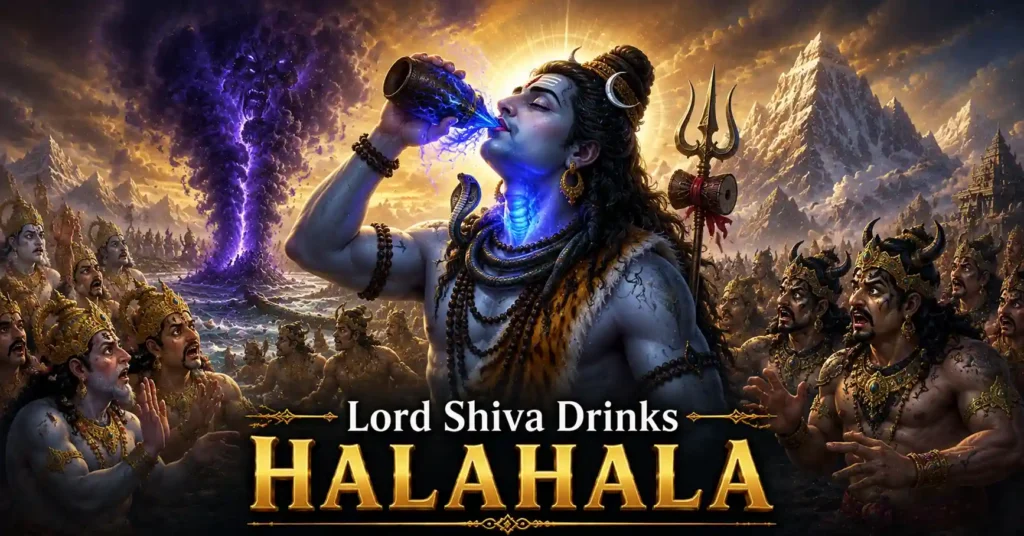
Without hesitation, he gathered the deadly poison and drank it. His selfless act prevented the Halahala from spreading across creation and destroying the worlds.
As the poison entered his body, Maa Parvati understood the danger. To protect Lord Shiva, she gently stopped the poison from moving beyond his throat.
The poison remained trapped there, turning Shiva’s throat a deep blue color. From that day onward, he became known as Neelkanth, meaning “the Blue-Throated One.”
The moment remains one of the most revered episodes in the Halahala Poison Story and a powerful example of divine sacrifice.
After the danger had passed, the Samudra Manthan Story continued. The devas and asuras resumed churning the Ocean of Milk, and many extraordinary treasures began to emerge.
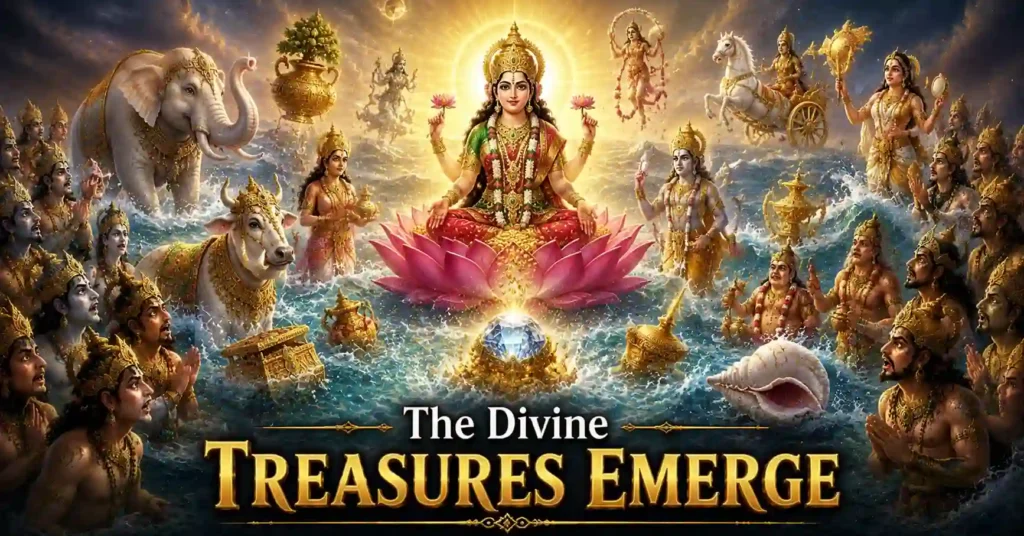
Among the divine treasures were Kamadhenu, the wish-fulfilling cow, Airavata, the celestial elephant, Kalpavriksha, the wish-fulfilling tree, and the radiant Kaustubha gem.
The moon, Chandra, also emerged from the ocean and later became associated with Lord Shiva.
One of the most celebrated moments occurred when Goddess Lakshmi emerged from the Ocean of Milk seated upon a lotus. The devas and sages welcomed her with great devotion, and she chose Lord Vishnu as her eternal consort.
As the churning continued, more divine treasures appeared, blessing the universe with prosperity, beauty, and abundance.
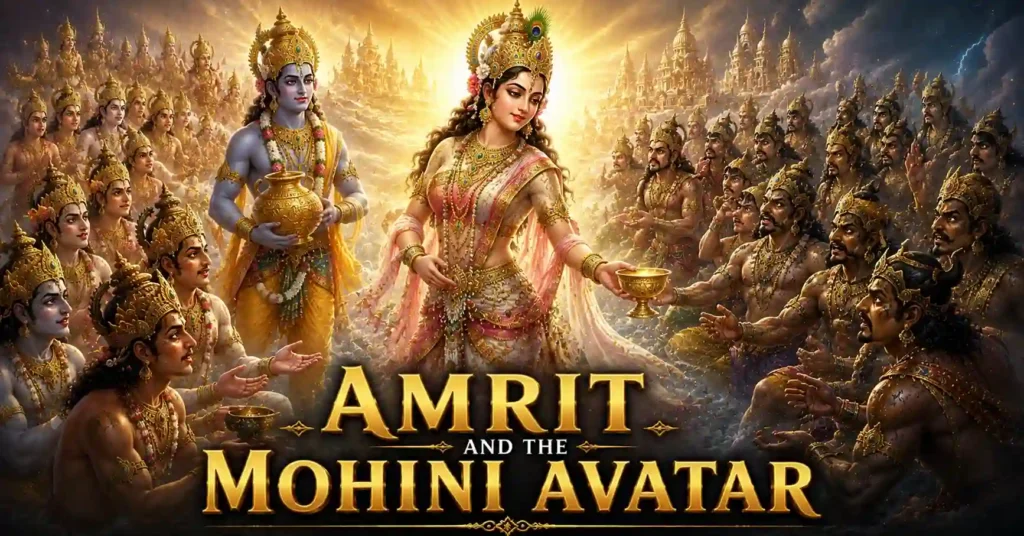
Eventually, Lord Dhanvantari emerged carrying a golden vessel filled with Amrit, the nectar of immortality. The sight of the nectar immediately created excitement among both the devas and asuras.
The asuras quickly seized the vessel and attempted to keep the Amrit for themselves. Fearing that the balance of the universe would be disrupted, Lord Vishnu devised a plan.
He assumed the enchanting form of Mohini Avatar, a divine maiden of extraordinary beauty and charm.
Captivated by Mohini, the asuras agreed to let her distribute the nectar. Using wisdom and divine strategy, Mohini ensured that the Amrit was given to the devas.
As a result, the devas regained their strength and divine power. Cosmic balance was restored, and the forces of Dharma once again prevailed.
The Samudra Manthan Story remains one of the most profound narratives in Sanatan Dharma. While many treasures emerged from the Ocean of Milk, the event is especially remembered for the compassion of Lord Shiva, whose willingness to drink Halahala and become Neelkanth saved all of creation.
What Does the Samudra Manthan Story Teach Us?
The Samudra Manthan Story offers profound spiritual lessons that remain relevant for devotees even today. While the narrative describes a cosmic event involving devas, asuras, and divine beings, its teachings extend far beyond mythology.
1. Great Rewards Often Require Patience and Effort
The devas and asuras did not obtain Amrit immediately. Before the nectar emerged, they had to overcome numerous challenges and continue their efforts despite setbacks.
The story reminds us that meaningful achievements often require perseverance, dedication, and patience.
2. Selfless Sacrifice Protects the World
One of the most powerful moments in the Samudra Manthan Story is when Lord Shiva drank the deadly Halahala poison.
Without considering His own safety, He chose to protect all of creation. This teaches the importance of selflessness, compassion, and serving the greater good.
3. Cooperation Can Achieve Extraordinary Results
Although the devas and asuras were rivals, they temporarily worked together to accomplish a common goal.
The story shows that cooperation and unity can help overcome challenges that may seem impossible to face alone.
4. Divine Wisdom Is as Important as Strength
The success of the Churning of the Ocean of Milk depended not only on physical effort but also on divine guidance from Lord Vishnu.
His wisdom, including the forms of Kurma and Mohini, ensured that Dharma ultimately prevailed.
5. Challenges Often Appear Before Blessings
Before the divine treasures and Amrit emerged, the deadly Halahala poison surfaced from the ocean.
This aspect of the Samudra Manthan Story teaches that difficulties sometimes arise before success, and faith is essential during challenging times.
6. Ego and Greed Can Lead to Downfall
When the Amrit appeared, the asuras attempted to claim it for themselves.
Their greed clouded their judgment and ultimately prevented them from obtaining the nectar. The story encourages humility, self-control, and righteous conduct.
7. The Story Reflects the Inner Spiritual Journey
Many spiritual teachers interpret the Samudra Manthan Story symbolically.
The ocean represents the human mind, the churning symbolizes spiritual effort, the poison represents negative tendencies, and the Amrit represents wisdom, self-realization, and spiritual growth.
8. Dharma Ultimately Prevails
Throughout the story, numerous obstacles threatened the success of the churning.
Yet through faith, perseverance, divine grace, and righteous action, cosmic balance was restored. This timeless lesson continues to inspire devotees to remain steadfast on the path of Dharma.
Why Is the Samudra Manthan Story Important in Sanatan Dharma?
The Samudra Manthan Story holds a special place in Sanatan Dharma because it brings together many of the core teachings of Hindu philosophy, including sacrifice, devotion, cooperation, divine intervention, and the triumph of Dharma.
It is not merely a story about the Churning of the Ocean of Milk. It is a profound spiritual narrative that explains how divine forces work to preserve balance and protect creation.
1. It Highlights Lord Shiva’s Supreme Compassion
One of the most important reasons the Samudra Manthan Story is revered is because it explains how Lord Shiva became Neelkanth.
When the deadly Halahala poison threatened all existence, Lord Shiva willingly drank it to save the universe.
His sacrifice represents selfless service and unconditional compassion for all beings.
2. It Demonstrates the Protective Role of the Divine
Throughout the story, Lord Vishnu and Lord Shiva intervene at crucial moments to ensure that creation is protected.
From the Kurma Avatar supporting Mount Mandara to Shiva drinking the poison and Vishnu appearing as Mohini, the story shows how the Divine guides and preserves cosmic order.
3. It Explains the Origin of Many Sacred Traditions
The Samudra Manthan Story is associated with several important figures and symbols in Hindu tradition.
The emergence of Goddess Lakshmi, Dhanvantari, Chandra, Kamadhenu, Airavata, and Amrit connects the story to many festivals, rituals, and devotional practices observed by Hindus today.
4. It Reveals the Importance of Divine Shakti
The episode in which Maa Parvati prevents the Halahala poison from spreading through Shiva’s body highlights the significance of Divine Shakti.
Without her intervention, the consequences of the poison could have been far greater.
The story therefore emphasizes the complementary roles of Shiva and Shakti in sustaining creation.
5. It Contains Deep Spiritual Symbolism
Many saints and spiritual teachers interpret the Samudra Manthan Story as a representation of the inner spiritual journey.
The ocean symbolizes the mind, the churning represents spiritual practice, the poison represents negative tendencies, and the Amrit symbolizes spiritual wisdom and self-realization.
This deeper symbolism gives the story lasting relevance for seekers on the spiritual path.
6. It Teaches That Dharma Requires Effort and Perseverance
The devas did not regain their strength immediately.
They faced obstacles, setbacks, and dangers before eventually obtaining the nectar of immortality.
The story reminds devotees that success, spiritual growth, and the restoration of Dharma often require patience, faith, and persistent effort.
7. It Celebrates the Victory of Cosmic Balance
The ultimate outcome of the Samudra Manthan Story is the restoration of harmony in the universe.
Through divine guidance, sacrifice, and righteous action, the forces of Dharma prevailed over chaos and imbalance.
This message continues to inspire devotees to remain committed to truth, duty, and spiritual growth in their own lives.
8. It Remains One of the Most Influential Stories in Hindu Tradition
For centuries, the Samudra Manthan Story has been retold in scriptures, temples, festivals, devotional literature, and spiritual teachings.
Its lessons about sacrifice, wisdom, cooperation, and divine grace continue to inspire millions of devotees across generations.
The story remains a timeless reminder that even in the face of great challenges, faith and Dharma ultimately lead to victory.
Did You Know?
The Samudra Manthan Story contains many fascinating details that are often overlooked in brief retellings. Beyond explaining how Lord Shiva became Neelkanth, this sacred narrative is connected to several important deities, symbols, festivals, and spiritual teachings in Sanatan Dharma.
Here are some interesting facts about the Samudra Manthan Story that continue to inspire devotees today.
1. The Samudra Manthan Involved Both Devas and Asuras
Although they were rivals, the devas and asuras worked together during the Churning of the Ocean of Milk.
The story shows that even opposing forces can temporarily cooperate to achieve a greater goal.
2. Lord Vishnu Took the Form of a Giant Tortoise
When Mount Mandara began sinking into the ocean, Lord Vishnu appeared as Kurma Avatar, the divine tortoise.
He supported the mountain on His back and made the entire churning possible.
3. Halahala Appeared Before Any Treasure
Before the divine treasures and Amrit emerged, the deadly Halahala poison surfaced from the ocean.
This event symbolizes how challenges and difficulties often appear before success and blessings.
4. Lord Shiva Earned the Name Neelkanth
The most famous episode of the Samudra Manthan Story explains how Lord Shiva became Neelkanth.
After drinking the Halahala poison, His throat turned blue, giving Him the name Neelkanth, meaning “the Blue-Throated One.”
5. Maa Parvati Played a Crucial Role
Many people focus on Shiva drinking the poison, but Maa Parvati’s role was equally important.
She stopped the poison from spreading through His body, allowing it to remain in His throat.
6. Goddess Lakshmi Emerged from the Ocean of Milk
One of the most celebrated moments in the Samudra Manthan Story is the appearance of Goddess Lakshmi.
She emerged seated on a lotus and later chose Lord Vishnu as her eternal consort.
7. Fourteen Divine Treasures Emerged During the Churning
Traditional accounts mention that the Samudra Manthan produced fourteen sacred treasures known as the Ratnas.
These included Lakshmi, Airavata, Kamadhenu, Kaustubha, Kalpavriksha, Chandra, Dhanvantari, and Amrit.
8. Dhanvantari Is Revered as the Divine Physician
Lord Dhanvantari emerged from the ocean carrying the pot of Amrit.
He is worshipped as the divine physician and is regarded as an important figure in the tradition of Ayurveda.
9. Lord Vishnu Appeared as Mohini
To prevent the asuras from taking the nectar, Lord Vishnu assumed the enchanting form of Mohini Avatar.
Through wisdom and strategy, He ensured that the Amrit reached the devas.
10. The Story Has a Deep Spiritual Meaning
Many spiritual teachers interpret the Samudra Manthan Story as a symbolic representation of the inner journey.
The ocean represents the mind, the churning represents spiritual practice, the poison symbolizes negative tendencies, and the Amrit represents self-realization and divine wisdom.
11. The Story Appears in Multiple Hindu Scriptures
Accounts of the Samudra Manthan Story can be found in texts such as the Bhagavata Purana, Vishnu Purana, Mahabharata, and Kurma Purana.
Its presence across multiple scriptures highlights its importance in Hindu tradition.
12. The Story Remains Relevant Today
The Samudra Manthan Story continues to inspire millions because its lessons are timeless.
It teaches sacrifice, patience, cooperation, wisdom, and faith while reminding devotees that Dharma ultimately triumphs over adversity.
Conclusion
The Samudra Manthan Story is one of the most profound and beloved narratives in Sanatan Dharma. It tells the remarkable tale of the Churning of the Ocean of Milk, the emergence of divine treasures, the appearance of Amrit, and the events that restored balance to the universe.
At the heart of the Samudra Manthan Story is the selfless sacrifice of Lord Shiva. When the deadly Halahala poison threatened all creation, He willingly drank it to protect the worlds and became known as Neelkanth, the Blue-Throated One.
The story also highlights the wisdom of Lord Vishnu, the devotion of the devas, the importance of Divine Shakti, and the ultimate triumph of Dharma over chaos and adversity.
Beyond its historical and spiritual significance, the Samudra Manthan Story continues to inspire devotees with timeless lessons about sacrifice, patience, cooperation, faith, and divine grace.
Its message remains as relevant today as it was thousands of years ago: challenges may arise before blessings appear, but through perseverance, righteousness, and trust in the Divine, even the greatest obstacles can be overcome.
Suggested Reading
If the Samudra Manthan Story inspired you, you may enjoy exploring other sacred stories that reveal the compassion of Lord Shiva, the wisdom of Lord Vishnu, the power of Divine Shakti, and the triumph of Dharma over adversity. Like the Samudra Manthan Story, these timeless narratives contain profound spiritual lessons that continue to guide devotees on their spiritual journey.
Many devotees are drawn to the Samudra Manthan Story because it beautifully demonstrates sacrifice, divine protection, and the pursuit of higher wisdom. The story of Lord Shiva becoming Neelkanth, the emergence of Amrit, and the blessings that arose from the Churning of the Ocean of Milk remind us that perseverance and faith ultimately lead to spiritual growth and divine grace.
Kurma Avatar Story: How Lord Vishnu Supported the Samudra Manthan
https://thesanatantales.com/kurma-avatar-story/
The Sacred Story of Gajendra Moksha: Vishnu’s Rescue of His Devotee
https://thesanatantales.com/gajendra-moksha-story/
Markandeya and Shiva Story: How Devotion Conquered Death
https://thesanatantales.com/markandeya-and-shiva-story/
Ardhanarishvara: The Sacred Union of Shiva and Shakti
https://thesanatantales.com/ardhanarishvara/
Parvati Tapasya: How Goddess Parvati Won Lord Shiva Through Devotion
https://thesanatantales.com/parvati-tapasya/
Birth of Lord Ganesha: The Story Behind His Elephant Head
https://thesanatantales.com/birth-of-lord-ganesha/
Durga and Mahishasura Story: How Maa Durga Defeated Mahishasura
https://thesanatantales.com/sacred-story-of-durga-and-mahishasura/
Spiritual Stories of Sanatan Dharma
https://thesanatantales.com/spiritual-stories-of-sanatan-dharma/
Samudra Manthana (Wikipedia)
https://en.wikipedia.org/wiki/Samudra_Manthana
Each of these stories carries unique spiritual teachings, yet all reflect the same truth found in the Samudra Manthan Story: faith, sacrifice, devotion, and divine guidance help overcome even the greatest challenges. These sacred narratives continue to inspire devotees to remain steadfast on the path of Dharma, trust in the Divine, and seek the spiritual wisdom symbolized by the Amrit that emerged from the cosmic ocean.
FAQs
1. What Is the Samudra Manthan Story?
The Samudra Manthan Story is one of the most important narratives in Sanatan Dharma. It describes how the devas and asuras worked together to perform the Churning of the Ocean of Milk in search of Amrit, the nectar of immortality.
During the churning, many divine treasures emerged from the cosmic ocean. However, before the nectar appeared, the deadly Halahala poison surfaced and threatened to destroy all creation.
The story is especially remembered because Lord Shiva drank the poison to save the universe and became known as Neelkanth, the Blue-Throated One. It remains a timeless symbol of sacrifice, divine compassion, and the triumph of Dharma.
2. Why Did Lord Shiva Drink Halahala Poison?
During the Samudra Manthan Story, the first major substance to emerge from the ocean was the deadly Halahala poison. Its power was so destructive that it threatened the devas, asuras, sages, and all living beings.
Unable to control the poison, the celestial beings prayed to Lord Shiva for help. Out of compassion for creation, Shiva chose to consume the poison Himself rather than allow the universe to perish.
This act of selfless sacrifice is one of the most revered moments in Hindu tradition. It demonstrates that true greatness lies in protecting others, even at personal risk.
3. How Did Lord Shiva Become Neelkanth?
After drinking the Halahala poison, Lord Shiva prevented it from spreading throughout creation. According to traditional accounts, Maa Parvati intervened and stopped the poison from moving beyond His throat.
As a result, the poison remained concentrated in Shiva’s throat, turning it blue.
From that day onward, He became known as Neelkanth, which means “the Blue-Throated One.” This name continues to remind devotees of His compassion and willingness to protect the universe.
4. Why Was the Ocean of Milk Churned?
The Churning of the Ocean of Milk became necessary after the devas lost their strength and prosperity due to Sage Durvasa’s curse on Indra.
As the asuras grew more powerful, the devas sought help from Lord Vishnu. He advised them to churn the cosmic ocean to obtain Amrit, which would restore their strength and help re-establish cosmic balance.
The event eventually led to the emergence of Amrit, divine treasures, Goddess Lakshmi, and several other sacred beings and objects.
5. Who Participated in the Samudra Manthan?
The Samudra Manthan Story involved both the devas and the asuras.
Although they were rivals, they temporarily joined forces to achieve the common goal of obtaining Amrit. Lord Vishnu guided the process, Mount Mandara served as the churning rod, and the serpent king Vasuki became the churning rope.
When the mountain began sinking, Lord Vishnu took the form of Kurma Avatar, the divine tortoise, and supported it on His back.
6. What Are the Fourteen Ratnas of Samudra Manthan?
The Samudra Manthan Story describes the emergence of several divine treasures known as the Fourteen Ratnas.
Different scriptures list them with slight variations, but commonly mentioned treasures include Goddess Lakshmi, Kamadhenu, Airavata, Kalpavriksha, Kaustubha Mani, Chandra, Varuni, Dhanvantari, and Amrit.
These treasures symbolize prosperity, wisdom, health, abundance, spiritual growth, and divine blessings.
7. What Is the Role of Kurma Avatar in the Samudra Manthan Story?
Kurma Avatar played a crucial role in the success of the Samudra Manthan Story.
As the devas and asuras churned the ocean, Mount Mandara began sinking into the waters because of its immense weight.
Lord Vishnu then appeared as a giant tortoise and supported the mountain on His back. Without Kurma Avatar, the churning could not have continued.
8. Why Did Lord Vishnu Take the Mohini Avatar?
After Dhanvantari emerged with the pot of Amrit, the asuras seized the nectar and attempted to keep it for themselves.
To protect cosmic balance, Lord Vishnu assumed the enchanting form of Mohini Avatar. Through wisdom and divine strategy, He ensured that the Amrit was distributed to the devas.
This episode highlights the importance of wisdom and discernment in preserving Dharma.
9. What Is the Spiritual Meaning of the Samudra Manthan Story?
Many spiritual teachers interpret the Samudra Manthan Story as a symbolic representation of the inner spiritual journey.
The ocean represents the human mind, while the churning symbolizes spiritual effort and self-discipline. The Halahala poison represents negative tendencies such as ego, anger, greed, and ignorance.
The Amrit symbolizes spiritual wisdom, self-realization, and the higher consciousness attained through sincere spiritual practice.
10. Why Is the Samudra Manthan Story Still Relevant Today?
The Samudra Manthan Story continues to inspire devotees because its lessons are timeless.
It teaches that challenges often appear before success, that cooperation can achieve extraordinary results, and that selfless service benefits the entire world.
Most importantly, the story reminds us that faith, perseverance, sacrifice, and divine guidance help overcome even the greatest obstacles. Just as the poison appeared before the nectar, life’s difficulties can become the path to growth, wisdom, and spiritual transformation.
References & Sources
This article is based on traditional teachings and narratives associated with the Samudra Manthan Story, one of the most significant events described in Sanatan Dharma. The story explains the Churning of the Ocean of Milk, the emergence of divine treasures, the appearance of Amrit, and how Lord Shiva became Neelkanth after drinking the deadly Halahala poison to protect creation.
The narrative is preserved in several sacred Hindu scriptures, including the Bhagavata Purana, Vishnu Purana, Mahabharata, Kurma Purana, and other traditional Puranic texts that describe the cosmic churning and its spiritual significance.
The article also draws upon traditional commentaries, devotional teachings, and interpretations that explore the symbolism of the Samudra Manthan Story, the role of Lord Shiva, Lord Vishnu’s Kurma and Mohini Avatars, the emergence of Goddess Lakshmi, and the deeper spiritual lessons associated with Dharma, sacrifice, and divine grace.
These sources have been used to present the Samudra Manthan Story in a simple, beginner-friendly manner while remaining aligned with the broader teachings and living traditions of Sanatan Dharma.
Explore More Topics from The Sanatan Tales