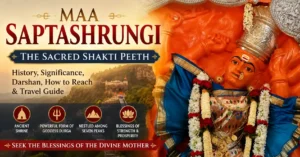
There are some temples you visit, and then there are places that quietly call you. Maa Saptashrungi Temple is one of those rare sacred destinations where devotion begins long before you reach the sanctum.
Nestled in the Sahyadri Hills near Nashik, Maharashtra, the Saptashrungi Temple stands at an altitude of about 4,600 feet and is surrounded by seven majestic peaks.
The name Saptashrungi comes from the Sanskrit words Sapta (seven) and Shrungi (peaks), reflecting the temple’s unique mountain setting.
Dedicated to Maa Saptashrungi, a powerful form of Goddess Durga, this ancient shrine is revered as one of the most sacred Shakti Peethas in Maharashtra.
Every year, lakhs of devotees visit the temple seeking the Divine Mother’s blessings for strength, protection, courage, and inner peace. The journey itself, whether by climbing the steps or taking the ropeway, becomes a meaningful part of the pilgrimage.
In this guide, you’ll discover the story of Maa Saptashrungi, her spiritual significance, darshan timings, temple rituals, festivals, travel information, and everything you need to know before planning your visit.
Maa Saptashrungi Temple at a Glance
| Particular | Details |
|---|---|
| Temple Name | Maa Saptashrungi Temple |
| Location | Saptashrungi Gad, near Nanduri Village, Nashik District, Maharashtra, India |
| Presiding Deity | Maa Saptashrungi (Mahishasura Mardini), a powerful form of Goddess Durga |
| Temple Type | Shakti Peeth |
| Religious Tradition | Shakta Tradition |
| Spiritual Significance | Believed to be the sacred place where Goddess Sati’s right arm fell, according to the Shakti Peeth tradition |
| Famous For | Swayambhu idol with 18 arms, seven surrounding peaks, Navratri celebrations, and one of Maharashtra’s Sade Teen Shakti Peethas |
| Altitude | Approximately 4,600 feet (1,400 metres) above sea level |
| Nearest Town | Vani |
| Nearest City | Nashik (about 65 km) |
| How to Reach the Temple | Climb approximately 510 steps or use the ropeway from the base |
| Temple Timings | Approximately 5:00 AM to 9:00 PM (subject to change on festivals and special occasions) |
| Major Festivals | Chaitra Navratri, Sharad Navratri, Vijayadashami |
| Best Time to Visit | October to March and during Chaitra or Sharad Navratri |
| Accommodation | Temple Trust Bhakta Niwas, guest houses, and budget hotels near the temple |
| Food Facilities | Mahaprasad, temple dining facilities, and vegetarian restaurants nearby |
| Nearest Railway Station | Nashik Road Railway Station (about 70–75 km) |
| Nearest Airport | Nashik (Ozar) Airport (about 50–55 km) |
| Managed By | Shree Saptashrungi Niwasini Devi Trust |
Did You Know?
Maa Saptashrungi Temple is one of Maharashtra’s revered Sade Teen Shakti Peethas (Three and a Half Shakti Peethas).
The Goddess is worshipped in her 18-armed Mahishasura Mardini form.
The temple stands at an altitude of about 4,600 feet in the Sahyadri Hills.
Pilgrims can reach the shrine by climbing 510 steps or taking the ropeway.
According to local tradition, Sage Markandeya recited the Devi Mahatmya here, and devotees believe the Goddess still listens to his sacred chants.
Table of Contents
ToggleWhy Maa Saptashrungi Temple Is Spiritually Significant
Maa Saptashrungi Temple is one of the most revered shrines dedicated to Goddess Durga and holds a special place in the Shakta tradition of Sanatan Dharma.
According to the Shakti Peeth tradition, the right arm of Goddess Sati is believed to have fallen at this sacred site after Lord Vishnu’s Sudarshana Chakra divided her body.
Because of this belief, devotees regard the temple as a place filled with powerful divine energy and the compassionate presence of the Divine Mother.
The Saptashrungi Temple is also counted among Maharashtra’s revered three and a half Shakti Peethas (Sade Teen Shakti Peethas). These ancient shrines have been important centres of Devi worship for centuries and continue to attract millions of devotees from across the country.
Many first-time visitors wonder why it is called a “half” Shakti Peeth. In Maharashtra’s traditional belief, three shrines are regarded as complete Shakti Peethas, while one is revered as a half Peeth because of its unique spiritual and regional significance. Together, they form the state’s most sacred network of Devi temples.
Another reason for the temple’s popularity is the belief that Maa Saptashrungi is a Jagrut Devi, or an awakened form of the Goddess who continues to bless sincere devotees. People visit the temple seeking strength, protection, good health, and peace of mind.
Whether pilgrims arrive with prayers, gratitude, or simply a longing for spiritual connection, many describe leaving with renewed courage and inner calm. This enduring faith has made Maa Saptashrungi Temple one of Maharashtra’s most cherished pilgrimage destinations, especially during Navratri.
Spiritual Benefits of Visiting Maa Saptashrungi Temple
Many devotees visit Maa Saptashrungi Temple not only to seek blessings but also to strengthen their spiritual connection with the Divine Mother. While every pilgrim’s experience is unique, the temple has long been regarded as a place of faith, courage, and inner transformation.
According to devotional tradition, visiting Maa Saptashrungi is believed to help devotees:
- Seek the blessings of the Divine Mother for courage and protection.
- Pray for the well-being, health, and prosperity of their family.
- Find strength to overcome challenges and difficult phases of life.
- Experience inner peace through prayer and darshan.
- Deepen their devotion to Goddess Durga and the Shakta tradition.
Many pilgrims also believe that the peaceful surroundings of the Sahyadri Hills encourage quiet reflection and meditation. Combined with the sacred atmosphere of the temple, the pilgrimage becomes an opportunity to reconnect with faith and experience a sense of gratitude and spiritual renewal.
Who Should Visit Maa Saptashrungi Temple?
- Devotees of Goddess Durga and Shakti seeking the blessings of the Divine Mother.
- Pilgrims exploring Maharashtra’s sacred Shakti Peethas and spiritual heritage.
- Families praying for health, protection, prosperity, and well-being.
- Spiritual seekers looking for peace, self-reflection, and a deeper connection with Sanatan Dharma.
- Nature lovers who wish to experience the beauty of the Sahyadri Hills along with a sacred pilgrimage.
- Trekking enthusiasts who enjoy combining a traditional hill climb with a meaningful spiritual journey.
- History and culture enthusiasts interested in the temple’s ancient traditions, local legends, and connection with Chhatrapati Shivaji Maharaj.
Whether devotees arrive with a specific prayer or simply to offer thanks, the journey to Maa Saptashrungi Temple is regarded by many as a reminder that true strength comes from unwavering faith, humility, and devotion to the Divine Mother.
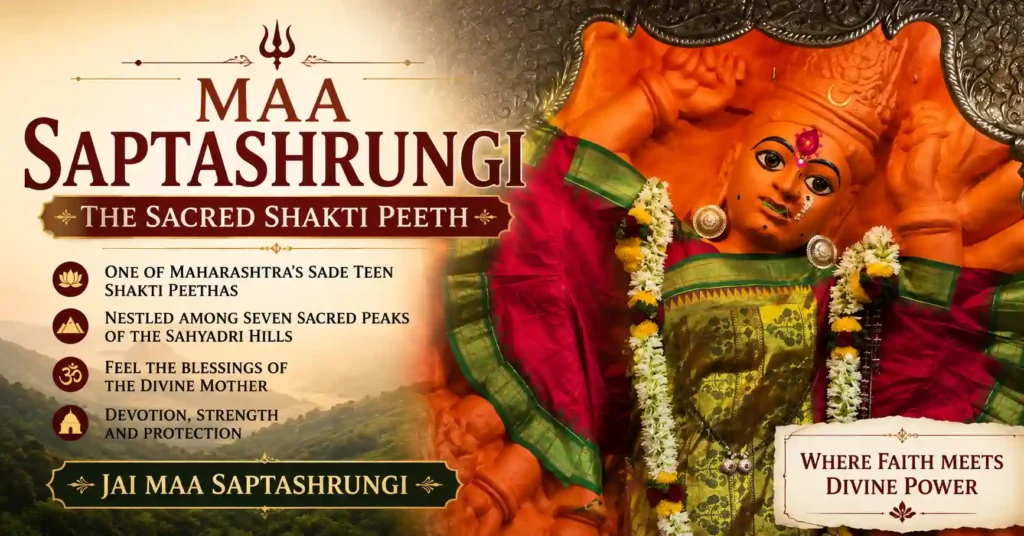
Why Is Maa Saptashrungi Called a Shakti Peeth?
Maa Saptashrungi Temple is revered as one of the sacred Shakti Peethas, the holy places associated with Goddess Sati in the Shakta tradition of Sanatan Dharma.
These pilgrimage sites are deeply respected because they are believed to mark the places where different parts of Sati’s body fell after the tragic events following her self-immolation.
According to the Shakti Peeth tradition, Lord Vishnu used his Sudarshana Chakra to divide Sati’s body so that Lord Shiva’s grief and cosmic destruction could come to an end.
As her body fell across the Indian subcontinent, each location became a sacred seat of Shakti, the Divine Feminine Power.
It is traditionally believed that Goddess Sati’s right arm fell at the site of present-day Maa Saptashrungi Temple. This belief has made the temple one of the most revered centres of Devi worship in Maharashtra, attracting millions of devotees every year.
In Maharashtra, Maa Saptashrungi is also honoured as one of the revered Sade Teen Shakti Peethas (Three and a Half Shakti Peethas). These temples hold a special place in regional devotional traditions and have been important pilgrimage centres for centuries.
For devotees, visiting a Shakti Peeth is not simply about offering prayers. It is believed to be an opportunity to experience the Divine Mother’s presence, seek her blessings, and strengthen one’s faith through devotion, surrender, and spiritual reflection.
The Story of Maa Saptashrungi Temple (Pauranik Katha)
According to the Devi Mahatmya, Maa Saptashrungi is worshipped as Mahishasura Mardini, the fierce yet compassionate form of Goddess Durga who destroyed the demon king Mahishasura. His growing power had disturbed the balance of the universe, and the gods prayed to the Divine Mother for protection.
In response, the Goddess manifested with the combined divine energies of the gods. Armed with celestial weapons gifted by different deities, she fought Mahishasura and ultimately defeated him, restoring dharma and peace. This victory continues to symbolize the triumph of good over evil and faith over fear.
According to local tradition, the Maa Saptashrungi Temple is associated with this powerful form of the Goddess. Nestled among the seven peaks of the Sahyadri Hills, the temple is believed to be a place where her divine presence continues to bless devotees seeking strength, courage, and protection.
Another cherished tradition connects the temple with Sage Markandeya, the revered sage believed to have composed or recited the Devi Mahatmya (Durga Saptashati). It is said that he performed deep penance in these hills while offering continuous prayers to the Divine Mother.
Devotees lovingly believe that the Goddess’s head is slightly tilted because she is still listening to Sage Markandeya’s sacred recitation. While this is a cherished local temple tradition rather than a scriptural account, it has become one of the most beloved beliefs associated with Maa Saptashrungi Temple.
For pilgrims, these stories are more than ancient legends. They bring the temple’s spiritual heritage to life and deepen the feeling that the Divine Mother continues to watch over everyone who visits her sacred abode.
History of Maa Saptashrungi Temple
The exact origin of Maa Saptashrungi Temple is not known, and no definitive historical records identify when the shrine was first established.
However, the temple has been an important centre of Shakti worship for many centuries and is deeply woven into the religious traditions of Maharashtra.
References to Maa Saptashrungi are closely associated with the Devi Mahatmya (Durga Saptashati) and the worship of Mahishasura Mardini, although the present temple structure has evolved over time through the efforts of local rulers, devotees, and temple authorities.
Like many ancient hill temples in India, the shrine has undergone several renovations while preserving its original spiritual identity.
The temple’s location on Saptashrungi Gad made it an important pilgrimage destination for devotees travelling across the Sahyadri region.
Over the centuries, improved roads, the construction of steps, and the introduction of the ropeway have made the temple more accessible while allowing pilgrims to continue the traditional hill pilgrimage.
Today, the temple is managed by the Shree Saptashrungi Niwasini Devi Trust, which oversees daily worship, festivals, pilgrim facilities, accommodation, and the preservation of the shrine.
Continuous improvements in infrastructure have helped make Maa Saptashrungi Temple one of Maharashtra’s most visited pilgrimage destinations without diminishing its spiritual atmosphere.
Although the temple has grown with time, its greatest strength remains unchanged. For generations, devotees have continued to visit this sacred shrine with unwavering faith, believing that the Divine Mother protects, guides, and blesses all who come to her with sincere devotion.
Chhatrapati Shivaji Maharaj's Connection with Maa Saptashrungi Temple
The association between Chhatrapati Shivaji Maharaj and Maa Saptashrungi Temple adds a meaningful historical and devotional dimension to this sacred pilgrimage site.
Although detailed historical records of his visits are limited, local tradition and popular belief have long connected the Maratha king with the blessings of the Divine Mother.
Shivaji Maharaj was deeply devoted to Goddess Bhavani, a revered form of Goddess Durga, and often sought her guidance and protection before important battles and decisions.
His unwavering faith in Shakti became a source of courage that inspired both his life and his mission to uphold dharma.
Many devotees believe that Maa Saptashrungi, worshipped as a powerful form of the Divine Mother, also blessed Shivaji Maharaj with strength, wisdom, and fearlessness during challenging times.
While this connection is rooted primarily in regional tradition rather than confirmed historical records, it remains an important part of the temple’s living heritage.
Even today, pilgrims remember this tradition as a reminder that sincere faith gives courage in times of adversity.
For many devotees, Maa Saptashrungi continues to be the compassionate protector who guides those who walk the path of righteousness with devotion and determination.
The Divine Form and Symbolism of Maa Saptashrungi
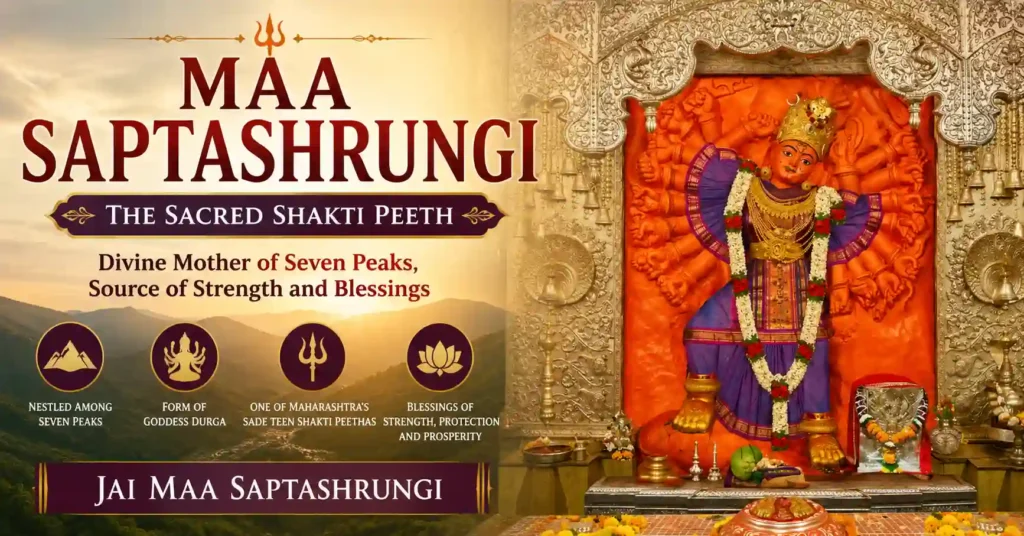
The sacred idol of Maa Saptashrungi is one of the most striking features of the Maa Saptashrungi Temple. Worshipped as Mahishasura Mardini, the Goddess appears in a powerful yet compassionate form that inspires both devotion and courage.
Unlike many temple idols that are sculpted separately, the image of the Goddess is believed to be Swayambhu (self-manifested) and naturally formed in the rock face of the mountain.
The idol is traditionally covered with sindoor, symbolising divine energy, strength, and the protective nature of the Divine Mother.
| Feature | Significance |
|---|---|
| Height | Approximately 8 to 10 feet tall |
| Form | Swayambhu (self-manifested) rock-cut idol |
| Appearance | Covered with sacred sindoor |
| Arms | Eighteen arms holding divine weapons |
| Divine Form | Worshipped as Mahishasura Mardini |
The eighteen arms of the Goddess represent her limitless power to protect the righteous and remove obstacles. According to tradition, each weapon was gifted by a different deity and symbolises a divine quality such as courage, wisdom, justice, compassion, or protection.
While different traditions describe the weapons in slightly different ways, together they reflect the united strength of the gods embodied in the Divine Mother.
For devotees, the idol is far more than an artistic representation. Standing before Maa Saptashrungi, many pilgrims experience a deep sense of faith, protection, and inner strength.
Her powerful form reminds devotees that the Divine Mother destroys negativity while guiding her children towards courage, righteousness, and spiritual growth.
Architecture and Sacred Features of Maa Saptashrungi Temple
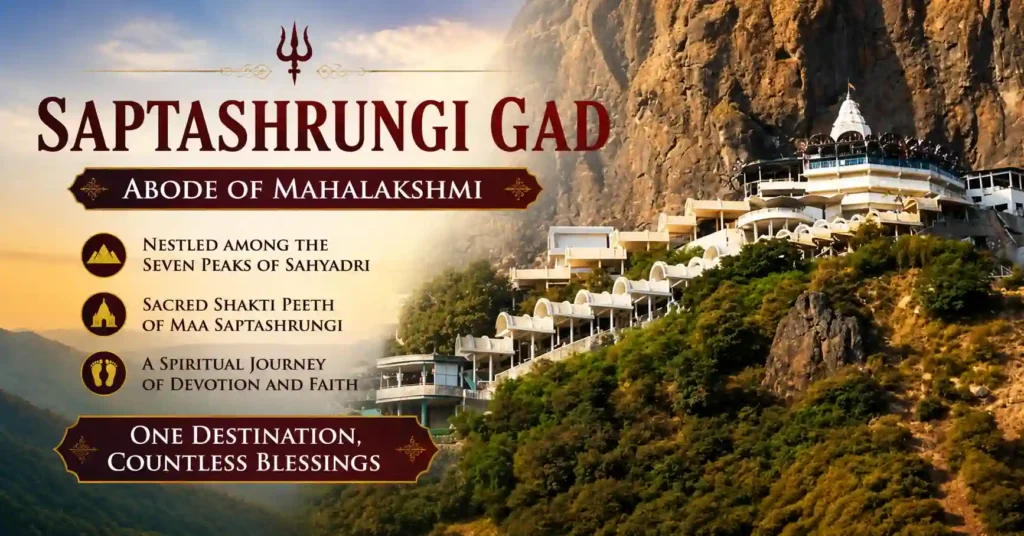
Unlike many temples built on open ground, Maa Saptashrungi Temple is nestled against a natural rock face on Saptashrungi Gad in the Sahyadri Hills.
The temple’s unique mountain setting gives it a timeless spiritual atmosphere, where nature and devotion exist in perfect harmony.
The Garbhagriha (sanctum sanctorum) houses the sacred Swayambhu idol of Maa Saptashrungi, which is naturally formed in the rock.
The sanctum is the spiritual heart of the temple, where devotees gather for darshan and offer prayers to the Divine Mother.
Over the centuries, the temple complex has been expanded to accommodate the growing number of pilgrims while preserving the sanctity of the original shrine.
Well-maintained pathways, protective railings, waiting areas, and modern facilities now make the pilgrimage more comfortable without altering the temple’s traditional character.
Within the temple complex, devotees will also find spaces for offering prayers, performing pujas, receiving Mahaprasad, and resting before or after darshan.
The ropeway station, stairway entrance, and other pilgrim facilities have been thoughtfully developed to make the shrine accessible to visitors of all ages.
One of the most remarkable aspects of Maa Saptashrungi Temple is how naturally it blends with its surroundings. The towering cliffs, rocky hills, and panoramic views of the Sahyadri Mountains create an atmosphere of peace that enhances the spiritual experience.
Rather than standing apart from nature, the temple appears to emerge from the mountain itself, reminding devotees of the Divine Mother’s eternal presence in creation.

Saptashrungi Gad and the Sacred Surroundings of Maa Saptashrungi Temple
Maa Saptashrungi Temple is located on Saptashrungi Gad, a sacred hill in the Sahyadri Mountains near Nashik. Surrounded by seven majestic peaks, this mountain landscape gives the temple its name, with Sapta meaning seven and Shrungi meaning peaks.
The temple is built against a natural rock face near a cave, creating a setting that feels both ancient and deeply spiritual. Unlike many temples built on open plains, the shrine blends naturally with the mountain, allowing devotees to experience the beauty of nature alongside their worship.
According to local temple tradition, the hills around Saptashrungi Temple are home to 108 sacred water reservoirs (kunds). These natural water sources have long been associated with purity and pilgrimage, although many are no longer easily accessible today. The belief in these sacred kunds continues to be an important part of the temple’s living heritage.
As pilgrims make their way through the winding mountain roads, climb the steps, or arrive by ropeway, they are greeted by panoramic views of the Sahyadri Hills, lush valleys, and fresh mountain air. The peaceful surroundings encourage quiet reflection even before reaching the sanctum.
For many devotees, the journey across Saptashrungi Gad is not simply a climb to a hilltop temple. It is a gradual spiritual experience where the beauty of nature, the silence of the mountains, and the presence of the Divine Mother come together to prepare the mind and heart for darshan.
Maa Saptashrungi Temple Darshan Timings and Aarti Schedule
The Maa Saptashrungi Temple is open to devotees every day, allowing pilgrims to participate in daily darshan and traditional worship.
If you wish to attend an aarti or perform a special puja, arriving early is recommended, especially on weekends and during Navratri, when the temple receives a large number of visitors.
| Activity | Approximate Timing |
|---|---|
| Temple Opening | 5:00 AM |
| Kakad Aarti | 5:30 AM |
| Panchamrit Puja | 7:00 AM – 9:00 AM |
| Madhyan Aarti | 12:00 PM |
| Evening Aarti | 6:00 PM – 7:00 PM |
| Temple Closing | 9:00 PM |
These timings are approximate and may change during festivals, special celebrations, or temple events. Before planning your visit to Saptashrungi Temple, it is always advisable to check the latest schedule through the official temple authorities.
For a peaceful darshan, many devotees prefer visiting early in the morning when the atmosphere is calm and queues are generally shorter. During Chaitra Navratri, Sharad Navratri, and other major festivals, expect longer waiting times due to the large number of pilgrims arriving from across Maharashtra and other parts of India.
Official Website and Useful Resources
For the latest information on Maa Saptashrungi Temple, it is always best to refer to the official website of the Shree Saptashrungi Niwasini Devi Trust.
The official website provides updated information on:
- Daily darshan and aarti timings
- Online puja, donation, and accommodation booking
- Live Darshan for devotees who cannot visit in person
- Ropeway and pilgrim facility updates
- Temple announcements and festival notifications
- Contact details and important visitor information
Official Website: https://ssndtonline.org/
Since temple schedules, accommodation availability, and special arrangements may change during festivals or major events, checking the official website before planning your pilgrimage is always recommended.
How to Worship Maa Saptashrungi Temple (Puja Vidhi)
Worship at Maa Saptashrungi Temple is simple, heartfelt, and centred on devotion rather than elaborate rituals. Most devotees begin their visit with darshan, offering their prayers to the Divine Mother before making any special offerings or performing puja.
A typical Puja Vidhi at the temple includes:
Taking darshan of Maa Saptashrungi with devotion.
Offering coconut, flowers, chunri, or other traditional items.
Lighting a diya as a symbol of faith and gratitude.
Offering silent prayers and spending a few moments in meditation before the Goddess.
Many pilgrims also choose to participate in special rituals such as Panchamrit Mahapuja, Abhishek, or other temple pujas that may be arranged through the temple authorities.
These rituals are performed according to temple traditions and provide devotees with an opportunity to seek the Goddess’s blessings in a more personal way.
While visiting the sanctum, devotees are encouraged to maintain silence, follow the instructions of the temple staff, and respect the sacred atmosphere. A calm and prayerful attitude helps preserve the spiritual experience for everyone.
Above all, the essence of worship at Maa Saptashrungi lies in bhakti and sincerity. Whether you offer flowers, light a lamp, or simply fold your hands in prayer, it is genuine faith and devotion that are believed to bring the Divine Mother’s grace into one’s life.
Darshan Process and Temple Etiquette at Maa Saptashrungi Temple
A visit to Maa Saptashrungi Temple is more than simply entering the sanctum for darshan. Following the temple traditions with patience and respect helps make the pilgrimage more meaningful and spiritually fulfilling.
Although individual customs may vary, most devotees follow this simple sequence during their visit:
Wash your hands and feet, if facilities are available, before entering the temple premises.
Purchase flowers, coconut, chunri, or other offerings from the authorised shops near the temple.
Join the darshan queue and patiently wait for your turn while chanting the name of Maa Saptashrungi or offering silent prayers.
Offer your prayers with devotion and avoid spending too much time in front of the sanctum so that other pilgrims can also have darshan.
Receive prasad and spend a few quiet moments in prayer before leaving the temple.
While visiting the shrine, devotees are encouraged to dress modestly, maintain silence inside the temple, and follow the directions given by the temple staff and volunteers. Respecting the queue system and avoiding unnecessary crowding helps ensure a peaceful experience for everyone.
Photography and videography may be restricted in certain parts of the temple, particularly inside the Garbhagriha (sanctum sanctorum). It is always advisable to follow the latest guidelines issued by the temple authorities.
Above all, remember that the true purpose of darshan is not to spend the longest time before the Goddess, but to offer sincere devotion with humility and faith. Even a few moments in the presence of the Divine Mother are believed to bring lasting peace and spiritual strength.
Bhog and Mahaprasad at Maa Saptashrungi Temple
Offering bhog to the Divine Mother is an important part of worship at Maa Saptashrungi Temple. It is a simple expression of gratitude, devotion, and surrender, symbolising the devotee’s love and faith in the Goddess.
Common offerings include coconut, fruits, sweets, flowers, and chunri. During special occasions and temple rituals, traditional Maharashtrian offerings such as Puran Poli may also be presented to Maa Saptashrungi as naivedya before being distributed as prasad.
Devotees visiting the Saptashrungi Temple can also partake in Mahaprasad, which is served at affordable rates through the temple’s facilities. Sharing Mahaprasad is regarded as a sacred experience, bringing together pilgrims from different regions in the spirit of equality and devotion.
While the type of offering may vary according to personal faith or family tradition, the true value of bhog lies in the devotion with which it is offered. Accepting Mahaprasad is considered a blessing, reminding devotees that the Divine Mother’s grace is received with humility, gratitude, and a pure heart.
Festivals Celebrated at Maa Saptashrungi Temple
The vibrant festival calendar is one of the reasons why Maa Saptashrungi Temple attracts millions of devotees every year.
Although pilgrims visit throughout the year, the temple comes alive during Navratri, when the Divine Mother is worshipped with exceptional devotion and grandeur.
Among all celebrations, Chaitra Navratri is considered the most significant. Lakhs of devotees from Maharashtra and other parts of India undertake the pilgrimage to seek the blessings of Maa Saptashrungi.
Sharad Navratri is also celebrated with great enthusiasm, filling the temple and surrounding hills with devotional energy.
During these festivals, devotees can witness:
Special pujas and aartis throughout the day.
Beautiful floral decorations and illuminated temple premises.
Traditional bhajans, devotional singing, and cultural programmes.
Religious fairs (mela) with stalls offering prasad and devotional items.
A continuous flow of pilgrims participating in darshan and worship.
As the number of visitors increases significantly during Navratri, waiting times for darshan can be longer than usual. Pilgrims are advised to arrive early, follow the temple authorities’ instructions, and plan their visit in advance for a smoother experience.
During these sacred days, Saptashrungi Temple becomes more than a place of worship. The sound of prayers, the chanting of hymns, and the unwavering faith of thousands of devotees transform the entire mountain into a living celebration of Shakti, devotion, and spiritual unity.
How to Reach Maa Saptashrungi Temple
Maa Saptashrungi Temple is located near Nanduri village in the Nashik district of Maharashtra, about 65 km from Nashik city. The temple is well connected by road, making it convenient to reach by private vehicle, taxi, or public transport.
Distance from Major Cities
| City | Approximate Distance | Estimated Travel Time |
|---|---|---|
| Nashik | 65 km | 1 to 1.5 hours |
| Mumbai | 250 km | 5 to 6 hours |
| Pune | 240 km | 5 to 6 hours |
| Shirdi | 115 km | 2.5 to 3 hours |
| Aurangabad (Chhatrapati Sambhajinagar) | 200 km | 4 to 4.5 hours |
By Air
The nearest airport is Nashik (Ozar) Airport, which is about 50–55 km from the temple. Visitors arriving from other parts of India can hire a taxi from the airport to reach Saptashrungi Temple. Those travelling from cities with limited flight connectivity can also fly to Mumbai and continue the journey by road or train.
By Train
The nearest major railway station is Nashik Road Railway Station, approximately 70–75 km from the temple. The station is well connected with Mumbai, Pune, Delhi, Ahmedabad, Hyderabad, Chennai, Kolkata, and several other major cities. From the railway station, taxis and local transport are readily available for the onward journey to the temple.
By Road
The temple can be easily reached by road from Nashik, Mumbai, Pune, and other cities in Maharashtra. Regular MSRTC buses and private buses operate towards Vani and nearby areas, while taxis and self-drive vehicles offer a more convenient option for families and groups. The drive from Nashik takes around 1 to 1.5 hours, depending on traffic.
Reaching the Temple
After reaching the base of the hill, devotees have two options to reach the shrine:
Climb around 510 steps, a traditional route chosen by many pilgrims as part of their spiritual journey.
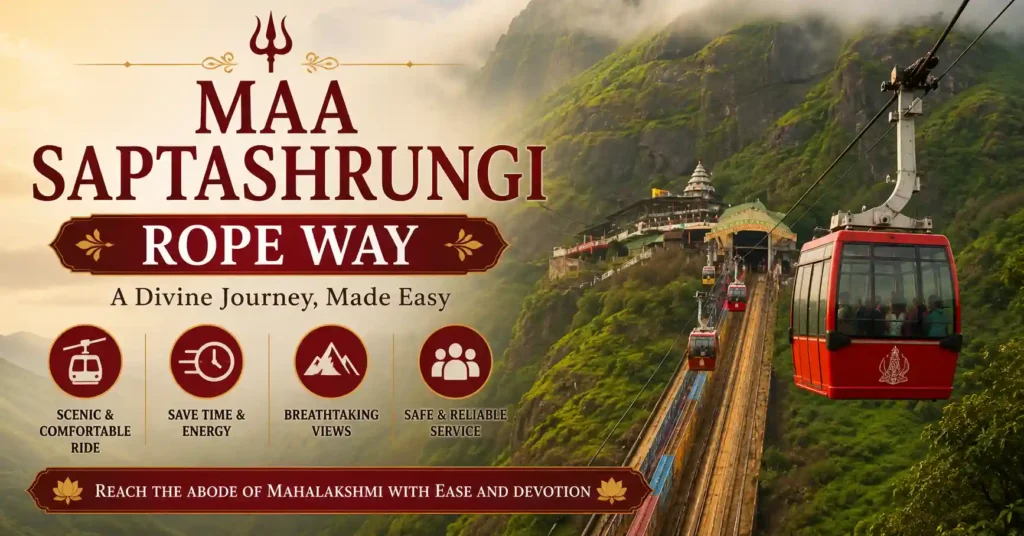
Use the ropeway (funicular railway), which reaches the hilltop in about 3 to 5 minutes and is especially convenient for senior citizens, children, and those with mobility concerns.
Travel Tips for Pilgrims
Start your journey early in the morning to avoid traffic and large crowds.
During Navratri and major festivals, expect longer queues and heavier traffic around the temple.
Comfortable footwear, drinking water, and light clothing are recommended if you plan to climb the steps.
Parking facilities are available near the temple base and ropeway station, though they can fill up quickly during festival periods.

Accommodation and Food Facilities Near Maa Saptashrungi Temple
Pilgrims visiting Maa Saptashrungi Temple have several accommodation options ranging from temple-managed Bhakta Niwas to budget lodges and guest houses near the temple. Whether you are visiting for a few hours or planning to stay overnight, you can find simple, clean, and affordable lodging suitable for families, senior citizens, and groups.
One of the most popular choices is the Shree Saptashrungi Bhaktaniwas Office, managed by the temple trust. The trust operates multiple Bhakta Niwas buildings with more than 200 rooms, offering economical accommodation for devotees. As these rooms are in high demand during Navratri and other major festivals, advance booking is strongly recommended through the temple trust.
If temple accommodation is fully booked, several private lodges and guest houses are available close to Saptashrungi Temple, including Gurukrupa Guest House, SwapnaShilp Niwas, and Saptsrungi Nivas Lodging. Most offer budget-friendly rooms with attached bathrooms, hot water, parking, and easy access to the temple or ropeway station.
Food facilities around Maa Saptashrungi Temple are simple and designed to meet the needs of pilgrims. Temple-operated dining halls and nearby vegetarian eateries serve wholesome meals at reasonable prices. Tea stalls, snack shops, and small restaurants are also available near the temple entrance and bus stand.
Many devotees choose to have Mahaprasad, which is served through the temple’s facilities at nominal charges. The meals are simple, hygienic, and prepared to serve large numbers of pilgrims, especially during festival seasons.
Tips for Staying Near the Temple
Book Bhakta Niwas well in advance if visiting during Chaitra Navratri, Sharad Navratri, weekends, or public holidays.
If travelling with elderly family members or young children, consider staying close to the ropeway station for easier access.
Carry a light shawl or jacket during winter months, as mornings and evenings on the hill can be cool.
During peak festival periods, rooms fill quickly, so confirm your accommodation before starting your journey.
With affordable accommodation, readily available vegetarian food, and temple-managed facilities, Maa Saptashrungi Temple offers pilgrims a comfortable and convenient stay while keeping the focus on devotion and spiritual reflection.
Quick Pilgrim Checklist
- Carry a valid ID if staying at Bhakta Niwas.
- Wear comfortable footwear if climbing the 510 steps.
- Carry drinking water, especially during summer.
- Dress modestly while visiting the temple.
- Book accommodation in advance during Navratri.
- Follow temple rules and keep the premises clean.
Things to Know Before Visiting Maa Saptashrungi Temple
A little preparation can make your visit to Maa Saptashrungi Temple more comfortable and spiritually fulfilling. Whether you are travelling with family, senior citizens, or children, keeping a few practical tips in mind will help you enjoy a smooth pilgrimage.
- Wear modest and comfortable clothing suitable for a sacred place of worship.
- Choose comfortable footwear, especially if you plan to climb the 510 steps to the temple.
- Carry drinking water, a cap, and sunscreen during summer, as parts of the climb are exposed to sunlight.
- Start early in the morning to avoid long queues, especially on weekends, public holidays, and during Navratri.
- Senior citizens and devotees with mobility concerns may find the ropeway a more convenient option than climbing the steps.
- Keep your belongings light, as large bags may become inconvenient during the climb and while waiting in queues.
- Follow the instructions of the temple authorities and volunteers for darshan, security, and crowd management.
- Photography may be restricted inside the sanctum. Always respect the temple’s rules and avoid using mobile phones where prohibited.
- Maintain silence and cleanliness within the temple premises to preserve the peaceful atmosphere for all devotees.
Photography Tips
- Photography is usually allowed outside.
- Photography inside the sanctum may be restricted.
- Respect temple rules.
With a little planning and a respectful attitude, your visit to Maa Saptashrungi Temple can become a comfortable, memorable, and spiritually enriching experience.
Best Time to Visit Maa Saptashrungi Temple
The best time to visit Maa Saptashrungi Temple depends on whether you are looking for pleasant weather, a peaceful pilgrimage, or the vibrant atmosphere of temple festivals. While the shrine remains open throughout the year, each season offers a different experience.
| Season | What to Expect | Recommended For |
|---|---|---|
| October to March | Cool and pleasant weather with clear skies | Sightseeing, families, senior citizens, and comfortable darshan |
| Chaitra & Sharad Navratri | Grand celebrations, special pujas, cultural programmes, and large crowds | Devotees seeking the full spiritual and festive experience |
| June to September (Monsoon) | Lush green hills, waterfalls, and misty views, but slippery paths and occasional rain | Nature lovers and photographers who don’t mind wet weather |
| April to May (Summer) | Warm afternoons, but cooler mornings and evenings due to the hill location | Early morning darshan and shorter visits |
For most pilgrims, October to March is considered the ideal time to visit Maa Saptashrungi Temple. The weather is comfortable for climbing the steps, exploring the surroundings, and enjoying a peaceful darshan without the challenges of heavy rain.
If your priority is spiritual celebration, visiting during Chaitra Navratri or Sharad Navratri offers an unforgettable experience.
The temple is beautifully decorated, special rituals are performed throughout the day, and thousands of devotees gather to worship Maa Saptashrungi. As this is the busiest period of the year, plan your accommodation and travel well in advance.
The monsoon season transforms the Sahyadri Hills into a breathtaking landscape filled with greenery and waterfalls. However, pilgrims should exercise caution, as the steps and walking paths can become slippery during heavy rainfall.
Whenever you choose to visit, starting your journey early in the morning helps you enjoy a calmer atmosphere, shorter queues, and a more peaceful pilgrimage experience.
Nearby Places to Visit from Maa Saptashrungi Temple
A pilgrimage to Maa Saptashrungi Temple can easily be combined with visits to several other sacred and scenic destinations in and around Nashik. Many devotees plan a one-day or two-day pilgrimage to explore these spiritually significant places.
| Place | Distance (Approx.) | Why Visit |
|---|---|---|
| Vani | 3 km | Base town of the pilgrimage with local markets, accommodation, and dining facilities. |
| Trimbakeshwar Jyotirlinga | 75 km | One of the twelve sacred Jyotirlingas of Lord Shiva and a major pilgrimage destination. |
| Panchavati, Nashik | 65 km | Associated with Lord Rama, Sita, and Lakshmana during their exile and home to several ancient temples. |
| Anjaneri Hills | 70 km | Believed to be the birthplace of Lord Hanuman and popular among pilgrims and trekkers. |
| Muktidham Temple | 65 km | A well-known marble temple complex featuring replicas of several important Hindu shrines. |
If you are travelling from Nashik, many tour operators and taxi services offer day trips that include Maa Saptashrungi Temple, Trimbakeshwar Jyotirlinga, and Panchavati. This allows devotees to experience some of the region’s most revered pilgrimage sites in a single journey.
For those with additional time, spending a day exploring Nashik’s temples, sacred ghats, and spiritual heritage provides a deeper understanding of the city’s importance in Sanatan Dharma.
Whether you are visiting only Maa Saptashrungi or planning a broader pilgrimage across Maharashtra, these nearby destinations make the journey even more meaningful and spiritually enriching.
Trek, Ropeway, and Parikrama at Maa Saptashrungi Temple
For many devotees, the journey to Maa Saptashrungi Temple is as meaningful as the darshan itself. Whether you choose to climb the sacred steps or take the ropeway, the ascent through the Sahyadri Hills becomes a part of the pilgrimage experience.
| Option | Details | Best For |
|---|---|---|
| 510 Steps | Takes about 45 to 60 minutes, depending on your pace. The climb is well maintained with resting places along the way. | Devotees who wish to undertake a traditional pilgrimage. |
| Ropeway | Reaches the temple in approximately 3 to 5 minutes and offers beautiful views of the surrounding hills. | Senior citizens, families with children, and pilgrims with limited mobility. |
Many devotees choose to climb the 510 steps as an act of faith and devotion. The gradual ascent allows pilgrims to chant the Goddess’s name, pause for prayer, and enjoy the peaceful surroundings before reaching the sanctum.
The ropeway provides a comfortable and time-saving alternative without reducing the spiritual significance of the visit. It has made Maa Saptashrungi Temple more accessible for elderly devotees and those who may find the climb physically challenging.
Some pilgrims also perform Parikrama, the sacred act of walking around the hill or designated temple pathways while remembering the Divine Mother. Although Parikrama is not compulsory, many devotees undertake it as an expression of gratitude, prayer, and devotion.
Before beginning your journey, carry drinking water, wear comfortable footwear with good grip, and check the weather if visiting during the monsoon.
Whether you climb every step or choose the ropeway, the journey to Maa Saptashrungi is not merely a physical ascent but a spiritual path that prepares the heart for the blessings of the Divine Mother.
The Spiritual Experience of Visiting Maa Saptashrungi Temple
Every pilgrimage leaves behind a memory, but for many devotees, a visit to Maa Saptashrungi Temple leaves behind something much deeper. It is an experience that often stays in the heart long after the journey has ended.
As pilgrims climb the sacred hill or arrive by ropeway, the noise of everyday life gradually gives way to the quiet of the Sahyadri Mountains. By the time they stand before Maa Saptashrungi, many feel a sense of peace that is difficult to describe in words.
Devotees often say that the mind becomes calmer, the heart feels lighter, and a renewed sense of courage begins to emerge. Whether these feelings come from unwavering faith, the peaceful surroundings, or the presence of the Divine Mother, the experience is deeply personal for every pilgrim.
Many visitors return year after year, not only to seek blessings but also to express gratitude. For them, Maa Saptashrungi Temple is more than a place where prayers are offered. It is a sacred space where faith is renewed, hope is strengthened, and the journey inward becomes just as meaningful as the journey to the temple itself.
10 Interesting Facts About Maa Saptashrungi Temple
- The name “Saptashrungi” means “Seven Peaks.” The temple is surrounded by seven majestic peaks of the Sahyadri Mountains, making it one of Maharashtra’s most picturesque pilgrimage sites.
- Maa Saptashrungi Temple is one of Maharashtra’s Sade Teen Shakti Peethas. It is regarded as one of the state’s holiest centres of Shakti worship and attracts millions of devotees every year.
- According to the Shakti Peeth tradition, Goddess Sati’s right arm fell here. This belief makes the temple one of the most sacred pilgrimage destinations for devotees of the Divine Mother.
- The idol of Maa Saptashrungi has eighteen arms. Each arm carries a divine weapon symbolising the Goddess’s power to protect devotees and destroy evil.
- The sacred idol is believed to be Swayambhu. Devotees believe the image of the Goddess naturally emerged from the mountain rock rather than being carved by human hands.
- The temple is closely associated with Sage Markandeya. Local tradition says he performed penance here and recited the Devi Mahatmya (Durga Saptashati) before the Goddess.
- Many devotees believe the Goddess’s head is slightly tilted. According to a cherished local belief, she continues to listen to Sage Markandeya’s sacred recitation.
- Pilgrims have been climbing the sacred hill for centuries. Today, devotees can still undertake the traditional climb of around 510 steps or use the ropeway for a quicker journey.
- Chaitra Navratri is the temple’s grandest celebration. During this festival, lakhs of devotees visit the shrine to participate in special pujas, aartis, devotional singing, and religious fairs.
- The pilgrimage is as meaningful as the destination. Many devotees believe that the climb, the mountain atmosphere, and the darshan together create a deeply spiritual experience that stays with them long after they return home.
Frequently Mistaken Beliefs About Maa Saptashrungi Temple
Many traditions and beliefs are associated with Maa Saptashrungi Temple, and it is helpful to understand which are based on scripture and which come from long-standing local traditions.
| Belief | What You Should Know |
|---|---|
| The temple is a Shakti Peeth. | According to the Shakti Peeth tradition, Goddess Sati’s right arm is believed to have fallen here. |
| The Goddess’s tilted head is mentioned in scriptures. | The tilted head is a cherished local temple tradition associated with Sage Markandeya and is not described in the Devi Mahatmya. |
| Maa Saptashrungi and Goddess Durga are different deities. | Maa Saptashrungi is worshipped as a powerful regional form of Goddess Durga, specifically Mahishasura Mardini. |
| Every pilgrim must climb the 510 steps. | No. Devotees may either climb the traditional steps or use the ropeway. Both are accepted ways to reach the shrine. |
| The temple is open only during Navratri. | The temple remains open throughout the year, although Navratri is the busiest and most celebrated period. |
Understanding these distinctions helps visitors appreciate both the scriptural significance and the living traditions that make Maa Saptashrungi Temple one of Maharashtra’s most cherished pilgrimage destinations.
Key Takeaways
- Maa Saptashrungi Temple is one of Maharashtra’s most revered Shakti Peethas, believed to be the sacred place where Goddess Sati’s right arm fell according to the Shakti Peeth tradition.
- Nestled among the seven peaks of the Sahyadri Hills, the temple offers a unique blend of natural beauty, spiritual serenity, and ancient devotion.
- The Swayambhu idol of Maa Saptashrungi, worshipped as Mahishasura Mardini with eighteen arms, symbolizes divine strength, protection, and the victory of good over evil.
- Pilgrims can reach the shrine by climbing 510 sacred steps or using the ropeway, making the temple accessible to devotees of all ages.
- Chaitra Navratri is the temple’s most important festival, drawing lakhs of devotees for special pujas, aartis, and grand celebrations.
- Along with spiritual significance, the temple offers practical facilities such as Bhakta Niwas, vegetarian food, Mahaprasad, and convenient travel options for pilgrims.
- More than a pilgrimage destination, Maa Saptashrungi Temple is a place where faith, history, mythology, and nature come together, leaving devotees with a lasting sense of peace, courage, and devotion.
Conclusion
Maa Saptashrungi Temple is far more than a sacred shrine nestled in the Sahyadri Hills. Revered as one of Maharashtra’s most important Shakti Peethas, it is a place where mythology, history, devotion, and nature come together to create a truly unforgettable pilgrimage.
Whether you visit to seek the blessings of Maa Saptashrungi, explore her ancient traditions, participate in darshan, or simply experience the peaceful atmosphere of the mountains, every step of the journey offers an opportunity for reflection and spiritual connection.
Many devotees believe the Divine Mother gives them strength to face life’s challenges with courage, faith, and hope. Some arrive with prayers, while others come with gratitude. Yet almost everyone leaves carrying a sense of peace that stays with them long after they return home.
Perhaps that is the greatest blessing of Maa Saptashrungi Temple. Somewhere between the climb, the darshan, and the silence of the sacred hills, you begin to realise that the Divine Mother is not only waiting in the sanctum. Her presence also awakens within your own heart.
Suggested Reading
If the story of Maa Saptashrungi Temple inspired you, continue your spiritual journey by exploring other sacred Shakti Peethas, revered temples, and important pilgrimage destinations across Sanatan Dharma.
These carefully researched guides from The Sanatan Tales will help you discover their history, spiritual significance, darshan information, and timeless traditions.
Maa Sharda Maihar: The Divine Shakti Peeth of Wisdom and Faith
https://thesanatantales.com/maa-sharda-maihar/Pavagadh Temple Gujarat: Shakti Peeth, History, Darshan, Steps and Ropeway Guide
https://thesanatantales.com/pavagadh-temple-gujarat/Ambaji Temple Banaskantha: A Sacred Experience Beyond Form
https://thesanatantales.com/ambaji-temple-banaskantha-guide/Vindhyavasini Devi: Story, Temple & Vindhyachal Darshan Guide
https://thesanatantales.com/vindhyavasini-devi/Mahalaxmi Temple, Kolhapur: Complete Pilgrim Guide to Ambabai Shakti Peetha
https://thesanatantales.com/mahalaxmi-temple-kolhapur/Salasar Balaji Temple: Story, Miracles, Darshan and Travel Guide
https://thesanatantales.com/salasar-balaji-temple/Saptapuri: The Seven Holy Cities in Sanatan Dharma
https://thesanatantales.com/saptapuri/Sanwariya Seth Temple: The Living Krishna of Mewar and Divine Business Partner
https://thesanatantales.com/sanwariya-seth-temple/Vrindavan Pilgrimage: A Complete Guide to the Land Where Devotion Feels Alive
https://thesanatantales.com/vrindavan-pilgrimage/Mahakaleshwar Jyotirlinga Ujjain: Mahakaal Mandir Darshan, Bhasma Aarti & Mahakaal Lok Guide
https://thesanatantales.com/mahakaleshwar-jyotirlinga-ujjain/Kedarnath Dham Yatra 2026: Complete Pilgrimage Guide
https://thesanatantales.com/kedarnath-dham-yatra-2026-pilgrimage-guide/Maa Saptashrungi (Wikipedia)
https://en.wikipedia.org/wiki/Saptashrungi
FAQs
Who is Maa Saptashrungi?
Maa Saptashrungi is a revered form of Goddess Durga, worshipped as Mahishasura Mardini, the destroyer of the demon Mahishasura. She is the presiding deity of Maa Saptashrungi Temple in Maharashtra and is believed to be one of the most powerful forms of the Divine Mother.
According to the Shakti Peeth tradition, Goddess Sati’s right arm fell here, making the temple one of India’s sacred Shakti Peethas. Devotees worship Maa Saptashrungi for courage, protection, prosperity, and inner peace.
Why is Maa Saptashrungi Temple famous?
Maa Saptashrungi Temple is famous as one of Maharashtra’s most revered Shakti Peethas and one of the state’s Sade Teen Shakti Peethas (Three and a Half Shakti Peethas). According to the Shakti Peeth tradition, Goddess Sati’s right arm is believed to have fallen here.
The temple is also known for its Swayambhu idol of Maa Saptashrungi, worshipped as Mahishasura Mardini with eighteen arms. Surrounded by the seven peaks of the Sahyadri Hills, the temple attracts millions of devotees every year, especially during Chaitra Navratri and Sharad Navratri.
Which body part of Goddess Sati is believed to have fallen at Maa Saptashrungi?
According to the Shakti Peeth tradition, Goddess Sati’s right arm is believed to have fallen at the present-day site of Maa Saptashrungi Temple. This belief is based on the sacred tradition associated with the Shakti Peeths, where different parts of Sati’s body are believed to have fallen after Lord Vishnu used his Sudarshana Chakra to calm Lord Shiva’s grief. Because of this association, the temple is regarded as one of the most sacred pilgrimage destinations dedicated to the Divine Mother.
Why is Maa Saptashrungi called one of Maharashtra's Sade Teen Shakti Peethas?
Maa Saptashrungi Temple is traditionally counted among Maharashtra’s Sade Teen Shakti Peethas, meaning the “Three and a Half Shakti Peethas.” These temples are considered the state’s most sacred centres of Devi worship and have been revered for centuries. The term “half” reflects a traditional regional classification rather than a lesser spiritual importance. Devotees regard all these temples as powerful manifestations of the Divine Mother and visit them to seek blessings, protection, and spiritual strength.
How many steps are there to reach Maa Saptashrungi Temple?
Devotees can reach Maa Saptashrungi Temple by climbing approximately 510 steps from the base of the hill. The climb usually takes 45 to 60 minutes, depending on your pace and the crowd. Resting places are available along the route for pilgrims. Those who are unable to climb or prefer a quicker journey can use the ropeway, which provides convenient access to the temple and is especially helpful for senior citizens, families with children, and devotees with mobility concerns.
Is a ropeway available at Maa Saptashrungi Temple?
Yes. A ropeway is available for devotees visiting Maa Saptashrungi Temple. It offers a convenient alternative to climbing the 510 steps and reaches the temple in just a few minutes. The ropeway is particularly useful for elderly pilgrims, young children, and anyone who may find the climb physically challenging. Since operating hours and maintenance schedules can change, it is advisable to check the official temple website before planning your visit.
What is the best time to visit Maa Saptashrungi Temple?
The best time to visit Maa Saptashrungi Temple is between October and March, when the weather is pleasant and ideal for sightseeing and pilgrimage. Many devotees also choose to visit during Chaitra Navratri and Sharad Navratri, when the temple hosts grand celebrations, special pujas, and cultural programmes. If you prefer a quieter experience, consider visiting on weekdays outside the festival season. During the monsoon, the surrounding hills become exceptionally beautiful, although pilgrims should take extra care on slippery paths.
Who manages Maa Saptashrungi Temple?
The temple is managed by the Shree Saptashrungi Niwasini Devi Trust, which oversees the daily worship, temple administration, pilgrim facilities, accommodation, and major festivals. The trust also provides services such as Bhakta Niwas, online donations, and other facilities to make the pilgrimage more convenient for devotees. For the latest information on darshan timings, accommodation, or temple announcements, visitors should refer to the official website of the trust.
Is Maa Saptashrungi Temple suitable for senior citizens and families?
Yes. Maa Saptashrungi Temple is accessible for pilgrims of all age groups. While many devotees choose the traditional climb of 510 steps, the ropeway offers a comfortable option for senior citizens, families with children, and visitors with limited mobility. The temple also provides accommodation, food facilities, and resting areas to make the pilgrimage more convenient. During major festivals, arriving early and planning the visit in advance is recommended due to large crowds.
Are photography and mobile phones allowed inside the temple?
Photography is generally permitted in the outer areas of the temple complex, but restrictions may apply inside the Garbhagriha (sanctum sanctorum) and certain sacred areas. Mobile phone usage may also be restricted during darshan or special rituals. As temple policies can change, visitors should always follow the instructions of the temple authorities and respect the sanctity of the shrine while taking photographs or using electronic devices.
What makes Maa Saptashrungi Temple different from other Shakti Peethas?
Every Shakti Peeth has its own unique traditions and spiritual significance. Maa Saptashrungi Temple is distinguished by its spectacular location among seven peaks of the Sahyadri Hills, its Swayambhu eighteen-armed idol of Mahishasura Mardini, and its status as one of Maharashtra’s Sade Teen Shakti Peethas. The combination of ancient mythology, living traditions, natural beauty, and the devotion of millions of pilgrims makes this temple one of the most spiritually significant pilgrimage destinations in western India.
Glossary of Important Terms
| Term | Meaning |
|---|---|
| Maa Saptashrungi | A revered form of Goddess Durga worshipped as Mahishasura Mardini at Saptashrungi Temple in Maharashtra. |
| Saptashrungi | A Sanskrit word meaning “Seven Peaks” (Sapta = seven, Shrungi = peaks), referring to the seven hills surrounding the temple. |
| Shakti Peeth | A sacred shrine associated with Goddess Sati. According to tradition, these are places where different parts of her body fell, making them important centres of Devi worship. |
| Sade Teen Shakti Peethas | The “Three and a Half Shakti Peethas” of Maharashtra, regarded as the state’s most sacred shrines dedicated to the Divine Mother. |
| Mahishasura Mardini | A fierce form of Goddess Durga who defeated the buffalo demon Mahishasura, symbolising the triumph of good over evil. |
| Swayambhu | A self-manifested deity or idol believed to have appeared naturally rather than being carved by human hands. |
| Darshan | The sacred act of seeing and receiving the blessings of a deity in a temple. |
| Aarti | A devotional ritual in which lamps are offered to the deity while prayers and hymns are sung. |
| Puja | A Hindu ritual of worship involving prayers, offerings, and devotion to a deity. |
| Panchamrit | A sacred mixture of milk, curd, ghee, honey, and sugar used for ritual bathing (Abhishek) and worship. |
| Abhishek | The ceremonial bathing of a deity with sacred substances such as water, milk, Panchamrit, or other offerings. |
| Prasad | Food or offerings first presented to the deity and then distributed to devotees as a sacred blessing. |
| Mahaprasad | Sanctified food prepared and distributed by the temple, regarded as the Divine Mother’s blessing. |
| Chunri | A sacred cloth, usually red or yellow, offered to the Goddess as a symbol of devotion and respect. |
| Garbhagriha | The innermost sanctum of a Hindu temple where the main deity is enshrined. |
| Parikrama | The act of walking clockwise around a temple, shrine, or sacred hill as an expression of devotion. |
| Navratri | A nine-night Hindu festival dedicated to the worship of Goddess Durga in her various forms. |
| Chaitra Navratri | The Navratri celebrated during the Hindu month of Chaitra, considered the most important festival at Maa Saptashrungi Temple. |
| Sahyadri Hills | The mountain range, also known as the Western Ghats, where Maa Saptashrungi Temple is located. |
| Saptashrungi Gad | The sacred hill on which Maa Saptashrungi Temple is situated. The word Gad means hill fort or fortified hill. |
| Bhakta Niwas | Budget accommodation provided by the temple trust or religious institutions for pilgrims and devotees. |
About the Author
Yateendra Chaturvedi is a spiritual writer, researcher, devotee, and the founder of The Sanatan Tales. With over 35 years of professional experience and a lifelong interest in Sanatan Dharma, he writes about Hindu deities, temples, scriptures, festivals, Mahavidyas, sacred stories, rituals, and living traditions that continue to guide and inspire devotees across India.
Drawing from traditional scriptures, regional beliefs, temple traditions, devotional literature, and historical sources, he aims to present authentic, well-researched, and easy-to-understand content for modern readers. His work focuses on preserving spiritual wisdom, explaining sacred traditions, and helping seekers develop a deeper understanding of India’s rich spiritual heritage.
Through The Sanatan Tales, Yateendra strives to make the timeless teachings of Sanatan Dharma simple, meaningful, and relevant for today’s generation while maintaining respect for traditional sources, regional practices, and diverse spiritual perspectives.
Learn More About Yateendra Chaturvedi →
https://thesanatantales.com/about-the-author/
References & Sources
This article is based on beliefs and traditions followed within the Shakta traditions of Sanatan Dharma, traditional knowledge associated with the Dashamahavidya tradition, Shakti worship, Devi sadhana, and insights drawn from various spiritual and religious study sources. Some concepts discussed in this article are also inspired by teachings and interpretations preserved through the guru-disciple tradition.
Note: Beliefs, interpretations, and spiritual practices may vary across different traditions, sects, and paths within Sanatan Dharma. The purpose of this article is not to present any single viewpoint as the absolute truth, but to explain widely accepted religious and spiritual perspectives in a simple and accessible manner.
Explore More Fascinating Topics from Sanatan Dharma