
Does the soul choose its next journey after death? This question has fascinated spiritual seekers for centuries.
There is a moment when almost every thoughtful person asks this question. What happens after death?
Does the soul simply disappear, or does it continue its journey somewhere else?
In the spiritual vision of Sanatan Dharma, death is not seen as the end. It is seen as a doorway.
A pause between two journeys. But an even deeper question quietly arises behind it.
Does the soul actually choose its next life?
Many scriptures, saints, and philosophical traditions within Hindu thought have tried to understand this mystery.
The answers are not always simple, but they reveal a fascinating picture of how consciousness, karma, and rebirth may work together.
Table of Contents
ToggleThe soul according to Sanatan philosophy
In the teachings of the Bhagavad Gita, the soul is described as eternal. It is never born and it never truly dies. The body may change, but the inner consciousness continues.
The famous verse explains that just as a person changes worn out clothes and wears new ones, the soul leaves an old body and takes a new one.
This idea is central to Sanatan philosophy. Life is not limited to one birth. It is part of a much larger cycle of existence known as Samsara, the endless cycle of birth, death, and rebirth.
But if the cycle continues, something must guide where the soul goes next.
Many seekers often wonder, does the soul choose its next journey, or is the next life decided purely by karma and divine law?
Karma: the invisible law that guides rebirth
Sanatan Dharma explains this through the law of Karma.
Karma simply means action and its consequences. Every thought, action, and intention creates an imprint on the subtle mind. These impressions are called samskaras.
When a person dies, the physical body dissolves, but the subtle body carrying these impressions continues with the soul.
Because of this, the next birth is not random. The soul is naturally drawn to a situation where these karmic impressions can unfold.
The philosopher Adi Shankaracharya explained that the subtle body carries these impressions across lifetimes. They quietly shape the experiences of the next birth.
So in many ways, karma becomes the guiding force behind where the soul goes next.
This naturally raises the deeper question: does the soul choose its next journey, or is the next birth entirely shaped by karma?
The subtle body that travels with the soul
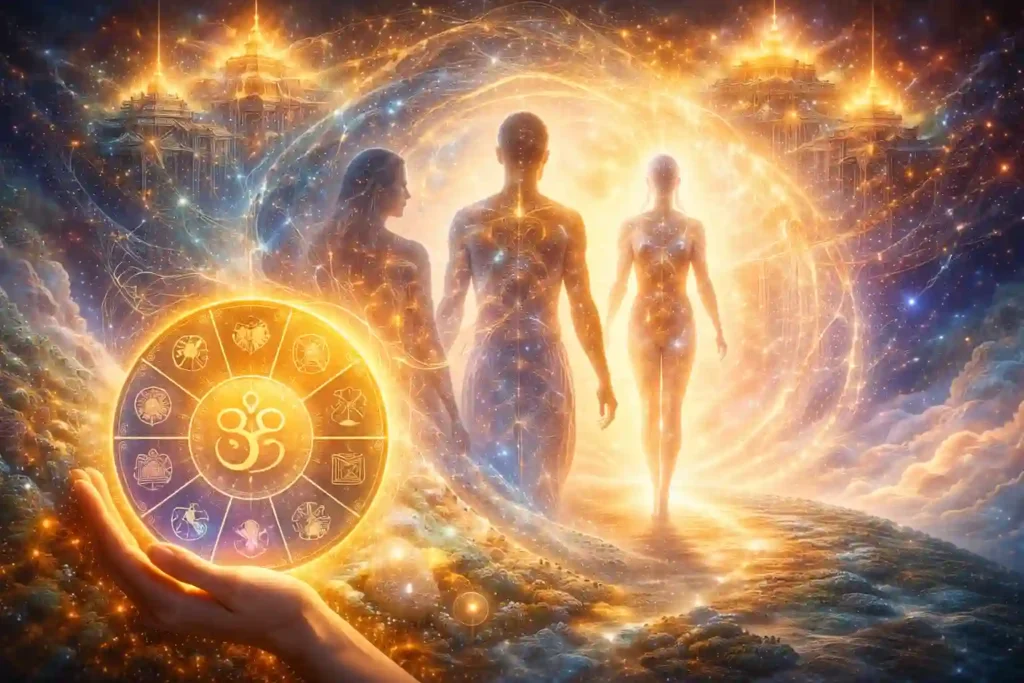
Sanatan philosophy explains that the soul does not travel alone after death. It carries a subtle energetic structure known as Sukshma Sharira, the subtle body.
This subtle body includes the mind, intellect, ego, and karmic impressions. While the physical body dissolves after death, this subtle body remains with the soul.
Because of this, the experiences, tendencies, and memories of past lives continue to influence the next birth.
In simple terms, the subtle body acts like a bridge between lifetimes.
Three types of karma that influence rebirth
Vedantic philosophy further explains karma through three important categories.
Karma type | Meaning |
Sanchita Karma | accumulated karma from many past lives |
Prarabdha Karma | the portion of karma shaping the present life |
Agami Karma | karma created by present actions |
At the time of death, only a portion of accumulated karma becomes active and determines the circumstances of the next birth.
This question, does the soul choose its next journey, has been discussed in many spiritual traditions within Sanatan Dharma.
The powerful role of desires (Vasanas)
Apart from karma, deep inner tendencies also influence rebirth. These tendencies are known as Vasana.
Vasanas are subtle desires and attachments stored within the subconscious mind.
If strong desires remain unfulfilled, the soul naturally moves toward another birth where those tendencies can continue.
The Brihadaranyaka Upanishad expresses this idea by explaining that a person ultimately becomes what their deepest desire is.
In this way, karma determines the conditions of the next birth, while vasanas influence the tendencies of the next life.
Many spiritual seekers quietly wonder, does the soul choose its next journey, or is the next birth shaped only by the karma carried from previous lives?
Does the soul consciously choose its next life?
The answer depends on the level of spiritual awareness of the soul.
For most people, the next birth is not a conscious choice. The soul is guided by its accumulated karma and desires.
Imagine a river flowing downhill. The water naturally moves in a certain direction because of the terrain. In the same way, karmic tendencies guide the next life.
However, advanced spiritual beings are believed to have greater awareness even after death. Many saints and enlightened souls are said to take birth intentionally to guide others.
In such cases, the birth is not forced by karma but chosen for a higher purpose.
This is why the Does the soul choose its next journey are deeply connected in Sanatan Dharma, shaping the experiences we face in every lifetime.
The role of cosmic order and Yama
Traditional scriptures also describe the role of Yama, the divine regulator of death and karmic balance.
In texts like the Garuda Purana, Yama is portrayed as the one who ensures that karmic balance is maintained.
Philosophically, Yama represents the universal law that ensures every soul experiences the results of its actions.
What happens between death and the next birth
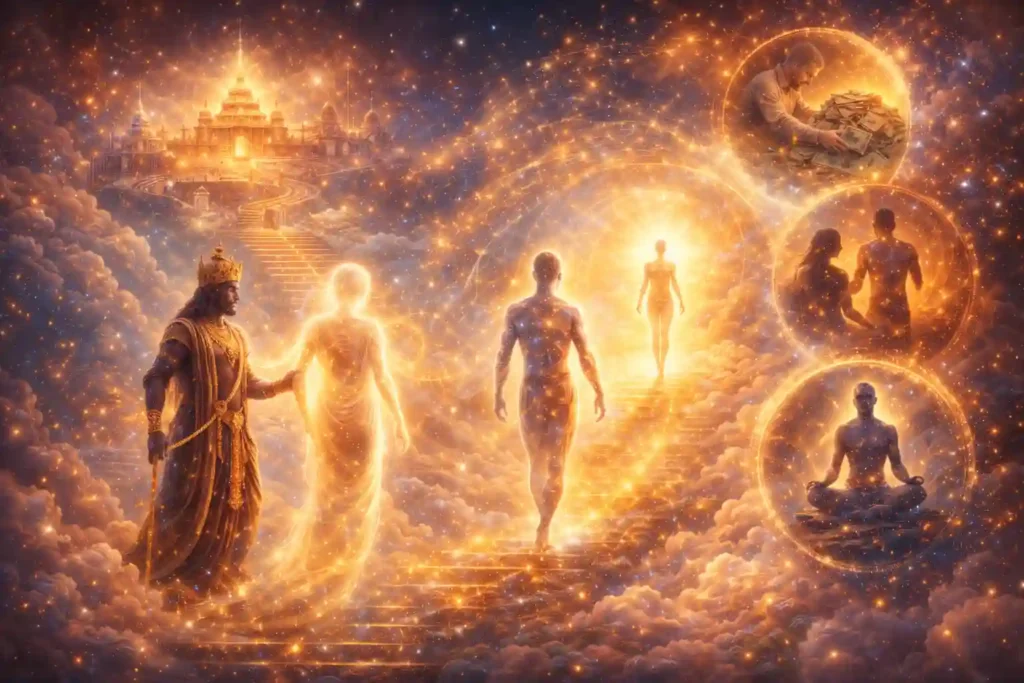
Ancient texts like the Garuda Purana describe the journey of the soul after death.
According to these teachings, the soul first passes through subtle realms where it experiences the results of past actions and gradually detaches from the previous life.
After this transitional period, the soul moves toward a new birth based on its karmic balance and inner tendencies.
The idea of multiple realms in the universe
Sanatan Dharma also speaks about many different realms of existence called Lokas.
These realms are not just physical planets but different levels of consciousness.
Depending on karma and spiritual evolution, the soul may temporarily experience these realms before returning to human birth.
Interestingly, modern science has also explored ideas such as the Multiverse, suggesting that reality may contain many layers beyond our visible universe.
A glimpse from modern research
Some modern researchers have also explored cases where children report memories of previous lives.
One of the most well known researchers was Ian Stevenson, who studied thousands of such cases across different cultures.
While these studies do not prove reincarnation conclusively, they have raised intriguing questions about the continuity of consciousness beyond death.
When we reflect deeply on life and rebirth, the question naturally arises again: does the soul choose its next journey, or does the universe guide the soul according to divine law?
The deeper goal beyond rebirth
In Sanatan Dharma, rebirth itself is not the final goal.
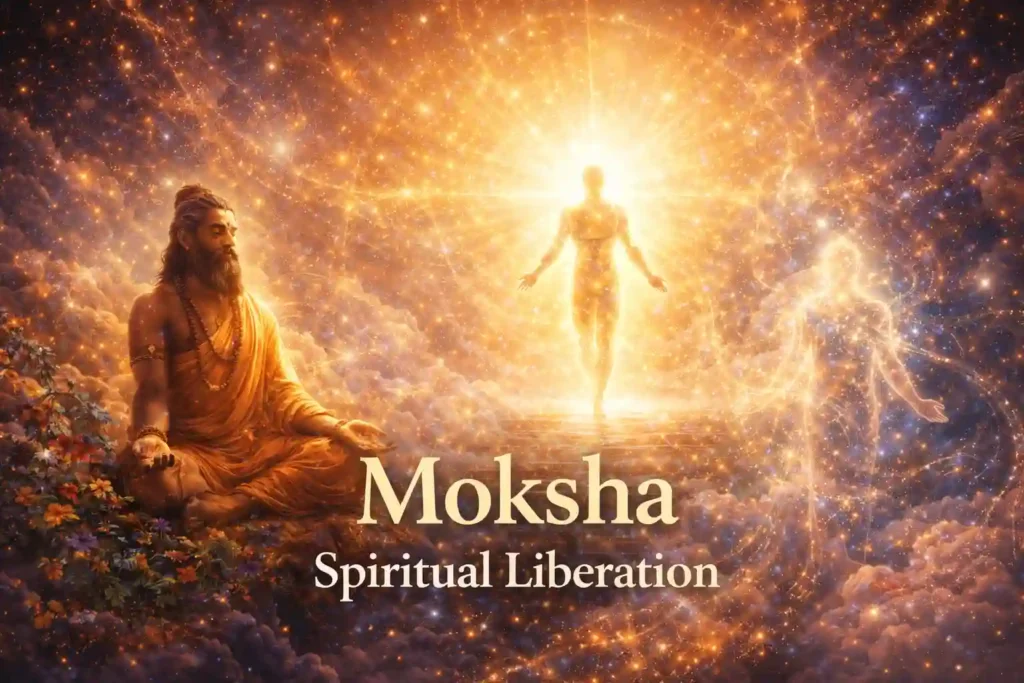
The ultimate aim is liberation known as Moksha.
When a soul realizes its true nature and becomes free from karmic impressions and desires, the cycle of birth and death ends.
The soul no longer needs to return to the physical world. Instead, it merges with universal consciousness.
In the deeper understanding of Sanatan Dharma, the soul’s journey and karma explain why every experience in life carries a hidden lesson for spiritual growth.
Why this question matters for our life today
When people think about death and rebirth, it often sounds like a distant philosophical topic. But in Sanatan wisdom, it is closely connected to how we live today.
Every thought, every action, and every intention creates subtle impressions that shape the future journey of the soul.
In that sense, the next life is slowly being written by the life we are living right now and perhaps that is the most important teaching hidden within this mystery.
So when we reflect on life and death, the real mystery remains the same: does the soul choose its next journey, or does karma quietly guide the path ahead?
Suggested Reading
You may also enjoy exploring these reflections on spiritual life from thesanatantales.com:
Spiritual Awakening: Meaning and Signs Beginners Often Experience
https://thesanatantales.com/what-is-spiritual-awakening-and-its-signs/
Kaal Bhairav Ashtakam Meaninbg for Beginners (Hindi & English)
https://thesanatantales.com/kaal-bhairav-ashtakam-meaning-benefits/
Maa Bhuvneshwari: The Mahavidya who holds the Universe
https://thesanatantales.com/maa-bhuvaneshwari-the-mahavidya-who-holds-the-universe/
FAQs
Does the soul immediately take rebirth after death?
According to many Hindu texts, rebirth does not always happen immediately. The soul may pass through subtle realms before entering a new body.
Can a soul remember its past life?
Most people do not remember past lives because memory is linked to the brain. However, rare cases of past life memories have been reported.
Do enlightened souls take rebirth?
Some enlightened beings may choose to take birth again to guide humanity.
Is rebirth mentioned in Hindu scriptures?
Yes. Scriptures like the Upanishads and the Bhagavad Gita discuss the cycle of rebirth.
Can good karma influence the next birth?
Yes. Compassion, devotion, and selfless actions create positive karma that can influence future births.