
Table of Contents
ToggleWhat is Durga Saptashati
During the nine sacred nights of Navratri, the sacred scripture Durga Saptashati is recited in temples and homes across India.
Lamps are lit, incense fills the air, and devotees gather before the image of the Divine Mother. In this calm and devotional atmosphere, the verses of Durga Saptashati begin to echo.
For many devotees, reading This sacred scripture during Navratri is not just a ritual. It is an act of faith, surrender, and connection with Maa Durga.
The scripture tells the story of how the Divine Mother protects the universe and destroys the forces of darkness.
Through these stories, it reminds devotees that the same divine strength exists within every soul.
For centuries saints, temples, and spiritual seekers have treated this sacred scripture as a guide to courage, devotion, and inner transformation.
To understand why millions read this sacred text during Navratri, we must first understand what This sacred scripture really is.
Durga Saptashati is one of the most important scriptures dedicated to the Divine Mother in Sanatan Dharma. It appears inside the ancient Markandeya Purana, a revered text of Hindu tradition.
The scripture contains seven hundred verses describing the victories of Goddess Durga over powerful demonic forces.
Because of these seven hundred verses, the text is called “Saptashati,” which literally means seven hundred.
Through dramatic stories of divine battles, the scripture celebrates the power of Shakti, the divine feminine energy that protects the universe and restores balance whenever evil becomes powerful.
Other names: Devi Mahatmya and Chandi Path
The sacred scripture is known by a few other names in different traditions.
One common name is Devi Mahatmya, which means “the glory of the Divine Mother.” This name reflects the central theme of the scripture, which praises the greatness and power of the Goddess.
The text is also called Chandi Path, especially when it is recited during temple rituals or Navratri ceremonies.
Although the names differ, they all refer to the same sacred scripture that celebrates the power of Maa Durga.
Meaning of the name
The name itself explains the nature of the scripture.
The word Durga refers to the Divine Mother who removes suffering and protects devotees from danger and hardship.
The word Saptashati comes from two Sanskrit words:
Sapta meaning seven, and Shati meaning hundred.
Together they mean seven hundred, referring to the seven hundred sacred verses that form the text.
Why it is known as the scripture of 700 verses
This sacred text is traditionally known as a scripture of seven hundred verses, which is why it carries the name Saptashati.
However, scholars explain that not all of these seven hundred are full poetic shlokas.
In the traditional Sanskrit counting system, the total includes complete verses along with shorter passages, repeated refrains, and certain half-verses.
Because of this method of counting, the scripture is considered to contain seven hundred verses, while the number of complete metrical shlokas is slightly lower and often estimated to be around 578.
Despite this difference in counting style, the sacred text is universally known and revered as Durga Saptashati, the seven hundred verses praising the power and glory of the Divine Mother.
Origin in the Markandeya Purana
The story of the scripture appears within the Markandeya Purana, traditionally attributed to Sage Markandeya.
The narrative begins with King Suratha, who loses his kingdom in battle and wanders into a forest. Even after losing everything, his mind remains attached to his former kingdom.
In the forest he meets a merchant named Samadhi, who had also been abandoned by his family. Both men feel troubled by their attachment to worldly life.
They approach Sage Medhas, asking why human beings remain attached to things that cause suffering.
To explain this mystery, the sage narrates the glory of the Divine Mother and her victories over powerful demons.
These sacred stories together form the scripture known as Durga Saptashati.
Structure of Durga Saptashati: The 13 Chapters
This ancient text contains 13 chapters divided into three major sections, known as Charitras.
Section | Form of the Goddess | Main Demon |
First Charitra | Mahakali | Madhu and Kaitabha |
Middle Charitra | Mahalakshmi | Mahishasura |
Final Charitra | Mahasaraswati | Shumbha and Nishumbha |
Each section reveals a different aspect of the Divine Mother’s power.
The four traditional sections of recitation
Although the scripture contains 13 chapters divided into three Charitras, traditional recitation often describes the scripture in four spiritual sections.
These sections help devotees understand the flow of the text.
- Prathama Charitra – Chapter 1, describing the defeat of Madhu and Kaitabha.
- Madhyama Charitra – Chapters 2 to 4, narrating the battle against Mahishasura.
- Uttama Charitra – Chapters 5 to 13, describing the battles with Shumbha, Nishumbha, Raktabeej and other demons.
- Phala Shruti – the concluding verses that describe the spiritual benefits of reading or listening to Durga Saptashati.
The Three Great Battles of the Goddess
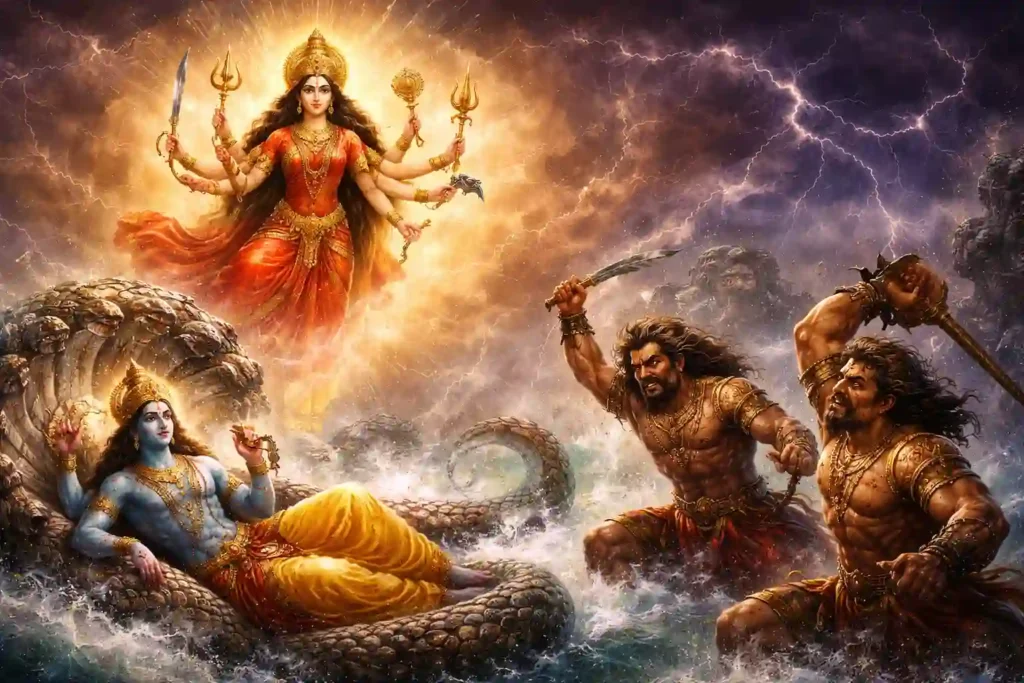
The Slaying of Madhu and Kaitabha
The first chapter describes how the demons Madhu and Kaitabha threatened creation. The Divine Mother appeared as Mahamaya and awakened Lord Vishnu from his cosmic sleep, enabling him to defeat the demons.
The Battle with Mahishasura
The second story describes the rise of the buffalo demon Mahishasura, who defeated the gods and captured heaven.
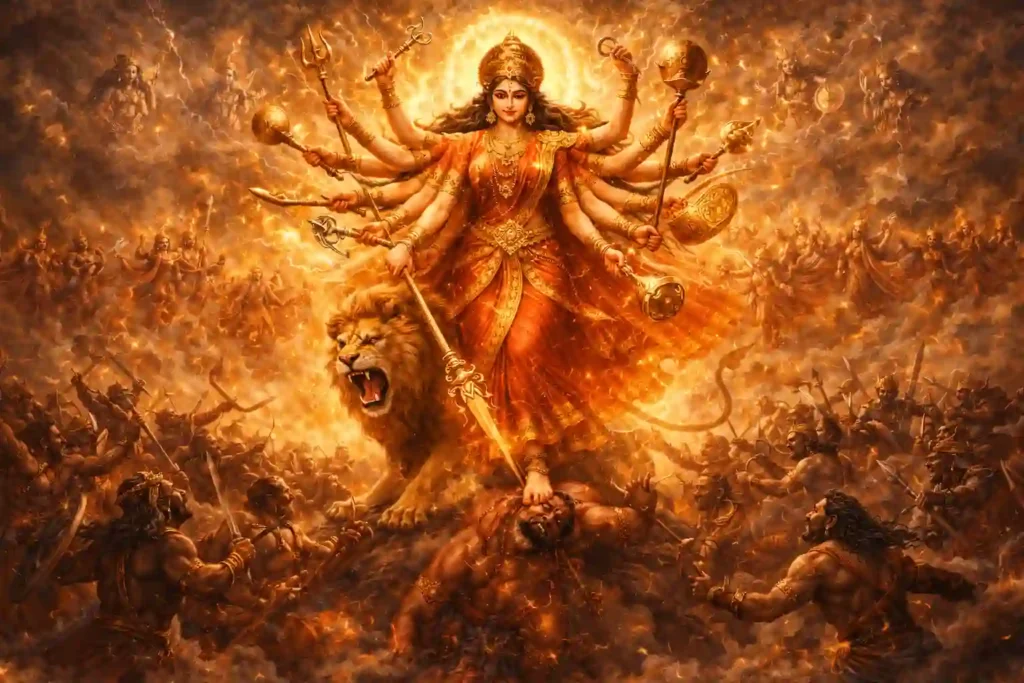
From the combined energy of the gods emerged Goddess Durga, who fought the demon and ultimately destroyed him. This victory gave her the name Mahishasura Mardini.
The Destruction of Shumbha and Nishumbha
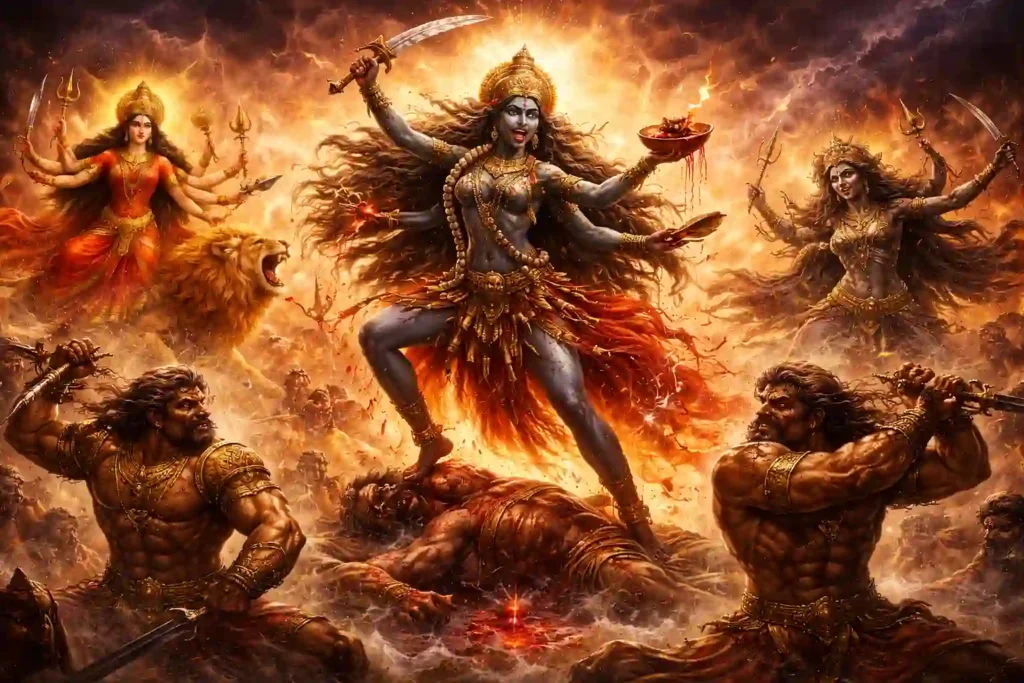
The final chapters describe the battle against the demon brothers Shumbha and Nishumbha.
During this battle the Goddess appeared in fierce forms such as Kali and Chamunda and defeated their generals including Chanda, Munda, and Raktabeej, restoring balance to the universe.
Hidden spiritual meaning
Beyond the dramatic battles, the scripture carries a deeper spiritual message.
The demons symbolize negative tendencies within the human mind.
Madhu and Kaitabha represent laziness and doubt.
Mahishasura represents ego and arrogance.
Raktabeej represents endless desires that multiply without control.
Shumbha and Nishumbha represent pride and attachment.
The Goddess represents the awakening of divine consciousness that destroys these inner obstacles.
Why Devotees Read Durga Saptashati During Navratri
Navratri is the sacred festival dedicated to the Divine Mother.
During these nine nights, devotees believe that the spiritual energy of the Goddess becomes especially powerful.
Because Durga Saptashati celebrates the victories of Maa Durga, it is traditionally read during this time.
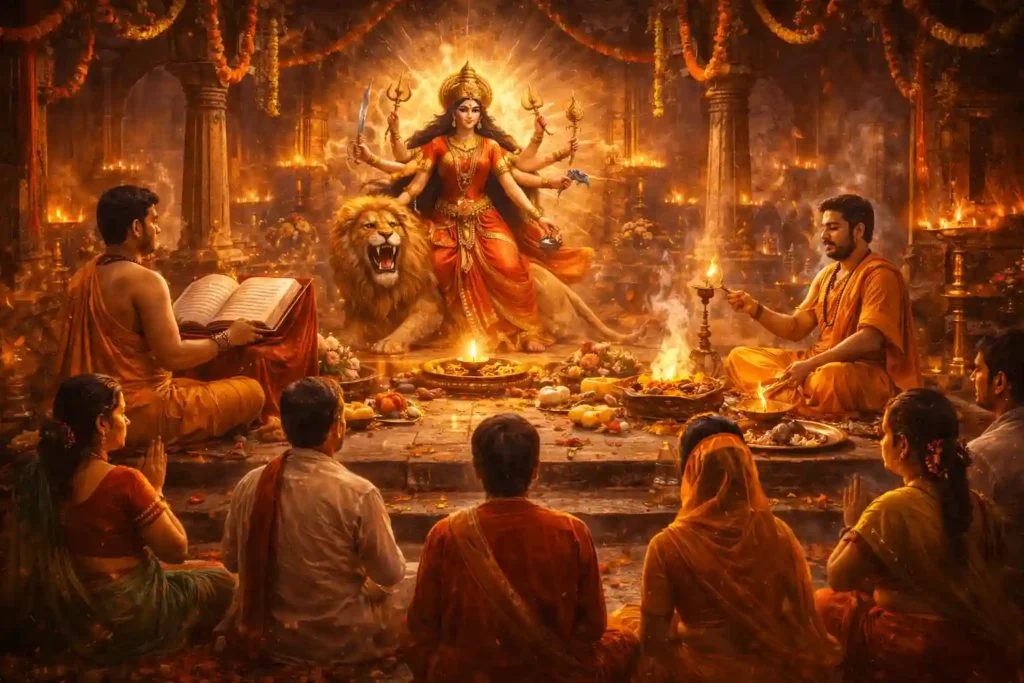
The recitation of Durga Saptashati is also an important part of Durga Puja celebrations in West Bengal, where priests chant the sacred verses during the worship of the Goddess.
Preparatory hymns before recitation
Before beginning the recitation, devotees often chant a few preparatory hymns.
These include:
Devi Kavach
Argala Stotra
Keelakam
These prayers are believed to create a protective spiritual atmosphere before the powerful verses of Durga Saptashati are read.
The Navarna mantra of the Divine Mother
One of the most sacred mantras associated with Durga Saptashati is the Navarna Mantra:
Om Aim Hreem Kleem Chamundayai Vicche
This mantra invokes the protective and transformative energy of the Divine Mother and is often chanted before and after the recitation.
Siddha Kunjika Stotram and its significance
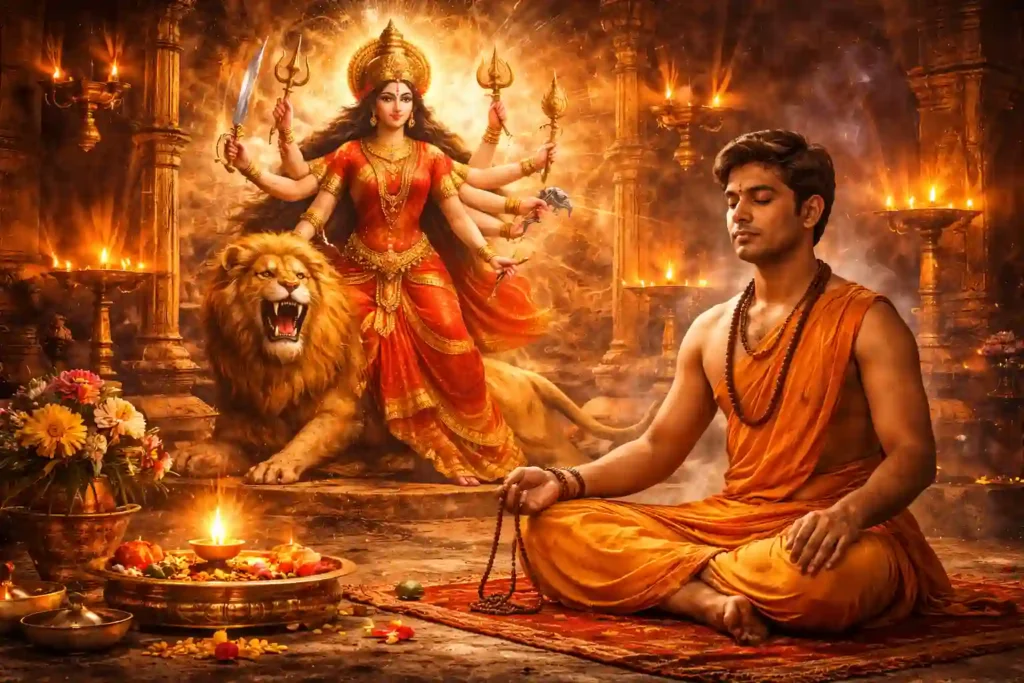
Some traditions recommend chanting Siddha Kunjika Stotram before reading Durga Saptashati.
It is believed to contain the essence of the entire scripture and is sometimes recited by devotees who cannot read all seven hundred verses.
How Devotees Recite Durga Saptashati
There are different ways devotees perform the recitation.
Some read all 13 chapters in one sitting, while others divide them across several days.
A common Navratri method is:
Day | Chapters |
Day 1 | Chapter 1 |
Day 2 | Chapters 2–4 |
Day 3–9 | Chapters 5–13 |
Benefits of reading it
Devotees believe that reading Durga Saptashati brings spiritual blessings.
It is believed to remove negative energies, give courage during difficult times, and bring peace to the mind.
Many devotees also experience a stronger sense of faith and connection with the Divine Mother.
A path of inner transformation
This sacred scripture is not only a story about divine battles. It is also a spiritual guide.
The scripture reminds devotees that the real battle happens inside the human mind. When ego, fear, and ignorance rise, the power of Shakti awakens to restore balance.
Through devotion and faith, the blessings of the Divine Mother guide devotees toward strength and spiritual growth.
Conclusion
For centuries Durga Saptashati has remained one of the most powerful scriptures dedicated to the Divine Mother.
Its stories remind devotees that whenever darkness rises, the energy of Shakti appears to restore balance.
During Navratri, when devotion to Maa Durga reaches its peak, reading Durga Saptashati becomes a way for devotees to connect with the grace, strength, and protection of the Divine Mother.
Suggested Reading
If you enjoy learning about the power and stories of the Divine Mother, you may also like exploring some other traditions of Shakti worship.
During the spring festival of Chaitra Navratri, millions of devotees worship the nine forms of Maa Durga and celebrate the victory of divine energy over darkness.
Ancient temples such as the mysterious 64 Yogini temples also reveal the deeper tantric traditions connected to the worship of the Divine Mother.
In different parts of India, the Divine Mother is worshipped in many unique forms. In Gujarat, devotees revere Khodiyar Maa, a protective serpent goddess believed to guard her devotees in times of danger.
These traditions show how the power of Shakti appears in many forms across Sanatan Dharma.
Please visit our website for more such article on Shakti and Shiva: www.thesanatantales.com.
FAQs
What is the main story of Durga Saptashati?
The Durga Saptashati describes the victories of Goddess Durga over powerful demons like Madhu-Kaitabha, Mahishasura, and Shumbha-Nishumbha, showing the triumph of divine power over evil.
Who cursed Durga Saptashati?
Durga Saptashati itself was not cursed. Some traditions mention symbolic “locks” on its power, which are spiritually unlocked through hymns like Keelakam before recitation.
What happens when you read Durga Saptashati?
Devotees believe that reading Durga Saptashati brings protection, courage, peace of mind, and the blessings of the Divine Mother.
Who wrote Durga Saptashati and when?
Durga Saptashati appears in the Markandeya Purana and is traditionally attributed to Sage Markandeya, composed many centuries ago in ancient India.
How powerful is Durga Saptashati?
Durga Saptashati is considered one of the most powerful Shakti scriptures because it invokes the protective and transformative energy of the Divine Mother.
How many times should I read Durga Saptashati?
There is no fixed rule. Many devotees read it once daily during Navratri or complete the full recitation over nine days.
Why is the Chandi Path done?
Chandi Path is the ritual recitation of Durga Saptashati performed to invoke the blessings of Maa Durga and remove obstacles, negativity, and fear.
What is the powerful mantra of Durga Saptashati?
One of the most powerful mantras associated with Durga Saptashati is the Navarna Mantra:
Om Aim Hreem Kleem Chamundayai Vicche.
Can we read Durga Saptashati without a guru?
Yes, devotees can read or listen to Durga Saptashati with faith and devotion, though traditional guidance from a guru can help understand its deeper meaning.
What is the inner meaning of Durga Saptashati?
The scripture symbolizes the inner battle between divine awareness and negative qualities like ego, anger, and ignorance.
Why is it called Durga Saptashati?
It is called Durga Saptashati because the text contains 700 verses (shlokas) praising the power and glory of Goddess Durga.