
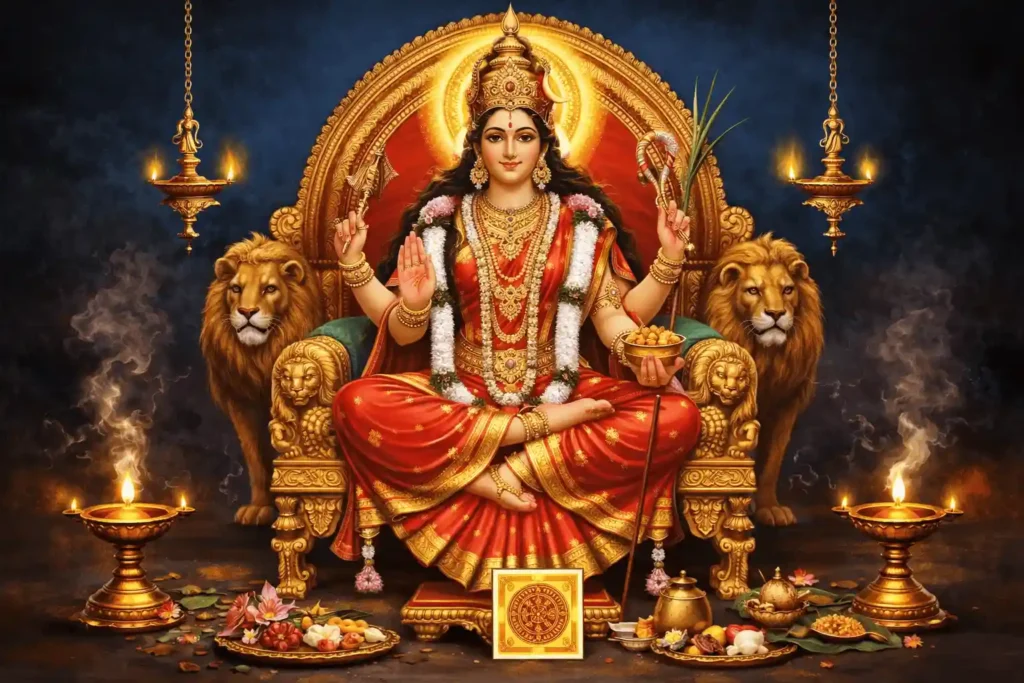
Maa Lalita Tripura Sundari is worshipped as the most complete, gentle, and luminous form of Adi Shakti. She is not only a goddess of beauty and grace, but also the supreme consciousness behind creation itself.
In Sanatan Dharma, Maa Lalita Tripura Sundari stands at the heart of Sri Vidya, a spiritual path where devotion and wisdom grow together.
Unlike fierce or renunciatory forms of the Divine Mother, Maa Lalita represents fullness. Her presence feels nurturing, sovereign, and deeply reassuring. Her worship does not begin with fear or austerity. It begins with love, harmony, and inner awareness.
Table of Contents
ToggleWho is Maa Lalita Tripura Sundari
Maa Lalita Tripura Sundari is the supreme goddess of the Sri Vidya tradition. The word Lalita means playful, graceful, and effortless. Tripura Sundari means the most beautiful one of the three worlds, physical, subtle, and causal.
She is not limited to form. She is pure consciousness expressing itself as beauty, order, and awareness. In many Sanatan traditions, she is regarded as Adi Parashakti, from whom all other forms of the Divine Mother emerge.
Meaning and symbolism of Tripura Sundari
Tripura Sundari symbolizes balance and completeness. Her beauty is not outer charm alone, but the harmony of wisdom and compassion.
She governs the three states of experience, waking, dreaming, and deep sleep, while also transcending them as pure awareness. Her symbolism teaches that spiritual realization does not require rejection of life. It requires understanding life deeply.
This is why worship of Maa Lalita Tripura Sundari feels gentle, fulfilling, and inwardly rich.
Story of Maa Lalita in Sanatan tradition
The primary story of Maa Lalita appears in the Lalitopakhyana. In this sacred narrative, she manifests to destroy Bhandasura, a demon who represents ego, imbalance, and misuse of power.
Maa Lalita does not fight with anger. She commands the universe with clarity and divine authority. Her celestial army symbolizes inner faculties like discipline, wisdom, devotion, and discrimination.
The story reminds us that when ego dissolves, harmony is naturally restored. This is the deeper meaning behind her divine victory.
Lalita Sahasranama and its spiritual meaning
Lalita Sahasranama is one of the most revered hymns in Sanatan Dharma. It describes a thousand names of Maa Lalita, each revealing a subtle truth about consciousness and creation.
Unlike prayers that focus on fear removal, Lalita Sahasranama refines awareness. Chanting it gradually calms the mind and opens deeper understanding. Over time, devotion matures into wisdom.
This is why Lalita Sahasranama holds a central place in Sri Vidya sadhana.
Sri Yantra and Maa Lalita’s divine presence
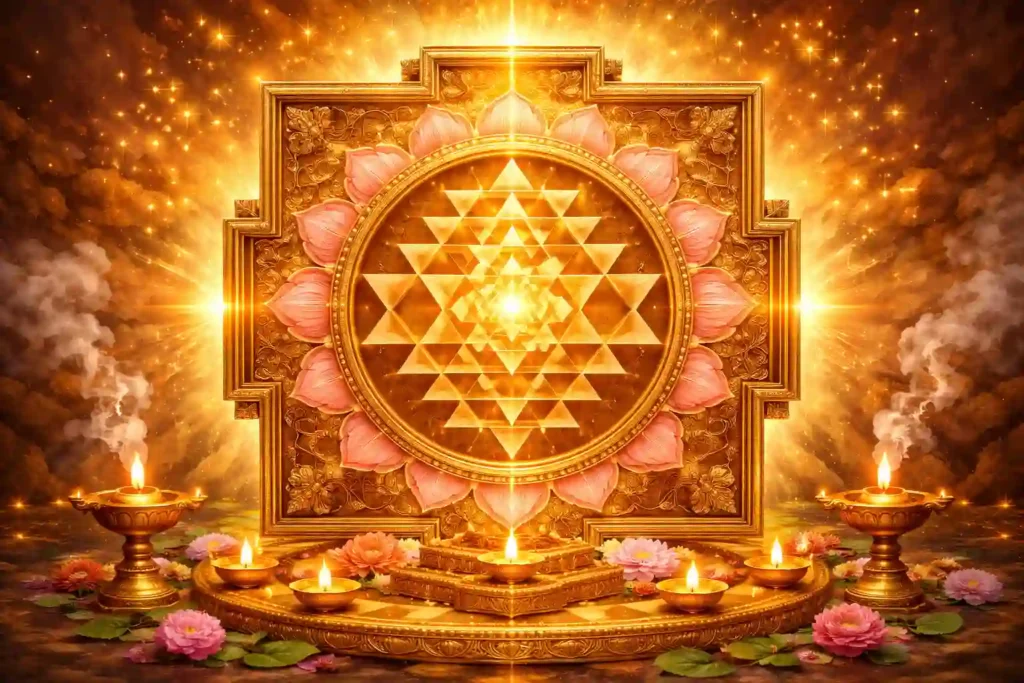
Sri Yantra is not merely a geometric symbol. It is considered the visual form of Maa Lalita herself. Each triangle represents the movement of consciousness, both inward and outward.
The central bindu symbolizes the point of stillness where all duality dissolves. Maa Lalita is said to reside in this bindu as pure awareness.
Meditation on Sri Yantra is essentially meditation on balance, harmony, and inner silence.
Sri Vidya sadhana explained simply
Sri Vidya is often misunderstood as secret or difficult. In truth, it is a path of refinement. It teaches how to recognize the divine in form, emotion, and intellect.
Sri Vidya sadhana begins with devotion, not rituals. It matures through mantra japa, meditation, and ethical living. Maa Lalita Tripura Sundari is both the guide and the goal of this path.
For householders, Sri Vidya is not renunciation. It is sacred, balanced living.
Difference between Kali, Tara and Lalita
Kali represents raw transformation and dissolution of ego. Tara guides seekers across fear and ignorance. Lalita represents fulfillment after transformation.
These forms are not in conflict. They are stages of inner evolution. Maa Lalita Tripura Sundari is worshipped when struggle gives way to harmony.
This is why Lalita is often described as the crown of the Mahavidya tradition.
Temples of Maa Lalita Tripura Sundari
Temples of Maa Lalita are found across India, often connected to ancient Shakti peethas and Sri Vidya centers. Her worship in these temples emphasizes mantra, yantra, and inner devotion rather than outward display.
Devotees often describe these temples as calm and grounding. Pilgrimage to such places is seen as an inward journey rather than a ritual obligation.
How devotees experience Maa Lalita’s worship
Devotees of Maa Lalita often describe her presence as soothing and steady. Her worship brings emotional balance, inner confidence, and clarity rather than dramatic experiences.
Many feel that regular remembrance of Maa Lalita Tripura Sundari gently transforms how they relate to life. Fear reduces. Awareness deepens. Devotion becomes natural rather than forced.
This quiet transformation is considered her greatest blessing.
Why Maa Lalita is worshipped as supreme Shakti
Maa Lalita is worshipped as supreme Shakti because she includes everything. Power without aggression. Beauty without attachment. Authority without ego.
She teaches that spirituality does not reject the world. It refines it. Her path leads to harmony within oneself and with life itself.
Conclusion: Maa Lalita as the path of inner fullness
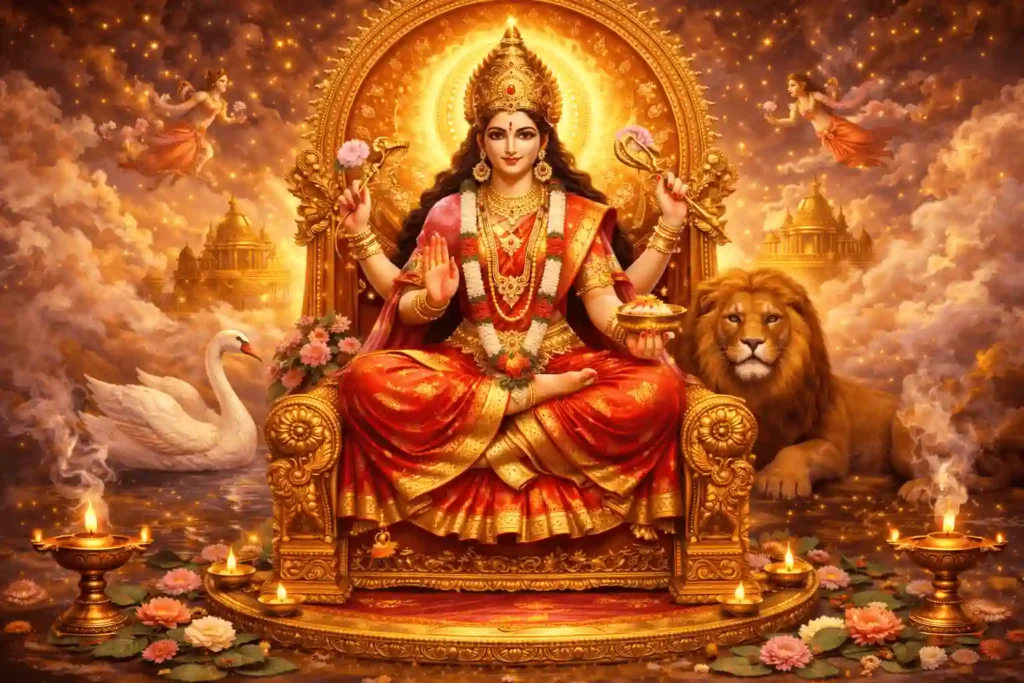
Maa Lalita Tripura Sundari is not worshipped to escape life, but to understand it deeply. Her path begins with beauty and matures into wisdom.
In today’s restless world, Maa Lalita Tripura Sundari offers harmony rather than withdrawal. Through her, devotion slowly becomes awareness, and life itself begins to feel sacred.
If you wish to explore further, you may read our guides on Sri Vidya sadhana, Lalita Sahasranama meaning, Sri Yantra symbolism, and other forms of Shakti on thesanatantales.com.
Together, these articles form a complete and balanced understanding of the Lalita tradition.
FAQs
Is Maa Lalita and Tripura Sundari the same?
Yes. Lalita is her name, and Tripura Sundari describes her cosmic nature.
Is Maa Lalita part of the Das Mahavidya?
Yes. She is often regarded as the highest expression within the Mahavidya tradition.
Is worship of Maa Lalita suitable for beginners?
Yes. Her worship is gentle and well suited for sincere beginners and householders.
Can householders worship Maa Lalita Tripura Sundari?
Yes. Sri Vidya is traditionally meant for balanced household life.
Is Sri Vidya sadhana dangerous or secret?
No. When followed with guidance and sincerity, it is a calm and enriching spiritual path.
Can beginners chant Lalita Sahasranama?
Yes. Chanting with respect and patience is enough to begin.