
Many people use the word Hinduism. But fewer pause to understand the deeper expression behind it, Sanatan Dharma.
The Sanatan Dharma meaning is gentle yet profound. It does not simply describe a religion. It points to an eternal way of living in harmony with truth, nature, and cosmic order.
It has no single founder, no fixed starting date, and no rigid boundary. It flows across time like a river, adapting yet remaining rooted in its essence.
To understand what is Sanatan Dharma is to understand the spiritual foundation of what the world today calls Hinduism. Let us explore it calmly and clearly.
To truly understand the Sanatan Dharma meaning, we must go beyond labels and see its eternal vision.
Table of Contents
ToggleWhat does Sanatan Dharma mean?
The word has two parts.
Sanatan means eternal, without beginning or end.
Dharma means that which sustains, the natural law, righteousness, moral duty, and cosmic order.
Dharma is often translated as religion, but that translation is incomplete. Religion usually refers to a belief system built around a founder or a historical event.
Dharma is different. It refers to the inherent order of existence. Fire burns. Water flows. The sun rises. That is their dharma.
In the same way, truthfulness, compassion, gratitude, and self discipline are human dharma.
So when we speak about Sanatan Dharma meaning, we are speaking about the eternal law that governs both the universe and human conduct. It is the rhythm of life itself.
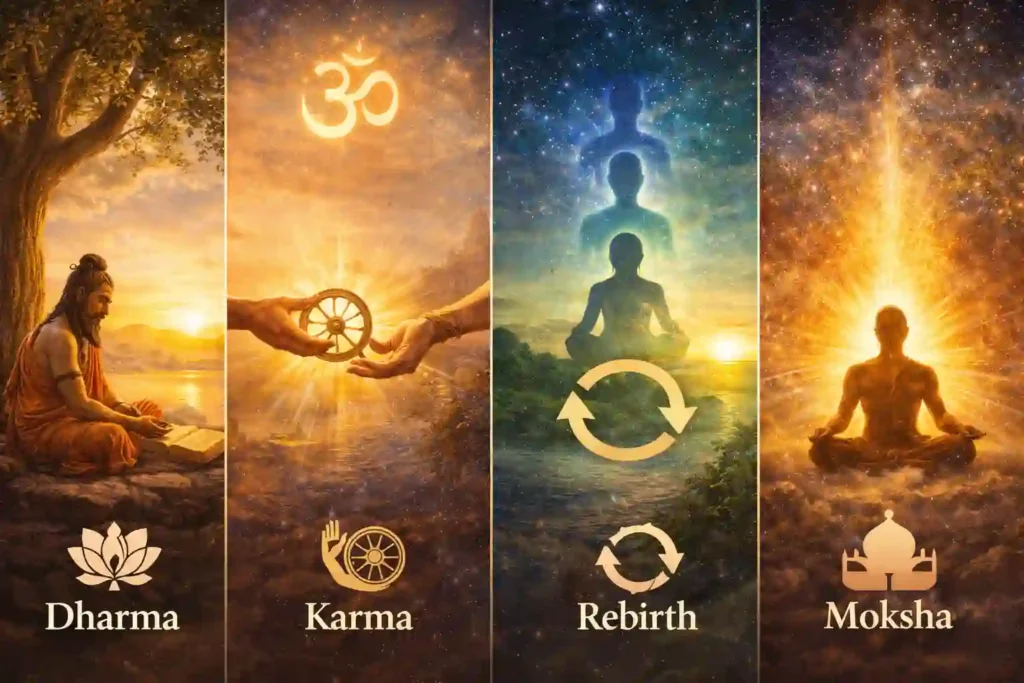
Is Sanatan Dharma the same as Hinduism?
This is one of the most searched questions today.
The word Hindu developed later in history. It came from the river Sindhu. Foreign travelers pronounced Sindhu as Hindu and gradually the term Hinduism became a civilizational label for the spiritual traditions of India.
However, within the tradition, the path was always described as Sanatan Dharma.
So they are connected, but not identical.
Hinduism is the broader cultural and civilizational identity.
Sanatan Dharma is the timeless philosophical foundation.
Sanatan Dharma has no single founder, no single mandatory scripture, no central religious authority, and no concept of forced conversion.
It is better understood as a spiritual ecosystem that includes many philosophies, practices, and devotional paths.
Origin of Sanatan Dharma
If someone asks when Sanatan Dharma began, the honest answer is that its beginning cannot be traced to a specific date.
Its wisdom is reflected in the ancient Vedas, especially the hymns of the Rig Veda. The Upanishads explore deep philosophical inquiry about the self and ultimate reality.
The Bhagavad Gita presents a dialogue on duty, devotion, and liberation. The Ramayana and Mahabharata express dharma through stories and lived dilemmas.
Yet none of these texts are considered the “starting point.” They are seen as expressions of eternal truths realized by ancient rishis in deep meditation.
Sanatan Dharma is traditionally described as apaurusheya, meaning not created by any human mind. It is discovered wisdom, not invented doctrine.
This understanding strengthens the Sanatan Dharma meaning as timeless and universal rather than historical and limited.
This timeless foundation strengthens the Sanatan Dharma meaning as something discovered through realization, not created by history.
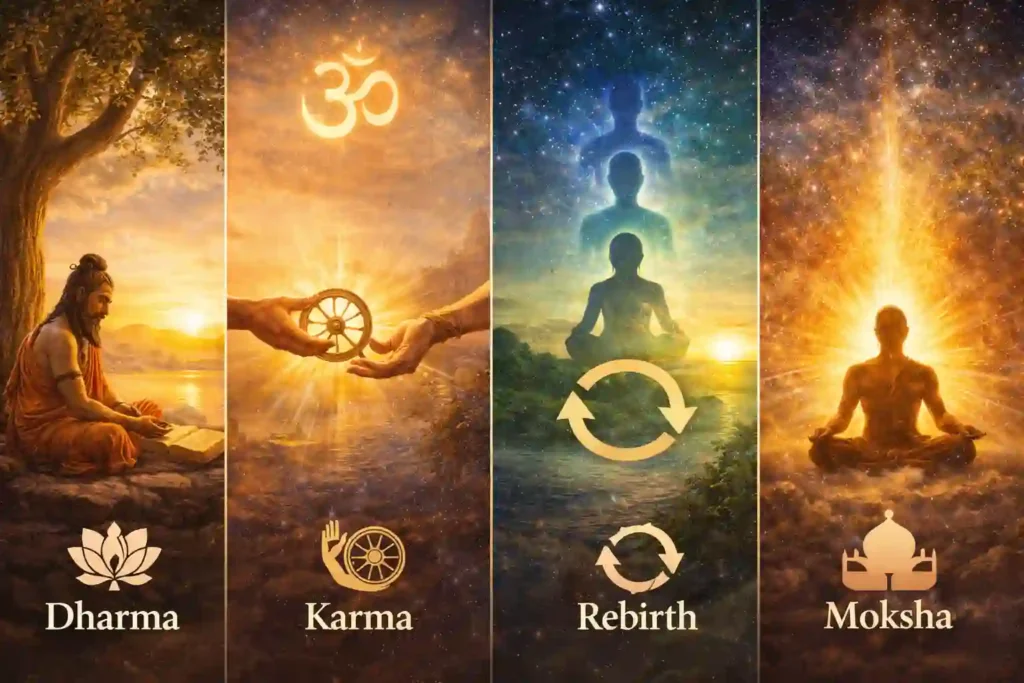
Core principles of Sanatan Dharma
To understand what is Sanatan Dharma, we must understand its foundational ideas. These are not rigid commandments. They are guiding principles that shape spiritual life.
Dharma
Living in alignment with righteousness and moral responsibility.
Karma
Every action produces a result. Nothing happens without cause.
Rebirth
The soul journeys through multiple lives, learning and evolving.
Moksha
The ultimate aim is liberation from the cycle of birth and death.
Satya and Ahimsa
Truthfulness and non violence form the moral backbone of life.
Principle | Meaning |
Dharma | Righteous living |
Karma | Law of action and result |
Rebirth | Continuity of the soul |
Moksha | Spiritual liberation |
Satya | Truthfulness |
Ahimsa | Non violence |
Together, these ideas form the living structure behind the Sanatan Dharma meaning.
These principles together form the heart of the Sanatan Dharma meaning and guide spiritual life across generations.
Why the Sanatan Dharma meaning is called eternal
Sanatan Dharma is called eternal because it is not dependent on a single historical event.
It accepts cosmic cycles such as Satya Yuga, Treta Yuga, Dvapara Yuga, and Kali Yuga. Time moves in cycles, yet truth remains constant.
Compassion does not expire. Meditation does not become outdated. Moral responsibility does not lose relevance.
The outer forms may adapt. The inner principles remain steady. That is why the Sanatan Dharma meaning carries the idea of timelessness.
Sanatan Dharma Meaing in daily life
Sanatan Dharma is not limited to philosophy or temple rituals. It lives in ordinary life.
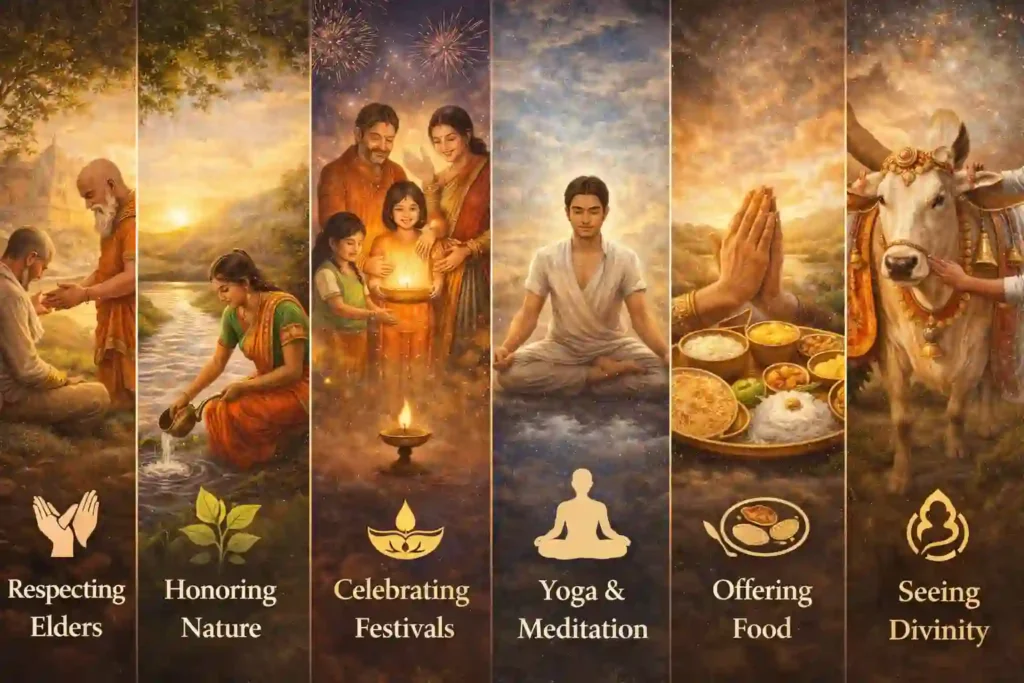
Touching elders’ feet is seen as honoring wisdom.
Respecting rivers and trees reflects ecological awareness.
Celebrating festivals connects family and community.
Practicing yoga and meditation cultivates inner clarity.
Offering gratitude before meals acknowledges interdependence.
Even fulfilling family responsibilities is seen as sacred duty.
In many Indian homes, these are not abstract concepts. They are lived quietly each day. That lived experience makes Sanatan Dharma practical and deeply rooted.
The Sanatan Dharma meaning becomes real when these values are practiced in everyday life.
Is Sanatan Dharma a religion or a way of life?
The simplest answer is that it is both.
It includes temples, rituals, and sacred texts. But it also includes ethics, discipline, inquiry, and personal realization.
The Upanishads encourage questioning. The Bhagavad Gita is a dialogue between Arjuna and Krishna.
Saints across centuries reflected, debated, and explored before realizing truth.
Sanatan Dharma does not insist on blind belief. It invites understanding. That openness makes it living and dynamic.
Common misconceptions
Some think it promotes many unrelated gods. In reality, it speaks of one ultimate reality expressed through many forms.
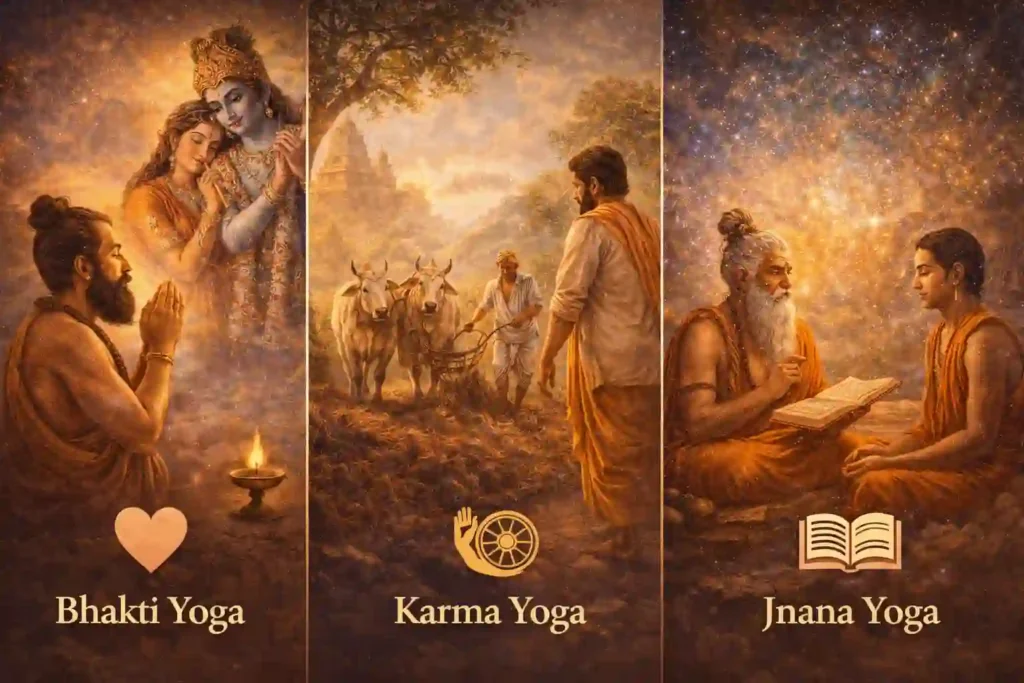
Some believe it is rigid. In fact, it allows multiple spiritual paths such as bhakti yoga, karma yoga, jnana yoga, and raja yoga.
Some dismiss it as mythology. Yet its philosophical ideas have influenced global discussions on consciousness, meditation, and ethics.
Sanatan Dharma operates on symbolic, philosophical, and practical levels at once.
Why understanding Sanatan Dharma matters today
Modern life moves quickly. Stress, comparison, and anxiety often dominate daily living.
The Sanatan Dharma meaning offers grounding. It emphasizes inner balance, self awareness, responsibility for actions, and harmony with nature.
Today the world speaks about mindfulness and sustainability. These principles have long existed within Sanatan Dharma’s framework.
Understanding it is not about political identity. It is about reconnecting with enduring wisdom that nurtures both inner peace and social harmony.
In a restless modern world, the Sanatan Dharma meaning offers stability and inner direction.
Conclusion
What is Sanatan Dharma?
It is the eternal path of truth, righteousness, and spiritual growth. It forms the philosophical heart of Hindu civilization and continues to guide millions quietly and steadily.
The Sanatan Dharma meaning points toward a life aligned with cosmic order, moral responsibility, and self realization.
It is ancient, yet deeply relevant.
It is vast, yet intimate.
It is timeless, and perhaps that is why it is called Sanatan.
When we reflect deeply, the Sanatan Dharma meaning is not just a definition, but a lived experience.
Suggested Reading
If understanding the Sanatan Dharma meaning has stirred something deeper within you, you may also explore a few related reflections from this category.
You can read “What Is Maya in Hindu Philosophy?” to understand how inner freedom works within daily life. It explains vairagya not as escape, but as emotional balance.
You may also explore “What Is Nishit Kaal?” which explains sacred time and how Sanatan Dharma views moments of spiritual intensity.
To understand divine feminine wisdom within Sanatan thought, read “Das Mahavidya: From Kali to Kamala, The Journey Within.” It reveals how cosmic principles are expressed through the ten Mahavidyas.
And for devotional understanding, “Navadurga and Their Spiritual Meaning” beautifully explains how spiritual evolution unfolds through nine divine forms.
For more such articles please visit our website:www.thesanatantales.com.
FAQs
What is the meaning of Sanatan Dharma?
Sanatan Dharma means the eternal law or eternal way of righteous living. It refers to timeless principles that guide both the universe and human conduct. Rather than being limited to a specific founder or book, it describes an ongoing alignment with truth, moral duty, and spiritual growth.
This is the deeper Sanatan Dharma meaning understood within Hindu philosophy.
Is Sanatan Dharma older than Hinduism?
The term Hinduism developed later as a cultural and geographical label. Sanatan Dharma refers to the philosophical foundation that predates this label. While both are closely connected today, Sanatan Dharma expresses the timeless spiritual identity behind what is now called Hinduism.
Who founded Sanatan Dharma?
No single person founded it. According to tradition, its wisdom was realized by ancient sages through meditation and reflection. It is considered timeless knowledge rather than a doctrine created at a specific historical moment.
Is Sanatan Dharma a religion?
It functions as both a religion and a way of life. It includes rituals, scriptures, and worship practices, but it also emphasizes ethics, inquiry, and personal spiritual development. Its scope goes beyond institutional boundaries.
What are the core beliefs of Sanatan Dharma?
Its central ideas include dharma, karma, rebirth, moksha, truthfulness, and non violence. These principles guide ethical living, spiritual evolution, and the search for liberation from the cycle of birth and death.
Why is it called eternal?
It is called eternal because it is not tied to a single event or founder. It recognizes cosmic cycles and evolving forms, yet its core truths remain constant across time.
Does Sanatan Dharma have one holy book?
No. It includes many revered texts such as the Vedas, Upanishads, Bhagavad Gita, and Puranas. These are seen as expressions of timeless wisdom rather than exclusive authority.
. Is Sanatan Dharma relevant today?
Yes. Its principles of responsibility, compassion, self awareness, and harmony with nature remain deeply relevant in modern life, especially in times of stress and imbalance.