
Have you ever wondered why your mind feels calm at one moment, restless the next, and heavy or unmotivated at another? These changing states are a natural part of human life, but Sanatan Dharma offers a profound explanation for why they occur.
According to the ancient philosophy of Sattva Rajas Tamas, also known as Triguna, all of creation arises from the union of Purusha (pure consciousness) and Prakriti (nature). While Purusha is the eternal witnessing consciousness, Prakriti expresses itself through three fundamental qualities, or gunas, that influence everything in the universe, from the natural world to the human mind.
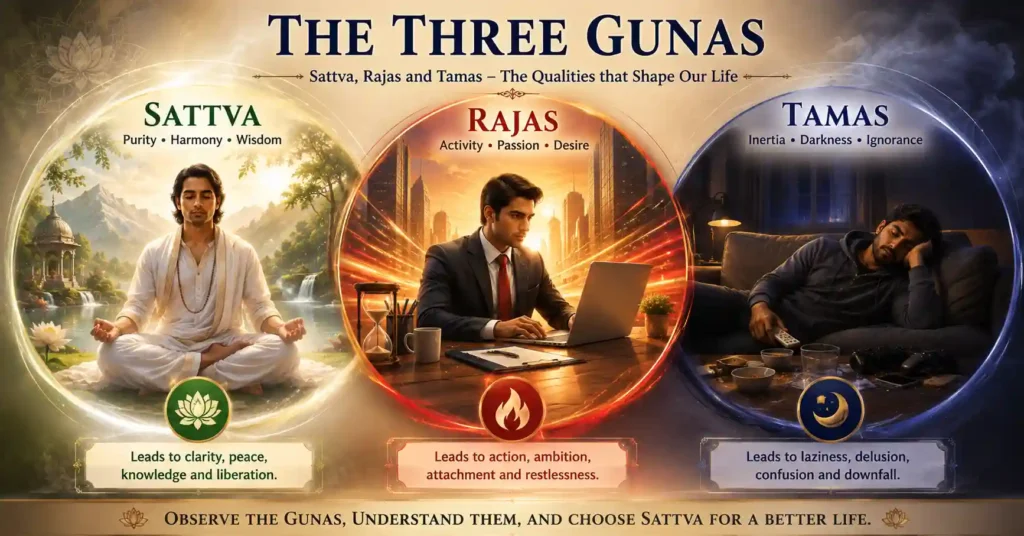
These three gunas are Sattva, which brings clarity and harmony, Rajas, which drives action and desire, and Tamas, which provides rest and stability but can also lead to inertia when out of balance. Every person possesses all three. What changes is their proportion, and this is why your thoughts, emotions, decisions, and behaviour keep changing throughout the day.
Understanding Sattva Rajas Tamas helps you see yourself with greater awareness. Instead of reacting to every mood or emotion, you begin to recognise the subtle play of the three gunas within your mind. This simple shift in understanding can transform the way you live, work, relate to others, and progress on your spiritual journey.
In this article, you will learn the meaning of Sattva Rajas Tamas (Triguna), their significance in Sanatan Dharma, their scriptural foundation, practical examples from daily life, their influence on food, thoughts, and personality, and simple ways to cultivate more Sattva for a balanced and spiritually fulfilling life.
Table of Contents
ToggleWhat Are Sattva Rajas Tamas (Triguna)?
Sattva Rajas Tamas, collectively known as Triguna, are the three fundamental qualities of Prakriti (nature) described in Sanatan Dharma. They are not something outside you but are present within every living being, influencing the way we think, feel, act, and respond to the world around us.
According to traditional philosophy, the universe is the union of Purusha (pure consciousness) and Prakriti (nature). While Purusha is the eternal witnessing consciousness, Prakriti expresses itself through these three gunas. Every person, object, and aspect of nature contains all three in different proportions.
Each guna has its own unique role:
| Guna | Represents | Primary Qualities |
|---|---|---|
| Sattva | Purity and harmony | Clarity, wisdom, peace, balance |
| Rajas | Activity and passion | Action, ambition, desire, movement |
| Tamas | Inertia and stability | Rest, heaviness, ignorance, inertia |
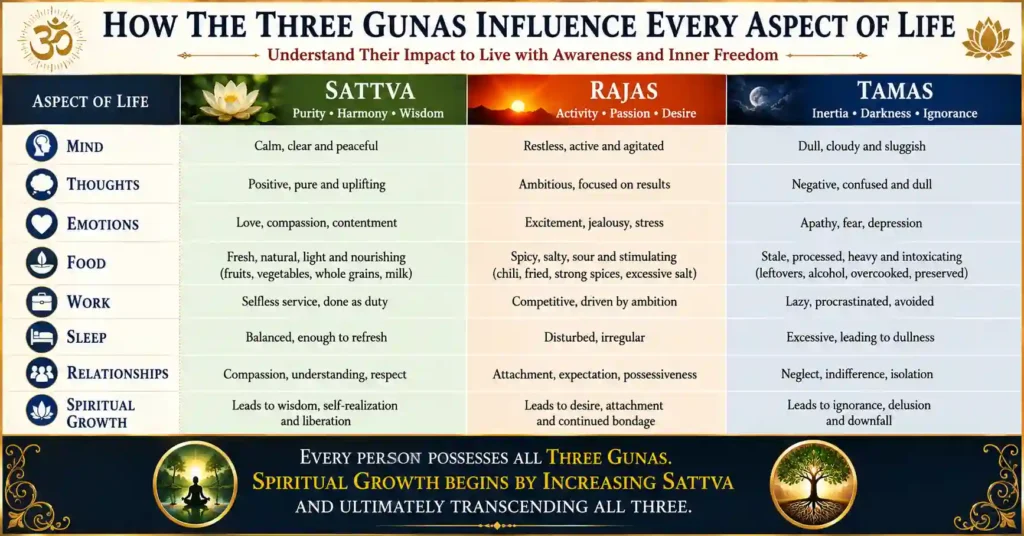
No person is made up of only one guna. All three are always present, but their influence keeps changing according to your thoughts, habits, environment, food, and actions. At one moment, Sattva may bring calmness and clear thinking. At another, Rajas may inspire action and ambition, while Tamas provides the rest your body and mind need.
Understanding Sattva Rajas Tamas helps explain why your inner state is constantly changing. Rather than seeing these changes as fixed parts of your personality, Sanatan Dharma teaches that they are the natural play of the three gunas, and through awareness and right living, their balance can gradually be transformed.
Origin of the Three Gunas in Sanatan Dharma
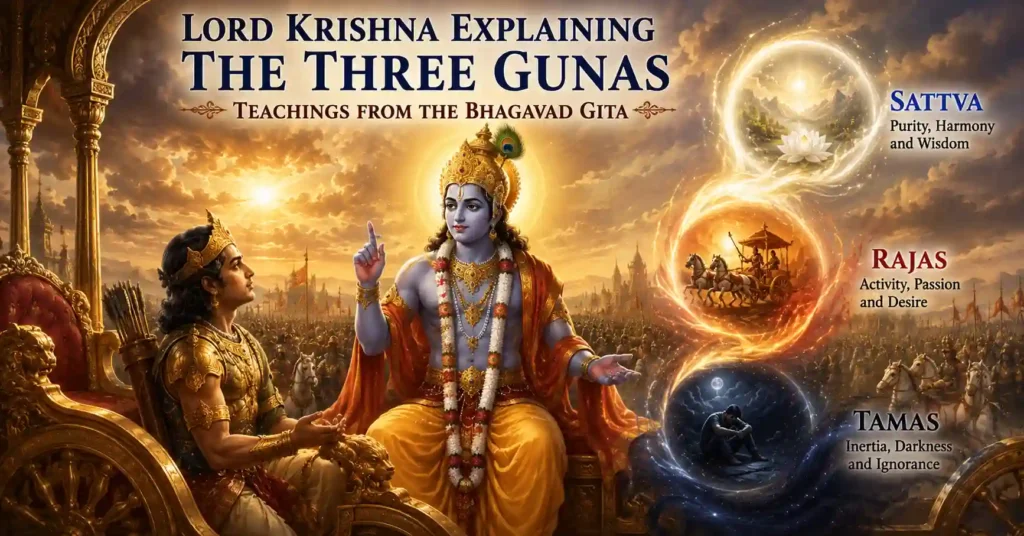
The philosophy of Sattva Rajas Tamas has its roots in the ancient wisdom of Sanatan Dharma and is explained most clearly in the Bhagavad Gita, especially in Chapter 14, known as Gunatraya Vibhaga Yoga (The Yoga of the Division of the Three Gunas).
In this chapter, Shri Krishna teaches Arjuna that all of Prakriti (material nature) is governed by three fundamental qualities known as the three gunas or Triguna. Every thought, emotion, action, habit, and tendency is influenced by the changing balance of Sattva, Rajas, and Tamas.
The concept of Triguna is also a central teaching of Samkhya philosophy, one of the oldest philosophical traditions of Sanatan Dharma. It explains that while Purusha is pure consciousness, Prakriti expresses itself through these three gunas, giving rise to the diversity of life and human experience.
This timeless wisdom has guided seekers for centuries in understanding the nature of the mind and the path to inner growth. One of its most comforting teachings is that your changing thoughts and emotions do not define who you truly are. Many times, they are simply the natural play of Sattva Rajas Tamas within the mind.
Once you begin to observe these three gunas instead of identifying with them, you naturally become less judgmental of yourself and more aware of the deeper consciousness that remains unchanged.
Scriptural References to the Three Gunas
The philosophy of the three gunas is not based on a single scripture. It appears throughout the sacred literature of Sanatan Dharma, where different texts explain their role from philosophical, spiritual, and practical perspectives.
The Bhagavad Gita gives the most detailed explanation, especially in Chapter 14 (Gunatraya Vibhaga Yoga). It describes how the gunas bind the individual soul to material nature and influence thoughts, actions, knowledge, faith, and behaviour.
The Samkhya philosophy explains that all of Prakriti functions through these three fundamental qualities, while Purusha remains the eternal witnessing consciousness beyond their influence.
The Upanishads encourage seekers to move beyond attachment to the changing qualities of the mind and realise the true Self, while many Yoga traditions teach that cultivating Sattva creates the inner purity needed for meditation and Self-realization.
Quick Reference
| Scripture / Tradition | Contribution |
|---|---|
| Bhagavad Gita | Explains the nature, characteristics, and influence of the three gunas. |
| Samkhya Philosophy | Describes creation through Purusha, Prakriti, and the three gunas. |
| Upanishads | Encourage Self-realization beyond the changing qualities of the mind. |
| Yoga Philosophy | Teaches that increasing Sattva supports meditation and inner purification. |
Sattva Guna in Daily Life (Purity and Balance)
Sattva is the quality of purity, harmony, and balance. When Sattva is dominant, the mind feels calm, clear, and focused. Instead of being driven by constant desires or confusion, you naturally experience contentment, wisdom, and inner peace.
In daily life, Sattva expresses itself through simple yet meaningful actions. You wake up feeling refreshed, spend a few quiet moments in prayer or meditation, eat fresh and nourishing food, speak kindly, and perform your duties with sincerity. You help others without expecting anything in return because compassion arises naturally.
A sattvic mind is not free from challenges, but it responds with patience and clarity rather than impulsive reactions. Decisions are guided by wisdom instead of emotions, and there is a sense of balance even during difficult situations.
Sattva is never hurried. It brings a quiet strength that creates stability without attachment and confidence without arrogance. This balanced state supports physical well-being, healthy relationships, and steady spiritual growth.
Signs of Sattva Guna
- Calm and peaceful mind
- Clear thinking and good judgment
- Compassion and kindness towards others
- Contentment without excessive desires
- Interest in prayer, meditation, and self-improvement
- Honest, disciplined, and balanced way of living
The more Sattva grows within you, the easier it becomes to live with awareness, make wise choices, and progress on the path of Dharma and inner peace.
Rajas Guna in Daily Life (Activity and Desire)
Rajas is the quality of activity, passion, and movement. It is the force that motivates you to act, achieve goals, and bring ideas into reality. Without Rajas, there would be no progress, creativity, or ambition.
In everyday life, Rajas appears as constant thinking, planning, working, and striving to accomplish more. It inspires you to build a career, care for your family, learn new skills, and pursue your dreams. In its balanced form, Rajas gives enthusiasm, determination, and the energy to fulfil your responsibilities.
However, when Rajas becomes excessive, it can disturb your inner peace. The mind remains restless, desires keep increasing, and satisfaction becomes difficult to find. You may constantly check your phone, feel busy without being productive, or find it hard to relax even after completing your work.
Rajas is neither good nor bad. In Sanatan Dharma, it is recognised as an essential force of action. When guided by Sattva, ambition is balanced with wisdom, purpose, and self-control.
Signs of Rajas Guna
- Strong ambition and desire to achieve
- Active and energetic lifestyle
- Constant thinking and planning
- Competitive and goal-oriented mindset
- Restlessness and impatience when excessive
- Difficulty slowing down or enjoying the present moment
Balanced Rajas helps you grow, serve others, and fulfil your Dharma. When guided by Sattva, it becomes a powerful force for positive action rather than a source of stress and attachment.
Tamas Guna in Daily Life (Rest and Inertia)
Tamas is the quality of inertia, stability, and rest. It slows the mind and body, allowing you to relax, recover, and regain energy. Without Tamas, restful sleep, physical recovery, and stillness would not be possible.
In daily life, Tamas is experienced through the need for sleep, quiet moments, and physical rest after a busy day. In its balanced form, it provides stability, patience, and the ability to pause before taking action. It reminds us that rest is just as important as activity.
However, when Tamas becomes excessive, it can cloud the mind and reduce motivation. You may oversleep, procrastinate, avoid responsibilities, or lose interest in personal growth. Negative thinking, confusion, and resistance to change can also become more noticeable.
Tamas is not something to fear or reject. Like Sattva and Rajas, it has an important role in maintaining balance. The goal is not to eliminate Tamas but to prevent it from dominating your thoughts and actions.
Signs of Tamas Guna
- Need for rest and recovery
- Calmness through stillness when balanced
- Oversleeping or lack of motivation when excessive
- Procrastination and avoidance of responsibilities
- Confusion, dullness, or negative thinking
- Resistance to change and personal growth
When balanced by Sattva and supported by the right amount of Rajas, Tamas becomes a source of stability rather than stagnation. Understanding this balance helps you work with your natural tendencies instead of struggling against them.
Sattva, Rajas and Tamas at a Glance
If you are new to Triguna, this quick comparison makes it easier to understand how each guna influences daily life.
| Aspect | Sattva | Rajas | Tamas |
|---|---|---|---|
| Nature | Purity and harmony | Activity and passion | Rest and inertia |
| State of Mind | Calm and clear | Active and restless | Slow and dull |
| Main Emotion | Contentment | Desire | Apathy |
| Primary Focus | Wisdom | Achievement | Comfort |
| Healthy Expression | Balance, compassion, clarity | Motivation, enthusiasm | Rest, recovery, stability |
| Excessive Expression | Attachment to goodness | Anxiety, stress, impatience | Laziness, confusion, ignorance |
| Daily Example | Meditation, selfless service | Working towards goals | Sleeping and recovering |
This comparison is not meant to label people. It simply shows how the three gunas express themselves in different situations. Most people experience all three every day, and the dominant quality keeps changing according to their lifestyle, choices, and level of awareness.

How Sattva Rajas Tamas Flow Through Your Day
If you observe your mind carefully, you will notice that Sattva Rajas Tamas naturally rise and fall throughout the day. This changing rhythm is part of human nature and reflects the continuous interplay of the three gunas within the mind.
Early morning, especially during Brahma Muhurta, is often dominated by Sattva. The mind feels calm, fresh, and clear, making it an ideal time for prayer, meditation, study, and quiet reflection.
As the day progresses, Rajas gradually becomes more active. Work, responsibilities, decision-making, and interactions with others require energy and action. This is why most people feel more driven and productive during the daytime.
By evening and night, Tamas naturally begins to increase. The body slows down, the mind becomes quieter, and the need for rest and sleep becomes stronger. This allows the body and mind to recover for the next day.
This daily cycle is both natural and necessary. Problems arise only when one guna remains dominant for too long. Excessive Rajas can lead to stress and restlessness, while excessive Tamas may result in laziness or lack of motivation. A balanced life is one in which Sattva gently guides the activities of Rajas and the rest provided by Tamas.
| Time of Day | Dominant Guna | Common Experience |
|---|---|---|
| Early Morning | Sattva | Calmness, clarity, prayer, meditation |
| Daytime | Rajas | Work, activity, ambition, productivity |
| Evening & Night | Tamas | Rest, relaxation, sleep, recovery |
Understanding this natural rhythm helps you plan your day more wisely. By aligning important activities with the qualities of each guna, you can improve your productivity, emotional balance, and spiritual well-being.
How Sattva Rajas Tamas Influence Your Thoughts and Emotions
Sattva Rajas Tamas do not just influence your actions. They shape the way you think, feel, respond, and experience the world around you. Every decision, emotion, and reaction is coloured by the guna that is most active at that moment.
When Sattva is dominant, the mind becomes peaceful, clear, and balanced. You are able to think calmly, make wise decisions, and respond to situations with patience instead of reacting impulsively. This inner clarity also strengthens compassion, gratitude, and emotional stability.
When Rajas becomes dominant, the mind is filled with activity. Thoughts move quickly, desires increase, and you may feel excited, ambitious, anxious, or restless. While Rajas provides the energy to achieve your goals, too much of it can make it difficult to relax or remain content.
When Tamas is dominant, the mind slows down. In its balanced form, it brings rest and recovery. However, when excessive, it can lead to confusion, lack of motivation, procrastination, and negative thinking. Even simple tasks may begin to feel difficult.
| Dominant Guna | Effect on the Mind | Common Emotions |
|---|---|---|
| Sattva | Clear, balanced, focused | Peace, contentment, compassion |
| Rajas | Active, restless, driven | Excitement, desire, anxiety |
| Tamas | Dull, slow, confused | Apathy, laziness, discouragement |
One of the greatest insights of Sanatan Dharma is that these mental states are not your true identity. They are temporary expressions of the three gunas. By observing them without attachment, you gradually develop greater self-awareness, emotional balance, and inner freedom.
How the Three Gunas Shape Your Personality
Your personality is not shaped by a single guna. Every person carries all three, but one or two may become more influential depending on age, upbringing, habits, environment, and life experiences.
The dominant guna influences how you think, make decisions, respond to challenges, build relationships, and pursue your goals. As these qualities change, your behaviour and outlook on life can also change.
| Dominant Guna | Personality Traits |
|---|---|
| Sattva | Calm, compassionate, truthful, balanced, wise, patient |
| Rajas | Ambitious, energetic, competitive, passionate, achievement-oriented |
| Tamas | Relaxed, slow, resistant to change, passive, comfort-seeking |
No personality is completely sattvic, rajasic, or tamasic. Most people display a mixture of all three qualities in different situations. A person may remain calm at home, become highly ambitious at work, and seek complete rest at the end of the day.
Sanatan Dharma teaches that personality is not fixed. As your thoughts, habits, and awareness evolve, the influence of the three gunas also changes. This is why self-improvement and spiritual growth are always possible.
Food and Its Effect on Sattva Rajas Tamas
According to the Bhagavad Gita (Chapter 17), the food you eat influences not only your physical health but also the balance of Sattva Rajas Tamas within your mind. Food nourishes both the body and the mind, which is why your dietary choices can affect your thoughts, emotions, and overall well-being.
Sattvic food is fresh, light, pure, and nourishing. Fresh fruits, vegetables, whole grains, milk, nuts, and simple home-cooked meals help promote clarity, calmness, and emotional balance. Such foods are traditionally recommended for those seeking a peaceful and disciplined life.
Rajasic food is spicy, oily, salty, or highly stimulating. While it provides energy and enthusiasm, excessive consumption may increase restlessness, impatience, and constant mental activity. It is best enjoyed in moderation according to your lifestyle and needs.
Tamasic food is stale, over-processed, excessively heavy, or lacking freshness. Regular consumption may make the body feel sluggish and the mind less alert. In excess, it can reduce motivation and mental clarity.
| Type of Food | Dominant Guna | Common Effect |
|---|---|---|
| Fresh fruits, vegetables, whole grains, milk | Sattva | Clarity, peace, balance |
| Spicy, fried, salty, stimulating foods | Rajas | Energy, activity, restlessness |
| Stale, processed, overly heavy foods | Tamas | Dullness, heaviness, inertia |
Sanatan Dharma does not encourage fear or rigid rules around food. Instead, it teaches awareness. Observe how different foods affect your body and mind, and choose a balanced diet that supports your health, daily responsibilities, and spiritual goals.

Examples of Sattva Rajas Tamas in Daily Life
The influence of Sattva Rajas Tamas is not limited to spiritual practice. The three gunas can be observed in everyday choices, habits, and reactions. Once you begin noticing them, you develop a deeper understanding of your own thoughts and behaviour.
Food
- You eat a fresh, home-cooked meal and feel light and refreshed. That reflects Sattva.
- You eat quickly while thinking about your next task and immediately return to work. That reflects Rajas.
- You overeat heavy or stale food and feel sleepy or sluggish. That reflects Tamas.
Work
- You work with calm focus and sincerity, without unnecessary stress. That reflects Sattva.
- You constantly rush, compete, and worry about results. That reflects Rajas.
- You postpone important tasks and lose motivation to begin. That reflects Tamas.
Relationships
- You listen patiently, speak kindly, and forgive easily. That reflects Sattva.
- You argue to prove yourself right or seek constant appreciation. That reflects Rajas.
- You ignore others, hold grudges, or withdraw from meaningful conversations. That reflects Tamas.
Daily Habits
| Situation | Sattva | Rajas | Tamas |
|---|---|---|---|
| Morning Routine | Wake up refreshed and meditate | Check emails and rush into work | Oversleep and delay the day |
| Decision Making | Calm and thoughtful | Impulsive and emotional | Confused and indecisive |
| Free Time | Reading, prayer, or nature | Constant activity and entertainment | Excessive sleeping or aimless scrolling |
These simple observations are not meant to judge yourself or others. They help you recognise which guna is influencing your mind at a particular moment. With awareness and consistent practice, you can gradually cultivate more Sattva while keeping Rajas and Tamas in healthy balance.
Which Guna Is Dominant in You?
You do not need a complicated test to understand which guna is most active in your life. The first step is simply to observe yourself honestly, without judgment.
Ask yourself these simple questions:
- Do I usually feel calm, restless, or mentally dull?
- Do I respond thoughtfully or react impulsively?
- Am I content with what I have, or am I always chasing something more?
- Do I feel energetic and focused, or do I often struggle with motivation?
Your answers can help you recognise which of the three gunas is influencing your thoughts and behaviour at this moment.
| If You Mostly Feel… | Dominant Guna May Be |
|---|---|
| Peaceful, clear, and content | Sattva |
| Busy, ambitious, and restless | Rajas |
| Tired, unmotivated, or confused | Tamas |
Remember, this is not a permanent label. Sattva Rajas Tamas are constantly changing based on your habits, food, environment, thoughts, and actions. A person who feels highly rajasic today may experience greater Sattva through mindful living, while excessive stress or unhealthy habits can increase Tamas.
The purpose of understanding the three gunas is not to judge yourself but to become more aware. Once awareness grows, positive change begins naturally.
Role of Sattva Rajas Tamas in Spiritual Growth
Sattva Rajas Tamas do more than influence your daily thoughts and actions. They also shape your spiritual journey. Understanding how these three gunas work helps you recognise where you are today and the direction in which you can grow.
When Tamas is dominant, the mind resists change. Laziness, confusion, fear, and attachment can make it difficult to move forward on the path of self-improvement or spiritual practice.
As Rajas becomes stronger, it awakens the desire to act, learn, and seek a higher purpose. This stage inspires effort, discipline, and the motivation to improve oneself. However, excessive Rajas can also create attachment to success, recognition, and personal achievement.
When Sattva becomes dominant, the mind grows calm, clear, and balanced. Compassion, wisdom, contentment, and devotion arise naturally, making it easier to practise Dharma, meditation, selfless service, and spiritual contemplation.
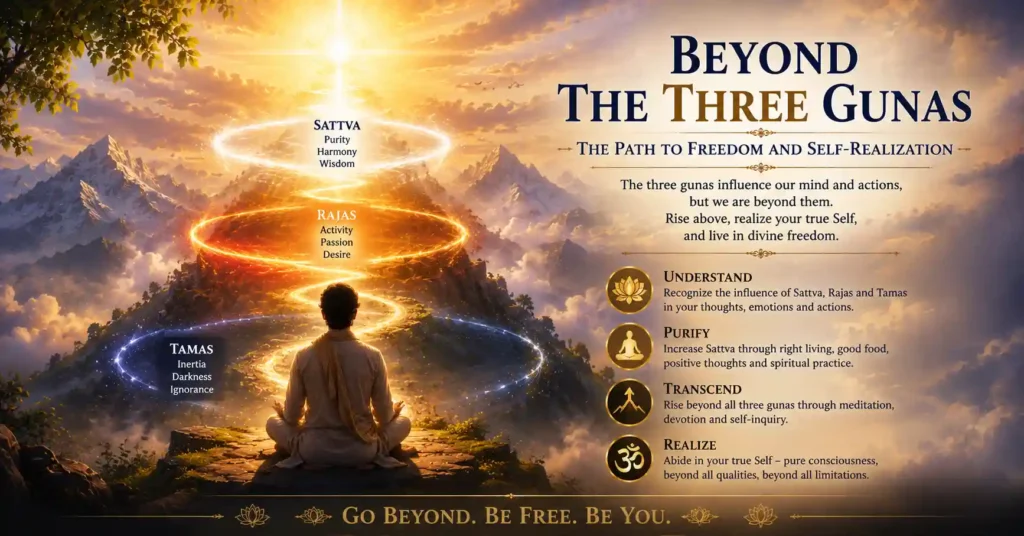
Yet Sanatan Dharma teaches an even deeper truth. Sattva is the highest of the three gunas, but it is not the final destination. In the Bhagavad Gita, Shri Krishna explains that the ultimate goal is to become Gunatita, one who rises beyond the influence of all three gunas and realises the true Self.
For most people, spiritual growth begins by cultivating Sattva through right thoughts, right actions, a balanced lifestyle, and sincere spiritual practice. As inner clarity increases, the mind becomes naturally prepared for deeper understanding and the journey towards liberation (Moksha).
Can Sattva Rajas Tamas Change?
Yes. Sattva Rajas Tamas are not fixed qualities. Their influence changes throughout life based on your habits, thoughts, environment, food, relationships, and the choices you make every day.
This is one of the most hopeful teachings of Sanatan Dharma. No matter which guna is dominant today, it does not have to remain that way forever. With conscious effort and the right lifestyle, the balance of the three gunas can gradually change.
The first step is simple awareness. Instead of judging yourself for feeling restless, lazy, or confused, observe your state with honesty and compassion. Once you recognise which guna is active, you can begin making small changes that encourage greater balance.
Real transformation does not happen overnight. It develops through consistent habits such as eating nourishing food, keeping positive company, practising meditation or prayer, performing your duties sincerely, and living with greater mindfulness. Over time, these simple choices strengthen Sattva and help bring Rajas and Tamas into healthy balance.
The journey is not about becoming perfect. It is about making steady progress through greater self-awareness. Over time, your thoughts, actions, and way of living begin to reflect that inner transformation.
How to Increase Sattva in Daily Life
Many people wonder how to increase Sattva Guna in everyday life. The good news is that you do not need complicated rituals or dramatic lifestyle changes. Sanatan Dharma teaches that lasting transformation begins with small, consistent choices made with awareness and sincerity.
Every habit you cultivate influences the balance of the three gunas. Over time, simple daily practices help the mind become calmer, clearer, and more balanced.
| Daily Practice | How It Helps |
|---|---|
| Wake up early | Encourages clarity, discipline, and a peaceful start to the day. |
| Prayer or meditation | Calms the mind and develops self-awareness. |
| Fresh, nourishing food | Supports physical health and mental balance. |
| Positive company | Encourages uplifting thoughts and good habits. |
| Truthful and compassionate speech | Builds harmony in relationships and within yourself. |
| Reduce unnecessary distractions | Creates more space for focus and inner peace. |
| Read spiritual literature or perform selfless service | Inspires wisdom, humility, and compassion. |
You do not have to practise everything perfectly. Even one positive habit, followed consistently, can gradually strengthen Sattva and bring greater balance to your daily life.
The goal is not perfection but steady progress. As Sattva grows, your thoughts become clearer, your decisions become wiser, and inner peace begins to arise naturally.
Why Balance Matters More Than Perfection
Many people believe that Sattva is good while Rajas and Tamas are bad. However, this is a common misunderstanding. According to Sanatan Dharma, all three gunas have an important role in maintaining the balance of life.
Rajas gives you the energy to work, fulfil your responsibilities, and pursue your goals. Without it, there would be no action, progress, or creativity.
Tamas allows the body and mind to rest, recover, and regain strength. Without it, you would not be able to sleep, relax, or restore your energy.
Sattva brings clarity, wisdom, and balance. It helps you use the energy of Rajas wisely and prevents Tamas from turning into laziness or ignorance.
| Guna | Positive Role | When It Becomes Excessive |
|---|---|---|
| Sattva | Clarity, harmony, wisdom | Spiritual pride or attachment to goodness |
| Rajas | Action, motivation, creativity | Restlessness, stress, attachment |
| Tamas | Rest, stability, recovery | Laziness, confusion, inertia |
The goal of spiritual growth is not to eliminate Rajas and Tamas, but to keep all three gunas in harmony, with Sattva guiding your thoughts and actions. As your awareness deepens, you gradually learn to use each guna at the right time and in the right measure.
Common Misunderstandings About Sattva Rajas Tamas
Sattva Rajas Tamas, collectively known as Triguna, are often explained in simple terms. As a result, many people develop misunderstandings about their true meaning. However, Sanatan Dharma presents a much more balanced and practical understanding of the three gunas.
Misconception 1: Tamas is always bad
This is not true. Tamas provides the rest and stability needed for the body and mind to recover. It becomes a problem only when it turns into laziness, ignorance, or resistance to positive change.
Misconception 2: Rajas should be avoided
Rajas is the force of action, ambition, and creativity. Without it, we could not fulfil our duties, care for our families, or make progress in life. The challenge is not Rajas itself but excessive attachment and restlessness.
Misconception 3: Sattva is a permanent state
Even Sattva rises and falls. A peaceful mind today may become restless tomorrow depending on your habits, environment, and circumstances. This is why spiritual growth requires continuous awareness and self-discipline.
Misconception 4: One guna defines your personality forever
No one is permanently sattvic, rajasic, or tamasic. Every person carries all three gunas, and their influence changes throughout life. The dominant guna can shift from one day to another and even from one situation to the next.
When you understand Sattva Rajas Tamas in this way, you stop judging yourself or others. Instead, you begin observing the changing play of the three gunas with greater awareness, compassion, and wisdom.
Recognising the Three Gunas in Everyday Life
Understanding Sattva Rajas Tamas becomes easier when you observe an ordinary day.
You wake up early, enjoy a few moments of silence, and your mind feels calm and clear. This reflects the influence of Sattva.
As the day progresses, you become busy with work, responsibilities, and decision-making. The energy that keeps you active is Rajas in action.
By evening, your body begins to slow down, and you naturally seek rest and sleep. This is the calming influence of Tamas, helping the body recover.
This daily rhythm is a natural expression of the three gunas. The purpose of understanding it is not to judge yourself but to become more aware of how these qualities influence your thoughts, actions, and emotions.
With regular observation, you begin making wiser choices that strengthen Sattva, keep Rajas balanced, and allow Tamas to serve its proper purpose. These small changes gradually lead to a more balanced, peaceful, and conscious way of living.
Why Understanding Triguna Matters Today
The wisdom of Triguna is just as relevant today as it was thousands of years ago. Modern life is filled with constant stimulation, stress, distractions, and emotional ups and downs. The three gunas offer a simple yet powerful way to understand these changing mental states instead of becoming overwhelmed by them.
Instead of blaming yourself for every emotion or reaction, you begin to ask a different question: Which guna is influencing my mind at this moment? This small shift from reacting to observing helps you make wiser decisions in your personal life, relationships, work, and spiritual practice.
The goal is not to become perfect overnight but to become more aware each day. As awareness grows, you naturally choose habits, thoughts, and actions that bring greater balance, inner peace, and steady personal growth.
Whether you are following a spiritual path or simply seeking a calmer and more meaningful life, the timeless philosophy of Triguna offers practical guidance that remains relevant in every stage of life.
Conclusion
Sattva Rajas Tamas are not merely philosophical concepts. They are the three fundamental qualities that quietly influence your thoughts, emotions, decisions, and actions every day.
By understanding the three gunas, you begin to observe your mind with greater awareness instead of reacting automatically. This simple shift helps you make wiser choices, develop healthier habits, and bring more balance into your daily life.
Sanatan Dharma teaches that the goal is not to reject Rajas or Tamas, but to understand their purpose, cultivate Sattva, and gradually rise above the limitations of all three gunas through self-awareness and spiritual growth.
The journey begins with observation. Every moment of awareness is a step towards greater clarity, inner peace, and a deeper understanding of your true nature. That is the timeless wisdom and quiet power of Sattva Rajas Tamas.
Key Takeaways
Before you leave, remember these key insights:
- Triguna refers to the three fundamental qualities of nature: Sattva, Rajas, and Tamas.
- Every person possesses all three gunas, but their influence changes throughout the day and different stages of life.
- Sattva brings clarity and balance, Rajas drives action and ambition, while Tamas provides rest and stability.
- None of the three gunas is completely good or bad. Balance is more important than eliminating any one of them.
- Your food, habits, thoughts, environment, and daily choices influence which guna becomes dominant.
- The Bhagavad Gita teaches that spiritual growth begins by cultivating Sattva and ultimately transcending all three gunas.
- Self-awareness is the first step towards recognising the changing play of the gunas and living with greater wisdom and inner peace.
Suggested Reading
If you found this guide to Sattva Rajas Tamas (Triguna) helpful, you may also enjoy these articles from our Sanatan Wisdom & Philosophy section. Together, they explore the timeless teachings of Sanatan Dharma, helping you understand Dharma, Karma, self-awareness, spiritual growth, and the path towards inner peace and Moksha.
1. Sanatan Dharma: Meaning, Origin, Core Principles and Way of Life
Understand the eternal philosophy of Sanatan Dharma and the principles that guide a balanced and meaningful life.
https://thesanatantales.com/sanatan-dharma-meaning/
2. What Are the Four Purusharthas? A Simple Guide to Dharma, Artha, Kama and Moksha
Discover the four goals of human life and how they provide a complete framework for righteous living and spiritual growth.
https://thesanatantales.com/four-purusharthas/
3. Karma Yoga Meaning: Action without Attachment
Learn how selfless action and the teachings of Karma Yoga help bring balance to the mind and reduce attachment to results.
https://thesanatantales.com/karma-yoga-meaning/
4. Spiritual Awakening: Meaning and Signs Beginners Often Experience
Explore how spiritual awakening begins and the inner changes that often accompany a deeper awareness of oneself.
https://thesanatantales.com/spiritual-awakening/
5. Vairagya is Trending, but Sthitpragya is the Original Mindset
Understand the difference between temporary detachment and the steady wisdom of Sthitpragya described in the Bhagavad Gita.
https://thesanatantales.com/vairagya-vs-sthitpragya/
6. Sri Vidya: Meaning, Philosophy, Sri Chakra and the Sacred Path of Lalita Tripura Sundari
Discover one of the highest spiritual traditions of Sanatan Dharma and its path to inner transformation and Self-realization.
https://thesanatantales.com/sri-vidya-meaning/
7. Chausath Yogini (64 Yogini): Story, Names, Temples and Spiritual Significance
Learn about the sacred Yogini tradition and its deeper spiritual symbolism within Sanatan Dharma.
https://thesanatantales.com/chausath-yogini/
You can add it in the same style as the other suggested reading entries.
8. Guṇa (Wikipedia)
Explore the concept of Guṇa (the three qualities of nature) from a broader historical and philosophical perspective, including its significance in Hindu philosophy, Samkhya, Yoga, and the Bhagavad Gita.
FAQs
What are Sattva Rajas Tamas in Sanatan Dharma?
Sattva Rajas Tamas, collectively known as Triguna, are the three fundamental qualities of Prakriti (nature) described in Sanatan Dharma. Every person possesses all three gunas, but their influence changes according to thoughts, actions, habits, and circumstances.
Sattva represents purity, wisdom, and balance. Rajas represents activity, desire, and movement, while Tamas represents rest, stability, and inertia. Together, they influence our personality, emotions, decisions, and daily behaviour.
The purpose of understanding the three gunas is not to label yourself but to develop greater self-awareness. By recognising which guna is active, you can gradually cultivate a more balanced and peaceful life.
Are Sattva, Rajas, and Tamas good or bad?
No. Sanatan Dharma does not describe any of the three gunas as completely good or completely bad. Each has a natural role in maintaining balance in life.
Sattva brings clarity and wisdom. Rajas provides the energy to work, achieve goals, and fulfil responsibilities. Tamas allows the body and mind to rest and recover.
Problems arise only when one guna becomes excessive. The goal is to maintain harmony among all three, with Sattva guiding the activity of Rajas and the stability of Tamas.
How can I know which guna is dominant in me?
You can recognise the dominant guna by observing your thoughts, emotions, and behaviour throughout the day.
If you generally feel calm, content, and mentally clear, Sattva may be more active. If your mind is constantly busy with plans, ambitions, or worries, Rajas may be dominant. If you often feel unmotivated, confused, or mentally heavy, Tamas may have a stronger influence.
Remember that the three gunas are constantly changing. Your dominant guna today may not be the same tomorrow, which is why regular self-awareness is more important than self-judgment.
How can I increase Sattva Guna naturally?
Increasing Sattva begins with simple daily habits rather than complicated rituals. Waking up early, eating fresh and nourishing food, spending time in prayer or meditation, speaking truthfully, and keeping positive company all help strengthen Sattva.
Reducing unnecessary distractions, practising gratitude, and performing your daily duties with sincerity also contribute to a calmer and more balanced mind.
Sanatan Dharma teaches that lasting transformation happens gradually. Small, consistent changes practised with awareness often bring deeper results than sudden or extreme efforts.
Does the Bhagavad Gita explain Sattva Rajas Tamas?
Yes. The Bhagavad Gita explains the philosophy of the three gunas in detail, especially in Chapter 14, known as Gunatraya Vibhaga Yoga. Shri Krishna teaches that all of material nature operates through Sattva, Rajas, and Tamas.
The Gita also discusses how these gunas influence faith, food, actions, knowledge, and human behaviour in Chapters 17 and 18.
These teachings help readers understand not only the nature of the mind but also the path towards self-awareness and spiritual growth.
Can Sattva Rajas Tamas change over time?
Yes. One of the most encouraging teachings of Sanatan Dharma is that the balance of the three gunas is not fixed. Their influence changes according to your lifestyle, food, environment, relationships, thoughts, and actions.
With conscious living, regular spiritual practice, and healthy habits, you can gradually cultivate more Sattva while keeping Rajas and Tamas in balance.
This process is gradual. The goal is not perfection but steady inner growth through awareness and right living.
What is the ultimate goal beyond the three gunas?
While Sattva is considered the purest of the three gunas, Sanatan Dharma teaches that it is not the final destination.
In the Bhagavad Gita, Shri Krishna explains that the highest spiritual state is to become Gunatita, meaning one who rises beyond the influence of Sattva, Rajas, and Tamas. This state leads to greater freedom, Self-realization, and ultimately Moksha.
For most people, the practical path begins by increasing Sattva. A calm and balanced mind becomes the foundation for deeper spiritual understanding and inner transformation.
Glossary of Important Terms
| Term | Meaning |
|---|---|
| Triguna | The collective concept of the three gunas—Sattva, Rajas, and Tamas—that govern the qualities of nature and influence the mind, behaviour, and the material world. |
| Guna | A Sanskrit word meaning quality, attribute, or fundamental characteristic of nature. |
| Sattva | The guna of purity, harmony, wisdom, clarity, balance, and inner peace. It promotes spiritual growth and right understanding. |
| Rajas | The guna of activity, passion, ambition, movement, and desire. It drives action and achievement but can create restlessness when excessive. |
| Tamas | The guna of inertia, stability, rest, and heaviness. It supports recovery and sleep but may lead to laziness and ignorance when out of balance. |
| Purusha | Pure consciousness or the eternal Self that remains unchanged and acts as the silent witness of all experiences. |
| Prakriti | Material nature or the creative force of the universe from which all physical and mental existence arises through the three gunas. |
| Gunatraya | A Sanskrit term meaning the three gunas. It is commonly used in the Bhagavad Gita, especially in Gunatraya Vibhaga Yoga (Chapter 14). |
| Gunatita | One who has transcended the influence of Sattva, Rajas, and Tamas through spiritual wisdom and Self-realization. |
| Dharma | Righteous duty, moral order, and the principles that guide a balanced and meaningful life according to Sanatan Dharma. |
| Karma | The universal law of cause and effect, where every action, intention, and thought produces corresponding consequences. |
| Moksha | Liberation from the cycle of birth and death (Samsara) and the ultimate goal of spiritual realization in Sanatan Dharma. |
| Bhagavad Gita | One of the most revered scriptures of Sanatan Dharma, where Shri Krishna explains the philosophy of the three gunas, Dharma, Karma, and the path to liberation. |
| Samkhya Philosophy | One of the six classical schools of Hindu philosophy that explains creation through Purusha, Prakriti, and the Triguna. |
| Brahma Muhurta | The sacred period approximately 1.5 hours before sunrise, traditionally considered the best time for meditation, prayer, and spiritual practices because Sattva is believed to be naturally dominant. |
About the Author
Yateendra Chaturvedi is a spiritual writer, researcher, devotee, and the founder of The Sanatan Tales. With over 35 years of professional experience and a lifelong interest in Sanatan Dharma, he writes about Hindu deities, temples, scriptures, festivals, Mahavidyas, sacred stories, rituals, and living traditions that continue to guide and inspire devotees across India.
Drawing from traditional scriptures, regional beliefs, temple traditions, devotional literature, and historical sources, he aims to present authentic, well-researched, and easy-to-understand content for modern readers. His work focuses on preserving spiritual wisdom, explaining sacred traditions, and helping seekers develop a deeper understanding of India’s rich spiritual heritage.
Through The Sanatan Tales, Yateendra strives to make the timeless teachings of Sanatan Dharma simple, meaningful, and relevant for today’s generation while maintaining respect for traditional sources, regional practices, and diverse spiritual perspectives.
Learn More About Yateendra Chaturvedi →
https://thesanatantales.com/about-the-author/
References & Sources
This article is based on the teachings of Sanatan Dharma, including traditional knowledge preserved in sacred scriptures such as the Bhagavad Gita, Upanishads, Vedas, and classical philosophical traditions including Samkhya. It also draws upon widely accepted interpretations and insights from traditional spiritual literature and scholarly study sources.
Note: Beliefs, interpretations, and spiritual practices may vary across different traditions, sects, and philosophical schools within Sanatan Dharma. The purpose of this article is not to present any single interpretation as the absolute truth, but to explain widely accepted spiritual and philosophical concepts in a simple, balanced, and accessible manner for readers.
Read More Interesting Articles on Sanatan Dharma