
Life does not always unfold the way we expect.
There are times when challenges appear despite our sincere efforts. Certain relationships test our patience, unexpected setbacks slow our progress, and some situations seem to repeat no matter how hard we try to move forward.
In such moments, many people begin to wonder whether these experiences carry a deeper purpose. This is where understanding karma and life lessons can offer a new perspective. Instead of seeing life as a series of random events, Sanatan Dharma encourages us to view every experience as an opportunity to learn, grow, and become more aware.
The connection between karma and life lessons is not about blame or punishment. It is about understanding how our actions, choices, attitudes, and responses shape our journey through life. Even difficult experiences can become valuable teachers when approached with awareness and reflection.
One of the most practical teachings of karma and life lessons is that every situation has the potential to reveal something about ourselves. Challenges can teach patience, relationships can teach compassion, and setbacks can teach resilience and inner strength.
In this article, you will discover how karma influences life experiences, why certain lessons may repeat, what Sanatan Dharma teaches about personal growth, and how these insights can help you live with greater wisdom, balance, and purpose in everyday life.
Karma and Life Lessons at a Glance
| Aspect | Simple Understanding |
|---|---|
| What Is Karma? | The law of cause and effect. Our thoughts, words, and actions create consequences that influence our experiences. |
| What Are Life Lessons? | The wisdom, growth, and understanding gained through life’s experiences, challenges, and relationships. |
| Main Teaching | Life is not always random. Many experiences can become opportunities for learning and self-discovery. |
| Why Do Patterns Repeat? | Some situations return because there may be a lesson, habit, or emotional pattern that still needs awareness and understanding. |
| Is Karma Punishment? | No. Sanatan Dharma generally views karma as a natural law of cause and effect rather than a system of reward and punishment. |
| Can Karma Be Changed? | While past actions may influence circumstances, present choices, awareness, and actions continue to shape the future. |
| Role of Dharma | Dharma guides us to make wise, responsible, and ethical choices in the present moment. |
| Three Types of Karma | Sanchita (accumulated karma), Prarabdha (karma currently unfolding), and Agami (karma created by present actions). |
| Connection to Samsara | Karma is linked to the soul’s journey through the cycle of birth, death, and rebirth. |
| Why Challenges Matter | Difficult experiences often help develop resilience, wisdom, compassion, patience, and self-awareness. |
| How Awareness Helps | Awareness allows us to recognize patterns, understand reactions, and make better choices. |
| What the Bhagavad Gita Teaches | Focus on performing the right actions with sincerity rather than becoming attached to results. |
| Practical Application | Reflect on experiences, learn from recurring patterns, act responsibly, and respond with greater awareness. |
| Ultimate Goal | Inner growth, self-understanding, wiser living, and spiritual evolution. |
Table of Contents
ToggleWhat Are Karma and Life Lessons?
Karma is one of the most misunderstood ideas in spiritual life.
Many people think karma simply means reward or punishment. In Sanatan Dharma, however, karma is understood as the law of cause and effect. Every thought, word, and action creates an influence that can shape our future experiences.
Some results appear quickly, while others may take years to unfold. Not every consequence is immediately visible, but every action leaves an impression on the mind and influences the direction of our lives.
This understanding helps us look beyond events themselves and focus on what they are teaching us. A difficult relationship may teach patience. A setback may teach resilience. A success may teach gratitude and responsibility.
This is where karma and life lessons become closely connected. Rather than viewing experiences as random or unfair, we begin to see them as opportunities for learning, self-awareness, and personal growth.
Like a seed that eventually bears fruit, our actions often return to us in the form of experiences that help us grow wiser, make better choices, and move forward with greater understandin

What the Bhagavad Gita Teaches About Karma and Life Lessons
The Bhagavad Gita teaches that while we have control over our actions, we do not always control the results. Lord Krishna encourages us to act with sincerity, responsibility, and awareness rather than becoming attached to outcomes.
This teaching shifts our focus from worrying about what may happen next to acting wisely in the present moment. Instead of becoming discouraged by success or failure, we learn to give our best effort and accept the outcome with balance and maturity.
When viewed through the lens of karma and life lessons, every experience becomes an opportunity to grow. A setback can teach patience, a mistake can teach wisdom, and a challenge can reveal inner strength that we did not know we possessed.
This perspective encourages us to focus less on blaming circumstances and more on learning from them. Over time, these lessons help us develop greater self-awareness, resilience, and personal growth in everyday life.
Did You Know?
According to Sanatan teachings, karma is not simply about reward and punishment. It is a much deeper principle of cause and effect that influences our thoughts, actions, habits, and life experiences.
The Bhagavad Gita teaches that while we have control over our actions, we do not always control the results.
This is why spiritual growth begins not by trying to control everything around us, but by becoming more aware of how we think, act, and respond to life’s lessons.
Why Karma and Life Lessons Often Repeat
If you observe your life carefully, you may begin to notice certain patterns.
Similar situations often appear in different forms. The same emotional struggles return, familiar relationship challenges resurface, or certain fears continue to influence your decisions. Even after moving forward, a lesson may seem to find its way back into your life.
At first, this can feel confusing or even unfair.
However, from the perspective of karma and life lessons, these experiences are not necessarily repeating to trouble us. Often, they return because there is something within them that still needs to be understood, healed, or transformed.
A lesson that is ignored may reappear in a different form. A pattern that remains unseen may continue quietly in the background, influencing our choices and reactions without us realizing it.
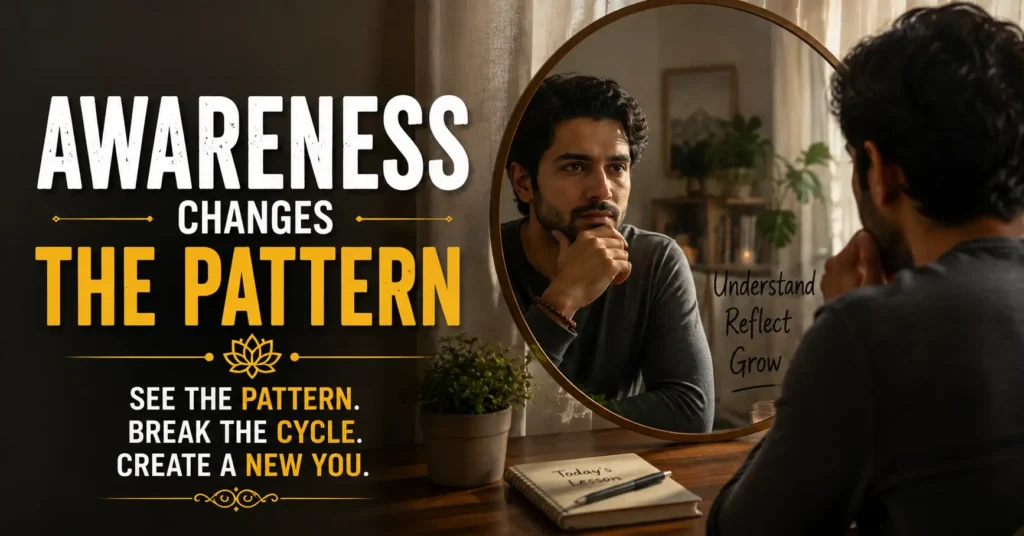
This is why self-awareness is so important. When we pause to reflect on our experiences, we begin to recognize recurring life patterns and the messages hidden within them.
As awareness grows, understanding grows with it. And when a lesson is truly understood, the pattern often begins to lose its hold on us.
This is one of the clearest examples of how karma and personal growth work together. Life does not always repeat experiences to test us. Sometimes it repeats them to help us learn, evolve, and move forward with greater wisdom.

How Challenges Become Life's Greatest Teachers
This is perhaps one of the most difficult aspects of life to understand.
Why do some of our greatest lessons arrive through challenges?
In many cases, comfort allows us to remain where we are. Difficult experiences, on the other hand, encourage us to pause, reflect, and see life from a different perspective.
If you look back carefully, some of the moments that shaped you most deeply may not have been the easiest ones.
A heartbreak may have taught self-respect. A failure may have revealed inner strength you did not know you possessed. A loss may have helped you recognize what truly matters in life.
This is why many spiritual traditions view challenges as opportunities for growth rather than meaningless suffering. Even painful experiences can become valuable teachers when approached with awareness and self-reflection.
Seen through the lens of karma and life lessons, challenges are not always obstacles to our progress. Often, they are opportunities for learning, transformation, and greater understanding.
This is an important part of spiritual lessons in life. Growth rarely comes from avoiding difficulties. It often comes from how we respond to them.
Many of life’s deepest lessons become clear only when we look back on our journey years later and recognize how those experiences helped us become wiser, stronger, and more compassionate.
Karma Is Not Punishment: A More Compassionate Understanding
One of the biggest misunderstandings about karma is the belief that every difficulty is a punishment for past actions.
Sanatan Dharma does not teach us to judge people based on their struggles or assume that someone deserves suffering. Life is far more complex than simple explanations of reward and punishment.
The law of karma is described as vast and subtle. Many factors influence our experiences, including past actions, present choices, circumstances, relationships, and the lessons we are meant to learn along the way.
This is why karma and life lessons should never be used to blame ourselves or others. Their purpose is not to create guilt, fear, or judgment.
Instead, they encourage us to respond to life with greater awareness, compassion, and personal responsibility. Rather than asking, “Who is at fault?” we can ask, “What can I learn from this experience?”
This perspective helps transform challenges into opportunities for karma and personal growth. It allows us to face life’s ups and downs with greater wisdom, patience, and understanding.
When approached in this way, the study of karma becomes less about punishment and more about learning, healing, and growing through life’s experiences.
A Simple Example of Karma and Life Lessons
Imagine someone who repeatedly finds themselves in situations where they feel ignored, unappreciated, or taken for granted.
The people may be different. The circumstances may change. Yet the emotional experience remains strangely familiar.
At first, it may seem like bad luck or the fault of others. But with time, self-awareness, and honest reflection, a deeper pattern begins to emerge.
They may realize that they have been accepting less than they deserve, avoiding difficult conversations, or struggling to set healthy boundaries. The real lesson may not be about changing other people, but about changing how they respond to those situations.
As awareness grows, their choices begin to change. They start valuing themselves more, communicating more clearly, and responding with greater confidence and self-respect.
The external world may not change overnight, but the pattern gradually begins to lose its hold. New choices often create new experiences.
This simple example shows how karma and life lessons often work in everyday life. Experiences repeat not because life wants to punish us, but because they can reveal areas where growth, healing, or greater understanding is needed.
Over time, these experiences become opportunities for karma and personal growth, helping us make wiser decisions and build healthier relationships.
Karma and Life Lessons in the Soul's Journey
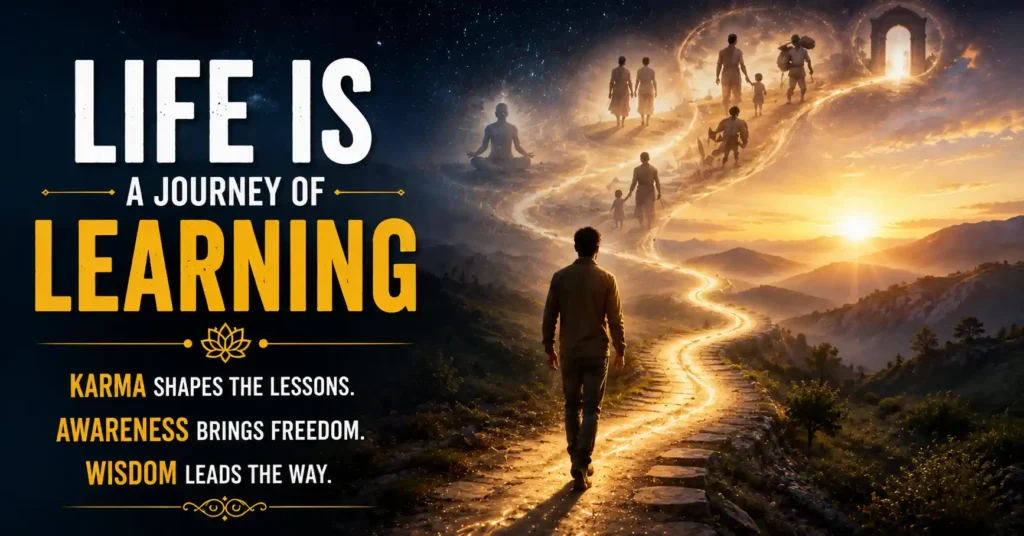
In the Sanatan understanding of life, the journey of the soul does not begin with birth or end with death.
The soul moves through many lifetimes in a continuous cycle known as Samsara. Each experience, choice, and action becomes part of a larger journey of learning and growth.
Along the way, our thoughts, actions, and experiences leave subtle impressions known as Samskaras. These impressions can influence our habits, tendencies, reactions, and the way we respond to different situations in life.
This is why personal growth is viewed as an ongoing process rather than something achieved overnight. Some lessons are understood quickly, while others may take years or even lifetimes to fully grasp.
From this perspective, karma and life lessons are not limited to a single event or phase of life. They are part of a continuous journey of self-discovery, awareness, and inner transformation.
As we grow in wisdom and understanding, old patterns begin to weaken and new possibilities emerge. Each lesson learned becomes a step forward on the soul’s journey toward greater awareness and spiritual growth.
The Three Types of Karma and Their Role in Life Lessons
Traditional Sanatan teachings describe karma in three primary forms. Understanding them can help us see how experiences and life lessons unfold over time.
1. Sanchita Karma
Sanchita Karma refers to the accumulated store of actions from the past. It can be understood as the collection of impressions and tendencies carried by the soul over its long journey.
Not all of this karma becomes active at once. It remains as a storehouse of potential experiences and lessons.
2. Prarabdha Karma
Prarabdha Karma is the portion of karma that has already begun to bear fruit in the present life.
Many of the circumstances we are born into, certain opportunities, and some challenges may be connected to Prarabdha Karma. While we may not control every situation, we can choose how we respond to it.
3. Agami Karma
Agami Karma is the karma we create through our present thoughts, choices, and actions.
Every decision we make today contributes to the experiences we may face in the future. This is why personal responsibility and mindful living are so important in Sanatan Dharma.
Together, these three forms of karma remind us that life is not shaped by the past alone. While some circumstances may already be unfolding, our present actions continue to influence what comes next.
This is one of the most empowering aspects of karma and life lessons. The past may influence our journey, but the choices we make today can help create a wiser and more meaningful future.
How Dharma Helps Us Learn Life's Lessons
Karma alone does not explain the whole journey of life.
In Sanatan Dharma, there is also the guiding principle of Dharma. While karma helps us understand the effects of our actions, dharma helps us choose the right response in the present moment.
Dharma is often understood as living in alignment with truth, responsibility, and what is right for a particular situation. It is not merely about following rules. It is about acting with wisdom, balance, compassion, and integrity in everyday life.
Karma helps us understand how past actions and choices may have shaped our experiences. Dharma guides us in deciding what to do next.
In simple terms, karma shows us what has brought us to this moment, while dharma helps us move forward with greater awareness and purpose.
This is why karma and life lessons are closely connected to dharma. Every experience presents a choice. We can react from habit, fear, or anger, or we can respond with patience, understanding, and responsibility.
When we choose actions that align with dharma, we begin to create positive changes in our lives. Over time, these choices support karma and personal growth, helping us develop wisdom, stronger character, and healthier relationships.
This is how karma and dharma work together in daily life. One helps us understand the lesson, while the other helps us apply it.

Karma Is Not Fate: The Role of Choice and Awareness
Many people think karma is simply a system of reward and punishment. Others assume it means that everything in life is already fixed and cannot be changed.
Sanatan Dharma presents a much deeper understanding. Karma is the law of cause and effect, but it does not remove the importance of choice, effort, or personal responsibility.
While past actions may influence certain circumstances, they do not completely determine how we respond. Every moment offers an opportunity to make new choices and create a different direction for the future.
This is why karma and life lessons are not about feeling trapped by the past. They are about becoming more aware of our thoughts, actions, and responses in the present.
Life is influenced by many visible and invisible factors, including our decisions, relationships, environment, and inner growth. As awareness increases, our ability to make wiser choices also increases.
Understanding karma is therefore not about blame or fear. It is about recognizing that our actions matter and that every choice can become a step toward greater wisdom, balance, and personal transformation.
This perspective is one of the most practical life lessons in Sanatan Dharma. While we cannot always control what happens to us, we can choose how we respond, learn, and grow from each experience.
Can Karma Be Changed?
One of the most common questions people ask is whether karma can be changed.
In Sanatan Dharma, past actions can influence our present circumstances, but they do not completely determine our future. While some situations may already be unfolding, our current thoughts, choices, and actions continue to create new karma.
This means we are not helpless or trapped by the past. Every moment gives us an opportunity to respond with greater awareness and wisdom.
When we act with honesty, compassion, self-discipline, and responsibility, we begin creating different causes that can lead to different results in the future.
This is where dharma becomes important. By choosing actions that are aligned with truth and righteousness, we gradually create better karma and support our spiritual growth.
Understanding this brings hope. Karma may influence our path, but conscious choices help shape the direction we take from here.
Self-Awareness Helps Us Understand Life's Lessons
If you look closely at your life, you may notice certain patterns appearing again and again.
Similar relationship challenges, familiar emotional triggers, or recurring situations can sometimes leave us wondering why the same experiences seem to return.
Not every pattern is connected to karma, and not every difficulty carries a deeper spiritual message. However, some experiences continue to appear because they highlight areas where growth, healing, or greater understanding may be needed.
This is where self-awareness becomes important. Instead of immediately reacting to a situation, we can pause and reflect on what it reveals about our thoughts, habits, expectations, and choices.
One of the most valuable aspects of karma and life lessons is that they encourage honest self-reflection. Rather than asking, “Why does this keep happening to me?” we can begin asking, “What is this experience trying to teach me?”
This simple shift in perspective often leads to deeper understanding. As awareness grows, we become better able to recognize recurring life patterns, make wiser choices, and respond with greater clarity.
Over time, this process supports karma and personal growth, helping us move through life with more wisdom, balance, and purpose.
Awareness Is the First Step Toward Change
A pattern can continue for years without being noticed.
We may keep repeating the same reactions, making similar choices, or facing familiar challenges without fully understanding what is driving them. As a result, the same experiences can continue to appear in different forms.
The moment awareness enters, something begins to change. We start recognizing the beliefs, habits, and emotional responses that may be contributing to those patterns.
This is one of the most important insights behind karma and life lessons. Change often begins not when circumstances change, but when our understanding changes.
Awareness does not transform life overnight. However, it helps us pause, reflect, and respond more consciously instead of acting on automatic habits.
Over time, these small shifts can lead to significant personal growth. New understanding creates new choices, and new choices often create new experiences.
This is why self-awareness plays such an important role in life lessons in Sanatan Dharma. The more clearly we see ourselves, the more capable we become of learning, growing, and moving forward with wisdom.
Why Karma and Life Lessons Sometimes Repeat
If you look closely at your life, you may begin to notice certain patterns appearing again and again.
Similar relationship challenges, familiar emotional reactions, or struggles that seem to return in different forms can sometimes leave us wondering why the same lessons keep showing up.
In the Sanatan understanding of karma and life lessons, life is not always about reward or punishment. Sometimes it is about learning. Certain experiences continue to return because there is something within them that still needs greater awareness, healing, or understanding.
This does not mean that every difficulty is karma or that every challenge carries a hidden spiritual meaning. Yet some recurring patterns can become opportunities for deeper self-reflection.
Instead of asking, “Why does this keep happening to me?” we can gently ask, “What is this experience trying to teach me?”
That simple shift changes the way we look at life. Rather than blaming circumstances, we begin to understand our reactions, choices, and habits more clearly.
In many ways, this is where karma becomes a teacher. The lesson is not hidden in the situation itself, but in what the situation helps us discover about ourselves.
Signs a Life Lesson Has Been Learned
One of the most common questions people ask is, “How do I know if I have actually learned the lesson life is trying to teach me?”
Often, the answer can be seen in the way we respond to situations that once disturbed us deeply.
A life lesson is usually not learned when circumstances change. It is learned when our response changes.
The same situation may arise, but the emotional trigger feels weaker. Reactions become calmer, and old patterns no longer have the same control over our thoughts and actions.
We begin making wiser choices more naturally. Instead of repeating habits that create suffering, we respond with greater awareness, patience, and understanding.
There may still be challenges, but they no longer affect us in the same way. In many cases, a deeper sense of acceptance and inner peace begins to emerge.
This is often one of the clearest signs that a lesson has been understood and genuine growth has taken place.
Why Do Good People Face Difficulties?
One of the most common spiritual questions is why good people sometimes face difficulties despite their sincere efforts and kind intentions.
From the perspective of karma and life lessons, present circumstances cannot always be explained by present actions alone. Life is shaped by many visible and invisible influences, including past choices, current decisions, relationships, circumstances, and opportunities for growth.
Sanatan Dharma does not encourage us to make quick judgments about why someone is suffering. The deeper workings of karma are often beyond our complete understanding.
Instead of viewing challenges as punishment, Sanatan wisdom encourages us to approach them with awareness, courage, and compassion. Even difficult experiences can help us develop patience, resilience, humility, and inner strength.
This does not mean we should seek suffering or assume that every hardship has a simple explanation. Rather, it reminds us that growth often comes through experiences that challenge us to see life differently.
One of the valuable life lessons in Sanatan Dharma is learning to respond wisely to difficulties instead of becoming consumed by them. While we may not always understand why something happens, we can choose how we learn, grow, and move forward.
Over time, this perspective can transform challenges from sources of despair into opportunities for greater self-awareness, wisdom, and personal growth.
How to Apply Karma and Life Lessons in Daily Life
Understanding karma and life lessons does not require becoming deeply spiritual overnight.
It often begins with something much simpler: awareness.
The next time a situation upsets you, pause for a moment before reacting. Notice what you are feeling and what thoughts are arising within you.
Then gently ask yourself, “Why is this affecting me so deeply?” or “What can I learn from this experience?”
The answer may not appear immediately, and that is perfectly okay. Some lessons reveal themselves slowly through patience, observation, and honest self-reflection.
As we become more aware, we begin to recognize the patterns behind our reactions, choices, and experiences. This awareness helps us respond more consciously rather than repeating old habits automatically.
This is where karma and life lessons become practical rather than theoretical. Karma is no longer just a spiritual concept. It becomes a way of understanding ourselves, our relationships, and the choices we make every day.
One of the most valuable life lessons in Sanatan Dharma is that lasting change often begins within. When awareness grows, our actions begin to change. When our actions change, our experiences often change as well.
This is how karma and personal growth work together. Small moments of awareness can gradually lead to wiser choices, healthier relationships, and a more balanced way of living.
Over time, what once felt automatic becomes conscious, and that is where real transformation begins.
Stop Comparing Your Journey to Others
Sometimes, our suffering becomes heavier because we compare our journey with someone else’s.
We look at other people’s relationships, achievements, financial success, or circumstances and begin wondering why our own life seems different.
However, one of the important lessons behind karma and life lessons is that every person walks a unique path. The experiences, challenges, and opportunities for growth that appear in one life may be very different from those in another.
In Sanatan Dharma, both karma and dharma are understood as deeply personal journeys. Each person carries different experiences, tendencies, responsibilities, and lessons that shape their path forward.
When we constantly compare ourselves with others, we often lose sight of our own growth. Instead of appreciating how far we have come, we focus on what someone else appears to have.
The moment we return our attention to our own journey, something begins to soften. We become more patient with ourselves and more accepting of the pace at which our life unfolds.
This shift does not mean giving up ambition or goals. It means trusting that growth happens in different ways and at different times for different people.
If this feels familiar, you may also enjoy reading: Why Comparison Hurts More in the Social Media Age
When we stop measuring our life against someone else’s story, we create space for greater peace, gratitude, and self-awareness. Sometimes the most important lesson is not learning how to be like others, but learning how to walk our own path with confidence and understanding.
Be Patient With Your Growth
Understanding karma and life lessons does not mean becoming harsh with yourself.
Every person is learning, growing, and making mistakes along the way. Spiritual growth is rarely perfect, immediate, or free from setbacks. Like any meaningful journey, it unfolds one step at a time.
There may be moments when you repeat old patterns, make choices you later regret, or struggle to understand a difficult experience. That does not mean you have failed. It simply means you are human and still learning.
One of the most important spiritual lessons in life is learning to treat yourself with the same compassion and understanding that you would offer to others.
The purpose of understanding karma is not self-judgment or guilt. It is greater awareness, personal responsibility, and conscious living. Each experience, whether pleasant or difficult, can become an opportunity to learn something valuable about yourself.
As awareness grows, growth follows naturally. Small changes in how you think, respond, and act can gradually transform the direction of your life.
This is why karma and life lessons are ultimately about learning, not perfection. The goal is not to become flawless. The goal is to become more aware, compassionate, and aligned with the person you are capable of becoming.
Key Takeaways
- Karma and life lessons help us understand how our actions, choices, and experiences contribute to personal growth.
- Life is not always about reward and punishment. Many experiences can become opportunities for learning and self-awareness.
- Repeating patterns often invite us to look deeper at our thoughts, reactions, and habits.
- Challenges can become valuable teachers when approached with patience, reflection, and understanding.
- Dharma helps guide our present choices, while karma helps us understand the effects of our actions.
- Awareness is often the first step toward breaking unhealthy patterns and creating positive change.
- Every person follows a unique journey of growth, learning, and inner transformation.
- The deeper purpose of karma and life lessons is not fear or blame, but greater wisdom, responsibility, and conscious living.
Conclusion: Learning Through Karma and Life Lessons
Understanding karma and life lessons brings a quiet shift in the way we look at life.
We begin to realize that not everything is happening against us, and not everything is simply random. Many experiences, both joyful and challenging, can become opportunities for learning and personal growth.
Some situations may be teaching patience. Others may be helping us develop resilience, self-awareness, compassion, or inner strength in ways we do not immediately recognize.
This does not mean that life’s challenges suddenly disappear. However, it can change the way we relate to them.
Instead of seeing every difficulty as an obstacle, we begin to see life as a journey of learning, growth, and self-discovery. We become less focused on blame and more willing to understand what each experience may be teaching us.
With that understanding, the heart becomes a little lighter. There is less resistance, less comparison, and greater acceptance of the path unfolding before us.
Perhaps that is one of the deepest lessons of karma and life lessons: life is not only happening to us, it is also helping us grow into who we are meant to become.
Ultimately, karma and life lessons are not about fear, guilt, or punishment. They are about awareness, wisdom, personal growth, and learning to live with greater purpose, compassion, and understanding.
Suggested Reading
Understanding karma and life lessons can help us look at our experiences with greater awareness and wisdom. As we explore the deeper connection between karma and life lessons, it also becomes helpful to cultivate a balanced lifestyle, mindful habits, and spiritual practices that support inner growth.
Home Mandir: Simple Setup Ideas, Vastu Tips and Daily Rituals
https://thesanatantales.com/home-mandir/
Sanatan Living: Finding Balance in a Fast-Paced World
https://thesanatantales.com/sanatan-living/
Digital Detox: How to Find Inner Peace in a Digital World
https://thesanatantales.com/digital-detox-inner-peace/
Daily Sattvik Routine for Working Professionals: Simple Habits for a Peaceful Life
https://thesanatantales.com/daily-sattvik-routine-for-working-professional/
Mudras: A Simple Practice for Balance, Awareness and Well-Being
https://thesanatantales.com/mudras-benefits-daily-life/
Daily Spiritual Habits: 7 Simple Sanatan Practices for Inner Peace
https://thesanatantales.com/daily-spiritual-habits-for-inner-peace/
Karma (Wikipedia)
https://en.wikipedia.org/wiki/Karma
FAQs
What Are Karma and Life Lessons?
Karma and life lessons are closely connected in the Sanatan understanding of life. Karma refers to our actions and their consequences, while life lessons are the wisdom and growth that emerge from our experiences.
Every thought, word, and action creates an effect. Some results appear quickly, while others take time to unfold. Through these experiences, life teaches us important lessons about relationships, choices, responsibility, patience, compassion, and self-awareness.
When we understand karma and life lessons together, we begin to see challenges not only as problems to solve but also as opportunities to learn, grow, and evolve. This perspective helps us approach life with greater awareness and maturity.
Is Karma a Punishment for Past Actions?
No. In Sanatan Dharma, karma is not viewed as a system of divine punishment.
Karma is better understood as the natural law of cause and effect. Just as a seed eventually produces fruit, our thoughts, words, and actions create consequences that influence future experiences. The purpose of karma is not to make us suffer but to help us learn, grow, and develop greater awareness.
This is why spiritual teachings encourage us to focus less on blame and more on understanding. Even difficult experiences can become opportunities for learning, self-reflection, and inner transformation.
Why Do the Same Life Lessons Keep Repeating?
Many people notice similar challenges appearing again and again in different forms.
A person may repeatedly face similar relationship problems, emotional triggers, or situations that create the same feelings of disappointment, fear, or frustration. While the people and circumstances may change, the underlying lesson often remains the same.
From a karmic perspective, some experiences continue to return because there is still something within them that needs greater awareness or understanding. Once we recognize the pattern and respond differently, its influence often begins to weaken.
Rather than asking, “Why does this keep happening to me?” it can be more helpful to ask, “What is this experience trying to teach me?”
Can Karma Be Changed Through Present Actions?
Yes. While past actions may influence certain circumstances, Sanatan teachings explain that present choices still matter greatly.
Every action we take today creates future karma. This means we are not trapped by the past. Awareness, responsibility, and wise decision-making allow us to shape a different future.
This is why the Bhagavad Gita emphasizes right action in the present moment. By acting with honesty, compassion, discipline, and responsibility, we gradually create better conditions for future growth and well-being.
Understanding this brings hope because karma influences our path, but it does not remove our ability to choose how we move forward.
What Is the Difference Between Karma and Dharma?
Although they are closely related, karma and dharma are not the same.
Karma refers to actions and their consequences. Dharma refers to living in alignment with truth, responsibility, righteousness, and what is right for a particular situation.
In simple terms, karma helps explain how past and present actions influence our experiences. Dharma guides us in choosing the right action today. When karma and dharma work together, they help us live with greater wisdom, balance, and purpose.
Does Karma From Past Lives Affect the Present Life?
Many Sanatan traditions teach that the soul journeys through multiple lifetimes in the cycle of Samsara.
According to this understanding, actions from previous lives leave subtle impressions known as Samskaras. These impressions may influence tendencies, habits, preferences, strengths, and challenges that appear in the present life.
This does not mean every event can be explained by past-life karma. Life is influenced by many visible and invisible factors. However, Sanatan teachings recognize that the soul’s journey extends beyond a single lifetime, and some lessons may continue until deeper understanding develops.
Why Do Good People Still Face Difficulties?
This is one of the most common questions people ask about karma.
From a karmic perspective, present circumstances cannot always be explained by present actions alone. Life is influenced by many factors that are not immediately visible or understandable.
Sanatan wisdom does not encourage judging another person’s suffering or assuming that every difficulty is a punishment. Instead, challenges are often viewed as opportunities to develop resilience, compassion, wisdom, and inner strength.
While we may not always understand why something happens, we can choose how we respond to it. Often, growth comes not from avoiding difficulties but from learning through them.
What Does the Bhagavad Gita Teach About Karma?
The Bhagavad Gita teaches that we have control over our actions but not always over the results of those actions.
Lord Krishna advises Arjuna to perform his duties sincerely and responsibly without becoming attached to success or failure. This teaching encourages us to focus on right effort rather than constant worry about outcomes.
The message is not to avoid action but to act with awareness, integrity, and dedication while accepting that results may unfold in their own time. This approach helps reduce anxiety and promotes inner peace.
Is Everything That Happens in Life Karma?
Not necessarily.
Karma is an important influence in life, but it is not the only factor. Personal choices, free will, circumstances, relationships, environment, and the actions of other people also shape our experiences.
Sanatan Dharma presents life as a complex interplay of many influences. Reducing every event to karma can oversimplify reality and lead to misunderstandings.
A balanced approach is to acknowledge the role of karma while also taking responsibility for our present actions and decisions.
What Is the Most Important Life Lesson Karma Teaches?
Perhaps the most important lesson is that our choices matter.
Karma reminds us that thoughts, words, and actions have consequences. It encourages personal responsibility while also teaching patience, compassion, and self-awareness.
When we understand karma and life lessons more deeply, we stop seeing life as something that simply happens to us. Instead, we begin to participate in our growth more consciously.
This shift in perspective often leads to greater wisdom, inner peace, and a more meaningful way of living.
Glossary of Important Terms
| Term | Meaning |
|---|---|
| Karma | The law of cause and effect in Sanatan Dharma. It teaches that our thoughts, words, and actions create consequences that influence our experiences and shape our future. |
| Life Lessons | The wisdom, understanding, and personal growth gained through life’s experiences, relationships, challenges, and choices. |
| Dharma | A person’s righteous duty, responsibility, and way of living in alignment with truth, wisdom, and ethical values. |
| Samsara | The continuous cycle of birth, death, and rebirth through which the soul evolves and learns spiritual lessons over many lifetimes. |
| Samskaras | Subtle impressions left on the mind by past thoughts, actions, and experiences. These impressions influence habits, tendencies, and behavior. |
| Sanchita Karma | The accumulated store of karma from past actions that has not yet produced results. |
| Prarabdha Karma | The portion of accumulated karma that is currently unfolding and influencing the circumstances of the present life. |
| Agami Karma | The karma created through present thoughts, choices, and actions that may influence future experiences. |
| Bhagavad Gita | One of the most respected scriptures of Sanatan Dharma, containing the teachings of Lord Krishna on duty, karma, dharma, devotion, and spiritual wisdom. |
| Awareness | The ability to observe one’s thoughts, emotions, actions, and life experiences consciously rather than reacting automatically. |
| Self-Reflection | The practice of honestly examining one’s thoughts, actions, patterns, and experiences to gain deeper understanding and personal growth. |
| Cause and Effect | The principle that every action creates a corresponding result. This forms the foundation of the karmic understanding of life. |
| Free Will | The ability to make conscious choices in the present moment, even when influenced by past experiences and circumstances. |
| Spiritual Growth | The gradual development of wisdom, self-awareness, compassion, inner peace, and understanding through life’s experiences and spiritual practice. |
| Inner Transformation | Positive change that occurs within a person through self-awareness, learning, and conscious effort rather than through external circumstances alone. |
| Soul Journey | The ongoing spiritual evolution of the soul across many lifetimes as it learns, grows, and moves toward higher awareness. |
| Compassion | The ability to respond to oneself and others with kindness, understanding, and empathy, especially during difficult experiences. |
About the Author
Yateendra Chaturvedi is a spiritual writer, researcher, devotee, and the founder of The Sanatan Tales. With over 35 years of professional experience and a lifelong interest in Sanatan Dharma, he writes about Hindu deities, temples, scriptures, festivals, Mahavidyas, sacred stories, rituals, and living traditions that continue to guide and inspire devotees across India.
Drawing from traditional scriptures, regional beliefs, temple traditions, devotional literature, and historical sources, he aims to present authentic, well-researched, and easy-to-understand content for modern readers. His work focuses on preserving spiritual wisdom, explaining sacred traditions, and helping seekers develop a deeper understanding of India’s rich spiritual heritage.
Through The Sanatan Tales, Yateendra strives to make the timeless teachings of Sanatan Dharma simple, meaningful, and relevant for today’s generation while maintaining respect for traditional sources, regional practices, and diverse spiritual perspectives.
Learn More About Yateendra Chaturvedi →
https://thesanatantales.com/about-the-author/
References & Sources
This article is based on the principles and philosophical teachings of Sanatan Dharma, including traditional understandings of karma, dharma, samsara, self-awareness, and spiritual growth.
The concepts discussed are inspired by insights found in Hindu scriptures such as the Bhagavad Gita, Upanishads, and other widely respected spiritual texts, along with teachings preserved through generations of spiritual practitioners, teachers, and devotional traditions.
Note: Interpretations of karma, life lessons, spiritual growth, and the soul’s journey may vary across different traditions, sampradayas, philosophical schools, regions, and individual spiritual paths within Sanatan Dharma.
The purpose of this article is not to present a single interpretation as the absolute truth, but to share commonly accepted spiritual perspectives in a simple, practical, and reader-friendly manner.
Sanatan Dharma embraces diverse approaches to self-discovery, devotion, knowledge, meditation, and inner transformation, allowing each individual to progress according to their own understanding and experience.
Explore More Fascinating Topics from Sanatan Dharma