
There are moments in life when something very small disturbs us more than it should.
Someone ignores us.
Someone disagrees.
Someone does not appreciate what we did.
Nothing significant happened outside, yet something within reacts immediately. We feel hurt, angry, or defensive without fully understanding why.
According to Sanatan Dharma, this inner reaction is often influenced by Ahankara, the subtle sense of “I” and “mine.” It quietly shapes our thoughts, emotions, decisions, and relationships, often without us even noticing.
It is commonly translated as ego, but its meaning is much deeper than pride or arrogance. This false sense of identity can hide behind knowledge, success, discipline, devotion, or even the desire to be seen as a spiritual person. Because it is so subtle, recognizing it is one of the greatest challenges on the spiritual path.
The Bhagavad Gita and other sacred teachings explain that the goal is not to suppress the ego but to understand it through awareness, humility, and self-inquiry. As this understanding deepens, we gradually move closer to our true nature.
In this article, you will learn what Ahankara means, why it develops, its signs in daily life, how it affects spiritual growth and relationships, and practical ways to overcome it according to the timeless wisdom of Sanatan Dharma.
Quick Facts
| Topic | Quick Answer |
|---|---|
| Meaning | Ahankara is the false sense of “I” and “mine” in Sanatan Dharma. |
| English Meaning | Ego or the sense of individuality. |
| Mentioned In | Bhagavad Gita, Upanishads, Vedanta, and Sankhya philosophy. |
| Root Cause | Avidya (spiritual ignorance). |
| Main Effect | Creates attachment, pride, comparison, and suffering. |
| Obstacle To | Inner peace, Self-realization, and spiritual growth. |
| How to Reduce It | Self-awareness, humility, Karma Yoga, Seva, meditation, and devotion. |
| Ultimate Goal | Realizing the Atman beyond Ahankara. |
Table of Contents
ToggleWhat Is Ego (Ahankara) and Why Does It Matter in Spiritual Life?
Ego, known as Ahankara in Sanskrit, is the false sense of “I” and “mine.” In Sanatan Dharma, its meaning goes far beyond pride or arrogance.
It is the identity we gradually build around our body, mind, thoughts, achievements, relationships, and possessions. This sense of individuality helps us live and perform our daily responsibilities.
By itself, the ego is not evil or something to be feared. It plays an important role in worldly life by giving us a sense of identity and helping us interact with the world.
The problem begins when we become deeply attached to this identity. We start believing that our roles, opinions, success, or possessions define who we truly are. This attachment creates pride, fear, comparison, and suffering.
In spiritual life, this false identity creates the feeling that “I am the doer” or “I know more.” It separates us from the awareness that our true nature is the eternal Atman, not the temporary body or mind.
As a person progresses on the spiritual path, the ego often becomes more subtle rather than disappearing. Instead of seeking praise in worldly life, it may seek recognition for spiritual knowledge, discipline, meditation, or devotion.
This subtle form is known as spiritual ego. Because it hides behind seemingly noble qualities, it is often more difficult to recognize than ordinary pride.

Common Misconceptions About Ego (Ahankara)
Many people misunderstand Ahankara and assume that it is always harmful. In reality, Sanatan Dharma presents a much more balanced understanding.
| Misconception | Reality |
|---|---|
| Ego means only pride or arrogance. | It is the sense of individuality or “I”-consciousness, of which pride is only one expression. |
| Spiritual people have no ego. | Even sincere seekers can develop subtle pride through knowledge, devotion, or spiritual achievements if they are not careful. |
| The ego should be destroyed immediately. | The goal is to understand and purify this false identity through awareness, humility, and Self-knowledge. |
| Self-respect and ego are the same. | Self-respect is rooted in dignity, while the ego depends on attachment and validation. |
| Success always increases the ego. | Success itself is not the problem. Attachment and identification with success strengthen the false sense of “I.” |
Understanding these differences helps remove common misconceptions and encourages a more balanced approach to spiritual growth. Rather than fighting the ego, Sanatan Dharma teaches us to observe it, understand it, and gradually transcend its limitations.
Ahankara in the Bhagavad Gita
The Bhagavad Gita explains Ahankara as the false sense of doership, the belief that “I alone am the one doing everything.” This identification makes a person forget that all actions take place through Prakriti (material nature) under the guidance of the Supreme.
Lord Krishna teaches that attachment to this false identity leads to pride, desire, fear, and suffering. When we constantly think, “I did this” or “This belongs to me,” the mind becomes bound by the results of its actions and the cycle of karma.
In Bhagavad Gita 3.27, Lord Krishna explains that all actions are performed by the three Gunas of Prakriti, but a person whose mind is clouded by ego believes, “I am the doer.”
Likewise, in Bhagavad Gita 18.58, Lord Krishna advises Arjuna that by surrendering to Him with humility, one can overcome obstacles through His grace. This reminds us that true spiritual progress comes through surrender rather than ego.
The Gita does not teach us to hate or suppress the ego. Instead, it encourages us to perform our duties with devotion, without pride or attachment to the results. This is the essence of Karma Yoga.
As attachment gradually gives way to surrender, this false sense of individuality gradually loses its hold on the mind. In its place arise humility, inner peace, and a deeper awareness of the true Self.
“Prakriteh kriyamanani gunaih karmani sarvashah; ahankara-vimudhatma kartaham iti manyate.” (Bhagavad Gita 3.27)
Meaning: All actions are carried out by the qualities of material nature, but a person whose mind is deluded by the ego thinks, “I am the doer.”
💡 Did You Know?
The word Ahankara comes from two Sanskrit words: “Aham,” meaning “I,” and “Kara,” meaning “maker” or “creator.” Together, the term literally means “the maker of the I-sense,” referring to the mental process that creates the feeling of individuality and personal identity.

Ahankara in Vedanta and Sankhya Philosophy
Different schools of Sanatan philosophy explain Ahankara from slightly different perspectives, but they all agree that it plays an important role in human experience.
According to Sankhya philosophy, it is one of the fundamental principles that arises from Prakriti (material nature). It creates the sense of individuality through which the mind, senses, and personality function in the world.
Vedanta offers a deeper spiritual understanding. It teaches that the false sense of identity causes the eternal Atman to identify with the body and mind, creating the illusion of a separate individual. This false identification is the root of attachment and suffering.
Although their explanations differ, both traditions agree that freedom comes through Self-knowledge. As ignorance is removed, the ego no longer controls the mind, and the seeker gradually realizes their true nature.
What Do the Scriptures Teach About Ahankara?
Ahankara is discussed in several sacred texts of Sanatan Dharma. While each scripture explains it from a different perspective, they all agree that attachment to the false sense of “I” is one of the main obstacles to Self-realization.
The Bhagavad Gita teaches that the ego creates the illusion of doership. Lord Krishna explains that all actions are performed by Prakriti, but a person influenced by this false identity believes, “I am the doer” (Bhagavad Gita 3.27).
The Upanishads repeatedly remind seekers that the true Self (Atman) is beyond the body, mind, and ego. Self-realization comes when this false identification is removed through knowledge and direct experience.
Vedanta explains that this sense of individuality arises because of Avidya (ignorance). When a person mistakes the body and mind for the Self, attachment, pride, and suffering naturally follow.
Sankhya philosophy describes it as one of the fundamental principles that evolves from Prakriti. It gives rise to individuality and enables worldly experience, but spiritual freedom comes from realizing that the Purusha (pure consciousness) is separate from it.
Although these traditions explain the concept from different perspectives, they all point towards the same goal: overcoming false identification through wisdom, self-awareness, devotion, and spiritual discipline.
Why Does Ahankara Develop?
Ahankara does not appear overnight. It develops gradually as we grow and begin identifying ourselves with our body, mind, name, relationships, achievements, and possessions.
From childhood, we build an image of who we are. Over time, this image becomes our identity. Without realizing it, we start protecting it, and whenever it feels challenged, the ego reacts.
That is why even small situations can hurt us deeply. A simple criticism, disagreement, or lack of appreciation feels personal because it touches the identity we have created.
According to Sanatan Dharma, the root cause of this false identity is Avidya, or spiritual ignorance. We forget our true nature as the eternal Atman and begin believing that the temporary body and mind are our real identity.
This false identification gives rise to attachment, pride, fear, comparison, and the constant desire for recognition. As these tendencies grow stronger, they become obstacles to inner peace and spiritual growth.
Understanding how this sense of individuality develops changes our approach. Instead of trying to suppress or fight it, we learn to observe it with awareness. That awareness is the first step towards freedom.
Why Is Ahankara Necessary in Human Life?
At first glance, Ahankara may seem like something entirely negative. However, Sanatan Dharma teaches that it also serves an important purpose in worldly life.
This sense of individuality allows us to say “I,” perform our responsibilities, build relationships, learn new skills, and interact with the world as unique individuals.
Without this sense of identity, it would be difficult to carry out our daily duties or fulfill our Dharma. In this way, the ego is a natural part of human existence.
The challenge begins when we forget that this identity is temporary. Instead of using it as a practical tool, we start believing that it is our true Self. This attachment gives rise to pride, fear, possessiveness, and suffering.
The scriptures therefore do not teach that the ego should be destroyed. They teach that it should be understood and purified through self-awareness, devotion, and right knowledge. When used wisely, it helps us live in the world. When allowed to dominate the mind, it becomes an obstacle to spiritual growth.
How Ahankara Enters the Spiritual Path
Many people think that spiritual practice automatically removes Ahankara. In reality, it often becomes more subtle and difficult to recognize.
A person usually begins the spiritual journey with sincerity and a genuine desire to grow. They pray, meditate, study the scriptures, or perform selfless service with a pure heart.
Over time, however, a quiet change can take place. Instead of looking within, the mind starts comparing itself with others. We begin to notice who is more devoted, more knowledgeable, or more disciplined.
Without realizing it, spiritual progress becomes a reason for pride. We may seek appreciation for our devotion, feel superior because of our knowledge, or silently judge those who follow a different path.
This is how spiritual ego develops. It does not always appear as arrogance. It often hides behind good deeds, religious discipline, scriptural knowledge, or the desire to be recognized as a spiritual person.
The more subtle this false identity becomes, the harder it is to detect. That is why humility, self-reflection, and honest introspection are essential companions on the spiritual path.
Signs of Ahankara in Daily Life
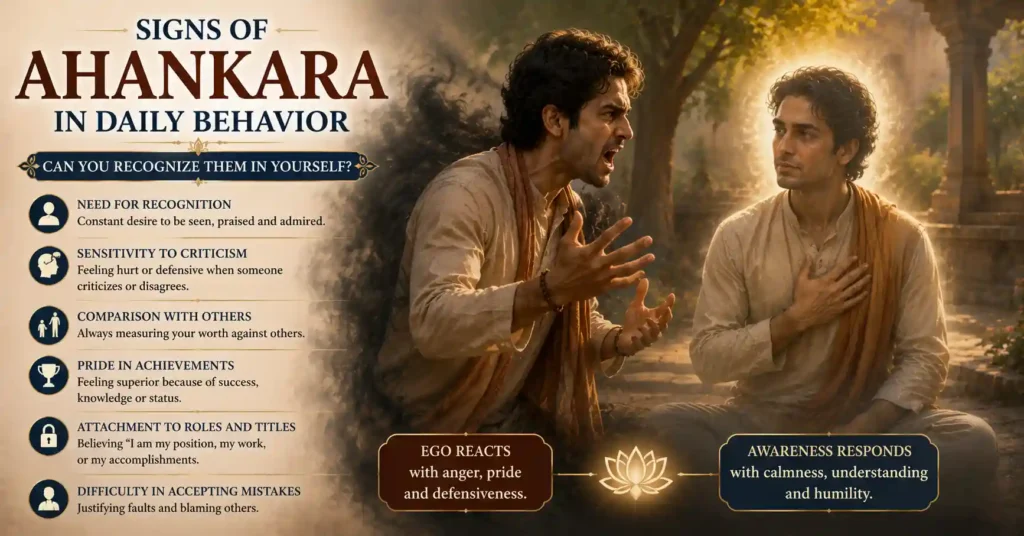
Ahankara does not always appear as pride or arrogance. More often, it reveals itself through small reactions and everyday situations that we hardly notice.
You may be influenced by the ego if you:
- Feel the need to prove that you are right.
- Feel hurt when your efforts are not appreciated.
- Become defensive when someone points out your mistakes.
- Compare your achievements or spiritual progress with others.
- Judge people because their beliefs or practices are different from yours.
- Find it difficult to accept criticism or admit you are wrong.
- Seek recognition, praise, or validation for your actions.
- Hold on to resentment because your expectations were not met.
Even ordinary situations can trigger these reactions. A message that goes unanswered, credit given to someone else, or a simple disagreement may disturb the mind more than the situation deserves.
The difference lies in awareness. The ego reacts immediately, while awareness creates a small pause before responding. In that pause, we gain the freedom to choose humility over pride and understanding over judgment.
Recognizing these signs is the first step towards overcoming this false sense of identity and cultivating inner peace.
Ahankara in Relationships
Ahankara becomes most visible in our relationships. Many relationships do not end because of major conflicts. They weaken because neither person is willing to let go of pride.
A small misunderstanding can grow into silence. A simple disagreement can create emotional distance when both people expect the other to apologize first.
When the ego takes control, the desire to be right becomes stronger than the desire to understand. Instead of listening with compassion, we defend our opinions, protect our image, and hold on to resentment.
Healthy relationships are built on humility, forgiveness, and open communication. These qualities become difficult to practice when the mind is attached to its own identity and expectations.
In spiritual life, love seeks connection, while this false sense of identity creates separation. The more we identify with the ego, the harder it becomes to accept mistakes, forgive others, or see situations from another person’s perspective.
Learning to pause, listen with empathy, and let go of the need to win every argument weakens its influence, strengthening trust, harmony, and lasting relationships.
Ahankara vs Self-respect
Many people confuse Ahankara with self-respect, but they are very different.
Self-respect comes from knowing your worth without needing approval from others. The ego, on the other hand, depends on recognition, comparison, and the desire to protect one’s identity.
Although both may appear similar on the surface, their intentions and effects are completely different.
| Ego | Self-respect |
|---|---|
| Seeks recognition and validation | Values dignity without seeking approval |
| Reacts quickly when challenged | Remains calm even during disagreement |
| Tries to prove itself | Has nothing to prove |
| Compares with others | Focuses on personal values and growth |
| Is driven by pride and attachment | Is guided by confidence and humility |
| Creates conflict and separation | Encourages healthy relationships |
True self-respect does not make us feel superior to others. It allows us to protect our values while treating everyone with kindness and respect.
Understanding this difference helps us respond with wisdom instead of reacting through the ego. As humility grows, relationships become healthier and inner peace becomes easier to experience.
Ahankara vs the True Self (Atman)
Ahankara is the identity we create through our body, mind, thoughts, roles, and achievements. The true Self (Atman), according to Sanatan Dharma, is our eternal, unchanging nature beyond all temporary identities.
When we identify only with the ego, we experience attachment, fear, pride, and separation. As we begin to recognize the Atman, we experience peace, freedom, and a deeper connection with all living beings.
| Ego | True Self (Atman) |
|---|---|
| Temporary identity | Eternal reality |
| Identifies with the body and mind | Exists beyond body and mind |
| Creates the feeling of “I” and “mine” | Sees the unity of all life |
| Seeks praise, control, and recognition | Remains peaceful and content |
| Driven by attachment and fear | Rooted in wisdom and freedom |
| Changes with circumstances | Remains unchanged in every situation |
Spiritual growth is not about creating a new identity or becoming someone special. It is about removing false identification and rediscovering the true Self that has always existed within.
As this false identity becomes weaker through self-awareness, devotion, and spiritual practice, the light of the Atman shines more clearly. This is the essence of inner transformation described in the Upanishads and the Bhagavad Gita.

Why Ahankara Blocks Spiritual Growth
Spiritual growth begins with humility, openness, and the willingness to learn. Ahankara, however, creates the illusion that we already know enough or that we are always right.
When this false identity becomes strong, it becomes difficult to accept guidance, admit mistakes, or learn from life’s experiences. Instead of observing ourselves honestly, we begin protecting our opinions and beliefs.
The ego also strengthens attachment to success, recognition, and personal identity. As a result, spiritual practices such as prayer, meditation, or scriptural study may become a source of pride instead of inner transformation.
Some common ways the ego blocks spiritual growth include:
- Believing that you know more than others.
- Seeking praise for your spiritual practices.
- Resisting constructive criticism.
- Comparing your spiritual journey with others.
- Becoming attached to your knowledge, role, or achievements.
- Forgetting that true wisdom grows through humility.
The Bhagavad Gita teaches that genuine spiritual progress comes through surrender, self-awareness, and freedom from the false sense of doership. As humility increases, its influence gradually weakens, allowing wisdom and inner peace to arise naturally.
True transformation does not happen by force. It begins when we become aware of our false sense of identity and gently let go of our attachment to it, one moment at a time.
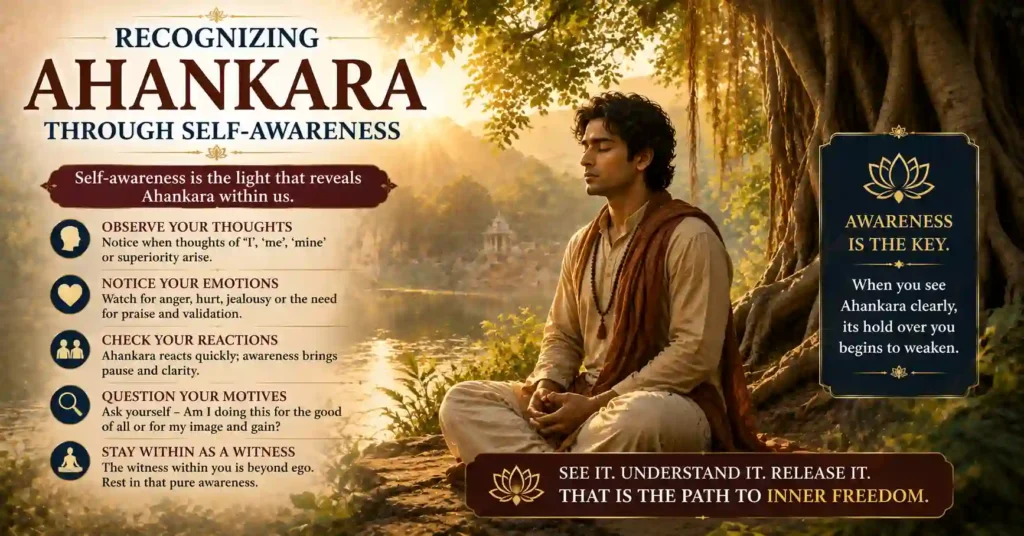
How to Recognize Ahankara Within Yourself
Recognizing Ahankara begins with honesty. Instead of looking for faults in others, gently observe your own thoughts, emotions, and reactions in everyday situations.
Ask yourself these simple questions:
- Do I feel hurt when someone disagrees with me?
- Do I always feel the need to prove that I am right?
- Do I become defensive when someone points out my mistakes?
- Do I compare my success or spiritual progress with others?
- Do I seek appreciation or recognition for my actions?
If your answer is “yes” to any of these, do not judge yourself. Simply become aware of the reaction. Awareness is the beginning of transformation.
Whenever you feel disturbed, pause for a moment and ask yourself:
“What am I protecting right now? Is it the truth, or is it my ego?”
Very often, we are not protecting truth or values. We are protecting an identity that we have created over time.
The more clearly you observe this false sense of identity without defending or condemning it, the weaker its influence becomes. This quiet awareness gradually opens the door to humility, inner peace, and genuine spiritual growth.
How to Overcome Ahankara in Daily Life
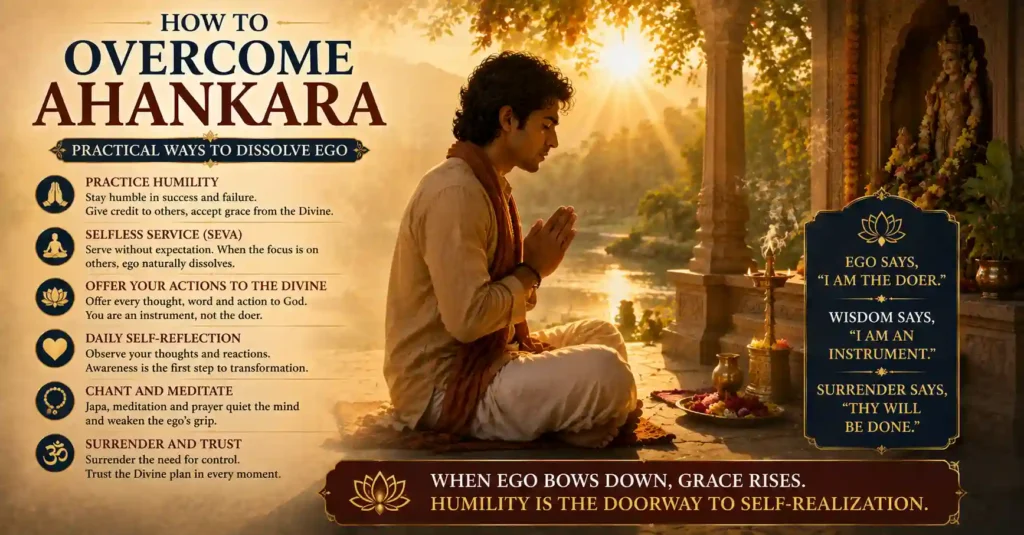
Many people wonder how to overcome Ahankara. The answer is not to fight or suppress it. True transformation begins with awareness, humility, and consistent spiritual practice.
You can gradually reduce its influence through simple daily habits:
- Accept your mistakes without becoming defensive.
- Listen with an open mind instead of trying to win every argument.
- Practice gratitude to reduce the constant focus on “I” and “mine.”
- Perform selfless service (Seva) without expecting praise or recognition.
- Meditate regularly to observe your thoughts without identifying with them.
- Offer your actions to the Divine, following the principles of Karma Yoga.
- Study the Bhagavad Gita and other sacred texts to deepen self-awareness.
- Spend a few moments in silence each day, allowing the mind to become calm and clear.
Overcoming the ego is a gradual journey, not a single achievement. Every moment of awareness weakens its hold and brings you closer to humility, inner peace, and the realization of your true Self.
Can Ahankara Ever Be Completely Removed?
One of the most common questions seekers ask is whether Ahankara can disappear completely.
According to Sanatan Dharma, as long as a person lives in the physical world, a functional sense of identity remains necessary for performing daily duties and fulfilling Dharma. However, spiritual practice gradually removes attachment to this identity.
The enlightened sages described in the Upanishads and the Bhagavad Gita continue to act in the world, but they no longer identify themselves as the sole doers of their actions. Their lives are guided by wisdom, compassion, and surrender rather than pride or possessiveness.
For most spiritual seekers, the goal is not to eliminate the ego overnight. It is to reduce its influence through self-awareness, devotion, selfless service, and right knowledge. As attachment becomes weaker, the true Self shines more clearly.
Ahankara in Devotion and Spiritual Knowledge
Ahankara can quietly enter even the noblest spiritual practices. A person may begin worship, meditation, or scriptural study with sincere devotion, but over time, pride can slowly replace humility.
Sometimes, we start believing that our prayers, fasting, rituals, or spiritual discipline make us better than others. Instead of deepening devotion, the mind begins seeking recognition and admiration.
The same can happen with spiritual knowledge. Learning the scriptures is valuable, but if it creates a feeling of superiority or the desire to prove others wrong, knowledge becomes a source of the ego rather than wisdom.
Both devotion and knowledge are meant to purify the mind, not inflate the ego. Without humility, devotion may become a mere ritual, and knowledge may turn into intellectual pride.
The saints and sages of Sanatan Dharma have always taught that the greatest sign of spiritual progress is not how much a person knows, but how humble, compassionate, and selfless they become.
When devotion is offered with surrender and knowledge is guided by humility, its influence gradually weakens, allowing genuine spiritual growth to unfold.
A Simple Reflection
ake a moment to think about a recent situation where you felt hurt, angry, or defensive.
Now pause and ask yourself:
“What was I protecting? Was it the truth, or was it my ego?”
Very often, we are not protecting what is right. We are protecting the image we have created of ourselves.
Simply noticing this without guilt or self-judgment is a powerful step. Awareness weakens the ego more effectively than force or suppression.
Every moment of honest self-reflection brings us closer to humility, inner peace, and the realization of our true Self.
Key Takeaways
- Ahankara is the false sense of “I” and “mine,” commonly translated as ego.
- It is a natural part of worldly life but becomes an obstacle when we become attached to it.
- According to the Bhagavad Gita, the ego creates the illusion of doership and binds us to karma.
- Self-awareness, humility, Karma Yoga, meditation, and Seva gradually reduce its influence.
- Spiritual growth is not about destroying the ego but understanding and transcending it.
- Real freedom comes through realizing the Atman, our true Self beyond the ego.

Conclusion
Ahankara is not an enemy that exists outside us. It is a subtle sense of identity that quietly shapes the way we think, react, and relate to the world.
According to Sanatan Dharma, the goal is not to destroy the ego but to understand it. Through self-awareness, humility, devotion, and selfless action, its influence gradually becomes weaker.
As we become less attached to the false sense of “I” and “mine,” we begin to experience greater peace, compassion, and inner freedom. This is the journey from identification with the ego to the realization of the true Self (Atman).
Spiritual growth is not about becoming perfect. It is about becoming more aware, more humble, and more authentic with each passing day.
In the end, Ahankara seeks recognition, but the soul seeks liberation. When we choose awareness over pride and surrender over attachment, we take one more step towards lasting peace and Self-realization.
Suggested Reading
If you found this article helpful, you may also enjoy these related guides on Sanatan Dharma. They explore selfless action, detachment, the three Gunas, and the path to inner peace and Self-realization.
- Karma Yoga: The Secret of Selfless Action Without Attachment
https://thesanatantales.com/karma-yoga-action-without-attachment/ - Detachment in Spiritual Life: Meaning, Benefits and Daily Practice
https://thesanatantales.com/detachment-in-spiritual-life/ - Purusharthas: A Simple Guide to Dharma, Artha, Kama and Moksha
https://thesanatantales.com/purusharthas/ - Sattva, Rajas and Tamas: Understanding the Three Gunas of Nature
https://thesanatantales.com/sattva-rajas-tamas/ - Sthitaprajna: Meaning, Qualities and Teachings from the Bhagavad Gita
https://thesanatantales.com/sthitaprajna/
FAQs
What is Ahankara in Sanatan Dharma?
Ahankara is the Sanskrit term for the false sense of “I” and “mine.” It is commonly translated as ego, but in Sanatan Dharma, it refers to the identity we develop by identifying ourselves with the body, mind, thoughts, possessions, and achievements.
The ego is not completely negative. It helps us function in the world and perform our daily responsibilities. However, when we become attached to this identity, it creates pride, fear, comparison, and suffering.
The goal of spiritual life is not to destroy the ego but to understand it through self-awareness, humility, and devotion so that our true nature, the Atman, can shine more clearly.
What does the Bhagavad Gita teach about Ahankara?
he Bhagavad Gita explains that Ahankara creates the false belief that “I am the doer.” This sense of doership binds a person to attachment, karma, and suffering.
Lord Krishna teaches that actions should be performed without pride or attachment to their results. This is the essence of Karma Yoga.
As a person develops humility, devotion, and surrender to the Divine, the ego’s influence gradually becomes weaker, leading to inner peace and spiritual growth.
What are the common signs of Ahankara?
Ahankara often appears in subtle ways rather than obvious pride. Feeling hurt by criticism, constantly seeking appreciation, comparing yourself with others, or always wanting to be right are some of its common signs.
It may also appear as spiritual superiority, where a person becomes proud of their knowledge, devotion, or religious practices.
Recognizing these reactions with honesty is the first step towards overcoming the ego.
How can I overcome Ahankara in daily life?
Overcoming Ahankara begins with awareness rather than force. Observe your thoughts and reactions without judging yourself whenever you feel hurt, defensive, or eager to prove your point.
Practices such as meditation, selfless service (Seva), gratitude, humility, and studying the Bhagavad Gita help reduce attachment to the false sense of “I.”
With regular practice, the ego’s influence gradually becomes weaker, allowing peace, compassion, and wisdom to grow naturally.
What is the difference between Ahankara and the true Self?
Ahankara is the temporary identity created by the mind through the body, thoughts, roles, and possessions. The true Self, known as the Atman, is eternal, unchanging, and beyond these temporary identities.
While the ego creates separation, comparison, and attachment, the Atman brings unity, peace, and inner freedom.
The purpose of spiritual practice is to move from identification with the ego to the realization of the true Self.
Can a spiritual person also have Ahankara?
es. Ahankara can become even more subtle on the spiritual path. A person may begin to feel superior because of their knowledge, meditation, devotion, or religious discipline.
This is often called spiritual ego. It is difficult to recognize because it hides behind good intentions and spiritual practices.
The saints and scriptures remind us that genuine spiritual progress is reflected in humility, compassion, and selflessness rather than recognition or pride.
Is Ahankara always harmful?
No. Ahankara is a natural part of human life and helps us develop individuality and perform our worldly duties.
Problems arise only when we become deeply attached to this identity and forget our true spiritual nature.
Sanatan Dharma teaches that by purifying the ego through self-awareness, devotion, and selfless action, it gradually becomes a tool for spiritual growth instead of an obstacle.
Glossary of Important Terms
| Term | Meaning |
|---|---|
| Ahankara | The Sanskrit term for the false sense of “I” and “mine.” It is commonly translated as ego and represents the identity formed through the body, mind, thoughts, and possessions. |
| Atman | The eternal Self or soul that exists beyond the body and mind. According to Sanatan Dharma, realizing the Atman is the goal of spiritual life. |
| Avidya | Spiritual ignorance or lack of true knowledge. It causes a person to identify with the temporary body and mind instead of the eternal Self. |
| Bhagavad Gita | One of the most important scriptures of Sanatan Dharma, in which Lord Krishna teaches Arjuna about duty, devotion, wisdom, Karma Yoga, and Self-realization. |
| Buddhi | The faculty of intelligence and discrimination that helps a person make wise decisions and distinguish truth from falsehood. |
| Chitta | The storehouse of memories, impressions, and emotions. It influences thoughts, habits, and reactions based on past experiences. |
| Gunas | The three fundamental qualities of nature: Sattva (purity and harmony), Rajas (activity and desire), and Tamas (ignorance and inertia). |
| Karma | The universal law of cause and effect, where every action, thought, and intention produces corresponding results. |
| Karma Yoga | The spiritual path of performing one’s duties selflessly without attachment to the results, as taught in the Bhagavad Gita. |
| Manas | The thinking and perceiving mind that receives information from the senses and processes everyday thoughts. |
| Moksha | Liberation from the cycle of birth and death (Samsara). It is the highest goal of spiritual life and is attained through Self-realization. |
| Prakriti | Material nature, consisting of the three Gunas. According to the Bhagavad Gita, all physical actions take place through Prakriti. |
| Samsara | The continuous cycle of birth, death, and rebirth, driven by karma and attachment. |
| Sattva | The quality of purity, wisdom, balance, and harmony that promotes spiritual growth and inner peace. |
| Seva | Selfless service performed without expecting recognition or reward. It is considered an important practice for reducing the ego. |
| Self-realization | The direct experience of one’s true nature as the Atman, beyond the body, mind, and ego. |
| Spiritual Ego | A subtle form of the ego in which a person becomes proud of their spiritual knowledge, devotion, meditation, or religious practices. |
| True Self | Another name for the Atman, the eternal and unchanging reality beyond all temporary identities and roles. |
About the Author
Yateendra Chaturvedi is a spiritual writer, researcher, devotee, and the founder of The Sanatan Tales. With over 35 years of professional experience and a lifelong interest in Sanatan Dharma, he writes about Hindu deities, temples, scriptures, festivals, Mahavidyas, sacred stories, rituals, and living traditions that continue to guide and inspire devotees across India.
Drawing from traditional scriptures, regional beliefs, temple traditions, devotional literature, and historical sources, he aims to present authentic, well-researched, and easy-to-understand content for modern readers. His work focuses on preserving spiritual wisdom, explaining sacred traditions, and helping seekers develop a deeper understanding of India’s rich spiritual heritage.
Through The Sanatan Tales, Yateendra strives to make the timeless teachings of Sanatan Dharma simple, meaningful, and relevant for today’s generation while maintaining respect for traditional sources, regional practices, and diverse spiritual perspectives.
Learn More About Yateendra Chaturvedi →
https://thesanatantales.com/about-the-author/
References & Sources
This article is based on the teachings of Sanatan Dharma, including concepts explained in the Bhagavad Gita, Upanishads, Vedanta, Sankhya philosophy, and other traditional Hindu scriptures. It also draws upon widely accepted spiritual teachings, traditional knowledge, and insights from respected religious and philosophical study sources.
Note: Interpretations of spiritual concepts may vary across different traditions, sects, and schools of thought within Sanatan Dharma. The purpose of this article is not to present any single interpretation as the absolute truth, but to explain widely accepted philosophical and spiritual perspectives in a simple, balanced, and accessible manner.
Read More Interesting Articles on Sanatan Dharma